Introduction
The manifestations of the autosomal dominant inherited neurodegenerative disease Huntington’s disease (HD) include motor disturbances, neuropsychiatric symptoms, and cognitive dysfunction (McColgan & Tabrizi, Reference McColgan and Tabrizi2018; Snowden, Reference Snowden2017). These cardinal symptoms are often accompanied by behavioral symptoms like apathy, irritability, perseverance, psychosis, and affective symptoms (Craufurd et al., Reference Craufurd, Thompson and Snowden2001; Eddy et al., Reference Eddy, Parkinson and Rickards2016). Apathy can be found in 34 % to 76 % of patients with HD and is a very distressing and burdensome neuropsychiatric symptom for the caregivers (Craufurd et al., Reference Craufurd, Thompson and Snowden2001; van Duijn, Kingma & van der Mast, Reference van Duijn, Kingma and van der Mast2007). Apathy may be a marker of disease progression (Camacho et al., Reference Camacho, Barker and Mason2018; Thompson et al., Reference Thompson, Harris, Sollom, Stopford, Howard, Snowden and Craufurd2012) and is continuously associated with cognitive impairments, motor symptoms, and depression (Hendel et al., Reference Hendel, Hellem, Hjermind, Nielsen and Vogel2021; Reedeker et al., Reference Reedeker, Bouwens, van Duijn, Giltay, Roos and van der Mast2011; van Duijn et al., Reference van Duijn, Reedeker, Giltay, Roos and van der Mast2010). Theoretically, apathy can be considered a deficit in goal-directed behavior caused by dysfunction of the prefrontal cortex-basal ganglia circuits (Levy & Dubois, Reference Levy and Dubois2006). The investigation of apathy involves a focus on the different cognitive processes implicated in goal-directed behavior such as selection of action based on evaluation of reward value and effort, planning and execution, outcome evaluation, and learning (Ernst & Paulus, Reference Ernst and Paulus2005; Le Heron et al., Reference Le Heron, Apps and Husain2018). Shared neural mechanisms may explain the association between processes of goal-directed behavior and symptoms of HD.
Apathy has been shown to be associated with executive dysfunction in HD (Andrews et al., Reference Andrews, Langbehn, Craufurd, Durr, Leavitt, Roos, Tabrizi and Stout2020; Baudic et al., Reference Baudic, Maison, Dolbeau, Boissé, Bartolomeo, Barba, Traykov and Bachoud-Levi2006; Reedeker et al., Reference Reedeker, Bouwens, van Duijn, Giltay, Roos and van der Mast2011; van Duijn et al., Reference van Duijn, Reedeker, Giltay, Roos and van der Mast2010). The specific aspects of executive functions that are associated with apathy have to our knowledge not been investigated, but in previous studies, tests on attention, working memory, set-shifting, fluency, and inhibition have been used.
Apathy may also be associated with social cognitive deficits since a significant association was found in two recent studies with premanifest and early manifest HD gene expansion carriers (Kempnich et al., Reference Kempnich, Andrews, Fisher, Wong, Georgiou-Karistianis and Stout2018; Osborne-Crowley et al., Reference Osborne-Crowley, Andrews, Labuschagne, Nair, Scahill, Craufurd, Tabrizi and Stout2019). Moreover, Ruff and Fehr (Reference Ruff and Fehr2014) illustrated that social decision making is based on similar neural processes as the value evaluations of nonsocial factors implicated in goal-directed behavior, and research into the neurobiological basis of apathy has increasingly focused on regions of the limbic loop, which is also thought to be relevant for the value evaluation processes (Le Heron et al., Reference Le Heron, Apps and Husain2018; Levy & Dubois, Reference Levy and Dubois2006; Martínez-Horta et al., Reference Martínez-Horta, Perez-Perez, Sampedro, Pagonabarraga, Horta-Barba, Carceller-Sindreu, Gomez-Anson, Lozano-Martinez, Lopez-Mora, Camacho, Fernández-León, Carrió and Kulisevsky2018). Accordingly, impairments of social cognition, as well as more classical processes in goal-directed behavior caused by dysfunction of the cortico-basal ganglia-thalamo-cortico circuits, may constitute the basis of apathy in HD. The previous studies on the association between apathy and social cognitive functions had some methodological weaknesses. One study included only 32 premanifest and manifest participants, and assessment of apathy was based on family ratings (Kempnich et al., Reference Kempnich, Andrews, Fisher, Wong, Georgiou-Karistianis and Stout2018). In the study by Osborne-Crowley et al. (Reference Osborne-Crowley, Andrews, Labuschagne, Nair, Scahill, Craufurd, Tabrizi and Stout2019), the indirect associations were investigated based on a classification of patients as apathetic or nonapathetic. Thus, whether the association between apathy and social cognition is based on specific functions, like emotion recognition as in the previous studies, or if other functions contribute to this association is not known. Further, a more comprehensive examination of apathy could indicate if an association between apathy and social cognitive or executive functions is dependent on the degree or type of apathy.
In the present study, we aimed to investigate if executive and social cognitive dysfunction is associated with apathy (as measured by a tailored, quantitative rating scale) in a large group of HD gene expansion carriers. We analyzed if scores on the Lille Apathy Rating Scale (LARS; Sockeel et al., Reference Sockeel, Dujardin, Devos, Denève, Destée and Defebvre2006) were associated with tasks of social cognition and executive functions when examined with a broad neuropsychological battery. By examining the associations between apathy and several executive and social cognitive tests, we wished to investigate to which degree the tests of each domain were associated with apathy and if different aspects of executive functions and social cognition were associated with apathy. Moreover, we examined the associations between apathy and variables as demographic information and results from neuropsychiatric measures. Finally, we examined which variables could significantly predict the degree of apathy, when both cognitive and basic clinical measures were also analyzed.
Methods
Participants
Eighty HD gene expansion carriers were included from the Neurogenetics Clinic, Danish Dementia Research Centre, Rigshospitalet, Copenhagen, Denmark, from June 2017 to June 2020. This cohort of participants have previously been described in Hendel et al. (Reference Hendel, Hellem, Hjermind, Nielsen and Vogel2021).
Inclusion and exclusion criteria
The participants were included based on the following criteria; a Mini-Mental State Examination (MMSE) score ≥ 24 (Folstein et al., Reference Folstein, Folstein and McHugh1975), a Montreal Cognitive Assessment (MoCA) score ≥ 19 (Nasreddine et al., Reference Nasreddine, Phillips, Bédirian, Charbonneau, Whitehead, Collin, Cummings and Chertkow2005), and a CAG repeat length ≥ 39. Exclusion criteria were other neurological disease, ongoing alcohol or drug abuse, or a native language other than Danish.
Classification of participants
Participants were classified as premanifest HD gene expansion carriers (N = 40) if their Unified Huntington’s Disease Rating Scale-99 Total Motor score (UHDRS-TMS) (Huntington’s Study Group, 1996) was ≤ 5, without substantial motor symptoms. If their UHDRS-TMS was > 5, they were given a classification of motor-manifest HD gene expansion carriers (N = 40).
Controls
The control group consisted of thirty-two previous 50 % at risk individuals tested negative for the gene expansion (with a CAG repeat length of < 30) before inclusion in this study. These individuals were chosen over unrelated healthy controls to better match for psychosocial and environmental factors.
All participants went through genetical counselling and were informed of their genetic status prior to and independently from study enrolment.
Procedure and instruments
The study was approved by the Ethics Committee of the Capital Region of Denmark (H-17002606), and it was completed in accordance to the Helsinki Declaration. Informed consent was obtained from all participants before enrolment in the study. The participants had a minimum of two planned visits; in random order participants went through a neurological examination and a neuropsychological examination. In addition to the measures outlined above, the neurological examination also included neuropsychiatric screening tests, the Hamilton Depression Scale (HAM-17) (Hamilton, Reference Hamilton1960), and the Symptom Checklist-90 Revised (SCL-90-R) (Derogatis, Reference Derogatis and Derogatis2009). Measures of disease progression, the CAG repeat length and a CAP score, were also included in the study. The CAG repeat length represents an indirect measure of the amount of toxic huntingtin that the individual is exposed to. The CAP score was used as a measure of disease progression based on age and the CAG repeat length. Both the CAG repeat length and the CAP scores were used to examine the importance of disease progression for apathy. All examinations were performed by the same physician (MNNH) and neuropsychologist (RKH).
Apathy
Apathy was examined using the Lille Apathy Rating Scale (LARS), a standardized structured interview with 33 items divided into 9 domains based on main clinical manifestations of apathy (Sockeel et al., Reference Sockeel, Dujardin, Devos, Denève, Destée and Defebvre2006). A global score is calculated as the sum of all items ranging from –36 to 36, with a higher score indicating more severe symptoms of apathy. Four subtypes describe the distinct dimensions of apathy; Intellectual Curiosity (decreased interest and perceived need for knowledge), Emotions (blunting of emotions and lack of concern), Action Initiation (decreased everyday productivity and lack of initiative), and Self Awareness (extinction of the awareness of self). Each of the four subtypes has an average score of –4 to 4. The results of the LARS have been presented previously in Hendel et al. (Reference Hendel, Hellem, Hjermind, Nielsen and Vogel2021), but all other analyses are new for the current study.
Neuropsychological examination
The neuropsychological examination consisted of an extensive examination with a test-battery on premorbid level of intelligence, psychomotor speed and attention, memory, visuospatial functions, executive functions, and social cognition. Here, only the tests from the executive functions and social cognition are reported.
Executive functions
The executive functions were examined with the Symbol Digit Modality Test (SDMT), the Trail Making Test B (TMT B) (Reitan, Reference Reitan1955), the Stroop Test (100 words) (Stroop, Reference Stroop1935), the Brixton Test (Burgess & Shallice, Reference Burgess and Shallice1997), the Lexical and Semantic Fluency Tests (Lezak et al., Reference Lezak, Howieson, Loring, Lezak, Howieson and Loring2004), and an Alternating Fluency Test.
The Symbol Digit Modalities Test
The SDMT investigates psychomotor speed through a brief substitution test where participants with the use of a reference key pair nine different numbers with specific geometric symbols (Smith, Reference Smith1982). Participants have 90 sec to pair as many numbers as possible. Number of correct responses was recorded and used for analysis.
The Trail Making Test B
The TMT B is a set-shifting test where participants should connect circles with the numbers 1–13 and the letters A-L, alternating between numbers and letters in an ascending sequence (Reitan, Reference Reitan1955). Time to completion was recorded.
The Stroop Interference Test
The Stroop Interference Test is a test of interference and inhibition. The 100 words version of the Stroop Interference Test consists of a simple reading task and an interference test (Stroop, Reference Stroop1935). In the interference test, participants are asked to name the color of the ink that the words are printed in. The words are names of colors that does not correspond to the color of the printed ink. For example, would the word red be printed in blue and the participants should say blue. Participants were instructed to complete the test as fast as possible. Time to completion was recorded for the interference test.
The Brixton Test
The Brixton Test measures task analysis and consists of a stimulus book where each page presents ten circles numbered 1–10 in the same basic display, but for each page one circle is printed blue (Burgess & Shallice, Reference Burgess and Shallice1997). The participants must guess the pattern of the movement of the blue circle based on the positions from previous pages and from page to page indicate the position of the blue circle on the next page. No feedback is given during the test. The number of errors (≤ 54) was recorded for analysis.
The Lexical Fluency Test
In the Lexical Fluency Test, participants must name as many words as possible within one minute beginning with each of the letters F, A, and S (Lezak et al., Reference Lezak, Howieson, Loring, Lezak, Howieson and Loring2004). All Danish words were accepted, except for proper nouns. The number of words was recorded and summed for a total score.
The Semantic Fluency Test
In the Semantic Fluency test, participants must name as many animals as possible within one minute. All types or categories of animals were accepted, and specific animals within a named category were also accepted. The total number of animals was recorded.
The Alternating Fluency Test
The Alternating Fluency Test measures internal attentional control. Participants must name as many words as possible within one minute, beginning with the letter K and the letter B in an alternating order. All words were accepted except proper nouns. Improper alternations were recorded as incorrect. The number of words in correct alternating order was recorded for analysis.
Social cognition
The social cognitive tasks consisted of The Awareness of Social Inference Test (TASIT) (McDonald et al., Reference McDonald, Flanagan, Rollins and Kinch2003), the Emotion Hexagon (EH) (Calder et al., Reference Calder, Young, Rowland, Perrett, Hodges and Etcoff1996; Sprengelmeyer et al., Reference Sprengelmeyer, Young, Calder, Karnat, Lange, Hömberg, Perrett and Rowland1996), and Reading the Mind in the Eyes Test – revised version (RMET) (Baron-Cohen et al., Reference Baron-Cohen, Wheelwright, Hill, Raste and Plumb2001).
The Awareness of Social Inference Test
The Danish version of The Awareness of Social Inference Test (TASIT) Social Inference Minimal (SI-M) Test consists of 15 short videotaped vignettes (15–53 s) portraying everyday conversational exchanges between two persons (Bliksted et al., Reference Bliksted, Fagerlund, Weed, Frith and Videbech2014). Of the 15 vignettes, five depicts sincere exchanges and 10 depicts sarcastic exchanges. The sarcastic vignettes are either portraying simple sarcasm (five vignettes), where the words are incongruent with the paralinguistic and facial cues, or paradoxical sarcasm (five vignettes), where the dialogue is meaningless unless it is understood that the person is being sarcastic. Outcomes are SI-M total score (0–60) and three subscores; the sincere score (0–20), the simple sarcasm score (0–20), and the paradoxical sarcasm score (0–20).
The Emotion Hexagon Test
The Emotion Hexagon Test (EH) consists of 30 pictures of facial expression of six basic emotions; happiness, surprise, fear, sadness, anger, and disgust (Calder et al., Reference Calder, Young, Rowland, Perrett, Hodges and Etcoff1996; Sprengelmeyer et al., Reference Sprengelmeyer, Young, Calder, Karnat, Lange, Hömberg, Perrett and Rowland1996). The pictures are morphed along a spectrum, so that each emotion is blended with two neighboring emotions (e.g., happiness is morphed with surprise and anger; the ratio of the happiness-surprise spectrum is 90:10, 70:30, 50:50, 30:70, and 10:90). Emotions blended by 50% served as neutral stimuli and were not included in the final score. Before the presentation of the pictures, the participants were shown a card with the names of the six emotions, and each emotion was explained. This card was present during the entire test. The pictures were presented in a random order and a total score (0–24) represents the number of correct answers.
The Reading the Mind in the Eyes Test
The revised version of the Reading the Mind in the Eyes Test (RMET) comprises 36 pictures of the eye region of different persons (male and female), depicting various negative and positive emotional states (Baron-Cohen et al., Reference Baron-Cohen, Wheelwright, Hill, Raste and Plumb2001). Each picture was presented together with four words describing a possible emotional state. The participants were presented to a wordlist of all possible words, explained and used in a sentence, and were encouraged to look at it, if they felt uncertain about the meaning of a word. The participants were then asked to choose the word from the four possibilities that best described the mental state of the portraited person. A total score (0–36) indicates the number of correct responses.
Statistical analyses
Group comparisons were performed with analysis of variance (ANOVA) or Kruskal-Wallis (when assumptions of homogeneity of variance were not met). Dunnett’s t-tests or Mann-Whitney U tests (for skewed distributions) were used for post hoc comparisons. Effect sizes were calculated as
 ${{\hat d}} = {{{{\overline x}_1}\; - \;{{\overline x}_2}} \over s}$
for the Dunnett’s t-tests, and based on the formula by (Field, Reference Field and Field2018): r =
 ${z \over {\sqrt N }}$
for the Mann-Whitney U tests. The Bonferroni–Holm correction was applied to adjust the level of significance on all analyses with multiple comparisons. For all HD gene expansion carriers, a CAP score was calculated as
 $CAP = Age\; \cdot \left( {CAG - 35{{ .}}5} \right)$
based on Penney et al. (Reference Penney, Vonsattel, MacDonald, Gusella and Myers1997). For the total group of HD gene expansion carriers, association analyses were performed between the LARS and social cognitive and executive tasks. No transformation of data was performed, and negative values of the LARS remained negative in the analyses. Correlation analyses were applied, and Pearson’s r or Spearman’s rho (for skewed distributions) was used to assess the level of significance. Based on the results from Hendel et al. (Reference Hendel, Hellem, Hjermind, Nielsen and Vogel2021), we entered the UHDRS-TMS and the HAM-17 score into a multiple stepwise regression analysis with the global LARS as dependent variable, along with one social cognitive test and one test of executive function. We entered the social cognitive and executive tests with the strongest association with the global LARS score, based on the correlation coefficients. Plot of residuals was used for model control for the regression analysis.
The alpha-level for significance was 5% for all analyses.
Results
Differences between HD gene expansion carriers and controls
Demographic data and the results on the cognitive and neuropsychiatric screening tests are presented in Table 1. Significant differences were found between the motor-manifest HD gene expansion carriers and the premanifest HD gene expansion carriers and the controls on almost all measures. The motor-manifest HD gene expansion carriers were significantly older than the premanifest HD gene expansion carriers, but there was no difference in the distribution of sex between the groups. Measures of disease progression (UHDRS-TMS and CAP score) were significantly higher in the motor-manifest HD gene expansion carriers, when compared to both premanifest HD gene expansion carriers and controls. Both the premanifest and the motor-manifest HD gene expansion carriers had higher CAG repeat length than the controls. Concerning the neuropsychiatric tests (HAM-17 and SCL-90-R GSI), the motor-manifest HD gene expansion carriers scored significantly higher than the two other groups.
Demographic data and results from the cognitive and neuropsychiatric screening tests for the HD gene expansion carriers and the controls. Results are presented as mean (SD)

Note. * Statistically significant difference from the controls (p < .05). ‡ Statistically significant difference from the premanifest HD (p < .05).
HD: Huntington’s disease; SD: standard deviation; UHDRS: Unified Huntington’s Disease Rating Scale. TMS: Total Motor Score. CAG: cytosine-adenine-guanine; CAP: cytosine-adenine-guanine age product; MMSE: Mini-Mental State Examination; MoCA: Montreal Cognitive Assessment; HAM-17: Hamilton Depression Scale; SCL-90-R: Symptom Checklist-90 Revised.
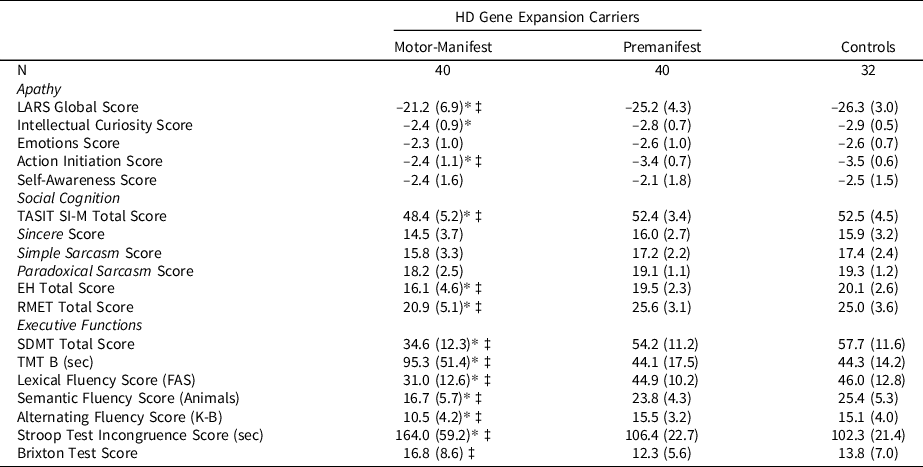
Table 2 presents the results on the LARS and the social cognitive and executive tasks for the HD gene expansion carriers and the controls. When compared to the premanifest HD gene expansion carriers and controls, the motor-manifest HD gene expansion carriers had significantly higher scores on the global LARS (p = .009, p = .001, respectively) and on the subscales Intellectual Curiosity (p = .044, p = .004 respectively) and Action Initiation (both p < .001). However, when correcting for multiple comparisons, the difference between the premanifest and motor-manifest HD gene expansion carriers on the Intellectual Curiosity subscale could not be considered significant. On the social cognitive and executive tasks, the motor-manifest HD gene expansion carriers had significant different scores on most measures (except on the TASIT subscores), when compared to the premanifest HD gene expansion carriers and the controls. The largest effect sizes were found for TMT B (premanifest: r = .67, controls: r = −.65) and Stroop Interference Test score (premanifest: r = .54, controls: r = −.55). There were no significant differences between the premanifest HD gene expansion carriers and the controls on the social cognitive or executive tests.
Results on the Lille Apathy Rating Scale, the social cognitive tasks, and the executive tasks for the HD gene expansion carriers and controls. Results are presented as mean (SD)

Note. * Statistically significant difference from the controls (p < .05). ‡ Statistically significant difference from the premanifest HD (p < .05).
HD: Huntington’s disease; SD: standard deviation; LARS: The Lille Apathy Rating Scale; TASIT: The Awareness of Social Inference Test; SI-M: Social Inference Minimal; EH: Emotion Hexagon; RMET: Reading the Mind in the Eyes Test; SDMT: Symbol Digit Modality Test; TMT B: Trail Making Test B.
Associations between apathy and cognitive tests
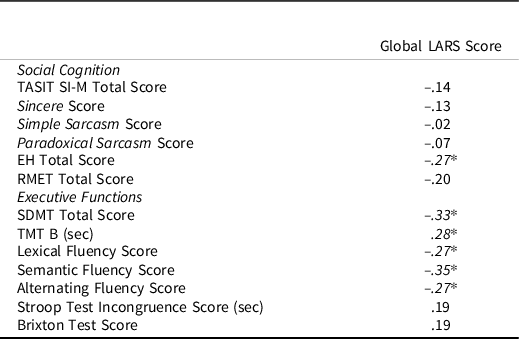
The association analyses between the global LARS and social cognitive and executive tasks for the total group of HD gene expansion carriers are presented in Table 3. The only significant correlation between apathy and the social cognitive tests was a negative association between the EH total score and the global LARS score (rho = −.27, p = .014), indicating that individuals with a high degree of apathy scored lower on the EH test. No other significant correlations were found between apathy on the global LARS and social cognitive test scores. Scores on almost all executive tests (except the Stroop Test interference score and the Brixton Test score) were significantly negatively correlated with the global LARS score, indicating that a higher degree of apathy is associated with lower performance on the executive tests.
Correlations between scores on the LARS and the social cognitive and executive tasks for the total group of HD gene expansion carriers.

Note. *Statistically significant (p < .05).
HD: Huntington’s disease; LARS: The Lille Apathy Rating Scale; TASIT: The Awareness of Social Inference test; SI-M: Social Inference Minimal; EH: Emotion Hexagon; RMET: Reading the Mind in the Eyes Test; SDMT: Symbol Digit Modality Test; TMT B: Trail Making Test B.
Associations between apathy and demographic variables
When assessing the associations between scores on the LARS and the demographic variables, we found a significant correlation between the UHDRS-TMS and the global LARS score (rho = .35, p = .002). Also, the global LARS score was significantly correlated with the neuropsychiatric screening tests (HAM-17: rho = .40, p < .001; SCL-90-R GSI: r = .30, p = .008).
Variables explaining apathy in HD gene expansion carriers
A multiple regression analysis was performed to examine which variables could explain the degree of apathy in the total group of HD gene expansion carriers. The analysis included the global LARS score as outcome variable and the UHDRS-TMS, the HAM-17 score, the EH test, and the Semantic Fluency test as predictor variables. When the predictor variables were entered the model, we found that the UHDRS-TMS (b = 0.14, SE b = 0.05, CI = [0.05; 0.23], p = .003) and the HAM-17 score (b = 0.41, SE b = 0.19, CI = [0.03; 0.79], p = .034) could significantly predict the global LARS score (constant = –26.32, SE c = 0.94, CI = [–28.19; –24.45], p = <.001). This model could explain 21 % of the total variance (R 2 = .21, p < .001). Neither the social cognitive test nor the executive test was entered the final model. Thus, the burden of depressive symptoms and the motor symptoms had a significant association with apathy symptoms, but executive symptoms and social cognitive symptoms did not have additional impact on the global LARS score.
Discussion
We investigated the association between apathy, as measured by a tailored quantitative rating scale, and social cognitive and executive dysfunction. In a cohort of 80 premanifest and motor-manifest HD gene expansion carriers, examined with a comprehensive battery investigating both executive functions and social cognitive processes (emotion recognition, theory of mind, and sarcasm detection), we found significant correlations between most executive test performance and the apathy score on the global LARS. Despite being significantly reduced in motor-manifest HD gene expansion carriers, most social cognitive test performances were not associated with apathy. Only the EH test score was significantly correlated with the global LARS. This result was in accordance to previous studies but unlike previous studies, we also examined if executive dysfunctions or social cognitive impairments could be predictive of apathy. Such finding would help explain the development of apathy and indicate if cognitive test performance could be used to support a clinical assessment of apathy. However, when entering the executive and social cognitive variables with the highest correlation coefficient, neither the Semantic Fluency test nor the EH test could predict the apathy score on the global LARS, when more general variables were added to the model.
Our results support the results of previous studies, where executive dysfunction has been linked to apathy both in HD (Andrews et al., Reference Andrews, Langbehn, Craufurd, Durr, Leavitt, Roos, Tabrizi and Stout2020; Baudic et al., Reference Baudic, Maison, Dolbeau, Boissé, Bartolomeo, Barba, Traykov and Bachoud-Levi2006; Reedeker et al., Reference Reedeker, Bouwens, van Duijn, Giltay, Roos and van der Mast2011; van Duijn et al., Reference van Duijn, Reedeker, Giltay, Roos and van der Mast2010) and in other neurodegenerative diseases like Parkinson’s disease (Dujardin et al., Reference Dujardin, Sockeel, Delliaux, Destée and Defebvre2009; Pluck & Brown, Reference Pluck and Brown2002) and Alzheimer’s disease (McPherson et al., Reference McPherson, Fairbanks, Tiken, Cummings and Back-Madruga2002). As expected, most executive test performances were significantly impaired in motor-manifest HD gene expansion carriers, compared to premanifest HD gene expansion carriers and controls. But unlike previous studies (Baake et al., Reference Baake, Reijntjes, Dumas, Thompson, Roos, Bentivoglio, Biunno, Bronzova, Dunnett, Frich, Giuliano, Illarioshkin, Illmann, Klempír, Landwehrmeyer, Levey, McLean, Nielsen, Päivärinta and Pica2017; Duff et al., Reference Duff, Paulsen, Mills, Beglinger, Moser, Smith, Langbehn, Stout, Queller and Harrington2010; Larsen et al., Reference Larsen, Vinther-Jensen, Gade, Nielsen and Vogel2015; Paulsen et al., Reference Paulsen, Smith and Long2013), premanifest HD gene expansion carriers were not impaired on any tests of psychomotor speed or other executive functions. We found that several executive test scores were significantly correlated to the global LARS score when examining the entire group of HD gene expansion carriers. Interestingly, the tests that were significantly associated with apathy were the same as used in previous studies (Andrews et al., Reference Andrews, Langbehn, Craufurd, Durr, Leavitt, Roos, Tabrizi and Stout2020; Baudic et al., Reference Baudic, Maison, Dolbeau, Boissé, Bartolomeo, Barba, Traykov and Bachoud-Levi2006; Reedeker et al., Reference Reedeker, Bouwens, van Duijn, Giltay, Roos and van der Mast2011; van Duijn et al., Reference van Duijn, Reedeker, Giltay, Roos and van der Mast2010) and included functions like attentional control, set-shifting, psychomotor speed, and fluency. However, the results could not demonstrate if any aspect of the executive functions were more associated to apathy than others, as the correlations coefficients were of almost equal sizes. It can be hypothesized that apathy affects the executive functions of HD gene expansion carriers, as apathy can lead to an inhibition of action. The inhibition of action could affect the executive functions by reducing the psychomotor speed or the ability to perform well on fluency tests by causing inactivity. However, as the present study did not examine the direction of the association, this cause of effects is only hypothetical. Yet, our study did examine if executive dysfunction could be used as a predictor of apathy. Interestingly, when entering the semantic fluency test (the executive test with the highest correlation coefficient) as a predictor variable in the multiple stepwise regression model, we did not show such predictive capabilities. This was a surprising finding which underline the importance of a deeper investigation of the associations between apathy and executive functions, as the association could be driven by other factors not included in this study.
In two previous studies, it has been shown that emotion recognition may be linked to apathy in premanifest and manifest HD (Kempnich et al., Reference Kempnich, Andrews, Fisher, Wong, Georgiou-Karistianis and Stout2018; Osborne-Crowley et al., Reference Osborne-Crowley, Andrews, Labuschagne, Nair, Scahill, Craufurd, Tabrizi and Stout2019) which we sought to replicate. Also, we extended the examination to involve several social cognitive functions. In accordance with previous studies (Allain et al., Reference Allain, Havet-Thomassin, Verny, Gohier, Lancelot, Besnard, Fasotti and Le Gall2011; Bora, Velakoulis & Walterfang, Reference Bora, Velakoulis and Walterfang2016; Eddy et al., Reference Eddy, Rickards and Hansen2018; Larsen et al., Reference Larsen, Vinther-Jensen, Gade, Nielsen and Vogel2016; Philpott et al., Reference Philpott, Andrews, Staios, Churchyard and Fisher2016), we showed that social cognitive test scores were significantly impaired in motor-manifest HD gene expansion carriers. In contrast, we showed that only the emotion recognition performance on the EH test was significantly correlated to apathy on the global LARS. The remaining social cognitive test performances were not significantly correlated with the apathy score. While the EH is an emotion recognition task, the RMET and the TASIT are both tests of theory of mind, which might not be associated with apathy. One explanation for why the RMET task was not associated with apathy in this study could be that while the task draws on abilities of both emotion recognition and theory of mind, it is directed at examining theory of mind. These results are in accordance with the previous studies (Kempnich et al., Reference Kempnich, Andrews, Fisher, Wong, Georgiou-Karistianis and Stout2018; Osborne-Crowley et al., Reference Osborne-Crowley, Andrews, Labuschagne, Nair, Scahill, Craufurd, Tabrizi and Stout2019), and similar findings have been shown in Parkinson’s disease (Martínez-Corral et al., Reference Martínez-Corral, Pagonabarraga, Llebaria, Pascual-Sedano, García-Sánchez, Gironell and Kulisevsky2010; Robert et al., Reference Robert, Le Jeune, Dondaine, Drapier, Péron, Lozachmeur, Sauleau, Houvenaghel, Travers, Millet, Vérin and Drapier2014). Thus, although social cognition as a domain might not be associated with apathy, processes of emotion recognition might be to some extent. One explanation for this association is that apathy reduces the social value evaluation of emotions and thus affects the goal-directed decision making when presented with facial stimuli (Ruff & Fehr, Reference Ruff and Fehr2014).
This study widened the investigation of the association between apathy and social cognitive and executive dysfunction by examining the predictive capabilities of these cognitive functions. To our knowledge, this is the largest study to include social cognitive functions as a predictor of apathy. Our results suggest that apathy is correlated to variables of general progression on all three cardinal symptoms of HD and illustrate that apathy is a marker of disease progression. When we entered the UHDRS-TMS, the HAM-17 score, the EH test, and the Semantic Fluency test into a multiple stepwise regression model with the global LARS score as the dependent variable, we found that the UHDRS-TMS and the HAM-17 score were the only predictive variables of the global LARS score. This was in line with studies showing that apathy is closely associated with disease progression and depressive symptoms (Camacho et al., Reference Camacho, Barker and Mason2018; Hendel et al., Reference Hendel, Hellem, Hjermind, Nielsen and Vogel2021; Reedeker et al., Reference Reedeker, Bouwens, van Duijn, Giltay, Roos and van der Mast2011; Thompson et al., Reference Thompson, Harris, Sollom, Stopford, Howard, Snowden and Craufurd2012; van Duijn et al., Reference van Duijn, Reedeker, Giltay, Roos and van der Mast2010). Despite being significantly correlated with the global LARS score, the EH test score was not a significant predictor of apathy in our study. This contrasts with the Kempnich et al. (Reference Kempnich, Andrews, Fisher, Wong, Georgiou-Karistianis and Stout2018) study and suggests that the significant correlation between emotion recognition and apathy might be a result of co-occurrence because of shared underlying neuropathology, or because both symptoms are dependent on a third explainable variable. In this instance, the disease progression could be one explanation for the progression of both symptoms. Accordingly, the UHDRS-TMS as a proxy for disease progression was a significant predictor of the global LARS score in our final stepwise multiple regression model. However, this model only explained 21% of the total variance and thus other factors must also be affecting the prediction of apathy. Among possible explainable factors are age, the male sex, or the use of pharmacological treatment like neuroleptics or benzodiazepines (van Duijn et al., Reference van Duijn, Reedeker, Giltay, Roos and van der Mast2010). None of these factors were included in the analyses of the present study.
Limitations and future directions
One important limitation of the present study that need mentioning concerns the self-reported nature of the LARS. While LARS is a sound and comprehensive measure of apathy, the participants must be able to recognize and acknowledge their perceived symptoms of apathy for the LARS to be a valid instrument. As HD gene expansion carriers have been found to have decreased insight into their own inabilities (McCusker & Loy, Reference McCusker and Loy2014), and since impaired awareness of deficits and apathy are both related to dysfunction of the frontal-subcortical circuitry (Duff et al., Reference Duff, Paulsen, Mills, Beglinger, Moser, Smith, Langbehn, Stout, Queller and Harrington2010), this could have affected the results. However, in recent studies, HD gene expansion carriers in early stages of the disease have been reported to be aware of their degree of apathy (Atkins et al., Reference Atkins, Andrews, Chong and Stout2021; Baake et al., Reference Baake, van Duijn and Roos2018) and since the present study included HD gene expansion carriers in the early stages of the disease, we do not believe that the results have been distorted by this to a large degree. However, future studies should seek to examine the awareness of deficits in HD gene expansion carriers, when investigating apathy.
Moreover, as this study included HD gene expansion carriers in premanifest or early stages of disease, we did not control for any possible pharmacological treatment that the participants might receive. However, as the participants were in early stages of disease, we would not expect them to receive treatment that could have affected the examination of their apathy symptoms, to a large degree. However, as treatment with neuroleptics and benzodiazepines might be associated with apathy (van Duijn et al., Reference van Duijn, Reedeker, Giltay, Roos and van der Mast2010), future studies should control for pharmacological treatment when examining apathy.
Conclusion
In conclusion, our results suggest that the examination of apathy in HD cannot be derived from the individual’s performance on neuropsychological tests. That is, the present results do not support the hypothesis that apathy can be explained by dysfunction of the different cognitive processes implicated in goal-directed behavior, since the social cognitive and executive tests were not predictive of apathy. Instead, this study demonstrates that apathy should be seen as an independent symptom of HD that requires separate and specific examination by a comprehensive measure.
Acknowledgements
The authors would like to thank all participants for their contribution to this study.
Funding statement
This work was supported by the Danish Huntington’s Disease Association Research Fund; the A. P. Møller Foundation for the Advancement of Medical Science; the Søren Segel & Johanne Wiibro Segel’s Research Fund; The Novo Nordisk Foundation (Grant number: NNF11OC1014514); and the Research Board at Rigshospitalet.
Conflicts of interest
The authors declare that they have nothing to report.