

I
In 1899, the Law Accident Insurance Society of London commissioned a small pamphlet entitled Burglars and burgling. Purporting to educate readers in the ‘fine art’ of burglars' tactics by familiarizing them with the exhibits of burglars' tools in Scotland Yard's police training facility, the ‘Black’ Museum, the pamphlet warned:
There is something irresistibly tantalizing, yet at the same time fascinating, about your average burglar. Those of nervous temperament may look under their beds for a whole twelvemonth – from the 1st of January to the 31st of December. But he is never there. He is a playful fellow – a merry man; he likes his joke, for on the very night you forget to peep under the couch … he is bound to be there, and the next morning you find all your drawers ransacked.Footnote 1
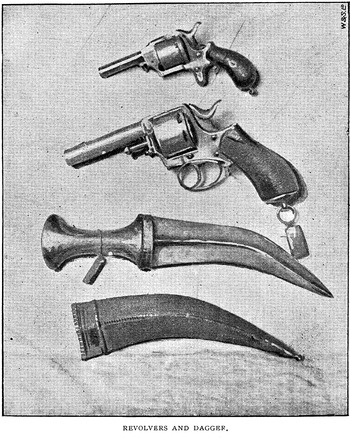
Painting a somewhat flippant and relatively sanitized portrait of crime and criminal, the pamphlet nonetheless communicated a more serious underlying message: that without any exceptional skill or tools, the ‘average’ burglar could penetrate not only into the home, but into one's most intimate possessions, with laughable ease. Whilst the ‘playful’ perpetrator of the burglary outlined in the pamphlet's initial description seemed a mischievous nuisance at worst, the prospect of a real burglary acquired an increasingly sinister aspect as the reader progressed to subsequent pages, on which were displayed photographs of burglars' tools in the Black Museum. Offering grainy documentation of knives, guns, jemmies, and disguises, insurers thereby qualified their representation of the dangers of burglary by inferring the probability of bodily harm alongside material loss, heightening the calibre of the menace (Figure 1).Footnote 2
‘Revolvers and dagger’, Law Accident Insurance Society, Burglars and burgling (London, 1899), p. 19. Reproduced by kind permission of the Chartered Institute of Insurance archives.

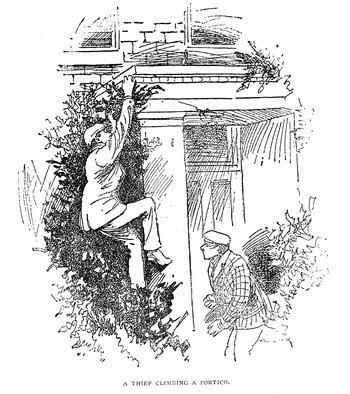
The proposed inescapability of being burgled was similarly visualized. The preface to Burglars and burgling was a plate entitled ‘A thief climbing a portico’, depicting thieves scaling the walls of a house (Figure 2).Footnote 3 Suggesting the sheer agility and physical strength of burglars, as well as their implacable determination, the plate served to remind homeowners and householders of the fortitude of the enemy they faced.Footnote 4 The image further communicated the type of home primarily under threat; with Grecian-style columns adorning its imposing façade, the affluence of the occupants was obvious. The visible infiltration of this wealthy home therefore implied that burglary was particularly directed at the middle and upper classes, the prospective clientele most lucrative to insurers. Epitomizing Burglary and burglars' preliminary themes, renowned burglar and murderer Charles Peace (b. 1832, hanged 1879) occupied the subject-matter of the latter half of the pamphlet.Footnote 5 With his effigy in waxwork at Madame Tussaud's, and his name consistently used by the press as a synonym for ‘professional’ burglary until the 1930s, Peace was a figure whose criminal identity had become the stuff of legend.Footnote 6 His identity was, however, revised in a very specific way in the pamphlet. Eradicating recent, romanticized versions of Peace's character and crimes, insurers harnessed the nefarious attributes that underscored his ‘success’, emphasizing Peace's mastery of disguise, ‘audaciousness’, and the ruthless criminal purpose with which he ‘practically killed’ the pony he travelled upon through sheer hard work.Footnote 7 The notorious burglar was reincarnated yet again, as the convicted professional criminal whose invasion into the home was a matter to be treated with preparative action: insurance.
‘A thief climbing a portico’, Law Accident Insurance Society, Burglars and burgling (London, 1899), preface. Reproduced by kind permission of the Chartered Institute of Insurance archives.

Burglars and burgling had thus far presented burglary insurance as the immediate defensive bastion of a civilization under omnipresent threat of invasion by thieves in the night. Defining crime and criminal in reference to convicted burglar Charles Peace, whilst presenting readers with frightening illustrations of burglars' tools retained at Scotland Yard, insurers' interpretation of burglary was clearly drawing upon that recognized in contemporary criminal law. Concurrently, this interpretation was couched in sensationalist journalistic prose common to newspaper reportage of crime, rendering the tone of the pamphlet into a familiar narrative of the latest ‘feats’ of criminal enterprise.Footnote 8 However, the pamphlet's final pages witnessed a radical change in discursive tone and textual composition. Offering complex tables specifying sliding scales of rates and premiums, the pamphlet provided the reader with proposal documents for the Law Accident Insurance Society's new scheme of burglary insurance (an independent branch of business before ‘household’ insurance policies against both fire and theft gained popularity during the 1920s).Footnote 9
In these latter pages, readers were invited to fill in and return to the company a legally binding document in which the nature of burglary was refined in accordance with insurers' civil law rights to set contractual limitations; generating, and demanding, highly specific conditions of entry, loss, and culpability. Within these caveats, limited cover was offered for those items of property most likely to be stolen: ‘Jewellery, Personal Ornaments, Watches, and Trinkets, and Gold and Plate’.Footnote 10 Such items would remain insured during a maximum absence of seven days. In a questionnaire, prospective clients were challenged to describe their premises, the length of time they had been occupied, any previous instances of burglary, and any measures taken to prevent future incidences of crime. The premiums offered rose in expense were a member of the household proven to have ‘connived’ in the burglary, cementing the impression that insurance was primarily a scheme for those wealthy enough to employ servants whilst endorsing, and magnifying, contemporary stereotypes of the working class as ‘criminal’.Footnote 11 Responsibility for a burglary was thus a matter of greater dispute than the main body of the pamphlet had suggested, as homeowners were exhorted to prove their eligibility to make insurance claims by fulfilling exacting standards of personal wealth and household integrity. Although the spectre of the ‘professional’ burglar continued to reside in the promise of recompense should a burglary occur in spite of the security measures specified, the crime was now, by contrast with the pamphlet's earlier pages, eminently within homeowners' capacity to prevent.
Burglars and burgling thus encapsulated within its pages the burglary insurance industry's dual representations of the nature and frequency of burglary during the period c. 1889–1939 with which this article is concerned. Intersecting, and modifying, cultural, criminological, and legal versions of burglary and burglars prevalent in contemporary discourse, British insurance companies like the Law Accident Insurance Society designed their adverts with an increasingly sophisticated invocation of the genuine problem of burglary's prevalence and effectiveness whilst exaggerating those aspects of crime around which fears were centred.Footnote 12 Having acquired an interested clientele on this basis, insurers defined strict legal and contractual conditions of burglary in their proposal documents that, as I will show, were the subject of tense debate in the event of a claim.
This article illuminates developing representations of burglary and burglars disseminated into the everyday lives of British consumers by the insurance sector. First charting the inception and consolidation of burglary insurance as an independent branch of domestic insurance cover, I proceed to analyse its marketing strategy in the forty years prior to the Second World War. It is shown that in letter, newspaper, exhibition, and billboard advertising campaigns, insurers used emotionally provocative, and contextually sensitive, language and visual devices to characterize burglary and burglars in a manner designed to cultivate an existing culture of fear about crime and criminal in a calculated bid to attract business. The term ‘fear’ is used here in reference to a specific form of the emotion: the rational fear generated in response to the realistic (and exaggerated) reports of burglary the public were exposed to through press reports, legal publications, and the advertising of the insurance industry amongst other sources. Considering, for example, images of burglars' invasion of the home such as that in Figure 2, and assertions of burglars' prevalence and violence, I build upon historian William Reddy's assertion that these gambits functioned as psychological tools (what Reddy terms ‘emotives’) to augment the desired emotion of fear of burglary in the hearts of readers/viewers.Footnote 13 This form of appeal was also engendered by a more subtle shift towards the emergence of what criminologists have termed ‘risk society’ globally; defined as a society which seeks to mitigate the ever greater ‘risks’ (such as the use of more complex weaponry by criminals) engendered by technological and economic progress.Footnote 14 This concern fosters demand for technologies of security, the proliferation of which, as Eamonn Carrabine has noted, ‘only serves to heighten our awareness of unforeseen danger lurking around every corner’.Footnote 15 In a period in which, as Sharon Marcus and Deborah Cohen have shown, the home and its possessions became architecturally, materially, and ideologically central to the sense of security and identity of an ever-expanding, increasingly wealthy middle class, insurers' emotive advertising strategies and engagement with the concerns arising from technological change therefore arguably accounted both for the burglary insurance industry's creation and extraordinary prosperity.Footnote 16 Although burglary insurance was not, nor has it become, a ‘preventative’ measure in the way that locks or bars on a window could literally thwart burglaries, the rhetoric employed in its marketing positioned insurance in those terms and thereby redefined burglary into a commercial product; a risk that could be alleviated for a certain price. We can therefore understand the origination and prosperity of this industry in broader terms as mutually constitutive of an ever more prudential attitude towards safeguarding the material trappings increasingly needed to fulfil one's life.Footnote 17
In tracing insurers' advertising strategies, this article also reshapes scholarly chronologies of psychologically intelligent forms of marketing. Matthew Thomson has observed of Britain that ‘it was not until the 1920s that psychological theory was being widely disseminated into the expanding advertising industry’, despite its earlier prominence in American advertising.Footnote 18 Certainly, in interwar Britain advertisers (including insurers) developed markedly more sophisticated visual and linguistic printed advertisements with which to elicit the desired emotional response from consumers, profiting from technological advances in printing such as chromolithography (the process of lithographing in colour from plates).Footnote 19 However, as I will show in the first section of this article, the earliest forms of burglary insurance advertising in the early twentieth century emphasized the threat of burglary not only in reference to statistical indices of crime but also through invoking the danger posed to consumers' physical safety and prosperity arising from burglars' presence within the home. In so doing, insurance adverts presaged future developments in advertising strategy, for as D. E. Lucas and C. E. Benson's handbook Psychology for advertisers noted in 1930, ‘negative’ appeals – centred upon stimulating readers' repulsion against the ‘dangers’ in not using an advertised product, and the corresponding association of the product with the pleasurable sensation of relief – were characteristic of ‘modern’ developments in advertising.Footnote 20 Whilst insurance advertisers did not explicitly construct their marketing around the discipline of psychology that became popular during the interwar period, burglary insurance adverts do illustrate that psychologically attuned advertising techniques were present in Britain informally from the beginning of the twentieth century.
The second section of this article explores claimant correspondence, insurance handbooks, and press and police interaction with the burglary insurance industry. It explores how legitimate and fraudulent claims upon burglary insurance policies were settled given the disparity between the versions of burglary and burglars in insurers' advertising campaigns and the strict contractual definitions between insurer and insured. Exploring the ways in which crime and criminal were conceptualized by this industry offers an insight into the array of depictions of burglary and burglars in circulation in the cultural landscape of early twentieth-century Britain. Furthermore, by continually tailoring its advertising to mirror the concurrent social, cultural, political, and economic context of its publication, insurance literature appealed to a range of broader contemporary preoccupations – the home and its occupants, including the gendered nature of familial responsibilities; the success or failure of government systems of regulation (such as the police and the judiciary system); technological advances, manifested in the construction of safes and other security appliances; and the purported refinement of British domestic life – of which this study can consequently also investigate the evolution.
In seeking to understand representations of crime and criminals in the cultural imagination of the nineteenth and twentieth century, historians of Britain, including especially Martin Wiener, Judith Walkowitz, Ginger Frost, and Shani D'Cruze, have focused primarily upon portrayals in legal testimony, criminological texts, newspapers, and fiction.Footnote 21 These interpretations have argued that discourses about criminals were the product of first-hand experience and/or the sensationalist rhetoric of moral panic, magnified and articulated in court, by journalists, and by novelists. Whilst this approach has usefully unearthed the resonance of crime as a pervasive aspect of everyday life, particularly in D'Cruze and Frost's respective explorations of rape, domestic violence, and breach-of-promise cases, it has failed to evoke its commercial dimensions, through which crime surfaced as the motor of a common household purchase.Footnote 22 Privileging the market (under which label reside the domains of the economy and commerce) alongside those sites historians of crime have considered crucial to the formulation of ideas about crime and criminals – social, political, cultural, and legal – therefore furnishes an entirely new set of agents and institutions responsible for the articulation and dissemination of a specific idea about crime in late nineteenth- and early twentieth-century Britain.
II
Insurance originated in Britain in the seventeenth century as a way of attempting to secure against the risks engendered by increasing levels of overseas trading. Initially offering to reimburse merchants for loss of cargo at sea, the industry soon expanded into what have remained the main arms of the business today: marine, fire, life, accident, and employer's liability insurance. Viewed originally as a disreputable form of gambling on the prospect of misfortune or loss of life, in the mid-nineteenth century insurers distanced themselves from former gambling associations and began establishing corporate headquarters in major cities and retaining large sums of capital in reserve.Footnote 23 This change was reflected in insurers' advertising, which by 1900 was framed around recognizable brand names, reassuringly large sums of capital and pay-outs, and symbols connoting security, solidity, and professionalism.Footnote 24 Contemporaries disagreed as to who first offered burglary insurance. A Pall Mall Gazette report of 31 October 1889 attributed the innovation to Lloyd's of London, whilst the insurance industry's own training textbooks, issued during the 1920s and 1930s, credited the Mercantile Accident and General Guarantee Corporation of Glasgow, again citing 1889 as the year of inception.Footnote 25 What is most interesting about both versions are the narratives of ‘popular’ crime and policing upon which they drew. As the Pall Mall Gazette article pronounced, ‘The idea of insuring one's goods and chattels against the predatory invasion of artists of the Charles Peace stamp is, to say the least, good.’Footnote 26 In the industry's training textbooks, the idea was attributed to a Police Constable Allan, who approached the Mercantile Accident and General Guarantee Corporation after his experience of burglary on the beat in London.Footnote 27 The link between famous instances of crime, state systems of regulation, and burglary insurance was thus deeply rooted in the insurance sector's history, literarily allying the birth of burglary insurance both with mediated descriptions of ‘predatory’ burglars and the agents of its prevention.
Burglary insurance soon became a common transaction. Established insurance companies, including the General Accident Assurance Corporation, the Law Accident and Contingency Insurance Society, the National Accident Insurance Company, and the Security Company, promoted burglary insurance in the early 1890s as a new strand of business alongside other individual ‘general’ household risks they would insure against (e.g. fire). Aligning burglary insurance in their pamphlets alongside concerns such as sickness, accidents, or fire, wealth of choice initially took precedence over individual risk as a marketing ploy.Footnote 28 Others perceived the scope for profit in concentrating their services upon this new branch of business. Specialist burglary insurance companies such as the National Burglary Insurance Corporation, the Fine Art Insurance Company, and the Goldsmiths and General Burglary Insurance Association were founded in 1889, 1890, and 1891 respectively.Footnote 29 Considering how recently burglary insurance had been devised, the rapid expansion of the business was a dramatic indicator of its immediate popularity and the level of existing anxiety about burglary. Indeed, the preface to the 1894 edition of the Home Office's annual report on criminal statistics for England and Wales identified burglary as one crime that, against the general trend of decrease in overall crime, had increased or remained stationary in frequency since 1891.Footnote 30
The earliest literature issued specifically to advertise burglary insurance took the form of pamphlets and proposal documents issued face-to-face through doorstep canvassing. In pamphlets issued in the 1890s, insurers prefaced their tables of rates and premiums with short, sensational statements emphasizing the threat of burglary: for example, the General Accident Corporation's pamphlet asserted (using the labels ‘burglar’ and ‘thief’ synonymously) that ‘the number of known thieves in Great Britain is estimated at over 70,000, and no class of the community … is free from risk’, whilst the Security Company's literature talked of the ‘depredations’ and ‘real danger’ of burglars that had resulted in a ‘general feeling of insecurity’.Footnote 31 Asserting the ‘feeling of insecurity’ apparently permeating throughout the populace was shrewd; suggesting readers should partake of this sensation, insurers employed what Reddy has called a ‘third-person emotion claim’ whereby conveying the emotional state of others acts as a trigger for eliciting that feeling in the audience.Footnote 32 The use of statistics additionally allotted a rational impetus to insurers' claims, quantifying the threat of burglary in a manner that lent an authoritative credence to insurers' emotionally charged warnings by echoing tropes familiar in government publications about crime.Footnote 33
Other companies employed less subtle methods. The Goldsmith's and General Burglary Insurance Association, for example, brandished the tag-line ‘Locks, Bolts and Bars, Soon fly asunder’ on its leaflets.Footnote 34 This approach was ironic: bemoaning the speed and success of burglars implicitly attacked the competence of the police, upon whose co-operation insurers relied when investigating claims; whilst insurers would later insist upon homeowners' use of safes and locks as part of their contractual obligations (see section II).Footnote 35 However, by positioning themselves – or rather, their policies – as safeguards where the police had failed, insurers successfully translated burglary insurance in their advertising as a form of quasi-police protection against the crime; a type of ‘security’ that would, unlike mere bolts, bars, or policemen, guarantee that the loss suffered to burglary would be minimal. Quantifying burglary as a phenomenon of intimidating proportions, and the abilities of burglars into that which could overcome the most advanced security appliances, insurers offered their services as the solution to a loosely defined imagining of crime and criminal in which thieves' skill and success were conceived as uniform.Footnote 36
The phrase ‘Locks, Bolts and Bars, Soon fly asunder’ also reflects insurers' attempts to undermine upper- and middle-class clients' belief in the impregnability of their homes. As Marcus asserts, ‘throughout the nineteenth century, architectural discourse defined the [middle-class] house as an impenetrable, self-contained structure with distinct and specialized rooms'.Footnote 37 This ideal was incompatible with the sense of burglars' easy ability to effect entry into the readers' home that insurers sought to promulgate. The proposed vulnerability of the suburban residence underpinned the very format of proposal documents. In the information enclosed, insurers requested to know ‘Are the premises Brick or Stone Built, and Tilled or Slated?’ and ‘How are Windows on the Ground Floor protected?’, suggesting that, regardless of houses' respective isolation from one another or independence from communal facilities, properties were ripe for invasion at every point not composed solidly of bricks and mortar.Footnote 38 Ordinary houses' structural and material fragility was further exacerbated by images of contrastingly fortress-like edifices of insurance companies' offices, which appeared as headings around which companies' names were entwined on pamphlets, proposal documents, and general correspondence.Footnote 39 The architectural ideal of the impenetrable residential home was thus not, by insurers' implication, a reality.
Correspondence was another early tool by which the insurance industry imparted the threat of burglary, utilizing a discursive framework that collapsed local incidences of crime into the imminent prospect of personal, individual attack. In 1904, London insurance brokers R. P. Walker and Son sent out 116 copies of a letter to clients in Kent, stating:
You are doubtless aware that a burglary was recently committed at the Red Cottage, Orchard Road, Bromley, when a considerable quantity of silver plate was stolen. We have Mr. Corfield's permission to say that he was insured through us with the Guardian Assurance Co. and that he is well satisfied with the manner in which his claim has been settled. In case you are not insured against Burglary we take this opportunity of sending you a prospectus of the policy issued by this old established Company, and trust we may be favored with instructions to effect an insurance in your behalf.Footnote 40
Invoking this specific, well-known local burglary (which had occurred on 26 May 1904 and was reported subsequently in the local newspaper, the Bromley District Times), the letter embedded the activities of burglars in the minds of readers not only as prevalent, but nearby, elaborating a highly localized climate of fear towards crime and criminal.Footnote 41 Although it is difficult to trace who received these letters, and, consequently, at whom they were targeted, the fact that most pamphlets of the 1890s and early 1900s offered insurance only for total household contents worth more than £100 suggests they were intended for middle- and upper- class clients.Footnote 42 Their language thus sought to engage with what Cohen has argued was a new, more fundamental relationship between the home and middle-class occupants' sense of selfhood in late Victorian and Edwardian Britain wherein the home and its furnishings became ‘the crucible for the self’, a reflection of one's personality and values that would, if violated, have constituted a trespass into the very soul of the owner.Footnote 43 Reading this letter in conjunction with the enclosed insurance pamphlet describing the thousands of burglaries occurring on a national scale, such clients would therefore have been unusually sensitive to the realistic danger of burglars pilfering the possessions they treasured, augmented by insurers' abstracted allusions to the ‘recent’ Red Cottage burglary in their locality.
Advertising was not, of course, the only means by which insurance companies garnered their clientele. Other letters sent by R. P. Walker and Son reveal that the brokers canvassed potential clients through their own social networks, subsequent contacts spreading through personal and written introductions.Footnote 44 Loyalties generated through this form of business practice were thereby located both in the realms of the personal and the professional. In terms of doorstep canvassing, as Sean O'Connell notes, such interactions required judgements of character as well as performative elements, like emotive appeals, from both canvasser and canvassed, as well as customers' realistic assessments of the affordability and prudence of an investment.Footnote 45 Indeed, in an early (c. 1900) training booklet entitled How to train a young agent, insurance canvassers were instructed to be ‘ready with sympathy to those in trouble, in sorrow, and endeavour to be the friend of every person, avoiding on all occasions giving offence to anyone’.Footnote 46 Insurance salesmen's personal demeanour and emotional sensitivity to the common concerns of prospective clients were therefore seen as integral to acquiring the business, and trust, of customers. Burglary insurance might also have been purchased on the advice of friends, from personal or second-hand experience of burglary, or when buying other forms of insurance to make sure properties were, in some measure, safeguarded. Whilst it is difficult for the historian to recover these processes of reasoning, the emphasis placed by R. P. Walker and Son upon cultivating business with clients upon word-of-mouth indications of interest reflects the credence given to the influence of friends and close associations in generating custom.
Between 1890 and 1914, insurers progressively inserted adverts into a wide range of national and local newspapers, the content and style of which varied in quality between different companies. The onset of the First World War inspired insurers to concentrate fully on this media, however. Tapping into what Nicoletta Gullace has called the ‘atrocity propaganda’ about German war crimes then ‘saturating’ the British press to encourage men to protect their homes and families by volunteering in the army, insurers began to produce adverts which offered coverage against specific wartime risks (like damage from Zeppelin bombs).Footnote 47 As insurers transferred the success of this formula onto their representation of domestic risks after the war, one company in particular – Eagle Star and British Dominions Insurance Co., Ltd – produced a press campaign for burglary insurance between the years 1920 and 1927 that exemplified these influences.
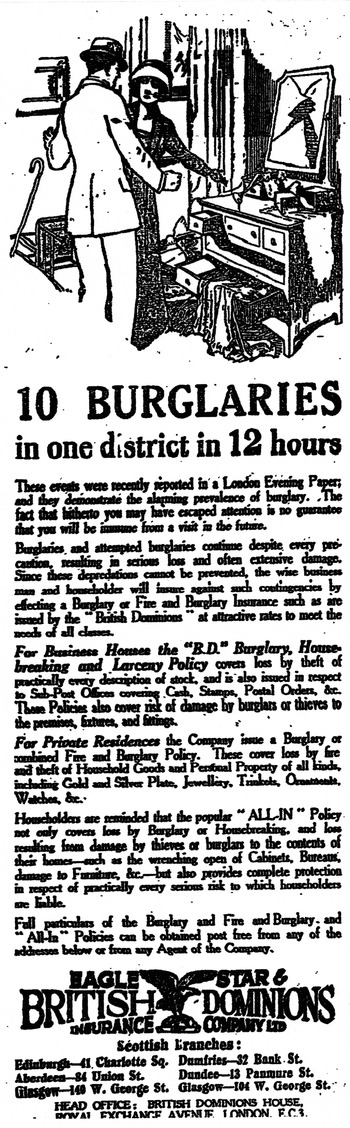
In 1920, Eagle Star published an advert in the Scotsman entitled ‘10 burglaries in one district in 12 hours’ (Figure 3).Footnote 48 Depicting a couple exclaiming over the disarray of the woman's dressing table in the aftermath of a burglary, the advert visualized the burglar's penetration into one's most intimate possessions and domestic space. As Amanda Vickery notes, privacy was a value entrenched in Western European ideology about the preferred nature of domestic life by the late eighteenth century, becoming a central tenet of the internal architectural and lived dynamics of the home from the nineteenth century onwards.Footnote 49 The details of the violently shattered mirror and the nightgown wrenched into public view from the drawer thus presented burglary as the sensation of being forcibly divested of privacy.Footnote 50 The premonition of this should then, by implication, induce one to purchase the requisite insurance.
‘10 burglaries in one district in 12 hours’, Scotsman, 15 Dec. 1920, p. 7. Image reproduced by kind permission of Scotsman Publications Syndication.

Figure 3 also offers a fascinating insight into the specific version of gender relations with which Eagle Star thought readers of The Scotsman would identify. Moulding its motifs around a traditional discourse about masculine responsibilities towards women, the advert stated: ‘Since these depredations cannot be prevented, the wise businessman and householder will insure against such contingencies by effecting a Burglary … Insurance.’Footnote 51 This was a perceptive model for insurers to play upon in a post-war context in which, as Susan Kingsley-Kent has argued, the home was culturally re-established as central to the stability of relations between the genders – and, consequently, the nation – after the upheaval occasioned by women's wartime involvement in the labour force and subsequent political gains.Footnote 52 Located on the same page as news from the international markets and law-courts, the use of a statistic as the headline of this advert couched the threat of burglary in a factual, legal, and scientific discourse that was both authoritative and, in this era, predominantly masculine. The home was thus presented as a space that, though characterized by the feminine domains of its interior, was ultimately in the safeguarding of the man, who stands in the foreground of the image as though attempting to shield his wife's possessions from further intrusion by the readers' gaze.
Other adverts portrayed the effects of burglary in more generalized terms. In an advert entitled ‘What's happening at home?’, published in The Times in July 1921, Eagle Star employed a discourse of anxiety about the sanctity of the domestic space by stating ‘The holiday season is the Burglar's busy period. Unoccupied homes are his special study’, intimating a ‘spoilt’ holiday and money worries should the burglar strike when the family were absent and uninsured. By contrast, another advert issued by the company in The Times in May 1923, entitled ‘Bolts and locks offer very little resistance to the modern burglar’, suggested that regardless of homeowners' presence or absence the ‘modern’ burglar was so skilled in picking locks and bolts that the home would inevitably be invaded.Footnote 53 That being the case, and without reference to possible police intervention, these adverts maintained a rhetoric of constant danger of burglary from which only insurance could offer recompense. Burglary in these adverts was, however, a crime depicted as being entirely beyond the abilities of homeowners to defend against, with no reference to the finer details of circumstance and security measures insurers calibrated burglary against when agreeing their contracts.
Whilst both adverts appeared in The Times, the ‘What's happening at home?’ advert additionally appeared in the Morning Post, the People and the Daily Telegraph, and Eagle Star disseminated others in The Scotsman, the Daily Mail and the Daily Express.Footnote 54 The dispersal of burglary insurance adverts across a broad spectrum of newspapers had a clear democratizing effect on the class of consumer towards whom insurance was directed. In ‘What's happening at home?’ the company were keen to stress that ‘The risk of loss from Burglary is covered at rates to suit all classes.’Footnote 55 This simultaneously highlighted burglary as a universal threat to homes of all classes (expanding the class of clients targeted by insurers away from fin de siècle insurance advertising aimed predominantly at upper- and upper-middle-class consumers) and presented insurance as the available solution. Indeed, as Joanne Hollows asserts, the expansion of the middle classes from the late nineteenth century witnessed their corresponding expenditure on domestic goods that would communicate subtle signs of status, a development that ensured the threat of burglary appeared of likely concern to more people than ever before.Footnote 56 Eagle Star took this a step further by collaborating with the Daily Express in 1921 to offer free insurance to regular readers, enhancing the newspaper's circulation figures whilst also, as the Prudential Company's bulletin noted, making people ‘accustomed to feeling insured’.Footnote 57 The juxtaposition of the words ‘feeling’ and ‘insured’ in regard to newspaper campaigns that drew upon legal discourse and journalistic prose thus perfectly demonstrates how insurance advertising intersected media, state, and market representations of burglary and burglars, using techniques that delivered the information as a personal, emotional experience to which readers/viewers were entreated to respond.
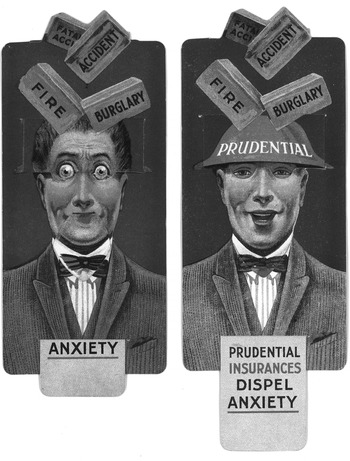
In consistently depicting the burglar as a male interloper and in elaborating the ‘thousands’ of burglars at large in Britain at any given time, burglary insurance adverts again used the experience they had gained in advertising during the war, by drawing upon tropes comparable to that used to describe the invading German army by the British press in August 1914.Footnote 58 Further, this rhetoric, and its longevity (identical themes can be found in Eagle Star adverts from 1927) reveals how insurers successfully positioned burglary as a threat equivalent to foreign invasion in the public mind.Footnote 59 Eagle Star was not the only company to deploy a sophisticated marketing strategy, though, nor unique in evoking the war as an analogy for burglary. Figure 4 shows a toy handed out by the Prudential Insurance Company at the British Empire Exhibition of 1924. In the company's bulletin of July 1924, those operating Prudential's kiosk explained the toy, reporting that
We have a number of advertising devices which appeal especially to children … there is great demand for a picture of a gentleman with bricks falling on his head (fire, burglary, etc.) who has an anxious-looking face in consequence. By pulling a tag a Prudential helmet comes over his head and his face is wreathed in smiles. The youngsters' faces are also wreathed in smiles in witnessing this remarkable transformation and … ‘That's Daddy looking worried’ is a fairly common remark, and Daddy has to read the advertisement intended for him before he goes away.Footnote 60
Visually comparing the threat of burglary to bricks threatening the homeowner's head, the appropriate emotional response – anxiety – was spelled out in emphatic black capitals beneath, as well as in the character's fearful expression (left). Pulling the tab (right) introduced Prudential Insurance with the visual metaphor of a military-style helmet, framing the company and its clients as combatants in a war against burglary, fire, and accidents. Created so that the threat would be identified and communicated by a child, and issued to people enjoying a family day out at the exhibition, the toy sought to reinforce the masculine and familial responsibilities of male homeowners. As the text on the reverse asserted, burglary was a ‘big risk’ present on a ‘daily’ basis, yet again quantifying burglary in a language that echoed official publications on crime. The intersection between state and market was also apparent in the context of the toy's dissemination; the British Empire Exhibition was a showcase in which, as John Mackenzie has noted, ‘Imperial rule could be portrayed as having made significant advances.’Footnote 61 Burglary insurance was therefore placed within the broader civilizing narrative of British Imperial ‘progress’, as another facet of a purportedly secure and enlightened existence.
1924 British Empire Exhibition artefact. On the left, before pulling tag; on the right, after pulling tag. Reproduced by kind permission of Prudential Group archives.

By the 1930s, newspaper adverts issued specifically to market burglary insurance largely disappeared, as the majority of insurers offered it as part of comprehensive household insurance policies. Burglary continued to be identified as a distinct branch of the business in such adverts, however, reflecting the popularity of the insurance and the effectiveness of its original marketing.Footnote 62 The prominence of the ‘burglary business’ could also be seen by prospective clients as they passed insurance offices' London headquarters. As the Prudential Company's bulletin of April 1932 reported, a fifteen foot long by ten foot high billboard displaying two burglars effecting entry into a safe adorned the frontage of their offices facing Brooke Street; whilst the General Life Assurance Company's centenary book of 1937 included an illustration of their chief offices at Aldwych, London, showing the word ‘BURGLARY’ displayed over the building's front door.Footnote 63 Additionally, insurers found an alternative outlet for asserting the threat of burglary, and the need for burglary insurance, in the marketing of safe companies, with whom they forged mutually profitable endorsement contracts.Footnote 64 The 1930s might therefore be seen not as a diminution of insurers' efforts to sustain a culture of fear about burglary, but as a period when those ideas had become so firmly entrenched in public perception that burglary insurance – initially, a marginal branch of business – had become a common household purchase. Strikingly, against the trend of declining prosperity of other industries during the economic downturn of the late 1920s and 1930s the insurance industry, as John Butt observes, ‘expanded greatly and diversified widely’.Footnote 65 The integration of burglary insurance within this unusually stable industry shows the strength of its popular demand.
III
How did insurers' advertising strategy relate to their commercial transactions with clients? Unfortunately, there are few surviving records of insurance claims made before 1939. However, the following case study of a seemingly legitimate claim, as well as newspaper reports of undoubtedly fraudulent attempts to swindle burglary insurers, illustrate how, in both scenarios, clients' articulation of the nature of burglary conformed to the parameters instilled in criminal law and insurers' generalized advertising rather than that stipulated by insurance contracts. This inherent tension in dealings between insurer and insured resulted in repeated disputes and re-evaluations of the nature and conditions of burglary, fostering new ideas about the distinctions between ‘professional’ and opportunistic incidences of crime and criminal in this period.
In March 1923, Samuel Edward Knight, a sub-postmaster in Wimbledon, south-west London, was burgled. Breaking through a window-shutter at the rear of the Post Office, the thief stole an entire safe and its contents (comprising both personal and Post Office property) from the bedroom, facilitated by the temporary absence of Knight and his wife. Applying to the Fine Art and General Insurance Company for remuneration, Knight was told by the insurer's assessors, Messrs. Francis Dod and Company, that the claim would be refused. In a personal call to the Post Office's Investigation Branch on 27 July to explain why,
Mr. Dod stated that under the terms of the Policy issued to Mr. Knight there was no legal liability on the Company to pay any part of the value of the stolen property inasmuch as more than one of the additional provisos typed upon the policy had not been complied with by the Sub Postmaster's failure to comply with the proviso (1) [stating that the policy holder must be above the age of 25 years] upon the copy of the Policy at page 71 and his alleged failure to provide some of the fastenings, especially the Hobbs padlock mentioned in proviso 4 (b).Footnote 66
Despite Knight's protestations that the burglary insurance policy had been issued to him after a thorough inspection of the property and its security measures by the insurance agent, and that neither he nor his wife had been asked their age (both were twenty-one), the insurance company refused to pay. In further correspondence, it emerged that Knight had been asked to buy a ‘Hobbs Hart close shackle padlock’ for the side gate, but being unable to find that specific brand, affixed an identical, unbranded lock from the blacksmith. This, however, Knight judged irrelevant, as the burglar had entered through the window-shutter. Fine Art and General disagreed. Knight had failed to meet their conditions, and in regard to the Sub-Postmaster's age, they insisted ‘The original contract was issued by us with the express condition that a responsible and capable person of not less than 25 years of age shall at all times of the day and night be actually present in and upon the premises.’Footnote 67 The Post Office's solicitor pronounced the claim impossible to recover, waspishly commenting that ‘if a man does not read his policy he has only himself to blame’.Footnote 68 Knight tendered his resignation on the grounds of ill health shortly afterwards.
There are many aspects of this account that command attention. Fine Art and General's policy against burglary carefully measured burglars' effectiveness against specific expectations of homeowners' personal levels of responsibility, embodied in homeowners’ ages – the suggested determinant of what constituted a ‘responsible and capable person’ – and their physical presence within their premises. Questioning homeowners' vigilance in protecting their properties implicitly gradated responsibility for a burglary, suggesting that homeowners could easily fend off most ‘ordinary’ thieves and, therefore, that ‘real’ burglaries should involve the demonstration of uncommon skill by the criminal. Similarly, specifying the ‘Hobbs Hart close shackle padlock’ as the only mechanism to pose a truly adequate obstacle to prospective thieves – by no means a unique insistence upon branded products to emerge in a claims dispute – distinguished the type of burglar against whose crimes insurers would actually provide recompense as a professional; one who could defeat the most well-known, successful makers of safes and locks.Footnote 69 This marked a clear departure from insurers' generalized promises to guard against the hordes of burglars of all levels of ability suggested in their advertising.
Distinguishing burglars this way partially appropriated contemporary criminological discourse. As Neil Davie has described, the notion of the ‘recidivist’ or ‘professional’ criminal – one who persistently reoffended, and was believed to be genetically predisposed to a life of crime – was a key figure in official and medical thought about crime in Britain between 1865 and 1918.Footnote 70 As a marker of the continuity of this idea, John H. Laub and Robert J. Sampson have noted how American criminologists Edwin Sutherland, and Sheldon and Eleanor Glueck, offered highly influential theories about the nature of criminals in the 1930s that revolved around identifying the persistent ‘professional’ offender.Footnote 71 Under criminal law, the distinction between one-time, opportunistic offenders and repeat offenders was recognized by harsher punishments for those with previous convictions.Footnote 72 Nonetheless, these distinctions constituted far more generalized analytical frameworks than those suggested by insurers' insistence that a ‘real’ burglar be defined by their skill in overcoming certain brands of security measures. Here, the commercial dimension of insurance companies' input into contemporary discourse about crime was magnified, as clients were forced to purchase those branded locks and safes insurers had chosen for their presumed or proven ability to withstand the efforts of potentially highly skilled criminals.
The age of the homeowner, and the implications of this variable upon their ability to guard effectively against burglary, were conspicuously absent from burglary insurance adverts. Conversely, whilst the adverts placed a clear emphasis upon masculine responsibilities to insure the home, no gendered discrimination attended this transaction in the business world, policies having been issued by various insurance companies to female homeowners (married and unmarried) as early as 1897.Footnote 73 Nor did insurers later cease this practice; a letter to Mary Elizabeth Phillips from the Royal Insurance Company dated 13 January 1917 revealed the insurers calmly negotiating the renewal of her existing policies.Footnote 74 Because few completed insurance policies survive for the period 1889–1939, information about insurers' clientele has been gleaned almost exclusively from the correspondence file of R. P. Walker and Son during the years 1900–4.Footnote 75 Given that insurers offered cover only against property worth a minimum of £100 at this time, it is somewhat inevitable to discover that all the female clients to whom the letters referred in detail were wealthy residents of upmarket areas of London and southern England.Footnote 76 Nonetheless, these letters show that emphasis upon traditional, patriarchal models of domestic life advanced in newspaper adverts and in the toy gimmicks offered by Prudential belied long-standing business practice of contracting with women homeowners. What did this disjunction mean? As Adrian Bingham has highlighted, recent historiographical analyses of interwar gender relations has identified a disjuncture between widespread cultural discourse of a perceived return to traditional ideals of domesticity, and accounts of women's involvement in organizations campaigning for reform.Footnote 77 Attitudes to female homeowners in insurance advertising versus the reality of their business practice was clearly sensitive to this disjuncture, again allowing insurers to profit from their engagement with broader cultural trends. Further, the ‘blindness’ of insurers towards the gender of the homeowner when issuing policies suggested that in the event of a burglary, the lack of a ‘male protector’ would not be considered sufficient grounds to exhort a pay-out at the expense of investigating whether the specified security measures had been used.
Still bruised from Fine Art and General's dismissal of his claim on those grounds, Samuel Knight launched an appeal against the company's verdict in November 1923, asserting that
I understand that as the matter now stands the Insurance Company do not appear to be legally liable for any claim under the Policy but as in my opinion they are morally or equitably liable to some extent I propose to write them again asking them to make some payment in the circumstances described.Footnote 78
Knight's proposition that the insurer was ‘morally’ liable (and corresponding failure to recognize the constrained terms of the civil law contract to which he had agreed) exposed his conceptual conflation of insurers' business tactics with a betrayal of an assumed code of ethical conduct, underlining the disparity between claim negotiations and the emotionally supportive relationship insurers promulgated in their advertising. Indeed, Knight's complaint, and the language of betrayal in which he articulated it, recurred periodically in newspaper reports of insurers' refusals to meet claims between 1900 and 1939. As early as 1904, the Daily Mirror published an article entitled ‘Is insurance a real safeguard?’, in which ‘a high authority’ was quoted warning that ‘In the case of burglary policies particularly, I should advise the public to be very careful as to the wording, the tendency of those issued by many companies being to practically exempt the company from all liability.’Footnote 79 Comparably, in 1926, John Bull reported a court dispute arising from the refusal of the Lancashire and General Assurance Co. to make good a burglary insurance claim in which the judge, Lord Wrenbury, remarked ‘that he thought it a mean and contemptible policy on the part of the company to take the premiums and then refuse to pay by availing themselves of a technical excuse’.Footnote 80
However, insurers were also highly justified in maintaining strict codes of business conduct, for alongside press critiques of insurance companies' refusal to make good burglary claims were articles relating to intermittent, but repeated, attempts to swindle insurers through faked or ‘bogus’ burglaries.Footnote 81 To take one example, in April 1923 The Times reported the case of Mrs Annie Fletcher (at that time styling herself the ‘Countess Wrateslaw’ in order to avoid her debtors), who lost her claim against the Traders and General Insurance Association Ltd for remuneration of a burglary insurance policy to the value of £1,500 effected on a picture supposedly painted by Rembrandt, stolen in a ‘burglary’ on 22 October 1921.Footnote 82 Summing up the evidence for the jury at the High Court of Justice in London, Mr Justice Swift found himself unable to state with certainty that the burglary from Fletcher's mansion at Bryant Square in London's wealthy West End was not real, the police having clearly identified the marks of a forcible entry made through a window at night whilst Fletcher was at the theatre.Footnote 83 Revelations during the course of the trial, though, of Fletcher's alleged association with known thieves and drug-dealers, and the testimony of a Sidney Jackson (a former inmate of a Borstal institution for young offenders) that he had received a £10 cheque signed by Fletcher as an incentive to commit a proposed burglary of the picture in February 1921, forced Swift to ask the jury to assess ‘whether a person of the character, disposition, and mode of life of the plaintiff ought to be believed’.Footnote 84 Finding in favour of the insurance company, the jury thus affirmed that in relation to insurance claims burglary was defined against the actions and behaviour of the homeowner, and not simply in relation to the parameters of its enactment written into the 1860 and 1916 Larceny Acts.Footnote 85 Notably, press critiques of burglary insurance frauds situated insurers as victims of theft in the same language insurers themselves used to emphasize the danger posed by thousands of burglars purportedly at large in Britain; as an exposé in the newspaper John Bull claimed on 19 September 1931, there was an ‘army’ of ‘phantom burglars’ targeting insurance companies numbering in the thousands.Footnote 86 Comparably, insurance expert C. E. Golding recycled the discourse used by angry claimants for the benefit of insurers when talking of such frauds: ‘As we have seen, an insurance policy is a contract of the utmost good faith, and the least amount of fraud or untruth will render it void.’Footnote 87 Insurers' contestation of burglary claims, and their precise lists of clauses for the crime's identification, were therefore both legitimized and recognized within a context of the ‘risks’ under which they also laboured, manifested in clients' potential attempts at fraud. It was thus widely recognized by the press, police, and government alike that the instance of a claim became the site at which the emotionally supportive relationship with clients crafted by insurers through their adverts collapsed, and commercial imperatives took over. Accordingly, the burglar changed too, measured by insurers both against the ‘professional’ skill of the criminal, who should commonly be defeated by branded security devices, and the character and dependability of homeowners.
IV
To conclude, the period c. 1889–1939 proved fertile ground for the consolidation of multiple commercially lucrative versions of burglary and burglars by insurance companies. Insurers proved remarkably adept at deploying marketing that successfully manipulated contextually sensitive emotional ‘triggers’ in the form of linguistic and visual prompts – emotives – with which to communicate, and augment, the threat of burglary, e.g. Charles Peace, the high statistical incidence of burglary, or through analogy, the invading German army. The growth of the burglary insurance sector indicates the receptivity of consumers to these influences, and the successful integration of state, media, and (most importantly) market representations of crime upon which insurers constructed their discourse. Additionally, the expansion of the middle classes, which increasingly brought domestic concerns to the forefront, and concurrent innovations in printing and the growth of newspaper advertising, furnished a mass audience for the consumption of burglary insurance that insurance companies would previously have been unable to acquire. Remaining sensitive to the complexity of this audience, insurers operated within the overlapping frameworks provided by ideas about domestic life and homeowners' responsibilities. By marketing towards the protective presence of a male owner, but practising a more realistic daily interchange with homeowners of both sexes, insurance companies exploited the tensions between public and private models of everyday life to their best advantage.
Insurers also successfully negotiated the divide between marketing towards versions of crime and criminal defined under criminal law and adopting more specific definitions within their contractual agreements. Establishing standards by which a burglar could be measured, such as extraordinary skill at safe-breaking or lock-picking, insurers were enabled to retain profits in the face of challenges by honest claimants and swindlers alike. Strikingly, in borrowing the category of ‘professional’ burglar from criminological and legal discourse and integrating it into their contracts, insurers exploited, and cleverly nuanced, discursive strategies they had successfully used for the purposes of marketing. Arguably, it is this aspect of insurers' involvement in the promulgation of ideas about burglary and burglars in early twentieth-century Britain that is most compelling. Illustrating the agency of commerce in the formulation of cultural, social, and political responses to crime and criminals, burglary insurance literature confounds the historiographical convention of treating these domains in isolation. Furthermore, it shows how crime shaped relatively mediocre decisions regarding domestic arrangements on an everyday basis. Burglary insurance is thus of fundamental significance, offering historians a fresh framework through which crime was understood historically in Britain.