Introduction
The Advisory Committee on Immunization Practices recommends that healthcare personnel receive seasonal influenza vaccination annually. Reference Lindley, Bridges and Strikas1 Data reported by acute care hospitals to the Centers for Disease Control and Prevention’s (CDC) National Healthcare Safety Network (NHSN) indicate declining influenza vaccination coverage among healthcare personnel in acute care hospitals in recent years. Reference Lymon, Meng and Reses2
Previous research found that mandatory vaccination and multifaceted strategies, including vaccination campaigns and vaccinate-or-mask policies, increase vaccination among healthcare personnel in regional health systems in the U.S. and other countries. Reference Schumacher, Salmanton-Garcia, Cornely and Mellinghoff3 However, it is unclear how facility-level policies affect coverage among healthcare personnel in hospitals throughout the U.S. This study examines facility-level influenza vaccination policies and their association with vaccination coverage among employees and licensed independent practitioners in U.S. acute care hospitals during the 2021–22 influenza season.
Methods
Data reported by acute care hospitals to NHSN were used for this study, which included healthcare personnel working in the hospital for ≥1 day from October 1, 2021, to March 31, 2022. Analysis was limited to facilities that submitted vaccination data and completed an optional survey about influenza vaccination programs and policies and which types of healthcare personnel they apply to.
Employees included full- and part-time staff paid directly by the facility. Licensed independent practitioners included physicians, advanced practice nurses, and physician assistants affiliated with but not directly employed by the facility. Vaccination coverage was calculated by dividing number of vaccinated healthcare personnel by total number of healthcare personnel and pooled by facility policy and healthcare personnel category.
Bivariate analysis was conducted to determine which policies (ie, facility influenza vaccination policies, methods to deliver vaccines to healthcare personnel, and strategies used by facility to promote personnel influenza vaccination) had the highest association with vaccination coverage. The final model was a multivariable logistic regression model using the Williams scale to account for overdispersion. The model included facility influenza policies outlining consequences for declining vaccination at reporting facilities [https://www.cdc.gov/nhsn/forms/57-215-Seasonal-Survey-form.pdf (Appendix A-question #5)] and classified as (1) employment termination, (2) masking if unvaccinated, (3) recommended, no consequence, (4) other consequence, and (5) no influenza vaccination policy. Masking was a dominant theme in the category other, specify and obtained by extracting the word “mask” in free response text for facilities that required masking for unvaccinated personnel. Less prominent themes included medical/religious exemption and signed declination.
Other facility-level factors in the final model included facility size (tertile distribution of healthcare personnel per facility), urbanicity (urban: metropolitan statistical areas with ≥ 1 million population, suburban: metropolitan statistical areas with ≥ 50,000–999,999 population, and rural: counties within and outside of micropolitan statistical areas) using the National Center for Health Statistics urban-rural classification scheme for counties, acute care hospital type, CDC/Agency for Toxic Substances and Disease Registry county-level social vulnerability index tertile, U.S. Department of Health and Human Services (HHS) region (1–10) and the interaction between healthcare personnel category and vaccination policy. Reference Lymon, Meng and Reses2,4–6 All analyses were conducted using SAS 9.4 (SAS Institute, Cary, NC).
Results
A total of 3,238 facilities (84.4% of acute care hospitals that reported healthcare personnel vaccination coverage to NHSN) with 5.4 million employees and 1.1 million licensed independent practitioners were included. Pooled vaccination coverage was 79.4%: 82.5% for employees and 64.5% for licensed independent practitioners (Table 1). Facilities with an employment termination policy reported the highest vaccination coverage for employees (94.0%) and licensed independent practitioners (81.2%).
Pooled influenza vaccination coverage of healthcare personnel in acute care hospitals for the 2021–2022 influenza season

Pooled vaccination coverage is the sum of vaccinated healthcare personnel divided by total healthcare personnel for all acute care hospitals.
a Healthcare personnel refers to both employees and licensed independent practitioners.
b HHS, U.S. Health and Human Services Region (https://www.hhs.gov/about/agencies/iea/regional-offices/index.html).
HHS Region 1- Boston includes Connecticut, Maine, Massachusetts, New Hampshire, Rhode Island, and Vermont.
HHS Region 4 – Atlanta includes Alabama, Florida, Georgia, Kentucky, Mississippi, North Carolina, South Carolina, and Tennessee.
Source: National Healthcare Safety Network, United States.
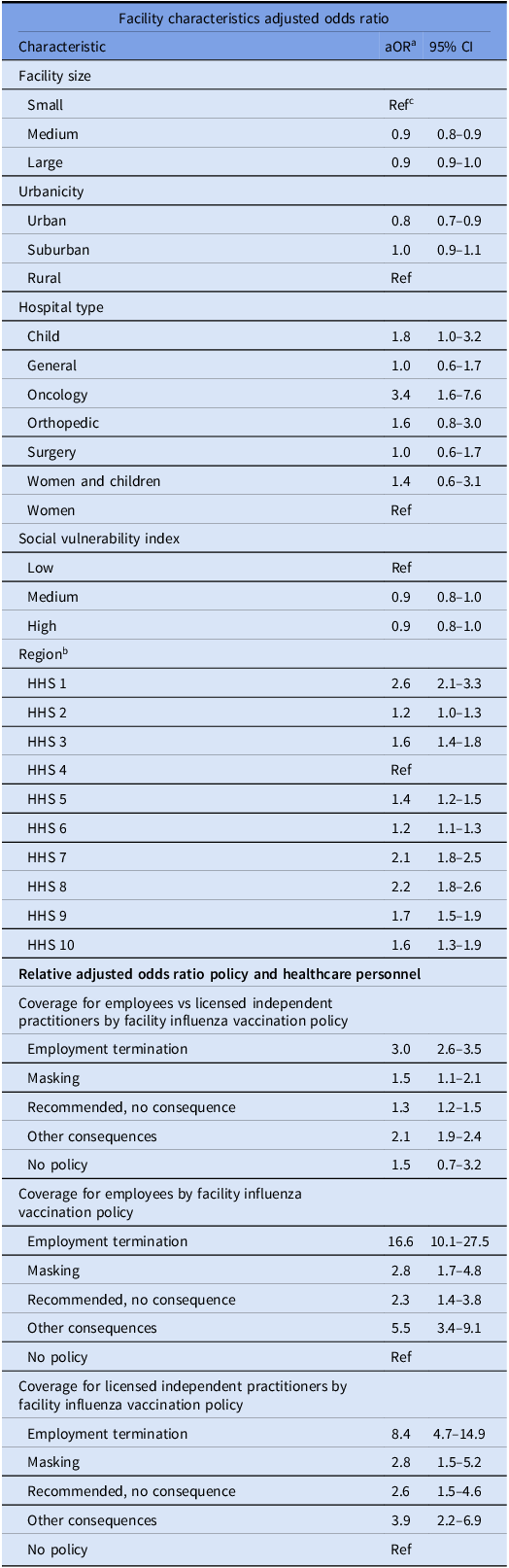
In the multivariable model, healthcare personnel working in urban areas had slightly lower odds of vaccination (adjusted odds ratio [aOR], 0.80; 95% CI, 0.70–0.90) compared with those working in rural areas. Healthcare personnel working in oncology hospitals had the highest odds of vaccination (aOR, 3.4, 95% CI, 1.6–7.6) compared with those working at women’s hospitals. Healthcare personnel working in HHS Region 1 had the highest odds of vaccination (aOR, 2.6, 95% CI, 2.1–3.3) compared with those working in HHS Region 4 (Table 2).
Results of multivariate analyses of the associations of facility-level characteristics, facility influenza vaccination policies, and healthcare personnel employment status with odds of influenza vaccination among healthcare personnel for the 2021–22 influenza season

a aOR, adjusted odds ratio.
b HHS, U.S. Health and Human Services Region (https://www.hhs.gov/about/agencies/iea/regional-offices/index.html).
HHS Region 1- Boston includes Connecticut, Maine, Massachusetts, New Hampshire, Rhode Island, and Vermont.
HHS Region 4 – Atlanta includes Alabama, Florida, Georgia, Kentucky, Mississippi, North Carolina, South Carolina, and Tennessee.
Source: National Healthcare Safety Network, United States.
c Ref = reference group.
Compared with licensed independent practitioners, employees had the highest relative odds of vaccination in facilities with an influenza policy of employment termination (aOR, 3.0; 95% CI, 2.6–3.5), followed by employees working in facilities with a policy of other consequences (aOR, 2.1; 95% CI, 1.9–2.4) and employees working in facilities with a policy of masking (aOR, 1.5; 95% CI, 1.1–2.1) (Table 2).
Among employees
Compared to employees working in facilities with no influenza vaccination policy, employees working in facilities with a policy of employment termination had the highest odds of vaccination (aOR, 16.6; 95% CI, 10.1–27.5) followed by employees working in facilities with a policy of other consequences (aOR, 5.5; 95% CI, 3.4–9.1) and employees working in facilities with a policy of masking (aOR, 2.8; 95% CI, 1.7–4.8) (Table 2).
Among licensed independent practitioners
Compared to those working in facilities with no influenza vaccination policy, personnel working in facilities with a policy of employment termination had the highest odds of vaccination (aOR, 8.4; 95% CI, 4.7–14.9), followed by personnel working in facilities with a policy of other consequences (aOR, 3.9; 95% CI, 2.2–6.9) and personnel working in facilities with a policy of masking (aOR, 2.8; 95% CI, 1.5–5.2) (Table 2).
Discussion
During the 2021–22 influenza season, facility-level influenza policies including employment termination, other consequences, and masking for unvaccinated healthcare personnel were associated with increased odds of vaccination among both employees and licensed independent practitioners, consistent with a study examining campaign strategies. Reference Schumacher, Salmanton-Garcia, Cornely and Mellinghoff3 Healthcare personnel working in oncology hospitals were more likely to be vaccinated, as healthcare personnel working with immunocompromised patients may be more receptive to vaccination. Reference Sharpe, LeClair-Netzel and Wagner7 Declines in vaccination coverage might have been affected by the decrease in influenza cases due to universal masking policies and the higher emphasis on COVID-19 vaccination during the COVID-19 pandemic. Reference Lymon, Meng and Reses2,Reference Razzaghi, Srivastav, de Perio, Laney and Black8 Regional differences in coverage underscore opportunities to improve vaccine uptake.
This demonstrates that even when a policy has consequences for noncompliance, there is variability in vaccine uptake among healthcare personnel in acute care hospitals. To supplement influenza vaccination policies, hospitals can consider other strategies shown to be effective at increasing vaccination coverage, including educational campaigns, free access to vaccines, incentives, flexible worksite vaccine delivery methods (eg, mobile carts), and signed vaccination declinations for non-medical reasons. Reference Schumacher, Salmanton-Garcia, Cornely and Mellinghoff3,9
This study is subject to several limitations. First, the study data do not address when hospitals enacted their influenza policies or changes in vaccination coverage over time. Therefore, we could not determine whether facility influenza vaccination policy increased vaccination coverage. Second, the survey did not directly ask about masking, which may have led to underreporting of masking policies. Third, licensed independent practitioners may work at multiple facilities during the influenza season, creating challenges with tracking and leading to underreporting. Fourth, it was unclear how strictly influenza policies were enforced. Lastly, our analysis did not consider how multifaceted campaigns or state-level vaccination laws may have increased coverage, as suggested in another study. Reference Schumacher, Salmanton-Garcia, Cornely and Mellinghoff3
Influenza vaccination policies with consequences are effective for increasing the odds of vaccination among employees but less effective for licensed independent practitioners. The factors associated with this finding were not evaluated by this study and warrant additional investigation. To improve vaccination among healthcare personnel for future influenza seasons, it may be beneficial to combine multiple interventions (ie, facility policy, education, and outreach to increase trust) and customize these for each healthcare personnel category. Reference Hall, Northam, Webster and Strickland10
Supplementary material
The supplementary material for this article can be found at https://doi.org/10.1017/ice.2025.24
Author contribution
Cam-Van T. Huynh provided study design, statistical analysis, and preparing and editing manuscript. Emily Haanschoten assisted with study design, statistical analysis, and preparing and editing manuscript. Minn Soe assisted with study design, statistical analysis, and editing manuscript. Kira Barbre assisted with preparing and editing manuscript. Lu Meng assisted with study design, statistical analysis, and editing manuscript. Jonathan Edwards assisted with study design and editing manuscript. Elizabeth J. Kalayil assisted with study design and editing manuscript. Megan C. Lindley assisted with study design and editing manuscript. Hannah E. Reses assisted with study design and editing manuscript. David Kuhar assisted with editing manuscript. Matthew Stuckey assisted with editing manuscript. Andrea Benin assisted with editing manuscript. Jeneita M. Bell assisted with study design and editing manuscript.
Financial support
This study was conducted as part of the official duties of the authors; no outside funding was received.
Competing interests
All authors report no conflicts of interest relevant to this article.
Disclaimer
The findings and conclusions in this report are those of the authors and do not necessarily represent the official position of the Centers for Disease Control and Prevention.