Introduction
Beryllium minerals are typical minor to rare accessory minerals in a variety of rocks. They mostly occur in granitic pegmatites of almost all classes/types as defined by Černý and Ercit (Reference Černý and Ercit2005) from abyssal (anatectic) pegmatites (Grew et al., Reference Grew, McGee, Yates, Peacor, Rouse, Huijsmans, Shearer, Wiedenbeck, Thost and Su1998; Grew, Reference Grew and Grew2002; Cempírek et al., Reference Cempírek, Novák, Dolníček, Kotková and Škoda2010) to rare-element pegmatites and miarolitic pegmatites of LCT (Lithium-Tantalum-Caesium) and NYF (Niobium-Yttrium-Fluorine) families (Černý, Reference Černý and Grew2002; London, Reference London2008; Černý et al., Reference Černý, London and Novák2012), or Group A (Wise et al., Reference Wise, Müller and Simmons2022), where beryl is typically by far the most abundant primary Be mineral. Beryl from granitic pegmatites has commonly undergone hydrothermal alteration at different stages of its subsolidus evolution (Černý, Reference Černý and Grew2002; London, Reference London2008, Reference London2014; Wang et al., Reference Wang, Che, Zhang, Zhang and Zhang2009; Novák and Filip, Reference Novák and Filip2010; Uher et al., Reference Uher, Chudík, Bačík, Vaculovič and Galiová2010, Reference Uher, Ozdín, Bačík, Števko, Ondrejka, Rybnikova, Chládek, Fridrichová, Pršek and Puškelová2022; Novák et al., Reference Novák, Dolníček, Zachař, Gadas, Nepejchal, Sobek, Škoda and Vrtiška2023a), facilitated by residual pegmatite fluids (Palinkaš et al., Reference Palinkaš, Wegner, Čobić, Palinkaš, Barreto, Váczi and Bermanec2014; Zachař et al., Reference Zachař, Novák and Škoda2020; Novák et al., Reference Novák, Dolníček, Zachař, Gadas, Nepejchal, Sobek, Škoda and Vrtiška2023a) and/or by external fluids derived from the host rock after solidification of a pegmatite melt in different stages of subsolidus evolution of a pegmatite body (Novák et al., Reference Novák, Prokop, Losos and Macek2017, Reference Novák, Dolníček, Zachař, Gadas, Nepejchal, Sobek, Škoda and Vrtiška2023a; Zachař et al., Reference Zachař, Novák and Škoda2020; Čopjaková et al., Reference Čopjaková, Prokop, Novák, Losos and Gadas2021; Chládek et al., Reference Chládek, Uher, Novák, Bačík and Opletal2021, Reference Chládek, Novák, Uher, Gadas, Matýsek, Bačík and Škoda2024). However, the timing of the residual fluid exsolution from pegmatite melt is still a matter of debate (Burnham and Nekvasil, Reference Burnham and Nekvasil1986; Veksler and Thomas, Reference Veksler and Thomas2002; London Reference London2008, Thomas et al., Reference Thomas, Davidson, Rhede and Leh2009; Thomas and Davidson, Reference Thomas and Davidson2012), as well as the timing and sources of external fluids (Martin and De Vito, Reference Martin and De Vito2014; Palinkaš et al., Reference Palinkaš, Wegner, Čobić, Palinkaš, Barreto, Váczi and Bermanec2014; Novák et al., Reference Novák, Škoda, Gadas, Krmíček and Černý2012, Reference Novák, Prokop, Losos and Macek2017, Reference Novák, Dolníček, Zachař, Gadas, Nepejchal, Sobek, Škoda and Vrtiška2023a; Pieczka et al., Reference Pieczka, Szuskiewicz, Szełeg and Nejbert2019). The stability of Be minerals is governed by externally imposed chemical potentials together with pressure/temperature conditions (Barton, Reference Barton1986; Barton and Young, Reference Barton, Young and Grew2002; Grew, Reference Grew and Grew2002). Thus, primary and secondary Be minerals, together with their mineral assemblages, serve as very sensitive geochemical and petrological mineral indicators (Burt, Reference Burt1978; Hsu, Reference Hsu1983; Wood, Reference Wood1992; Markl and Schumacher, Reference Markl and Schumacher1997; Černý, Reference Černý and Grew2002; Franz and Morteani, Reference Franz, Morteani and Grew2002; London and Evensen, Reference London, Evensen and Grew2002; Wang et al., Reference Wang, Che, Zhang, Zhang and Zhang2009; Novák and Filip, Reference Novák and Filip2010; Uher et al., Reference Uher, Chudík, Bačík, Vaculovič and Galiová2010, Reference Uher, Ozdín, Bačík, Števko, Ondrejka, Rybnikova, Chládek, Fridrichová, Pršek and Puškelová2022; Palinkaš et al., Reference Palinkaš, Wegner, Čobić, Palinkaš, Barreto, Váczi and Bermanec2014; Wang and Li, Reference Wang and Li2020; Novák et al., Reference Novák, Dolníček, Zachař, Gadas, Nepejchal, Sobek, Škoda and Vrtiška2023a).
Four small beryl-bearing granitic pegmatites (Drahonín IV, Věžná I, Dolní Rožínka, Kovářová) with contrasting assemblages of secondary Be minerals occur along the eastern border of the Strážek Unit in the Moldanubian Zone, in the Czech Republic (Fig. 1). Due to their distinct position along the shear zones in the Rožná-Olší ore field (U deposits) they appeared to be very suitable objects for the investigation of hydrothermal processes occurring along tectonically active major regional geological units where a variety of hydrothermal mineralisation is developed, chiefly at the Rožná-Olší ore field (Kříbek et al., Reference Kříbek, Žák, Dobeš, Leichmann, Pudilová, René, Scharm, Scharmová, Hájek, Holeczy, Hein and Lehmann2009; Novák et al., Reference Novák, Toman, Škoda, Šikola and Mazuch2023b). We examined mineral assemblages and compositions of proximal secondary Be minerals in pseudomorphs after beryl at the pegmatites with respect to the Rožná and Olší ductile to brittle shear zones. Subsolidus hydrothermal processes, including extensive dissolution of beryl crystals at the Drahonín IV and Věžná I pegmatites, were investigated in detail to reveal pressure/temperature conditions of these alteration processes, the composition of fluids, their potential sources, and the role of fine-scale brittle tectonics in this region.
Geological setting
The Moldanubian Zone represents a crustal (and upper mantle) tectonic collage assembled during the Variscan orogeny (∼370–300 Ma). Two main lithotectonic units with distinct lithologies have been recognised: (1) Drosendorf Unit, structurally divided on the lowermost Monotonous Group overlain by the Varied Group, overlain by (2) the structurally highest high-grade Gföhl Unit (Guy et al., Reference Guy, Edel, Schulmann, Tomek and Lexa2011; Schulmann et al., Reference Schulmann, Lexa, Janoušek, Lardeaux and Edel2014 and references therein). The metamorphic rocks experienced a polyphase metamorphic evolution with a HT-HP event in upper amphibolite to granulite facies at T max. ∼ 900–1000°C and P max. = 1.6–2.0 GPa at ∼345–340 Ma (Kotková, Reference Kotková2007) which was overprinted during a rapid decompression by a HT-MP event at T < ∼700°C and P ≈ 0.4–0.6 GPa (Tajčmanová et al., Reference Tajčmanová, Konopásek and Schlumann2006; Pertoldová et al., Reference Pertoldová, Týcová, Verner, Košuličová, Pertold, Košler, Konopásek and Pudilová2009, Reference Pertoldová, Verner, Vrána, Buriánek, Štědrá and Vondrovic2010; Štípská et al., Reference Štípská, Powell, Hacker, Holder and Kylander‐Clark2016).
The easternmost part of the Moldanubian Zone, the Strážek Unit (Fig. 1), consists of the Gföhl Unit and Varied Group. The NNW–SSE- to NNE–SSW-striking foliation in rocks from the eastern part of the Strážek Unit is interpreted as a result of E–W compression at lower crustal levels (Tajčmanová et al., Reference Tajčmanová, Konopásek and Schlumann2006; Verner et al., Reference Verner, Buriánek, Vrána, Vondrovic, Pertoldová, Hanžl and Nahodilová2009). Longitudinal N–S to NNW–SSE-striking ductile shear zones (Rožná and Olší shear zones; Fig. 2) dip WSW at an angle of 70–90° and strike parallel to the tectonic contact between the Strážek Unit and the Svratka Crystalline Unit. Also occurring in this area together with bodies of (ultra)potassic syenites (e.g. Drahonín body) related to the Třebíč Pluton (Leichmann et al., Reference Leichmann, Gnojek, Novák, Sedlák and Houzar2017; Janoušek et al., Reference Janoušek, Hanžl, Svojtka, Hora, Kochergina Erban, Gadas, Holub, Gerdes, Verner, Hrdličková, Daly and Buriánek2020; Kubeš et al., Reference Kubeš, Leichmann, Buriánek, Holá, Navrátil, Scaillet and O’Sullivan2022), and tourmaline-bearing leucogranites (Jiang et al., Reference Jiang, Yang, Novák and Selway2003; Buriánek and Novák, Reference Buriánek and Novák2007; Buriánek et al., Reference Buriánek, Dolníček and Novák2016), are abundant rare-element granitic pegmatites (e.g. Rožná, Dobrá Voda, Věžná I, II, Drahonín III, IV, Řečice, Pikárec, Strážek, Dolní Bory - Hatě, Cyrilov; Novák and Cempírek, Reference Novák and Cempírek2010; Novák et al., Reference Novák, Gadas, Cempírek, Škoda, Breiter, Kadlec, Loun and Toman2015b). Some of these are estimated to be emplaced at 337–332 Ma (Novák et al., Reference Novák, Černý, Kimbrough, Taylor and Ercit1998; Melleton et al., Reference Melleton, Gloaguen, Frei, Novák and Breiter2012, Ackerman et al., Reference Ackerman, Haluzová, Creaser, Pašava, Veselovský, Breiter, Erban and Drábek2017). They intruded various metamorphic rocks of the Strážek Unit at a shallow crust level of P < ∼0.2–0.3 GPa (Ackermann et al., Reference Ackerman, Zachariáš and Pudilová2007; Novák et al., Reference Novák, Kadlec and Gadas2013).
Simplified geological map of the north-eastern part of the Bohemian Massif including the Moldanubian Zone and Svratka Crystalline Unit.

Simplified geological map of the Rožná-Olší ore field with the examined pegmatites.

Internal structure and mineral assemblages of the pegmatites
The beryl-bearing granitic pegmatites investigated include the Drahonín IV pegmatite from the U mine Drahonín in the Rožná-Olší ore field which closed in the late 1960s, and the Věžná I pegmatite situated east of the Olší shear zone (Fig. 2). The Dolní Rožínka pegmatite (Novotný and Cempírek, Reference Novotný and Cempírek2021) located west of the Rožná and Olší shear zones and the Kovářová pegmatite from the adjacent part of Svratka Crystalline Unit located east of the Rožná-Olší shear zone (Přikryl et al., Reference Přikryl, Novák and Gadas2012, Reference Přikryl, Novák, Filip, Gadas and Galiová2014) were also included in this study as they are located outside of the shear zones (Fig. 2). Geological setting, host rocks, and hydrothermal alterations of these pegmatites are presented in Table 1, which illustrates that they have similar size and most exhibit comparable overall primary mineral assemblages and zoned internal structure.
Geological setting and mineral assemblages of the granitic pegmatites investigated

Key: A – abundant; M – minor; R – rare.
Used abbreviations according to Warr (Reference Warr2021): Ab – albite, Aeg – aegirine, Alm – almandine, Arf – arfvedsonite, Brl – beryl, Bt – biotite, Cal – calcite, Cst – cassiterite, Clb – columbite, Chl – chlorite, Crd – cordierite, Drv – dravite, Edd – epidydimite, Elb – elbaite, Fap – fluorapatite, Grt – garnet, Hrm – harmotome, Ilm – ilmenite, Kfs – K-feldspar, Mnz-Ce – monazite-(Ce), Ms – muscovite, Phl – phlogopite, Plg – plagioclase, Pln – polylithionite, Pol – pollucite, Prg – pargasite, Py – pyrite, Qz – quartz, Sok – sokolovaite, Sps – spessartine, Srl – schorl, Tpz – topaz, Trl – triplite, Ttn – titanite, Tur – tourmaline, Vrm – vermiculite, Xtm-Y – xenotime-(Y), Zrn – zircon.
The Drahonín IV pegmatite located very close to the main shaft of the Drahonín U-mine, 3rd level was accessible during active mining in the 1960s (Sojka, Reference Sojka1969). A cross section through the pegmatite dyke (Fig. 3) shows an irregular zoned internal structure with miarolitic pockets, up to ∼1 m in size, lined with large crystals of quartz overgrown by late calcite and pyrite. Compared to the other pegmatites examined, it is situated on or very close to the NNW–SSE striking Olší shear zone, where several areas of hydrothermal mineralisation are developed. They include (1) pre-uranium quartz–sulfide and carbonate–sulfide mineralisation; (2) three types of uranium mineralisation – (2a) network disseminated coffinite > uraninite mineralisation, (2b) vein-type ore uraninite > coffinite in calcite veins typically from the upper part of the deposit, and (2c) disseminated coffinite locally accompanied by U–Zr-silicate mineralisation in albititised, desilicified, and commonly porous rocks; and (3) post-uranium carbonate–quartz–sulfide mineralisation (Kříbek et al., Reference Kříbek, Žák, Dobeš, Leichmann, Pudilová, René, Scharm, Scharmová, Hájek, Holeczy, Hein and Lehmann2009), as well as three distinct generations of zeolite and apophyllite mineralisation (Novák et al., Reference Novák, Toman, Škoda, Šikola and Mazuch2023b).
Idealised cross-section of the Drahonín IV pegmatite (modified from Sojka, Reference Sojka1969).

The Věžná I pegmatite is a steeply dipping NW-striking dyke with almost symmetrical zoning cutting a serpentinite body (Fig. 4; Černý, Reference Černý1965; Černý and Povondra, Reference Černý and Povondra1966, Reference Černý and Povondra1967; Černý et al., Reference Černý, Smith, Mason and Delaney1984, Reference Černý, Novák and Chapman2000; Dosbaba and Novák, Reference Dosbaba and Novák2012; Novák et al., Reference Novák, Prokop, Losos and Macek2017; Toman and Novák, Reference Toman and Novák2020). The blocky unit contains large masses of albite, up to several dm in size, locally with minor Be-cordierite, schorl–dravite, beryl and several accessory minerals (Table 1). Brownish blocky K-feldspar with a very rare Cs,Li-rich mineral assemblage (pollucite + elbaite + lepidolite) in the albite–pollucite unit represents the most fractionated, but volumetrically negligible Cs,Li-rich unit (Teertstra et al., Reference Teertstra, Černý and Novák1995; Toman and Novák, Reference Toman and Novák2018, Reference Toman and Novák2020).
Idealised cross-section of the Věžná I pegmatite (modified from Černý and Povondra, Reference Černý and Povondra1967).

Mineral assemblages of the individual pegmatites are quite similar (Table 1). Occurrences of Al-rich minerals (Ms, Tur, Crd, Grt) as well as the common accessory fluorapatite, indicate a peraluminous LCT signature (Černý et al., Reference Černý, London and Novák2012) for these pegmatites. The main differences include the degree of fractionation, high in the pegmatites with Li- and Cs-minerals (Dolní Rožínka; Novotný and Cempírek, Reference Novotný and Cempírek2021 and Věžná I; Teertstra et al., Reference Teertstra, Černý and Novák1995; Toman and Novák, Reference Toman and Novák2018, Reference Toman and Novák2020), and strong external contamination from the host serpentinite in the Věžná I pegmatite (Dosbaba and Novák, Reference Dosbaba and Novák2012; Novák et al., Reference Novák, Prokop, Losos and Macek2017; Čopjaková et al., Reference Čopjaková, Prokop, Novák, Losos and Gadas2021).
Beryl and its breakdown products from the Drahonín IV, Věžná I, Dolní Rožínka and Kovářová pegmatites
Beryl, typically the only primary Be mineral at the localities studied, was found in several distinct textural/paragenetic and compositional types within single pegmatite dykes, in common with other pegmatites worldwide (Černý et al., Reference Černý, Anderson, Tomascak and Chapman2003; Wang et al., Reference Wang, Che, Zhang, Zhang and Zhang2009; Uher et al., Reference Uher, Chudík, Bačík, Vaculovič and Galiová2010, Reference Uher, Ozdín, Bačík, Števko, Ondrejka, Rybnikova, Chládek, Fridrichová, Pršek and Puškelová2022). Consequently, we use the following abbreviations for description purposes to recognise distinct types of primary beryl and secondary recrystallised beryl because it was typically recrystallised during early subsolidus processes (Wang et al., Reference Wang, Che, Zhang, Zhang and Zhang2009; Novák and Filip, Reference Novák and Filip2010; Přikryl et al., Reference Přikryl, Novák, Filip, Gadas and Galiová2014; Uher et al., Reference Uher, Ozdín, Bačík, Števko, Ondrejka, Rybnikova, Chládek, Fridrichová, Pršek and Puškelová2022; Chládek et al., Reference Chládek, Novák, Uher, Gadas, Matýsek, Bačík and Škoda2024). Primary beryl (homogeneous or with coarse oscillatory zoning) is labelled as beryl I, II, III and IV from different textural/paragenetic units, generally arranged from the least to the most evolved pegmatite units, and there are no relationships between these symbols from the individual pegmatites. Recrystallised secondary beryl, mostly as compositionally heterogeneous veinlets or irregular masses replacing early primary beryl, is marked as beryl IA, IIA etc. This terminology is, in general, consistent with the nomenclatures of beryl used by Wang et al. (Reference Wang, Che, Zhang, Zhang and Zhang2009), Uher et al. (Reference Uher, Chudík, Bačík, Vaculovič and Galiová2010) and Novotný and Cempírek (Reference Novotný and Cempírek2021). Beryl and its breakdown products found in various investigations are given in Table 2.
Review of the published data for beryl and secondary Be minerals from the Drahonín IV, Věžná I, Dolní Rožínka and Kovářová pegmatites, in the Czech Republic

Key: A – abundant; M – minor; R – rare
In the Drahonín IV pegmatite, Sojka (Reference Sojka1969) reported large prismatic crystals of beryl with hexagonal habits, up to ∼40 cm in length and ∼15 cm in thickness, in strongly albitised blocky K-feldspar that were commonly almost completely dissolved. Secondary bavenite was described but not examined in detail by Sojka (Reference Sojka1969), however it has been recently determined by Novák et al. (Reference Novák, Dolníček, Zachař, Gadas, Nepejchal, Sobek, Škoda and Vrtiška2023a) as Bav56–40Boh60–44. Relics of homogeneous primary beryl II are more common. Toman and Novák (Reference Toman and Novák2020) recognised three distinct paragenetic and textural types of primary beryl at the Věžná I pegmatite: (1) beryl I as rare pale yellowish to greenish subhedral grains, up to 5 mm in size, associated with black tourmaline and albite; (2) the most abundant greyish to pale greenish beryl II as large subhedral to euhedral crystals, up to 20 cm in length, in the intermediate blocky unit and albite (Novák et al., Reference Novák, Korbel and Odehnal1991; Toman and Novák, Reference Toman and Novák2020); and (3) very rare equant anhedral grains of colourless Cs-enriched beryl III, up to 8 mm in size, in albite close to brownish blocky K-feldspar and Cs,Li-rich mineralisation (Toman and Novák, Reference Toman and Novák2018, Reference Toman and Novák2020). Columnar crystals of beryl II are locally recrystallised to beryl IIA (veinlets of Cs-enriched beryl) and commonly replaced by a fine-grained aggregate of secondary phases (Černý, Reference Černý1963, Reference Černý1965, Reference Černý1968; Novák et al., Reference Novák, Korbel and Odehnal1991), whereas rare small grains of beryl I and beryl III were not altered. Novák et al. (Reference Novák, Korbel and Odehnal1991) described an almost complete pseudomorph after beryl II consisting of the assemblage bertrandite + epididymite + K-feldspar + muscovite (Table 2).
Methods and samples
Sampling
The samples of beryl and associated minerals from the Drahonín IV pegmatite were collected by J. Běluša in the 1960s during active mining and were provided by the Moravian Museum, Brno from its mineralogical collection. Most samples from the Věžná I pegmatite were obtained from the Moravian Museum and several samples were collected by the authors as were all samples of beryl from Kovářová.
Electron-probe microanalyses (EPMA)
Analyses of the minerals investigated were performed on carbon-coated epoxy mounts using a Cameca SX-100 electron-probe microanalyser in wavelength-dispersive mode (WDS). The following analytical conditions were used for zeolites and other minerals): accelerating voltage of 15 kV; beam current of 4 nA (10 nA); and beam diameter of 10 μm (5 μm). The following natural and synthetic standards were used for quantification: albite (Na); sanidine (K, Al, Si); pyrope, (Mg); almandine (Fe); spessartine (Mn); wollastonite (Ca); titanite (Ti); topaz (F); vanadinite (Pb, Cl); Ni2SiO4 (Ni); gahnite (Zn); baryte (Ba); and SrSOs4 (Sr). Peak counting times (CT) were 10 s for main elements and 20–40 s for minor elements; CT for each background was one-half of the peak CT. The raw intensities were converted to the concentrations using X-PHI (Merlet, Reference Merlet1994) matrix-correction software involving the theoretical amount of unanalysed oxides in the correction routine.
Micro-Raman spectroscopy
Minerals in grains several mm to several µm across found in polished sections were very difficult, if not impossible, to characterise by X-ray diffraction and thus were studied by Micro-Raman spectroscopy. This method was used as a supplementary technique to the WDS analysis to confirm the identification of selected minerals. Single Raman spectra analyses were obtained at room temperature by means of a Horiba Jobin Yvon LabRam-HR Evolution at the Department of Geological Sciences, Masaryk University, Czech Republic. The Raman spectrometer was equipped with a Si-based, Peltier-cooled charge-coupled device detector, coupled to an Olympus BX41 microscope and diffraction grating with 1800 grooves per millimetre. Spectra were mainly excited with the 473 nm emission of a diode laser. Attempts to obtain new Raman spectra were also made with 532, 633 and 785 nm laser excitation to verify the measurements and to eliminate possible analytical artefacts caused by laser-induced photoluminescence. The instrument was calibrated using the Rayleigh line, resulting in a 0.5 cm–1 wavenumber accuracy. An Olympus 100× objective (numerical aperture 0.90) was used, whereby spectra were obtained in a range of 100–3800 cm–1 in confocal mode; the lateral resolution was better than 1 μm. The spectral resolution was better than 1.2 cm–1. Data were processed with Seasolve PeakFit 4.12 and LabSpec 6 software. Band fitting was done after appropriate background correction, assuming Lorentzian-Gaussian band shapes.
Results
Paragenetic types and composition of primary and secondary beryl
This section provides brief information regarding the paragenetic position (host textural-paragenetic unit) and mineral assemblages of primary beryl in the examined pegmatites based on our research and in part on the published data (see Table 2; Drahonín IV – Sojka, Reference Sojka1969; Novák et al., Reference Novák, Dolníček, Zachař, Gadas, Nepejchal, Sobek, Škoda and Vrtiška2023a; Věžná I – Černý, Reference Černý1963, Reference Černý1965, Reference Černý1968; Novák et al., Reference Novák, Korbel and Odehnal1991; Toman and Novák, Reference Toman and Novák2018, Reference Toman and Novák2020, Dolní Rožínka – Novotný and Cempírek, Reference Novotný and Cempírek2021, Kovářová – Přikryl et al., Reference Přikryl, Novák and Gadas2012, Reference Přikryl, Novák, Filip, Gadas and Galiová2014). Subsolidus recrystallisation of primary beryl to secondary beryl (Cs-enriched beryl to pezzottaite) as late veinlets or irregular masses is briefly mentioned, as well as the compositions of secondary recrystallised beryl from Věžná I and Kovářová.
Our description of the paragenetic position of beryl from the Drahonín IV pegmatite is based on data presented by Sojka (Reference Sojka1969) and mainly on the detailed study of numerous samples from the Moravian Museum, Brno. Large hexagonal prisms of beryl I, up to ∼40 cm in length and ∼15 cm in thickness, occur in strongly albitised blocky K-feldspar and are typically almost completely dissolved. Rare crystals of homogeneous beryl II, up to 3 cm in size, associated with spessartine in the albite unit were moderately altered (Fig. 5a). Both beryl I and beryl II were replaced by a rich assemblage of secondary minerals but recrystallisation to secondary beryl was not observed, perhaps because relics of primary beryl I and beryl II are very rare in our samples. The Věžná I pegmatite contains three distinct paragenetic types of primary beryl (Table 2, Toman and Novák, Reference Toman and Novák2020). The most abundant greyish beryl II, as large subhedral to euhedral crystals, up to 20 cm in length and 5 cm in thickness, in the intermediate blocky unit and albite (Novák et al., Reference Novák, Korbel and Odehnal1991; Toman and Novák, Reference Toman and Novák2020), is locally recrystallised (Fig. 5b) to beryl IIA (Cs-enriched beryl) and commonly replaced by fine-grained aggregates of secondary minerals (Černý, Reference Černý1968; Novák et al., Reference Novák, Korbel and Odehnal1991; this work).
BSE images of primary and secondary beryl; (a) relics of homogeneous primary beryl II, Drahonín IV; (b) homogeneous primary beryl II with veinlet of heterogeneous secondary Cs-enriched beryl IIA, Věžná I; (c) primary beryl IV with numerous veinlets of heterogeneous secondary beryl IVA (Cs-rich beryl to pezzottaite), Dolní Rožínka, CM – clay minerals; (d) prismatic zoned crystal of primary beryl I with narrow rims of beryl IA, Kovářová. Scale bar for all figures 200 µm. Abbreviations are according to Warr (Reference Warr2021) in Figs 5, 7, 8 and 10: Ab – albite, Apy – arsenopyrite, Bvn – bavenite, Brl – beryl, Btd – bertrandite, Cst – cassiterite, Chl – chlorite, Edd – epididymite, Grt – garnet, Hgug – hydroxylgugiaite, Hrm – harmotome, Kfs – K-feldspar, Lö – löllingite, Mil – milarite, Ms – muscovite, Py – pyrite, Qz – quartz, Tur – tourmaline.

The composition of primary and secondary recrystallised beryl from the individual localities is presented in Table 3 and Fig. 6. At the most evolved Dolní Rožínka and Věžná I pegmatites the individual types of primary beryl evolved from Na, Fe, Mg-enriched compositions to Cs-enriched ones. Relics of beryl II from the Drahonín IV pegmatite are close to the ideal composition with low Fe and Na contents. Compositional evolution from primary beryl to recrystallised secondary beryl exhibits an obvious trend from Cs-enriched beryl (Věžná I) to Cs-enriched beryl and pezzottaite (Dolní Rožínka; Fig. 5c). In the pegmatite Kovářová, several textural and compositional types of secondary beryl were described by Přikryl et al. (Reference Přikryl, Novák and Gadas2012, Reference Přikryl, Novák, Filip, Gadas and Galiová2014). Primary beryl I and beryl II have a similar composition and are enriched in Cs, Na, Fe and Mg; rims of secondary beryl IA (Fig. 5d) are slightly Mg-enriched.
Classification diagrams for primary and secondary beryl from (a), (b) the examined pegmatites Drahonín IV, Věžná I and Kovářová and (c), (d) from Dolní Rožínka (slightly modified from Novotný and Cempírek, Reference Novotný and Cempírek2021).

Representative compositions of primary and secondary beryl

Note:
* determined by stoichiometry; bdl = below detection limit
Assemblages of secondary minerals after beryl
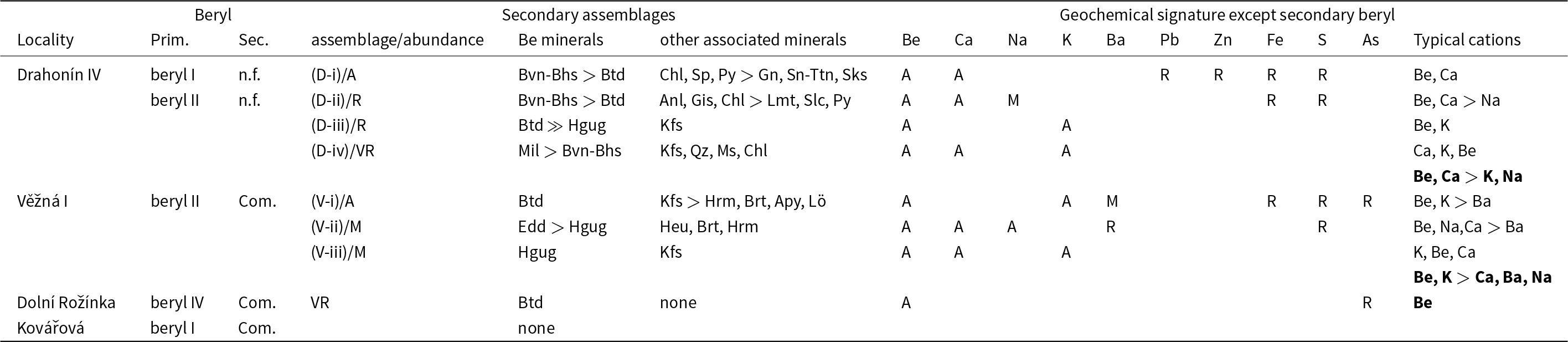
The individual localities differ significantly in the degree of hydrothermal alteration and in the assemblages of secondary minerals after beryl (Table 4). We focused mainly on the proximal assemblages of secondary Be minerals in the sense of Novák et al. (Reference Novák, Čopjaková, Dosbaba, Galiová, Všianský and Staněk2015a, Reference Novák, Dolníček, Zachař, Gadas, Nepejchal, Sobek, Škoda and Vrtiška2023a) because distal secondary Be minerals on tectonic fractures and fissures are known only from the Věžná I pegmatite where they typically occur on fractures situated close to strongly altered Be-enriched cordierite. These secondary Be minerals (milarite, bohseite) are very likely to be related to hydrothermal alteration (Černý and Povondra, Reference Černý and Povondra1966, Reference Černý and Povondra1967; Gadas et al., Reference Gadas, Novák, Galiová, Szuszkiewicz, Pieczka, Haifler and Cempírek2020; Toman and Novák, Reference Toman and Novák2020; Novák et al., Reference Novák, Dolníček, Zachař, Gadas, Nepejchal, Sobek, Škoda and Vrtiška2023a).
Review of secondary mineral assemblages and their geochemical signature

A – abundant; M – minor; R – rare; VR - very rare; Prim. – primary; Sec. – secondary; Com – common; n.f. – not found
Used abbreviations according to Warr (Reference Warr2021): Anl – analcime, Apy – arsenopyrite, Bvn – bavenite, Bhs – bohseite, Brt – baryte, Btd – bertrandite, Chl – chlorite, Edd – epididymite, Gis – gismondine, Gn – galena, Heu – heulandite, Hgug – hydroxylgugiaite, Hrm – harmotome, Kfs – K-feldspar, Lmt – laumontite, Lö – löllingite, Mil – milarite, Ms – muscovite, Py – pyrite, Qz – quartz, Sks – stokesite, Slc – scolecite, Sp – sphalerite, Ttn – titanite
Four distinct assemblages (D-i, D-ii, D-iii and D-iv) of secondary minerals after beryl were recognised at the Drahonín IV pegmatite (Table 4). The (D-i) assemblage is very abundant and the most advanced secondary assemblage, developed in the secondary pockets after large, dissolved crystals of beryl I and exceptionally in their very close vicinity (<1–2 cm); relics of beryl I are extremely rare. Bavenite–bohseite is a dominant secondary Be mineral, together with less abundant euhedral grains of bertrandite arranged in belts or irregularly distributed as euhedral grains enclosed in and locally replaced by the host bavenite–bohseite (Fig. 7a, b). Bavenite–bohseite also forms colourless tabular crystals and aggregates with abundant pyrite. This assemblage also contains several rare accessory minerals. Euhedral grains of cassiterite (Fig. 7c), xenotime-(Y) and a microlite-group mineral are very probably inclusions in the primary beryl I. Abundant chlorite and very rare pyrite, sphalerite, galena, Sn-rich titanite, titanite and stokesite are secondary phases associated with the secondary Be minerals, which volumetrically predominate over the secondary Be-free phases. Less advanced replacement assemblages after beryl II are characterised by complex mineralogy and textural relations (Table 4, Fig. 7d, e, f). The (D-ii) assemblage consists of numerous veinlets of bavenite–bohseite ± analcime, also containing minor euhedral bertrandite and gismondine-Ca, with rare chlorite, laumontite, scolecite-Ca and pyrite (Fig. 7d, e). The (D-iii) assemblage of Btd + Kfs with rare hydroxylgugiaite was found only in a few places. The fourth assemblage (D-iv) of a very rare veinlet in beryl II, zoned milarite (locally Y-enriched) + bavenite–bohseite + quartz + K-feldspar + muscovite + chlorite (Fig. 7f) is spatially closely associated with an elongated grain of primary cassiterite; bertrandite is absent in the (iv) assemblage (Table 4). An absence of spatial relationships of the separately distributed individual secondary mineral assemblages in the Drahonín IV pegmatite described above does not allow us to distinguish their sequential relationships.
BSE images of assemblages of secondary Be minerals from the Drahonín IV pegmatite. (a), (b) Bertrandite crystals enclosed in bavenite from pseudomorph after beryl I (D-i); (c) bavenite + chlorite after beryl I (D-i) with inclusion of cassiterite; (d) contact of garnet replaced by muscovite + chlorite and beryl II replaced by bavenite–bohseite, less common euhedral bertrandite, and pyrite (D-ii); (e) bertrandite + bavenite + K-feldspar + chlorite after beryl II (D-ii); (f) heterogeneous milarite + quartz + albite in veinlet cutting beryl II (D-iv). Scale bar for all figures 200 µm.

At the Věžná I pegmatite, the individual assemblages (V-i to V-iii) of proximal secondary Be minerals after beryl II are very complex (Fig. 8; Table 4) but in contrast to the Drahonín IV pegmatite, they locally show evident sequential relations. The assemblage (V-i) of Kfs + Btd in thin irregular veinlets is the most abundant with locally associated harmotome (Fig. 8a) and heulandite-Ca. Rare, to very rare, baryte, arsenopyrite, löllingite, a Fe3SbAs6 phase + secondary scorodite are only locally present in these veinlets (Fig. 8b). At the contact of beryl II and zoned and fractured tourmaline crystal thin veinlets of the (V-i) assemblage are developed. They differ by the absence of bertrandite in K-feldspar veinlets cutting the schorl grain; hence, the occurrence of bertrandite is restricted solely to the replaced beryl crystal (Fig. 8d). The assemblage (V-ii) is of minor veins of epididymite cross-cutting the (V-i) veinlets Kfs + Btd (Fig. 8b, c, e). Epididymite is associated with less abundant hydroxylgugiaite, baryte and heulandite-Ca (Fig. 8f; Table 4). Both early veinlets (V-i) and veins (V-ii) are cut by (V-iii) long and thin veins of late hydroxylgugiaite + K-feldspar, where hydroxylgugiaite is commonly developed in outer parts of these veins (Fig. 8f). The complex textures characteristic of the rarer minerals do not obscure the relationships defining the sequence (V-i) → (V-ii) → (V-iii).
BSE images of assemblages of secondary Be minerals from the Věžná I pegmatite. (a) K-feldspar (locally Ba-enriched) + bertrandite + harmotome after beryl II (V-i); (b) the assemblage (V-i) K-feldspar + bertrandite with euhedral grain of löllingite + arsenopyrite is cut by a thin epididymite veinlet (V-ii); (c) the assemblage (V-i) cut by epididymite veinlet (V-ii); (d) contact of zoned tourmaline and beryl II, the assemblage (V-i) is developed exclusively within the beryl grain; (e) the assemblage (V-i) with abundant bertrandite + harmotome is cut by epididymite veinlets (V-ii); (f) veinlets of early assemblages (V-i) and (V-ii) cut by veinlet of the assemblage (V-iii) hydroxylgugiaite + K-feldspar (both minerals are not recognisable in this BSE image). Scale bar for all figures 200 µm.

In the Dolní Rožínka pegmatite alteration of beryl is weak disregarding the very common recrystallised secondary beryl (Cs-rich beryl to pezzottaite; Fig. 5c). Very rare bertrandite is the only proximal secondary Be mineral in a small secondary pocket after dissolved beryl from cleavelandite (Novotný and Cempírek, Reference Novotný and Cempírek2021). No secondary Be minerals were observed in beryl I in the Kovářová pegmatite (Fig. 5d), disregarding heterogeneous recrystallised beryl IIA which hosts numerous inclusions of Cs-rich annite and muscovite (Přikryl et al., Reference Přikryl, Novák, Filip, Gadas and Galiová2014).
Composition of secondary Be minerals
Some secondary Be minerals are close to their ideal formulae (bertrandite). Epididymite as well as hydroxylgugiaite have minor to trace concentrations of FeO, MgO, SrO and Rb2O (Table 5). Only bavenite–bohseite and milarite from Drahonín IV are rather heterogeneous showing moderate variation in Al and Y, respectively (Table 5). The associated Be-free secondary minerals (Table 3) usually yielded compositions close to the ideal formulae with no notable variations. Only secondary K-feldspar (≤0.39 wt.% BaO) associated with bertrandite and locally with harmotome from the Věžná I pegmatite is Ba-enriched (Fig. 8a).
Representative compositions of secondary Be minerals

Note:
* determined by stoichiometry; bdl = below detection limit.
** epididymite – contents on a basis of 15 O and Be = 2; hydroxylgugiaite – contents on a basis of 14 anions; bavenite – contents on a basis of 28 anions and Be = 13 – (Si + Al); milarite – contents on a basis of 18 cations = Σ (Na, Si, Al, Mg, Ca, K, Be) and Be = 2.
Raman spectroscopy of secondary minerals
A spectroscopic study focused on identification of microscopic grains of secondary Be minerals, compared with reference spectra in the RRUFF database (Lafuente et al., Reference Lafuente, Downs, Yang, Stone, Armbruster and Danisi2015), revealed the following minerals: quartz, tourmaline (elbaite type – for comparison see Huy et al., Reference Huy, Nguyen, Chen, Ming and Yang2011), albite, K-feldspar, beryl, bertrandite, bavenite, bohseite and hydroxylgugiaite (Fig. 9). A detailed study of the bavenite–bohseite solid solution found that spectra for the Drahonín IV and Věžná I pegmatites differ. On the basis of vibrations in the OH region, the bavenite–bohseite from the Drahonín IV locality corresponds to a 1:1 bavenite–bohseite composition (similar spectra to those of a pegmatite at Ruprechtice – see also Novák et al., Reference Novák, Dolníček, Zachař, Gadas, Nepejchal, Sobek, Škoda and Vrtiška2023a). A different sample from Věžná I, has a spectrum typical for distal bohseite as described at the Věžná I pegmatite in Novák et al. (Reference Novák, Dolníček, Zachař, Gadas, Nepejchal, Sobek, Škoda and Vrtiška2023a). The Raman spectra of hydroxylgugiaite are similar at bothlocalities.
Raman spectra of selected secondary minerals.

Discussion
The alteration products after primary beryl and other primary minerals from several granitic pegmatites located along the boundary of the Strážek Unit and Svratka Crystalline Unit (Fig. 1) are very distinct, including their textural and paragenetic relationships (Tables 1, 2, 4). Consequently, they could identify the sources of the fluids which facilitated the origin of these proximal assemblages of secondary Be minerals including recrystallisation generating secondary beryl. The role of compositionally contrasting host rocks and fine brittle tectonics also are discussed.
Assemblages of secondary minerals after beryl
Identification of the individual secondary minerals is primarily undertaken using back-scattered electron (BSE) images supported by EDS spectra and subsequent WDS analyses. However, we have found that this approach is not always sufficient. In this study Micro-Raman spectroscopy provides significant advantages over other analytical techniques (discussed below), and its compatibility with optical microscopy is a noteworthy benefit (Araujo et al., Reference Araujo, Hulsbosch and Muchez2020; Groppo et al., Reference Groppo, Rinaudo, Cairo, Gastaldi and Compagnoni2006). On the basis of this compatibility, we were able to distinguish different secondary Be minerals from other minerals, especially in the case of discriminating K-feldspar from hydroxylgugiaite (Fig. 10). This is a significant problem for distinguishing phases in pegmatites using BSE imaging (Schulz et al., Reference Schulz, Sandmann and Gilbricht2020), as gugiaite or hydroxylgugiaite could be more widespread than thought as they might not be identified correctly (Grice et al., Reference Grice, Kristiansen, Friis, Rowe, Cooper, Poirier, Yang and Weller2017).
Representative comparison between BSE and optical microscope images of hydroxylgugiaite. (a) BSE image shows the merging of colour intensities for hydroxylgugiaite and K-feldspar, suggesting the occurence of a single phase; (b) In contrast, these minerals can be easily distinguished using reflected light microscopy.

The pegmatites investigated differ significantly in the assemblages of secondary minerals after primary beryl (Table 4). Recrystallisation of primary beryl to secondary beryl is the earliest process and it was most extensive at Kovářová, where secondary beryl IIA volumetrically predominates over primary beryl II (Přikryl et al. Reference Přikryl, Novák, Filip, Gadas and Galiová2014), less extensive at Dolní Rožínka, only moderate at Věžná I and Kovářová beryl I, and absent in Drahonín IV (Fig. 5), although scarcity of beryl relics at Drahonín IV partly obscures this trend. The secondary beryl IIA from the Kovářová pegmatite with common inclusions of mica (Přikryl et al., Reference Přikryl, Novák, Filip, Gadas and Galiová2014) differs significantly in the texture and mineral assemblage and is not discussed in detail.
The abundances of proximal secondary Be minerals in the individual localities differ considerably. The highest grade of alteration was evidently attained in the Drahonín IV pegmatite. Bavenite–bohseite + minor bertrandite are dominant in the (D-i) assemblage after beryl I (Fig. 7a, b). The secondary assemblages after less altered beryl II are more variable and include the dominant (D-ii) assemblage of bavenite–bohseite + minor analcime, rare bertrandite, zeolites and rare sulfides (Fig. 7c, d), rare (D-iii) bertrandite + K-feldspar ± hydroxylgugiaite (Fig. 7e) and very rare (D-iv) assemblage milarite ± bavenite–bohseite (Fig. 7f).
The grade of primary beryl II alterations in the Věžná I pegmatite is strong to weak. Complete to almost complete dissolution of primary beryl crystals similar to Drahonín IV was not observed (see also Novák et al., Reference Novák, Korbel and Odehnal1991; Toman and Novák, Reference Toman and Novák2020). The assemblages of proximal secondary minerals are different, with at least three successive stages locally documented by evident cross-cutting textures (Fig. 8b, c, e, f). The most abundant assemblage is (V-i) bertrandite + K-feldspar ± harmotome (Fig. 8a) together with less abundant assemblages (V-ii) epididymite + hydroxylgugiaite + rare baryte, and (V-iii) hydroxylgugiaite + K-feldspar (Fig. 8f). These individual assemblages from Věžná I differ from the Drahonín IV pegmatite in a locally evident succession of crystallisation (Fig. 8b, c, e, f) and the presence of epididymite, abundance of hydroxylgugiaite and locally Ba-enriched minerals (harmotome, K-feldspar) (Fig. 8a, c).
The mineral assemblages in Table 4 evidently show that Ca + Be (bavenite–bohseite > bertrandite > Ca-zeolites) are dominant cations in the secondary minerals from Drahonín IV together with minor to rare K (K-feldspar) and Na (analcime). In contrast, the Věžná I pegmatite has dominant Be + K (bertrandite, K-feldspar) and moderate to minor Ca (hydroxylgugiaite, heulandite-Ca), Ba (harmotome, baryte) and Na (epididymite). At the Dolní Rožínka pegmatite, only Be is present in rare secondary bertrandite. Traces of Zn, Pb, Fe, Ti and Sn in rare secondary minerals are typical in Drahonín IV as well as the participation of S in sulfides. In the Věžná I pegmatite, traces of As + S in rare arsenopyrite, löllingite, an Fe3SbAs6 phase and secondary scorodite were found. Different textural relations at the Drahonín IV and Věžná I pegmatites showing spatial versus sequential assemblages, distinct mineral assemblages and the geochemical signature of secondary minerals (Table 4) manifest different types and availability of fluids which facilitated the origin of secondary minerals after beryl in addition to implying distinct sources of fluids (see below).
RAMAN spectra of hydroxylgugiaite
Most of the identified minerals have characteristic Raman spectra without the presence of any abnormalities. A unique occurrence of the mineral hydroxylgugiaite in the granitic pegmatites was confirmed by micro-Raman spectroscopy. Given the vibrational features of structure and its classification in the melilite group (Grice et al., Reference Grice, Kristiansen, Friis, Rowe, Cooper, Poirier, Yang and Weller2017), the possible tentative assignments were made based on similarities with other minerals from this group. Part of the spectrum in the low-frequency region from 300 cm−1 to 600 cm−1 represents bands of various forms of deformation vibrations and translational vibrations of major structural units and cations associated with (Si,Be,Al)O3 units (Fig. 9). At 676 cm−1, a high-intensity band corresponding to the symmetrical stretching mode of the bridging oxygen in the Si2O7 dimer is present. The Raman band at 960 cm−1 probably involves the contribution of the [(Si,Be)O4] stretching. Other Raman bands in the range between 800–1100 cm−1 should be related to a pyrosilicate unit for non-bridging and bridging stretching modes (for comparison see Sharma et al., Reference Sharma, Yoder and Matson1988). As hydroxylgugiaite incorporates a hydrogen atom, we were able to detect OH− vibrational modes at 3572, 3615 and 3643 cm−1. Using the correlation of O–H stretching frequencies and O–H···O bond lengths, the frequency range for hydroxylgugiaite most probably corresponds to the distance for d(H···O) of ∼2.3 Å (Libowitzky, Reference Libowitzky1999) which coincides with weak hydrogen bonds to the two O3 sites observed by Grice et al. (Reference Grice, Kristiansen, Friis, Rowe, Cooper, Poirier, Yang and Weller2017).
Textural characteristics of beryl replacement
The individual localities differ significantly in the textural development of replacement processes. Microscopic, irregular, long and thin fractures (<0.5 mm) cutting grains of primary beryl II typically predominate in the Věžná I pegmatite, whereas in the Drahonín IV pegmatite almost complete breakdown of a large crystal of beryl I (several dm3) is characteristic. In addition, no sequential processes, disregarding minor alteration of bertrandite crystals by bavenite–bohseite (Fig. 7b), were observed in beryl I from the Drahonín IV pegmatite, suggesting the extensive action of diverse fluids. Evident cross-cutting textures in large beryl II crystals from the Věžná I pegmatite (Fig. 8b, c, e, f) indicate several sequential and rather independent hydrothermal substages although such evident sequential behaviour was not observed in all examined samples.
Because zeolites and extensive alterations were not found in other pegmatites of the Strážek Unit (Novák et al., Reference Novák, Gadas, Cempírek, Škoda, Breiter, Kadlec, Loun and Toman2015b), tectonic processes along the border of the Strážek Unit and Svratka Crystalline Unit played a significant role in the alteration primarily at the examined pegmatites Drahonín IV, Věžná I, Věžná II (Černý, Reference Černý1963, Reference Černý1965, Reference Černý1968; Novák et al., Reference Novák, Dolníček, Zachař, Gadas, Nepejchal, Sobek, Škoda and Vrtiška2023a) and in the barren pegmatite Domanínek near Bystřice nad Pernštejnem (Novák et al., Reference Novák, Toman, Škoda, Šikola and Mazuch2023b). All these pegmatites are situated at the Olší shear zone (Drahonín IV), close to it (Věžná I, Věžná II), or close to other subparallel less important shear zones (Domanínek), demonstrating that tectonic fracturing of the host pegmatite was necessary for an effective fluid flow and subsequent replacement processes.
PTX conditions
Very complex and typically evident disequilibrium assemblages of secondary minerals in the individual pegmatites (Figs 5, 7, 8, 10) enable only an approximation of PTX conditions of the alteration processes based on the experimentally obtained stabilities for some secondary minerals (Barton, Reference Barton1986; Barton and Young, Reference Barton, Young and Grew2002; Chipera and Apps, Reference Chipera, Apps, Bish and Ming2001; Frey and Robinson, Reference Frey and Robinson2009; Weisenberger and Bucher, Reference Weisenberger and Bucher2010, Reference Weisenberger and Bucher2011). Recrystallisation of primary beryl to secondary beryl (typically Cs-enriched beryl to pezzottaite) with none to very low Mg contents, as well as the observed textures (Fig. 5b, c) indicate that this process proceeded before opening the pegmatite, or at least the relevant part of pegmatite body containing primary beryl, to the fluids from the Mg-rich host rocks (serpentinite, dolomite marble; Table 1). The conditions at T ∼300–400°C and P <∼ 200–300 MPa, corresponding to lithostatic pressure of the pegmatite melt emplacement assumed for the rare-element granitic pegmatites of the Moldanubian Zone (Ackermann et al., Reference Ackerman, Zachariáš and Pudilová2007; Novák et al., Reference Novák, Kadlec and Gadas2013, Reference Novák, Gadas, Cempírek, Škoda, Breiter, Kadlec, Loun and Toman2015b), were estimated for this beryl recrystallisation process (see also London, Reference London2008; Novák et al., Reference Novák, Dolníček, Zachař, Gadas, Nepejchal, Sobek, Škoda and Vrtiška2023a; Chládek et al., Reference Chládek, Novák, Uher, Gadas, Matýsek, Bačík and Škoda2024).
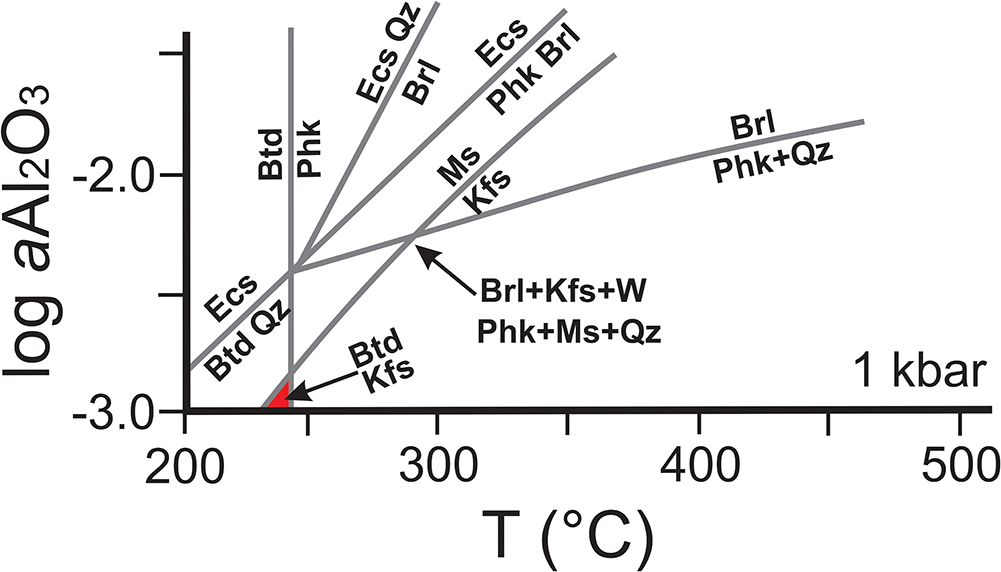
The assemblage (i) bertrandite + K-feldspar is rare in Drahonín IV but abundant in the Věžná I pegmatite. Bertrandite is stable at T < 240°C, P = 100 MPa and low activity of Al according to Barton (Reference Barton1986) and Barton and Young (Reference Barton, Young and Grew2002) (Fig. 11). However, the recent study of bavenite–bohseite and its mineral assemblages including the abundant assemblage K-feldspar + bertrandite indicated that the temperature of bertrandite crystallisation could be raised up to T ≈ 300°C and its stability to at least moderately alkaline conditions (Novák et al., Reference Novák, Dolníček, Zachař, Gadas, Nepejchal, Sobek, Škoda and Vrtiška2023a). Rims around K-feldspar enriched in Ba (Fig. 8a) might be related to precipitation of low-T harmotome. Alkaline conditions are supported by the occurrence of abundant zeolites at the Drahonín IV and at Věžná I pegmatites (Table 4; Toman and Novák, Reference Toman and Novák2018; Novák et al., Reference Novák, Toman, Škoda, Šikola and Mazuch2023b) as well as the associated hydroxylgugiaite (Figs 8f, 10). The bertrandite assemblages with secondary Be minerals (epididymite, hydroxylgugiaite, behoite, leucophanite) typical mainly for syenite pegmatites (Grice et al., Reference Grice, Kristiansen, Friis, Rowe, Cooper, Poirier, Yang and Weller2017 and references therein) support an alkaline environment. Moreover, evident cross-cutting textures in the Věžná I pegmatite show that the early assemblage (V-i) bertrandite + K-feldspar is followed by rather alkaline assemblages (V-ii) with epididymite and (V-iii) with hydroxylgugiaite. Consequently, the acidity/alkalinity of fluids might vary significantly in time and space, predominantly at the Věžná I pegmatite. The temperature of < ∼200–300°C is feasible for the early assemblage K-feldspar + bertrandite. However, the occurrence of zeolites associated with bertrandite + K-feldspar (harmotome) and with epididymite rather support lower temperatures of <∼150–200°C and hydrostatic pressures of ˂∼0.5 MPa. Moreover, widespread occurrences of harmotome in Věžná I (Teertstra et al., Reference Teertstra, Černý and Novák1995; Toman and Novák, Reference Toman and Novák2020; Novák et al., Reference Novák, Dolníček, Zachař, Gadas, Nepejchal, Sobek, Škoda and Vrtiška2023a) synthesized at T = 95°C (Perrotta, Reference Perrotta1976) indicates low T ≈100°C as well.
Assemblage stability diagram in the Be–Al–Si–O–H system at P = 100 MPa (modified from Barton, Reference Barton1986, Barton and Young, Reference Barton, Young and Grew2002). Note very small stability field of the assemblage bertrandite + K-feldspar. Used abbreviations according to Warr (Reference Warr2021): Brl – beryl, Btd – bertrandite, Ecs – euclase, Kfs – K-feldspar, Ms – muscovite, Phk – phenakite, Qz – quartz, W – water.

Potential sources of fluids for the individual secondary mineral assemblages
Evident differences in the degree of hydrothermal alteration, textural relations, mineral assemblages, as well as in the composition of secondary minerals including Be-rich and Be-free phases, imply different sources and availability of fluids which facilitated the breakdown of primary ± recrystallised secondary beryl in individual pegmatites. Zeolites were not observed in other granitic pegmatites of the Strážek Unit (Novák et al., Reference Novák, Gadas, Cempírek, Škoda, Breiter, Kadlec, Loun and Toman2015b) and were described only from the pegmatites situated along its eastern border (Černý Reference Černý1965, Pauliš and Cempírek, Reference Pauliš and Cempírek1998; Toman and Novák, Reference Toman and Novák2018; Novák et al., Reference Novák, Toman, Škoda, Šikola and Mazuch2023b). Consequently, tectonic fracturing and availability of fluids along the border of the Strážek Unit and Svratka Crystalline Unit played a significant role in the alteration processes and mainly in the Drahonín IV and Věžná I pegmatites situated close to or directly in the Olší shear zone (Fig. 2).
Secondary recrystallized beryl
Irregular veinlets and aggregates of secondary beryl in primary beryl have been described from large LCT granitic pegmatites such as the Bikita pegmaite, Zimbabwe (Černý et al., Reference Černý, Anderson, Tomascak and Chapman2003) and Koktokay No.3, China (Wang et al., Reference Wang, Che, Zhang, Zhang and Zhang2009), as well as from small NYF pegmatites (Kožichovice II, Třebíč Pluton; Novák and Filip, Reference Novák and Filip2010; Zachař et al., Reference Zachař, Novák and Škoda2020) and LCT pegmatite (.Maršíkov D6e; Chládek et al., Reference Chládek, Novák, Uher, Gadas, Matýsek, Bačík and Škoda2024). Secondary beryl is Na,Cs,(Li)-enriched and Fe,Mg-poor at two large and highly evolved pegmatites noted above, whereas it is depleted in Na, Fe and Mg relative to the primary beryl in Kožichovice II but Na,F,Mg-enriched in the Marisikov D6e pegmatite (Chládek et al., Reference Chládek, Novák, Uher, Gadas, Matýsek, Bačík and Škoda2024). In the examined localities, secondary beryl (Cs-enriched beryl to pezzottaite in Dolní Rožínka) shows elevated concentrations of Cs but very low Mg (Novotný and Cempírek, Reference Novotný and Cempírek2021, Fig. 5c). In the Věžná I pegmatite low contents of Mg in secondary beryl IIA might have been sourced from primary Mg-enriched beryl II (Fig. 6a; Table 3). Consequently, the origin of secondary beryl after primary beryl in most granitic pegmatites including the examined pegmatites was very possibly facilitated by residual pegmatite fluids in a system closed to the host rock. This conclusion is supported by the textures, elevated concentrations of Cs and the absence or very low contents of Mg in the recrystallised secondary beryl, although the examined pegmatites are typically enclosed in Mg-rich rocks (Table 1). In contrast, elevated Mg in secondary beryl and the overall assemblage of secondary minerals, including chlorite, in the pegmatite D6e, Maršíkov (Chládek et al., Reference Chládek, Novák, Uher, Gadas, Matýsek, Bačík and Škoda2024) suggest participation of external fluids in the origin of secondary beryl. However, the Maršíkov district exhibits a strong tectonic/metamorphic overprint (Černý et al., Reference Černý, Novák and Chapman1992; Rybnikova et al., Reference Rybnikova, Uher, Novák, Chládek, Bačík, Kurylo and Vaculovič2023) significantly distinct from the examined region. Only beryl I from Kovářová contains narrow rims of recrystallised Mg-enriched beryl IA and is texturally similar to the Maršíkov D6e pegmatite (Chládek et al., Reference Chládek, Novák, Uher, Gadas, Matýsek, Bačík and Škoda2024).
Secondary Be minerals in Drahonín IV
The rather alkaline character of the beryl alteration from Drahonín IV is indicated by common zeolites and differs significantly from the alteration of beryl described in other granitic pegmatites from the Strážek Unit and regions of the Moldanubian Zone (e.g. Novák et al., Reference Novák, Kadlec and Gadas2013, Reference Novák, Gadas, Cempírek, Škoda, Breiter, Kadlec, Loun and Toman2015b, Reference Novák, Toman, Škoda, Šikola and Mazuch2023b; Přikryl et al., Reference Přikryl, Novák, Filip, Gadas and Galiová2014; Gadas et al., Reference Gadas, Novák, Szuskiewicz, Szeleg, Galiová and Haifler2016, Reference Gadas, Novák, Galiová, Szuszkiewicz, Pieczka, Haifler and Cempírek2020). Textures and mineral assemblages (muscovite + Mn-rich chlorite + albite) in the veins after altered garnet at Drahonín IV and their geochemical signature also are very distinct from altered garnets in the Li-bearing granitic pegmatites of the Moldanubian Zone where they are locally replaced along their rims by blue Fe-rich fluor-elbaite (Buřival and Novák, Reference Buřival and Novák2018; unpubl. data of the authors) and/or by zinnwaldite–masutomilite mica (Němec, Reference Němec1990). However, the dominant participation of residual pegmatite fluids is evident in the Li-poor pegmatite Drahonín IV and in Li-bearing pegmatites. In the Drahonín IV pegmatite (Table 4) calcium is a dominant cation (bavenite–bohseite, gismondine-Ca, laumontite, scolecite-Ca, apatite, hydroxylgugiaite) together with minor Na (analcime, albite) and rare K (muscovite, K-feldspar). An almost total breakdown of the large beryl crystal, abundant pyrite + chlorite, and rare sphalerite and galena typically associated with dominant bavenite–bohseite as well as calcite and pyrite growing on crystals of quartz from a large miarolitic pocket (Sojka, Reference Sojka1969) suggest a substantial flow of fluids enriched in Ca, Na, Fe, Pb, Zn, CO2 and S. The strong alteration to a total breakdown of primary beryl I, absence of Ba-rich minerals, occurrence of sulfides as well as high temperatures of the alteration process estimated from the mineral assemblages (Table 4) indicate that it is probably related to the pre-uranium quartz–sulfide and carbonate–sulfide mineralisation defined in this region by Kříbek et al. (Reference Kříbek, Žák, Dobeš, Leichmann, Pudilová, René, Scharm, Scharmová, Hájek, Holeczy, Hein and Lehmann2009) which has a similar geochemical signature. This conclusion is also supported by the close spatial relation of the Drahonín IV pegmatite to the NNW–SSE striking shear zone Olší associated with hydrothermal mineralisation at the Rožná-Olší ore field (e.g. Kříbek et al., Reference Kříbek, Žák, Dobeš, Leichmann, Pudilová, René, Scharm, Scharmová, Hájek, Holeczy, Hein and Lehmann2009; Wertich et al., Reference Wertich, Kubeš, Leichmann, Holá, Haifler, Mozola, Hršelová and Jaroš2022; Novák et al., Reference Novák, Toman, Škoda, Šikola and Mazuch2023b). In addition, early zeolite and apophyllite assemblages from the Rožná-Olší ore field examined by Novák et al. (Reference Novák, Dolníček, Zachař, Gadas, Nepejchal, Sobek, Škoda and Vrtiška2023a) exhibit a similar geochemical signature for the fluids and are very possibly related to the pre-uranium quartz–sulfide and carbonate–sulfide mineralisation (see Kříbek et al., Reference Kříbek, Žák, Dobeš, Leichmann, Pudilová, René, Scharm, Scharmová, Hájek, Holeczy, Hein and Lehmann2009).
Secondary Be minerals in Věžná I
The multistage evolution and geochemical characteristics observed at the Věžná I pegmatite suggest that these alteration processes were different from the Drahonín IV pegmatite. The mostly microscopic cross-cutting veins and veinlets, although typically proximal to the replaced beryl II, demonstrate an important role of fine fracturing on a microscopic scale. Rather minor participation of Ca (hydroxylgugiaite) but high K (K-feldspar), moderate Na (epididymite) and locally high Ba (harmotome, baryte, Ba-enriched K-feldspar) as well as traces of As, Fe, Sb and S indicate different sources of fluids for the Drahonín IV pegmatite. Mineral assemblages of zeolites on tectonic fractures and fissures from this pegmatite (Novák et al., Reference Novák, Toman, Škoda, Šikola and Mazuch2023b) have a similar geochemical signature. The participation of fluids, generated during a retrograde stage of the Variscan metamorphism, is feasible. Alternatively, a contribution of low-temperature highly alkaline fluids responsible for a large-scale HFSE and REE remobilisation from (ultra)potassic plutons related to the formation of Moldanubian U deposits is also possible (Kubeš et al., Reference Kubeš, Leichmann, Wertich, Mozola, Holá, Kanický and Škoda2021, Reference Kubeš, Leichmann, Wertich, Čopjaková, Holá, Škoda, Kříbek, Mercadier, Cuney, Deloule, Lecomte and Krzemińska2024). However, traces of As, S and Sb also indicate another source. Because löllingite and arsenopyrite are quite abundant accessory minerals in most granitic pegmatites from the Strážek Unit (Novák et al., Reference Novák, Gadas, Cempírek, Škoda, Breiter, Kadlec, Loun and Toman2015b; Novotný and Cempírek, Reference Novotný and Cempírek2021), residual pegmatite fluids are a potential source of As, S and Sb together with K > Ca, Na > Ba. As similar assemblages of secondary Be minerals in the Věžná II pegmatite (Černý, Reference Černý1965; Pauliš and Cempírek, Reference Pauliš and Cempírek1998; Novák et al., Reference Novák, Toman, Škoda, Šikola and Mazuch2023b) and zeolites (phillipsite-Ca to harmotome, thomsonite-Ca, rare natrolite and chabazite-K), were found in other pegmatites cutting serpentinite in the Moldanubicum (e.g. Bernartice; Sejkora et al., Reference Sejkora, Pauliš, Dolníček, Plášil and Škoda2023) Ba may have been sourced from the host rock.
Secondary Be minerals in Dolní Rožínka and Kovářová
Very rare proximal bertrandite (As-enriched; Novotný and Cempírek, Reference Novotný and Cempírek2021) after beryl and abundant fresh beryl crystals in the Dolní Rožínka pegmatite indicate rather limited participation of fluids during subsolidus processes compared to the Drahonín IV and Věžná I pegmatites. Elevated concentrations of As in bertrandite are similar to the Věžná I pegmatite where late löllingite, arsenopyrite and scorodite are associated with secondary Be minerals in the assemblage (V-i). Recrystallisation of beryl I to slightly Mg-enriched beryl IA as well as recrystallised beryl IIA in the Kovářová pegmatite with abundant inclusions of Cs-rich annite and muscovite (Přikryl et al., Reference Přikryl, Novák, Filip, Gadas and Galiová2014) are very different and suggest an evidently different subsolidus processes in this locality situated in the Svratka Crystalline Unit (Fig. 2) compared to the pegmatites examined from the Strážek Unit. Both pegmatites are situated outside of the shear zones Rožná and Olší and quite far from the tectonic contact of these units (Fig. 2).
Conclusions and summary
Considerable fluid flow through the ductile to brittle shear zones of Rožná and Olší and associated brittle tectonics along the border of the Strážek Unit and Svratka Crystalline Unit is manifested by several areas of hydrothermal mineralisation in the U deposits from the Rožná-Olší ore field (Kříbek et al., Reference Kříbek, Žák, Dobeš, Leichmann, Pudilová, René, Scharm, Scharmová, Hájek, Holeczy, Hein and Lehmann2009; Wertich et al., Reference Wertich, Kubeš, Leichmann, Holá, Haifler, Mozola, Hršelová and Jaroš2022; Novák et al., Reference Novák, Dolníček, Zachař, Gadas, Nepejchal, Sobek, Škoda and Vrtiška2023a). Strong alterations of primary beryl I and beryl II in the Drahonín IV pegmatite (bavenite–bohseite > bertrandite) located in the Olší shear zone is characterised by the presence of sulfides (pyrite, galena, sphalerite) and zeolites (analcime, gismondine-Ca, laumontite, scolecite-Ca) is very likely to be related to the pre-uranium quartz–sulfide and carbonate-sulfide mineralisation events defined by Kříbek et al. (Reference Kříbek, Žák, Dobeš, Leichmann, Pudilová, René, Scharm, Scharmová, Hájek, Holeczy, Hein and Lehmann2009). An almost total replacement of a large beryl I crystal required a substantial fluid flow, manifested by several hydrothermal mineralisation stages at this ore field (Kříbek et al., Reference Kříbek, Žák, Dobeš, Leichmann, Pudilová, René, Scharm, Scharmová, Hájek, Holeczy, Hein and Lehmann2009; Novák et al., Reference Novák, Toman, Škoda, Šikola and Mazuch2023b).
Alterations of beryl II in the Věžná I pegmatite showing several distinct and cross-cutting textures of the individual substages (bertrandite + K-feldspar; epididymite + K-feldspar; hydroxylgugiaite + K-feldspar) including rare Fe-sulfides and arsenides are controlled by postmagmatic residual fluids (recrystallised secondary beryl, early assemblage bertrandite + K-feldspar) followed by fluids related to a retrograde stage of metamorphism of the compositionally contrasting host serpentinite. The pegmatites Dolní Rožínka and Kovářová located outside of the shear zones (Fig. 2) exhibit only a low degree of alteration in Dolní Rožínka facilitated by residual fluids (As-enriched bertrandite) and different compositional, textural and paragenetic development in the Kovářová pegmatite located in the Svratka Crystalline Unit.
Micro-Raman spectroscopy is a suitable technique to identify and distinguish hydroxylgugiaite, as well as other Be minerals such as bavenite–bohseite solid solution species (Novák et al., Reference Novák, Toman, Škoda, Šikola and Mazuch2023b), bertrandite and beryl. The uncommon mineral hydroxylgugiaite is barely distinguishable from K-feldspar in BSE-images but can be distinguished optically (textures and habit) or by using Raman spectroscopy and has probably not been recognised in some previous studies. This work has described hydroxylgugiaite for the first time by a unique set of Raman bands with OH present in the region around 3600 cm–1.
Highly variable assemblages of secondary minerals after beryl that is frequently unstable in subsolidus conditions are perfect mineral indicators of hydrothermal overprint during subsolidus processes including residual fluids and external fluids of various origin. However, the scarcity of beryl in nature makes its wide usage limited in the study of subsolidus hydrothermal processes in general.
Acknowledgements
The authors thank E. Grew and two anonymous reviewers for constructive criticism that significantly improved the manuscript and V. Wertich for technical assistance. This research was supported by OP RDE [grant number CZ.02.1.01/0.0/0.0/16_026/0008459 (Geobarr) from the ERDF] for MN. This work also appears through the institutional support of long-term conceptual development of research institutions provided by the Ministry of Culture (ref. MK000094862) for JT.
Competing interests
The authors declare none.