Introduction
World Englishes (henceforth WEs) theory recognizes that English today is an international language that comprises ‘a unique cultural pluralism, and a linguistic heterogeneity and diversity’ (Kachru, Reference Kachru, Quirk and Widdowson1985: 14). That is, WEs theory recognizes and appreciates an emerging group of English varieties worldwide (such as Australian English, Indian English, Singaporean English, etc.), seeing each as being of equal validity and legitimacy. This appreciation of the pluricentricity of English has aroused particular interest in the field of ESL/EFL teaching (e.g., Kachru, Reference Kachru and Kachru1992; Jenkins, Reference Jenkins2006; Kirkpatrick, Reference Kirkpatrick2008). It is well known that ESL/EFL teaching has long been dominated by the Inner Circle model (Kachru, Reference Kachru, Quirk and Widdowson1985), also known as the native speaker (NS) model. The Inner Circle model of English teaching focuses on so-called ‘Standard English’ education and aims to develop ‘native-like proficiency’ among ESL/EFL learners. Such a monocentric approach posits the superiority of Anglo-American norms and cultures at the expense of other English varieties and cultures. However, criticisms of such an ‘exonormative native speaker model’ (Kirkpatrick, Reference Kirkpatrick2008: 184) have been frequently raised in the past decade, and a growing number of researchers (e.g., Kachru, Reference Kachru1986, Reference Kachru and Kachru1992; Canagarajah, Reference Canagarajah1999; Jenkins, Reference Jenkins2000, Reference Jenkins2006; Seidlhofer, Reference Seidlhofer2001; McKay, Reference McKay2002; Kirkpatrick, Reference Kirkpatrick, Saraceni and Rubdy2006, Reference Kirkpatrick2008) have called for a paradigm shift to replace the monocentric Inner Circle model in ESL/EFL teaching. New models have also been proposed; for instance, Phillipson (Reference Phillipson1992a) argued for models in various specific English varieties that maintain international intelligibility; Kramsch (Reference Kramsch, Byram and Fleming1998) proposed an intercultural speaker model, and Kirkpatrick (Reference Kirkpatrick2008) advocated a lingua franca approach to replace the NS model; finally, Jenkins (Reference Jenkins2006) put forward the pluricentric approach to replace the monocentric approach in English teaching. Though different in some respects, these proposed new models all share the same aims for ESL/EFL teaching, that is, to promote pluralism in different cultures and English varieties, to raise ESL/EFL learners' awareness of the various English varieties, and to enhance ESL/EFL learners' confidence in their own English varieties. In this study, the term pluricentric approach is adopted because this term vividly catches the essence of the pluricentricity of English today.
Despite the obvious advantages of the pluricentric approach over the traditional monocentric approach, bringing about a paradigm shift from the long-dominant monocentric approach to the pluricentric approach will inevitably involve radical changes in almost every aspect of teaching practice, including curriculum design, teaching objectives, teaching materials, teacher recruitment, teaching methodology, and teaching assessment. In addition, the implementation of the pluricentric approach will be subject to the social reality of a particular teaching context, which includes considerations of such factors as the country's education policy, the teaching environment, as well as teachers' and learners' beliefs of and attitudes towards English teaching and learning. Therefore, the implementation of the pluricentric approach will inevitably face both challenges and opportunities. Accordingly, an understanding of the real situation in a particular teaching context is a prerequisite for theoretical and practical explorations of the pluricentric approach.
Unfortunately, most previous studies (e.g., Canagarajah, Reference Canagarajah1999; Jenkins, Reference Jenkins2000, Reference Jenkins2006) have tended to focus only on developing theoretical arguments for the strengths and necessity of the pluricentric approach in English language teaching. Only a few empirical studies (e.g. McKay, Reference McKay2003; Jin, Reference Jin2005) have investigated what happens when practitioners attempt to introduce pluricentric approaches in particular teaching/learning contexts. McKay (Reference McKay2003), for example, proposed a list of pluricentric practices in English language teaching, such as including topics reflecting local cultures, selecting a teaching methodology suitable for the local context, and appreciating the advantages of local non-native speaker (NNS) English teachers. She conducted a questionnaire survey and interviews on primary and secondary English teachers in Chile and found growing support for these pluricentric practices and attitudes. The present researcher argues that empirical studies like McKay's contribute to our knowledge of the real situation in a given context and help to reveal potential challenges and opportunities for practitioners interested in implementing a pluricentric approach in their own contexts. Focusing on the case of tertiary College English Teaching (CET) in mainland China, this study first briefly discusses the implications of the pluricentric approach for CET in China in relation to four issues: teaching objectives, cultural content in the teaching materials, teaching methodology, and the relative merits of NS versus NNS English teachers. The paper then reports on an empirical investigation into China's current CET practice via a careful examination of current CET textbooks and a survey on Chinese college English teachers' views on the above-mentioned four aspects. The results reveal a disjuncture between the theoretical appeal of the pluricentric approach and the actual practice: the cultural content of the textbooks is still dominated by Anglo-American norms, and the Chinese teachers' attitudes towards CET practice are deeply influenced by the monocentric approach. However, favorable attitudes towards pluricentrism are also found in this study. The paper concludes by arguing that the challenges and opportunities identified in this study shed light on future theoretical and practical explorations of the pluricentric approach, both for China's CET and in other ESL/EFL teaching contexts.
Background: CET in China
CET in China is undertaken at the tertiary level for non-English major college students in compliance with the College English Curriculum Requirement (2007, henceforth CECR), issued by the Chinese Ministry of Education. According to the CECR, it is compulsory for non-English major students to take the course College English for the first 2 years of their undergraduate study (i.e. about 16 credits and 280 class hours). In addition, the nationwide College English Test Band 4 is attached as a compulsory condition to the Bachelor degree. Under such circumstances, Chinese college students as well as teachers spend much time on the test. Similar to other ESL/EFL teaching contexts, CET in China has been dominated by the monocentric NS model; the language and culture input that students get from the CET courses are restricted to the native English-speaking countries (e.g., the US, the UK, Australia), Anglo-American norms dominate, and ‘standard pronunciation’ (i.e., Received Pronunciation or General American) and absolute notions of ‘correct grammar’ are emphasized. In spite of the tremendous effort in teaching and learning English, the ‘paying too much and receiving too little’ phenomenon in CET remains a big concern among English educators and practitioners in China. Chinese college students' English proficiency is generally low, especially in speaking and writing. Therefore, CET reform has become an urgent and challenging project facing educators and scholars in China.
Many Chinese scholars have recognized the weaknesses of the monocentric NS model of English teaching in China and have argued for the legitimacy of Chinese English alongside American or British English (e.g. Li, Reference Li1993; Xu, Reference Xu and Kirkpatrick2002; Wang, Reference Wang1991). Furthermore, the question of how to build ‘a better teaching model suitable to its local culture’ (Ma, Reference Ma2007) has been a popular topic of debate among educational researchers in China. The present researcher contends that the pluricentric approach to English teaching offers a new perspective for CET reform in China. The implications of the pluricentric approach for China's CET practice will be discussed briefly in the next section.
Implications for CET in China
The implications of the pluricentric approach for CET practice in China are many and varied. For reasons of space, therefore, this study will focus on the following four aspects: teaching objectives, cultural content in the teaching materials, teaching methodology, and the relative merits of NS versus NNS English teachers. Each of these will be discussed in turn below.
Teaching objectives
The pluricentric approach calls for a shift from viewing native-like proficiency to communicative competence and international intelligibility as the major teaching objectives. As Kachru (Reference Kachru1996) has pointed out, achieving native-like proficiency is impractical or even pragmatically counterproductive, since most ESL/EFL learners learn English not just for interacting with the native English speakers but also for communicating with people of other cultures using English as a lingua franca. Therefore, cultivating the students' communicative competence should be the focus of the CET practice. On the other hand, international intelligibility is also crucial for successful international interactions. Research on international intelligibility so far is not a very full-fledged area in current literature, but Jenkins (Reference Jenkins2000, Reference Jenkins2006) and Seidlhofer (Reference Seidlhofer2004) have provided inspiration by outlining some of the core features of the phonology and lexico-grammar of English as a lingua franca. CET teachers should focus more on these core features and less on supposed ‘problems’ such as speaking English with a Chinese accent.
Cultural content in the teaching materials
Given that the pluricentric approach promotes cultural pluralism, it follows that the cultural content of teaching materials should reflect not only the norms and values of Inner Circle countries such as the US, the UK, Australia, Canada and New Zealand, but also the Chinese local culture and other cultures in the world. To be specific, the characters, topics, pictures, norms, values, ways of thinking, and lifestyles presented in teaching materials should not be limited to those of the Inner Circle countries. Instead, the cultures of Kachru's Outer and Expanding Circles should also be given due presentation in teaching materials. In addition, the Chinese local culture is an indispensable part of the teaching content. As Kirkpatrick (Reference Kirkpatrick, Saraceni and Rubdy2006) points out, this is because it is common for ESL/EFL learners to use English to talk about their own culture rather than about Anglo-American culture when engaging in international interactions.
Teaching methodology
In the past two decades, following the lead of the Inner Circle countries, the teaching methodology Communicative Language Teaching (CLT) has become the most influential methodology in CET practice in China. As has often been noted, CLT incarnates a very Western view of communication and learning culture, so its effectiveness in the Chinese context is constantly being doubted and questioned by Chinese scholars. Although there is no conclusive agreement as to what might be the best teaching method or methodology for CET in China, the choice of a pedagogical model, as Baumgardner & Brown (Reference Baumgardner and Brown2003) have argued, needs to take the local context into consideration. This means that CLT or any other Western teaching methodology should not be indiscriminately imported into CET practice in China. Instead, such methodologies should be adapted to the Chinese culture of teaching and learning, as well as to Chinese learners' expectations and needs.
NS versus NNS English teachers
There has been a deep-rooted view in the Chinese education community that NS English teachers are more qualified and competent than local Chinese teachers for teaching English in China. Such admiration and preference for NS teachers, as a matter of fact, disempowers the local teachers and lowers their self-confidence in English teaching. In contrast, the pluricentric approach encourages a re-evaluation of the particular merits of NNS teachers, such as their sound knowledge of the ESL/EFL learners' mother tongue and culture, and their shared learning experiences with their learners (Braine, Reference Braine1999; Medgyes, Reference Medgyes1994). These advantages make it possible to view ‘the educated local teacher as the ideal teacher of English’ (Phillipson, Reference Phillipson1992b). In brief, nativeness should not be regarded as a yardstick in evaluating or recruiting English teachers in CET practice in China; instead, their teaching abilities should be the priority.
In summary, we can see that the pluricentric approach has the potential to free both teachers and students from the counterproductive pursuit of ‘standard English’ and ‘native-like proficiency’, and to enhance their confidence in teaching and learning English. However, as mentioned earlier, the replacement of the traditional monocentric approach with the pluricentric approach will inevitably meet obstacles. It is to a consideration of these that we now turn.
Evaluation of current CET textbooks
As mentioned above, this study investigates China's existing CET practice by studying some prevailing CET textbooks on the one hand and surveying Chinese college English teachers' views on the other. The two sets of CET textbooks examined are both included in the list of National ‘Eleventh Five-Year Plan’ Planning Textbooks for Regular Higher Education in China and are rated as the Excellent Teaching Materials of Higher Education in China. They are also the most widely used materials in present CET practice in China. The present researcher has previously used these textbooks during her 5 years of CET teaching experience and is familiar with their content. Aiming to find out the cultural content contained in these textbooks, the present researcher carefully examined the sources of the texts used and, more specifically, the cultural information carried by the content of these texts.
In total, 80 texts were examined in six textbooks; three of these texts (which talk about the general topics of how to learn a foreign language, job hunting, and computers, respectively), from the Experiencing English series, come from an unspecified source, and all the other texts come from Inner Circle countries, namely the US, the UK, Australia, Canada, and New Zealand. To be specific, 82.5% of the texts originate from the US and reflect American culture and norms. This is followed by the UK (8.8%), Australia (2.5%), Canada (1.2%), and New Zealand (1.2%), with 3.8% coming from an unspecified source. There are no texts originating from or representing the local Chinese culture or the cultures of other Outer or Expanding Circle countries. This simplex source of input reflects the dominance of Anglo-American norms in the textbooks. Such monolithic cultural content goes against not only the axiom of the cultural pluralism of the pluricentric approach, but also the principle of the CECR, which stipulates that ‘college English courses should take full account of the diversified cultural information worldwide’. This monolithic presentation of Anglo-American norms may also mislead the Chinese college students into becoming narrow-minded in their view of the English-speaking world and its diverse cultures.
Chinese college English teachers' views of English teaching
To obtain the views and attitudes of the Chinese local college English teachers towards CET practice, a survey was conducted among 104 in-service Chinese college English teachers from seven tertiary institutions located in different provinces in China: four in Guangdong province, one in Zhejiang province, one in Henan province, and one in Jiangxi province. Of these, three were comprehensive universities, two normal universities, one a polytechnic university, and one a university of finance and economics. These institutions represent the current spread of tertiary institution types in China. The survey respondents were all Chinese English language teachers, most of whom (73%) had been teaching the course College English for 5 years or more. The survey questions were adapted from those used in McKay's (Reference McKay2003) study. In addition to basic demographic questions, the survey consisted of 17 questions grouped into four themes: teaching objectives, cultural content in the teaching materials, teaching methodology, and NS versus NNS teachers. The following sections will report on the results of each of these themes in turn.
Teaching objectives: native-like proficiency or communicative competence?
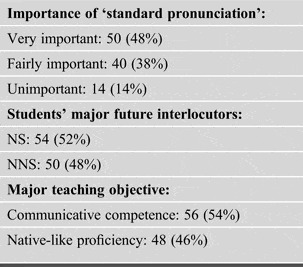
For this section, teachers were asked about their views on: (1) the importance of native-like standard pronunciation; (2) the future interlocutors that their students will mostly engage with in using English; and (3) whether they see communicative competence or native-like proficiency in English as their teaching objective.
As Table 1 illustrates, 48% of the teachers considered it a very important goal to cultivate Chinese students' standard pronunciation. As one teacher wrote, ‘pronunciation is the first step of learning English’. Others (38%) perceived pronunciation to be a fairly important goal, as exemplified by the comment ‘it's not practical for every student to speak standard English, but it's still important to encourage students to improve their pronunciation’. Only a small portion (14%) of the teachers didn't consider standard pronunciation as an important objective, arguing that ‘it's totally fine if students speak English with Chinese accent so long as they can use English to express themselves and communicate with others’. Some teachers clearly realized that ‘the goal of English learning is to cultivate students' communicative ability in English, not native-like pronunciation’. Another interesting finding was that, when asked who they thought Chinese students will mostly interact with when they use English in the future, almost half of the teachers (48%) predicted that it would be with other non-native English speakers, giving reasons such as ‘many people from other non-native English speaking countries come to China to do business or study, and Chinese students might have lots of chances to communicate with them in English; they will also communicate with other non-native English speakers while abroad studying and working using English as the lingua franca’. Also encouraging from a pluricentric perspective was the finding for the third question: 54% of respondents favored communicative competence rather than native-like proficiency as their main teaching objective.
Chinese college English teachers' views on the teaching objectives of CET

Cultural content: Anglo-American culture or world cultures?
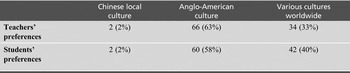
There were two questions on this topic. The first solicited Chinese teachers' views of the cultural content in the teaching materials that they used, and the second asked them to speculate on what cultural content their students might prefer. The results of this section are presented in Table 2.
Chinese college English teachers' views on the cultural content of teaching materials

As can be seen, most of the teachers (63%) thought that Anglo-American culture should be the main source of content in the teaching materials. As one respondent put it, ‘the focus of the college English course is English, so the cultural content should be that of the native English-speaking countries’. Some teachers thought that ‘Anglo-American culture is the main carrier of the English language, so it should be the focus’. However, as many as 33% of the teachers were in favor of various world cultures being reflected in the teaching materials. A typical comment on this point was, ‘besides the English abilities and skills, CET should develop students’ global vision, so culture learning should not be limited to a particular kind. Instead diversified cultures in the world need to be embodied in the teaching content'. The survey also found that most Chinese teachers focused on other cultures and didn't take the Chinese local culture into consideration when thinking about the cultural content of their teaching materials. In fact, only two teachers expressed the view that the local Chinese culture should also be included in the teaching materials, arguing that ‘current Chinese students know too little about their own culture, and as CET aims to cultivate students' intercultural communicative abilities, the students also need to know their local culture and use English to introduce Chinese culture to the outside world’.
As for Chinese students' preferences in this regard, 58% of the teachers believed that the Chinese students would mostly like to learn about Anglo-American culture because ‘the US and UK as the most advanced and powerful western countries are what the students long for most’. In summary, it can be argued that most of the teachers' views on the cultural content of teaching materials reflect the ingrained influence of the traditional monocentric approach, although some teachers also applaud cultural pluralism in their teaching materials.
Teaching methodology
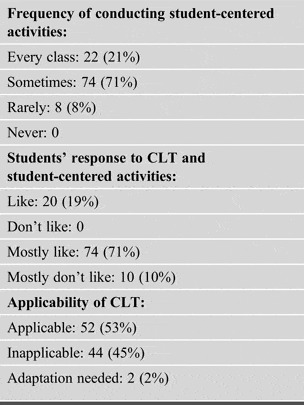
This topic aimed to investigate Chinese teachers' views on the currently popular teaching methodology, CLT, as well as on student-centered activities such as group/pair work, which is heavily promoted by CLT. Table 3 presents a summary of the findings for this topic.
Chinese college English teachers' views on CLT and student-centered activities

As can be seen, most teachers (71%) sometimes use group/pair work and perceive such activities to be popular with their students. When asked about the applicability of CLT in CET in China, however, as many as 45% of them took a negative stance. Teachers who thought favorably of CLT gave reasons such as ‘CLT is a trendy methodology and it's better than the traditional cramming method of teaching; it helps to develop students’ communicative competence'. In comparison, teachers who thought negatively of the applicability of CLT mentioned the large class size in CET, Chinese students' habitual silence, and their ‘passiveness’ in class as barriers to the successful implementation of CLT in the CET classroom in China. Interestingly, two teachers clearly stated that CLT needs to be adapted in CET in China in order to be more effective precisely because ‘CLT isn't totally suitable for CET practice in China due to the different learning culture in China’. On the basis of these results, it is reasonable to conclude that CLT and student-centered activities are generally viewed favorably by Chinese college English teachers.
Who to employ: NS or NNS teachers?
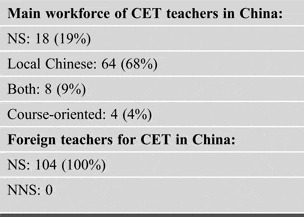
For this topic, teachers were asked about the advantages and disadvantages of NS teachers and local Chinese teachers, respectively. The results (summarized in Table 4) show that Chinese teachers generally think NS teachers have the following strengths in teaching CET in China: (1) language strength (‘standard’ pronunciation, better accent, natural and native expressions); (2) cultural strength (better knowledge of the culture of the English-speaking countries); and (3) teaching strength (flexible teaching methods, creating a better English learning ambience). In terms of weaknesses, respondents said that NS teachers in CET ‘usually have problems in communicating with the students as they don't speak Chinese and know little about Chinese culture; they can't grasp important and difficult teaching points as they are not familiar with China's teaching requirements and syllabus; some or even many of them are poor in their teaching skills’.
Chinese college English teachers' views on teacher recruitment

The survey respondents also had a very clear idea of their own strengths and weaknesses as CET teachers, describing themselves as ‘more responsible, sharing learning experiences with the students, knowing the students better and the CET policy and practice in China, having systematic knowledge of English grammar’, etc. Significantly, it was also clear that they thought their advantages outweighed their disadvantages (i.e., their perceived unfamiliarity with English culture and their less ‘standard’ pronunciation). Therefore, when asked about their preference for employing NS or local Chinese as the main workforce for CET in China, as many as 68% of them chose local Chinese. Only 19% of them expressed an explicit preference for NS teachers. Four teachers also pointed out that the recruitment of NS or local Chinese should vary according to different courses. As one respondent put it, ‘NS teachers are better for courses like Speaking and Writing, whereas local Chinese teachers are more competent in teaching Reading and Listening’. However, eight teachers took a neutral position, arguing that both NS and local Chinese teachers are needed since the two kinds of teachers complement each other in practice in the CET context.
Nevertheless, in terms of recruiting foreign teachers, all of the teachers chose NS from Inner Circle countries; none favored bilingual NNS from other Outer and Expanding Circle countries such as India, Malaysia, or Europe. Their reasons were mainly that ‘people from the UK or US speak English with better pronunciation and know the English culture best’. Some teachers even went so far as to say that ‘hiring people from other non-native English speaking countries is no different from hiring us Chinese, so why bother hiring them?’ It is clear from this observation that pluricentric attitudes are still rather limited among Chinese teachers.
Conclusion
As Seidlhofer (Reference Seidlhofer, Gnutzmann and Intemann2005: 170) has pointed out, ‘there is a mismatch between the meta level’, where WEs researchers assert the need for the pluricentric approach in ESL/EFL teaching, and ‘grassroots practice’, where there is still ‘(unquestioning) submission to native-speaker norms’. The findings of this study also reveal a disjuncture between the theoretical appeal and actual practice in CET in China. The cultural content of current CET textbooks is still Anglo-American dominated, and the Chinese college English teachers' views of English teaching still, to a great extent, reflect a deep-rooted influence from the long-dominant monocentric model. It would seem that a large number of Chinese teachers still stick to the view that the Anglo-American culture is the major carrier of English and therefore should be the major source of input into the cultural content of the CET textbooks. In addition, their attitudes towards foreign CET teachers in China are still ‘native oriented’, and they fail to see the point of hiring other NNS as foreign teachers in CET in China. These monocentric views of English teaching are obviously discordant with the axioms of the pluricentric approach and therefore pose challenges for the implementation of the pluricentric approach. In mainland China, WEs theory so far is a comparatively less thriving subfield of Applied English Linguistics than other areas such as Second Language Teaching or Sociolinguistics. With the increasing attention drawn to the WEs theory and its application in ESL/EFL teaching, however, it is possible that Chinese college teachers' views of the CET practice may become more thoroughly pluricentric in the not too far distant future.
Reasons for such optimism stem from the current study's finding that a growing number of Chinese teachers appreciate and embrace other pluricentric practices in the CET classroom. For example, many Chinese teachers now recognize the importance of cultivating their students' communicative competence as a major teaching objective. This, of course, has something to do with the wide promotion of CLT in China in the past two decades. Also, this study shows that most Chinese teachers are becoming more fully aware and appreciative of their own unique strengths and are confident about themselves as college English teachers.
The pluricentric approach to English teaching provides a new angle for CET reform in China and in other ESL/EFL teaching contexts in the world. However, as this study indicates, the long-dominant monocentric Inner Circle or NS model of English teaching still has a deep influence on local ESL/EFL teachers. This will pose potential challenges for the execution of the pluricentric approach in ESL/EFL teaching practices. On the other hand, with the growing support for the pluricentric views of ESL/EFL teaching, opportunities also exist for the practical exploration of the pluricentric approach. Although this study is focused on the context of CET in China, it is hoped that the findings of this study may inform future theoretical and practical studies of the pluricentric approach in other ESL/EFL teaching contexts around the globe.
 JIANPING XIE is a current PhD candidate of Applied English Linguistics of the English Department at the Chinese University of Hong Kong, HKSAR, China. Her doctoral research is on the evaluation of Chinese EFL learners' thesis writing in English. She previously spent 5 years lecturing college English at tertiary level in mainland China. Her major research interests include English academic writing, World Englishes and discourse analysis. Email: sallyxjp@gmail.com