Transmission of Staphylococcus aureus in healthcare settings, including among newborns, is frequent.Reference Sax, Posfay-Barbe and Harbarth 1 – Reference Carey, Duchon, Della-Latta and Saiman 3 Despite a similar attributable mortality between methicillin-resistant S. aureus (MRSA) and methicillin-susceptible S. aureus (MSSA),Reference Wang, Chen and Wang 4 literature focuses almost exclusively on MRSA.Reference Sax, Posfay-Barbe and Harbarth 1 , Reference Giuffre, Cipolla and Bonura 5 S. aureus persistently colonizes ~20%–40% of healthy individualsReference Weidenmaier, Goerke and Wolz 6 and ~5%–55% of infants, including neonates.Reference Rana, Abughali, Kumar, Super, Jacobs and Kumar 7 – Reference Pinter, Mandel, Hulten, Minkoff and Tosi 10 Several bacterial and host factors play roles in the process of colonization,Reference Weidenmaier, Goerke and Wolz 6 , Reference Frank, Feazel, Bessesen, Price, Janoff and Pace 11 , Reference Ruimy, Angebault and Djossou 12 and the risk of infection is 3 to 6 times higher in colonized individuals compared with noncolonized individuals.Reference Cope, Shooter, Green and Noble 13 – Reference Wertheim, Vos and Ott 15 There are no generally accepted recommendations to decolonize neonates for MSSA. Furthermore, no solid data exist on overall MSSA infection rates in this population.
A monoclonal cluster of 5 MSSA infections among neonates in our hospital’s 30-bed neonatal ward (NNW) in January 2012 triggered an in-depth investigation of S. aureus epidemiology during 2012–2013 to elucidate strain clonality, potential reservoirs, and transmission routes in this population. The objective of this report is to add real-world epidemiological data to the recent debate regarding the infectious risk engendered by MSSA colonization in neonates and the consequential need for interventions.
STUDY POPULATION
Setting
The NNW at the University Hospital of Zurich, Switzerland, features 30 beds for neonates including 8 beds for neonatal intensive care and 5 beds for intermediate care. The average nurse-to-patient ratio in 2012 was 1:3 during the day and 1:4 during night shifts.
The hospital’s infection surveillance program includes daily reviews of clinical microbiology and virology results targeted on epidemiologically important pathogens, and surgical site infections associated with selected surgical procedures (eg, cardiac surgery, appendectomy, etc.). Annual institution-wide prevalence studies are conducted as well.
Case Definitions
A case was defined as a newborn admitted to the NNW between January 1, 2011, and December 31, 2013, from whom S. aureus had been isolated. We distinguished between S. aureus colonization and infection. The latter was defined as a positive S. aureus culture and clinical signs of infection, with or without bacteremia.
METHODS
Outbreak Investigation
Epidemiological investigation
The outbreak investigation consisted of 3 distinct periods: (1) a retrospective period during 2011 with identification of cases with S. aureus infections that occurred based on isolation of S. aureus and documented symptoms; (2) a prospective 6-week surveillance screening period from February 20 through April 1, 2012, of all neonates for nasal S. aureus carriage at the day of delivery, at the day of ward discharge, and once weekly every Monday; (3) a follow-up period during 2012–2013 with prospective surveillance of S. aureus infections detected during regular ward rounds by 3 investigators (YA, ND, EA) and positive microbiological samples. Bacteremia of any etiology was recorded. Colonization was monitored by repeated prevalence screenings of the nares of all neonates at convenient time points.
Additional source investigation
The following additional source investigation activity was conducted: environmental microbiological sampling (isolettes, vital sign monitors, stethoscopes, telephones, computer mice, ultrasound heads, and preparations of enteral feeding solutions); extensive onsite observations including time–motion studies of care activity and standardized hand hygiene observation according to the World Health Organization’s “My Five Moments of Hand Hygiene” method;Reference Sax, Allegranzi, Chraiti, Boyce, Larson and Pittet 16 , Reference Sax, Allegranzi, Uckay, Larson, Boyce and Pittet 17 assessment of alcohol-based hand rub consumption; documentation of all cases and controls with demographic and clinical information.
The Zurich Ethics Review Board formally waived the necessity for an ethics evaluation.
Risk Factor Analysis
To assess risk factors for the presence of MSSA and for MSSA carriage, 2 analyses were performed on the prospective 6-week cohort. Differences in means and medians were compared using the Student t test and the Wilcoxon rank-sum test, respectively, and differences in group proportions were evaluated using χ2 or Fisher’s exact tests, as appropriate.
Multivariate logistic regression analyses was used to assess risk factors for MSSA carriage. Risk factors with P<.1 in univariate analyses were considered for inclusion in multivariate models based on clinical judgment. The limited number of outcomes was factored in when building the models to prevent overfitting. Variables with logically suspected collinearity were excluded from multivariate models. All calculations were performed using Stata software, version 11.2 (Stata Corp, College Station, Texas, USA). P<.05 was considered statistically significant.
Microbiology
Sample collection
Samples were obtained from the nares of neonates and from various surfaces using cotton swabs premoistened with sterile saline. In addition, fingers of healthcare workers (HCWs) were swiped directly onto agar plates. Enteral nutrition (Adapta, Prematil) and additives (Frauen Milch supplement and maltodextrin) were collected as liquid samples from ready-to-use milk bottles.
Bacterial identification
Nasal swabs, enteral nutrition, and environmental swabs were plated directly onto Columbia nalidixic acid blood agar and sheep blood agar plates (BioMérieux, Marcy l’Etoile, France) and incubated for 24–48 h at 37°C. For HCW finger sampling, tryptic soy agar plates with neutralizers (Merck, Kenilworth, NJ) were used. Isolates were identified as S. aureus by positive catalase and StaphAureux tests (Remel Europe, Dartford, Kent, UK). Oxacillin, cefoxitin, and ampicillin resistance tests were performed using the Kirby-Bauer disc diffusion method.
Pulsed-field gel electrophoresis
The first S. aureus isolate detected in a given neonate and all the S. aureus isolates from the environment were characterized by pulsed-field gel electrophoresis (PFGE) of total-genome SmaI (New England Biolabs, Ipswich, MA) digests as previously described.Reference Chung, de and Matthews 18 The resulting patterns were analyzed by visual inspection, photocopying by Gel Doc XR (Bio-Rad, Rheinland, Switzerland), and by automated analysis using the GelCompar II computer software (Applied Maths, Kortrijk, Belgium) for relatedness evaluation.
agr grouping and detection of tst and pvl genes
Representative S. aureus isolates belonging to PFGE types that occurred at least 3 times were grown in Luria-Bertani broth medium (Difco Laboratories, Detroit, MI) at 37°C until the stationary growth phase. Genomic DNA used as template for polymerase chain reaction (PCR) was extracted using a standard phenol-chloroform procedure.Reference Barnett and Larson 19 agr typing was performed by multiplex PCR using previously described primers and conditions.Reference Jarraud, Mougel and Thioulouse 20 S. aureus strains RN6390, RN6607, Sanger252, and RN8540, corresponding to agr functional groups I, II, III, and IV, respectively, were obtained from the Network on Antimicrobial Resistance in S. aureus (NARSA) and served as controls. Results from agr-PCRs served as positive controls for the integrity of genomic DNA extracts, which were also used for the detection of tst and pvl genes using previously published methods.Reference Jarraud, Mougel and Thioulouse 20 , Reference Lina, Piemont and Godail-Gamot 21 pvl encodes for Panton-Valentine leukocidin, a pore-forming toxin that targets phagocytic leukocytes, especially polymorph-nuclear leukocytes, which constitute the first line of defense against invading S. aureus.Reference Labandeira-Rey, Couzon and Boisset 22 tst encodes for toxic shock syndrome toxin, a S. aureus superantigen responsible for toxic shock syndrome. Strains N315 and JE2 (also from NARSA) were used as controls for the specificity of PCR amplifications for tst and pvl, respectively.
Multilocus Sequence Typing (MLST)
The allelic profiles, referred to as the sequence types of representative strains of a distinct PFGE type that included >2 strains, were defined by the nucleotide sequence of an internal fragment of 7 housekeeping genes (arcC-aroE-glpF-gmk-pta-tpi-yqiL), as previously described.Reference Enright, Day, Davies, Peacock and Spratt 23 MLST allele names and STs were derived using the MLST database (http://www.mlst.net).
RESULTS
Retrospective Cases in 2011
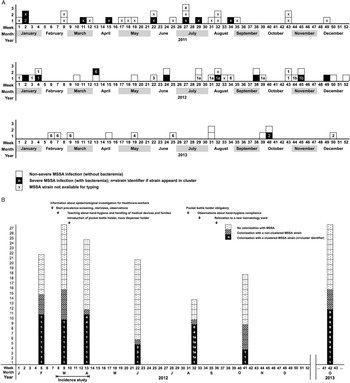
Among 697 neonates hospitalized during 2011, 26 cases (3.7%) of MSSA infection occurred (Figure 1A) including 8 (1.2%) with bacteremia. Strains were generally unavailable for typing.
Epidemiology of Staphylococcus aureus infection and colonization, 2011–2013. MSSA, methicillin-suseptible Staphylococcus aureus; 1, strain PFGE-1-ST30; 1a, strain PFGE-1a-ST30; 1b, strain PFGE-1b-ST30; 2, strain PFGE-2-ST45; 3, strain PFGE-3-ST34; 4, strain PFGE-4-ST109; 6, strain PFGE-6-ST5. (A) Incidence of Staphylococcus aureus infections among all neonates (B) Prevalence assessments of Staphylococcus aureus colonization and preventive measures

Prospective 6-Week Surveillance Screening Period in 2012
During the 6-week surveillance screening period in early 2012, all 87 admissions were included in this study. Of those, 26 infants were asymptomatic nasal carriers (30%) and 3 had infections (3.5%), including 1 neonate with conjunctivitis, 1 with bronchopneumonia, and 1 with bacteremia secondary to a skin infection. A predominant MSSA strain, PFGE-1-ST30, was found in 11 carriers (42%) but not among infected infants.
Follow-Up Period During 2012–2013
Infections with S. aureus during 2012–2013
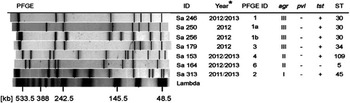
In 2012, 726 infants were hospitalized in our NNW; of these, 30 (4.1%) were infected with MSSA, and 8 (1.1%) suffered from bacteremia (Figure 1). Of 30 MSSA infections, 6 (20%) were caused by PFGE-1-ST30, 4 by PFGE-1a-ST30, 2 by PFGE-1b-ST30, 1 by PFGE-3-ST34, 2 by PFGE-6-ST5. The remaining 15 infections were caused by other PFGE types with distinct patterns (Figure 2).
Selected clustered Staphylococcus aureus genotype patterns. Staphylococcus aureus multilocus sequence typing (MLST) of the outbreak strain with pulsed-field gel electrophoresis (PFGE) identification number 1, its 3 variants (1a, 1b, and 3) with similar PFGE patterns and other clones that occurred at least 3 times between January 2011 to December 2013 in the neonatal ward. For each clone, 1 representative isolate is shown. ID, strain identification; Year*, year in which the respective clone was detected; PFGE ID, PFGE identification; agr, pvl, tst, virulence factors; ST, sequence type.

In 2013, the incidence of MSSA infections decreased to 2.0% (13 of 655 admissions; P=.03) and the incidence of bacteremia decreased to 0.3% (2 of 655 admissions; P=.11). None of the infections were caused by the 2012 MSSA PFGE-1-ST30 predominant strain. Of the 13 MSSA infections, 4 were caused by PFGE-6-ST5 and 2 were caused by PFGE-4-ST109, both of which were already present in 2012 (Figures 1 and 2). In addition, 2 infections (including the bacteremia) were caused by PFGE-2-ST45, which had already caused bacteremia in 2011 (Figures 1 and 2). The remaining infections were caused by isolates with distinct PFGE patterns (Supplementary Figure 2).
In 2012, the incidence of bacteremia caused by any microbial pathogen was 4.7% (34 of 726 admissions). Of these 34 cases, 13 bacteremia cases (38%) were caused by coagulase-negative staphylococci; 8 (24%) by S. aureus; 8 (24%) by Streptococcus spp.; 3 (9%) by Bifidobacterium spp.; 1 (3%) by Enterococcus spp.; and 1 (3%) by Escherichia coli. No incidents of Klepsiella pneumonia, Citrobacter spp., or Eikenella spp. were identified in 2012. In 2013, the incidence of bacteremia caused by any microbial pathogen was 3.5% (23 of 655 admissions). Of these 23 cases, 11 (48%) were caused by coagulase-negative staphylococci; 2 (9%) by S. aureus; 1 (4%) by Bifidobacterium spp; 1 (4%) by Enterococcus spp., 3 (13%) by Escherichia coli; 1 (4%) by Klepsiella pneumoniae; 1 (4%) by Citrobacter spp.; and 1 (4%) by Eikenella spp.
Colonization with S. aureus during 2012 and 2013
In 2012, 150 of all 726 neonate admissions (21%) were screened for S. aureus colonization. Of these 150 neonates, 62 (41%) tested positive for MSSA carriage; 27 of these 62 (44%) were identified as the PFGE-1-ST30 strain. Ten point-prevalence screening studies during 2012 resulted in a median MSSA carriage of 52% (range, 24%–75%). Of these, 17%–92% were identified as PFGE-1-ST30 strains (Figure 1B). Colonization with PFGE-1-ST30 was persistently found in prevalence screenings. PFGE-1-ST30 is pvl-negative, tst-positive, and belongs to agr group III. The 2 related PFGE types 1a and 1b differed by 1 and 2 bands, respectively, and also belonged to the ST30 strain. Another clustered strain also differed from PFGE-1-ST30 in 1 band and was typed as PFGE-3-ST34 (Figure 2). Supplementary Figure 1 displays the remaining PFGE strain patterns during 2012.
In 2013, in a single prevalence screening during week 42, we found 15 MSSA carriers among 27 screened neonates (56%), of whom 3 (11%) were colonized with PFGE-1-ST30 and 8 (57%) were colonized with PFGE-6-ST5 (Figure 1B). PFGE-1-ST30 also caused 3 infections in the first half of 2013 (Figure 1A).
None of the S. aureus strains was methicillin resistant.
Source Investigation
Repeated time-motion studies revealed non-conforming HCW behavior that could explain hand transmission of S. aureus directly or via fomites, eg, touching monitors or incubator doors of consecutive patients without intermittent hand cleansing. HCWs frequently used portable phones, calculators, computers, or incubators in sequence without hand hygiene. During our observations in the unit, we could not single out a particular HCW with extremely low hand hygiene compliance or obvious skin disease who appeared to be a potential super-spreader. Isolettes were cleaned according to protocol based on probing observations.
Overall, we performed 43 environmental swabs, of which 3 swabs (7%) were positive for MSSA. Of these 3 swabs, 2 were positive for PFGE-1-ST30: 1 on a bedside monitor and 1 on an isolette door handle of a colonized neonate with the same strain. The third MSSA-positive swab was a unique strain found on a computer mouse in an office space. No S. aureus grew from delivery facilities or milk preparations.
From 3 of 13 conveniently tested HCWs, MSSA was isolated from fingers before hand cleansing and from the fingers of 1 HCW after hand cleansing. None of these MSSA strains were PFGE-1-ST30 or any other clustered strain.
Risk Factor Analysis
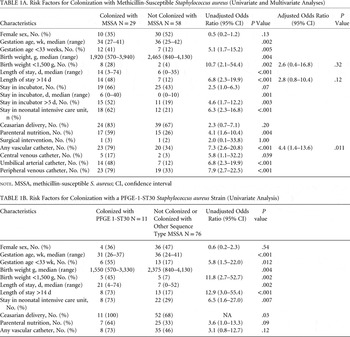
Of the 87 neonate patients in the prospective 6-week cohort, 29 carried any MSSA and 11 carried the predominant PFGE-1-ST-30 strain. MSSA acquisition was independently associated with vascular catheterization (Table 1) but not with any particular midwife, nurse, or physician. Statistical power was too limited to detect differences between MSSA acquisition in general and acquisition of PFGE-1-ST-30.
Prospective Cohort of 87 Neonates with Surveillance Screening for Nasal Staphylococcus aureus Carriage at the Day of Delivery, of Discharge from the Ward, and Once Weekly Every Monday from February 20 Through April 1, 2012

Note: PFGE, pulsed-field gel electrophoresis; MSSA, methicillin-susceptible S. aureus; CI, confidence interval.
Control Measures
Control measures were sequentially reinforced as the persistence of clonally related MSSA strains became clear (Figure 2). All HCWs were repeatedly informed about the outbreak and its most likely transmission pathways. Each bed was newly equipped with alcohol-based hand rub dispensers, and portable 100-mL containers were introduced. Training sessions were held based on the “Five Moments of Hand Hygiene” concept in fall 2012. Overall performance was 66% (162 of 245) before and 73% (148 of 202) after training sessions (adjusted odds ratio, 1.18; 95% confidence interval, 0.77–1.82, multivariate logistic regression controlling for professional category and indications).Reference Sax, Allegranzi, Uckay, Larson, Boyce and Pittet 17 Hand rub consumption increased 19% from 189 L per 1,000 patient days in 2012 to 224 L in 2013 (P<.001). Cleaning and disinfection schedules were intensified and well applied according to audits. The NNW was never closed for admissions, and no contact isolation or cohorting was introduced. On September 5, 2012, the entire NNW moved to a newly constructed and equipped location in the hospital.
DISCUSSION
A cluster of 5 S. aureus infections in neonates triggered an outbreak investigation including extensive screening of asymptomatic carriers. We identified a predominant MSSA clone PFGE-1-ST30. This clone persisted and accounted for 20% of the MSSA infections and 39% of all nasal swabs growing MSSA. In 2013, a new clone, PFGE-6-ST5, became predominant. Other minor clusters occurred and were also responsible for infections. Intensified infection control efforts and moving the unit to a new location did not stop S. aureus transmission but infection incidence did decrease, in 2013. We inferred that, once introduced by HCWs or parents, PFGE-1-ST30 and other clonal MSSA strains were propagated among neonates through direct and indirect hand transmission, which is a notoriously efficient pathway in neonatology.Reference Oelberg, Joyner, Jiang, Laborde, Islam and Pickering 24
Although vertical transmission from mothers to neonates occurs habitually,Reference Leshem, Maayan-Metzger and Rahav 25 this does not explain the striking clonality. S. aureus has been shown to survive for up to 8 weeks on inanimate surfaces.Reference Beard-Pegler, Stubbs and Vickery 26 – Reference Conceicao, Aires de Sousa and Miragaia 28 We detected PFGE-1-ST30 on a monitor and an incubator door of a neonate colonized with the same strain, but these surfaces were unlikely sustained point sources because they are cleaned repeatedly. Furthermore, and very importantly, persistence of clones beyond moving to an entirely new facility makes a persistent environmental point source unlikely.
Colonized HCWs have been responsible for S. aureus outbreaks in neonates.Reference Graham, Morel and Zhou 2 , Reference Bertin, Vinski and Schmitt 29 , Reference Gomez-Gonzalez, Alba, Otero, Sanz and Chaves 30 We found hands of 3 HCWs to be positive for MSSA, providing proof for at least transient MSSA hand carriage. Without systematic HCW screening, we cannot formally exclude the possibility that a colonized HCW acted as a point source. However, it is unlikely that 1 person colonized so many infants. The case control studies did, however, exclude the existence of a source individual on the obstetric team.
In our 2 case-control studies, we found birth weight, prolonged length of stay, and use of vascular catheters to be independent risk factors for MSSA acquisition in general as well as specifically for PFGE-1-ST30 acquisition. Graham et alReference Graham, Morel and Zhou 2 described a similar correlation of colonization/infection with length of hospital stay.
Many effective outbreak control strategies have been described in the literature including cohorting of neonates and HCW, strong leadership, staff training in proper hand hygiene, readily accessible alcohol-based hand sanitizer at the point of care, decolonization with mupirocin,Reference Kim, Chang and Kim 31 , Reference Lepelletier, Corvec, Caillon, Reynaud, Roze and Gras-Leguen 32 and closing the ward for in-depth cleaning. A recent study documented reduction of MSSA colonization and infection by unselective use of mupirocin.Reference Delaney, Wang and Melish 33 However, mupirocin use harbors the risk of resistanceReference Lepainteur, Royer and Bourrel 34 and possible future treatment failure. Thus, we focused our control efforts on standard infection control measures including promoting hand hygiene through training and ergonomic dispenser placement (Figure 1B).Reference Allegranzi and Pittet 35 While formally observed hand hygiene performance did not significantly improve with behavioral interventions, hand rub consumption increased and HCW problem awareness (measured anecdotally) did improve. Moving the NNW to a new location was thought to act as behavior modifier and to eliminate any potential environmental source. While these strategies failed to control clonal MSSA transmission between babies, overall MSSA infection incidence decreased in 2013.
The main S. aureus strain was identified as PVL-negative ST30 MSSA. ST30 is a very common genotype that can both colonize and cause disease in inpatients and in the community.Reference Robinson, Kearns and Holmes 36 Even though ST30 is circulating in Europe, it is not a predominant genotype among MRSA or MSSA strains.Reference Grundmann, Aanensen, van den Wijngaard, Spratt, Harmsen and Friedrich 37 , Reference Rolo, Miragaia and Turlej-Rogacka 38
Data on MSSA colonization rates and clonality in the neonatal population are rare. A pediatric study showed that by 100 hours of hospitalization, 43% of newborns of S. aureus– colonized mothers were also colonized in contrast to 7% of the newborns of S. aureus– negative mothers.Reference Leshem, Maayan-Metzger and Rahav 25 HCWs and the environment are likely sources for neonatal S. aureus colonization.Reference Graham, Morel and Zhou 2 , Reference Bertin, Vinski and Schmitt 29 , Reference Gomez-Gonzalez, Alba, Otero, Sanz and Chaves 30 Hence, it is difficult to fully appraise the present findings. In very young infants, colonization with S. aureus of up to 40%, a level equal to our findings, seems to be physiological in the community.Reference Megevand, Gervaix and Heininger 39 A prevalence study in Swiss babies <2 months of age, excluding neonates, examined the prevalence within 2 days of hospital stay and found 42% MSSA carriers.Reference Megevand, Gervaix and Heininger 39 Acquisition is probably facilitated by the inexperienced immune system. While S. aureus demonstrated high genetic variability in the community,Reference Megevand, Gervaix and Heininger 39 the clonality in our investigation proves healthcare-associated transmission.
Even improving standard infection prevention measures to a level that met or exceeded that of other NNWs did not seem to prevent transmission. Consequently, clonal spread of MSSA may occur in many NNWs around the world unnoticed, rendering MSSA transmission an endemic situation rather than an outbreak. In a recent account of S. aureus epidemiology among neonates, 39% (54 of 139) of included infants were affected by S. aureus, the large majority of strains being methicillin susceptible.Reference Romano-Bertrand, Filleron and Mesnage 40 In this study, S. aureus infection incidence was 12.2% (compared with our incidence rates of 4.1% in 2012 and 2.0% in 2013). Of 6 cases in a MSSA infection cluster, 5 showed the same PFGE type, but typing of colonizing strains was not performed. A potential point source concerned white protection gowns, while hand hygiene compliance was 60% and 76% in two NNW sectors.
From these study results, an important question arises regarding whether clonality leads to an increased burden of MSSA infections directly through the virulence of predominant strains or indirectly via increased colonization rates. Without prolonged prospective surveillance of colonization and infection incidence, this question cannot be answered with certainty. However, in our investigation, clonal strains were less frequent in MSSA-infected neonates than in MSSA-colonized neonates. PFGE-1-ST-30 was particularly successful in spreading but less in generating infections.
CONCLUSION
With this report, we add insights into the hitherto scarcely known epidemiology of methicillin-susceptible S. aureus in a neonatal inpatient population. We found sustained healthcare-associated clonal MSSA transmission resulting in colonization more often than infection. Based on strain typing, observations, environmental specimens, and analysis of risk factors, direct and indirect spread via HCW hands constituted the most likely explanation. Clonal spread did not cease with multimodal control measures, but MSSA infection incidence decreased. Whether eradication of the clonal MSSA strains would lead to reduced infection rates remains an open question.
ACKNOWLEDGMENTS
Financial support: This work was supported by the Swiss National Foundation (Grant no. 310030_146295/1 to ASZ).
Potential conflicts of interest: All authors report no conflicts of interest relevant to this article.
SUPPLEMENTARY MATERIAL
To view supplementary material for this article, please visit http://dx.doi.org/10.1017/ice.2015.184