INTRODUCTION
Huntington’s disease (HD) is an autosomal-dominant neurodegenerative disorder caused by expanded CAG-repeat in the Huntingtin gene. The disease is characterized by the gradual emergence and progression of motor impairment, neurocognitive deficits, and psychiatric symptoms. Subtle neurocognitive deficits can precede the emergence of the motor symptoms of HD (Paulsen, Miller, Hayes, & Shaw, Reference Paulsen, Miller, Hayes and Shaw2017; Stout et al., Reference Stout, Paulsen, Queller, Solomon, Whitlock, Campbell and Aylward2011) and commonly include impairments in social cognition, such as facial emotion recognition (Bora, Velakoulis, & Walterfang, Reference Bora, Velakoulis and Walterfang2016; Henley et al., Reference Henley, Novak, Frost, King, Tabrizi and Warren2012). Recognition of negative emotions appears to be predominantly affected (Tabrizi et al., Reference Tabrizi, Langbehn, Leavitt, Roos, Durr, Craufurd and Stout2009). An important unanswered question, though, is whether these social cognition deficits are a component of broader neuropsychiatric syndromes which affect social functioning more generally (Kordsachia, Labuschagne, & Stout, Reference Kordsachia, Labuschagne and Stout2017).
Apathy is a prevalent neuropsychiatric symptom in patients with HD (Camacho, Barker, & Mason, Reference Camacho, Barker and Mason2018) and has important implications for the patients’ functional capacity of the patient (Hamilton et al., Reference Hamilton, Salmon, Corey-Bloom, Gamst, Paulsen, Jerkins and Peavy2003; van Duijn et al., Reference van Duijn, Craufurd, Hubers, Giltay, Bonelli and Rickards2014), quality of life (Eddy & Rickards, Reference Eddy and Rickards2013), employment (Jacobs, Hart, & Roos, Reference Jacobs, Hart and Roos2018), and social functioning (Fritz et al., Reference Fritz, Boileau, Stout, Ready, Perlmutter, Paulsen and Carlozzi2018). Indeed, both patients and caregivers rate apathy in the top three most impactful features of the disease (Simpson, Lovecky, Kogan, Vetter, & Yohrling, Reference Simpson, Lovecky, Kogan, Vetter and Yohrling2016). Thus, furthering our understanding of apathy in HD has the potential to improve the quality of life of both patients and caregivers.
Clinical apathy is defined as a lack of motivation that has an impact on activities of daily living, leading to a lack of spontaneous and sustained goal-oriented activities (Levy & Dubois, Reference Levy and Dubois2006). As well as being common in HD, apathy is also commonly reported following lesions of the prefrontal cortex (PFC) (Eslinger & Damasio, Reference Eslinger and Damasio1985; Stuss, Van Reekum, & Murphy, Reference Stuss, Van Reekum and Murphy2000) or basal ganglia (Bhatia & Marsden, Reference Bhatia and Marsden1994; Engelborghs, Marien, Pickut, Verstraeten, & De Deyn, Reference Engelborghs, Marien, Pickut, Verstraeten and De Deyn2000; Ghika-Schmid & Bogousslavsky, Reference Ghika-Schmid and Bogousslavsky2000), as well in Parkinson’s disease (PD; Aarsland et al., Reference Aarsland, Larsen, Lim, Janvin, Karlsen, Tandberg and Cummings1999; Aarsland, Litvan, & Larsen, Reference Aarsland, Litvan and Larsen2001; Isella et al., Reference Isella, Melzi, Grimaldi, Iurlaro, Piolti, Ferrarese and Appollonio2002; Pluck & Brown, Reference Pluck and Brown2002) and progressive supranuclear palsy (Aarsland et al., Reference Aarsland, Litvan and Larsen2001; Litvan, Paulsen, Mega, & Cummings, Reference Litvan, Paulsen, Mega and Cummings1998). Thus, apathy can be considered a clinical consequence of disruption to the of the PFC-basal ganglia axis, a functional system critically involved in the generation and control of purposeful behavior.
The orbitomedial PFC also appears to be critical for processing affective information in the faces of others (Adolphs, Tranel, & Damasio, Reference Adolphs, Tranel and Damasio2003). In HD specifically, both emotion recognition deficits and apathy have been associated with atrophy and white matter changes of the orbitofrontal cortex and striatum (Delmaire et al., Reference Delmaire, Dumas, Sharman, van den Bogaard, Valabregue, Jauffret and Lehéricy2013; Henley et al., Reference Henley, Wild, Hobbs, Warren, Frost, Scahill and Tabrizi2008; Ille et al., Reference Ille, Schäfer, Scharmüller, Enzinger, Schöggl, Kapfhammer and Schienle2011; Scahill et al., Reference Scahill, Hobbs, Jones, Frost, Reilmann, Bechtel and Hicks2009). Thus, an association between emotion recognition and apathy may be predicted on the grounds of shared neuropathology.
In addition to sharing overlapping anatomical underpinnings, emotion recognition and apathy may be mechanistically linked as well. One proposed mechanism of apathy is the inability to associate the affective value of rewards with ongoing and forthcoming behavior (Levy & Dubois, Reference Levy and Dubois2006). Since affect is important in providing the motivational value of an action, a loss of the link between affect and behaviors leads to a loss of incentive to perform those behaviors. Specifically, connectivity of the limbic structures to the orbital and medial PFC is the route through which this affective information is thought to influence behavior (Rolls, Reference Rolls2000). This affective information may be particularly important in motivating behavior in the social domain, where the behavioral outcomes we experience have strong emotional value.
In support of this, problems with social and emotional goal-directed behavior form a significant part of the clinical picture of apathy, manifesting as disinterest in social interactions and resulting in social withdrawal (Levy & Dubois, Reference Levy and Dubois2006). This loss of motivation for social experiences may result from a lack of affective engagement with the social rewards which usually motivate such behavior (Ruff & Fehr, Reference Ruff and Fehr2014). A lack of engagement with social stimuli, such as the facial expressions of others, may also preclude the processing of information contained within the stimuli and result in impairments in emotion recognition.
Indeed, an association between apathy and emotion recognition has been demonstrated in a range of neurologic conditions with frontostriatal pathology, including PD (Drapier et al., Reference Drapier, Drapier, Sauleau, Haegelen, Raoul, Biseul and Millet2006; Martínez-Corral et al., Reference Martínez-Corral, Pagonabarraga, Llebaria, Pascual-Sedano, García-Sánchez, Gironell and Kulisevsky2010; Robert et al., Reference Robert, Le Jeune, Dondaine, Drapier, Péron, Lozachmeur and Drapier2014; Schroeder, Reference Schroeder2004), brain injury (Njomboro & Deb, Reference Njomboro and Deb2014; Njomboro, Humphreys, & Deb, Reference Njomboro, Humphreys and Deb2014), thalamic infarction with damage to the striatal-ventral pallidal-thalamic-frontomesial limbic loop (Ioannidis et al., Reference Ioannidis, Kimiskidis, Loukopoulou, Geroukis, Vlaikidis and Kosmidis2013), and aneurysmal subarachnoid hemorrhage (Buunk et al., Reference Buunk, Spikman, Veenstra, van Laar, Metzemaekers, van Dijk and Groen2017). In one study, conjunction analyses showed that overlap between the networks underlying apathy and emotion recognition impairments included the right premotor cortex, right orbitofrontal cortex, left middle frontal gyrus, and left posterior cingulate gyrus in participants with PD (Robert et al., Reference Robert, Le Jeune, Dondaine, Drapier, Péron, Lozachmeur and Drapier2014).
Thus, there is evidence from a range of patient groups to suggest that emotion recognition deficits frequently co-occur with apathy as the result of damage to shared brain circuitry. These results together support the existence of an anatomical and functional relationship between apathy and impaired emotion recognition in neurological patients, involved in both motivation and emotion processes.
The relationship between apathy and emotion perception has only once been assessed in an HD sample. The study found that performance on the Emotion Evaluation Test of The Awareness of Social Inference Test (TASIT-EET) was associated with informant ratings of apathy on the Frontal System Behavior Scale (FrsBe) above general disease progression (Kempnich et al., Reference Kempnich, Andrews, Fisher, Wong, Georgiou-Karistianis and Stout2017). The current study aimed to replicate these results in a larger, multinational sample of participants with HD. In line with past research in HD and other neurological samples, we hypothesized that apathetic participants with early HD from the TRACK-HD study would be impaired on an emotion recognition task compared to non-apathetic participants and healthy controls matched for age and level of education. We also controlled for disease progression and symptoms of depression, which both may contribute to impaired emotion recognition (Dalili, Penton-Voak, Harmer, & Munaf, Reference Dalili, Penton-Voak, Harmer and Munaf2015; Tabrizi et al., Reference Tabrizi, Langbehn, Leavitt, Roos, Durr, Craufurd and Stout2009).
METHODS
Participants
Participants were those with early HD and controls who completed the baseline visit of the TRACK-HD study. Premanifest participants were not included in the current analysis as only a small number of them met criteria for apathy. The TRACK-HD study included 123 control subjects and 123 early-stage HD participants from four different sites (National Hospital for Neurology and Neurosurgery, London, UK; the Department of Medical Genetics at the University of British Columbia, Vancouver, Canada; the Department of Genetics and Cytogenetics at the Hôpital de la Salpêtrière-Université Pierre and Marie Curie, Paris, France; and the Department of Neurology at Leiden University Medical Centre, Leiden, Netherland). Participants met the following inclusion criteria: aged between 18 and 65 years; ability to tolerate MRI and biosample collection; absence of major psychiatric disorder or history of significant head injury at time of enrolment. Subjects were not excluded based on medication usage, unless actively part of an experimental therapeutic trial.
Early HD participants were defined as having a diagnostic confidence score of 4 on the Unified Huntington’s Disease Rating Scale (UHDRS) motor assessment. Early HD subjects required presence of motor features consistent with HD, and a diagnostic confidence score of 4, according to the well-established UHDRS (Huntington Study group 1996). Early HD subjects were required to be within Shoulson and Fahn stage I or II assessed according to UHDRS total functional capacity (TFC ≥ 7) (Shoulson & Fahn, Reference Shoulson and Fahn1979).
Of the 123 controls, 8 were excluded because they had a Problem Behaviour Assessment (PBA) apathy score of>1, indicating apathy of at least mild severity. A further 2 were excluded because they did not complete the Hospital Depression and Anxiety Scale (HADS), and a further 6 were excluded because they did not complete the emotion recognition task. The remaining 107 controls were included in the current analysis. Of the 123 participants with HD who completed the baseline visit, 110 were included in the analysis. Nine were excluded because they did not complete the emotion recognition task, and a further 4 were excluded because they did not complete the HADS. The t-tests determined that the groups did not differ in terms of age and Chi-squared tests determined that the groups did not differ in proportions of males and females, or proportions of participants at different levels of education (see Table 1). Demographic characteristics of the groups can be seen in Table 1.
Demographic variables of three study groups

Note. M=mean; SD=standard deviation; HD-A=Huntington’s disease apathetic group; HD-NA=Huntington’s disease non-apathetic group; CAG=CAG trinucleotide repeat length, TMS=total motor score; DBS=disease burden score; TFC=Unified Huntington’s Disease Rating Scale total functional capacity; SSRIs=selective serotonin reuptake inhibitors; PBA=Problem Behaviours Assessment; HADS=Hospital Anxiety and Depression Scale; p=significance level of univariate analysis of variance.
MATERIALS
PBA
The Problem Behaviour Assessment – Short version (PBA-S; Callaghan et al., Reference Callaghan, Stopford, Arran, Boisse, Coleman, Santos and Craufurd2015) is a semistructured interview which assesses 10 neuropsychiatric symptoms common in HD: depressed mood, suicidal ideation, anxiety, irritability, angry outbursts/aggressive behavior, apathy, perseveration, paranoid thinking/delusions, hallucinations, and behavior suggesting disorientation. The PBA-S is a shortened version of the earlier PBA for HD (Craufurd, Thompson, & Snowden, Reference Craufurd, Thompson and Snowden2001).
Study staff who had been trained to criterion for standardized PBA-S interview guidelines administered the measure to all TRACK-HD participants. Each neuropsychiatric symptom is rated in terms of its severity and its frequency in the past month. The interviewers are provided with the following suggested prompts for assessing apathy in patients: “In the past four weeks, have you found that you have lost interest in things that used to be important to you?”, “Are you just as interested as always in trying new things or starting new projects?”, “Do you have to be pushed to get started on chores that need doing?”, “Do you leave it to friends for taking the initiative for organising social activities?”, “Do you sit around and do a lot of nothing?”. The interviewer may also follow-up with any additional questions that help them to accurately rate the behavior.
Based on responses provided by the participants themselves or by a companion present at the interview (usually a partner or family member), the interviewer rates both the severity of the apathy in the last month and the frequency with which it has occurred. Severity was rated on a scale from 0 to 4 (0=absent, 1=slight, questionable, 2=mild, 3=moderate, 4=severe) and frequency was rated on a scale of 0 to 4 (0=never/almost never; 1=seldom, less than once/week; 2=sometimes, up to 4 times per week; 3=frequently, most days of the week; 4=daily/almost daily for most or all of the day). The score of interest for this study was the total apathy score, which is the product of the severity and frequency score for the apathy item. The cutoff for the apathetic group was a score of>1, indicating that apathy was of at least mild severity.
HADS
The HADS (Zigmond & Snaith, Reference Zigmond and Snaith1983) is a commercially available scale with 14 items: 7 measuring anxiety and 7 measuring depression. Each item is rated on a four-point scale. The depression score was used for this analysis.
Emotion Recognition Task
Facial stimuli from the Ekman and Friesen face stimulus set (Ekman & Friesen, Reference Ekman and Friesen1976) were presented on a Lenovo ThinkPad X61 tablet PC (IBM, New York) that had a 12-inch LCD stylus-sensitive screen with 1400 × 1050 pixel resolution. For each task trial, a face expressing one of six basic emotions (anger, disgust, fear, happiness, sadness, and surprise) or a neutral expression was displayed in the middle of the screen, with seven emotion labels displayed at the bottom of the screen. The face stimuli were 60 mm × 90 mm and were presented in a random order for each participant. Each of the emotion labels were presented in a 26 mm × 13 mm ellipse. Across participants, the array of response labels was randomly displayed, but within each participant, it was kept consistent across trials.
Seven practice trials (one for each emotion and the neutral face) preceded the experimental trials to familiarize participants with the response labels. There were 70 experimental trials, 10 for each of the six emotional and neutral stimulus types. The faces were displayed for 4000 ms and the emotion response labels were displayed for up to 8000 ms, allowing participants time to respond after the face had disappeared. All trials were followed by a 1000-ms intertrial interval. Participants were instructed to sit approximately 30 cm from the screen and were asked to respond by tapping the appropriate label with a stylus held in their dominant hand.
General Cognitive Tasks
For an overall measure of cognitive ability, a cognitive composite score was created using scores from the five main cognitive measures completed on visit 1 of the TRACK-HD study, detailed below (Trails A, Trails B, symbol digit modalities task, Stroop word reading task, spot the change). First, Z-scores were calculated for each test using the mean and standard deviation of the whole sample. These Z-scores were then summed to create the composite. All cognitive tasks were intercorrelated with r values between 0.44 and 0.84 (all ps<0.001). A principle components analysis yielded a single component with an eigenvector>1. For the component with the eigenvalue>1, all variables yielded similar values (ranging from 0.75 to 0.91), making it reasonable to define the global composite as a sum of the standardized scores.
Trails A and B
The Trail Making Test (TMT; Reitan, Reference Reitan1955) is a test of processing speed, sequencing, mental flexibility, and visual-motor skills. In part A, the subject uses a pencil to connect a series of 25 encircled numbers in numerical order. In part B, the subject connects 25 encircled numbers and letters in numerical and alphabetical order, alternating between the numbers and letters. For example, the first number “1” is followed by the first letter “A,” followed by the second number “2” then second letter “B” and so on. The numbers and letters are placed in a semi-random fixed order, in such a manner as to avoid overlapping lines being drawn by the examinee. The variable of interest was time to completion for parts A and B.
Symbol Digit Modalities Test
The Symbol Digit Modalities Test (SDMT) is a test of visuomotor integration, involving visual scanning, tracking, and motor speed (Smith, 1982). In the task, participants are provided with a key at the top of the page that matches the numbers one to nine with a series of nine different symbols. The test consists of blank boxes underneath a series of symbols into which participants must write the corresponding number as quickly as possible. The variable of interest was the total number of boxes filled correctly in 90 s.
Stroop Word Test
The Stroop Test has three conditions that require visual scanning, cognitive control and processing speed (Golden 1978). Because the Word Reading condition (the first condition normally presented) is the most sensitive in premanifest HD, it was the only Stroop condition used in the TRACK cognitive battery (Stout et al., Reference Stout, Tomusk., Queller, Lifer, Hastings, Dawson and Johnson2008). Subjects were given a card on which the names of colors were printed in black ink and must read as many words as they are able in 45 s. The variable of interest was the number of words correct after 45 s.
Spot the change
Spot the Change is a computerized test of visuospatial working memory, which was developed based on earlier work by Cowan and colleagues (Reference Cowan, Elliott, Saults, Morey, Mattox, Hismjatullina and Conway2005). On each trial of this test, participants viewed a display of five randomly placed colored squares for 250 ms (target display). After a 1000-ms delay, the target display was replaced with a display of five squares in the same locations, but one of the squares was circled. The non-circled squares remained the same color as they appeared previously. However, on half of the trials, the circled square changed color. The participant was asked to indicate whether the circled square was the same color or a different color, as quickly and accurately as possible. There were 32 trials. The variable of interest was Cowan’s k 22 , the number of correct trials, adjusted for guessing as follows:
k=5* ([number correct hits/32]+[number correct rejections/32] − 1).
Procedure
At each visit, participants completed a battery of cognitive tests, multiple neuropsychiatric questionnaires, gave blood samples, and had an MRI scan. In approximately 90% of participants, all of these data were collected in one visit. Written informed consent was obtained from all subjects according to the Declaration of Helsinki and the study was approved by local ethics committees.
Statistical Analysis
The 110 participants with HD were split into two groups: those with a PBA apathy score of>1 (HD-Apathy; n=43) and those with a PBA apathy score of ≤1 (HD-No Apathy; n=67). Significant apathy was defined as a PBA apathy score of>1, indicating apathy that is of at least mild severity.
First, cognitive composite scores were compared across groups using a univariate analysis of covariance (ANCOVA) with HADS depression score entered as a covariate. Additionally, to compare the HD-Apathy group with the HD-No Apathy group while controlling for the effect of disease burden, the analysis was repeated with the addition of the UHDRS total motor score (TMS) as a covariate.
Next, recognition scores for each emotion were compared between groups using a mixed ANCOVA, with the HADS depression score entered as a covariate, group (HA-Apathy, HD-No Apathy, and controls) as the between-subjects factor, and emotion (happiness, surprise, neutral, fear, disgust, anger, and sadness) as the within-subjects factor. Additionally, to compare the HD-Apathy group with the HD-No Apathy while controlling for the effect of disease progression, the analysis was repeated with the addition of TMS as a covariate.
RESULTS
The HD-Apathy and HD-No Apathy groups did not differ in CAG repeat length. However, the HD-Apathy group had higher disease burden score (DBS), higher TMS, and lower functional capacity (TFC). The DBS score is calculated from the formula (age × [CAG-35.5]), and represents an estimate of an individual’s lifetime exposure to mutant huntingtin, at any age, before or after motor onset (Penney, Vonsattel, MacDonald, Gusella & Myers, Reference Penney, Vonsattel, MacDonald, Gusella and Myers1997). The HD groups were more likely than the control group, and the HD-Apathy group were more likely than the HD-No Apathy group, to take both neuroleptic medications and selective serotonin reuptake inhibitors (SSRIs) (see Table 1).
Overall Cognitive Ability
Of all the participants, three controls, seven apathetic participants, and three non-apathetic participants did not have a composite score as they were unable to complete all of the cognitive measures. The ANCOVA with HADS depression and study site entered as covariates revealed a significant main effect of group, F(4,203)=99.08, p<0.001, partial η2=0.49. Post hoc pairwise comparisons revealed that the control group had significantly greater cognitive composite scores (M=4.11; SD=3.04) than both the HD-Apathy (M=−5.44; SD=4.68) and HD-No Apathy (M=−2.74; SD=3.74) groups, p<0.001. After additionally controlling for TMS, there was no significant difference between cognitive composite scores for the HD-Apathy and HD-No Apathy groups, p=0.111.
Emotion Recognition
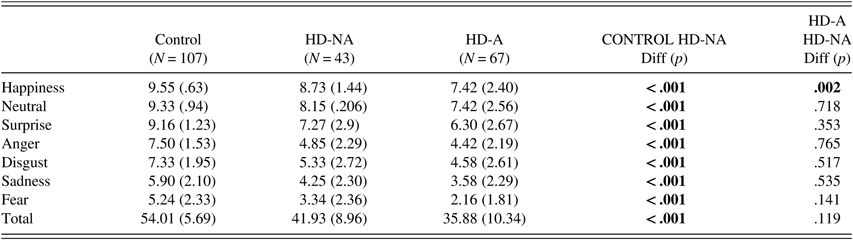
The ANCOVA with HADS depression and study site entered as covariates revealed a significant effect of group, F(2,212)=84.38, p<0.001, partial η2=0.44, a significant effect of emotion, F(6,1272)=27.58, p<0.001, partial η2=0.12, and an emotion by group interaction, F(12,1272)=2.67, p=0.001, partial η2=0.03. Bonferroni post hoc pairwise comparisons showed that the control group (M=54.01; SD=5.69) had higher emotion recognition scores than HD-No Apathy group (M=41.93; SD=8.96; p<0.001), who had higher scores than the HD-Apathy group (M=35.88; SD=10.34; p=0.005).
To examine the interaction effect, univariate analyses of variance comparing scores for the three groups were conducted separately for each emotion, with HADS depression and study site entered as covariates. The Bonferroni corrected threshold was α=0.007 (=0.05/7). These analyses revealed that while the control group performed better than the HD-No Apathy group on every emotion (p<0.001 in each case), the HD-Apathy group differed from the HD-No Apathy group for recognition of happiness (<0.001), but not for recognition of surprise (p=0.064), fear (p=0.074), neutral (p=0.195), sadness (p=0.312), anger (p=0.658), or disgust (p=0.197).
Next, these analyses were repeated with the addition of TMS as a covariate (as well as HADS depression and study site), to control for the effect of disease progression, which differed between the HD-Apathy and HD-No Apathy group. The results remained the same, whereby the HD-Apathy group differed from the HD-No Apathy group for recognition of happiness (p=0.002), but not for recognition of surprise (p=0.353), fear (p=0.141), neutral (p=0.718), sadness (p=0.535), anger (p=0.765), or disgust (p=0.517). The effect size for the difference between apathetic and non-apathetic participants on recognition of happy expressions was d=0.66, an effect of medium size. Entering neuroleptic use, SSRI use and the cognitive composite as covariates did not change the results (p=0.016 for difference between HD-Apathy and HD-No Apathy on recognition of happy expressions). Results of group comparisons for each emotion can be found in Table 2.
Emotion recognition scores for each study group and pp values for group differences

Note. Means are presented and standard deviations are in parentheses. Univariate analysis of covariance was used to determine group differences. P The p values for differences between control and HD-NA group are after controlling for HADS depression score and study site. P The p values for differences between HD-A and HD-NA group are after controlling for HADS depression score, study site and TMS. Significant differences are given in boldface type.
HD-A=Huntington’s disease apathetic group; HD-NA=Huntington’s disease non-apathetic group; HADS=Hospital Depression and Anxiety Scale.
DISCUSSION
In line with past research on emotion recognition in patients with early Huntington’s disease (for a recent meta-analysis see Bora et al., Reference Bora, Velakoulis and Walterfang2016), we found that participants with HD who did not have apathy were impaired on recognition of all basic emotions compared to controls. Additionally, in partial agreement with our hypothesis, we found a specific impairment in the recognition of happy facial expressions in apathetic participants with HD compared to non-apathetic participants, after controlling for disease progression and symptoms of depression.
Furthermore, this impairment was found despite no difference in general cognitive functioning between the two groups. One previous study found that overall emotion recognition score on the TASIT was related to FrsBe apathy scores in a smaller sample of participants with HD (Kempnich et al., Reference Kempnich, Andrews, Fisher, Wong, Georgiou-Karistianis and Stout2017). Kempnich and colleagues, however, did not explore relationships with specific emotions and thus may have overlooked the possibility of particular emotions driving the effect. Although causal conclusions cannot be made based on the current analysis, these results suggest that impairments in the recognition of happy expressions may be a part of the clinical picture of apathy in HD.
One hypothesis about the link between emotion recognition and apathy is that damage to orbitomedial frontostriatal pathways results in deficits in social reward processing, contributing to both problems with emotion recognition and reduced motivation for social behavior. The orbitofrontal cortex is critical for processing rewards which motivate behavior (Rolls, Reference Rolls2000) and for processing the affective information in faces (Adolphs, Reference Adolphs2002). In HD specifically, both apathy and emotion recognition are related to atrophy or white matter changes in the orbitomedial PFC and striatum (Delmaire et al., Reference Delmaire, Dumas, Sharman, van den Bogaard, Valabregue, Jauffret and Lehéricy2013; Henley et al., Reference Henley, Wild, Hobbs, Warren, Frost, Scahill and Tabrizi2008; Ille et al., Reference Ille, Schäfer, Scharmüller, Enzinger, Schöggl, Kapfhammer and Schienle2011; Scahill et al., Reference Scahill, Hobbs, Jones, Frost, Reilmann, Bechtel and Hicks2009). Thus, the neuropathology underpinning apathy and emotion recognition impairments in HD overlap. However, it is predominantly the recognition of negative emotions that has been linked to this pathology in HD. It is not clear, then, from this account, why the recognition of happiness alone would be associated with apathy.
Indeed, that apathetic HD participants differ from non-apathetic HD participants only on recognition of happy expressions is a point of convergence from findings in other neurological patient groups. Impairments across numerous, typically negative, emotions have been found in apathetic participants with PD, AD, and brain injury (Buunk et al., Reference Buunk, Spikman, Veenstra, van Laar, Metzemaekers, van Dijk and Groen2017; Martínez-Corral et al., Reference Martínez-Corral, Pagonabarraga, Llebaria, Pascual-Sedano, García-Sánchez, Gironell and Kulisevsky2010; Njomboro et al., Reference Njomboro, Humphreys and Deb2014; Robert et al., Reference Robert, Le Jeune, Dondaine, Drapier, Péron, Lozachmeur and Drapier2014). Furthermore, in PD, non-apathetic participants were just as good as controls on emotion recognition, leading the authors to conclude that apathy accounted for the entire disease effect on emotion recognition. This is in contrast to our finding that the specific impairment in the apathetic group on happy expressions was in addition to a general disease-related impairment across all emotions. However, with studies using different measures of apathy and different measures of emotion recognition, it is difficult to compare results.
Additionally, most research, including the current study, has not delineated cognitive, behavioral, and affective apathy, which may have distinct relationships with emotion recognition. Cognitive apathy, for instance, is likely to affect recognition particularly of more difficult emotions. Affective apathy, on the other hand, could have stronger relationships with recognition of more “social” emotions. Furthermore, these apathy subtypes are associated with different underlying neuropathology (Levy & Dubois, Reference Levy and Dubois2006). Cognitive apathy, for instance, is associated with the dorsolateral PFC and its connections with limbic areas, while affective apathy is associated with the orbitomedial PFC and its connections with limbic areas (Moretti & Signori, Reference Moretti and Signori2016). Thus, the relationships between recognition of different emotions, different apathy presentations, and their underlying neuropathology in people with HD need to be explored in future research.
The specificity of the impairment in recognition of happy expressions among apathetic participants in this study raises some interesting questions. In our emotion recognition task, happiness was the only positive emotion tested, and thus the only emotion tested that represents a rewarding stimulus associated with social approach motivation. This raises the question of whether other positive social emotions would be affected to a greater degree in apathetic compared to nonapathetic participants with HD. Typically, only Ekman’s six “basic” emotions are tested on emotion recognition tests, which are primarily negative emotions. These basic emotions include those that are experienced rarely in everyday life and are arguably not particularly social in nature, such as fear. In contrast, there are a wealth of positive social emotions that we experience on the faces of others on a daily basis, including interest, amusement, and excitement, which are important in motivating social behavior. Future research should seek to determine whether recognition of these other positive social emotions are impaired in apathetic participants compared to non-apathetic participants.
The specificity of the relationship between recognition of happy expressions and apathy is also of interest because happiness is the easiest of the six basic emotions to recognize and reliably produces near ceiling effects in healthy controls (Rosenberg, McDonald, Dethier, Kessels, & Westbrook, Reference Rosenberg, McDonald, Dethier, Kessels and Westbrook2014). Perhaps due to happiness being relatively easy to identify, recognition of happy expressions is only affected in later stages of HD and with much smaller effect sizes than for impairments in recognition of other emotions (Bora et al., Reference Bora, Velakoulis and Walterfang2016). As such, a more sensitive measure of recognition of happy expressions may reveal a larger effect of apathy. The most common way to increase the difficulty of expression recognition tasks is to include stimuli in which the emotion is not expressed at full intensity. The use of such tasks and the inclusion of more positive emotions in future research will help to clarify the relationship between expression recognition and apathy.
An important limitation of the current study was that the PBA measure of apathy was unable to distinguish between different types of apathy, namely, cognitive, affective, and behavioral apathy. Indeed, there is some evidence that emotion recognition may be specifically associated with affective apathy in people with brain injury (Njomboro & Deb, Reference Njomboro and Deb2014), but this needs to be further explored in HD. Furthermore, in this study, apathy was measured by a single item on the PBA-S and, thus, may not always be sensitive to detecting apathy.
Another limitation is that, although the apathetic and non-apathetic groups did not differ on the cognitive composite score, a greater proportion of apathetic patients (9%) compared to non-apathetic (4%) participants and controls (2%) were unable to complete all cognitive tasks. This indicates that there may have be some cognitive impairment in the apathetic group that was not tapped by the cognitive composite score. On the other hand, refusal to complete tasks may have also contributed to the missing data in the apathetic group.
Furthermore, the apathetic group did have a higher disease burden score, higher total motor score, and lower functional capacity, indicating that they were slightly more advanced in disease stage than the non-apathetic group. To address this, we controlled for disease severity in the analyses by adjusting for total motor score. Moreover, the relationship with happiness but not the other emotion domains suggests this is not just an overall disease stage effect but instead may represent a more specific association between apathy and impaired recognition of happiness.
The current study demonstrated a specific impairment in the recognition of happy expressions in apathetic compared with non-apathetic participants. This is partially in line with the broader emotion recognition impairments found previously in apathetic participants with HD and other neurological disorders (Buunk et al., Reference Buunk, Spikman, Veenstra, van Laar, Metzemaekers, van Dijk and Groen2017; Kempnich et al., Reference Kempnich, Andrews, Fisher, Wong, Georgiou-Karistianis and Stout2017; Martínez-Corral et al., Reference Martínez-Corral, Pagonabarraga, Llebaria, Pascual-Sedano, García-Sánchez, Gironell and Kulisevsky2010; Njomboro et al., Reference Njomboro, Humphreys and Deb2014; Robert et al., Reference Robert, Le Jeune, Dondaine, Drapier, Péron, Lozachmeur and Drapier2014). While shared reliance on frontostriatal pathways may broadly explain associations between emotion recognition and apathy found across several patient groups, further work is needed to determine what relationships exist between recognition of specific emotions, distinct subtypes of apathy, and underlying neuropathology.
ACKNOWLEDGMENTS
Preparation of this manuscript was supported by a Wellcome Trust Collaborative Award (200181/Z/15/Z). There are no conflicts of interest associated with this publication.