INTRODUCTION
Ten per cent of the 300 recent species of serpulid polychaetes are known to produce aggregations of calcareous tubes (Ten Hove & Van den Hurk, Reference Ten Hove and Van den Hurk1993). In Loch Creran, Scotland, the intertwining tubes of Serpula vermicularis L. typically grow up from a shell, cobble or boulder substrate on muddy sand to produce patch reefs with a maximum height often exceeding 50 cm and width of 60 cm (Moore et al., Reference Moore, Harries, Lyndon, Saunders and Conway2003). Reefs mostly occur within a band around the margin of the loch from around chart datum to 15 m depth, with a density attaining 25% coverage of the seabed (Moore et al., Reference Moore, Bates, Mair, Saunders, Harries and Lyndon2009). Although rarely recorded, S. vermicularis reefs have also been observed in Ardbear Lough, Ireland (Bosence, Reference Bosence1973), Killary Harbour, Ireland (Minchin, Reference Minchin1987) and Loch Teacuis, Scotland (Dodd et al., Reference Dodd, Baxter and Hughes2009); the reefs in Loch Sween, Scotland (Bosence, Reference Bosence, Larwood and Rosen1979) are now believed to be extinct (Moore et al., Reference Moore, Saunders and Harries1998). Similar sublittoral reefs are produced by S. narconensis in the Antarctic (Pickard et al., Reference Pickard, Adamson and Heath1986; Kirkwood & Burton, Reference Kirkwood and Burton1988; Ramosa & San Martin, Reference Ramosa and San Martin1999) and by Galeolaria hystrix in New Zealand (Smith et al., Reference Smith, McGourty, Kregting and Elliot2005).
In 2005 Loch Creran was designated as a Special Area of Conservation (SAC) under the European Council Habitats Directive (92/43/EEC) principally for the purpose of conservation management of the biogenic reefs of S. vermicularis and the horse mussel, Modiolus modiolus. Serpulid reefs have also been identified as a priority habitat by the UK Government's Biodiversity Action Plan, the response of UK Government to the Convention on Biological Diversity.
Serpula vermicularis reefs are believed to support a rich and diverse community which utilizes the habitat for a food source, a substrate and for refuge (Bosence, Reference Bosence, Larwood and Rosen1979; Poloczanska et al., 2004). However, no comprehensive studies of the associated biota of any serpulid reefs have been published. The aim of this study is to characterize the community associated with the reefs of S. vermicularis in Loch Creran and to assess the effect of reef size on composition and diversity.
MATERIALS AND METHODS
Ten reefs of S. vermicularis were selected for collection by divers at Rubha Mór, Loch Creran (56°30.8′N 5°22.9′W) at depths of 8.0–10.3 m on 10 March 2001. The reefs varied in size from 5–50 cm maximum width, in increments of 5 cm. The following in situ measurements were taken for each reef using a 100 cm rule: maximum width (major axis), maximum width perpendicular to the major axis (minor axis) and maximum height. Reefs of 5–15 cm width were gently placed directly into 5 l buckets which were sealed in situ. Larger reefs were enveloped by a cotton bag and gently lifted from the seabed before sealing the bag beneath the reef. These reefs within the sealed bags were placed in 80 l bins before transferring the samples to the covering research vessel. Following removal of excess water from the samples using a 1 mm mesh sieve, the reefs were preserved in 12% formosaline.
On return to the laboratory the reef material was drained through a 1 mm sieve and transferred to 95% industrial methylated spirit for storage prior to examination. Reefs were broken into fragments of approximately 6 cm in length and rinsed thoroughly in seawater over a 1 mm sieve to remove trapped sediment and motile epifauna; forceps were employed to remove easily detached epibiota and tube-dwelling fauna. The biota was identified to species level where possible and enumerated, except for algae and the colonial sponges, cnidarians and ascidians, which were recorded as present or absent. Barnacles and bryozoan colonies were fully enumerated for reefs of 5–15 cm width but were enumerated from a subsample of 380 g of drained reef material for the larger reefs. This wet weight corresponds to that of the 15 cm reef. For each reef the weight of tube fragments was measured before and after drying at 70°C for 24 hours.
RESULTS
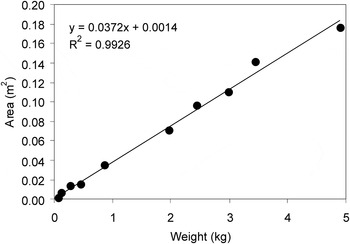
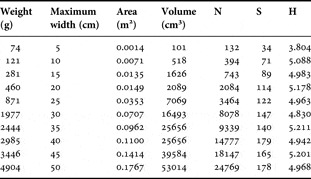
Size measures of the 10 reefs are given in Table 1. Area has been estimated as areal coverage of the seabed, based on the model of an ellipse using the measures of major and minor axes. Volume has been estimated using an ellipsoidal model, incorporating maximum height as the third diameter. Reef weight and area exhibit a strong linear relationship (Figure 1), the deviation from expected curvilinearity being due to the more diffuse nature of the larger reefs. The regression provides an estimated weight of 2.651 kg for a reef of area 0.1 m2.
Relationship between areal coverage of the seabed and dry weight for reefs of Serpula vermicularis, showing fitted linear regression line and coefficient of determination (R2).

Size parameters for ten reefs of Serpula vermicularis, together with abundance (N), number of taxa (S) and Shannon–Wiener species diversity (H) of the associated community. Calculation of H employed log2.

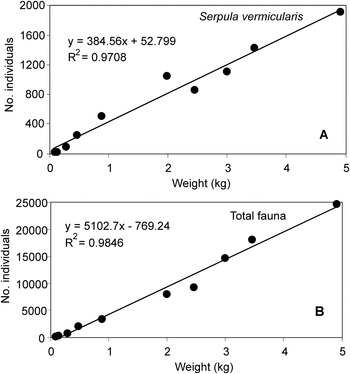
There is a strong linear relationship between abundance of S. vermicularis and reef weight (Figure 2A), implying that tube occupancy does not decline with increasing reef size. Total faunal abundance also increases linearly with reef size (Figure 2B; Table 1). Utilizing the regression equations from Figure 2; this provides abundance estimates of 1072 ind./0.1 m2 and 12756 ind./0.1 m2 for S. vermicularis and total fauna respectively.
Relationship between abundance of Serpula vermicularis (A) and total fauna (B) and dry weight of S. vermicularis reefs, with fitted linear regression lines and coefficients of determination (R2).

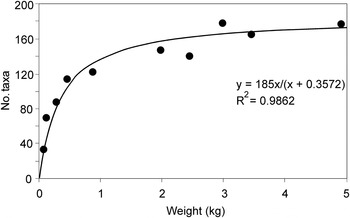
In contrast to abundance, taxon richness of the associated community shows a hyperbolic relationship with reef size, with an upper asymptote of 185 taxa (Figure 3). A total of 278 taxa was recorded from all the reefs. Taxon richness ranges from 34 on the 5 cm width reef to 179 on the 40 cm reef. For reefs larger than 25 cm there is relatively little increase in richness with reef size. From the hyperbolic regression it can be predicted that a reef of area 0.1 m2 would support 163 taxa. With the exception of the smallest reef, Shannon–Wiener diversity is remarkably constant at 5.0 ± 0.2 (Table 1).
Relationship between taxon richness of the associated community and the dry weight of Serpula vermicularis reefs, showing fitted hyperbolic curve and coefficient of determination (R2).

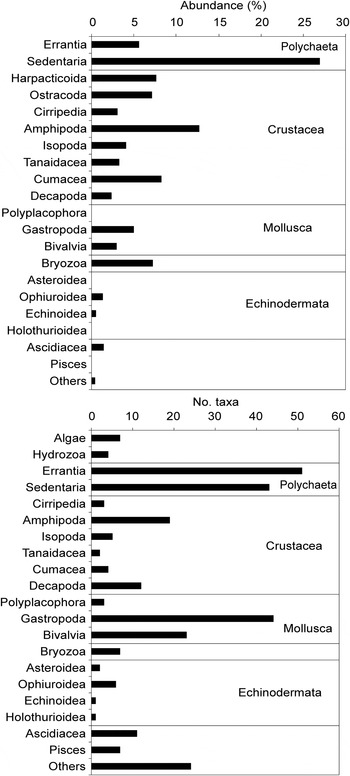
In terms of abundance the reef community is dominated by crustaceans (48.5%), polychaetes (32.5%) and molluscs (8.1%), with the dominant components being amphipods, sedentary polychaetes and gastropods respectively (Figure 4). Large numbers of harpacticoid copepods and ostracods, generally regarded as meiofauna, were retained on the 1 mm mesh sieve. In terms of species richness the community was dominated by the same groups, with 94 polychaete taxa, 70 molluscs and 45 crustaceans, together representing 75% of all taxa. Errant polychaetes were the richest subgroup (51 taxa), with gastropods (44 taxa) and amphipods (19 taxa) dominating the other groups.
Composition of the associated community of Serpula vermicularis reefs. The relative abundance and taxon richness of the major biotic groups recorded from ten reefs is shown.

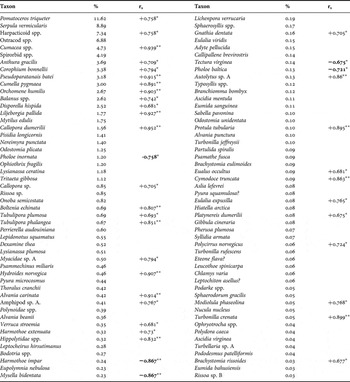
The quantitative species composition of the reef community, based on all reefs sampled, is summarized in Table 2, which shows the relative abundance of the top 100 taxa, which together account for 96% of total abundance. Species authorities follow Howson & Picton (Reference Howson and Picton1997). The structure-forming serpulid worms are clearly the dominant taxa, represented especially by Pomatoceros triqueter and S. vermicularis, but also including spirorbids, Hydroides norvegica and Protula tubularia, together accounting for 25%. In addition to these species there is a small number of large, conspicuous species generally associated with hard substrata, viz. the sponge Esperiopsis fucorum, the hydroids Kirchenpaueria pinnata and Obelia dichotoma, the polychaete Eupolymnia nebulosa, the scallop Chlamys varia, the echinoderms Ophiothrix fragilis and Psammechinus miliaris and the ascidians Ascidia mentula, A. virginea, Pyura microcosmus and Diplosoma listerianum. Most of the remaining species are small, cryptic forms, generally associated with rock, crevices and stony and shelly substrates. At least one of the most dominant species is a known inhabitant of serpulid tubes, the vermiform isopod Anthura gracilis. A minor component of the community, more typical of soft sediments, is presumably confined to sediment pockets within the reef; it includes the polychaetes Chaetozone setosa and Scoloplos armiger and the bivalve Abra alba. Seven species of fish were recorded within the reefs: Centrolabrus exoletus (rock cook), Ctenolabrus rupestris (goldsinny), Pholis gunnellus (butterfish), Gobiusculus flavescens (two-spot goby), Chirolophis ascanii (Yarrell's blenny), Diplecogaster bimaculata (two-spot clingfish) and the rarely recorded Lepadogaster candollei (Connemara clingfish), found on 3 of the 10 reefs.
Relative abundance (%) of the top 100 taxa identified from ten serpulid reefs. Also given is Spearman's rank correlation coefficient (rs) for the relationship between taxon density on a reef (as ind./kg reef) and reef weight; negative correlations in boldface, *P < 0.05, **P < 0.01.

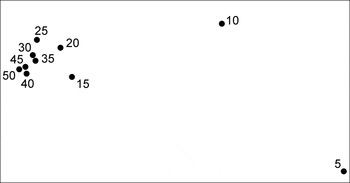
Similarities and trends in the species composition of the 10 reefs are summarized in the multidimensional scaling plot of Figure 5. There is clearly a pattern of compositional change related to reef size, with the rate of change markedly decreasing with increasing reef size. Reefs greater than 25 cm width vary little, with a minimum Bray–Curtis similarity of 77%.
Non-metric multidimensional scaling plot showing similarities in the associated community found on ten reefs of Serpula vermicularis of differing size (labels denote maximum reef width in cm). The analysis was based on logged densities (ind./kg reef) for each taxon. Stress = 0.01.

The pattern of compositional change in part reflects the relationship between species richness and reef size (Figure 3). To further characterize this pattern, the relationship between the density (as ind./kg reef) and reef weight was examined for all non-singleton taxa (>1 individual on any reef) using Spearman's rank correlation coefficient. Table 2 shows the significant correlations amongst the top 100 taxa. Of the 207 taxa analysed, most showed no relationship between density and reef size. 57 taxa increased in density with reef size (including 11 of the top 14 taxa), and 6 species showed higher densities on smaller, presumably younger, reefs: the scale worms Pholoe inornata, P. baltica and Harmothoe impar, the pycnogonid Callipallene phantome, and the molluscs Tectura virginea and Mysella bidentata.
DISCUSSION
Black et al. (Reference Black, Hughes, Provost and Pereira2000) studied the infauna retained on a 1 mm sieve from five soft mud sites within Loch Creran, recording 17–67 species and 61–1155 individuals in a 0.1 m2 grab sample. Gage (Reference Gage1972) studied the macrobenthos retained on a 1 mm sieve from anchor dredge samples at eight sites in the loch, one of which was close to the reef site and of similar depth and sediment composition (7 m, muddy sand). 30 species were recorded from an estimated sample area of 1.5 m2. In the present study a reef of 0.1 m2 is estimated to support 163 taxa and 12756 individuals, which suggests that the presence of reefs produces a marked augmentation of species diversity and abundance in sedimentary areas. Schwindt et al. (Reference Schwindt, Bortolos and Iribarne2001) also showed that reefs produced by the serpulid, Ficopomatus enigmaticus, influence infaunal community structure by enhancing the abundance of crabs, whose predatory activity can influence the abundance of infaunal polychaetes.
It is believed that this is the first detailed examination of the associated community of serpulid reefs. Previous reports of the S. vermicularis community focus on the subset of species observed by divers (Bosence, Reference Bosence, Larwood and Rosen1979; Minchin, Reference Minchin1987; Connor et al., Reference Connor, Dalkin, Hill, Holt and Sanderson1997) or by underwater television (Poloczanska et al., 2004).
Kirkwood & Burton (Reference Kirkwood and Burton1988) found reefs of S. narconensis to represent the most species rich habitat in Ellis Fjord, Antarctica. However, the low mean count of 8.5 species per 0.525 m2 quadrat is explicable in terms of the low efficiency of the photographic approach employed to record the community. Schwindt & Iribarne (Reference Schwindt and Iribarne2000) recorded the abundance of eight species, as well as noting the presence of bryozoans, harpacticoid copepods, nematodes and ostracods from amongst the tubes of Ficopomatus enigmaticus in a shallow, brackish, Argentinean lagoon. Samples were taken from around the edges of the reefs but how these samples were collected and examined is unclear.
The only comprehensive studies of the associated community of serpulids have been carried out on small clusters of tubes. Haines & Maurer (Reference Haines and Maurer1980a, Reference Haines and Maurerb) examined 10–400 cm3 clusters of Hydroides dianthus which rise 2–10 cm above the muddy seabed in Delaware Bay, USA. Using a screen of 0.125 mm they recorded a total of 54 species from analysis of 120 clusters. Apart from corophiid amphipods and harpacticoids, the dominant taxa were quite different from S. vermicularis reefs, being composed principally of nematode, oligochaete and polychaete worms and lacking the large macrofaunal taxa, although compositional differences may be in part due to methodological differences. Kaiser et al. (Reference Kaiser, Cheney, Spence, Edwards and Radford1999) examined the fauna associated with tube clusters of Pomatoceros triqueter and P. lamarckii on shells and stones off Anglesey, UK, recording a total of 68 taxa. Several of the dominant taxa are also common on S. vermicularis reefs, e.g. Lepidonotus squamatus, Eumida sanguinea, P. triqueter, Hydroides norvegica, Anthura gracilis and Hiatella arctica. As with the H. dianthus community the Pomatoceros clusters lack the diversity and many of the dominant and larger taxa found on S. vermicularis reefs, which is likely to result in part from the small size of the clusters and the dredged mode of collection of the material.
The associated community of Sabellaria reefs has received more detailed attention than serpulid reefs. Although they have been found to enhance the diversity of areas (e.g. George & Warwick, Reference George and Warwick1985; Dubois et al., Reference Dubois, Retière and Olivier2002), they do not appear to attain the level of diversity of S. vermicularis reefs. George & Warwick (Reference George and Warwick1985) recorded 88 taxa from 0.5 mm sieved material from a total area of 0.98 m2, supplemented by dredge material, from an area supporting extensive reefs of S. spinulosa in the Bristol Channel, UK. Dias & Paula (Reference Dias and Paula2001) recorded 107 and 73 taxa from 0.5 mm sieved material from a total area of 0.32 m2 at each of two S. alveolata reef sites in Portugal. Also based on a 0.5 mm mesh size, in the Bay of Mont Saint-Michel, France Dubois et al. (Reference Dubois, Retière and Olivier2002) identified 63 species from a sampled area of 0.54 m2 at one S. alveolata reef site, whilst Dubois et al. (Reference Dubois, Commito, Olivier and Retière2006) recorded 66 species from an area of 0.675 m2 at a second reef site in the same bay.
The serpulid reef structure provides a rich availability of crevice habitats and, probably as a result of this, harbours a significant component of smaller macrofaunal species often recorded from kelp holdfasts (Hayward & Ryland, Reference Hayward and Ryland1990). In a survey of 72 Laminaria hyperborea holdfasts from 15 North Sea sites Moore (Reference Moore1973) recorded 174 non-meiofaunal species of which 59 species, or close relatives, were found amongst S. vermicularis tubes.
Certain mussel beds would appear to offer a similar range of habitats to that of S. vermicularis reefs, with a mix of hard, calcareous substrates, crevices and sediment pockets. The community associated with a bed of the horse mussel, Modiolus modiolus, in Loch Creran has been studied by Mair et al. (Reference Mair, Moore, Kingston and Harries2000) and Moore et al. (Reference Moore, Saunders, Harries, Mair, Bates and Lyndon2006). Although a 0.5 mm sieve was used to retain the fauna from mussel clumps of area 0.03 m2 in these studies, diversity values are very similar, with mean Shannon–Wiener values of 4.9 and 5.2 respectively, compared to approximately 5.0 for S. vermicularis reefs. Species richness is slightly lower for the mussel clumps with means of 84 (Mair et al., Reference Mair, Moore, Kingston and Harries2000) and 96 (Moore et al., Reference Moore, Saunders, Harries, Mair, Bates and Lyndon2006), compared with 128 taxa for a reef of similar areal extent, but greater volume. Given the similarity in the availability of potential colonists resulting from their co-location in Loch Creran, it is not surprising that there is a large number of species common to the two habitats. 111 of the taxa recorded on S. vermicularis reefs were also found associated with the Modiolus clumps.
From a conservation perspective, one of the most interesting species associated with the S. vermicularis reefs is the clingfish, Lepadogaster candollei. This has a predominantly southern European and North African distribution, reaching its northerly limit of distribution on the west coast of Scotland, where hitherto it has been very rarely recorded (Wheeler, Reference Wheeler1978; FishBase, 2011; NBN Gateway, Reference NBN2011). Four specimens were found on three of the larger (>25 cm width) reefs. Poloczanska et al. (2004) also recorded its presence on Loch Creran serpulid reefs. It is therefore possible that these reefs represent a stronghold for this species at the edge of its biogeographical range.
This study presents a snapshot of the reef community at one location in Loch Creran during the winter of 2001. There are likely to be seasonal variations in composition and diversity, with the appearance of additional taxa, especially algae, in spring and summer. Based on a survey of the larger associated species recordable by divers, geographical variation in composition and species richness of the associated community of Loch Creran serpulid reefs is known to occur (Moore et al., Reference Moore, Saunders, Harries, Mair, Bates and Lyndon2006). Anthropogenic modification of the community has been caused by reef fragmentation through fishing, aquaculture and mooring activities in the loch, resulting, inter alia, in loss of the keystone serpulids (Moore et al., Reference Moore, Saunders, Harries, Mair, Bates and Lyndon2006). Detailed examination of the nature of anthropogenic impacts on the associated community is yet to be carried out, although our unpublished observations of ophiuroid-dominated reef communities in the vicinity of aquaculture facilities suggest that further work is necessary.
ACKNOWLEDGEMENTS
The authors are grateful to Professor Hamish Mair for assistance with collection of material and to Dr Steve Jarvis and Ms Sue Hamilton for aid with faunal identification. This research received no specific grant from any funding agency, commercial or not-for-profit sectors.