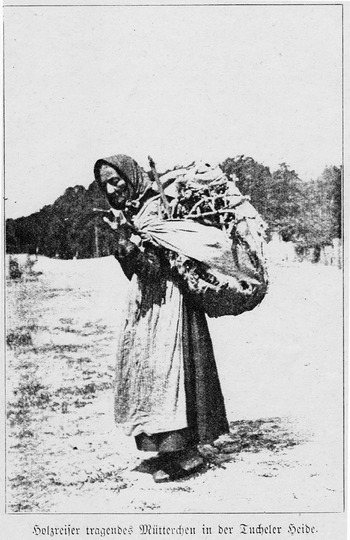
The Tuchel Heath (Tucheler Heide, Bóry Tucholskie) and Kashubia (Kassubei, Kaszuby), the two regions comprising the geographical region known as Pomerelia (roughly the area of the “Polish Corridor”), came into Prussian possession with annexations from Poland in 1772, when Friedrich II seized most of what would become the provinces of Poznania and West Prussia from the ailing Polish Republic. These territories, some liked to imagine, resembled the North American frontier. Friedrich II apparently compared it to Canada and “jokingly named the inhabitants his Iroquois.”Footnote 1 Gustav Freytag immortalized Friedrich's arrival on the frontier in his work Bilder aus der deutschen Vergangenheit, characterizing the place as “an abandoned land, without law, without authority; it was a wasteland.”Footnote 2 Certainly, the harsh climate, the sprawling pine forests and barrens, and the impoverished populace suggested a certain affinity. In one description of the region from 1879, the author depicted the Slavic game poacher “as a red Indian on the warpath.”Footnote 3
The Germans, of course, were the bearers of civilization (or Kultur) in this colonial fantasy. In one description of the Tuchel Heath, the author described a primitive Slavic population “interspersed with Germans, who more and more bring culture here,” and contrasted the piney wastes of the heath with the “fertile and well-cultivated land settled by Germans” just to the west, in which “we feel ourselves in the German countryside.”Footnote 4 German authors thus identified the introduction of a rational agriculture as one of the primary benefits to the region of Prussian rule.Footnote 5 According to an 1881 Gartenlaube article entitled “German Pioneers in the East,” the German cultural mission involved cutting flourishing agricultural communities out of the wild woodlands.Footnote 6 Medieval German monks in the east spread “Christianity and civilization” among the heathen Slavs, and “with shovels and axes created a secure home for their cultural work.”Footnote 7 Nationalists celebrated the agricultural achievements of German peasants, who “won blossoming fields from forests and swamps.”Footnote 8 This orderliness was all the more distinct when one contrasted it with Russian territory just over the border. One author describing a Vistula cruise was surprised by the poverty and disorder just beyond the German frontier: “Yes, here Poland began—the contrast between either side of the border, which was only an imaginary line drawn on political maps and not created by nature, was astounding. Upstream a tightly organized, clearly discernable dredged riverbed—downstream a broad plain, traversed not by a river but a chain of lakes overgrown with marshy woods.”Footnote 9 Such wild forests and swamps were regarded as impediments to culture, deserving to be swept away by a German colonization that would bring order to the unkempt landscape and expand productive agriculture.
Lawlessness in the east, and in Pomerelia in particular, contributed to its reputation as a wild frontier. Shortly after the region's annexation to Prussia, a “decent person” could not travel through the heath without an armed escort for fear of robbery or even worse at the hands of “vagabonds.” In the Napoleonic Era, many Poles and Kashubs reportedly celebrated Prussia's defeat in 1806 with acts of defiance. Two peasants from Repiczno ambushed and killed Tuchel's chief forester after he confiscated their plows in a land dispute (a cross erected in his memory was subsequently vandalized in 1848), while others put state property to the torch. When French troops withdrew from Napoleon's disastrous Russian campaign through the region, some locals allegedly took their revenge for earlier abuses, barbarously slaughtering them in their retreat and, in one case, burying them in the backyard.Footnote 10 Such tales, recounted many decades later, corresponded to regionally higher-than-average rates of crime down to the First World War, confirming for many the violent nature of the impoverished eastern frontier, lending it something of the air of the American “Wild West.”Footnote 11 German authors repeatedly asserted that Prussian rule had brought law and order to this otherwise chaotic region.
This colonial imagery reflected an imperial mindset on the part of many German officials and authors in the nineteenth century. They regarded the Prussian east as a territory that needed to be torn out of the past and dragged into modernity, its populace freed from stultifying traditions and detrimental practices. A great many studies of the ethnic conflicts in the region have focused on Prussian efforts to assimilate its Polish population forcibly. Over the course of the nineteenth century, Berlin sought to integrate these territories more fully into the kingdom through a whole series of measures designed to combat sources of opposition and strengthen those loyal to the dynasty: abrogating the traditional rights and freedoms of the towns and nobility and subordinating them to the absolutist state, limiting the autonomy of the Catholic Church, imposing the German language in schools and administration, favoring German commercial interests, fostering German cultural institutions, encouraging the settlement of German colonists, and generally harassing non-Germans with all manner of bureaucratic impediments.Footnote 12 All of these state policies aimed to transform local society, shifting power away from Poles and to Germans. Yet despite the fact that this struggle took place in a largely rural society—and came into sharp focus with the Prussian campaign to tilt landownership in the Germans' favor through the Ansiedlungkommission after 1886—scholars have largely ignored the important role the environment played in this conflict.
Control of the landscape was of critical concern to German nationalists and Prussian officials by the late nineteenth century. The gradually shifting demographics of the region began to alarm them. Germans—disproportionately induced by the pull of industrial jobs and city life—abandoned the countryside, while Poles—with a higher birthrate—bought up land. And not only was the Polish population growing rapidly, but so, too, was the Polish nationalist movement. Bismarck reportedly worried that a resurrected Poland might “cut through the best sinews of the Prussian state.”Footnote 13 Radical nationalist groups in particular vocalized their desire to secure Germany's eastern borders against possible ethnic revision.Footnote 14 To address this issue, the Prussian state created the Königliche Ansiedlungkommission in 1886, which sought to buy up the estates of failing Polish nobles for conversion into German peasant settlements. Ultimately, however, this endeavor failed to alter the ethnic balance of landownership significantly, as Polish nationalists organized to block the transfer of land into German hands, and the Ansiedlungkommission failed to recruit enough settlers to shift the demographic balance.Footnote 15
The story of the Ansiedlungskommission is a familiar one, but it was not the only effort by Prussian authorities to secure the eastern landscape. State foresters likewise sought to gain control over large swaths of the countryside and stamp it in the German mold. Indeed, given the apparent environmental degradation of parts of the region, they intended to gain mastery over nature and transform the land and its inhabitants into a rational, productive landscape, well-integrated into the German economy and nation. Foresters invoked a discourse of “environmental chauvinism” to justify their work and imperial rule, identifying a cadre of German technicians as the only people capable of effectively managing the land, very much along the same lines William Rollins has outlined for Germany's overseas colonies.Footnote 16 In Pomerelia, as overseas, German foresters prided themselves alone on having the knowledge necessary to make the land productive; as Thaddeus Sunseri has argued for Tanganyika, “Germans believed that only by controlling the forests would it be possible to relocate people in a manner that facilitated agricultural development.”Footnote 17 Whereas the colonial natives (in this case Poles and Kashubs) had apparently destroyed their environment and could now only scratch a meager living from it, German experts (the foresters) would restore the land to productivity. Unlike colonial natives, however, the inhabitants of the Prussian east were regarded as assimilable, should they learn the right attitudes and behaviors. Above all, forestry officials viewed their “civilizing mission” as the imposition of discipline on what they regarded as an unruly populace and landscape. Disciplining the land, they believed, would also produce a disciplined and German populace.
This paper is structured in two parts: in the first I will describe the challenges Prussian foresters perceived in their efforts to “civilize” the region, and in the second, I will explain their attempts to address these challenges. Above all, Prussian authorities questioned the loyalty of the region and interpreted any resistance to state forestry policy as part of a Polish nationalist campaign of resistance against German rule. Yet despite ongoing (and sometimes violent) struggles between Prussian foresters and the locals, at no point did state policy shift from its goal of cultural assimilation. Given my focus on understanding the German colonial project, my purpose here is not so much to reconstruct the ethnic conflict in this region, but rather to understand the ways in which German perceived this struggle and the means for its resolution.
Prussian Forestry and Peasant Resistance
Pomerelia suffered from poor agricultural conditions. In the south, the Tuchel Heath was an area of piney woods and desolate sandy wastes that sprawled over approximately 1,900 square kilometers, about sixty kilometers south of Danzig. One local forester described the heath in 1871 as a silent and dismal setting, where crows thrived, songbirds languished, and foxes departed for better hunting elsewhere.Footnote 18 Another forester noted that agriculture suffered from frosts as late as May and June.Footnote 19 According to an 1878 government survey, the region was “dry and windy,” and generally “unfavorable” for farming.Footnote 20 Conditions were so poor in the region, it took provincial authorities a year to find someone willing to fill the post of Landrat when the Kreis Tuchel was formed in 1875, and the eventual appointee had to be forced to stay in the position after just a few days on the job.Footnote 21 Neighboring Kashubia, to the north of the heath, was hillier, but suffered from similar conditions. A description from the 1890s indicated that the region was plagued by blowing sand, sterile soil, and a general lack of vegetation, combined with a hostile environment complete with frequent droughts, frosts, and strong winds.Footnote 22 These conclusions were not just the self-serving assertions of foresters. Whereas farmers in the Vistula Delta found profit in the late nineteenth century growing wheat and sugar beets, these could not be cultivated in the heath or the Kashubian highlands. And even winter rye failed in the heath. Such conditions meant land values were only a sixth of more fertile areas in the province.Footnote 23
As both soil quality and climate could be ameliorated through the planting of forests, Prussian authorities concluded that the improvement of agriculture necessitated a concerted campaign of reforestation. In particular, foresters, botanists, and other scientists recognized woodlands performed a number of critical services for agriculture: forests 1) helped moderate temperatures, preventing the earth from gaining or losing heat quickly; 2) regulated the flow of water by holding it in the soil, on the one hand preventing the fall of water tables in areas where swamps had been drained and rivers regulated, and on the other preventing rainwater and snowmelt from inundating lowlands; 3) increased rainfall in arid areas (not everyone accepted this conclusion); 4) increased the air's humidity and ozone; 5) reduced wind speed and the consequent soil erosion; 6) cleansed the air of dust and bacteria; and 7) returned valuable nutrients to poor soil.Footnote 24 Prussian authorities hoped a program of afforestation would provide all of these benefits for local agriculture.
For most of the nineteenth century, this project of reforestation was regarded primarily as a private affair. During the 1870s, under pressure from the Landtag to address the ongoing deforestation of the region, the state encouraged landowners to protect stands of trees on their land and form forest cooperatives. Authorities in Berlin also provided funds for reforestation efforts on private and municipal lands and passed laws against deforestation. These measures appear to have achieved little, however, and in 1876 the Landtag set aside funds for the state's acquisition and afforestation of wasteland. Yet in the coming years legislators increasingly complained that the state did not use these funds.Footnote 25
In the early 1890s, however, the situation seemed to change. By that point, the Ansiedlungskommission's failure to bring about the desired demographic shift was becoming clear to at least some in Berlin. Meanwhile, one state forester's campaign to use forestry to improve the east began to gain attention. In the late 1880s, R. Schütte, chief forester of the Woziwoda forest district in the Tuchel Heath, produced a short book documenting the success of Prussian efforts to revive the local state forests since the 1850s. In it, he argued the introduction of rational forestry had transformed the region and was beginning to create a productive populace and landscape. Schütte financed the publication of his findings himself, and distributed copies to senior forestry officials in Berlin. His work received approval from the highest levels. In 1890, the Prussian Ministry of Agriculture compensated Schütte for the publication costs, and the following year he received a promotion. Eventually, the Woziwoda forest district in which he had worked for decades would be renamed in his honor: Schüttenwalde. Schütte republished his work on the heath in 1893, arguing that the model of Woziwoda should be spread throughout the region.
Schütte's message was enthusiastically embraced by Gustav von dem Borne, a senior official in the Ministry of Agriculture to whom Schütte had sent his book. Borne sought to apply Schütte's methods in neighboring Kashubia, and in 1892 published an article to this effect in a prominent forestry journal. Together, they anticipated transforming this poor, unruly, and ethnically contested region into a “blossoming stretch of land” on the eastern frontier, well-integrated into the nation and its economy. And these plans seemed to capture the imagination of other officials in the Prussian Ministry of Agriculture as well. From 1893 onward, the state began making progressively larger investments in the reforestation of Kashubia and the Tuchel Heath. Hundreds of personnel were deployed to the region and the area of state forests doubled.Footnote 26
This project of afforestation in the Tuchel Heath differed markedly from Prussian policy toward the Lüneburg Heath, in the Province of Hanover. Although both were the product of deforestation and presented similar challenges for agriculture, Prussian officials and nature enthusiasts viewed the regions differently on account of their population. Originally, state authorities anticipated reforesting both areas. In 1900, the rural reformer Heinrich Sohnrey noted that “while not long ago the Lüneburg Heath constituted a true desert, in which only a few flocks of sheep could find their sustenance, in the last few years reforestation has progressed so far, that soon one will need to speak of a Lüneburg Forest.”Footnote 27 Another reforestation advocate later predicted that Germany would one day have its largest woodland there.Footnote 28 The project of reforestation was carried out differently in the west than in the east, however. Borne contrasted the two districts directly, arguing that in the Lüneburg Heath one found “a longstanding, solid farming community (Bauernstand),” which simply needed to plant their own stands of trees and implement better agricultural techniques to improve the land, while in the Tuchel Heath one found peasants incapable of defeating the forces of nature. Consequently, he prescribed private reforestation in the west, and state-led reforestation in the east.Footnote 29 This reflected the different attitudes toward the inhabitants of the two regions prevalent among Prussian authorities at the time, and fit in well with the state's overall strategy of shifting state forestry resources from west to east in an effort to consolidate state power in the borderlands.Footnote 30
In keeping with their environmental chauvinism, Prussian foresters universally identified Polish “mismanagement” as having destroyed this supposedly once healthy woodland.Footnote 31 According to Schütte and Borne, when the region passed into Polish hands in 1466 (with the defeat of the Teutonic Knights), the newly installed prefects (starosti) exploited the forests without restraint. The prefects, highly influential nobles, pressured the king into granting them extensive rights over the crown's woodlands. “The deciding principle,” Schütte wrote, was “not so much the common good, but much more the advantage of the starost.” He concluded that the result for the heath “was a remorseless, destructive abuse,” especially along the rivers where wood could be easily transported away for export. In the interior, peasants cleared forests for agricultural purposes, despite the poor soil quality.Footnote 32 Other authors also impugned the Polish prefects, to whom the forests were “delivered for limitless use,” and whose “unmanaged sylvan practices” consequently destroyed the woods “under the capriciousness of the reckless drive for profits.”Footnote 33 This discourse essentially equated the local Slavs with colonial natives, who, once having destroyed their environments, stood helpless against them.Footnote 34 Only the power of German forestry would be able to restore this desolate landscape to productivity, its practitioners believed.
German depictions of the region identified Friedrich II (“the Great”), the hero of Prussian historiography, as the savior of the Tuchel Heath and Kashubia. Just as he worked to drain the swampy Oderbruch to create new agricultural settlements, as David Blackbourn has recently described (along with the attendant environmental consequences), so, too, did he work further to the east to stamp the land with Prussian order.Footnote 35 His “genius” and “sharp-sightedness” allowed him to halt the damage to the landscape, according to Schütte. In particular, Friedrich was credited with recognizing the need for reforestation and initiating it in many areas, especially along the denuded riverbanks. But Friedrich's concerns were less environmental than economic; on his frequent travels through the heath, he reportedly declared it Prussia's future “wood reservoir.”Footnote 36 Friedrich, a cameralist concerned with making Prussia a more productive land, attempted to impose discipline on this unruly landscape.
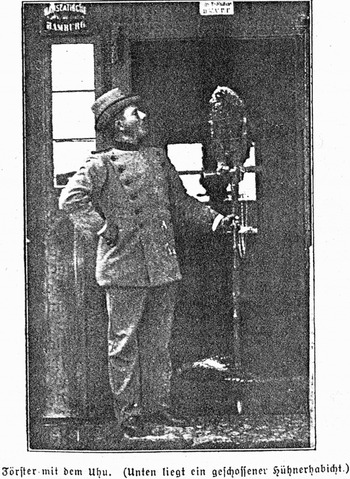
The new discipline of forestry was an important tool through which Friedrich hoped to impose order. With wood a valuable commodity, foresters developed new, “rational” techniques to increase production. Fear of a wood shortage (Holznot) in the late eighteenth century also prompted cameralist states to find ways of maximizing production.Footnote 37 Foresters imposed new mathematical models on the woods, transforming the forest into statistical data that could be manipulated for greatest output. Their methods transformed the forest from an ecosystem into an abstract natural resource, “imposing on disorderly nature the neatly arranged constructs of science.” With a greater knowledge of which trees provided the greatest amount of timber in the shortest amount of time under specific conditions, forestry experts began to reshape the woods. Fast growing pines, some of them non-native species, proved most efficient, and large swaths of territory were given over to their production. Moreover, foresters eliminated all “unproductive” plantlife (and with it, many sylvan animals) and planted trees in grids for easier surveillance. For the forester, a new aesthetic arose that took “geometric perfection as the outward sign of a well-managed forest.”Footnote 38 These changes allowed for the deskilling of sylvan laborers through the standardization of cutting procedures. It also required the exclusion of the peasantry, who in many places still maintained feudal use-rights (Servituten) to the woods, for “unauthorized disturbances—whether by fire or by local populations—were seen as implicit threats to management routines.”Footnote 39 This new method of production, pioneered in Germany and emulated across the globe, imposed a new set of legal standards regulating wooded property. While Prussian authors hailed Friedrich's struggle to drag the region “out of chaos and into freedom,” as one commentator put it, not everyone was so keen on German forestry's new techniques and legal sanctions.Footnote 40 As on the North American frontier, indigenous people did not welcome the encroachment on their way of life. Therefore, Friedrich placed the heath under the administration of his War Department (Kriegskammer) and installed soldiers and officers in the roles of chief foresters and other forestry officials. While they might have had little idea how to cultivate the stands of timber, they did know how to protect state property.Footnote 41
Friedrich's soldier-foresters maintained a semblance of order in the state forests, according to Borne, but most Pomerelian land was in private hands. With the crown's woods now inaccessible to the local populace (who along with the starosti had used the lands of the Polish monarchs), many ostensibly turned upon their own stands of trees. The West Prussian Forest Ordinance of 1805 attempted to regulate private woodlands, but Borne argued the subsequent liberal property reforms of the Stein-Hardenberg era undermined this measure. He maintained the forests were “exposed to the unlimited recklessness of a population unripe for the freedom of using a great sylvan treasure.” Heavy deforestation followed, a problem apparently only seriously addressed after the pregnant year 1871, Borne asserted.Footnote 42 Even on the eve of the First World War, peasants in the Tuchel Heath reportedly continued to engage in suspect forestry practices. One observer described private Kusselwälder throughout the heath, consisting of over-exploited and uncultivated trees, pillaged of their branches before they could fully develop.Footnote 43 German foresters and other observers told a very similar story about Kashubia, where Berlin “surrendered” royal forests to the local peasantry in the summer of 1808. The end of state restrictions on land use—meant to promote development—unleashed instead destruction on the woods. As Schütte explained,
The population of these territories failed to see that the productivity of their fields, a steady income, and indeed their entire existence depended on the presence of their forests. Often half-drunk, they cast off their timber reserves to wood-dealers one tree or whole plots at a time; what the merchants could not use, they cut into firewood, and they did not stop until their supply was exhausted and the present sorry state had been achieved.Footnote 44
Confident of their own ability, Prussian foresters emphasized that the peasants of the Tuchel Heath and Kashubia were immature and lacked managerial sense. Rather than conserving their resources, they squandered them “half-drunk” for quick gain, without any regard for the future. Of course, such authors overlooked the many German estate owners who also cut down their own stands of trees in economic hard times.Footnote 45 This irresponsibility necessitated state intervention, according to Schütte and Borne, both in the form of reforestation as well as the complete reform of local social and economic conditions. The essence of the environmental chauvinist argument ran thus: Germany (and the Prussian foresters in particular) needed to save the Pomerelians from themselves.
The majority of Pomerelians, for the most part Slavic-speakers (generally Polish dialects in the south and Kashubian in the north) along with a German-speaking minority, suffered from endemic poverty; the poor soil meant low agricultural productivity and consequently destitute peasants. In particular, German authors often depicted Kashubians as a primitive rural people (unlike their more “haughty” Polish cousins who sought to assimilate them), living a hardscrabble existence on this marginal land.Footnote 46 Ostensibly exacerbating the meager soil were the Kashubs' flawed farming practices. Borne lamented that their “agriculture is as planless as their handling of the forest,” and characterized the condition of their fields, pastures, livestock, farm buildings, and roads as dismal. The forester Oskar von Riesenthal portrayed the Kashubs as “simple,” satisfied to subsist on a diet of herring, potatoes, and sauerkraut (bread was apparently a rare luxury).Footnote 47 Indeed, in places the land was so unproductive that peasants depended on the many lakes for food. Reportedly, some Kashubian villages lived solely from fish, but as with the forests and the fields, the Kashubs were also charged with overtaxing the waters.Footnote 48 The long-term project to reform the landscape and address this poverty became a justification for German rule.
Of course, many German authors considered such impoverished conditions as an impediment to the advance of civilization. The impecunious residents of the Tuchel Heath supposedly stood “helpless against an unfriendly environment.” Their superstitions, particularly about vampires, struck one German teacher as particularly “inimical to culture (kulturfeindlich),” leading them to adhere desperately to Catholicism; in discussing this backwardness, he proclaimed, “an absolute devotion to the Church and a total subordination under the command of the priest rule there, as much as the clinging to old customs and morals.”Footnote 49 As a strong advocate for reforestation in Kashubia, Borne likewise complained of the “unusually low level of culture” in Kashubia, despite Prussian rule. Both Borne and Schütte dismissed the Kashubs with their “low level of education”; their “laziness, drunkenness, and filth”; as well as their lack of “a sense of order and of industriousness.”Footnote 50 From the German point of view, these characteristics made the Kashubs more loathsome than the nationally minded Poles, but at the same time less dangerous. Borne commented that “the Kashubs lack the national consciousness and the fiery liveliness of the Poles,” suggesting that Kashubian backwardness was an economic problem but not a political one. Yet Prussian officials in Pomerelia had to contend with another vexing characteristic attributed to the Kashubs that threatened the state: their “tendency toward the theft of wood, fish, and game.”Footnote 51
Many Pomerelians (likely regardless of their ethnicity) seem to have resisted the encroachment of the Prussian state on their territory and livelihoods. According to German sources, as the authority of the old Polish kings eroded, everyone appropriated the fruits of the forest for themselves. Prussian foresters perceived a continuation of such practices into their own time. One observer commented, “the people of the Tuchel Heath regarded the woods for centuries only as property of the Polish king, which one could dispose of as one wished.” Thus, foresters complained of the difficulties in establishing their authority, eager as they were to impose “law over chaos” and exclude everyone from their rationally managed forests. German authors perceived these limits as especially irritating to the Polish gentry, the szlachta, which had enjoyed certain rights to the woods that Prussian foresters now revoked as aspects of “Polish arbitrariness and mismanagement.”Footnote 52 But common Pomerelians—Poles, Kashubs, and Germans alike—also resented their exclusion from forests they had once used, and often resorted to surreptitious protest. Schütte complained of the days when “the cutting down of trees and signposts lining the roads, the knocking down of stacked cordwood and public notices, the disarranging of the sector markers, [and] the tending of livestock in the newly planted areas” vexed local foresters.Footnote 53 While some of this resistance—such as pasturing cattle in the forest, or wood theft and poaching, as we'll see—clearly profited the peasantry, most of the acts Schütte identified aimed to sabotage the foresters' work. Indeed, to use James Scott's term, they sought to undermine the “legibility” of the forest by removing the markers that allowed the foresters to read and control the space.Footnote 54 Vandalized signposts no longer guided their way through the woods, rearranged sector markers failed to correlate to maps, toppled cordwood had to be reassessed before it could be sold, and missing public notices blurred the boundaries of where, for instance, one could legally pasture one's animals. These challenges to the foresters' authority made it difficult to impose the order deemed necessary for rational forestry.
Whether as a means to harass Prussian officials, turn swift profits, or simply make ends meet, Pomerelians engaged in a broad range of activities that contravened Prussian law. Royal foresters—as symbols of the advance of capitalism, state authority, and/or German domination—became the object of much resentment.Footnote 55 As tensions rose and foresters enforced laws more rigorously at mid-century, violence erupted in the woods. German authors increasingly viewed conflicts over forest practices through a nationalist lens; however, we should be cautious not to read peasant resistance in nationalist terms. One recent study of the region found that nationalism did not emerge from below, and that a process of assimilation between Polish and German peasants was underway before state and religious authorities interrupted it in the late nineteenth century.Footnote 56 By the First World War, however, it was probably true that Prussian foresters, “amid an ill-willed population,” still had “three enemies in the Tuchel Heath: the poacher, the wood thief, and the forest fire.”Footnote 57
Wood Theft
Pomerelian peasants relied on a wide range of forest resources to sustain themselves in a tough environment. Mushrooms and berries supplemented the human diet; livestock found fodder in the forest undergrowth and clearings; peasants carted away dead leaves and pine needles as feed and bedding for their animals. But above all, wood was a critical resource, necessary as fuel for heating and cooking, as well as material for crafts and construction. Of course, some also sold timber to supplement their incomes as well. And wood became the source of great conflict between peasants and foresters, given that timber was the resource the state most prized. Whereas these resources had once been widely available for the taking, Prussian efforts to enforce new legal limits on public use denied many what were daily necessities. In the name of the common good, foresters criminalized traditional forms of subsistence to maximize profit for the state.Footnote 58 Consequently, as the state intensified its control over its territory in the nineteenth century (i.e., as more foresters patrolled the woods), reports of theft increased.
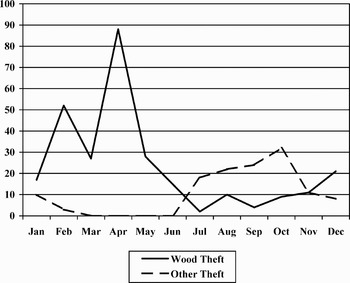
Such appropriation constituted an important element of peasant subsistence in the Tuchel Heath, tied to the seasonal rhythms of rural life. Wood theft predominated in the winter, when work was scarce and fuel was in high demand, and declined in the summer and fall, when peasants tended their fields. By contrast, other forms of theft (such as of berries, grass, or mushrooms) rose in the months when these products flourished. Records of the 410 thefts from Schütte's Woziwoda forest district in 1875 illustrate this seasonal pattern (see figure 1).Footnote 59
Cases of Forest Theft in the Woziwoda Forest District, 1875.Footnote 60

As the graph suggests, wood theft stood as the most prominent form of theft in Woziwoda. Forestry records from the 1870s recorded some personal information about the accused wood thieves. Most of them were local crofters and herders, generally men, although sometimes their wives and daughters were also caught in the act. Moreover, the lists indicated several members of the same families were accused, sometimes multiple times, suggesting they may have depended on the forests more heavily than others.Footnote 61
Wood theft had long constituted an enormous problem for the Prussian foresters of the Tuchel Heath. According to Friedrich II's chief tax assessor, the village of Wigonin lived solely from trafficking timber stolen from state forests.Footnote 62 In the early nineteenth century, state profits from its timberlands in the region remained meager as peasants carried off several whole trees nightly. Foresters of the period despaired of ever getting the problem under control.Footnote 63 One former forester recalled that wood thieves operated on a commercial level in the 1850s, arriving on dark nights in three or more wagons to help themselves to the sylvan bounty. Local sawmills abetted the pirates, accepting stolen timber without question and declining to inform authorities of irregularities. A state crackdown—including the posting of more foresters to the region and stepped-up patrols—resulted in a rising level of violence, including gunfights.Footnote 64
Archival materials from the early 1870s through the early 1890s illustrate the range of conflicts between foresters and peasants, frequently resulting in physical altercations. Pomerelians continued to resist the state's attempts to limit their access to the forests and persisted in appropriating wood and other resources for themselves. Records from the state-owned Czersk forest district in the Tuchel Heath documented several encounters between foresters and suspected wood thieves, several of which escalated into violence. Often the circumstances were the same: the forester ran across a man in the act of collecting wood and pursued him home, where some deception and/or struggle would ensue. Sometimes the encounter would prove more vexing than violent, as in the 1881 case of the Kartz family. After witnessing Johann Kartz and his son Anton in the act of stealing timber, the forester Kliewert reported tracking them to their home where he confronted them. They gave him false names, and several days later when Kliewert discovered this deception, he returned to confront them again. Undeterred by the angry official, Johann Kartz claimed Kliewert had miswritten their names in a drunken stupor.Footnote 65 Such an accusation likely infuriated Kliewert, undermining as it did the fundamental dichotomy between the industrious Prussian officials and the indolent Polish peasants.
Other episodes in the battle against wood theft threatened more than just irritation. In 1871, for example, the forester Christow chased the alleged wood thief Slominski to his home. Upon arriving at Slominski's cottage, Christow discovered Slominski's horse in its stall. Slominski's wife claimed her husband was away and that the gray mare in the barn was not theirs, but when Christow attempted to seize the horse as collateral, Slominski himself emerged claiming no knowledge of the heist and demanding the return of his mare. When Christow insisted he had evidence, Slominski shoved the forester and ripped the reins from his hands.Footnote 66
While Christow's encounter proved relatively harmless, other officials encountered more stubborn and violent opposition. In 1888, the forester Knop found himself in an altercation involving firearms. Following tracks from the stump of an illegally felled tree, he arrived at the farm of the Kannach brothers. There he discovered what he believed to be the stolen wood, whereupon Stephan Kannach seized the rifle slung over Knop's shoulder. The two struggled for the weapon, attempting to tear it from each other's hands. Desperate, Knop released the trigger, attempting to wound Stephan and regain control of his gun. The shot missed and attracted the attention of Stephan's brother Vincent. Both Kannach brothers managed to wrest the gun from Knop and evict him from the house. The humiliated forester then sought the intervention of the village elder Przytarski, who negotiated the return of the rifle.Footnote 67 Knop's struggle illustrates how dangerously close foresters and wood thieves came to killing one another.
Interestingly, violent episodes frequently involved the entire family. In an 1892 incident, the forester Lange along with his assistant Emig attempted to search the farm of the suspected wood thief Johann Grzonka for stolen timber. While they found neither Grzonka nor the wood, they did come upon Grzonka's furious wife, who denounced the two with a variety of insulting names (“Spitzbuben …, Räuber, Landstreicher, Louis, Bummler”) and proceeded to lock the hapless Emig in the barn.Footnote 68 Only with force could Lange push the woman aside and free his assistant, he reported, at which point Frau Grzonka came at Emig wielding a log. Lange used the flat of his knife blade to block the attack.Footnote 69 In a more serious clash six years earlier, the forester Knop persued the alleged wood thief Johann Wloch home, where he disappeared inside. When Knop demanded entrance, Wloch's children and angry wife Katharina swarmed him. Detecting Wloch under a cover of blankets and cushions, Knop attempted to arrest the man, only to be blocked again by the visibly pregnant Katharina and her children. Knop reported threatening her with his knife, to no avail, and then resorted to beating her with its butt until she released her grasp from her husband (he noted he did this in a way so as not to harm the pregnant woman).Footnote 70 Such stories not only illustrate the continuing violence associated with wood theft, but also highlight the role of entire families in confronting Prussian authorities.
Besides confrontations over wood theft, women and children also ran afoul of the authorities for appropriating other sylvan resources. In particular, foresters confronted many locals for allowing their livestock to graze in unauthorized areas, as well as for collecting straw and leaves in the forest for fodder. Prussian forestry regulations strictly controlled these practices, worried that a complete removal of the woods' undergrowth would harm the production of healthy timber. Yet, as with the theft of wood, the local populace felt few constraints. In the summer of 1888, forester Haase reported that he caught Frau Stamplewski with a forged permit for the collection of straw, a document her husband admitted to altering.Footnote 71 While Frau Stamplewski apparently did not offer resistance in this case, other women (like the wives of the accused forest thieves) were more demonstrative. Marianna Wloch embarrassed the infamous forester Knop when he ordered her to dump out her basket of illegally garnered straw and leave state property. She insisted in Polish that he had no right to evict her from the woods and then, according to Knop, “she lifted her skirts, squatted in my immediate vicinity, and sh … (improved the forest soil).”Footnote 72 Similar vexing defiance also found its way into the forester Oskar von Riesenthal's sketches of the Tuchel Heath. He grumbled in 1871 about children letting the animals in their care devour freshly planted saplings. In his drawings of an encounter with such young herders, the forester berates the children while they “act as if they were mute.” During his tirade, a bull charges the forester's horse, sending the steed galloping off into a bog to the children's delight. Riesenthal used the fictional episode to convey a point: “The people's way of thinking is reflected in this bovine:/ Appearing as innocent as a child, they seek quietly to do harm;/ Perhaps he who shoots at you tomorrow kisses the hem of your coat today,/ “Be on your guard at all times”—that is the moral of this picture.”Footnote 73 Along with male wood thieves, women and children challenged state control of the forest.
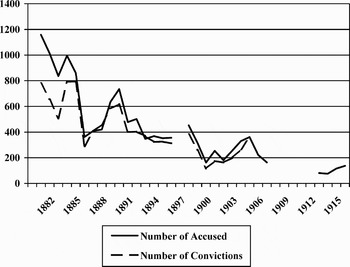
Fortunately for the foresters, incidents of wood theft generally declined from 1880 onward. As records from the Ciss forest district indicate, accusations against wood thieves fell from a high near 1,200 annually to well below 200 by the First World War (see figure 2). This decline suggests wood theft became less of a generalized problem after about 1893, when the state initiated a reforestation campaign in the Prussian east. It therefore may have been due to an intensification of sylvicultural activity in the woods, meaning more foresters on the ground and more of the locals drawn into the formal economy of the woods as seasonal laborers in the winter. This effect may also have been compounded by the generally improving economy, both in the industrial and agricultural sectors, drawing seasonal laborers away from the heath. At the same time, while the number of accusations sank dramatically, those accused were increasingly likely to be found guilty. Foresters' growing success in nabbing their foes may indicate the courts' increasing intolerance for suspected wood thieves, but combined with the decreasing rates of accusation, it seems more likely foresters had gained better control over their forest districts and could more effectively monitor them.Footnote 74
Criminal Statistics, Ciss Forest District, 1880–1915.Footnote 75

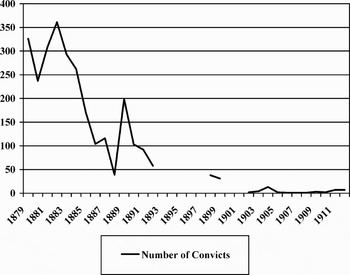
A look at the numbers of penal laborers sentenced to work in the Königsbruch forest district corroborates the apparent decline in forest theft. Courts mandated such penal labor for those who could not pay the required fines. The fluctuations in the numbers of those condemned to penal labor at Königsbruch corresponded fairly closely with the numbers of accusations at Ciss (see figure 3).
Penal Labor in Königsbruch Forest District, 1878–1913.Footnote 76

On both graphs, the rates plunged in the mid-1880s, suddenly rose to a peak in 1889, and then fell again sharply during the early 1890s. Thereafter, it appears, despite some gaps in the data, that the numbers gradually declined to a mere fraction of their 1880s' highs. While this trend could indicate a shift away from the system of penal labor, when combined with the similar fall in the number of convictions, it seems to confirm the overall waning of the wood theft problem.
While the problem of commercial-scale forest theft had abated in the second half of the nineteenth century, anecdotal evidence suggests many peasants continued to appropriate what they needed from state forests. As the pastor Johannes Mühlradt, who served a Protestant congregation on the northern edge of the heath, reported in 1908,
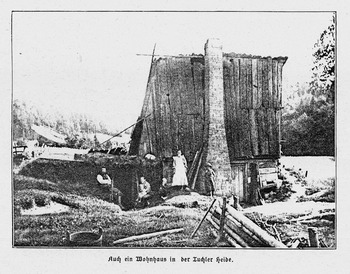
most of the workers' and crofters' homes in the Tuchel Heath are built from stolen wood and almost everyone in this region made no secret of how once, and even still today despite all of my reproaches in this matter, forest theft is not regarded as a sin; here one regards it as the ancient Spartans, who allowed their children to steal, as long as they were not caught.Footnote 77
As one local teacher testified, forest theft continued to vex the heath's caretakers, who could never quite eliminate the practice.Footnote 78 But as frustrating as the confrontations with forest thieves were, another more dangerous foe lurked in the forest: the poacher.
Poaching
The Polish gentry, the szlachta, had enjoyed hunting rights in the royal forests under Polish rule. These rights were denied them by the Prussian state, which sought to liberate the kingdom's woods from all manner of medieval privileges, asserting the absolute property rights of landowners and the government in order to carry out new, scientific methods of cultivation. Despite some efforts at monetary compensation, many members of the szlachta insisted on their traditional prerogatives and continued to pursue game in the state forests. In part, economic imperatives motivated them into defiance; members of the Polish gentry, particularly in Pomerelia, were hardly distinguishable from their impoverished non-noble neighbors and therefore used hunting to supplement their income. “In bands of ten to twenty men, made unrecognizable with black crosses drawn with coal over their eyebrows and noses,” Schütte recalled, “the poachers perpetrated their mischief.” Following mass on Sundays and holidays, they strode out into the woods, so disguised, to take advantage of the foresters' day off.Footnote 79 Yet poachers sought not only fresh game, according to German authors, but also revenge on the Prussian state.
Committed to the memory of the Polish Commonwealth (as well as their lost privileges), so the German narrative ran, some members of the szlachta conducted a clandestine campaign against the Prussian interlopers. In the 1870s, the forester Oskar von Riesenthal complained bitterly of poaching in his illustrated book on the Tuchel Heath. He related a fictionalized account of one unlicensed hunter caught in the act: after promising the chief forester he would reform, the poacher returned later to steal his geese. “Even if Madame [Chief Forester] is very angry,” the mustachioed thief gleefully exclaimed as he absconded into a wintry night, “I like the taste of roast goose!”Footnote 80 Thus the poacher pursued his craft not only for economic motives, Riesenthal suggested, but also in a purposeful effort to antagonize the Prussian official.
In a much more pointed representation, an introduction to the region described the poacher, unlike the common wood thief, possessing “national consciousness … he seems like a red Indian on the warpath; he is a loyalist, who continues his nation's lost war against the Germans; he is irreconcilable, preparing his sons for a greater war that the future will bring.” Indeed, poachers often resorted to violence. In testing the mettle of new officials, poachers at mid-century reportedly turned to torture or even assassination when bribery and intimidation failed.Footnote 81 Schütte summoned up (admittedly humorous) incidents of foresters being forced to dance barefoot on pine needles by such malicious bandits.Footnote 82 Thus he insisted that duty in the heath demanded “a constant awareness during one's service in the field, which was not rarely tied to mortal danger,” on account of the hostile locals.Footnote 83 And while contraventions of Prussian forest law generally declined to the First World War, they did not disappear altogether. Although poaching both expressed folk resentment and undermined Prussian authority in the region, another perhaps even more treacherous threat lurked in these frequently parched woods: fire.
Arson
While by the 1890s the state had largely imposed its own order on the heath, fire continued to threaten both life and property. The Tuchel Heath was often struck by drought, turning Friedrich II's woodlot into a tinderbox. As Riesenthal commented in the 1870s, “that the heath has not yet totally burned is truly a wonder of God.”Footnote 84 Riesenthal's belief in divine intervention stemmed not only from the forest's survival in spite of the elements, but also despite human conspirators. Perhaps as the most radical form of protest against Prussian rule, arsonists set the timberlands alight, not only destroying state property, but also frustrating Berlin's plans for the region. While some peasants set fires for purely agricultural reasons, such as creating new pastures for their livestock or areas of heather for their bees, in many cases German foresters suspected political motivations dominated. As Schütte observed, wildfires were “often enough set out of vengeful resistance against the new government.”Footnote 85 In most detailed discussions of the Tuchel Heath, authors mentioned the relationship of major forest fires with political unrest.
Schütte apparently first proposed the connection between politics and fire.Footnote 86 The early 1860s, when Russian Poland exploded in unrest, stood out in particular. Schütte himself witnessed particularly large fires in 1862, followed by the calamitous year of the January Uprising itself. On Sunday, August 30, 1863, while most of the community sat in church, a huge blaze erupted that consumed more than twelve square kilometers. Meanwhile, Polish (and even some German) volunteers departed for the Russian frontier to fight the archconservative colossus and restore Poland. These partisans waged a guerilla war against the tsar's army, sometimes ambushing Russian units only a hundred kilometers away. Tensions would have been high in the German east, where nationalist Poles and Germans alike anticipated the outcome of the uprising, and the application of such guerilla techniques as the sabotage of state property would not come as a surprise under these circumstances. Large fires also afflicted the heath the following year, as the insurrection across the border petered out. Smaller infernos also erupted during the height of the Kulturkampf, which attempted to alter everyday life in even the remotest schoolhouse and parish. To Schütte, these fires contained a sinister political message.
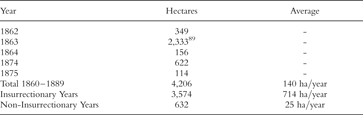
Schütte proceeded to tabulate the amounts of woodland lost annually and found a strong correlation between periods of ethnic unrest and unusually severe fire seasons (see table 1). According to Schütte, between 1860 and 1889, forest fires ravaged an average of 140 hectares per year. In years of political unrest, however, that average rose to 714 hectares. If one excludes those years, however, the annual average falls to a mere 25 hectares. Moreover, he suspected that this pattern had long preceded the records, which had only been kept since 1860. Schütte observed that, “If one considers that the events of 1794 and 1807—probably also 1846 to 1848—were burned deep into the memory of the heath, then the connection with political events leaps before our eyes.”Footnote 87
Forest Fires in the Tuchel Heath, 1860–1889Footnote 88
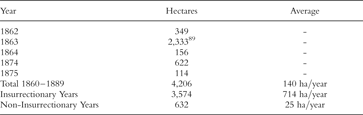
These figures confirmed what he already believed: the fires were politically motivated. The attitude of the local peasantry, as he perceived it, betrayed the origins of the conflagrations: “They first looked for a long time at the smoke with malicious joy, being pleased at the ruin of state property and the torment of forest officials, before they slowly and reluctantly reported to the firelines.”Footnote 90 Whether Schütte's observations were coincidental, other authors embraced them as illustrations of Polish treachery.
Accusations and coercion from the Prussian foresters inspired resentment among the inhabitants of the heath. In May 1888, fourteen residents of the small lumber-mill town Czersk leveled their own complaints against local foresters. Appealing to district authorities, these peasants claimed that Chief Forester Feußner, in an attempt to extort the name of a local arsonist, refused to allow their animals to graze on state property. While such pressure seems in keeping with Prussian tactics, the Czersk petitioners went on to make a much more serious allegation. They believed the foresters sought to reserve all the state pastures for their own livestock, purposefully excluding the peasants. Moreover, they claimed “the foresters themselves are the arsonists, in order to make room” for more of their own cattle at state expense. According to this account, the heath's corrupt foresters, in an attempt to expand their herds, supposedly torched the woods to increase the area for grazing, in turn blaming the peasants for the problem and consequently barring their livestock from the pastures.Footnote 91 Both sides thus traded accusations of arson.
District authorities responded by ordering an investigation of the petitioners. They sought to uncover the sponsors of this “insult” against the royal forest officials. After questioning, a number of the petitioners identified a Czersk linen weaver named Radtke as the culprit. Interviews revealed that he had drawn up the document (in German, which he read to the peasants, with an oral translation into Polish for the two who did not understand the original) based on two pieces of evidence. One petitioner claimed to have witnessed the outbreak of a fire shortly after a forester had passed (although he apparently could not remember the exact circumstances), and three others encountered four cows reportedly belonging to the ill-tempered forester Knop grazing in the forest.Footnote 92 While it remained unclear why Radtke in particular initiated the petition, the peasants' resentment of the Prussian forest authorities, and especially Knop (the only forester mentioned by name in the petition), probably contributed to their assent. Indeed, one of the petitioners was Johann Wloch of Czersk, likely the same man whom two years earlier Knop had arrested for wood theft and whose pregnant wife Knop had beaten with the blunt end of his knife. Thus the peasants' claims, while based on thin evidence, illustrate their resentment of the foresters and the increasing politicization of the issue.
By the late 1880s, Schütte claimed the worst period of the forest fires, like forest theft and poaching, lay in the past.Footnote 93 The optimistic pastor Johannes Mühlradt agreed twenty years later, relegating politically motivated arson to the past. Forest fires resulted from inattention, he claimed, and “seldom from malice, in order to fool the forester or make life uncomfortable for him.” Such arson no longer occurred, Mühlradt observed, because the population had come to recognize the state forests as a positive element of the landscape, an institution upon which they had come to depend. They reportedly “gladly assist and support the foresters” by bringing them beer to quench their thirst during pitched battles with the flames.Footnote 94 Fire, like poaching and wood theft, apparently had faded into memory.
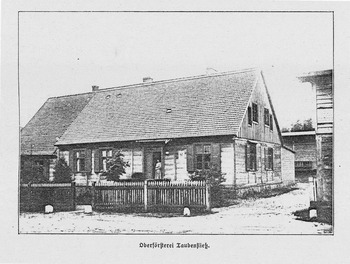
Yet Mühlradt's sentimental pictures of harmony on the ethnic frontier belied the continuing seriousness of political arson. In 1912, one observer noted that while incidents of wood theft and poaching had declined, arson remained a problem.Footnote 95 And a 1908 review of Mühlradt's work indicated that “the struggle between the Germans and the Poles” had in fact spilled over into backwaters such as the Tuchel Heath and had “taken on a harshness even in these regions.”Footnote 96 According to government statistics, in May 1901 (as the Wreschen/Września school strike commenced in the neighboring province of Poznania), one arson fire in the Junkerhof and Taubenfliess forest districts alone ravaged a total of 663 hectares of woodland, more than in all of the heath during the crisis-year 1874.Footnote 97 Likewise, in 1910 (following the verdicts in school strike trials), another 400 hectares burned in the Wildungen forest district alone.Footnote 98 These major fires, far exceeding the annual average, seem to suggest the foresters' fears were not far fetched. Indeed, comparisons to the rest of Prussia suggest that the forest fires in years of political turmoil may not have been simply the cause of climate. Across the kingdom, large forest fires broke out in the dry summers of 1868, 1881, 1892, 1900, 1901, and 1911. The Tuchel Heath's large fires of the early 1860s and mid-1870s therefore seem more inspired by political events than climate.Footnote 99 Given that arson, more than poaching and wood theft, presented few if any material gains for its perpetrators, it would seem more likely an act of political resistance. The ongoing episodes of arson suggest resentment of the Prussian state's interference in the woods persisted, whether for nationalist or economic reasons.
Polish firebrands, German nationalists charged, targeted their attacks not only on the Prussian state, but also on order in general. As an anarchic band of thieves unaccustomed to discipline and averse to law, so the argument ran, the Poles naturally rejected Prussian authority and regulations. One guide to the region stated that, “as Prussian order permeated [the heath], the beekeepers, the poachers, the wood thieves, and all manner of other riff-raff could no longer do as they pleased; therefore they gave vent to their grievances in arson.”Footnote 100 Neither the Kulturkampf against the Catholic Church, the language ordinances against the use of Polish in schools, nor the myriad of other intrusions on the daily lives of Slavic speakers in eastern Germany provoked these attacks, such authors implied; rather, the friction between Prussian order and Polish chaos had ignited the woods. Thus burning state timberlands was not a protest against the abuses of German rule, but instead an act of “vengeance against the ordered discipline of the Prussian forest authorities.”Footnote 101 Another author concluded “that chaos's hate of the Prussian desire for order led to the forest fires,” characterizing such attacks as the “senseless vengeance of impotence.”Footnote 102 According to this view, Germans countered this reckless lawlessness and imposed civilization. German authors agreed that only once the Slavic population of Pomerelia learned the Prussian virtues of order and discipline, along with the benefits of German rule, would the attacks on the forests and the state come to an end.
While the Prussian foresters approached the local populace with a stern paternalism, these provocations—whether real or imagined—do not seem to have led the foresters or other state officials to embrace the language of race to explain their problems. Only two German authors writing about the Tuchel Heath on the eve of the First World War—Erich Wernicke and Adalbert Luntowski—briefly identified the region's problems as racial in origin. Wernicke, a girls' school principal in nearby Marienwerder, described the economic and cultural decline of the heath after the departure of the Teutonic Knights as the result of “blood mixtures” between German settlers and the indigenous Slavs.Footnote 103 Luntowski—a translator of Gobineau into German and a völkisch eccentric who would found a spiritual commune during World War I—echoed Wernicke's “racial law.”Footnote 104 But even with these forthright statements of racism, both authors held out hope for the assimilation of the local Slavs. Wernicke seemed to have no problem with the Teutonic Knights' policy of “the melting together of the German settlers with the Slavic [wendischen] inhabitants, as they succeeded in doing on the other side of the Vistula [in East Prussia].”Footnote 105 Luntowski, meanwhile, celebrated state efforts to “improve the land and its people.”Footnote 106 Despite momentarily deploying commonplace racial formulas, both authors seemed to believe that German rule could transform the region and assimilate its populace. No one proposed driving the indigenous peasantry off the land. Indeed, reforming the land and populace went hand in hand.
Forestry as Civilization: Discipline and Improvement
Critical to their control of the landscape, Prussian foresters understood, was the control of the local population. One forester who had worked in the Prussian east in the 1870s recalled, “We protected the forest from fires by forest rangers and by having proper morals in the neighborhood.”Footnote 107 Extending their influence over the forest thus meant policing and reforming its populace. Policing was easy enough; the level of poaching fell, Schütte testified, with the increased patrols of the forest on holiday mornings to prevent this “bad habit” (Unsitte).Footnote 108 In 1872 the provincial government in Danzig, perhaps responding to a sense of laxity, reminded foresters in the province to wear their uniforms and to carry weapons in order to enforce forestry regulations effectively.Footnote 109 Hundreds of impoverished members of the szlachta convicted of violating forest regulations lost their titles.Footnote 110 In 1884, provincial police authorities banned all fires (including smoking) from the woods, required permits for all those engaging in economic activities in the forest, and ordered all timber products being transported from state forests be accompanied by a testament as to their origin.Footnote 111 In order to elicit (or coerce) cooperation against forest fires from the peasantry, the local forest officials agreed to return a portion of their pasture fees should no large fires break out in the forest district. As Schütte observed, “With the indolence of the heath's population and their lack of recognition that their own well-being was closely tied to the forest, one turned to their immediate pecuniary interests.”Footnote 112
Schütte's comment suggests the larger goal of Prussian foresters in the region. While policing could limit the financial losses to the state over the short term, overcoming the local peasantry's “indolence” and “lack of recognition” of their own welfare stood as an important, ongoing aim. After all, the peasants had been paying the extra pasture fees since the 1830s, yet forest fires continued to erupt in times of crisis through the turn of the century. Fundamentally, the foresters sought to discipline the local Slavs as they were disciplining the landscape: transforming an unproductive land and people into a well-regulated part of the national economy. Indeed, already in 1834 the chief forester at Schwiedt had insisted that “The Polish inhabitants of the Tuchel Heath must be cultivated by all conceivable means, which admittedly in the first years will be as impossible as the planting of trees (Anlage einer Kultur) on dead soil.”Footnote 113 In this formulation, the connection between the two primary meanings of Kultur becomes clear; a flourishing human culture depended on a blossoming agriculture. Development of land and people thus would be carried out hand in hand.
Disciplining this region had long been a priority. As early as 1773, shortly after Prussia acquired the territory, Friedrich II built the Bromberg Canal to link the region to the developing Prussian economy. After the disruptions of the early part of the nineteenth century, the state resumed the major public works program in the region in 1842. Investment in canals, dikes, bridges, roads, and eventually the extension of railways (the Bromberg-Dirschau railway of 1853, the first in the Prussian east, ran through part of the heath) strengthened West Prussia's integration into the kingdom's transportation infrastructure. The Ministry of Agriculture, interested in extracting the heath's timber, sponsored road improvements and new rail depots. The Ministry also initiated drainage and irrigation projects in the heath to develop new pastures and cropland. By the 1880s, these efforts encompassed more than a thousand hectares.Footnote 114 Foresters in particular imposed order on a large part of the province, laying out their forest districts on a grid. They straightened and paved the sandy tracks, planted their pines in neat rows for easier harvesting, and created a huge gridwork of firebreaks visible on maps of the province.Footnote 115 At the turn of the century, Pastor Mühlradt commented on the modern sawmills that sprang up around the heath, arguing “the wood industry in the Tuchel Heath is indeed highly developed.”Footnote 116 The nearby town of Czersk benefited from not only the sawmills, which employed about 390 laborers, but also the picture frame industry. At least one factory employing 400 workers turned the soft pinewood into the ornately carved borders, another gilded them, and yet another provided the glass.Footnote 117 Another facility produced railroad ties for German railway expansion, as well as for export to England.Footnote 118 Local officials celebrated this modernization; one forester gave a loving description of his forest district with its mixture of trees, scattered settlements, church steeples, and modern railway bridge.Footnote 119 Far from a romanticized landscape, German authors reveled in the heath's modernization and looked forward to the growing benefits of Prussian rule.
The expansion of state forests in the Marienwerder Administrative District, the southern half of the Province of West Prussia including the Tuchel Heath, contributed to the Germanization of the region. According to the Eastern Marches Society, Prussian reforestation efforts meant the state forests in the district had doubled in size between 1867 and 1911, growing by more than 180,000 hectares (or 1,800 square kilometers).Footnote 120 While in 1874 there were a total of twenty-seven state forest districts organized in four inspectorates, by 1918 their numbers had almost doubled to fifty forest districts in seven inspectorates.Footnote 121 In the Tuchel Heath between the 1890s and the First World War, the state doubled its landholdings to own a full two thirds of the land, as well as expanding the number of forest districts from nine in 1886 to twenty-three in 1913. This enormous expansion of both the dimensions and administration of the local state forests occasioned the stationing of extra personnel in the region. The number of forestry officials in the heath doubled during the 1890s to more than two hundred by 1901. Added to this number were at least another hundred watchmen in 1892 (tripling to three hundred by World War One), not to mention around eight hundred servants and farm hands employed privately by forestry officials.Footnote 122 This enlargement of the state forests extended the control of Prussian officials over the landscape and its inhabitants.
While the state maintained only two hundred officials in the Tuchel Heath by the turn of the century, this relatively small number helped to tip the balance of power to the Germans (and the state) in this sparsely populated region.Footnote 123 A look at the Tuchel Heath on an ethnic map of the Province of West Prussia from 1905 reveals that in this predominantly Polish area, the state forests tended to be designated as German, while the surrounding fields were not.Footnote 124 By 1897, after just a few years of the state's concerted efforts to expand its property, foresters played an important part in local administration. Of the fifteen communities (Amtsbezirke) in Tuchel county, chief foresters controlled four and foresters served as deputies in a further four (most of the remaining positions were occupied by local landowners).Footnote 125 Foresters, more than private citizens, could be counted on to carry out the agenda of the state. As Prussian state employees working in the German east, foresters were obliged by the Beamtenerlaß of 1898 to work “in the interest of Germandom.” Specifically, this meant officials could be dismissed for sending their children to Polish schools or voting for Polish candidates. Five years later, in an effort to keep German officials at their posts, the Eastern Marches Subsidy (Ostmarkenzulagen) provided hardship compensation (a ten-percent raise) for those government employees who had worked in the settlement zone for more than five years.Footnote 126 While foresters did not differ from other state bureaucrats in this regard, they proved of special utility because their influence spread over the countryside, while most other officials were concentrated in the larger towns.
Apparently, foresters fulfilled their political role well. In a meeting of the Prussian cabinet in 1904, several government agencies reported difficulties in getting their staffs to adhere to the regulations set down by Berlin. Minister of Agriculture Victor von Podbielski proudly boasted that “no official (Beamte) of his ministry has cast his vote in favor of a Polish delegate.” Those who had simply avoided the polls, he announced, had been shifted to other provinces. He justified this administrative procedure by claiming he had never taken measures against any bureaucrat based on his electoral behavior, but rather used this information to determine “whether the official proved himself capable and in the appropriate position.”Footnote 127 Clearly, the minister regarded voting for German candidates as a mandatory responsibility of all his bureaucrats, and contravening this expectation had consequences for one's career.
Podbielski's pressure on his local agents to vote German contributed to a shift in the political balance of power in the heath. In the Reichstag elections of 1881, the electoral districts of Neustadt-Karthaus, Berent-Preußisch Stargard, and Konitz-Tuchel—running southward from the Baltic through the Kashubian highlands to the Tuchel Heath—formed “a firm bastion of the Poles and the Kashubians, such that a German candidate had absolutely no chance of gaining a seat.”Footnote 128 By 1912, however, West Prussia's Polish delegation in the Reichstag had been reduced to defending their electoral fortress. While in 1881 Poles had carried three other constituencies, in 1912 they managed to take only the hills of Kashubia and the pine barrens of the heath.Footnote 129 And even there, Polish electoral predominance had eroded. In the Konitz-Tuchel electoral district in particular, German political parties gained significant support. Between 1871 and 1912, German parties more than doubled their number of votes (growing from 2,579 in 1871 to 6,511 in 1912), whereas the Polish party increased its vote by less than half (6,373 in 1871 to 9,104 in 1912). While the Poles continued to carry the Tuchel Heath, they now had to contend with a growing German political presence, rising from thirty percent of the vote in 1871 to forty-two percent in 1912.Footnote 130 While several other factors likely contributed to the Germans' electoral gain, the presence of two hundred loyal Prussian foresters in the region, as well as the laborers under their control, surely contributed to this narrowing gap, particularly in the heath.
Defending the interests of Germandom meant more than just casting one's vote for reliable German candidates; it also meant, according to Podbielski, imposing Germandom on local employees, whose numbers in the heath fluctuated with the season; their total could climb to three thousand during the winter timber harvest.Footnote 131 Besides woodsmen, foresters in the 1880s also employed roughly 1,200 workers to transport timber by cart or by river.Footnote 132 Altogether, in the Marienwerder Administrative District, 13,634 workers labored a total of 864,974 workdays in 1900.Footnote 133 At the same 1904 cabinet meeting mentioned above, Podbielski touted his 1902 order that forestry officials act as “dependable agents of Germandom,” requiring that they “may not speak Polish with any worker.” Podbielski stressed that he “could not abide sympathy for the Poles among the foresters and other officials of the eastern provinces” and considered “severe measures” against any such sympathy as justified.Footnote 134 Podbielski's tradition of strident anti-Polonism set a precedent in the Ministry, extending not only to the language of seasonal laborers, but also to their politics. According to the Polish politician Bernhard Łosiński, a delegate to the Prussian Landtag, Polish and Kashubian woodsmen had to endure political harassment by state foresters. In 1907, one group of lumberjacks near Karthaus (Kartuzy) had been dismissed despite possessing a six-year contract. The local chief forester first claimed he terminated the contract because they had refused to work, and later accused the group of forest theft, a charge that could not be substantiated. According to the woodsmen, the chief forester had abrogated their contract when they refused to sign a declaration in favor of replacing the Polish language with German in religious education in the local schools. Łosiński indicated that there had been similar incidents in the neighboring Mirchau state forest district.Footnote 135 Foresters thus apparently tried to coerce their Slavic employees to support state Germanization efforts in the region.
Beyond the short-term strategies of language restrictions on and political manipulation of its employees, however, the Prussian state still had to achieve its long-term mission of overcoming local “indolence” and “ignorance.” Schütte believed he had laid the foundations for this transformation of the inhabitants of the Tuchel Heath. As he commented in 1893, “the improvement (Hebung) of the inhabitants of the heath—who in their entire lifestyle and civilization (Lebensweise und Gesittung) were still very backward only a generation ago—required none other than the opportunity and the education (Erziehung) for work.” He described how woodsmen learned the necessary attributes of efficient workers:
The punctual start of the work day, the specified time for the continuous planting of trees, the necessary alertness in this project, the orderliness of the correct measurement and good positioning of the saws in cutting trees, the proper felling and cleaning of the trunks, in short, all those details upon which the forest administration places great emphasis, provide in their entirety a very important factor in becoming accustomed to orderly, sustained activity.
State employment also meant officials could reward diligent woodsmen for their efforts—perhaps with a garden plot or an inexpensive rate on animal feed—and punish recalcitrant ones—perhaps by canceling a lease or denying access to pastures.Footnote 136 Schütte thus demonstrated the power of the state to modernize its citizens.
As noted earlier, Schütte's apparent success inspired Borne to pursue a similar project in Kashubia. In an 1892 article in a prominent forestry journal, he advocated reforestation as the remedy to the region's socio-economic maladies. While Prussia had introduced order, military service, and education to the province, Borne contended, there still remained the task of “healing of all damage that Polish rule has left behind.” That damage consisted not only of abysmal environmental conditions, but also a ruined economy and a populace too mired in tradition and superstition to better itself. As Borne put it, “the improvement of the conditions totally or substantially on the initiative of the Kashubian population is not possible.” He proposed an expansive project of reforestation, like that which had already begun in the neighboring Tuchel Heath. Such state intervention would “improve the economically and morally degenerated population. Above all, the habituation to regular activity and the creation of a sufficient earned income contribute to this goal. The extensive cultivation of the wasteland will offer the first opportunity for the employment (Beschäftigung) of workers.”Footnote 137 Thus reforestation benefited the region not only through its impact on the local environment and economy, but also through the “moral” education provided by regular work under German supervision.
For Borne, the Tuchel Heath shone out on the eastern landscape like a beacon of social and economic progress. There, he explained somewhat wishfully, “the barrens are cultivated. The timber planted in the course of the past several years now form a noteworthy source of revenue for the state. The population has accustomed itself to order and work.” The local contingent of foresters had, as he put it, “contributed to the strengthening of Germandom in the Tuchel Heath, encouraged the workers to be industrious and orderly, and served as examples.” Regular work, and inspiration from German authority figures, had apparently led to the decline of taverns and drunkenness, while the state had developed more and better (meaning German) schools. Borne hoped to transform Kashubia in the same way, creating “a forest out of the wasteland, in which a settled population works and finds reward.” He hoped that such sylvan labor would encourage the Kashubians to “accustom themselves to order, industriousness, and thriftiness.”Footnote 138 Borne's favored categories of self-improvement, his belief in the moral virtues of work, and his faith in the attractiveness of the Germans' model of behavior reflected less a conservative agenda than a liberal nationalist attempt to foster the development and integration of Germany's Polish and Kashubian minorities into the national economy.
Borne and Schütte were not alone in their belief that the locals could be educated and molded into a more prosperous society. Many felt that the provision of regular employment in the Tuchel Heath had transformed the destitute locals into hard-working citizens. One author in 1914 celebrated the “the cultivating (erzieherische) power of work, which the forester generously offers.”Footnote 139 In 1901, another account approvingly commented on the state's improvement of the local economy, commenting that the inhabitants, largely dependent on the woods for work, understood German and were “skillful, willing, and able.”Footnote 140 The pastor Johannes Mühlradt of Grünthal observed in 1908 that the inhabitants of the village of Wigonin, who once subsisted from wood theft and poaching, now lived from the wages of migrant workers.Footnote 141 Indeed, in 1904 the district government reported improving labor conditions in the region, noting a steady increase of forest workers' housing, which by that point accommodated 193 families.Footnote 142
Even the two authors who denigrated the locals for their racial origins—Wernicke and Luntowski—embraced the transformative power of labor on the natives. Wernicke attested that the state forests stood at the heart of the heath's economy, bringing prosperity to the entire region. The growth of state forests and the labor they provided for so many of the local families made them “all more or less closely tied to the woods.” Not only men were drawn into the forest's orbit, but women and children also supplemented the family income during the spring tree planting. For Wernicke, forestry converted the locals from exploiters of the landscape into conscientious cultivators.Footnote 143 And Luntowski, although he dismissed the people of the heath as “these squalid mongrels (diese verwahrlosten Mischlingen),” acclaimed the “educational (erzieherische) power of work, which the forester generously offers.” And it seemed the foresters were succeeding in their task of transforming the natives. “What was initially coercion to them gradually became a necessary custom,” he averred, “which carried over into their entire way of life.” Whereas local peasants had once avoided hard work, preferring instead to steal wood, dig up amber, and poach game and fish, “now serious, ongoing, and regulated activity is demanded of them,” he crowed. Locals learned punctuality and order from the foresters, for “the rows of cordwood must be well measured and built.” Work, so central to German identity in Luntowski's formulation, became the “morality-producing (sittlichkeitsschaffenden) center of their lives.” Despite his initial condemnation of the heath's inhabitants, he celebrated the foresters' work in “the improvement of the land and its people in the Tuchel Heath.”Footnote 144
Of course, one conceivable way of Germanizing the heath might have been to drive non-Germans off the land. Such a move could have been conceivable. The population of the region was relatively small and poor, squeezing a living from infertile soil. Certainly, a significant number of peasants sold their land to the state for reforestation efforts; that policy could have been extended to buy out all non-German landowners. Seasonal laborers, so common on the manorial estates of the region, could have been hired for planting and harvesting. At least one prominent agricultural reformer, Heinrich Sohnrey, worried that reforestation efforts throughout Germany were destroying peasant communities and driving farmers off the land.Footnote 145 Yet, no one appears to have contemplated this solution, even in the ethnically contested Prussian east. Rather than displacing the locals, Prussian policy appeared concerned with (forcibly) integrating them into a healthy economy.
Beyond labor, the woods provided other means of sustenance; peasants leased small fields and pastures, which foresters had reclaimed from swamps or made fertile through irrigation, at low prices. The foresters also offered cheap wood for heating and construction, as well as pine needles for animal feed. Small farmers earned extra income hauling logs from the woods to the train depots and sawmills around the forest. The woodworking industry employed thousands in the area, particularly in the town of Czersk. The extension of the railways facilitated the sale of the heath's lumber throughout Germany, apparently bringing about a rise in wages (although they remained below the national average). The foresters had succeeded in transforming the Tuchel Heath, observers commented; without the state forests, Schütte claimed, “the changing level of culture and growing population of the villages in the heath would be impossible, as otherwise there is no population growth in West Prussia.” With praise for the Prussian administration, he announced in 1893, “So today the Tuchel Heath stands as a wooded region with a population of mixed blood, capable of education, secure in their existence, and advancing in their well-being, with the large forests in the hands of the state.”Footnote 146 Apparently for Schütte, mixed blood was a sign of improvement, not decline. And although he would have disagreed with Schütte on this point, even Wernicke twenty years later declared that the heath's residents “live more contentedly, better, and more luxuriously than the urban poor.” All of these factors led him to conclude, “The forest makes the entire economic life of the Tuchel Heath fertile.”Footnote 147
The forester stood as the champion of this transformation. A review of Mühlradt's work on the heath applauded the foresters' “German cultural work (Kulturarbeit)” in this backward and isolated region.Footnote 148 The völkisch author Adalbert Luntowski lauded foresters' productive strength (Kulturkraft). In glowing terms, he heroicized their efforts, reminding Germans they were to thank them as much as Friedrich II for bringing order to the region:
The man, upon whom this creation in the Tuchel Heath depends, is primarily the forester. It is he who calls the other residents to take part in this creation … [He is], so to speak, the law-giving authority for all human effort and for all the activities of these forces all around. The work that he orders has called forth a fruitful reversal in the common condition of culture among the residents of the heath.Footnote 149
In the eyes of these observers, foresters stood out as the heroes of the struggle between chaos and order in this forsaken land. Mühlradt's illustrations reflected this message; whereas the old woman in figure 4, burdened with a load of firewood, appeared oppressed by nature, the forester in figure 5, having tamed an owl and shot a hawk, had conquered it.Footnote 150 Likewise, Mühlradt's depictions of German homes—such as the chief forester's residence at Taubenfließ, where presumably the forester's wife waited in the doorway—demonstrated the domestic order Prussia brought to the heath, quite in contrast to the squalor of the local peasants' dwellings, where male and female inhabitants appeared to loaf about (see figures 6 and 7).Footnote 151
An Old Woman Carrying Wood in the Tuchel Heath.

Forester with an Owl (A shot goshawk lies underneath).

Chief Forester's Residence at Taubenfließ.

Also a House in the Tuchel Heath.

The foresters' intervention in the heath's economy provided positive role models and combated negative cultural influences, commentators believed. Schütte confidently reported in 1893 that, after much effort by Prussian foresters, “the people learned to protect order in the forest themselves.”Footnote 152 The forester Saekel exuded a similar self-assurance when he remarked that “the mostly Polish peasants have learned a lot from the Germans in the last century, and so their whole standard of living has not only improved, but today one also sees that some tidy brick farmhouses with hard roofs have been erected.”Footnote 153 The Poles owed their rising living standards and new farmhouses less to the expanding economy (or to their own hard work), Saekel contended, than to what they had learned from the Germans. Not only had Prussian officials developed local agriculture and industry, so the story went, but they had turned the Poles away from an exploitative and destructive relationship with nature to a more constructive one, as demonstrated by the foresters and others. Pastor Mühlradt cited the example of a local teacher who, along with a class of spade-toting schoolboys, aided the local forester in extinguishing a forest fire. The district administration commended the teacher for his efforts “and for the good example that he provided the population.” While Poles and Kashubs might be inclined to stand aside (if not fan the flames) as state property burned, Prussian officials such as the teacher attempted to illustrate the importance of the forest. To his satisfaction, Mühlradt observed that “increasingly among the population the realization that their interests are intertwined with those of the woods is gaining ground, and that he who damages the forest also hurts [local interests].”Footnote 154 For Mühlradt, it seemed the champions of Kultur had achieved some measure of success.
The Failure of Environmental Chauvinism
The self-confidence foresters and other Prussian officials felt when they looked upon the transformation of the Tuchel Heath could only be sustained with an element of self-delusion. The boundaries of the ethnic communities were generally hardening, not softening, during this period. One study of electoral statistics in the region reveals that ethnicity remained the central factor for the bulk of voters, with few opting for candidates of a different ethnicity.Footnote 155 Moreover, although resistance to the state intrusion into the woods faded significantly by the early twentieth century, it had by no means disappeared and would flare up again in the crucible First World War. Indeed, the First World War saw a rash of poaching, arson, and violence against foresters, reportedly with the support of the local population.Footnote 156 Otto Busdorf, a Berlin chief inspector tasked with combating poaching and the killing of foresters in the eastern provinces, related a sensational account of the poacher Franz Kleinschmidt. Over the course of three years, from 1916 to 1918, Kleinschmidt led an assault against state control of the forests. According to Busdorf's account, Kleinschmidt—a soldier who fled garrison duty in Thorn—led a gang of poachers that “almost entirely wiped out the abundant game population and set countless forest fires” in the heath. He was also accused of burglaries and train robbery. Even more seriously, however, Busdorf connected him to a campaign of intimidation against Prussian authorities, threatening local officials, terrorizing fire spotters (to the point where no one was willing to man the isolated observation towers), killing foresters' livestock, and attacking several state functionaries, including four foresters wounded and one local official and four foresters (along with a private estate manager) killed. Busdorf required six months and a contingent of forty soldiers to track Kleinschmidt down in the wilds of the heath, finally killing him in a gun battle in August 1918. Despite a reward of 13,800 marks, no one among the local populace turned him in.Footnote 157
Busdorf portrayed Kleinschmidt as a Polish nationalist (despite his German name), ostensibly owing to his use of Polish newspapers in the fabrication of handmade cartridges and to his apparent popularity among the common people. His choice of paper may have been purely incidental, however, and the failure of anyone to denounce him may have been the result of intimidation. After all, Kleinschmidt regularly threatened his opponents with death and administered a severe beating to one elderly tailor who cooperated with the police. Moreover, Busdorf does not provide any evidence of Kleinschmidt's political sentiments, although he might have had other information that led him to this conclusion. Regardless of his ethnic allegiance, however, Kleinschmidt's activities undermined the Prussian state's forestry apparatus, taking game, setting fires, and intimidating and killing officials. The fact that the public seemed to grant tacit support to his efforts suggests the failure of Berlin's integration project.
Conclusion
Through the lens of environmental chauvinism, the Prussian state identified two interlocking problems in Pomerelia: poverty and resistance. Peasants scraped a marginal existence from the poor soil, and the region contributed little to the national economy. At the same time, attempts to rationalize production (particularly with regard to forestry) came into conflict with traditional agricultural practices. Local observers regarded the resistance to change as inspired by a stubborn Polish nationalism. As this nationalism had not been squashed by the Kulturkampf or the efforts of the Ansiedlungskommission—indeed, it seemed only invigorated by them—Prussian authorities launched a campaign of state reforestation in the 1890s. The growth of state forests, they believed, would help increase the direct influence of Prussian authority (and hence Germanization) through two avenues: 1) the ownership of large swaths of ethnically contested territory, and 2) the employment of a large number of Poles and Kashubians. These two factors allowed the Prussian state to discipline directly both a wild landscape and an unruly populace. By possessing, developing, and policing the land, Prussian foresters believed they could overcome the long-term economic “mismanagement” they identified there and introduce modernity into the region. New transportation and economic infrastructure would gradually pull Pomerelians into the German nation. Foresters would break the “bad habits” of Slavic wood thieves and poachers, and instead of fighting them as intruders, instruct them as model employers in the bourgeois virtues of orderliness, thrift, hard work, and discipline. Imposing order on Pomerelia would Germanize both the land and its people.
This program of modernization ultimately failed to achieve its main goal: the wholesale assimilation of Slavic minorities into the German nation. Although foresters gained increasing control over the landscape and had some success in stamping out most forms of peasant appropriation from the woods, arson remained a problem. Moreover, the foresters' harsh methods and condescension seem likely to have spurred on the resistance, and perhaps even recast it in nationalist terms. Far from erasing the differences between Prussian foresters and Pomerelian peasants, the expansion of the state forests exacerbated long-standing tensions. And the refusal of Pomerelia's Poles and Kashubs to conform to the foresters' expectations, and indeed their apparent sympathy for those who would willfully destroy the order of the Prussian state forests during the First World War, surely provoked anger and despair. The faith that ethnic minorities could be assimilated to Germandom—a sentiment widely held down to the First World War among observers of the region—eroded after the war, when the territory was transferred to Poland. It would only be in the wake of the First World War, following the frustrating loss of broad swaths of eastern Europe captured from the Russians (not to mention parts of imperial Germany as well), that the German colonial project in the east would be transformed from a program of cultural assimilation to one of racial reordering.Footnote 158