Introduction
Emergency Medical Services (EMS) is an important part of the health care system in the United States. This rapidly evolving specialty requires a unique body of knowledge encompassing both clinical and administrative components.Reference Cone and Kroemer 1 The American Board of Medical Specialties (ABMS; Chicago, Illinois USA) officially recognized EMS as the sixth sub-specialty of emergency medicine in September of 2010, with the first certification examination given in 2013. 2 Once the specialty was recognized by ABMS, the Accreditation Council for Graduate Medical Education (ACGME; Chicago, Illinois USA) created program requirements and an accreditation process for EMS fellowships. 3 The first EMS fellowships were accredited for the 2012-2013 academic year.Reference Brice, Perina and Liu 4 Although the ACGME accreditation process has standardized the basic components of EMS fellowship programs, there is a paucity of published information describing EMS fellows, their perspectives on their educational programs, and the fellowship programs themselves. Surveys of medical toxicologyReference Wax and Donovan 5 and pediatric emergency medicine fellowshipsReference Izsak 6 have previously provided useful information on the state of fellowship training in those fields. The goal of the current study was to describe the current state of EMS fellowship education.
Methods
In 2016, EMS fellowships were invited to participate in the EMS In-Training Exam (EMSITE). Fellowship directors were asked to register their program and verify if they had current fellows and would like to participate, had fellows but were going to opt out for the current year, or had no current fellow. All accredited fellowships that did not respond were individually contacted and asked to register or confirm that they did not have current ACGME-accredited fellows. As part of the EMSITE, fellows were asked to complete a pre-test survey. Fellows from programs that chose to opt out of the EMSITE were invited to separately complete the pre-test survey.
The survey was administered through the ClassMarker website (ClassMarker Pty Ltd; Sydney, Australia). Participants were asked to self-report their status in fellowship training. Those who were not currently in an ACGME-accredited fellowship were excluded from the analysis.
Fellows were asked to answer multiple-choice questions regarding their age, gender, previous emergency medical technician (EMT) certification, prior site of residency training, use of a physician fly car, helicopter experience, emergency department clinical shifts, textbook used, and comfort with the core content areas (Appendix 1; available online only). Fellows were asked to answer free-response questions regarding the specialty and year they completed their residency training.
Data were imported into Microsoft Excel 2007 (Microsoft; Redmond, Washington USA). Basic percentile statistics were calculated. Information about fellows was weighted equally among the responding fellows. For programs with more than one fellow, multiple answers about individual fellowships were averaged.
All data were originally collected for programmatic/quality assurance purposes as part of the EMS Question Bank/In-Training Exam program. Surveys were distributed as part of an EMSITE that was developed from an EMS Question Bank created by members of the Council of EMS Fellowship Directors (Overland Park, Kansas USA).Reference Clemency, Martin-Gill and Rall 7 The exam consisted of 170 multiple-choice questions and allowed fellows to compare their performance to their peers and to candidates who were preparing for the 2015 EMS Sub-Specialty Exam.
No identifiable information was used for research purposes. The review and publication of these data was designated “not human subjects research” by the University at Buffalo’s Intuitional Review Board (Buffalo, New York USA).
Results
From April to June 2016, 55 fellows completed the survey. This included three fellows from one program that did not participate in the in-training exam. Two fellows were excluded because they were currently participating in a supplemental (non-accredited) year as part of a two-year commitment to a one-year ACGME-accredited program. Three fellows were excluded because they were in a non-ACGME-accredited program.
There were 50 ACGME-accredited EMS fellowships, and 50 EMS fellows at the end of the 2015-2016 academic year. 8 Fifty fellows from 35 of these fellowships completed the survey and were included in the analyses. Some accredited programs had no fellows; some had more than one. Therefore, the participation rate among both ACGME-accredited fellowships with at least one filled position and fellows in ACGME-accredited programs was 100%.
Twenty-two (63%) programs had one fellow, 11 programs had two fellows, and two programs had three fellows. Thirty-five (70%) fellows were male, and 15 (30%) were female. Forty-one (28%) fellows were 26-30 years old, 30 (60%) were 31-35 years old, three (6%) were 36-40 years old, and three (6%) were more than 40 years old. Thirty-one (62%) reported prior EMT certification, including seven (14%) who had obtained paramedic certification. Nineteen (38%) had no prior EMT certification.
Forty-eight (96%) fellows reported being previously trained in emergency medicine, one (2%) had previously trained in pediatrics and pediatric emergency medicine, and one (2%) fellow did not answer this question. Twenty (40%) were undergoing fellowship training at the same institution as their prior residency training. Most fellows (77%) reported finishing residency in 2015.
Twenty-nine (83%) fellowships, including all fellowships with more than one fellow, had a dedicated day of the week for didactics. Among those with a set day, 24 (55%) fellows and 14 (48%) fellowships utilized Tuesday, and nine (20%) fellows and 14 (24%) fellowships utilized Wednesday.
Twenty-five (50%) fellows in 18 (51%) fellowships performed direct patient care aboard a helicopter during their fellowship. Thirty-three (66%) fellows in 21 or 22 (60% or 63%) fellowships had a dedicated physician response vehicle for the fellows. There was discordance regarding the presence of a physician response vehicle between responses from two fellows from a single program.
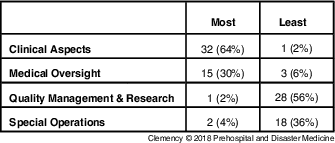
All fellows reported using the National Association of EMS Physicians (NAEMSP; Overland Park, Kansas USA) textbooks as their primary reference. Forty-seven (94%) fellows and 33 (94%) fellowships used the new two-volume set. Three (6%) fellows and two (6%) programs utilized the older, four-volume set. Fellows felt most prepared for the Clinical Aspects questions and least prepared for Quality Management and Research questions on the board exam. The fellows’ opinion on their preparation for the various content areas is shown in Table 1.
Which Subject Areas do Fellows Feel Most/Least Prepared for on the EMS Boards?

Abbreviation: EMS, Emergency Medical Services.
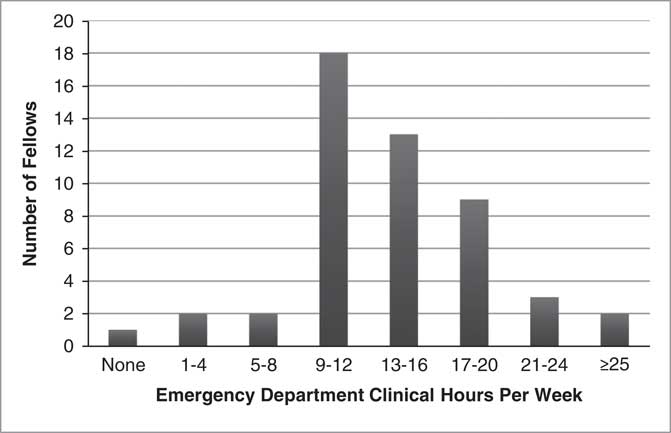
Fellows’ responses regarding the average number of hours per week they worked clinically in an emergency department are provided in Figure 1.
Fellow’s Clinical Hours Worked per Week.

Discussion
This study provides unique insights into ACGME-accredited EMS fellowship education during its fourth year. Strong support of EMS fellowship directors and linkage with the 2016 EMSITE likely contributed to a rare 100% response rate. The study identified 50 fellows attending 35 of the 50 accredited fellowship programs in existence in 2016. Prior to accreditation, there were over 62 fellowships identified.Reference Delbridge and Perina 9 In spite of attrition of available programs measured as those that have achieved accreditation, there continues to be a gap between physicians seeking fellowship training and fellowship positions.
Most EMS fellows were male (70%), representing a larger gender gap than exists among emergency medicine residents which are 62% male. 8 The majority of fellows were less than 36 years old, yet almost one-fourth of the fellows identified a gap between residency and fellowship training.
While there is no requirement that didactics be on a fixed day, or even held weekly, 3 the majority of programs provide required didactics on a weekly basis. One-half of EMS fellowships provide didactics on Tuesdays. More programs adopting a uniform day for didactic education could facilitate increased collaboration among programs through distance learning, such as the monthly “EMS Live” webinars hosted by the SUNY Upstate (Syracuse, New York USA) and University at Buffalo (Buffalo, New York USA) fellowships. 10
Among core content areas, fellows felt most prepared in Clinical Aspects and least prepared in Quality Management and Research. These findings are similar to a survey of candidates preparing for the 2015 EMS Certifying Exam. 11 This provides valuable information for EMS Program Directors who may need to alter their curriculum to provide greater emphasis on these topics. Similarly, organizers of EMS board review courses and similar content may take this into consideration when targeting education to EMS fellows who will be the only individuals eligible to take the EMS board exam after 2019.
While residents are eligible for EMS fellowships after completing any ACGME-accredited residency, 96% reported previous training in emergency medicine. Prior experience as an EMT or paramedic was common, and may be helpful, but is certainly not required among EMS fellows.
Two-thirds of fellows had access to a dedicated physician response vehicle. Physician response vehicles may afford the fellow unique opportunities to respond to calls in a timely fashion, but may not always be possible due to financial and logistical constraints. While fellows are required to have exposure to helicopter EMS, there is no requirement that they fly. Yet, one-half of the fellows reported providing direct care aboard a helicopter. It is unclear if the other half did not fly at all or felt they did not perform direct patient care while on the helicopter. This question may need to be refined before the survey is offered in the future.
The ACGME requirements limit fellows to no “more than 12 hours per week of clinical practice unrelated to Emergency Medical Services, averaged over four weeks.” 3 This echoes recommendations that predate ACGME accreditation of fellowships.Reference Marx 12 More than one-half of the fellows self-reported working more than 12 hours per week clinically in an emergency department. This figure includes shifts as part of the fellowship, internal, and external moonlighting. While this finding does not necessarily reflect non-compliance, fellows and fellowship directors should work to ensure that emergency department shifts do not negatively impact fellows’ overall learning environment.
Limitations
The results were based on the responses of EMS fellows and may have been affected by a recall bias. Also, the results were from a single year and may not necessarily be generalizable to future years.
Conclusion
These data provide insight into the characteristics of EMS fellows in ACGME-accredited programs. The ACGME program requirements were an important step in standardizing and improving medical education for EMS fellows. As EMS fellowship education continues to mature, an understanding of the current state of EMS fellowship education will help inform fellowship directors and other stakeholders.
Supplementary Material
To view supplementary material for this article, please visit https://doi.org/10.1017/S1049023X18000249