Introduction
Host range expansion and host shift of herbivorous insects are always the concerns for agriculturists and forest managers. This might be a part of the dynamic evolutionary process (Farrell et al., Reference Farrell, Mitter and Futuyma1992; Bernays and Chapman, Reference Bernays and Chapman1994; Janz et al., Reference Janz, Nylin and Wahlberg2006), but global climate change may accelerate it (Williams and Liebhold, Reference Williams and Liebhold1995; Logan et al., Reference Logan, Régnière and Powell2003). Behavioural adaptation is required for a successful host range expansion of a herbivorous insect species. This includes the adaptability of a species in the new habitat or host plant for mating, ovipositing and foraging (Wiklund, Reference Wiklund1975; Thomas et al., Reference Thomas, Ng, Singer, Mallet, Parmesan and Billington1987; Henniges-Janssen et al., Reference Henniges-Janssen, Schöfl, Reineke, Heckel and Groot2011). An understanding of the habitat utilization of herbivorous insect pests for the essential requirement for their survival, particularly for egg-laying, can do much to control pest outbreaks by disrupting egg distributions that lead to a rapid population build-up (Wiklund, Reference Wiklund1977; Floater and Zalucki, Reference Floater and Zalucki2000; Azerefegne and Solbreck, Reference Azerefegne and Solbreck2010).
Lepidopteran pests often pose a major threat to the tea industry of Northeastern (NE) India (Hazarika et al., Reference Hazarika, Bhuyan and Hazarika2009). Hyposidra talaca Walker (Lepidoptera: Geometridae) has successfully expanded its host range to nearly 60,000 ha tea plantations of NE India between 2006 and 2008 (Rehman et al., Reference Rehman, Sharma, Borthakur and Barthakur2007). Today, H. talaca is the most abundant insect pest among all other major pests of tea in the region that include Buzura suppressaria Guen. (Lepidoptera: Geometridae), which has been a historically important pest of tea (Das, Reference Das1965; Hazarika et al., Reference Hazarika, Bhuyan and Hazarika2009) since 1903. Hyposidra talaca is a polyphagous species, and thought to have expanded its host range to include tea from nearby Sal-dominated forests (Shorea robusta Roth. [Dipterocarpaceae]) in the influence of climatic variability (Sinu et al., Reference Sinu, Mandal and Antony2011a). Thus S. robusta and Sal forests could be an ancestral habitat (Intachat et al., Reference Intachat, Holloway and Staines2001; David and Ananthakrishnan, Reference David and Ananthakrishnan2004; Sen-Sharma and Thakur, 2008), while tea plantations are a derived habitat for H. talaca. Because of the magnitude of crop losses due to H. talaca, the tea industry of NE India relies heavily on chemical control measures for the management of the pest. However, recently, interest in biological pest control has grown rapidly in the Indian tea industry also because the general public negatively perceives the widespread application of pesticides, coupled with governmental bans on several synthetic pesticides (Meissle et al., Reference Meissle, Mouron, Musa, Bigler, Pons, Vasileiadis, Otto, Antichi, Kiss, Pálinkás, Dorner, Van Der Weide, Groten, Czembor, Adamczyk, Thibord, Melander, Cordsen Nielsen, Poulsen, Zimmermann, Verschwele and Oldenburg2010). In addition, pests continually evolve resistance to many pesticides (Meissle et al., Reference Meissle, Mouron, Musa, Bigler, Pons, Vasileiadis, Otto, Antichi, Kiss, Pálinkás, Dorner, Van Der Weide, Groten, Czembor, Adamczyk, Thibord, Melander, Cordsen Nielsen, Poulsen, Zimmermann, Verschwele and Oldenburg2010). This being so, we aimed to develop an integrated pest management (IPM) programme to manage H. talaca. To develop an IPM strategy, we investigated the life traits, habitat utilization and biotic mortality agents of different life stages of the species (Antony et al., Reference Antony, Sinu and Das2011; Sinu, Reference Sinu2011; Sinu et al., Reference Sinu, Antony and Mallick2011b). Here we provide some crucial information on the oviposition pattern of H. talaca in tea plantations. Based on our findings, the possible measures that need to be considered to manage the pest are discussed.
Materials and methods
Tea plantations of NE India and the study species
Tea plantations of NE India, excluding those of Darjeeling hills, are situated in the sub-Himalayan plains (altitude, 60–400 masl). Tea, although a perennial plant, undergoes winter dormancy (no new leaf flush) in NE India (Barua, Reference Barua1969). Shade trees are an important component of tea plantations and are recommended as a measure to conserve soil humidity, enrich soil nutrients and maintain the optimum leaf temperature of tea for photosynthesis (Barua, Reference Barua1994). While about 20 native and exotic tree species are recommended as shade trees in tea plantations, six to eight species are widely used in the northern parts of West Bengal (Dooars), where the study took place (Barua, Reference Barua1994). A mixture of four to eight shade tree plants can be seen in a plantation. Although trees differ in the timing of their leaf flushing and shedding phenology, winter is generally a leafless period for shade trees. Almost all exotic shade trees that are in use in NE India today are deciduous in nature. Tea, being a perennial plant, has leaves during the winter, although new growth is minimal.
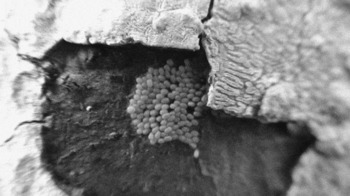
Hyposidra talaca is a pest of cocoa and cinchona plantations of Southeastern Asia, tea plantations of Japan and silviculturally and ecologically important forest plants of Old World tropics (Entwistle, 1972; Intachat et al., Reference Intachat, Holloway and Staines2001; Novotny et al., Reference Novotny, Miller, Cizek, Leps, Janda, Basset, Weiblen and Darrow2003; Sen-Sharma and Thakur, 2008). It has at least eight generations per year in tea plantations, with a prolonged developmental phase during the winter, but no obligate diapause (Anonymous, 2011). The females prefer shade tree barks to lay eggs in clutches (Fig. 1). The eggs are deposited underneath the scales of the barks of trees that may provide physical protection from generalist predators. The neonate looper larvae, immediately after emergence, drop on a salivary thread to access the undergrowth of tea bushes and are dispersed through wind to larger areas. Initial field observations showed that foliage of some of the wild and exotic shade tree species is infested by H. talaca, but in different gradients. No specialist insect natural enemies have so far been reported for any life stage of H. talaca. However, birds are potential predators of H. talaca in tea plantations (Sinu, Reference Sinu2011). A nucleopolyhedrovirus is another prospective microbial control agent of H. talaca (Antony et al., Reference Antony, Sinu and Das2011; Sinu et al., 2011b).
Part of an egg deposit of Hyposidra talaca

Field observation techniques
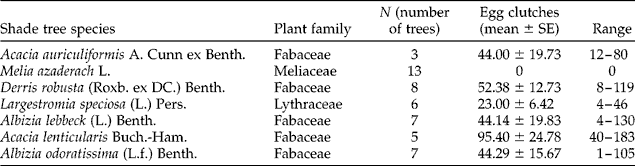
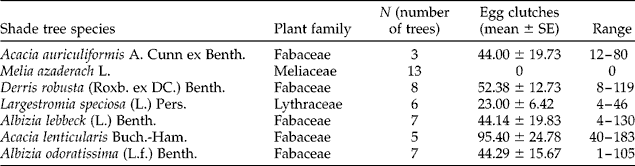
The study was conducted during October 2010–January 2011 in a tea plantation in the Dooars (150 ha) of West Bengal. The survey was carried out in 49 shade trees of seven plant species [Acacia auriculiformis A. Cunn ex Benth., Derris robusta (Roxb. ex DC.) Benth, Albizzia lebbeck (L.) Benth., Acacia lenticularis Buch.-Ham., Albizia odoratissima (L.f.) Benth. (all Fabaceae), Melia azaderach L. (Meliaceae) and Largestromia speciosa (L.) Pers. (Lythraceae)] (Table 1).
Number of egg clutches in different shade tree plants of tea plantations of NE India
Since permanent shade trees were all planted on a particular date, all the trees were same age (31 years). Canopy height of the trees was uniform among the trees of permanent shade tree species. Among the species selected in the study, M. azaderach was a temporary shade tree species. Temporary shade trees are those that are planted along with tea saplings during the establishment phase of a plantation. These trees are fast-growing and removed when permanent shade trees attain a stage to give conditional light on tea underneath. Permanent shade trees remain until the replanting of tea. The height of M. azaderach trees was half the height of permanent shade tree species, as lopping was frequently done to provide optimum lighting on tea. The circumference of all shade trees was measured at breast height (girth at breast height (GBH), at 1.31 m) and ranged between 0.4 and 1.6 m (mean 0.79 ± 0.23 SD). Tree trunks were inspected for eggs from 0 to 8 m above ground. Starting at 0 m at ground level, bark height up to a reach of 8 m was rigorously examined throughout. Bark scales, epiphyte root mantles, and moss and lichen cover were carefully removed using a fine knife to detect egg clutches. The height of every egg clutch from the ground was recorded. During the study, stem and foliage of a total of 400 tea plants growing close to the shade trees were also thoroughly examined to record H. talaca eggs.
Data analysis
The difference in the mean number of egg clutches among the different shade tree species was compared using a one-way ANOVA test. The number of egg clutches was log-transformed to achieve normality. To understand the vertical distribution pattern of egg clutches, we classified shade trees into six height classes: 0–1, 1.01–2, 2.01–3, 3.01–4, 4.01–5 and 5.01–8 m. The mean number of egg clutches in the different height classes of the different shade tree species was compared using simple regression analysis. All the analyses were performed using Statistica.
Results
A total of 1785 egg clutches were located in 49 trees of seven species (Table 1). The number of eggs in a clutch varied between 84 and 302 (average 258 eggs). In all egg clutches, the eggs were physically protected under the scales of tree bark, lichen cover and the root mantles of epiphytes and hemiepiphytes (Fig. 1). An average of 45.77 ( ± 7.06 SE, range 0–183, N= 49) egg clutches was found per tree. The highest mean number of egg clutches was in A. lenticularis (95.4 ± 24.78, range 40–183, N= 5) and the lowest was in L. speciosa (vernacular name jarul) (23.0 ± 6.42, range 4–46, N= 6). Egg clutches were not found on M. azaderach (vernacular name bokhain) (N= 13) trees, a temporary shade tree. Egg clutches were also not found on tea plants. The difference in the mean number of egg clutches among seven shade tree species was significant (F 6,42= 19.13, P< 0.0001; Table 1). However, Tukey's post hoc comparisons for unequal N showed that the difference in the mean number of egg clutches was significant between M. azaderach and the other six shade tree species (P range = 0.001–0.02), but not among the six shade tree species (P range = 0.23–0.99).
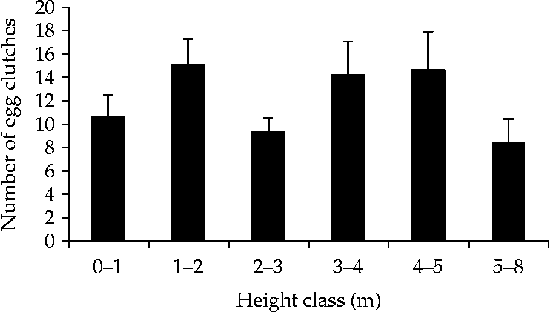
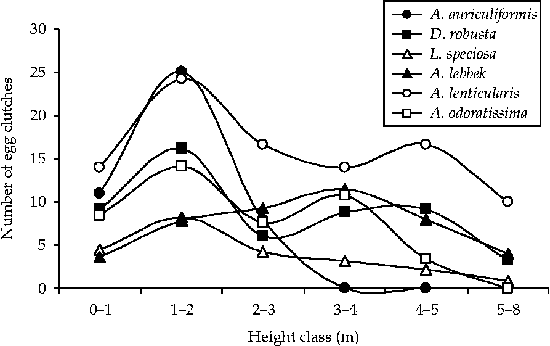
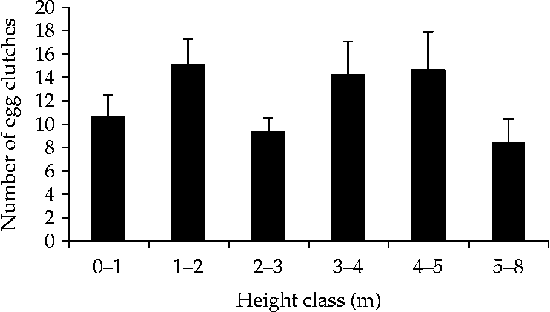
Although egg clutches generally reduced with the height of shade trees (Fig. 2), this relationship was significant only in A. odoratissima (R 2= 0.11, P= 0.00 003; Fig. 3).
Bar diagram showing the mean number of egg clutches ( ± SE) of Hyposidra talaca in different height classes of pooled shade tree plants
Line diagram showing the mean number of egg clutches of Hyposidra talaca in different height classes of individual shade tree plants

Discussion
Lepidopteran insect pest management in tea plantations of NE India is a challenge as shade trees are used as an alternative food plant in the tea ecosystem. The tea industry of NE India, particularly in the sub-Himalayan plains, despite requiring shade trees in plantations, is seriously considering the composition and structure of shade trees in the advent of the recent spread of H. talaca. All the recommended shade trees in NE India's tea plantations are deciduous in nature and have a leafless period of about 2–3 months during the winter that coincides with tea dormancy. Evergreen in nature, only tea plants have leaves in this ecosystem during the winter.
The present study provides crucial information on the egg-laying pattern of H. talaca, the most important pest of tea of NE India. This study demonstrates that females oviposit on all the shade trees examined except on the neem tree M. azaderach. Despite tea being a major food source for H. talaca (P.A. Sinu, unpublished data), female moths avoid tea plants for egg-laying. It appears that H. talaca moths prefer shade trees for oviposition as they provide physical protection from natural enemies. The diversity of micro-sites on shade tree barks, including scales, lichen and moss cover, and root mantles of parasitic plants, offers physical protection to the eggs of H. talaca. However, it is not rare that lepidopteran species prefer one niche or plant species for oviposition, and another for feeding (Wiklund, Reference Wiklund1977). Hence, our results corroborate reports that oviposition of geometrids can occur on non-feeding plants (Tammaru et al., Reference Tammaru, Kaitaniemi and Ruohomäki1995).
Herbivorous insect pests can discriminate host plants based on the quality of plants (Leather and Burand, Reference Leather and Burand1987; Leather et al., Reference Leather, Watt and Forrest1987; Price, Reference Price1994; Tammaru et al., Reference Tammaru, Kaitaniemi and Ruohomäki1995; Floater and Zalucki, Reference Floater and Zalucki2000). However, selective oviposition could be a disadvantage for lepidopteran pests, as a relatively short-lived female moth may die before all her eggs are laid (Jaenike, Reference Jaenike1990). Usually, it is predicted that females lay eggs on hosts that are optimal for the development of their offspring (Cunningham et al., Reference Cunningham, West and Zalucki2001). However, our data do not conform to that hypothesis. Instead, it seems that female H. talaca were choosing hosts that are optimal for hiding their eggs from natural enemies (Cunningham et al., Reference Cunningham, West and Zalucki2001; Tanhuanpää et al., Reference Tanhuanpää, Ruohomäki and Kaitaniemi2003). It would be interesting to prove this experimentally in a later study. Egg deposits of H. talaca were not found on the barks of M. azaderach in a plantation with a mixture of shade tree species. The neem tree, unlike leguminous trees, lacks scaly bark and is less colonized by epiphytes and hemiepiphytes. This might have decreased the availability of potential physical protection sites for the eggs of H. talaca (Tammaru et al., Reference Tammaru, Kaitaniemi and Ruohomäki1995).
In our study, the egg deposits were found on shade trees between 0.02 and 7.2 m from the ground. Although insignificant for all shade tree species, for A. odoratissima, this relationship proved to be significant, as we observed a trend that egg deposits decreased with the height of all shade trees. Determining the factors that govern this relationship was beyond the scope of this study. However, we hypothesize that: (1) the lower-middle portion of a shade tree might facilitate a hindrance-free spread of neonate loopers through wind to the under-growing resourceful tea plants (Tammaru et al., Reference Tammaru, Kaitaniemi and Ruohomäki1995), (2) the branches at the canopy level are relatively less scaly than those of the lower bark and (3) the eggs and looper caterpillars of H. talaca are more susceptible to bird predation at tree canopy (Sinu, Reference Sinu2011).
Our results suggest that oviposition of H. talaca is typical for an outbreak species and certainly contributes to the eruptive population dynamics of the species in tea plantations, mainly because: (1) females deposit eggs in such a way that the larvae can find and access the host plants easily and quickly (Wiklund, Reference Wiklund1975, Reference Wiklund1977) and (2) females find and accept several host plants as oviposition sites (Thomas et al., Reference Thomas, Ng, Singer, Mallet, Parmesan and Billington1987). Additionally, H. talaca larvae are oligophagous in nature in the tea agroecosystem (P.A. Sinu, unpublished data). Very few natural enemies have been identified attacking the different life stages of H. talaca in tea plantations, which is another reason for the successful establishment of the pest in tea plantations. Field-collected eggs yielded no parasitoids (Sinu et al., Reference Sinu, Mandal and Antony2011a), and the larvae are behaviourally adapted to escape predation (Sinu et al., Reference Sinu, Mandal and Antony2011a). So far, the HytaNPV nucleopolyhedrovirus is the only effective biocontrol agent of H. talaca (Sinu et al., Reference Sinu, Mandal and Antony2011a). However, the virus has limited virulence during the winter months, which is a peak pest activity period. Hence, cultural control has an important role in the pest management of H. talaca in tea plantations. We suggest that the role of shade trees should be considered in this. In the light of the present findings, epiphytes and hemiepiphytes should be removed regularly to reduce the available niches for H. talaca oviposition. Upon discovery of moths in plantations, shade tree trunks should be properly inspected for egg deposits, and eggs should be removed (Anonymous, 2011). This may include tactics such as debarking, application of fumigants on shade tree barks and use of fire. Light trap data may be useful to properly time such interventions, as light trap clearly indicates the moth emergence time and the generations in tea plantations (unpublished data). Possible replacement of shade tree species that favour H. talaca oviposition with, for example, M. azaderach may reduce pest activity, though this is probably more of a long-term solution and the influence of such changes in shade tree species composition on aspects of tea production other than pest management needs to be carefully examined (Beer, Reference Beer1987).
Acknowledgements
We thank S.K. Pathak [the CAO (WB)], NBRR&DC-TRA for necessary help in carrying out the study. We gratefully acknowledge the support provided by the Tea Board of India (Kolkata). Critical comments and suggestions by two anonymous reviewers also helped in the overall improvement of the paper.