Introduction
The World Health Organization (WHO, 2003), the European Commission Directorate for Public Health (EC-Public Health, 2002) and the American Academy of Pediatrics (AAP; Gartner et al. Reference Gartner, Morton, Lawrence, Naylor, O'Hare, Schanler and Eidelman2005) all recommend exclusive breastfeeding for the first 6 months of life. Despite the established benefits of breastfeeding, rates are still low, and even though rates of breastfeeding initiation are high, there is a marked decline in breastfeeding during the first few weeks, and exclusive breastfeeding at 6 months postpartum is rare (Chalmers et al. Reference Chalmers, Heaman, Sauve and Kaczorowski2009; Barnes et al. Reference Barnes, Cox, Doyle and Reed2010). Identification of women at risk for early cessation of breastfeeding is a recognized health priority (EC-Public Health, 2002; WHO, 2003; AAP, 2005). Depression during pregnancy could serve this proposal, as pregnant depressed women are less likely to intend to breastfeed (Fairlie et al. Reference Fairlie, Gilman and Rich-Edwards2009; Insaf et al. Reference Insaf, Fortner, Pekow, Dole, Markenson and Chasan-Taber2011), to initiate (Green & Murray, Reference Green, Murray, Cox and Holden1994; Seimyr et al. Reference Seimyr, Edhborg, Lundhand and Sjögren2004) or to maintain breastfeeding during the postpartum period (Field et al. Reference Field, Hernandez-Reif and Feijo2002; Seimyr et al. Reference Seimyr, Edhborg, Lundhand and Sjögren2004; Pippins et al. Reference Pippins, Brawarsky, Jackson, Fuentes-Afflick and Haas2006; Kehler et al. Reference Kehler, Chaput and Tough2009; Ystrom, Reference Ystrom2012).
Literature reviews suggest that breastfeeding is also less common among postpartum depressed mothers, even though their infants benefit from breastfeeding (e.g. Field, Reference Field2008). However, the pathway of the association between breastfeeding and postpartum depression remains equivocal (e.g. Dennis & McQueen, Reference Dennis and McQueen2009).
Some studies suggest that postpartum depression may cause early cessation of breastfeeding, and depression symptoms have been noted to precede the cessation of breastfeeding (Cooper et al. Reference Cooper, Murray and Stein1993; Galler et al. Reference Galler, Hussain and Biggs1999; Henderson et al. Reference Henderson, Evans, Straton, Priest and Hagan2003; Taj & Sikander, Reference Taj and Sikander2003; Hatton et al. Reference Hatton, Harrison-Hohner, Coste, Dorato, Curet and McCarron2005; Dennis & McQueen, Reference Dennis and McQueen2007; Akman et al. Reference Akman, Kuscu, Yurdakul, Ozdemir, Solakoğlu and Orhon2008; Gagliardi et al. Reference Gagliardi, Petrozzi and Rusconi2012), whereas other studies show that postpartum depression may result from breastfeeding cessation and breastfeeding cessation has been noted to precede postpartum depression (Astbury et al. Reference Astbury, Brown, Lumley and Small1994; Mezzacappa & Endicott, Reference Mezzacappa and Endicott2007; Ystrom, Reference Ystrom2012).
For example, a recent study showed that mothers with greater levels of depressive symptoms immediately after delivery have a higher likelihood of bottle-feeding their infants at 3 months postpartum (Gagliardi et al. Reference Gagliardi, Petrozzi and Rusconi2012). An association between higher levels of depressive symptoms 1 month after delivery and breastfeeding cessation at 4 months postpartum was also obtained in an earlier study (Akman et al. Reference Akman, Kuscu, Yurdakul, Ozdemir, Solakoğlu and Orhon2008). Compared to mothers with lower depression scores, mothers with higher depression scores were more likely not to breastfeed at 4 months postpartum.
By contrast, another recent study also showed that breastfeeding cessation predicted higher levels of postpartum anxiety and depression (Ystrom, Reference Ystrom2012). Anxiety and depression levels during pregnancy and at 6 months postpartum were related to breastfeeding cessation: baseline levels of anxiety and depression were increased at 6 months postpartum by the effect of breastfeeding cessation (Ystrom, Reference Ystrom2012). Empirical data have shown that mothers who do not initiate or maintain breastfeeding are at risk for depression during the postpartum period and that early cessation of breastfeeding may contribute to postpartum depression (Astbury et al. Reference Astbury, Brown, Lumley and Small1994; Mezzacappa & Endicott, Reference Mezzacappa and Endicott2007; Ystrom, Reference Ystrom2012).
Breastfeeding has been associated with numerous positive health outcomes for both the child and the mother. The breastfeeding benefits for children are well known. They include fewer health problems (Shields et al. Reference Shields, O'Callaghan, Williams, Najman and Bor2006; Horta et al. Reference Horta, Bahl, Martines and Victora2007) and better developmental performance (Sacker et al. Reference Sacker, Quigley and Kelly2006; Kramer et al. Reference Kramer, Aboud, Mironova, Vanilovich, Platt and Matush2008). Various other benefits have also been reported for the physical (Newcomb et al. Reference Newcomb, Storer, Longnecker, Mittendorf, Clapp and Burke1994; Jonas et al. Reference Jonas, Nissen, Ransjö-Arvidson, Wiklund, Henriksson and Uvnäs-Moberg2008) and psychological well-being of the mother, for example an attenuated response to stress (Heinrichs et al. Reference Heinrichs, Meinlschmidt, Neumann, Wagner, Kirschbaum, Ehlert and Hellhammer2001; Groer & Davis, Reference Groer and Davis2006; Tu et al. Reference Tu, Lupien and Walker2006) and better sleep patterns (Heinrichs et al. Reference Heinrichs, Neumann and Ulrike2002; Doan et al. Reference Doan, Gardiner, Gay and Lee2007). However, more empirical evidence is needed on the relationship between breastfeeding and postpartum depression (Heinrichs et al. Reference Heinrichs, Neumann and Ulrike2002).
The current study explored: (1) the effects of prenatal and postpartum depression on the initiation, early cessation and duration of exclusive breastfeeding; and (2) the effects of initiation and early cessation of exclusive breastfeeding on postpartum depression.
Method
Sample
In total, 181 primiparous or multiparous women were contacted in an Obstetrics Out-patient Unit (Porto, Portugal) during the first pregnancy trimester. The exclusion criteria were not reading or writing Portuguese and multiple gestations. A sample of 145 (80%) women agreed to participate and were included in the analyses, and 124 (86%) of them completed the Edinburgh Postnatal Depression Scale (EPDS) in all assessment waves.
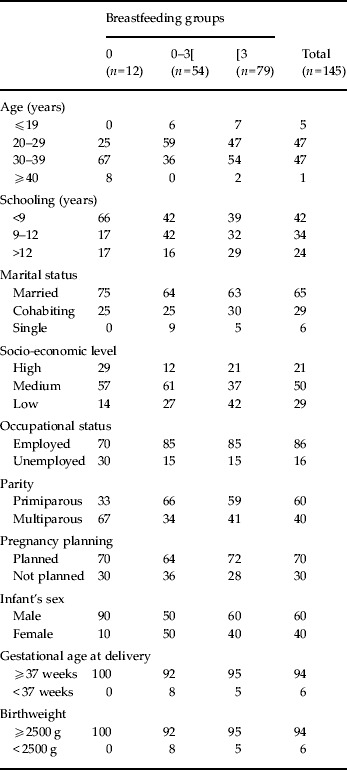
Nearly all the participants were Portuguese (97%), Caucasian (96%), Catholic (87%), were married or cohabitating (94%) and between 20 and 39 years old (94%). Women were primiparous (60%) or multiparous (40%). The majority of the women had ⩾9 years of education (58%), had low to middle socio-economic status (79%) and were employed (86%) (see Table 1). None of the participants were receiving treatment or medication for depression.
Sociodemographics for total sample and exclusive breastfeeding groups: exclusive breastfeeding no initiation (0), early cessation (0–3[) and for ⩾3 months ([3)

Values given are percentages.
Measures
Sociodemographic Questionnaire
Information about the participants was collected using a Sociodemographic Questionnaire (Figueiredo et al. Reference Figueiredo, Teixeira, Conde, Pinto and Sarmento2009). This questionnaire on social, demographic and obstetric information included: age, ethnicity, nationality, religion, marital status, occupational status, educational level, pregnancy planning, infant sex, gestational age and birthweight.
Index of Breastfeeding Status (IBS)
Exclusive breastfeeding since birth was determined according to the IBS (Labbok & Krasovec, Reference Labbok and Krasovec1990; Labbok et al. Reference Labbok, Belsey and Coffin1997), using mother feeding practices recall since birth, at childbirth and at 3, 6 and 12 months postpartum. In this study the IBS was modified to define feeding practices since birth as exclusive breastfeeding versus no exclusive breastfeeding/bottle-feeding. Exclusive breastfeeding included Labbock & Krasovec's level 1 (full breastfeeding: exclusive breastfeeding, no other liquid or solid is given) and level 2 (almost exclusive breastfeeding: only vitamins, minerals or water are given in addition to breastfeeding). All other categories that involved any amount of artificial milk or solids (level 3 to 7) were defined as no exclusive breastfeeding/bottle feeding.
EPDS
The Portuguese version (Augusto et al. Reference Augusto, Kumar, Calheiros, Matos and Figueiredo1996) of the EPDS (Cox et al. Reference Cox, Holden and Sagovsky1987), a self-report questionnaire comprising 10 items, was used to assess symptoms of depression within the previous 7 days. The EPDS Portuguese version has good internal consistency (Cronbach's α = 0.85) and has been used in several studies during pregnancy and the postpartum period (e.g. Figueiredo & Conde, Reference Figueiredo and Conde2011).
Procedures
This prospective cohort study received approval from the Institutional Ethical Commission. Participants were recruited from an Obstetrics Out-patient Unit at their first appointment. The aims and the procedures of the study were explained. After signing an informed consent form, the Sociodemographic Questionnaire and the EPDS were administered to the pregnant women (8–14 weeks gestation). The EPDS was administered again during the second (20–24 weeks gestation) and third trimester (30–34 weeks gestation), at childbirth (between days 1 and 3) and at 3 months (10–14 weeks postpartum). Data on exclusive breastfeeding since birth were collected at birth and at 3, 6 and 12 months postpartum, using mother feeding practices recall since birth.
Statistical analyses
To determine whether prenatal depression scores at the first, second and third trimester were predictors of exclusive breastfeeding and no initiation, logistic regressions (forward stepwise method) were performed. To determine whether prenatal and postpartum depression were predictors of exclusive breastfeeding, no initiation or early cessation and duration, logistic (forward stepwise method) and multiple linear (stepwise method) regressions were performed. In model 1, depression scores at the first, second and third trimester were assessed as predictors. In model 2, depression scores at 3 months postpartum were added. Depression scores were found to be associated with exclusive breastfeeding initiation, breastfeeding no initiation or early cessation and breastfeeding duration at p < 0.10 and were included as predictors in the models. The criteria for variables to stay or enter the models were defined as p < 0.05.
To determine the effects of exclusive breastfeeding or no initiation and early cessation on postpartum depression, repeated-measures ANOVAs were applied. Analyses were conducted with breastfeeding as the grouping variable: exclusive breastfeeding no initiation, exclusive breastfeeding early cessation, and exclusive breastfeeding for ⩾3 months. The model included depression scores as a measure of the same within-subjects factor with five levels, corresponding to the first, second and third trimester, childbirth and 3 months postpartum measuring time points. Differences between groups were determined through independent-sample t tests.
Statistical analyses were performed using SPSS version 20 (SPSS Inc., USA). All available data were included in the analyses. Cohen's effect size d was estimated for the independent-sample tests according to Kinnear & Grey's (Reference Kinnear and Gray2010) recommendation (d = M1–M2/σ pooled). In addition, the effect-size measure partial eta squared (η p 2) was estimated for all ANOVAs.
Post-hoc power calculations, performed using the software G*Power (Faul et al. Reference Faul, Erdfelder, Lang and Buchner2007), demonstrated that the sample size was adequate to detect small-to-medium effects on the results of the logistic regression [model's odds ratio (OR) 2.13, p < 0.05, n = 126, power = 0.96], the linear regression (model's effect size f 2 = 0.08, p < 0.05, n = 126, number of predictors = 4, power = 0.93) and the repeated-measures ANOVA (effect size f range = 0.10–0.20, p < 0.05, n = 124, correlation of the repeated measures = 0.62, power range = 0.88–0.89).
Results
Exclusive breastfeeding
Within the total sample, 12 women did not initiate exclusive breastfeeding (8%), 54 women initiated but ceased exclusive breastfeeding early (breastfed for < 3 months) (37%), 55 women breastfed exclusively for > 3 months but < 6 months (38%), and 24 women (17%) breastfed exclusively for ⩾6 months. No differences were noted between these groups on age (χ 2 9 = 13.84, n.s.), schooling (χ 2 6 = 7.81, n.s.), marital status (χ 2 12 = 11.67, n.s.), socio-economic status (χ 2 6 = 8.12, n.s.), occupational status (χ 2 = 0.78, n.s.), parity (χ 2 3 = 4.37, n.s.), pregnancy planning (χ 2 6 = 4.81, n.s.), infant sex (χ 2 3 = 4.96, n.s.), gestational age (χ 2 3 = 0.53, n.s.) and birthweight (χ 2 3 = 0.29, n.s.).
Sociodemographic variables
Sociodemographic variables (mother's age, occupational status, pregnancy planning, gestational age at delivery and infant's birthweight and gender) were assessed as potential predictors. These variables were not associated at p < 0.10 with exclusive breastfeeding initiation, no initiation or early cessation and duration, and therefore were not eligible to be included in the regression models.
Effects of prenatal and postpartum depression on breastfeeding
Exclusive breastfeeding initiation
Depression scores at the first, second and third trimester were assessed as predictors of exclusive breastfeeding or no initiation. The regression model was not statistically significant (χ 2 3 = 2.70, n.s.).
Exclusive breastfeeding, no initiation or early cessation
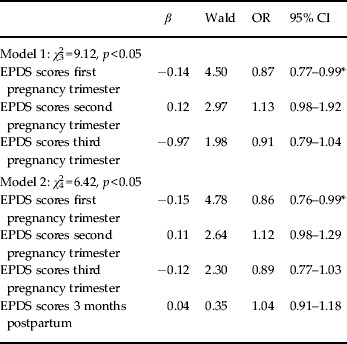
Depression scores at the first, second and third trimester were assessed as predictors of exclusive breastfeeding at 3 months postpartum (Table 2, model 1). The regression model emerged as statistically significant (χ 2 = 9.12, p < 0.05), with a goodness of fit of 60%. The model had a sensitivity of 46% and a specificity of 72%. The area under the curve (AUC) in the receiver operating characteristic (ROC) curve was 0.62 [p < 0.05, 95% confidence interval (CI) 0.53–0.71]. Variability was explained by depression scores at the first, second and third trimester in the range 7.0–9.3% (Cox & Snell R 2 = 0.07, Nagelkerke R 2 = 0.09). Depression scores at the first trimester were the best predictor of exclusive breastfeeding at 3 months postpartum (β = –0.14, Wald = 4.50, p < 0.05). Women with higher depression scores at the first trimester had 0.87 times the chance of not initiating or ceasing exclusive breastfeeding early (OR 0.87, 95% CI 0.77–0.99).
Prenatal and postpartum depression as predictors of exclusive breastfeeding at 3 months postpartum

EPDS, Edinburgh Postnatal Depression Scale; OR, odds ratio; CI, confidence interval.
* p < 0.05.
When depression scores at 3 months postpartum were added to the regression model (Table 2, model 2), the goodness of fit increased to 63% (χ 2 4 = 9.48, p < 0.05). Nevertheless, model 2 was not found to be statistically different from model 1 (χ 2 1 = 0.71, n.s.). This model had a sensitivity of 53% and a specificity of 72%. The AUC in the ROC curve was 0.65 (p < 0.01, 95% CI 0.56–0.75). Variability was explained by depression scores at the first, second and third trimester and at 3 months postpartum in the range 7.2–9.7% (Cox & Snell R 2 = 0.07, Nagelkerke R 2 = 0.10). In this model, depression scores at the first trimester were the best predictor of exclusive breastfeeding at 3 months postpartum (β = −0.15, Wald = 4.78, p < 0.05). Women with higher depression scores at the first trimester had 0.86 times the chance of not initiating or ceasing exclusive breastfeeding early (OR 0.86, 95% CI 0.76–0.99).
Exclusive breastfeeding duration
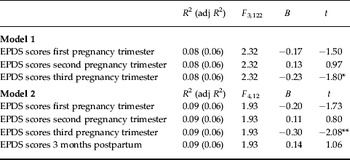
Depression scores at the first, second and third trimester were tested as predictors of the exclusive breastfeeding duration (Table 3, model 1). The regression model explained 7.7% of the variance (adjusted R 2 = 0.06, F 3,122 = 3.41, p < 0.01). Depression scores at the third trimester were the best predictor of exclusive breastfeeding duration (β = −0.23, t = −1.80, p < 0.05). The results indicate that women with higher depression scores at the third trimester breastfed for a shorter period of time. When depression scores at 3 months postpartum were added to the regression analysis (Table 3, model 2), the model explained 8.6% of the variance (adjusted R 2 = 0.06, F 4,121 = 2.84, p < 0.05). Depression scores at the third pregnancy trimester were the best predictor of exclusive breastfeeding duration (β = −0.30, t = −2.08, p < 0.05). Depression scores at 3 months postpartum did not add to the variance in the exclusive breastfeeding duration when the effects of depression scores at the first, second and third trimester were controlled statistically (R 2 change = 0.008, F 1,121 = 1.12, n.s.).
Prenatal and postpartum depression as predictors of exclusive breastfeeding duration

EPDS, Edinburgh Postnatal Depression Scale; adj R 2, adjusted R 2.
R 2 change = 0.008, F 1,121 = 1.12, not significant (n.s.).
* p < 0.01, ** p < 0.05.
Effects of breastfeeding on postpartum depression
Exclusive breastfeeding
Women who initiated exclusive breastfeeding had lower depression scores at the first, second and third pregnancy trimester, and also at childbirth and at 3 months postpartum, compared with women who did not initiate exclusive breastfeeding. However, these differences were not significant (F 1,122 = 1.26, n.s.). Depression scores differed at different time points for the women who initiated breastfeeding (F 4,397 = 2.63, p < 0.05, η p 2 = 0.02), but not for those who did not initiate breastfeeding (F 4,36 = 1.37, n.s.). Tests of within-contrast results suggest that, in the group of women who initiated breastfeeding, depression scores decreased from childbirth to the 3-month postpartum period (F 1,113 = 4.60, p < 0.05, η p 2 = 0.04). Pairwise comparisons revealed that women who initiated breastfeeding had higher depression scores at the first pregnancy trimester than at 3 months postpartum (p < 0.05), whereas women who did not initiate breastfeeding had no significant differences in depression scores across the time points (see Fig. 1 and Table 4).
Depression symptoms [Edinburgh Postnatal Depression Scale (EPDS) range, mean and standard deviation scores] from early pregnancy to 3 months postpartum for women who did not initiate exclusive breastfeeding and women who initiated exclusive breastfeeding. Significant differences are presented with a continuous line.
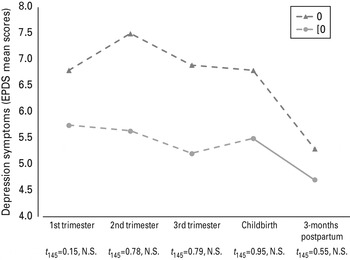
Depression symptoms (EPDS scores) from early pregnancy to 3 months postpartum for women who did not initiated exclusive breastfeeding (0) and women who initiated exclusive breastfeeding ([0)

EPDS, Edinburgh Postnatal Depression Scale.
Values given as mean (standard deviation) range.
Exclusive breastfeeding, no initiation or early cessation
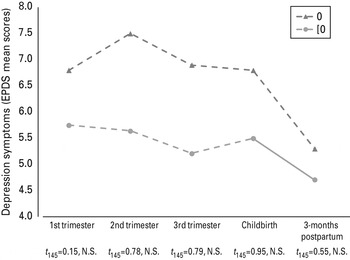
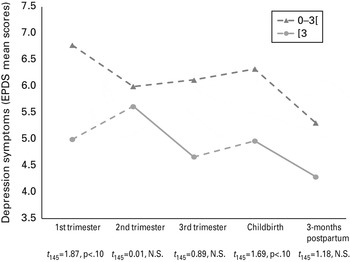
Marginally significant differences on depression symptoms (EPDS) scores were found between groups (F 1,122 = 3.69, p < 0.10, η p 2 = 0.03). Women who did not initiate or ceased exclusive breastfeeding early had higher depression symptoms scores both at the first trimester (t 143 = 1.87, p < 0.10, d = 0.31) and at childbirth (t 130 = 1.69, p < 0.10, d = 0.30) compared with women who exclusively breastfed for ⩾3 months.
In the group of women who exclusively breastfed for ⩾3 months, depression scores differed at the different time points (F 3,220 = 2.65, p < 0.05, η p 2 = 0.04). Tests of within-contrast effects suggest that depression scores decreased from the second to the third trimester (F 1,65 = 6.73, p < 0.05, η p 2 = 0.09) and from childbirth to 3 months postpartum (F 1,65 = 3.73, p < 0.10, η p 2 = 0.05), whereas no differences were found in the group of women who did not initiate or ceased exclusive breastfeeding early (F 4,228 = 1.91, n.s.). Pairwise comparisons revealed that women who exclusively breastfed for ⩾3 months had lower depression scores at 3 months postpartum when compared to the first (p < 0.001), second (p < 0.001) and third trimester (p< 0.05), and also at childbirth (p < 0.001), whereas women who did not initiate or ceased exclusive breastfeeding early had lower depression scores at 3 months postpartum when compared to the first pregnancy trimester (p < 0.05) (see Fig. 2 and Table 5).
Depression symptoms [Edinburgh Postnatal Depression Scale (EPDS) mean scores] from early pregnancy to 3 months postpartum for women who did not initiate or ceased exclusive breastfeeding early and women who exclusive breastfed for ⩾3 months. Significant differences are presented with a continuous line.

Depression symptoms (EPDS scores) from early pregnancy to 3 months postpartum for women who did not initiate or ceased exclusive breastfeeding early (0–3[) and women who exclusively breastfed for ⩾3 months ([3)

EPDS, Edinburgh Postnatal Depression Scale.
Values given as mean (standard deviation) range.
Discussion
Prenatal depression, but not postpartum depression, predicted both exclusive breastfeeding at 3 months postpartum and exclusive breastfeeding duration. Higher depression scores at the first trimester accounted for early cessation of breastfeeding, and higher depression scores at the third trimester accounted for a shorter period of time breastfeeding.
Other studies have also shown that when women are depressed during pregnancy, they are less likely to maintain breastfeeding (Field et al. Reference Field, Hernandez-Reif and Feijo2002; Seimyr et al. Reference Seimyr, Edhborg, Lundhand and Sjögren2004; Pippins et al. Reference Pippins, Brawarsky, Jackson, Fuentes-Afflick and Haas2006; Kehler et al. Reference Kehler, Chaput and Tough2009; Ystrom, Reference Ystrom2012). Results suggest that screening for symptoms of depression during pregnancy could help to identify women at risk for early cessation of breastfeeding. Providing suitable information is a main health priority recommendation; that is the identification of women at risk of failing breastfeeding maintenance (EC-Public Health, 2002; WHO, 2003; Gartner et al. Reference Gartner, Morton, Lawrence, Naylor, O'Hare, Schanler and Eidelman2005). Results also suggest the need to consider prenatal depression when studying the association between breastfeeding and postpartum depression. A few recent studies are consistent with the present study, concluding that prenatal depression predicted breastfeeding duration even when postnatal depression was considered (Kehler et al. Reference Kehler, Chaput and Tough2009; Ystrom, Reference Ystrom2012).
In women who initiated breastfeeding, a decrease in depression scores was observed from birth to the 3-month postpartum period whereas there were no significant changes in depression scores in women who did not initiate breastfeeding. This result suggests that breastfeeding may help to reduce mothers' depression symptoms from birth to 3 months postpartum. Other studies have also shown that mothers who initiate or maintain breastfeeding are less at risk for depression during the postpartum period, and that early cessation of breastfeeding may contribute to postpartum depression (Astbury et al. Reference Astbury, Brown, Lumley and Small1994; Mezzacappa & Endicott, Reference Mezzacappa and Endicott2007; Ystrom, Reference Ystrom2012).
As suggested previously, breastfeeding may have an antidepressant effect (Field, Reference Field2008). Research has shown that breastfeeding decreases hormonal and psychological conditions associated with depression during the postpartum period. This could explain the decrease in depression symptoms from birth to 3 months postpartum observed in the women who breastfed.
Some authors propose that breastfeeding may have a protective effect on maternal psychological health because it attenuates stress responses (for a review, see Heinrichs et al. Reference Heinrichs, Neumann and Ulrike2002; Mezzacappa & Katkin, Reference Mezzacappa and Katkin2002; Kendall-Tackett, Reference Kendall-Tackett2007). The lactogenic hormones, oxytocin and prolactin, are associated with anxiolytic and antidepressant effects (Mezzacappa & Katkin, Reference Mezzacappa and Katkin2002). Lactation has been associated with attenuated stress responses, especially that of cortisol (Heinrichs et al. Reference Heinrichs, Meinlschmidt, Neumann, Wagner, Kirschbaum, Ehlert and Hellhammer2001; Groer & Davis, Reference Groer and Davis2006; Tu et al. Reference Tu, Lupien and Walker2006). Attenuated cortisol stress responses (Amico et al. Reference Amico, Johnston and Vagnucci1994; Altemus et al. Reference Altemus, Deuster, Galliven, Carter and Gold1995; Groer & Davis, Reference Groer and Davis2006), in addition to attenuated total cortisol and free cortisol stress responses (Heinrichs et al. Reference Heinrichs, Meinlschmidt, Neumann, Wagner, Kirschbaum, Ehlert and Hellhammer2001), have been noted in lactating compared to non-lactating mothers. These results suggest that lactation attenuates neuroendocrine responses to stress (Altemus et al. Reference Altemus, Deuster, Galliven, Carter and Gold1995), a circumstance that has been related to fewer postpartum depression symptoms (Nierop et al. Reference Nierop, Bratsikas, Zimmermann and Ehlert2006; Goyal et al. Reference Goyal, Gay and Lee2009).
In addition, the usual diurnal pattern of cortisol, consisting of high morning levels and gradual decline throughout the day, also associated with fewer postpartum depression symptoms (Taylor et al. Reference Taylor, Glover, Marks and Kammerer2009), was found to be more characteristic of multiparous women who were breastfeeding versus those who were not breastfeeding (Tu et al. Reference Tu, Lupien and Walker2006). A diurnal pattern of cortisol, with higher cortisol levels at waking and no increase from waking to ⩾30 min, was reported in postpartum depressed women as compared to a significant increase in cortisol levels from waking to ⩾30 min found in non-depressed women (Taylor et al. Reference Taylor, Glover, Marks and Kammerer2009). These data support the possibility that postpartum depression may be associated with a dysregulated (hypothalamic–pituitary–adrenal) HPA axis. Breastfeeding might promote a tighter regulation of diurnal basal cortisol secretion (Heinrichs et al. Reference Heinrichs, Meinlschmidt, Neumann, Wagner, Kirschbaum, Ehlert and Hellhammer2001; Groer & Davis, Reference Groer and Davis2006; Tu et al. Reference Tu, Lupien and Walker2006) and the stability of diurnal cortisol secretion across days that seems to lowers the risk of postpartum depression (Taylor et al. Reference Taylor, Glover, Marks and Kammerer2009).
Another important associated change during breastfeeding relates to the regulation of sleep and wake patterns for both the mother and the infant, helping the mother to feel less tired, and could possibly also prevent symptoms of depression. Parents of infants who were exclusively breastfed slept an average of 40–45 min more and self-reported less sleep disturbance than parents of infants given formula (Doan et al. Reference Doan, Gardiner, Gay and Lee2007). Women with postpartum depression have experienced poorer sleep than women without postpartum depression, and sleep quality has worsened with increasing postpartum depression severity (Posmontier, Reference Posmontier2008; Dørheim et al. Reference Dørheim, Bondevik, Eberhard-Gran and Bjorvatn2009; Goyal et al. Reference Goyal, Gay and Lee2009). Thus, although sleep disturbance dysregulation may lead to postpartum depression (Posmontier, Reference Posmontier2008; Dørheim et al. Reference Dørheim, Bondevik, Eberhard-Gran and Bjorvatn2009; Goyal et al. Reference Goyal, Gay and Lee2009), breastfeeding enhances mothers' sleep patterns (Doan et al. Reference Doan, Gardiner, Gay and Lee2007).
Research has also shown that breastfeeding improves psychological conditions and processes that can reduce postpartum depression. Mothers' emotional involvement with the infant, for example, seems to be enhanced by breastfeeding (Ekström & Nissen, Reference Ekström and Nissen2006), whereas it is negatively correlated with postpartum depression (Figueiredo & Costa, Reference Figueiredo and Costa2009). Mothers' self-efficacy, a condition that is inversely associated with postpartum depression (Cutrona & Troutman, Reference Cutrona and Troutman1986), has improved in mothers who breastfed (Field et al. Reference Field, Hernandez-Reif and Feijo2002; Dennis, Reference Dennis2006). In other studies, mothers who breastfed rather than bottle-fed their infants had higher confidence levels and also rated their infants as less alert and less irritable during feeding (Field et al. Reference Field, Hernandez-Reif and Feijo2002). Breastfeeding mothers were also less likely to have infants with highly reactive temperaments and sleep problems (Field et al. Reference Field, Hernandez-Reif and Feijo2002; Jones et al. Reference Jones, McFall and Diego2004), whereas those problems have been linked to mothers' postpartum depression (Cutrona & Troutman, Reference Cutrona and Troutman1986). Infant competencies have been noted to be enhanced by breastfeeding (Hart et al. Reference Hart, Boylan, Carroll, Musick and Lampe2003; Sacker et al. Reference Sacker, Quigley and Kelly2006), and adversely affected by postpartum depression (e.g. Murray & Cooper, Reference Murray and Cooper1997). Breastfeeding also facilitates mother–infant interactions (Field et al. Reference Field, Hernandez-Reif and Feijo2002, Reference Field, Diego, Hernandez-Reif, Figueiredo, Ezell and Siblalingappa2010), which are typically more disturbed in depressed mother–infant dyads (e.g. Murray & Cooper, Reference Murray and Cooper1997). Breastfed infants have shown more physical contact, vocalizations and positive play, and their mothers have shown more proximal behavior with their infants (Field et al. Reference Field, Hernandez-Reif and Feijo2002; Jones et al. Reference Jones, McFall and Diego2004). These results are consistent with those from the present study suggesting that breastfeeding may act as a protective factor against postpartum depression.
Although the prospective design and the time frame from early pregnancy to 12 months postpartum were strengths of this study, the small number of participants in the group who did not initiate breastfeeding was a limitation. Effect sizes were found to be small to moderate. However, the directionality and/or bidirectionality of effects, that is greater depression leading to lack of breastfeeding and/or lack of breastfeeding leading to less depression, would be better tested in a larger sample. Moreover, future research should aim at investigating processes, such as hormonal changes, that underlie and may explain the directionality and/or bidirectionality of effects between depression and breastfeeding.
Exclusive breastfeeding was determined using mother feeding practices recall since birth. This method is highly recommended compared to mother 48-h recall (e.g. Aarts et al. Reference Aarts, Kylberg, Hornell, Hofvander, Gebre-Medhin and Greiner2000; Li et al. Reference Li, Scanlon and Serdula2005), as it is more accurate and follows usual exclusive breastfeeding definitions (e.g. WHO, 2003). However, it requires a longer recall period than was used in this study, as we repeated the surveys at birth, 3, 6 and 12 months postpartum.
Depression symptoms were assessed with the EPDS, a self-report measure. Like most self-report measures, there is the possibility for biases of either under- or over-reporting. The potential bias introduced by the absence of data (namely depression) from women who refused to participate (20%) or could not be contacted or refused to complete the EPDS at some of the measuring time points (14%) affects the study validity. It is difficult to make predictions, but we would expect that these are the more depressed women and the less likely to breastfeed.
Although the mean depression scores were below the EPDS cut-offs, they highlight the importance of screening even low-scoring women for predicting the lack of breastfeeding along with the risk of postpartum depression. This study suggests that screening for depression symptoms during pregnancy can help to identify women at risk for both early cessation of exclusive breastfeeding and subsequent postpartum depression. This study provides more empirical evidence that supporting pregnant depressed women and exclusive breastfeeding can be a good measure to improve maternal and child health.
Acknowledgments
This research was supported by FEDER Funds through the Programa Operacional Factores de Competitividade - COMPETE and by National Funds through FCT – Fundação para a Ciência e a Tecnologia under the project: PTDC/SAU/SAP/116738/2010, and by a FCT grant to the first author (BSAB/1300656063).
Declaration of Interest
None.