Introduction
Home gardens are reported to be the oldest agroecosystem (Soemarowoto, Reference Soemarowoto, Steppler and Nair1987; Hodel et al., Reference Hodel, Gessler, Cai, Thoan, Ha, Thu and Ba1999; Nair, Reference Nair2001; Trinh et al., Reference Trinh, Watson, Hue, De, Minh, Chu, Sthapit and Eyzaguirre2003). In Nepal, home gardens are an integral part of the traditional farming system. It is a land use practice around a homestead where many annual and perennial plant species are planted and maintained by the members of the household (HH). Their products are intended primarily for HH consumption (Shrestha et al., Reference Shrestha, Gautam, Rana, Sthapit, Watson and Eyzaguirre2002). Home gardens are characterized by an abundance of multi-purpose species to meet the dietary requirements of the HH and as sources of fodder, fuel, medicines, spices, construction materials and income. Livestock are also raised within the home garden foraging on HH waste and providing milk, meat and eggs for HH and manure for the fields.
Home gardens are dynamic in their evolution, composition and uses. They are often used as a place where farmers can experiment with, introduce and domesticate useful plants (Eyzaguirre and Linares, Reference Eyzaguirre and Linares2004). Their structural composition, and species and varietal diversity are influenced by the socio-economic circumstances and cultural values of the users. These gardens are not only important sources of food, but are also important for on-farm management of a wide range of plant genetic resources not found in larger agroecosystems (Agnihotri et al., Reference Agnihotri, Sharma, Joshi and Paini2004; Sthapit et al., Reference Sthapit, Rana, Hue, Rijal, Eyzaguirre and Linares2004). In recent years in Europe and developed nations, agriculture is increasingly moving towards organic and sustainable, low-input farming systems (van Bueren et al., Reference van Bueren, Ostergard, Goldringer and Scholten2008), and the home garden provides a platform for growing body of research using local genetic materials, local expertise to development that are best adapted to local market and offer difficult conditions. This awareness was recently expressed in the European Cooperative Programme for Plant Genetic Resources (ECPGR) meeting (ECPGR On-farm Conservation and Management Task Force – 3rd meeting and Home gardens workshop, 2–5 October 2007, Ljubljana, Slovenia).
In Nepal, the importance of home gardens has been undervalued by policy makers and researchers. The Nepalese NGO Local Initiatives for Biodiversity, Research and Development (LI-BIRD) made a study in the villages of Durbardevisthan in Gulmi district, Dudhrakshya in Rupandehi, Gaurigunj in Jhapa and Panchkanya in Ilam as part of a global research project to address this gap. The project explored the roles, importance and diversity of home gardens in Nepalese farming systems, tracking historical changes in home gardens in order to understand the effects of ecological and social factors on the structure, composition and dynamics of home gardens. As research methods for the identification of key species were not available, the study aims to develop criteria for the key species identification in traditional Nepalese farms. Through an in-depth analysis of key home garden species, the study analysed: (1) how much species and genetic diversity there is and how it is distributed, (2) the characteristics of key home garden species, (3) how the community manages key home garden species, (4) who maintains key home garden species and (5) how key home garden species planting materials are selected and stored. We also discuss the implications of such information in formulating strategies for the development and conservation of home gardens.
Methodology
Study site selection
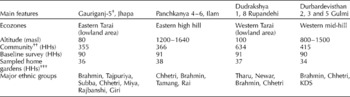
We conducted studies in four contrasting eco-sites in Nepal: two on a vertical north–south transact in the east and two on a vertical north–south transact in the west. In this way, there were two sites from the Tarai conditions (lowland plains along the Indian border) and two from the hill environments: Jhapa represented eastern Tarai; Rupandehi, western Tarai; Ilam, eastern hills; and Gulmi, western hills (Table 1; Fig. S1).
Home garden project sites in Nepal

† Figures indicate ward number of the village development committee (VDC). In Nepal, ward is the smallest political unit and each VDC has a total of nine wards.
†† The community refers to the village in Nepal, having not more than around 1000 HHs where all members of a group of people have some form of collective claim over a territory and recognize some form of collective governance to influence decisions in matters of public choice that affect their livelihood (Suwal et al., Reference Suwal, Gautam, Sunwar, Basnet and Subedi2005).
††† Samples used for farmer seed system studies.
Site selection used four primary criteria (species diversity, unique species, status of home garden and importance of home garden) and three secondary criteria (accessibility, community interest and ethnic composition of the community; Jarvis et al., Reference Jarvis, Myer, Klemick, Guarino, Smale, Brown, Sadiki, Sthapit and Hodgkin2000; Suwal et al., Reference Suwal, Gautam, Sunwar, Basnet and Subedi2005). The final selection of the sites was done after reviewing secondary information, consultation with the collaborating partners and a participatory rural appraisal survey of the possible sites by a multi-stakeholder team.
Sampling strategy for home garden survey
The HH was the main sampling unit for the study. A total of 145 HHs from different socio-economic categories (rich, medium income and poor, as defined by the communities themselves) were surveyed (Table 1). The participating farmers in project activities at each site were selected based on a proportionate sampling from each wealth category.
Participatory identification of key species
The criteria for the key species identification were adopted from Watson and Eyzaguirre (Reference Watson and Eyzaguirre2002) and Trinh et al. (Reference Trinh, Watson, Hue, De, Minh, Chu, Sthapit and Eyzaguirre2003). In each of the project sites, focus group discussions (FGD) were organized involving both male and female farmers. The participating farmer groups discussed and shared information on the importance of key species, their characteristics and their composition and structure. The contributions of different home garden key species for food security, nutrition and on-farm management of biodiversity were highlighted. The group was asked to define and prioritize their own criteria for selecting the key species in their home gardens. The project team then discussed and reviewed these criteria with the multidisciplinary team. Baseline studies identified a preliminary list of representative species that met the five agreed criteria for the key species (Gautam et al., Reference Gautam, Suwal and Basnet2005; Suwal et al., Reference Suwal, Gautam, Sunwar, Basnet and Subedi2005). Ambiguous data in the reports were clarified using FGD in each site. Finally, community diversity fairs were organized, in which farmers could compare home garden crop diversity and further validate the list. The home garden system analysis and discussion that follow are based on the key species identified.
Diversity estimates
Richness and evenness are key measures of biological diversity (Frankel et al., Reference Frankel, Brown and Burdon1995). Richness refers to the number of types or species regardless of their frequencies and was measured using species count per HH. The average home garden richness was calculated as the average number of traditional varieties per HH. The area of each home garden was also estimated to understand the relationship between the home garden area and species richness. Evenness compares the frequencies of the different types or species, with low evenness indicating dominance by one or a few types. Evenness was assessed using the Simpson index (λ) and the Shannon–Weaver index (H′). The total community richness was calculated by summing the number of distinct traditional varieties found across villages in the community ( Jarvis et al., Reference Jarvis, Brown, Cuong, Collado-Panduro, Latourniere-Moreno, Gyawali, Tanto, Sawadogo, Mar, Sadiki, Hue, Arias-Reyes, Balma, Bajracharya, Castillo, Rijal, Belqadi, Rana, Saidi, Ouedraogo, Zangre, Keltoum, Chavez, Schoen, Sthapit, de Santis, Fadda and Hodgkin2008). These measures together provided a clear indication of the biodiversity composition of home gardens.
HH survey for understanding seed systems of home gardens
The first-level survey consisted of collecting information on seed management systems from the farmers surveyed, using a semi-structured interview. The responses were elicited by using an open-ended questionnaire with subsequent coding. In the second-level survey, nodal farmers (those farmers who select and exchange germ plasm and knowledge within their social network) within the home garden seed system were identified in order to collect network data on their seed systems through a sociometric survey using a snowball sampling method (Subedi et al., Reference Subedi, Chaudhary, Baniya, Rana, Tiwari, Rijal, Jarvis and Sthapit2003). This technique determines the sample by asking the existing study subjects to recruit future subjects from their acquaintances. The enumerators were trained in participatory tools before the implementation of the questionnaire.
Results
Size of home gardens, species richness and their relationship
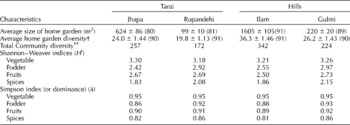
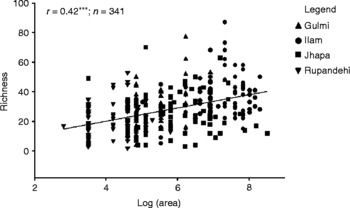
The average size of the home gardens ranged from 99 to 1605 m2, whereas the average species diversity ranged from 18.8 to 36.3 species per home garden (Table 2). Total community species diversity was found high, ranging from 172 to 257 in the Tarai plains, and 224–342 in the Hill agroecosystems. There were substantial differences in home garden size between sites and, therefore, the data of home garden area were log transformed to correlate with species richness. Positive correlation between size of home garden and species richness was found significant for Hill agroecosystem (r = 0.46, P < 0.001), whereas the relationship was weak in Tarai agroecosystems (r = 0.20). Irrespective of all sites, a positive relationship between size of home garden and species richness was found (r = 0.42; n = 341; P < 0.001; Fig. 1). However, the species richness was found dense in those home gardens whose area is below 500 m2.
Community and home garden statistics and estimates of diversity for home garden species in crops in Hill and Tarai agroecological zones of Nepal

Shannon–Weaver indices (H′) and Simpson indices (λ) or dominance (Shannon and Weaver, Reference Shannon and Weaver1949; Simpson, Reference Simpson1949).
Figures in parenthesis are sample size.
† Species richness at the home garden level measured as the average number of species per home garden with SEM; n = 90.
†† Species richness at the community level measured as the average number of species per community/village.
Relationship between the area of home garden (transformed to log area, m2) and species richness across Hill (Gulmi and Ilam) and Tarai plain (Jhapa and Rupandehi) sites, Nepal.

Criteria for key home garden species
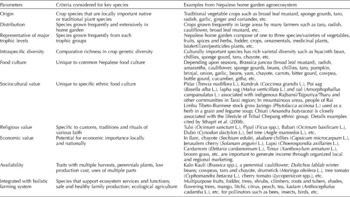
It is difficult to carry out scientific studies in the home garden system due to existence of large numbers of species and, therefore, identification of key species is essential to have a representative plant species for better understanding of complex integrated system. Table 3 lists the farmers' criteria of the key species selection in home gardens of Nepal. FGD with community identified a total of ten potential criteria that can be considered. Key species refers to a portfolio of locally important plant species that are frequently and extensively grown in home garden in the context of specific sociocultural and agroecology, primarily intended for HH consumption and food culture. This portfolio of plant species include vegetables, crops, fruits, fodder, spices and herbs, medicinal plants, fuel wood trees, ornamental and green manure/biopesticides plants, but vegetables are the most dominant species. The list of key species should at a minimum be representative of these major trophic groups such as vegetable, fruits, fodder and spices in Nepalese home gardens. Within each trophic level, plant species that are frequently grown in home gardens in a relatively large area by many HHs are considered the key species as they seem locally important for the community. Four-cell analysis was used to determine this as described by Sthapit et al. (Reference Sthapit, Rana, Subedi, Gyawali, Bajracharya, Chaudhary, Joshi, Sthapit, Joshi, Upadhyay, Sthapit, Shrestha and Upadhyay2006). Broad leaf mustard, radish, hyacinth bean, garlic, yams, Biyee (Solanum anguivi L.), etc. are the common key species in winter season, whereas sponge gourd, pumpkin, bottle gourd, taro, cucumber, chillies, etc. are the key species in summer season. Within these key species, the amount of intraspecific diversity is relatively high compared with other plant species since it is an indication of farmers' diverse needs and preferences (Table S1). Based on the criteria described in Table 3, a total of 24 species were identified as key home garden species from all the sites (Table S1). On an average, most HHs grew more than one variety of the key species identified. Farmers, particularly women, prefer plant species with easy maintenance, multiple harvests and uses for the year round supply of diverse foods. Perennial cauliflower (Brassica spp.), hyacinth beans (Dolichos lablab), sponge gourds, chillies, chayote, etc. are few such examples. The ethnocultural background of each farming community leads farmers to maintain special and unique types of plants in their home gardens and is thus an important criterion for the key species identification. The vegetables such as broad leaf mustard, sponge gourd, taro and radish are common to most Nepalese food culture across a wide range of ethnicity. One example of the unique crops strongly linked culturally to indigenous ethnic communities is Pidar (Trewia nudiflora L.), a fruit harvested from a tree domesticated from the wild and found in the home gardens of the Rajbansi/Tharu communities in the Tarai. Newars, a dominant ethnic group of Kathmandu valley specifically maintain Cholecha (special kind of Allium spp.), black soybean, cress (Lepidium sativum L.), spinach (Spinacia oleracea L.) and red turnip (Brassica rapa L.). In mountainous areas, people of Rai Limbu Tibeto Burmese stock grow Jaringo (Phytolacca acinosa L.), used as a herb in a grain and legume soup, whereas the Brahmin Chhetri Hindu hill communities cultivate a plant with medicinal properties known as Pakhanbed (Berginia ciliata L.; Table 3). Therefore, some key species of home garden also represent their cultural and spiritual value close to the homestead and family members. In order to cite a common example, a large proportion (48–58%) of home gardens contain at least a few plants of holy basil (Ocimum sanctum L.), commonly known as tulsi, a ‘sacred herb’ for all Hindus. Ayurvedic literature describes this plant as having at least 52 kinds of medicinal properties and ‘tulsi water’ is offered to a patient on his deathbed. As an ornamental plant, marigold is widely grown as it is an essential component of the festival of light (Tihar) and is used for garlands and decorations of spiritual significance.
Criteria for identification of key species in home gardens of Nepal

Table S1 illustrates 21 of the 24 key species present in both Hill and Tarai home gardens. The remaining two key species are unique to ethnic communities in the Hill ecosystems. The crop species, such as Pidar (T. nudiflora L.), Kundruk (Coccinea grandis L.) and Poi sag (Basella alba L.), are strongly linked culturally to indigenous ethnic groups in Tarai. They are not commonly widespread amongst other communities.
Composition of home gardens in different agroecosystems and key species
Unlike larger production system, home garden systems harbour larger number of species with few plants or small areas of single variety. An earlier baseline study showed that Nepalese home gardens contain mainly vegetables (30–47% of total species), followed by fruits (13–20%), ornamental plants (4–30%), fodder (5–10%) and spices (5–9%; Gautam et al., Reference Gautam, Suwal and Basnet2005). Shannon and Weaver indices measured at the trophic levels reveal that richness in vegetable group are largest across agroecologies followed by fodder, fruits and spices groups (Table 2). The most common key vegetable species in Nepalese home garden across sites are broad leaf mustard var. rayo (61–76% HHs) followed by radish (51–76% HHs) and sponge gourds (22–82% HHs; Table S1). In Ilam, Gulmi and Rupandehi, fodder has the second richest diversity after the vegetable crops, reflecting the importance of livestock in these sites. In Jhapa, on the other hand, fruit diversity is higher than fodder. The analysis of dominance as measured by Simpson index reveals that there is a greater dominance by certain vegetable species, and less among the spices, with fodder and fruits roughly in the middle (Table 2). Spices are present in nearly all gardens but are produced in small quantities as small handfuls of fresh produce to season the HH dishes, whereas vegetable species are sometimes cultivated also for local markets. Amongst the spices group, 9–12 species were reported from each of the four sites with chilli, ginger, garlic and coriander as the most common. Although the richness of ornamental, religious and medicinal plants is noticeable, it was not examined in depth in this study.
Who maintains key species in home gardens
All HHs, regardless of their socio-economic status, manage between 12 and 14 key species in their home garden, suggesting that the key home garden species are valued across all the main socio-economic groups. Although majority of the farmers produce, distribute and maintain seeds of the home garden's key species to community, certain individuals – defined herein as nodal farmers (are those farmers who frequently exchange seed and knowledge with the members of community and beyond through social connections) – in a community maintain a higher than average level of diversity in their home gardens. They are not only potential seed sources but also a knowledge bank in the community as they have a better understanding of the interactions between genotype and environment and are drivers behind the seeking, selecting, exchanging and maintaining of diversity within the community. Unlike in large production system, these diversity-minded and experienced nodal farmers from home gardens represent different socio-economic strata. The study found that the farmers in the middle socio-economic category are the main seed producers in the community and the main means for distribution to others. They are also more widely perceived as the ones who manage the good quality seeds of the home garden's key species (Table 4). However, in the Tarai region (Rupandehi and Jhapa), poor farmers are also perceived as contributing to the production of seed and planting materials for others.
Farmers' perceptions on production, maintenance and distribution of quality seeds in the community by the farmers of different socio-economic strata

The numbers in parenthesis represent the percentage of the total respondents.
Communities practices for securing access of home garden germplasm
The major source of seed in home gardens is the self-saved seed. More than 60% of the respondents in the Jhapa study sites and more than 80% of the respondents in the Rupandehi study sites reported that they saved seed for the next season (data not shown). Exchanging and purchasing seeds of some vegetable crops were also reported. In the hill sites, Gulmi and Ilam, farmers use home-saved seed for planting the home garden species the following year. Farmers also manage self-propagating or wild plants within their home gardens. The farmers' seed acquisition method (self-saved, exchange, gift, purchase, naturally grown or domesticated from wild) varies according to the species and agroecology. There is seed flow of the key species in the form of exchange, gifts and purchase at the HH level or in local markets. Thus, farmers cope with seed shortages or replacement of poor quality seeds, and satisfy their interest in growing better or unique cultivars as observed in other farmers' fields.
Table S2 presents the reasons given by surveyed informants for supplying planting materials of home gardens to other community members. Nodal farmers play a key role in establishing the strong social seed networks that were reported in the study area. The principle factors influencing the prevailing seed network are social interdependence and the customs and culture of the society. As seen in Table S2, reciprocity, social relationship strengthening and exchange for mutual benefits are the most common reasons for seed flow in the study sites. There are cultural and religious norms that sharing seeds and information improves social relationships and gains people respect and recognition from community members and neighbours. Cash payments for home garden seeds are not common or socially valued (Table S2). Frequencies of such trends are not very obvious in newly established immigrant settlement like Jhapa site.
Seed selection practices for key species of home gardens
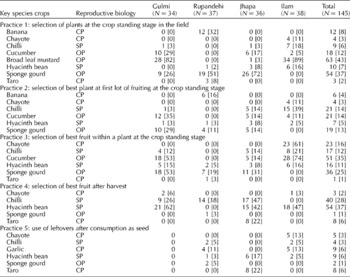
At least five seed or seedling selection and saving practices were reported for selected key home garden species (Table 5). Selection in the field is common, either at the crop standing stage or, more commonly, at the first fruiting when farmers selected the best plants or the best fruit. These practices are quite common, respectively, with broad leaf mustard (Brassica juncea var. rayo), sponge gourd (Luffa cylindrical L.) and cucumber (Cucumis sativus L.). Some farmers select fruit or seeds from the harvest (especially beans and chilli) and a few farmers use seed or germplasm that is left after consumption, as in the case of taro and beans in Jhapa. The difference in farmers' practices is related to the reproductive biology of the key species and seems to be more careful in seed selection for open-pollinated crops (Table 5).
Seed selection practices of representative key home garden species, 2005

CP, clonally propagated; SP, self-pollinated; OP, open pollinated (out-crossing).The numbers in parenthesis represent the percentage of the total respondents.
Seed selection of open-pollinated species, such as cucumber, broad leaf mustard and sponge gourds, tends to be at the stage when the crop is still standing or it is done by retaining seed from the first fruiting. By contrast, seed selection of self-pollinated crops, such as hyacinth bean and chillies, is done after the harvest or by keeping seed left over after consumption. Vegetatively propagated crops, such as taro and garlic, are generally selected only after the harvest, although a few farmers also use the material left over after consumption. Banana suckers, also clone, are identified from the best disease-free plants in the field or from the plants that have the best fruit at the first lot. Chayote (an open-pollinated crop, whose mature fruit is generally used for planting material) and chilli seeds/seedling are identified either from the best plants in the field or from the plants that have the best fruit at the first lot of fruiting based on the farmer's convenience. From a socio-economic perspective, there is a preference for selecting in the field among rich and medium-income respondents, whereas more respondents from the poor socio-economic strata select seeds after harvest (data not shown).
Storage practices of key species
Home garden farmers require very small amounts of seeds and therefore they store them in different ways. Knowledge about storage is generally held by women farmers in the HH. Bean, broad leaf mustard and sponge gourd seeds were found stored in cloth bags, medicine bottles, plastic pots and bamboo pots. Some farmers kept intact whole pods and fruits of beans and sponge gourd hanging from the ceiling, and removed the seeds only at the time of planting. Chayote (fruit) is found stored in moist soil because of its vivipary nature, as the seed germinates within the fruit. Cucumber seed is stored by splashing seed liquid extracted from mature fruits onto a mud wall. This local practice helps to dry the seed and believed to be better than storing in plastic bags. Chilli and cucumber seeds are dried and kept in cloth bags, plastic bags, bottles and cans. Taro corms are generally sun-dried and stored in cool dry places but are sometimes left in the field, or reburied in soil. In summary, there is great diversity in methods and practices of storage employed by farmers.
Discussion
The amount and distribution of key species diversity
As is the case in other home garden studies (Soemarowoto, Reference Soemarowoto, Steppler and Nair1987; Hodel et al., Reference Hodel, Gessler, Cai, Thoan, Ha, Thu and Ba1999; Castineiras et al., Reference Castineiras, Fundora Mayor, Pico and Salinas2000; Nair, Reference Nair2001), home gardens in Nepal can be characterized by high levels of species diversity with a mixture of annual and perennial plants. The differences in species richness in the composition of home gardens in Hill and Tarai regions are due to their ecological and ethnic diversity. The findings are consistent with previous studies done in Bangladesh (Oakley, Reference Oakley2004), Nepal (Sunwar et al., Reference Sunwar, Thornstrom, Subedi and Bystrom2006) and India (Agnihotri et al., Reference Agnihotri, Sharma, Joshi and Paini2004; Das and Das, Reference Das and Das2005), which reveal that as a small niche within a larger agroecosystem, home gardens contain a disproportionate species richness. Kumar and Nair (Reference Kumar and Nair2004) reported that species richness of home gardens within a region is influenced by the size of the home gardens. In Nepal, we found a substantial variation in the size of home garden, bigger in Hill than Tarai, between sites. Although a positive correlation was found between the log area of home garden size and species richness across sites, it is interesting to note that small home gardens (below 500 m2) tend to have high species composition (data cannot be seen as Fig. 1 was log transformed). This finding agrees with the previous report of average 402–434 m2 (Sunwar et al., Reference Sunwar, Thornstrom, Subedi and Bystrom2006), and indicates sufficient home garden area for family needs and conservation of key species.
There are several factors that can explain why home gardens are more biologically diverse than agricultural fields. First, the choice of species to grow in home gardens is based on what is valued culturally, the local agroecology, ethnic food culture, market accessibility and HH needs and preferences. This includes food, fodder, ornamental and medicinal plants from the wild, which are moved into and maintained in a home garden. Second, they function as a means to convenient provision of quality food all year round at a minimum cost for the family (Sthapit et al., Reference Sthapit, Rana, Eyzaguirre and Jarvis2008). Third, home gardens within and across agroecosystems provide a wide network of sources for the goods and services that home gardens provide, such as food, fodder, medicines, dyes, fuels and timber, and ecosystem services, such as habitats for pollinators, nutrient recycling and carbon sequestration, which provide indirect use and aesthetic values. Home garden management practices not only use the available biodiversity within large ecosystems, bridging natural and cultivated landscapes, they also shape the genetic diversity of traditional crops and varieties in situ through the process of natural and human selection (Benton et al., Reference Benton, Vickery and Wilson2003).
This study has shown that the key species have rich intraspecific diversity, evidenced by multiple-use, multiple-harvest varieties. While all key species identified in this study have more than one variety per garden, the more culturally valued species in each of the zones tend to have more intraspecific diversity; for example, chayote in Ilam (26 varieties), hyacinth bean in Rupandehi (18), citrus in Gulmi (13) and chilli in Ilam and Rupandehi (17–18). The presence of unique and rich varietal diversity within species is considered as one of the important criteria of key species; since very little intraspecific diversity was found with fruits and fodders, they are not considered first-degree key species. Such key species reflect the importance of each of these varieties in meeting diverse HH needs and cultural preferences. Varieties grown by many home gardens (frequency of occurrence) in a large area are considered ‘common’ key species that have both subsistence preference as well as commercial value on the local market. Broad leaf mustards, radish, sponge gourds, pumpkin, hyacinth bean, taro, chilli, banana, mango, citrus spp. and holy basil are among these species reported to be grown by most HHs as they have both sociocultural importance and value in local markets. Many climbers and runners, which are predominately vegetables, such as chayote, gourds, and yams, are well integrated into agroforestry systems. They are also considered key species because they are an important source of home-produced vegetables throughout the year.
The presence of rich fodder diversity is unique to the Nepalese home gardens as it is an integral part of the practice of mixed farming with a low number of livestock. A typical Nepalese home garden contains at least a few stall-fed cattle or buffalo, goats or pigs and free-ranging chickens, depending upon the preference of farmers' ethnic, cultural and religious background. The choice of plant species and composition is thus also determined by the type and number of animals the homestead maintains. The role of these trees in ensuring the sustainability of agricultural production and the importance of agroforestry systems for the conservation of integrated genetic resource management has also been reported earlier (Acharya, Reference Acharya2006).
The key species noted are often local or native species, whose seeds are not easy to obtain from the market. They contribute to the dietary diversity of HHs either directly or through better livestock production (Johns and Sthapit, Reference Johns and Sthapit2004). Some key species with a perennial growth habit (e.g. hyacinth bean, chillies, garlic, etc.) require relatively little management input, are easy to maintain and can provide a continuous HH supply of vegetables. The composition of Nepalese home gardens is significantly dominated by vegetable species possibly because of the vegetarian diets of the Hindu culture. Unlike other East Asian countries, the amount and distribution of fruits is relatively poor in Nepalese home gardens (Hodel et al., Reference Hodel, Gessler, Cai, Thoan, Ha, Thu and Ba1999; Trinh et al., Reference Trinh, Watson, Hue, De, Minh, Chu, Sthapit and Eyzaguirre2003; Gautam et al., Reference Gautam, Suwal and Basnet2005).
Management of home garden key species
Little research has been done to understand the practices that create and maintain high levels of diversity in such small pockets. Farmers, very often women, organize and introduce genetic materials into the home garden system by selecting and manipulating the genetic variability of crop plants according to the HH needs and preferences. Our studies found that self-saved seed and exchanges are the main sources of planting materials in Nepalese home gardens. In this way, constant exchange of seed and experimentation improve access of locally preferred germplasm for the communities' needs. Hence, it is important to understand the role of people in the HH and to document how they seek, select and maintain genetic diversity of key species, as well as how the species are managed and used in the system.
It has been argued that the plot size and number of plants of key species in home gardens are so small that they cannot be considered an effective population size for conservation efforts (Brown, Reference Brown and Brush2000). In reality, however, farmers have managed to maintain genetic diversity of cross-pollinated and self-pollinated crop varieties in home garden ecosystems by exchange of seed and knowledge as social practices. These seed exchange systems resemble the dynamics of a metapopulation, where different farmer populations represent subpopulations, seed flow represents migration, and the rate of seed exchange determines extinction and colonization (Hastings and Hartison, Reference Hastings and Hartison1994). A consideration of the populations of key species found in home gardens through the lens of metapopulation theory can explain how, for example, farmers can maintain two to six distinct varieties of cross-pollinated sponge gourd in a community.
Home gardens, though small in population size, offer not only refuge to crops that are no longer grown in larger agroecosystems, but also offer a method of conservation of many rare and unique components of biodiversity, which are then inherently decentralized and evolutionary. Many spices, herbs and non-timber forest products (medicinal plants) are in this category. This provides an ideal setting to promote local-level innovation. This study adds to the growing body of information on farmers' traditional knowledge and skills for the selection and maintenance of crop genetic diversity for species covering a wide range of plant reproductive biology. This farmer knowledge applied to home garden diversity provides ample scope for improvement of grassroots breeding and selection through training of nodal farmers. The challenge is to develop community-based systems that (1) enhance farmers' knowledge and skills in genetic resources and plant breeding of home garden species and (2) improve the continued access by farmers to a wide range of genetic resources for local innovation (Sthapit and Rao, Reference Sthapit and Rao2007).
Emerging issues and recommendation
Although home gardens cover only 2–11% of the total land holdings of the family in Nepal, they can supply 60% of the family requirements for fruits, spices and vegetables (Gautam et al., Reference Gautam, Suwal and Basnet2005). Home gardens seem devoted towards family well-being and nutrition but not necessarily oriented towards commercial production with the subsequent monoculture of vegetable crops. Being small in size, home gardens have always been neglected by policy makers for research, development and conservation programmes. There are two reasons for this: first, it is difficult to demonstrate large-scale economic impact from home garden interventions, and second, farming communities that rely on home gardens are generally managed by women and smallholders and are not well organized to lobby policy makers. This suggests that government policies, linked to the millennium development goals (MDGs) and poverty reduction strategies, and research priorities need to re-examine home gardens in the context of their value towards family welfare in particular and society, in general.
In Nepal, the government policies support the promotion of kitchen garden programmes that basically introduce free or partially subsidized seed of hybrids from multinational seed companies. This policy support threatens the stable and resilient home garden systems, which are rich in biodiversity, and causes rapid genetic erosion of traditional home garden species. Consequently, access to traditional vegetable and fruit seeds is becoming increasingly difficult as young women farmers are losing their knowledge of seed selection and maintenance of native species. As a result, farmer seed systems in urban and peri-urban areas are already showing signs of stress such as changes in patterns of access to seed materials and associated knowledge, unavailability of preferred local varieties and increase use of suboptimal cultivars.
This paper thus brings out new research and development issues that challenge the current focus of biodiversity-based livelihood programmes. The study has shown how farmers can balance livelihood gains with conservation goals in the home garden production system using their own knowledge resources and biodiversity assets. By definition, the poor in developing countries have limited land for cultivation and have poor access to research and development. Home garden programme has already demonstrated that it can be an appropriate entry point to address MDGs and poverty reduction through social inclusion and community empowerment. This implies that the conservation, utilization and management strategy for home garden's key species can have wide applicability and relevance to all socio-economic strata of society.
Acknowledgements
Time of community participation, field-based staff and support of Swiss Development Cooperation, Nepal is gratefully acknowledged. The authors are thankful for the useful comments of Mauricio Bellon, Arwen Ruth Bailey, Carlo Fadda (Bioversity) and Sajal Sthapit (Eco-agriculture Partners) on an earlier draft of the manuscript. We would also like to thank the technical support of Rosy Suwal, Parshu BK (LI-BIRD) and Ambika Thapa (Bioversity).