Introduction
Depression in elderly populations is commonly precipitated and potentiated by vascular diseases (Kales et al., Reference Kales, Maixner and Mellow2005; van Sloten et al., Reference van Sloten2015). Selective serotonin reuptake inhibitors (SSRI) are a frontline treatment option for depression in elderly persons with vascular diseases such as hypertension, coronary heart disease, and cerebrovascular disease (Baumeister et al., Reference Baumeister, Hutter and Bengel2011). Because of the association between depression and vascular risk factors, one clinical guideline for late-life depression proposed antidepressant augmentation with calcium channel blockers (CCB) in addition to intensive management of vascular risk factors such as hypertension and cholesterol (Naismith et al., Reference Naismith, Norrie, Mowszowski and Hickie2012). While emerging genetic, ex-vivo, and clinical trial evidence indicates that CCBs improve mood and cognitive function, there is scant research from general population samples.
Two randomized controlled trials (RCT) indicated an improved depression response and higher depression remission rates in patients randomized to SSRI and CCB augmentation therapy over follow-up ranging from 8 to 12 months (Taragano et al., Reference Taragano, Allegri, Vicario, Bagnatti and Lyketsos2001; Taragano et al., Reference Taragano, Bagnatti and Allegri2005). Similarly, a longitudinal evaluation of depression symptom change in hypertensive patients randomized to CCB (verapamil) versus beta-blocker (atenolol) indicated that CCB was associated with lower positive affect, interpersonal problems, and somatic disturbances (Wilson and Ried, Reference Wilson and Ried2012). Otherwise, the benefits of Ca2+ channel blockade are predominantly investigated in relation to mania symptoms in bipolar depression, cognitive function, and dementia.
A recent systematic review of bipolar depression studies demonstrated that the CCB verapamil was not inferior to lithium, however, verapamil was not superior to placebo, and non-RCT evidence was inconclusive (Cipriani et al., Reference Cipriani2016). With regards to dementia, recent studies indicate that CCBs may reduce dementia risk (Peters et al., Reference Peters, Booth and Peters2014). Collectively, evidence supports CCB use as favorable to cognitive function and hypomania symptoms (Peters et al., Reference Peters, Booth and Peters2014; Cipriani et al., Reference Cipriani2016). However, it remains unclear whether SSRI augmentation with CCB is more effective than SSRI augmentation with other antihypertensive drugs.
The current study extends beyond previous reports by examining the effects of SSRI augmentation with CCB in relation to depression symptoms and cognitive function in a prospective cohort of elderly individuals. The main hypothesis is that SSRI and CCB therapy would be associated with a greater reduction in depression symptoms by comparison to SSRI and other antihypertensive drugs. It is also hypothesized that CCB and SSRI therapy would be associated with less cognitive decline by comparison to SSRI and other antihypertensive drugs.
Methods
Population
The Three-City (3C) Study is a prospective cohort study investigating the determinants of dementia, coronary heart disease, and stroke (The 3C Study Group, 2003). Briefly, 9,294 non-institutionalized community dwelling French adults aged ≥ 65 years underwent extensive baseline examinations. Serial clinic visits were scheduled at approximately 2, 4, 7, and ten-years to assess cognitive function, depression, incident neurological diseases, and comorbidities. The current analyses were restricted to a sub-group prescribed and utilizing a SSRI for depression and an antihypertensive drug for hypertension at baseline and the two-year follow-up (flow chart in Figure 1). Participants lost to two-year follow-up in 3C were more often men (p = 0.042), had less education (p = 0.036), and had more often smoked (p = 0.046) than persons with at least one follow-up visit (The 3C Study Group, 2003). The study protocol was approved by the Ethical Committee of the University Hospital of Kremlin-Bicêtre.
Flow chart of participants through the study. CCB, calcium channel blocker; SSRI, selective serotonin reuptake inhibitor.

Depression symptoms
The Center for Epidemiologic Studies-Depression (CES-D) scale was used for measuring depression symptoms (Radloff, Reference Radloff1977). The CES-D asks respondents to rate whether they have experienced 20 symptoms in the past week on a scale of 0 (rarely or none of the time (less than one day)) to 3 (Most or all of the time (5–7 days)). Higher scores are indicative of a greater severity of depression symptoms and CESD scores ≥ 16 are indicative of mild to severe depression symptoms.
A four factor structure proposed by Radloff (Reference Radloff1977) is most commonly replicated (Shafer, Reference Shafer2006) representing somatic symptoms (seven items), depressed affect (seven items), low positive affect (four items, reverse keyed and then reverse scored), and interpersonal problems (two items). A principal component analysis with varimax rotation supported a four-factor structure, accounting for 50% of the variance in baseline CES-D scale scores (see Table S1 and Figure S2, available as supplementary material attached to the electronic version of this paper at http://journals.cambridge.org/ipg). Participant's responses at baseline and every follow-up were allocated to the four depression symptom factors. Factor scores were standardized by converting to z-scores with a mean = 0 and SD = 1 as reported elsewhere (Tully et al., Reference Tully, Debette, Mazoyer and Tzourio2017a).
Participants also underwent a structured interview to determine depression status at baseline with the Mini-International Neuropsychiatric Interview (MINI) (Sheehan et al., Reference Sheehan1998). The MINI has established psychometric validity for mood disorders, including inter-rater agreement and concurrent validity with other structured clinical interviews. For brevity, only the major depression and dysthymia modules were administered to determine depression disorders.
Cognitive function
Participants underwent assessments with a battery of validated cognitive tests administered by trained psychologists. Isaac's Set Test (IST) evaluates verbal fluency abilities and speed of verbal production (Isaacs and Kennie, Reference Isaacs and Kennie1973). The Benton Visual Retention Test (BVRT) evaluates immediate visual recognition memory and attention (Benton, Reference Benton1945). The Mini-Mental State Examination (MMSE) is a common screening tool for dementia and tests global cognitive function (Folstein et al., Reference Folstein, Folstein and McHugh1975). The Trail Making Test (TMT) (Armitage, Reference Armitage1946) is a test of visual attention, processing speed, and mental flexibility. The ratio of time to complete TMT part B/A is broadly representative of executive function independent of motor speed (Arbuthnott and Frank, Reference Arbuthnott and Frank2000).
Because of the possibility for age-related decline, but also stable or improved cognitive function over time due to practice effects and reduced testing anxiety, cognitive test scores were converted to z-scores, using reliable change index (RCI) methodology. The RCI estimates clinically significant change at each follow-up corrected for measurement error and practice effects (Jacobson and Truax, Reference Jacobson and Truax1991). The RCI was calculated for each cognitive measure at each follow-up period, using the mean (M1) and follow-up (M2) data. First, the standard error of the difference (SEdiff) between measurements was calculated; SEdiff = √[SE21 + SE22]. The SEdiff describes the spread of distribution of change scores expected if no actual change had occurred. The RCI is then calculated as: ((X 2–X 1) – (M 2–M 1))/SEdiff, where M 1 is the group mean pretest score, M 2 is the group mean posttest score, and X 2–X 1 are an individual participants’ scores at follow-up and baseline, respectively. Appropriate modifications were made to the RCI for TMT so that lower scores represented worse cognitive function to remain consistent with interpretation of the other cognitive tests. Consistent with the normal distribution of z-scores, any change score exceeding ±1.96 (95% confidence interval) is statistically rare and thus indicates significant improvement or decline. Accordingly, patients were coded as declined when the RCI declined by less than −1.96.
Diagnoses of prevalent and incident dementia was made by local neurologists according to DSM-IV criteria and then adjudicated by a panel of independent neurology experts (The 3C Study Group, 2003). In Dijon, because of a larger number of participants, only those suspected of having dementia based on their neuropsychological test performance on MMSE and IST underwent further examination with a neurologist at baseline and follow-up.
Primary exposure: SSRI and antihypertensive use
At baseline drug use during the preceding month was determined during the face-to-face interview, and, where feasible, the medications themselves were seen by the interviewer. The name of the medication was recorded, and all drugs were subsequently coded according to the Anatomic Therapeutic Chemical (ATC) classification of the World Health Organization (World Health Organization, 2002). For approximately half of the cohort additional data on medication use was obtained via database linkage with the French National Health Insurance System. The SSRIs included drugs with ATC code N06AB. Drug use for hypertension was explicitly differentiated from other uses (Brindel et al., Reference Brindel2006) and CCBs included ATC codes C08C, C08D, C08E. Use of other antihypertensive included angiotensin converting enzyme inhibitors, angiotensin-II receptor blockers, beta-blockers, and thiazides. Two groups were constructed based on use of SSRI and CCB or use of SSRI and other antihypertensives, each with hypertensive monotherapy.
Assessment of covariates
A standardized questionnaire was administered covering demographic characteristics, daily life habits and medical history. Assessment of the number of alcoholic drinks (g per day) and tobacco consumption was collected by a designated survey (Guigoz et al., Reference Guigoz, Vellas and Garry1996). Diabetes was defined as medication use for diabetes or fasting plasma glucose ≥7.0 mmol/L. Comorbidities were classified according to international classification of disease criteria and included cardiovascular diseases (myocardial infarction, coronary artery bypass or percutaneous intervention, peripheral vascular disease, and stroke) and atrial fibrillation arrhythmias. Clinic blood pressure (BP) was measured according to a standardized protocol (Brindel et al., Reference Brindel2006), with an appropriately sized cuff placed on the left arm using a validated digital electronic tensiometer OMRON M4 (OMRON Corp., Kyoto, Japan). BP was recorded at each clinic visit after the participant rested at least 5 min in a seated position. A total of three measurements were recorded separated by 2 min (mean of 3 BP readings per clinic visit). Hypertension was defined as medication use for blood pressure or having BP ≥ 140/90 mmHg. Stage of chronic kidney disease (CKD) was calculated from glomerular filtration rate (mL/min/1.73 m2) according to the Guidelines of the National Kidney Foundation (2002). The protocol and criteria used to define prevalent stroke are defined elsewhere (The 3C Study Group, 2003). Incident stroke was confirmed if the participant had a new focal neurological deficit of sudden onset attributable to a cerebrovascular event that persisted for more than 24 h (Tully et al., Reference Tully, Debette, Dartigues, Helmer, Artero and Tzourio2016).
Statistical analyses
Continuous data are represented as mean and SD or median and interquartile range (IQR) as appropriate, categorical data are presented as n(%). Because of the non-randomized nature of exposure to CCB and other antihypertensive drugs, a propensity score was created for use of SSRI and CCB (reference group SSRI and other antihypertensive drugs). The propensity score was calculated from participant's systolic BP, comorbid cardiovascular disease, and atrial fibrillation. Demographic factors (e.g. age, sex) were adjusted for separately in multivariate models.
Change in depression symptoms and cognition was categorized as short (two years) and long-term (ten years). Short-term change in depression symptoms from baseline to two-year follow-up was assessed with repeated measures analysis of variance (ANOVA). These analyses controlled for age, sex, and propensity score. All main and interaction effects with time were tested. The first set of analyses compared the SSRI + other antihypertensive group to the SSRI + CCB group on change in global depression symptoms and change in the four CESD depression factors. In a sensitivity analysis, the sample was restricted to persons with symptomatic depression at baseline (CESD total ≥16) and analyzed global CESD score change. The association between use of CCB and cognitive decline at two year follow-up was analyzed with logistic regression showing the odds ratio (OR) and 95% confidence interval (CI). The logistic regression utilized the binary reliable cognitive deterioration variable derived from the RCI for each cognitive test. Logistic regression models were adjusted for age, sex, education, and propensity score.
Longer term depression and cognitive outcomes were modeled with linear mixed models to estimate within and between subject effects and change over time. This permitted analysis of outcomes over ten years and including persons who were lost to follow-up prior to ten years. The models specified correlated residuals within subjects and random effects with restricted maximum likelihood function and robust covariance estimation. The data analysis assessed the slope of depression and cognitive function over time, utilizing a random slope, and random intercept. All mixed models were adjusted for age, sex, and propensity score, and the cognitive function analyses additionally included education. A positive β coefficient indicates that use of SSRI + CCB is associated with an increase in a cognitive test performance independent of practice effects over time (i.e. an improvement). For depression, a negative β coefficient indicates that use of SSRI + CCB is associated with lower depression symptoms (i.e. an improvement). All analyses were performed with PASW for Windows® version 22.0, a p value ≤ 0.05 was considered as statistically significant. No adjustment was made for multiple comparisons (Rothman, Reference Rothman1990).
Results
Characteristics of sample
The final sample incudes 296 persons with a mean age of 75.2 ± 5.47 years and 78% of participants were female. There were 243 (82.1%) users of SSRI and other antihypertensives and 53 (17.9%) were users of SSRI and CCB. There were no significant differences between the two groups on descriptive variables and major comorbidities (Table 1). Of SSRI users at baseline and two years, SSRI use over follow-up was; 84.7% at four years, 84.4% at seven years, and 78.8% at ten years. Of antihypertensive drug users at baseline and two years, antihypertensive drug use over follow-up was; 84.7% at four years, 78.0% at seven years 86.7% at ten years.
Descriptive comparisons between SSRI and antihypertensive drug users

Data shown as n(%) unless specified otherwise. Categorical data was analyzed with the χ2 statistic; normally distributed continuous data was analyzed with independent samples t-tests; Non-normally distributed continuous data was analyzed with Mann–Whitney U tests.
a Fisher's exact test.
b χ2 for trend.
ADL, activities of daily living; BMI, body mass index; BP, blood pressure; CCB, calcium channel blocker; CESD, Center for Epidemiologic Studies – Depression (CESD) scale; HTN, hypertension; IQR, inter-quartile range; SD, standard deviation; SSRI, selective serotonin reuptake inhibitor.
Change in depression symptoms and cognitive function at two years
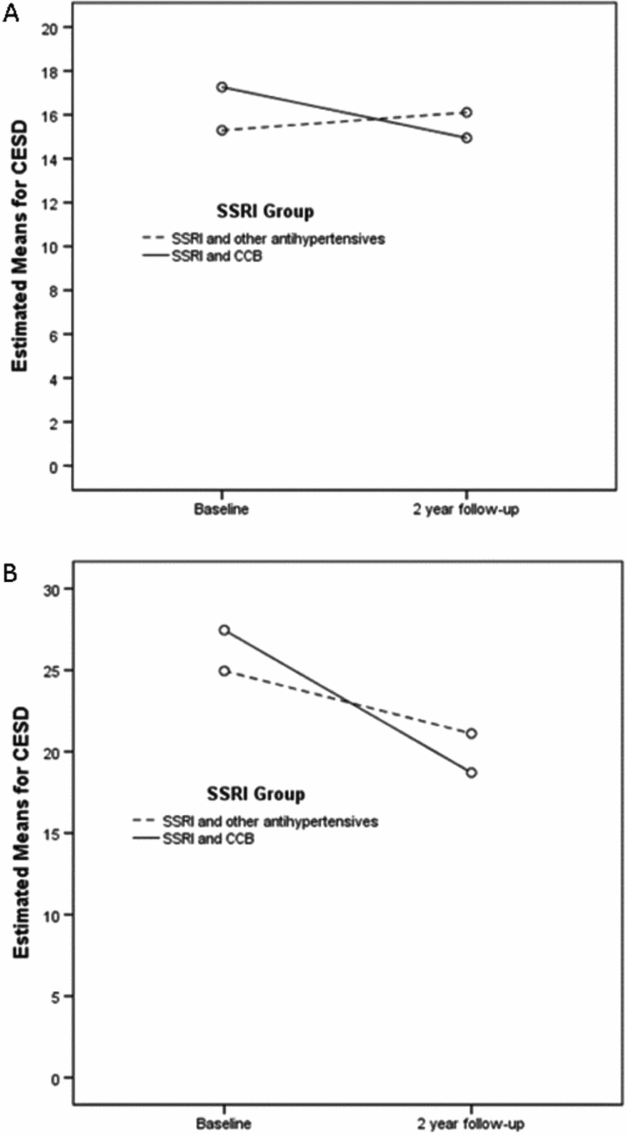
The baseline and two year CESD scores are shown in Table 2. The repeated measures ANOVA analysis indicated a significant group by time interaction for change in CESD scores (F(1,291) = 4.13; p = 0.043), however the effect size was small (η2p = 0.014). As depicted in Figure 2, depression symptoms reduced at two-year follow-up in the SSRI and CCB group and increased among the SSRI and other antihypertensives group. Sensitivity analysis among persons with baseline CESD scores >16 corroborated a group by time interaction for change in CESD scores (F(1,127) = 4.97; p = 0.028), however the effect size was small (η2p = 0.039).
Mean depression symptoms at baseline and two years in persons treated with SSRI and antihypertensive drugs

CCB, calcium channel blocker; CESD, Center for Epidemiologic Studies – Depression scale; SSRI, selective serotonin reuptake inhibitor;
The table shows results for repeated measures analysis of variance, adjusted for age, sex, and propensity score. The propensity score was calculated from participant systolic BP, comorbid cardiovascular disease, and atrial fibrillation.
Graph showing the mean CESD scores at baseline and follow-up. Persons treated with SSRI and CCB (bold line) and persons treated with SSRI and other antihypertensives (dashed line). Panel A depicts the estimated marginal mean CESD scores at baseline and two-year follow-up in the total sample (n = 296). Panel B depicts estimated marginal mean CESD scores at baseline and two-year follow-up in the sub-group of participants with baseline CESD scores ≥ 16 (n = 132). CCB, calcium channel blocker; CESD, Center for Epidemiologic Studies – Depression scale; SSRI, selective serotonin reuptake inhibitor.

Analysis of the CESD sub-factors in the total sample showed a significant group by time interaction for the negative affectivity CESD factor, F(1,296) = 7.30; p = 0.007, η2p = 0.03 (see Table S3). Analysis of reliable deterioration showed no association between use of SSRI and antihypertensive drugs with cognitive function (see Table S4).
Ten-year depression and cognitive function outcomes
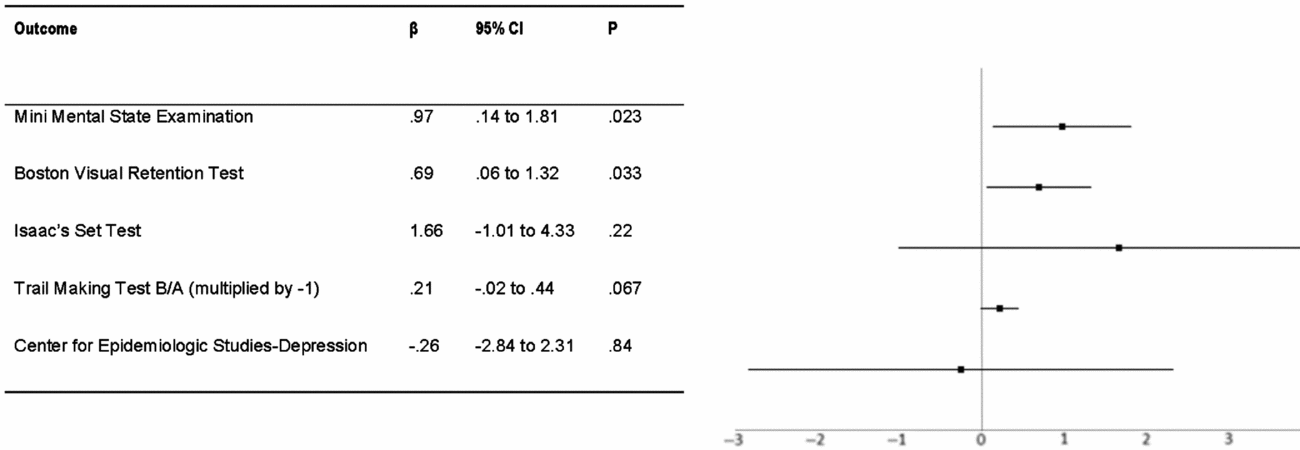
The use of SSRI with CCB (vs. other antihypertensives) was associated with improved general cognitive function (MMSE: β = 0.97; 95% CI 0.14 to 1.81, p = 0.023) and immediate visual memory (BVRT: β = 0.69; 95% CI 0.06 to 1.32, p = 0.033) (Figure 3). The use of SSRI with CCB was not significantly associated with executive function (TMTB/A: β = 0.21; 95% CI −0.02 to 0.44, p = 0.067), verbal fluency (IST: β = 1.66; 95% CI −0.1.01 to 4.33, p = 0.22) or total depression symptoms (CESD: β = −0.26; 95% CI −2.84 to 2.31, p = 0.84). Analysis of the depression factors indicated a reduction in somatic depression symptoms with use of SSRI and CCB (β = −0.31; 95% CI −0.58 to −0.03, p = 0.031) (see Table S5).
Forest plot showing the β coefficient and 95% CI for the association between SSRI and CCB use with cognitive function and depression over ten years of follow-up. A β coefficient and 95% CI that exceeds 1 (vertical line) indicates a significant increase cognitive function (or depression) over time in persons treated with SSRI and CCB versus persons treated with SSRI and other antihypertensives (reference group). CCB, calcium channel blocker; CI, confidence interval; CESD, Center for Epidemiologic Studies – Depression scale; SSRI, selective serotonin reuptake inhibitor.

Discussion
This study found that SSRI and CCB use was associated with a small but significant reduction in depression symptoms at two-year follow-up. No reduction however was observed on total depression symptoms over ten years follow-up. With regards to cognitive function, SSRI and CCB use was not associated with cognitive decline at two years, however SSRI and CCB use was associated with improved general cognitive function and immediate visual memory in the longer term. These findings provide the first general population evidence that SSRI and CCB drug therapy is associated with mood and cognitive function among elderly hypertensives treated with SSRIs.
The finding that SSRI and CCB use was associated with a significant decrease in depression symptoms aligns with previous reports. The RCT of fluoxetine augmentation with nimodipine reported significantly lower Hamilton Depression Rating Scale scores in elderly persons with major depression onset after 65 years (Taragano et al., Reference Taragano, Bagnatti and Allegri2005). By contrast, our results did not support a reduction in depression symptoms over ten years, which is a longer follow-up than previous trials. Our findings relating to a reduction in long-term somatic symptoms are consistent with a RCT head-to-head comparison of CCB versus beta-blocker. The RCT showed that verapamil was associated with significantly lower anhedonia, interpersonal problems, and somatic disturbances at 12-month follow-up (Wilson and Ried, Reference Wilson and Ried2012). Wilson and Ried (Reference Wilson and Ried2012) performed a latent class analysis of the CESD whereas here a principal components analysis was performed to derive the CESD factor scores. Other methodological differences relate to the randomized and head-to-head comparison design by Wilson and Ried (Reference Wilson and Ried2012), whereas we compared the use of CCB and SSRI to several antihypertensive drug classes. Moreover, our population sample did not randomize participants to receive specific antidepressant or antihypertensive drugs, which were at the discretion of local physicians.
There are few comparable studies reporting SSRI augmentation with CCB in relation to cognitive outcomes. However, the efficacy of CCBs to delay dementia onset and ameliorate cognitive decline was investigated in large clinical trials (Forette et al., Reference Forette2002). A meta-analysis review of CCB RCTs reported no significant reduction in Alzheimer's disease (risk ratio 0.79; 95% CI 0.53–1.17) (Peters et al., Reference Peters, Booth and Peters2014). However, observational cohort studies generally support that the use of antihypertensive drugs, including CCBs, significantly reduce dementia risk (Rouch et al., Reference Rouch2015). Decelerated cognitive decline and allayed progression to dementia is postulated because some CCBs cross the blood–brain barrier and Ca2+ signaling is involved in neuronal processes, including amyloid β clearance, tau hyperphosphorylation and apoptosis (LaFerla, Reference LaFerla2002). Taking a similar line, others have theorized that the dihydropyridine class of CCBs could delay Alzheimer's disease onset (Peters et al., Reference Peters, Booth and Peters2015) by blocking the inappropriately increased transmembranous transport of Ca2+ through L-channels into neurons (Yasar et al., Reference Yasar, Corrada, Brookmeyer and Kawas2005). L-type Ca2+ channel blockade is also the main proposed mechanism explaining pleiotropic effects on mood and hypomania symptoms. Genetic research has particularly focused on novel polymorphisms responsible for L-type Ca2+ channels in bipolar disorder. Specifically, genome wide association studies indicate an association between CACNA1C, which encodes L-type calcium channels, with bipolar disorder (Psychiatric GWAS Consortium, 2011). Ex-vivo studies also suggest altered Ca2+ channel signaling in neurons of persons with bipolar disorder (Chen et al., Reference Chen2014).
The practical implications of these findings relate to SSRI augmentation with CCB in elderly individuals with hypertension and depression, as recommended by Naismith et al. (Reference Naismith, Norrie, Mowszowski and Hickie2012) and the RCT by Taragano et al. (Reference Taragano, Bagnatti and Allegri2005). Augmentation and intensive vascular disease management might be especially important in persons with sub-clinical cerebrovascular disease. Persons with late life onset depression and sub-cortical white matter burden typically demonstrate executive dysfunction and antidepressant treatment resistance (Taylor et al., Reference Taylor, Aizenstein and Alexopoulos2013). The interaction between white matter lesions and systolic BP could be clinically important to cognitive functioning in late-life depression (Tully et al., Reference Tully, Debette and Tzourio2017b). Our findings also suggest that the combination of SSRI and CCB was associated with improved cognitive function but only in the longer term and in specific cognitive domains. However, our findings do not offer practical guidance on CCB or SSRI dosage, as this information was not available. Drug combination, dosage and duration of use would be important to investigate further given that higher doses of the CCB nitrendipine were associated with greater reduction in dementia risk in the Syst-Eur trial (Forette et al., Reference Forette2002).
The strengths of this study include the representative elderly sample and comprehensive examinations for depression symptoms and cognitive function at regular follow-ups. The main limitation of this study is the small effect size for depression symptom reduction with a SSRI and CCB augmentation strategy. The small effect size may be due to a head-to-head comparison of SSRI + CCB augmentation versus other antihypertensive drugs, as opposed to a CCB versus placebo comparison (Taragano et al., Reference Taragano, Allegri, Vicario, Bagnatti and Lyketsos2001; Reference Taragano, Bagnatti and Allegri2005). Several limitations temper the conclusions drawn here including that the dosage, total duration, and adherence to taking SSRI and antihypertensive drugs was not recorded thus dose-response relationships were not quantified. Likewise, the duration and severity of depression and hypertension prior to the study was unknown. It is possible that detection of comorbid depression and hypertension in primary care leads to less aggressive antihypertensive treatment to lower BP. Similarly, it is possible that antidepressants and antihypertensive drugs are prescribed less aggressively to persons showing signs of cognitive impairment or dementia. Another limitation here is that the side-effect profiles were not evaluated which may be important to patients given that verapamil is associated with headache, changes in BP, and alterations in heart rate among bipolar disorder patients (Cipriani et al., Reference Cipriani2016). Also, because of the non-randomized design of our study, indication biases cannot be ruled out in persons treated with SSRIs and antihypertensive drugs, though we have adjusted for propensity score and cardiovascular risk factors. Another limitation is that information about switches between antidepressants was not analyzed. Switches between antidepressant drugs could be indicative of treatment resistance, a typical characteristic of the “vascular depression” sub-type (Taylor et al., Reference Taylor, Aizenstein and Alexopoulos2013). Moreover, persons with late-life depression are at risk of progression to dementia, and our cognitive test battery did not examine delayed-memory recall, a key cognitive domain that is impaired in Alzheimer's disease. Another limitation is the small sample size that prohibited adjustment for other covariates known to influence depression and cognitive function. The study could therefore be replicated in larger cohorts to determine the effect sizes after adjustment for a more comprehensive list of covariates.
In conclusion, these findings indicate that CCB and SSRI use was associated with a small but significant improvement in depression symptoms at two-year follow-up. However, beneficial effects upon total depression symptoms were not observed over ten years follow-up, and only somatic depression symptoms improved in SSRI and CCB users. SSRI and CCB use was associated with improved general cognitive function and immediate visual memory in the longer term. No protective effect on cognitive function was evident at two years. Collectively, the findings provide some support for SSRI augmented with CCB as having off-label effects on mood and cognitive function.
Conflict of interest
None.
Description of author's roles
P. Tully designed the study, performed the statistical analysis, and wrote the paper. R. Peters designed the study and assisted with writing the paper. K. Pérès supervised the data collection and assisted with writing the paper. K. Anstey designed the study and assisted with writing the paper. C. Tzourio designed the study, supervised the data collection, and assisted with writing the paper.
Acknowledgments
The Three-City (3C) Study is conducted under a partnership agreement between the Institut National de la Sante et de la Recherche Medicale (INSERM), the Victor Segalen-Bordeaux II University, and Sanofi-Aventis. The Fondation pour la Recherche Medicale funded the preparation and initiation of the study. The Fondation Plan Alzheimer partly funded the follow-up of the study. The 3C Study is also supported by the Caisse Nationale Maladie des Travailleurs Salaries, Direction Generale de la Sante, MGEN, Institut de la Longevite, Conseils Regionaux of Aquitaine and Bourgogne, Fondation de France, la Caisse Nationale de Solidarité et d'Autonomie (CNSA) and the Ministry of Research-INSERM Programme “Cohortes et collections de donnees biologiques.” The funding organizations played no role in the design and conduct of the study and were not involved in collection, management, analysis, and interpretation of the data or in preparation, review, or approval of the manuscript. The 3C Study supports are listed on the Study website (www.three-city-study.com).
Supplementary material
To view supplementary material for this article, please visit https://doi.org/10.1017/S1041610217002903