Introduction
Currently, approximately 24 million individuals around the world have a dementia diagnosis, a number that is expected to double in the next 20 years (Qiu, De Ronchi, & Fratiglioni, Reference Qiu, De Ronchi and Fratiglioni2007). With dementia already having a major impact on healthcare costs (Jonsson & Wimo, Reference Jonsson and Wimo2009; Wimo, Winblad, & Jonsson, Reference Wimo, Winblad and Jonsson2010), in its 2010 World Alzheimer Report, Alzheimers Disease International (ADI) predicted a near-doubling in worldwide societal costs, from US$604 billion in 2010 to US$1117 billion by 2030 (Prince, Prina, & Guerchet, Reference Prince, Prina and Guerchet2013). The financial burden mainly results from the professional care that is needed to compensate for the deterioration in the patients’ performance of activities of daily living (ADL) due to the severe and progressive cognitive decline, eventually necessitating admission to nursing homes or other care facilities when patients are no longer able to function independently and informal care-giver burden becomes too high.
Pharmacological interventions have so far only shown relatively modest effects on cognitive and ADL capability in people with mild to moderate dementia (Seltzer et al., Reference Seltzer, Zolnouni, Nunez, Goldman, Kumar and Ieni2004; Zec & Burkett, Reference Zec and Burkett2008). The challenge in dementia care therefore is to try and keep individuals with dementia as independent for as long as possible. Reducing informal care-giver burden and behavioural problems in people with dementia may help delay nursing home admission, while augmenting both the patient's and the care giver's quality of life and reducing societal costs. Typically, non-pharmacological dementia treatments, such as cognitive rehabilitation (CR) programmes, focus on maintaining quality of life despite the deficits that are likely to progress over time. CR interventions aim to increase the patients’ autonomy and decrease care-giver burden by exploiting compensatory and restorative strategies, and may comprise adaptations of the environment, the use of external aids and interventions to relearn specific skills. Specific teaching methods have been developed that promote the use of strategies based on automatic, implicit forms of learning, which are relatively spared in dementia (Baddeley & Wilson, Reference Baddeley and Wilson1994). One such approach is errorless learning (EL). The basic assumption of EL is that errors made during the acquisition phase of learning may interfere with correct responses during the retrieval of what has been learned. Due to explicit memory deficits, these errors are not recognised and corrected, but may be implicitly consolidated in memory. Systematic reviews of the literature indicate that, compared to trial-and-error learning, or errorful (EF) learning, EL is considered a promising method in some studies, but shows a limited or no advantage in other studies on brain-impaired patients, including those with dementia (Clare & Jones, Reference Clare and Jones2008; Middleton & Schwartz, Reference Middleton and Schwartz2012). Specifically focusing on everyday-skill learning in dementia, de Werd, Boelen, Olde Rikkert and Kessels (Reference de Werd, Boelen, Olde Rikkert and Kessels2013b) report that EL has been found to be beneficial in some studies in people with dementia. Studies that have included long-term follow-up assessment also report beneficial effects of EL (de Werd et al., Reference de Werd, Boelen, Olde Rikkert and Kessels2013b). While studies show that at least some people with dementia are able to re-acquire meaningful skills, potentially improving and prolonging their autonomy, independence and quality of life while reducing both the informal care-giver and societal burden, findings so far are mixed. This may be due partly to methodological shortcomings and a large variety of EL instructions, trained tasks and treatment duration. Specific information on the effective ingredient of EL is needed in order to implement EL in dementia care.
One important issue that is relevant in this respect is that treatment success also depends on an individual's active effort during the acquisition of information. In more standard, passive approaches to EL, the information to be learned is simply repeated and the answers are provided by the trainer. In addition, there is an EL approach that promotes active and deep encoding by, for instance, directing the patient's focus of attention to the information to be learned and creating semantic cues to self-generate the correct responses (self-generation method). This approach has been shown to enhance the effects of EL (Lubinsky, Rich, & Anderson, Reference Lubinsky, Rich and Anderson2009; Metzler-Baddeley & Snowden, Reference Metzler-Baddeley and Snowden2005; Tailby & Haslam, Reference Tailby and Haslam2003). Tailby and Haslam (Reference Tailby and Haslam2003) found an overall benefit of EL over EF learning in terms of the number of words recalled in people with acquired brain injury (including three dementia patients). In the self-generated EL condition, in which strong semantic cues were given, patients retained significantly more words than in the standard (passive) EL condition. These results were replicated by Laffan, Metzler-Baddeley, Walker and Jones (Reference Laffan, Metzler-Baddeley, Walker and Jones2010) in a group of patients with Alzheimer's dementia, prompting their conclusion that cued recall (self-generated EL) yields significantly better outcomes than those obtained with standard EL. They also found that the Alzheimer patients with milder overall cognitive impairments benefited more from active generation than the more severely impaired patients. Middleton and Schwartz (Reference Middleton and Schwartz2012) stated that passive EL might not be the preferred approach when the target skill requires the explicit recall of learned information. A more active way of learning appears to be more appropriate. The application of EL in clinical practice should preferably comprise a combination of teaching techniques aimed at reducing the amount of errors during acquisition as much as possible and effortful learning strategies involving a deep and ‘meaningful’ encoding of the information to be learned (de Werd et al., Reference de Werd, Boelen, Olde Rikkert and Kessels2013b). Such EL interventions should then involve elements such as inviting the patient not to guess, having the patient master the task in small, comprehensible steps, with the steps being customised by the therapist, providing verbal instructions, and using vanishing cues (VC) to gradually decrease the need for assistance during recall. By actively guiding the patient while preventing errors from being made, the patient is coached to perform the task her/himself (self-generated EL).
However, to date no practical manual, protocol or guidelines on EL are available that offer such an integrated, structured and implementable approach, neither do we know whether and how health professionals use and incorporate structured teaching principles in their daily routines, and whether there is a true need for EL in dementia care. With the present study we, therefore, first aimed to explore the interest in and feasibility of an EL teaching protocol by means of a nationwide survey among dementia professionals. We subsequently sought to translate the survey results and conclusions from the existing literature into a manual on EL for use in dementia care and, finally evaluated its content and clinical feasibility.
Methods
Feasibility Survey
The survey to explore the need for, and feasibility of, an EL manual for use in dementia care was sent via e-mail to the 33 nursing homes and private dementia residences that were part of our Radboud Alzheimer Centre nursing-home network. Care was taken that different health disciplines (i.e., physicians, psychologists, occupational therapists, physiotherapists, speech therapists, activity coordinators, and geriatric nurse and nursing assistants) were recruited. The questionnaire contained items about the type of teaching methods respondents had been using to date (if any); which disciplines were involved in the teaching programmes; what kind of tasks, activities or skills were deemed useful and feasible for (re)learning; expectations of EL in terms of augmented learning outcomes; and which disciplines within the facilities could best promote learning abilities in residents with dementia (for the full feasibility survey, see supplementary Appendix A, available online).
For analysis of the survey results we followed the methodology used by Joosten-Weyn Banningh, Vernooij-Dassen, Olde Rikkert and Teunisse in their 2008 study, which was adapted from grounded theory (Corbin & Strauss, Reference Corbin and Strauss1990). First, the answers to the open-ended questions were transcribed and categorised into different concepts by three independently operating teams (no consulting among teams), each consisting of two neuropsychologists with expertise in dementia. Each team defined domain concepts, that is, common denominators for various responses and response categories. Thus, washing and dressing were categorised as Activities of Daily Living (ADL), while walking with a walking aid and chair-to-bed transfers were classified under Mobility. These preliminary concepts were subsequently discussed in a plenary meeting until consensus was reached among team members on the final concepts for analysis. These were additionally scrutinised by an independent assessor and definitive concepts (see supplementary Appendix A) were determined during a second plenary meeting. For each concept response, frequencies were determined. For example, the question ‘Which other tasks, skills or activities could individuals with dementia in your facility (re)learn’ yielded the following ans-wers: Washing, making coffee, dressing, using the telephone, using a GPS, using an alarm clock. As washing and dressing are covered by the ADL concept, this was awarded a frequency score of 2, as were the IADL (instrumental activities of daily living) concepts (making coffee and using a telephone) and the orientation skills concepts (using a GPS and using an alarm clock).
Development and Evaluation of the EL Manual
Trial in care facilities
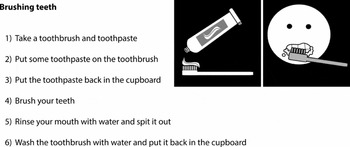
With the aim to provide healthcare professionals with a comprehensive ‘hands-on’ description of how to apply EL in clinical practice, based on the results of the feasibility survey and literature reviews (Clare & Jones, Reference Clare and Jones2008; de Werd et al., Reference de Werd, Boelen, Olde Rikkert and Kessels2013b; Middleton & Schwartz, Reference Middleton and Schwartz2012), we composed a first draft of the EL manual. This manual described EL as a teaching method in which patients are prevented from making errors during the acquisition or retrieval of information and skills. With our concept manual we sought to provide guidelines, evidence-based working instructions and practical suggestions for EL training schemes, together with clinical examples. Chapter 1 of the manual comprised the rationale and general description of EL as based on the literature. It further specified the type of patients who might benefit (most) from EL and which care disciplines are considered most suitable to provide the interventions. It next provided suggestions for task selection, training intensity and duration; finally, trainer requirements and interdisciplinary communication and transfer were discussed. The next chapter contained the actual EL working instructions, consisting of a meticulous, step-by-step description of error-prevention techniques and suggestions on how to fade out support once the targeted information or skill has been retrieved. Also, additions to the basic EL procedure were proposed (e.g., offering ancillary visual cues or repetitions). Procedures were further illustrated with practical examples of tasks, prompts and visual cues (see Figure 1), and comprehensive descriptions of adapted training sessions were provided.
Example of a step-by-step EL action plan for ‘brushing teeth’. Pictograms have been added to clarify some of the steps. These (and many other) pictograms may be freely downloaded from www.sclera.be.

We then had this concept manual with its detailed EL working instructions evaluated in several steps. The draft was first sent to the care facilities that had participated in the feasibility survey, with the request to have various members representing different disciplines scrutinise the manual and stage a pilot EL intervention with one of their residents diagnosed with dementia, or with patients suffering from other severe cognitive impairments due to stroke or traumatic brain injury (TBI). Worksheets were provided to evaluate the training sessions. One worksheet enquired about the applicability of EL as described in the concept manual and details of the training sessions delivered (e.g., duration, type of task trained). With the use of a visual rating scale (using emoticons with happy-to-sad faces) the participating residents were invited to rate their experience with the training session. We refer the reader to supplementary Appendices B and C for the complete worksheets and patient rating form.
Delphi round
In a subsequent Delphi round, all professionals who had piloted an EL training programme for a resident with dementia were asked to fill in the Appraisal of Guidelines for Research and Evaluation (AGREE) questionnaire (Poitras et al., Reference Poitras, Avouac, Rossignol, Avouac, Cedraschi, Nordin and Hilliquin2007; The AGREE Collaboration, 2001), a validated instrument to assess manuals and protocols. It consists of 23 questions covering six domains, querying: (1) the scope and purpose; (2) stakeholder involvement; (3) rigour of development; (4) clarity of presentation; (5) applicability; and (6) editorial independence; and one final item asking for an overall appraisal of the manual and whether the respondent would recommend it for use in clinical practice. A supplement elucidates the domains and provides instructions on how to rate each item using a four-point scale (1, fully disagree to 4, fully agree). AGREE domain scores are calculated by summing up the scores of the individual items of a domain and by scaling the total as a percentage of the maximum possible score for that domain. To facilitate the respondents in rating rigour of development, they were provided with relevant papers on EL in dementia, because the information on this topic was incomplete in the concept manual.
We also had the concept manual evaluated by an independent expert panel, consisting of healthcare professionals from various disciplines with expert knowledge and experience in the field of dementia care (physicians, neuropsychologists, occupational therapists, physiotherapists and speech therapists). The panel also completed the AGREE questionnaire and were asked to provide additional feedback and suggestions for improvement.
Results
The following sections summarise the results of the feasibility survey and the Delphi round. The survey's domain concepts are printed in italics and clarified where this was deemed opportune, with frequencies for the various concepts or percentages for the answers provided in parentheses.
Feasibility Survey Results
Respondent characteristics
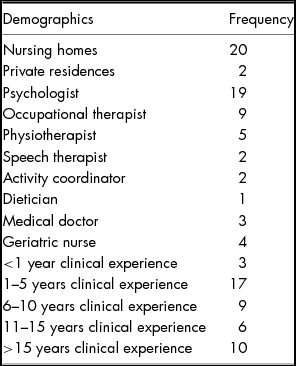
A total of 45 healthcare professionals associated with 22 care homes responded and the data they provided were all analysed. The demographics of the respondents are listed in Table 1. The greater majority (n = 43) worked in a nursing home; the two other respondents were the owners of a private care residence for people with dementia and a dementia day-care centre. Of the 45 forms, 42.2% had been completed by psychologists and an equal proportion by professionals of other care disciplines, with medical doctors (6.7%) and nursing staff (8.9%) having completed the remaining seven forms. All respondents were experienced in working with people with cognitive impairments due to dementia, stroke or TBI.
Characteristics of the Feasibility Survey Respondents

Applicability of EL in patients with dementia
All respondents deemed EL applicable in people with mild dementia; 63.6% indicated that EL might be most useful for people with moderate dementia, while 86.4% reported that EL would not benefit people with severe dementia. In addition, 75% of the respondents noted that EL might be beneficial for people with mild cognitive impairment (MCI). The majority judged EL to be relevant and applicable for various care facilities and disciplines: dementia day clinic (86.7%), dementia day-care centre (57.8%), rehabilitation unit (77.8%), special care units (80%), somatic unit (77.8%), but also at people's homes (22.2%).
Current skill training and learning methods
Among the tasks and skills being trained most frequently in the respondents’ facilities at the time of the survey were IADLs (32), ADLs (24) and exercises promoting the residents’ mobility (25; e.g., bed-to-chair transfers, use of a walking aid), with skills in the orientation (11) and leisure activity (2) domains also being practised. Training was mainly provided by occupational therapists (70.5%), physiotherapists (59.1%), nursing assistants (47.7%) and nurses (29.5%). The most frequently reported training techniques were structuring or simplifying tasks and providing feedback (44; e.g., stepwise learning, rewarding, consistent coaching, correction of errors and task repetitions), while visual guidance (31; e.g., written action plans, images, symbols or pictograms) and verbal guidance (21; verbal instructions) were also frequently employed. Although the above-mentioned teaching techniques all allow the prevention of errors during the acquisition process, none of the facilities actually used this approach in this particular way. Sixteen respondents did mention incidental learning, including EF learning and ‘discovery learning’, in which methods cues are given but errors corrected afterwards.
Perceived benefits and drawbacks of skill relearning in dementia in general
Respondents judged that skill (re)training (whether using EL or not) was likely to increase the autonomy (47) and wellbeing (38) of people with dementia, and some (6) deemed patient stimulation an asset. With patients remastering tasks and skills, the care burden for nursing staff and informal care givers (both 31) was assumed to be reduced, while five respondents noted that it was also likely to improve the quality of the patient–care-giver relationship (e.g., promoting more equality in the spousal roles).
Perceived benefits and drawbacks of EL
The professionals who perceived possibilities to incorporate EL into their practice, routines and institution also saw opportunities to improve the quality of, or to expand, their care services. By having people with dementia relearn tasks and skills, or by modifying their behaviour using the EL approach, psychologists deemed they could improve the patients’ wellbeing (9), while by training the use of a walking aid, for instance, the physiotherapist could help enhance their mobility (7), the occupational therapist their autonomy (2), and activity coordinators their increasing engagement in leisure activities (10). Some professionals (4) perceived that EL could foster a more positive and supportive interaction between nursing staff and residents with dementia and improve the wellbeing of the informal care giver (8). With patients remastering tasks and skills using EL, 31 professionals reported the care burden for nursing staff and informal care-givers to be reduced, while five respondents noted that this was also likely to improve the quality of the patient–care-giver relationship (e.g., promoting more equality in the spousal roles). In contrast, other professionals of different disciplines judged EL to be time consuming and thus increase burden, with the highest burden perceived for nurses (30).
In addition to these somewhat contradictory findings on perceived burden for the care givers, respondents proposed that the EL training process might be too great a burden (34) for the patient and too strong a confrontation with his or her limitations. Moreover, it might raise unrealistic expectations in both informal (8) and professional carers (3) (e.g., with respect to levels of regained independence or remediation of cognitive deficits). Even though EL was seen to entail a switch in procedures requiring flexibility and creativity, some respondents did not expect that having patients relearn tasks and skills using EL would have any disadvantages for themselves or their colleagues (4).
Implementation of errorless learning in dementia care
According to the respondents, the most important skills likely to be best (re)learned using EL were IADLs (90) and ADLs (36), with skills relating to orientation (14; route learning, using a calendar), mobility (17) and leisure activities (18) also being mentioned relatively frequently. Occupational therapists (77.8%) and nurses (71.1%) were deemed best-equipped to deliver EL interventions, followed by physiotherapists (51.1%), activity coordinators (53.3%), psychologists (33.3%) and nursing assistants (24.4%). Sixty-nine per cent of the respondents judged that the primary care-giver (i.e., spouse or family member) could play a purposeful role, for instance by helping train the patient to achieve the task using EL or by adopting a supportive (e.g., motivating and calming) stance (31.1%).
To assess the perceived feasibility of EL in clinical practice, we asked the respondents to approximate how much time professionals in each discipline would be able to spend on face-to-face training. Only nine respondents answered this specific question, estimating that all disciplines would be able to allot 1–5 hours over 5 days to EL sessions. The other respondents stated that they were unable to give an estimation since training duration and intensity would be patient-specific. They did indicate that tasks could be practised repeatedly (69.8%) and over longer periods of time (82.9%). As to who should provide the EL interventions, respondents mentioned nurses (62.5%) most frequently, followed by occupational therapists (52.5%), activity coordinators (40%) and physiotherapists (35%).
Patient limitations (52) such as speech–language problems or apraxia were suggested as the main reason why the EL method would not be viable. Another prohibitive factor was that the respondents’ facilities did not fulfil the prerequisites (17) for a proper implementation of EL, among which were time, financial and staffing restraints, and that implementation would be poor (16; e.g., due to a lack of co-operation or communication between disciplines, or inconsistent training). In contrast, other respondents reported that their facility would afford good implementation (30) and that the prerequisites for successful EL were met (7; e.g., well-motivated staff, patient-tailored programmes, systematic approach by all disciplines). It was further noted that patients were likely to benefit from EL because it would engage their residual capacities in terms of their cognitive reserves (24). Almost all respondents deemed communication and transfer of the (new) EL working procedures attainable (95.3%), but only half assumed that other disciplines than their own would actually adhere to the same EL protocol (53.5%).
Evaluation and Revision of the Concept Manual
Trial in care facilities
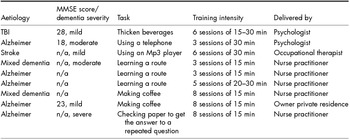
The survey respondents who had put the EL manual to the test by staging training sessions in their facility concluded that it was indeed possible to teach people with dementia tasks or skills using EL (see supplementary Appendix B for the worksheets). A total of nine residents of two nursing homes and one private home took part; see Table 2 for details of patients, trainers and skills trained. Interventions comprised between three and eight sessions lasting 15 to 30 minutes. Six trainers used additional visual cues, such as a step-by-step task script or coloured stickers on materials to help direct the patient's attention. All trainers mentioned that it was possible to prevent and to correct errors using the EL method. Seven of them reported that the patient was able to perform the task more independently than before the start of the training. The trainers praised the manual in that it helped them to focus on the patient's (residual) abilities rather than their cognitive deficits and (physical) limitations. It had enabled them to prevent the patient from making errors, with the manual providing clear clues for handling (near) errors. The manual had also facilitated (constructive, positive) interactions with the patient. Moreover, patients were motivated and training was successful despite their specific cognitive limitations. Patients rated the training sessions from neutral to very enjoyable (see supplementary Appendix C for the patient evaluation form).
Characteristics of Patients Trained and EL Training Sessions Provided

n/a, Not available.
In their feedback, trainers stressed the importance of patient-tailored training schemes. They mentioned an initial inconvenience with having to be consistent and directing towards their patient but soon found that it facilitated the learning process and that the patient was happy to be given clear, explicit instructions as this prevented hesitation, errors and anxiety. They also noted that, given their patient's severe cognitive impairments, having to be creative and flexible in their implementation of the protocol was demanding at times, but none indicated this to be a burden or a disadvantage of EL. They did mention that the time required to fully train the task or skill did pose a problem, but they solved the issue by integrating EL instructions and training in their routine or daily interactions with the patient and by involving colleagues from various disciplines. For an example of an EL pilot intervention, see Box 1.
Delphi round results
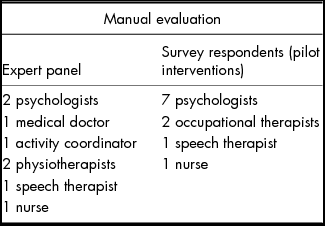
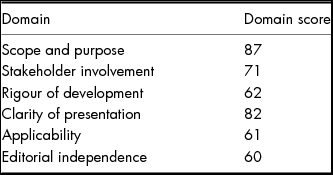
In this section the results obtained from the Delphi round using the AGREE questionnaire are described. A total of 19 AGREE forms, 11 of which were completed by the professionals who had piloted an EL intervention based on the concept manual; the other eight questionnaires were completed by the members of our expert panel (see Table 3 for contributor details). The domain scores (Table 4) were calculated by summing up the scores for the individual items within a domain of all 19 forms and by scaling the total as a percentage of the maximum possible score for that domain. We did not stratify the scores for the two responder groups because of the small sample sizes.
Contributors to the Delphi Round (AGREE Instrument)

Results of the AGREE Analysis

All respondents stated that they would recommend the EL manual and deemed EL a relevant approach to teaching everyday tasks and skills to people with dementia. Scores for all domains were sufficient. Next, we will discuss the positive and negative comments per domain, with domain scores in parentheses.
The description of the scope and purpose of the manual was clear according to 17 respondents (87). Considering the stakeholder involvement domain (71), five respondents commented that too few disciplines had been involved in developing the manual, while again five found the manual lacking in its recommendations as to the professionals for which the EL protocol would be relevant. With respect to clarity of presentation (82), all respondents judged the working instructions to be clear and unambiguous. However, five respondents regretted that the manual did not address EL-related costs and organisational issues. As to its applicability (61) ten respondents’ stated that the manual lacked information on how to implement EL in terms of costs, while 12 respondents noted that the potential organisational barriers to successful implementation of the recommendations were sufficiently addressed. The question in the rigour of development (62) domain, whether the manual substantiated an explicit link between its recommendations and the supporting evidence, was answered affirmatively by 11 respondents, with 13 respondents commenting that the manual did not contain information on how the results of the AGREE analysis would be used to revise it. Finally, there were some doubts about the editorial independence (60) in terms of conflicts of interests of the developers of the manual. The item ‘competing interests of guideline development group members have been recorded and addressed’ was rated negatively by nine respondents but none provided further explanation for their rating.
Case example
Step-by-step task script ‘How to thicken beverage’
-
1. Take a glass
-
2. Fill the glass with the beverage
-
3. Take the container with thickening agent
-
4. Take the lid off the container
-
5. Pick up the measuring spoon
-
6. Put 1 measuring spoon of powder into the glass
-
7. Stir for 20–30 seconds
-
8. The beverage is now ready to be drunk
Mrs B is a 73-year-old woman who lives at home with her husband. She was diagnosed with planning and executive dysfunction and mild attention and memory problems. She visits a day clinic for treatment three times a week. As she has difficulties swallowing, she needs to thicken her beverages but keeps forgetting how and when to do so. Her trainer hence proposes to help her to learn how to thicken beverages using an EL approach. Mrs B accepts and is eager and motivated.
The trainer next drafted a customised step-by-step plan. During training, Mrs B's key problem proved to be the amount of thickening powder needed and she evidently benefited from the strict structure the training procedure provided and the trainer's clear instructions and prompting. The trainer made sure to repeat the relevant step in case of (near) errors, hesitation, distraction, frustration or confusion, after which he instructed Mrs B to repeat the entire sequence up to that point while providing additional verbal cues or assistance (e.g., by using modelling and physical guidance to support the verbal instructions).
After five 20-minute sessions, Mrs B was able to thicken her beverages unassisted. As she still had trouble reminding herself to do so, the trainer presented her with two drinking cups with the text ‘thicken’ written on them, to serve as a cue. The trainer also gave her the action script as a reminder and to enable her to check the steps and their sequence, which helped her to get started and to refocus after having been distracted.
When asked 2 weeks after training completion, Mrs B reported she was doing well. She still occasionally forgot to thicken her beverages, but then had problems swallowing, which reminded her to add the thickener. Her husband also prompted her or reminded her to use the script, if needed. She no longer used the cups with the ‘thicken’ cues, but after the follow-up phone call from her trainer and some urging by her husband, she decided to start using them again.
The above case example is an adaptation of a case example presented in the EL manual: Errorless learning in dementia: a practical manual (de Werd, Boelen, & Kessels, Reference de Werd, Boelen and Kessels2014).
The revised manual
Using the AGREE domain scores and the feedback from the professionals having run EL pilots and our expert panel, we refined the initial manual. Additions and changes comprised an introductory chapter on cognitive and, more specifically, memory deficits in dementia; an elaboration of the EL concept and its assumed working mechanisms; a review of the evidence for EL in dementia; and a chapter providing recommendations about the care disciplines in which EL could be applied, as well as additional suggestions to boost training outcomes (e.g., time allocation, goal setting, motivating patients). The revised manual also includes anecdotes and case examples that had been provided by the survey respondents and Delphi round contributors. A summary of the revised EL manual can be found in Box 2.
Overview of the revised manual on errorless learning
The EL manual is a practical interpretation of the relevant literature, providing professionals in the dementia care domain with guidelines and detailed instructions on how to achieve (re)learning of everyday skills by people with dementia using an errorless approach. The manual provides:
-
• An overview of the various dementia types, a cognitive model of memory, recommendations on memory functions to be addressed and teaching techniques to be applied to help optimize learning.
-
• An overview of the literature on EL:
-
− review papers discussing EL-based training of relevant activities of daily living for people with dementia;
-
− systematic evidence that adults with dementia can (re)learn relevant, everyday tasks using error-reducing techniques;
-
− systematic evidence of the role of specific variables such as patient characteristics, dementia severity, type of task/skill suitable for (re)training, training intensity and duration, EL elements, outcome measures, experimental designs and follow-up assessment.
-
-
• The results of our feasibility survey among health professionals of various disciplines working in clinical geriatric care:
-
− ensuring that the manual meets the needs of clinical practice as much and as effectively as possible;
-
− showing that from the professionals’ point of view there is a need for evidence-based guidelines and instruction on training techniques such as EL in geriatric care;
-
− showing that the respondents anticipate multiple advantages of (re)learning everyday tasks and skills in individuals with dementia, and that EL is feasible in their patient population;
-
− showing that the respondents perceive temporal, institutional/organisational and financial restraints that may hamper the implementation of EL in clinical practice.
-
-
• EL procedures and working instructions:
-
− suggestions for task/skill selection, interdisciplinary transfer of and share in training interventions, and practical skill training plans (e.g., detailing goals, task scripts, practical arrangements/materials);
-
− recommendations on time investment and handover to other disciplines;
-
− detailed descriptions of error-reducing techniques and alternative combinations, implementation, ways to address (near) errors and hesitation in patients, and directions on how to fade out support after the skill or information has been mastered;
-
− examples of step-by-step skill training plans and visual cues;
-
− comprehensive examples of EL training programmes.
-
-
• The results of the Delphi round:
-
− in an AGREE evaluation dementia experts and healthcare professionals working in residential geriatric facilities who had piloted a training as prescribed by the concept manual appraised the practicality, readability and feasibility of the proposed manual and working instructions, which were judged to be clear and unambiguous.
-
Discussion
To explore the need for and feasibility of structured errorless learning approaches for adults with cognitive impairment due to dementia or other causes, we conducted a survey among professionals working in residential and specialised dementia facilities in The Netherlands, taking care to include all relevant disciplines. Most of the participating care residences already provided some skill training (e.g., through discovery or trial-and-error learning), but training was mostly unstructured and inconsistent. Respondents were most interested in adding EL to their toolkit or that of other disciplines, and judged that helping residents to (re)learn everyday tasks or skills with the EL approach would be feasible within their facility.
We next developed a concept EL manual and had this implemented and evaluated in a Delphi round (AGREE analysis). The results and feedback from the professionals having piloted the protocol and the expert panel were, in general, very positive. They found the working instructions clear, comprehensible and applicable in clinical practice, and all were pleased to recommend the manual to other disciplines involved in dementia care. Among the various benefits of EL, they mentioned that, by creating a structured learning environment, both the trainer and the patient know what is expected of them, providing reassurance and reducing anxiety for both parties. EL was also suggested to improve the patient's mood and self-esteem. In their study of goal-oriented cognitive rehabilitation, Clare et al. (Reference Clare, Linden, Woods, Whitaker, Evans, Parkinson and Rugg2010) also reported that personalised interventions had shown small improvements in quality of life.
Subsequently, based on the survey and Delphi round results and suggestions, we revised and expanded the EL manual, which has recently been published (Dutch edition: de Werd, Boelen, & Kessels, Reference de Werd, Boelen and Kessels2013a; English edition: de Werd et al., Reference de Werd, Boelen and Kessels2014). An outline of the EL manual and an example of a step-by-step training plan can be found in Box 2 and Figure 1, respectively. Furthermore, online instructional videos are available that show how a skill can be (re)trained without errors, what to do when the patient does make an error, and common trainer mistakes and their solution.
Despite being motivated to incorporate EL into their regular procedures, the main concern of the survey and Delphi round respondents was a perceived lack of time to provide EL training for individual patients. Smit, Willemse, de Lange and Pot (Reference Smit, Willemse, de Lange and Pot2013), however, suggested that it should be possible to offer people with dementia in nursing homes wellbeing-enhancing (leisure) activities with current staff levels and within existing budgets. The key factor here is to equip staff with the knowledge and skills they need to integrate these activities into their daily practice. The majority of our respondents judged themselves and their co-workers sufficiently motivated and flexible to implement EL schemes successfully. They indicated these two attributes as important prerequisites for incorporation of EL into their current workload. For instance, once he or she has gained experience with the new procedure, it would not take a physiotherapist wanting to teach an individual with dementia to use a walking aid, for instance, much extra effort or time to do so using an EL rather than a trial-and-error approach. Moreover, structuring a patient's activities and strictly adhering to daily routines will expedite the learning process, reducing training time. Also, involving the informal care giver in the training process will help cut the time professionals need to invest (Grandmaison & Simard, Reference Grandmaison and Simard2003). Our survey and Delphi round contributors already suggested that informal care givers might be instrumental in motivating and reassuring their spouse with dementia, as well as in actually assisting in training the skill using the EL approach in residential care or at home. In the latter instance, it may help prolong the period people with dementia will be able to go on living in their own home, a desire of many dementia patients as well as their spouses or home carers (Kraijo, de Leeuw, & Schrijvers, Reference Kraijo, de Leeuw and Schrijvers2014). Arguably, actively involving informal care givers in skill (re)training would then also help keep our national dementia care services sustainable. Of course, future studies are needed to evaluate the clinical implementation of EL and our protocol, taking both the health and cost benefits into consideration.
Future Research
To our knowledge this is the first study to explore the need for, and feasibility of, EL for use in dementia care, and the first clinical EL manual to be developed based on information obtained from professionals working in the field. The efficacy and effectiveness of our manual will now need to be established, while further research should examine how EL interventions can best be integrated into clinical routines, and should determine what outcomes and quality indicators are most suitable to evaluate their outcomes reliably. Ongoing randomised controlled trials (Voigt-Radloff, Leonhart, Olde Rikkert, Kessels, & Hüll, Reference Voigt-Radloff, Leonhart, Olde Rikkert, Kessels and Hüll2011) are examining the efficacy of the EL approach as outlined in our manual. Future studies should not only focus on improvements in task performance, but should also address the effects of our proposed EL approach on quality of life, self-efficacy, mood and cognitive function of people with dementia. Also, potentially ameliorating effects on perceived stress levels of care givers and families, and improvement of their quality of life, should be examined, as well as cost-effectiveness, all compared to care as usual (see also Clare et al., Reference Clare, Bayer, Burns, Corbett, Jones, Knapp and Whitaker2013).
Supplementary Material
To view supplementary material for this article, please visit http://dx.doi.org/10.1017/BrImp.2015.8
Acknowledgments/Disclosures
This study was funded by the NutsOhra Foundation (grant #1301–019) and extended previous work funded by a grant from the Devon Foundation. We would like to thank all institutions in The Netherlands who participated in the survey study and/or evaluation of the manual. The manual Errorless learning in dementia: A practical manual is available from the Australasian Society for the Study of Brain Impairment (ASSBI) at www.assbi.com.au.
The authors report no conflicts of interest in this work and receive no royalties for the published Dutch and English versions of the manual.