


INTRODUCTION
Conservation interventions aimed at improving the sustainability of natural resource use take place within a complex and dynamic ecological, economic, and social landscape (Dawson et al. Reference Dawson, Rounsevell, Kluvánková-Oravská, Chobotová and Stirling2010; Rissman Reference Rissman2011). Understanding these complexities is important for the design of successful conservation interventions, especially in areas with high degrees of inequality, to ensure conservation interventions do not inadvertently further disadvantage vulnerable people (Lawlor et al. Reference Lawlor, Weinthal and Olander2010). In response to the failure of ‘fortress’ conservation efforts that often had substantial negative impacts on local people, many conservation projects now aim to work with local communities (community-based conservation) and include social objectives, such as poverty reduction, as part of their aims (Hutton et al. Reference Hutton, Adams and Murombedzi2005). However, too frequently community-based conservation initiatives are implemented without fully understanding the local socioeconomic context (Homewood Reference Homewood, Collen, Pettorelli, Baillie and Durant2013). This ignores the heterogeneity of stakeholders and important factors, such as gender, ethnicity, religion, livelihoods, and reliance on biodiversity, that affect how people are able to respond and interact with conservation initiatives (Agrawal & Redford Reference Agrawal and Redford2006). Failing to recognize these differences risks unequal distribution of costs and benefits from the intervention, with powerful elites capturing the majority of benefits, and the poor becoming further marginalized (Iversen et al. Reference Iversen, Chhetry, Francis, Gurung, Kafle, Pain and Seeley2006; Saito-Jenson et al. Reference Saito-Jenson, Nathan and Treue2010). This not only violates the ethical responsibility of conservation to do no harm (Homewood Reference Homewood, Collen, Pettorelli, Baillie and Durant2013), but is also likely to generate conflict between practitioners and communities, undermine support for conservation and ultimately compromise the long-term success of the intervention (Sommerville et al. Reference Sommerville, Jones, Rahajaharison and Milner-Gulland2010). Understanding the local socioeconomic context can help mitigate the unequal distribution of costs and benefits from conservation by informing the design of appropriate conservation initiatives and associated monitoring strategies (Barrett et al. Reference Barrett, Travis and Dasgupta2011; Homewood Reference Homewood, Collen, Pettorelli, Baillie and Durant2013).
Given the unequal, and often highly-skewed distribution of resources and access to their benefits in developing countries, it is evident that researchers must analyse conservation benefits to the poor separately from the rest (or whole) of society (Daw et al. Reference Daw, Brown, Rosendo and Pomeroy2011), which requires wealth inequality to be measured so the poor can be identified. Thus far, the majority of conservation-based studies looking at poverty have used income as a measure of household poverty (Cavendish Reference Cavendish1999; Ambrose-Oji Reference Ambrose-Oji2003; Fisher Reference Fisher2004; Yemiru et al. Reference Yemiru, Roos, Campbell and Bohlin2010), mainly because income information is often readily available (Perry Reference Perry2002). While monetary approaches can be useful, they do not provide the multi-dimensional picture of poverty that is necessary to develop targeted conservation and development strategies. Poverty is understood to be a multi-dimensional concept, incorporating elements of political disempowerment, a lack of access to critical investments such as education, and economic exclusion, rather than just low levels of wealth (Sen Reference Sen, Nussbaum, Sen and pp1993; Chambers Reference Chambers1995; Gönner et al. Reference Gönner, Haug, Cahyat, Wollenberg, de Jong, Limberg, Cronkleton, Moeliono and Becker2007; McGregor & Sumner Reference McGregor and Sumner2010; Alkire & Foster Reference Alkire and Foster2011). In addition, income data have limitations in both accuracy and measurement, particularly in the context of developing countries where community-conservation projects are based, due to temporal fluctuations in income, inaccuracy in recollection, and sensitivity of certain types of income (such as that derived from illegal extraction). Income may not provide the best indicator of wealth inequality, particularly for short-term studies (see Nielsen et al. Reference Nielsen, Pouliot and Bakkegaard2012) often required in community-conservation efforts. Income data also fail to reflect the full amount of resources available to a household, including productive assets (such as livestock) and financial assets (for example savings), which can be used as insurance against income shortfalls (Brandolini et al. Reference Brandolini, Magri and Smeeding2010; Nielsen et al. Reference Nielsen, Pouliot and Bakkegaard2012).
Broader definitions and consequently measurements of poverty, such as asset wealth, are widely used in development economics (Carter & May Reference Carter and May2001). Filmer and Pritchett (Reference Filmer and Pritchett2001) developed an approach to asset wealth measurement in the absence of expenditure data that used an aggregate index based on durable assets owned by households to rank households. Assets provide a better picture of long-term wealth because they accumulate over time, last longer and contribute to the productive capacity of a household through its resource stock (Moser & Felton Reference Moser, Felton, Addison, Hulme and Kanbur2009). Asset-based poverty classifications better predict future income and expenditure than income and consumption measures (Liverpool-Tasie & Winter-Nelson Reference Liverpool-Tasie and Winter-Nelson2011) and are the most important determinant of household choice of livelihood strategy (Ellis & Freeman Reference Ellis and Freeman2004; Babulo et al. Reference Babulo, Muys, Nega, Tollens, Nyssen, Deckers and Mathijs2009; Nielsen et al. Reference Nielsen, Pouliot and Bakkegaard2012). In addition, development studies that have examined the empirical relationship between initial inequality and subsequent growth have found land and human capital inequality has a stronger effect than income inequality, suggesting that asset inequality matters more (Birdsall & Londoño Reference Birdsall and Londoño1997; Rodríguez-Pose & Tselios Reference Rodríguez-Pose and Tselios2010). Asset measures of wealth inequality may thus better inform conservation strategies than income or consumption inequality.
Typically, an asset measures approach uses presence/absence data on ownership of assets that capture living standards (for example radio, television, telephone, bike, motorbike, refrigerator and car ownership; Alkire & Santos Reference Alkire and Santos2010) and infrastructure and housing characteristics (such as source of water or sanitation facility; Vyas & Kumaranayake Reference Vyas and Kumaranayake2006), which may form an index of socioeconomic status (or material style of wealth; Cinner Reference Cinner2009). Measurement is often limited to assets that are in some way measureable, and more intangible assets (such as social capital, access and power) are often ignored. Intangible assets are difficult to quantify because they are linked to the context, and to other complementary assets through which the intangible asset is deployed (Kaplan & Norton Reference Kaplan and Norton2001; Hulme & McKay Reference Hulme and McKay2005). The asset approach usually involves an external assessor determining the kinds of assets to be assessed (Rakodi Reference Rakodi, Rakodi and Lloyd2002). This external approach can be less informative for conservation studies, particularly where standard asset lists (for example possession of a radio, TV, fridge or bicycle) are inappropriate (because all households lack basic assets).
Assessments of poverty can either be participatory or non-participatory. Participatory approaches are reflexive, flexible and iterative, and therefore better able than external approaches to facilitate exploring local knowledge and perceptions and encourage learning and empowerment at local levels (Chambers Reference Chambers1992; Cornwall & Jewkes Reference Cornwall and Jewkes1995). Participatory approaches to poverty assessments are becoming more widely used in the conservation and development arenas, including methods such as wealth ranking, which involves categorizing households or individuals (Chambers Reference Chambers1994; Laderchi et al. Reference Laderchi, Saith and Stewart2003). However, people's own assessment of their condition may be biased as a result of limited information and social conditioning (Laderchi et al. Reference Laderchi, Saith and Stewart2003), or exaggerated in hope of receiving tangible benefits (Krishna Reference Krishna, Addison, Hulme and Kanbur2009). In addition, despite the measures being nominally participatory, the level of participation is usually only extended to a few key stakeholders (McGee & Brock Reference McGee and Brock2001; Naughton-Treves Reference Naughton-Treves, Ingram, DeClerck and Rumbaitis del Rio2012).
Across many remote rural areas there are constraints to the use of typical assessments of wealth inequality, such as limited engagement with a cash economy, strong social networks and complex family and tribal ties, and absence of basic infrastructure and development. To gather appropriate and valid data, an approach that goes beyond monetary, presence/absence of standard assets, and key informant approaches is required. With this paper, we aim to present a simple participatory approach to measure wealth inequality that does not pre-define the indicators to be used, but enables local people to identity them. This ensures a flexible and inclusive method, providing a perspective on poverty that is sensitive to local contexts, while simultaneously remaining straightforward and replicable for remote rural community-conservation projects. We demonstrate our approach using a remote and data-deficient region of the Solomon Islands, where there was no prior information on poverty. Our specific objectives were to: (1) identify locally appropriate indicators of wealth, (2) assess whether these indicators are able to represent variation in wealth within communities, (3) compare the indicators with annual monetary income and expenditure, and (4) determine the key predictors of poverty.
METHODS
Study area
The Solomon Islands are an archipelago in the South-West Pacific (Fig. 1) that contains one of the last remaining tracts of coastal tropical rainforest (Bayliss-Smith et al. Reference Bayliss-Smith, Hviding and Whitmore2003) and is part of the East Melanesian Islands biodiversity hotspot (Myers et al. Reference Myers, Mittermeier, Mittermeier, Fonseca and Kent2000). These islands are undergoing rapid environmental and social change, with an economy heavily based on extractive industries, coupled with one of the highest population growth rates in the world (2.6% per annum; UNICEF [United Nations Children's Fund] 2011).
Location of Kahua region of Makira, Solomon Islands.
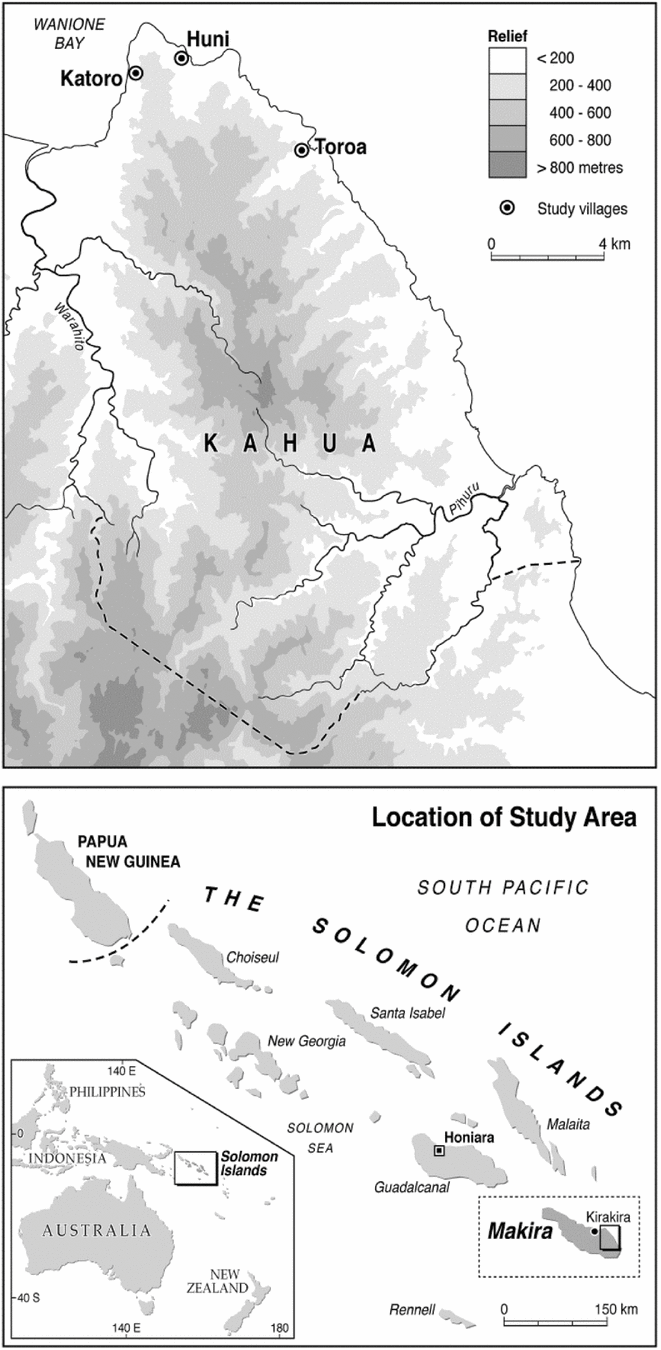
This study was conducted in the Kahua region (Wards 12 and 13; 162°0–162°15 E, 10°25–10°40 S) of Makira Island (formally San Cristobal). Makira is the fourth largest island of the archipelago, with an area of 3191 km2, and consists of a narrow coastal plain with steep forested central ridges with altitudes up to 1200 m (Allen et al. Reference Allen, Bourke, Evans, Iramu, Maemouri, Mullen, Pollard, Wairiu, Watoto and Zotalis2006). There is limited infrastructure, with no roads and only a limited number of high-frequency radios for communication. Transport to the provincial capital of Kirakira (access to main market and hospital) is either by foot or fibreglass boats with small outboard motors. Lack of market access is a major constraint on economic development (Allen et al. Reference Allen, Bourke, Evans, Iramu, Maemouri, Mullen, Pollard, Wairiu, Watoto and Zotalis2006).
The Kahua region has approximately 4500 inhabitants across 42 communities, mostly located on the coast. The main livelihood strategy is subsistence agricultural production, supplemented by fishing and exploitation of a wide range of species. Kahua is experiencing rapid social and environmental change through an increasing population, desire for monetary prosperity, a loss of social cohesion (Fazey et al. Reference Fazey, Pettorelli, Kenter, Wagatora and Schuett2011) and a loss of traditional methods of natural resource use and management (Ministry of Environment Conservation and Meteorology 2008). Changes in primary productivity suggest significant ecological change at a landscape scale (Garonna et al. Reference Garonna, Fazey, Brown and Pettorelli2009) and at the local level, the availability of forest and marine resources may be declining with reports of falling crop yields and increasing incidence of pests and diseases (Bourke et al. Reference Bourke, McGregor, Allen, Evans, Mullen, Pollard, Wairiu and Zotalis2006; Fazey et al. Reference Fazey, Pettorelli, Kenter, Wagatora and Schuett2011).
The market economy was introduced to the Solomon Islands far later than in other developing countries (Furusawa & Ohtsuka Reference Furusawa and Ohtsuka2006). Interaction with the cash economy in Kahua is limited, but increasing, mainly through the payment of school fees, transport and imported foods. Households engage in a range of income-generating activities, including the sale of agricultural produce, handicrafts and livestock (chickens and pigs), and the production of cash crops (copra and cocoa). Participation in these income-generating activities requires access to land, which is predominantly customary-owned across Melanesia, with tenure established through genealogy (Fazey et al. Reference Fazey, Pettorelli, Kenter, Wagatora and Schuett2011). The Solomon Islands have a traditionally male dominated society, and men continue to dominate all sectors of society from political posts to village chiefs (Fazey et al. Reference Fazey, Pettorelli, Kenter, Wagatora and Schuett2011; Mataki Reference Mataki2011) and consequently there are major gender inequalities. Men also dominate most income-generating activities and tend to have a lower commitment (than women) to spending on the health and education of their children (Gibson Reference Gibson2000; McMurray et al. Reference McMurray, Foale, Roberts, Breen and Cann-Evans2008; Macintyre Reference Macintyre2009). Cultural traditions remain strong, and as with other Pacific Island economies there is an emphasis on redistributive activities, with most households involved in tribe-specific networks that give and reciprocate goods and services, termed the ‘wantok system’ (Gibson Reference Gibson2006).
Data collection
Our research approach was broadly exploratory and inductive, with a combination of focus groups, discussions and a widely-scaled household survey. It aimed to facilitate exploration of local knowledge and perceptions using deliberative methods that in Kahua are more closely aligned to social deliberative ways in which people communicate (Fazey et al. Reference Fazey, Kesby, Evely, Latham, Wagatora, Hagasua, Reed and Christie2010; Kenter et al. Reference Kenter, Hyde, Christie and Fazey2011). Data were mostly collected by five local villagers, trained as facilitators and closely supervised by T. Davies; these local facilitators were essential for maintaining trust between researchers and communities, engaging with local communities, and translating information. Data collection methods were simplified to account for the facilitators’ low levels of education and limited ability to simultaneously translate and record information, while also designed to capitalize on their local cultural and social expertise and knowledge (Fazey et al. Reference Fazey, Pettorelli, Kenter, Wagatora and Schuett2011).
Focus groups were conducted in six villages, with one coastal and one inland village sampled from each of the eastern, central and western localities. All village inhabitants were invited to participate. A total of 12 focus groups were conducted, which included a total of 109 participants, with an average of nine per group. Focus groups lasted on average c. 3 hours; all were conducted in local language (Kahuan), and separately for men and women, to manage gender-based power relationships. Due to low levels of literacy, informed consent was sought verbally from all participants at the start of the focus group. After an ice-breaker exercise, participants were asked to identify different wealth groups within their community. All groups identified three different categories: poor, average and wealthy. In groups, participants were then asked to identify items or characteristics that changed across these categories (indicators of wealth). Groups were asked to choose an item close to hand, such as leaves, to represent their chosen indicators, which were then brought together for discussion. How these indicators changed across the wealth categories was then discussed. The total list of indicators from all focus groups was presented and discussed at a workshop, with 30 participants from across Kahua, where in groups of three, participants were given five stones and asked to rank the indicators they considered the best. This led to a shortlist of five asset indicators.
A household survey was used to collect information on ownership of the top five asset indicators at the household level. A household was defined as people living together and sharing meals. The household survey was piloted in April 2011, refined and then conducted across 74 households from three communities in February 2012 and July 2012. All households were surveyed in each of the three communities. The head of the household was interviewed, or if unavailable another adult from the household was interviewed. Basic information on household social structure including composition and levels of education was collected, and in January and July, households were also asked to recall major sources of income and expenditure in the last six months. Income and expenditure data were then combined for a crude annual figure. Where there were differences in the information collected (for example household members or age) between January and July, the average value was used for analysis.
Analyses
All data were analysed with R v2.15.1 (R Core Team 2013). Local indicators of wealth were identified as household ownership of number of pigs, chickens, coconut trees, cocoa trees and gardens. A principal component analysis (PCA) was applied to household data on ownership of these locally-defined indicators of wealth; the indicators are all continuous variables well suited to PCA. The factor scores from the first principal component (the vector that provides the most information about the variables) were used as the socioeconomic status index (wealth score) for each household. The higher the wealth score, the higher the implied wealth of the household. Differences in wealth score between villages were determined using an ANOVA.
To explore the variation in household demographics, a PCA was also applied to the household social structure data (number of household members, number of household members < 18 years, age of household head, education of household head and dependency ratio (number of dependents [0–14 or > 65 years] to the working-age population [15–64 years old]) as a first step to determine the factors explaining most of the variation within the data. We did not consider the first axis of the household social structure PCA as a factor explaining the variation of the first axis of the household asset PCA, as we aimed to assess how each component of the household asset dataset related to wealth inequality between households. To identify the main characteristics of the poor, the constructed household wealth score was then included as a continuous independent variable in a general linear model to explore the relationship between the wealth score and the household social structure: number of household members, age of household head, education of household head, gender of household head, proportion of males in the household and the dependency ratio. All possible combinations of main effects, followed by combinations of interactions were explored and then compared using Akaike's information criterion (AIC) values, which were compared among all possible combinations of explanatory variables. AIC is an evidence factor that is corrected for model complexity. Weighting AICs can be used to assess the model that best fits the data by approximating Kullback-Leiber information loss to see how changing the model affects the fit (Bradshaw & Brook Reference Bradshaw, Brook, Sodhi and Ehrlich2010), with a small value representing a better fit of the model to the data. To avoid model selection uncertainty where there were rival models, weighted averages of parameter estimates were calculated following Burnham and Anderson (Reference Burnham and Anderson2002). General linear models were used to compare the wealth score with income and expenditure, with the strength of the correlation assessed using Spearman rank correlation and R-squared values.
RESULTS
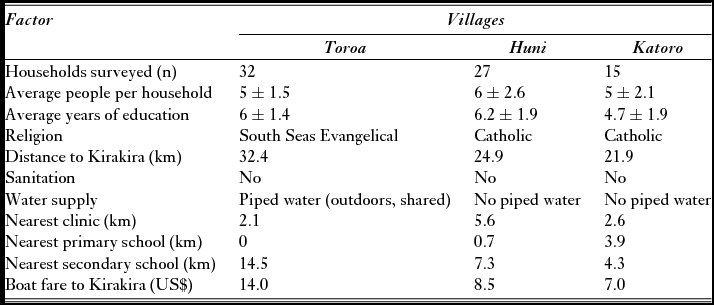
Data was collected from 74 households across three communities (Table 1). Respondents had a mean age of 47.5 (± 15.0) years, with an average of 5.6 (±2.4) years of education. Households had an average of 5 members (± 2.1), with a mean of 2.4 (±1.6) children (those under 18 years).
Population and social structure of the study villages in Kahua.
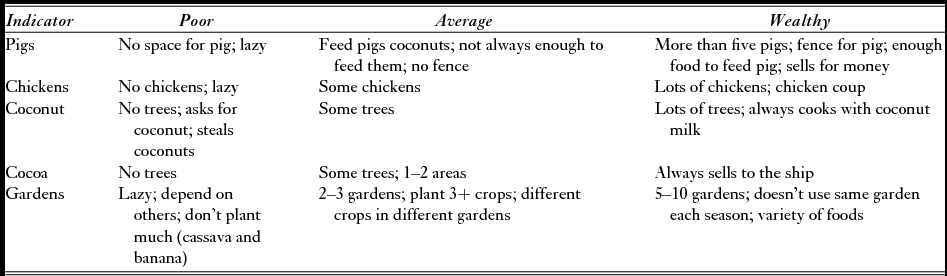
Focus group discussions indicated that wealthier households owned more of the locally-defined indicators, which was corroborated with analysis of asset ownership (Table 2). PCA of these assets generated three components that together explained 71.4% of the variation (Table 3). The first component was composed of chickens with the greatest positive loading, followed by number of pigs, number of cocoa trees and number of coconut trees; these factors explained 36% of the variation in the data. The second component, with positive loading from number of coconut trees and strong negative weighting of garden number and garden size explained 20% of the variation, indicating less variation in gardens across the different wealth categories. The third component, explaining 15% of the variation, had a positive loading from number of gardens and number of cocoa trees, and a high negative loading from garden size and number of coconut trees.
Descriptive information gathered from all focus groups on how each indicator changes across the wealth categories (only main indicators identified at the workshop).
Wealth factor scores from the principal components analysis of locally-identified indicators of poverty.
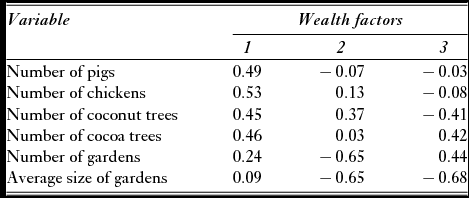
Based on the factor scores from the first principal component, wealth scores for households ranged from –2.07 (poorest) to 5.40 (wealthiest) (mean = 0.00 ± 1.5). Villages did not differ in wealth scores (ANOVA F = 1.4, df = 2, p = 0.25) and therefore all analyses refer to grouped data.
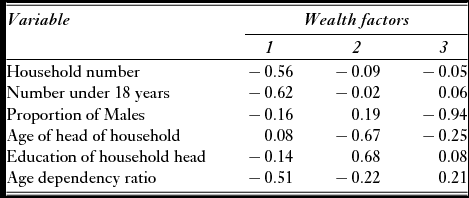
A PCA of household social structure data generated three components that together explained 79 % of the variation (Table 4). The first component consisted of negative loading from number of household members, number under 18 years and the dependency ratio; the first component of this PCA explained 41% of the variation in the data. The second component had a positive loading from education of household head and negative loading from age of household head; the second component of this PCA explained 22% of the variation in the data. The third component had a strong negative loading from the proportion of males in the household; the third component of this PCA explained 16% of the variation in the data.
Wealth factor scores from the principal components analysis of household social structure.
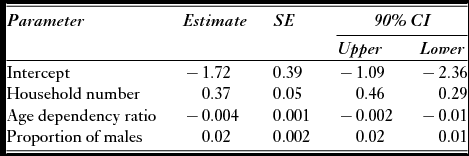
AIC model weights revealed the household social structure data, modelled as main effects, which best explained the variation in wealth scores were number of household members, age dependency ratio and proportion of males. A higher number of household members, lower age dependency ratio and higher proportion of males were associated with a higher wealth score. Based on Akaike weights, there was a rival model composed of number of household members and age dependency ratio. To avoid model selection uncertainty, weighted averages of parameter estimates were calculated (Table 5).
Composite model of the strongest predictors of household wealth scores.
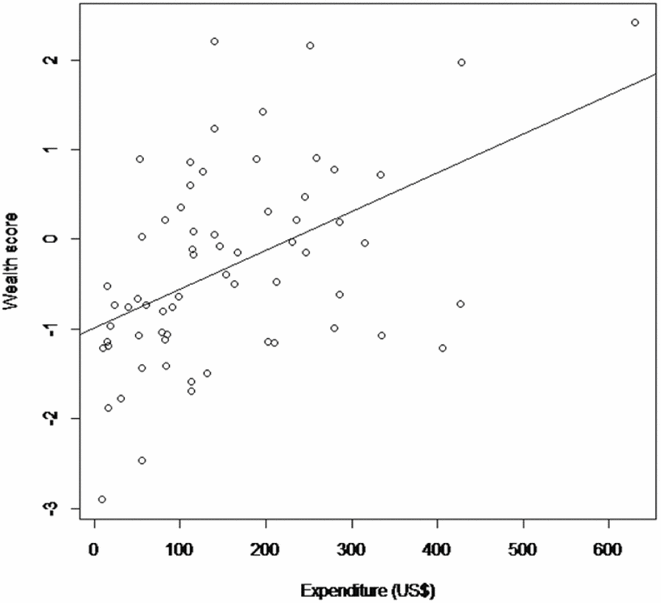
There were positive correlations between wealth scores and monetary income (p = 0.006, R2 = 0.11), the strongest being between wealth scores and monetary expenditure (p < 0.0001, R2 = 0.24; Fig. 2).
Wealth score versus annual monetary expenditure.
DISCUSSION
Our participatory asset measurement method avoided typical constraints to assessments of wealth inequality in remote rural areas, such as limited interaction with the cash economy, in addition to avoiding biases associated with external approaches. Our approach provided key insights into characteristics of poor households where there was no prior information on poverty in a culturally sensitive manner that enabled participants to express their views on which indicators were important. Household asset wealth was particularly well correlated with household expenditure, which tends to be a better metric than income because households can smooth their expenditure during a temporary low-income period by borrowing or using savings (Perry Reference Perry2002). As we only collected a crude measure of household expenditure, more detailed data would be expected to improve the strength of this correlation. However, our participatory approach to asset measurement goes beyond monetary metrics by providing better characterizations of the poor, which in turn provides further insights for the design and implementation of appropriate conservation projects and poverty reduction policies.
The poor in Kahua owned less of the locally-defined indicators of wealth, particularly chickens, pigs, coconuts and cocoa trees. Little is known about rural poverty in Melanesia; however these assets reflect traditional Melanesian symbols of power. For example, pig ownership and pig killing traditionally conveyed status, wealth and informal power in Melanesia (Miles Reference Miles1997) and pigs are still culturally important in the region, remaining currency for major transactions (Glasse Reference Glasse1959; Miles Reference Miles1998), including compensation payments and bride price that are commonly applied across the Solomon Islands. Food produce has long been used as a display of power, prestige and competition in Melanesia (Roscoe Reference Roscoe2000), with the group with the largest number and size of pigs, food crops and cooked food commanding the most respect (Nanau Reference Nanau2011).
Analysis of ownership of these assets also provided insights into the household characteristics of the poor, whose households had fewer members, a higher age dependency ratio and a lower proportion of males. In fact the poorest households contained no male members (older female living with young female child); other studies have also found female-headed households to be over-represented among the poor (see Buvinić & Gupta Reference Buvinić and Gupta1997; Biewen Reference Biewen2006; Medeiros & Costa Reference Medeiros and Costa2006). Our participatory research approach enabled additional information to be elicited that would have been difficult to achieve otherwise. Focus group discussions revealed that people felt the poor's social position could be improved through hard work, and a recurring theme was that the poor were lazy. For example, they might have access to land, but did not necessarily put in the effort to cultivate it, and therefore depended on exploiting the wantok system. Views that the poor are lazy are common (see for example Lockwood Reference Lockwood2002). However, although the poor may appear lazy, they may in fact be marginalized in some way, which means that they are unable to capitalize upon opportunities. For example they may have low personal empowerment (for example low confidence or social skills), or may not conform to social norms or abide by the same values as the rest of society (Applebaum Reference Applebaum2003). In addition, the poor may not have access to land, for example if they are immigrants from other areas or families of men who have married into the region.
These results may help planning of appropriate community-based conservation and development initiatives to benefit the poorest. The locally-defined indicators of wealth are collectively correlated with land tenure. Thus, a higher wealth score can be seen to equate to ownership of, or access to more land, and consequently conservation and development initiatives that are linked to land will naturally favour uptake by the wealthy, whereas the poor may be unable to invest or allocate land for such schemes (Corbera et al. Reference Corbera, Kosoy and Martínez Tuna2007; Börner et al. Reference Börner, Wunder, Wertz-Kanounnikoff, Tito, Pereira and Nascimento2010). Yet, current development activities in Kahua are focused on the promotion of cash crops, activities which are unlikely to benefit poor households that have less land and are thus less likely to directly participate in these initiatives. In addition, monetization of resources can increase gender inequalities, adversely impacting women, which is of concern for poverty alleviation efforts in Kahua, where poor female-headed households could become further marginalized. The commodification of natural resources (for example through the introduction of cash crops) has shifted the Melanesian relationship with land from cultural to economic, and this shift is eroding social cohesion, with property rights currently a major source of conflict across Melanesia (Bonnemaison Reference Bonnemaison and Lamour1984; Foale & Manele Reference Foale and Manele2004; Fazey et al. Reference Fazey, Pettorelli, Kenter, Wagatora and Schuett2011). Given the assets and characteristics of poor households in Kahua, cash payments for conservation (such as payments for ecosystem services) are unlikely to be an appropriate conservation strategy there, because they could increase community conflicts, ultimately undermining conservation activities. Strategies that focus on small-scale resource management, balancing food security and conservation, such as agroforestry and locally-managed marine areas are likely to be more appropriate for the social context in Kahua. Understanding the local socioeconomic context could help develop an appropriate enabling environment with interventions to improve people's capabilities and conditions, such as empowerment programmes and land reform (see McGregor & Sumner Reference McGregor and Sumner2010).
Community conservation projects are often constrained by time and resources, with a limited portion of these available for monitoring activities (Gardner Reference Gardner2010). Our asset-based approach within a participatory framework is well suited approach to community-based conservation projects in areas with low levels of literacy and resources because it can collect valid and reliable data in an easily replicable manner. The participatory approach also provides an excellent starting point for discussing inequalities, and providing insights into how they can be alleviated or managed (Moser & Felton Reference Moser, Felton, Addison, Hulme and Kanbur2009). Findings from this approach can then be used to assist decision making on how best to target the poor and also as an input to other research problems, such as the relationship between wealth and observed behaviours, for example use of destructive fishing gear (Cinner Reference Cinner2009), uptake of conservation initiatives (Brandolini et al. Reference Brandolini, Magri and Smeeding2010) and livelihoods (Reardon & Vosti Reference Reardon and Vosti1995). For those community-based conservation projects that also aim to reduce poverty, longitudinal asset data can be used to monitor and determine transitions out of poverty. Although we used asset measures to provide an initial assessment of wealth inequality, this approach can also be employed in community-conservation projects before and after an intervention as part of monitoring activities to record longitudinal asset data or ‘asset dynamics’, which can help elucidate transitions out of poverty (Carter & Barrett Reference Carter and Barrett2006; Adjei et al. Reference Adjei, Arun and Hossain2009). An approach for assessing household strategies for poverty alleviation has been pioneered by Krishna (Krishna & Shrader Reference Krishna and Shrader1999; Krishna Reference Krishna, Addison, Hulme and Kanbur2009).
Although our approach goes further than basic income measures of wealth inequality commonly used in community-conservation projects, it is still restricted to material dimensions of poverty. Our approach was unable to distinguish between important capabilities, for example those who do not have access to land, and those who have access to land but choose not to cultivate it. Less tangible dimensions of poverty, such as social capital and power, were also not reflected in our assessment. Our approach is not a panacea and further research is required into advancing poverty measurement that is better able to capture both tangible and intangible aspects of deprivations. However, it did provide insights into how poverty is viewed in the region, which appears to be based heavily on traditional hierarchies and symbols of power (pigs), and therefore the locally-identified wealth assets may also be a proxy for power; although the extent to which these assets reflect power should be further explored. Social capital is the most commonly cited intangible asset (Moser & Felton Reference Moser, Felton, Addison, Hulme and Kanbur2009), yet kin and friendship networks are often the most important relationships that households mobilize to reduce vulnerability (Bacon Reference Bacon2005). The wantok system is an important informal institution in Melanesia for social cohesion and its contribution to balancing wealth inequality, and its ability to function as a support network, should be further explored using approaches that go beyond asset measures (Krishna & Shrader Reference Krishna and Shrader1999).
ACKNOWLEDGEMENTS
We are grateful to the villagers of Toroa, Huni, Katoro, Pa’a, Nama, Borowe, Naopaworo. Taratarena and Narame, and particularly thank research assistants: James Ta’ata, Freda Wagoa, Romano Tarohania, Nellie Haga, Betty Haga, Mevis Kamera, Eddie Maka, Bassie Wa’apa, Mandy Haga, and the Kahua Association for guidance and support. Thanks are also extended to the Ministry of Education and provincial authorities of Makira-Ulawa Province for supporting this research. Tammy Davies was supported by a Natural Environment Research Council studentship (DTG: AGS6-NERC10). Additional funding for fieldwork was provided by Chester Zoo and Rufford Small Grants (11022-1). We thank two anonymous reviewers for the insightful comments that improved the manuscript.



