Is archaeology a social science? Most archaeologists would probably agree that the goal of our discipline is to learn about the people, societies and cultures of the past. Thus there should be little objection to labelling archaeology a ‘social’ field of study. We study both people and society, but what about the ‘science’ part? This label is more controversial. Many archaeologists reject the notion that archaeology is, can be or should be a science. Others assume that archaeology is indeed a science and get on with their work, not worrying much about epistemology or definitions of science. Still others pursue decidedly non-scientific goals yet borrow scientific techniques from other disciplines and call it ‘archaeological science’.
One reason for the confusion and debate over the ‘scientific’ status of archaeology is that few archaeologists have considered the social sciences as fields akin to archaeology. Social science methodologist John Gerring (2012: 1) defines it as “a scientific study of human action focusing on elements of thought and behavior that are in some degree social (nonbiological)”. He includes fields such as demography, economics, education, public policy, sociology, political science, geography and some parts of anthropology, but excludes interpretivist disciplines and sub-disciplines such as post-processual archaeology and post-modern cultural anthropology.
I was taught explicitly in graduate school that disciplines such as sociology and economics had little to contribute to archaeology. Failure to recognise the potential of the social sciences for archaeological research has had two negative effects on archaeological epistemology and theory. First, considerations of whether archaeology is or should be a ‘science’ have employed outdated and inappropriate concepts such as the ‘covering law’ method of Carl Hempel (Reference Hempel1965) and the logical positivists (Johnson Reference Johnson2010; Martinón-Torres & Killick Reference Martinón-Torres, Killick, Gardner, Lake and Sommer2013). In this obsolete approach to explanation, an event is explained by showing that it is an instance of a universal generalisation known as a covering law (Bunge Reference Bunge1997; Tilly Reference Tilly2008: 135). If one were to accept these straw-man arguments, ‘science’ would indeed be a poor model for archaeology. But the epistemologies and approaches of the social sciences today bear little resemblance to the caricature of science presented by many post-processualist archaeologists. Second, many archaeologists have missed out on methodological and epistemological advances in the social sciences that can be helpful in thinking through and carrying out archaeological research and argumentation (Smith 2011, 2015).
I propose that much of archaeology fits comfortably within the modern social sciences—fields such as those listed by Gerring (above). Furthermore, methodological guidelines from these fields provide archaeologists with a wealth of models and suggestions that can improve the scholarly rigour of our field.
What is, initially, meant by ‘science’? My experience in archaeology and my reading of literature in science, social science and the philosophy of science (e.g. Little Reference Little1998; Bunge 1999; Wylie Reference Wylie2000; Sokal Reference Sokal and Fagan2006; Kosso Reference Kosso2009; Gerring 2012) leads me to the following three-part definition of science:
-
1. Science is a method for gathering knowledge about the natural and social world. It gives primacy to reason and observation.
-
2. Science has a critical spirit. Claims or hypotheses are constantly tested through observation and experiment, and findings are always tentative, incomplete and open to challenge.
-
3. Science is complex. It consists of an interconnected network of diverse evidence and theory, and its content and findings are evaluated by communities of scientists.
John Gerring gives a similarly succinct definition of science:
Inquiry of a scientific nature, I stipulate, aims to be cumulative, evidence-based (empirical), falsifiable, generalizing, nonsubjective, replicable, rigorous, skeptical, systematic, transparent, and grounded in rational argument. There are differences of opinion over whether, or to what extent, science lives up to these high ideals. Even so, these are the ideals to which natural and social scientists generally aspire, and they help to define the enterprise in a general way and to demarcate it from other realms (Gerring 2012: 11).
Note that there is nothing in these definitions about experiments or laws. Hempel's (Reference Hempel1965) covering laws are nowhere to be seen. This definition is very different from the way that the ‘New Archaeologists’ of the 1960s and 1970s viewed science (Binford Reference Binford1968; Watson et al. Reference Watson, LeBlanc and Redman1971). In fact, their faulty views of science and explanation caused great harm to archaeology by setting scientifically minded archaeologists on an unproductive tangent. Neither does my approach coincide well with the various traits that Matthew Johnson (Reference Johnson2010: 38–41), in his textbook on archaeological theory, includes in sections titled ‘Definitions of science’ and ‘Positivism’. His discussion parallels that of the New Archaeologists and resonates with an outdated literature in the philosophy of science.
My definition of science is about epistemology, not about methods. In some archaeological discourse, the term ‘science’ is applied to both of these domains. For example, Martinón-Torres and Killick (Reference Martinón-Torres, Killick, Gardner, Lake and Sommer2013) distinguish ‘scientific archaeology’ (the use of a natural-science epistemology in archaeology) from ‘archaeological science’ (the use of natural-science techniques by archaeologists); see also Jones (Reference Jones2002). For these authors, ‘scientific archaeology’ describes the bad guys—New Archaeologists, behavioural archaeologists and evolutionary archaeologists—all of whom are accused of being neo-positivists under the spell of Hempel and the logical positivists. I do not want to speak for those three approaches, but the work of Martinón-Torres and Killick—and that of Johnson, and Jones—employs an outmoded scientific epistemology that excludes or ignores the kind of social-scientific approach I am promoting here.
The second concept of Martinón-Torres and Killick, ‘archaeological science’, is ironic when describing archaeometric work by archaeologists who fail to follow a scientific epistemology. Martinón-Torres and Killick give an extended discussion of how ‘archaeological science’ has helped further high-level abstract social theory in archaeology (e.g. materiality, social constructivism), but those approaches do not conform to the definitions of science given above. Perhaps the simplest ‘litmus test’ of the scientific status of an argument is to pose two questions: ‘How would you know if you are wrong?’ (Haber Reference Haber1999; Smith 2015) and ‘Is there a search for causality?’ (Gerring Reference Gerring2005). A look at archaeological papers on materiality or post-structuralism would show that they do not pass this litmus test. I am not arguing that interpretivist approaches are not valuable perspectives in archaeology; instead, my proposal here is for recognition of an additional approach based on the social sciences.
What is distinctive about the social sciences? One way to highlight this issue is to contrast them with the natural sciences on one hand and the humanities on the other. The former are often said to focus on instrumental knowledge, the latter on reflexive knowledge. As described by sociologist Michael Burawoy, the social sciences fall somewhere in the middle:
The social sciences are at the crossroads of the humanities and the natural sciences since in their very definition they partake in both instrumental and reflexive knowledge. The balance between these two types of knowledge, however, varies among the social sciences (Burawoy Reference Burawoy2005: 22).
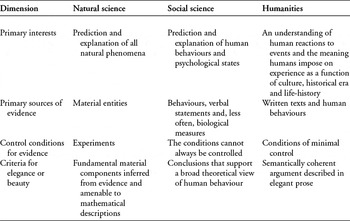
A more detailed account of this perspective is given in Jerome Kagan's book, The Three Cultures (Reference Kagan2009: 4–5); his view is summarised in Table 1. Half a century ago, C.P. Snow (Reference Snow1959) described scholarship as a choice between two cultures—the natural sciences and the humanities. There are now clearly three domains or ‘cultures’ of relevance (Kagan Reference Kagan2009)—the natural sciences, the social sciences and the humanities. Archaeologists, however, have been slow to get the news; authors such as Andrew Jones (Reference Jones2002: 1–22) continue to use the ‘two cultures’ framework. I should admit that I am deliberately portraying these domains as more coherent and distinctive than they are in practice in order to make my argument. Many realms of scholarship cut across the lines of separation such as the ‘historical sciences’ (Toulmin & Goodfield Reference Toulmin and Goodfield1965; Mayr Reference Mayr1982; Smith Reference Smith and Knapp1992), or the explanatory approach labelled ‘erudition’ by Pascal Boyer (Reference Boyer, Slingerland and Collard2012). In spite of the fuzzy boundaries, however, Kagan's division of scholarly knowledge into three domains is important.
Distinctions between the ‘three cultures’ of natural science, social science and humanities; based on Kagan (Reference Kagan2009: 4–5).

What do the social sciences do? Charles Ragin and Lisa Amoroso (2011: 35–56) show that social scientists:
-
1. Identify general patterns and relationships.
-
2. Test and refine theories.
-
3. Make predictions.
-
4. Interpret culturally or historically significant phenomena.
-
5. Explore diversity.
-
6. Give voice to marginal, oppressed or underrepresented groups.
-
7. Advance new theories.
This list could easily describe the activities of current archaeologists—we do all of these things. Ragin and Amoroso use this scheme to organise their textbook, where archaeologists will find many pertinent observations and suggestions.
The social sciences today contain a wide variety of approaches to reality or ontologies. The historical social scientist Charles Tilly (Reference Tilly2008: 6–7) identifies the four major social science ontologies as follows:
-
1. “Methodological individualism insists on decision-making human individuals as the basic or unique social reality”.
-
2. “Phenomenological individualism refers to the doctrine that individual consciousness is the primary or exclusive site of social life”.
-
3. “Holism is the doctrine that social structures have their own self-sustaining logics. In its extreme form—once quite common in social science but now unfashionable—a whole civilisation, society, or culture undergoes a life of its own”.
-
4. “Relational realism, the doctrine that transactions, interactions, social ties, and conversations constitute the central stuff of social life, once predominated in social science”.
Again, all four of these ontologies can be found in contemporary archaeology.
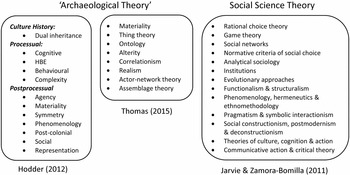
I was stimulated to write this paper by a seeming contradiction: I am concerned with theory and have published several papers on the subject (Smith Reference Smith and Knapp1992, 2011; Smith et al. Reference Smith, Dennehy, Kamp-Whittaker, Stanley, Stark and York2016); my approach to theory and epistemology are not, however, included in definitions of ‘archaeological theory’ by prominent archaeologists. Figure 1 lists the diverse approaches considered ‘archaeological theory’ by Ian Hodder (Reference Hodder and Hodder2012) and Julian Thomas (Reference Thomas2015). While my own work touches on several of the topics listed by Hodder, it is far removed from all of the approaches listed by Thomas. Does that mean that I do not do archaeology? It is true that I recently have become heavily involved in transdisciplinary social scientific research (e.g. Ortman et al. Reference Ortman, Davis, Lobo, Smith, Bettencourt and Trumbo2016; Stanley et al. Reference Stanley, Dennehy, Smith, Stark, York, Cowgill, Novic and Ek2016), but I still consider myself an archaeologist, and I use archaeological data in almost all of my research. Have I crossed the line and exited from the domain of archaeology? Or do these lists (Figure 1) simply present an impoverished view of the terrain of relevant theory today?
The scope of theory in archaeology and the social sciences today.

Figure 1 also illustrates the range of theoretical approaches that characterise the social sciences as they stand, and the very real gulf between mainstream social science and ‘social archaeology’ (Preucel & Meskell Reference Preucel and Meskell2004; Thomas Reference Thomas2015). This list of topics organises the essays in The Sage handbook of the philosophy of the social sciences (Jarvie & Zamora-Bomilla Reference Jarvie and Zamora-Bomilla2011). While the list does include the kinds of approaches listed by Hodder and Thomas, the majority of social science approaches find no place in their schemes of archaeological theory. The theoretical approaches of Hodder (under ‘post-processual’) and Thomas, in fact, pertain more to the humanities than to the social sciences. Works on social science methodology (e.g. Gerring 2012: 3) explicitly exclude this kind of interpretivist approach, in part because the theoretical propositions in these frameworks cannot be disproven. They are so abstract that they cannot be tested and either supported or rejected (Little Reference Little1998; Mjøset Reference Mjøset, Smelser and Baltes2001; Bunge 2004; Abend Reference Abend2008; Gerring 2012; Smith 2015). As such, my proposed social science model for archaeology should be seen as an alternative to post-processual, post-modern and other humanities-based approaches in archaeology. It is not offered as a holistic model to encompass all of archaeology, but rather as a productive approach to generate reliable social information from the archaeological record.
I want to make it clear that I am not implying that there is anything inherently wrong with abstract, philosophical social theory, but I do think, however, that an obsession with this material has slowed progress in the development of archaeology as a social science, if only because an appropriate scientific alternative was lacking once the New Archaeology collapsed. Perhaps this statement requires qualification as it seems that some post-processualist archaeologists are unaware that the New Archaeology is no longer with us. What I am referring to are statements to the effect that anyone who claims to have a ‘scientific’ epistemology in archaeology must be clinging to the sinking ship of positivist-based processualism (Hodder & Hutson Reference Hodder and Hutson2003; Johnson Reference Johnson2010; Gillespie Reference Gillespie2013; Martinón-Torres & Killick Reference Martinón-Torres, Killick, Gardner, Lake and Sommer2013), when the New Archaeology actually died long ago. The failure of its scientific epistemology of logical positivism and covering laws was pointed out decades ago by both philosophers of science (e.g. Morgan Reference Morgan1973) and archaeologists (e.g. Sabloff et al. Reference Sabloff, Beale and Kurland1973). Covering laws are simply inadequate for the social and historical sciences (Bunge Reference Bunge1997, 2004; Tilly Reference Tilly2008: 89; Little Reference Illari, Russo and Williamson2011). The social scientific approach I advocate here employs a very different epistemology and scholarly framework.
So, what does a social science model for archaeology look like? Much archaeology being done at the moment would fit easily within the social sciences when it deals with causality and with arguments that can be tested (Smith 2015). The key criteria are in method and theory, in epistemology, and not in subject matter. Certainly, some topics lend themselves more clearly to a social science perspective, while others have more affinity for a humanities perspective. A recent paper intended to show other social scientists that archaeological research could be relevant to their concerns (Smith et al. Reference Smith, Feinman, Drennan, Earle and Morris2012) singles out studies of village aggregation and urbanisation, the development of states and markets, and ancient standards of living as topics for which archaeologists have findings of relevance for the other social sciences.
These and other topics that archaeologists already study—or could study—from a social science perspective are amenable to the identification of causal mechanisms as a form of explanation. This is the dominant form of explanation in the social sciences (Bunge 2004; Elster Reference Elster2007; Tilly Reference Tilly2008; Hedström & Ylikoski Reference Hedström and Ylikoski2010; Gerring 2012). To reiterate, I would single out a concern with causality and with arguments of a form that can be proved wrong as the major differences between the social scientific and humanities approaches in contemporary archaeology.
If adopted by more archaeologists, the social scientific approach can help us ensure that the ancient societies we study are documented and explained following the highly successful and widely used methods of the social sciences. I see three advantages that a social scientific approach holds for much of archaeology:
-
1. The use of social science approaches and epistemologies in archaeology will produce more rigorous understandings of past human societies and the causes for their change over time. Social science methods focus on issues such as sampling, rigour and measurement, in order to create better descriptions and explanations of human behaviour and society in the past and present (Ragin & Amoroso Reference Ragin and Amoroso2011; 6 & Bellamy 2012; Gerring 2012). Social science approaches and explanations are especially productive because they favour and promote comparative analysis, an essential element for advancing understanding of the archaeological past (Trigger Reference Trigger2003; Smith 2012a; Scheidel Reference Scheidel2014; Turchin et al. Reference Turchin, Brennan, Currie, Feeney, Francois, Hoyer, Manning, Marciniak, Mullins, Palmisano, Peregrine, Turner and Whitehouse2015).
-
2. If archaeologists follow this approach, it will foster integration with other social and historical sciences (such as historical sociology or economic history). Archaeologists share with other social sciences a concern with, and knowledge of, topics such as social inequality, political domination, urbanisation, economic processes and community formation.
-
3. The pursuit of a social scientific archaeology will help us to produce knowledge about human societies that is relevant and useful today and into the future (Sabloff Reference Sabloff2008; Barton et al. Reference Barton, Ullah, Bergin, Mitasova and Sarjoughian2012; Smith 2012b; Isendahl & Smith Reference Isendahl and Smith2013). Can scholarly findings about past human societies be of use to the policy-makers and officials of the present? Those individuals are unlikely to pay attention to archaeological accounts using abstract and philosophical humanities-based concepts. Rather, they look to the findings of the social sciences. But will archaeology be represented among the social sciences? That remains to be seen.
Acknowledgements
I thank Gary Feinman, Cynthia Heath-Smith, Matthew Peeples and Barbara Stark for insightful comments on an earlier draft of this paper, and I also acknowledge the helpful remarks of two reviewers.