INTRODUCTION
Many forest species with economic importance are now threatened due to overexploitation (Peres Reference Peres, Gardner, Barlow, Zuanon, Michalski, Lees, Vieira, Moreira and Feeley2010), and protecting remaining populations by establishing reserves or specific legislation prohibiting harvesting has not been an effective solution in regions with weak environmental governance. Although legal instruments to improve the conservation of biological diversity around the world have strengthened in recent decades, ongoing difficulty in their enforcement and unintended consequences of legislation result in continued environmental degradation and species loss (Bradshaw et al. Reference Bradshaw, Giam and Sodhi2010). However, conservation practitioners increasingly acknowledge the limits of government-led enforcement and the need to move beyond the protected area and command-and-control paradigm. With the recognition that smallholders, indigenous peoples and other local stakeholders should be included in the conservation process, opportunities are being expanded for strong environmental governance, which should foster information exchange, adaptive management, and access to knowledge, benefits and authority (Lebel et al. Reference Lebel, Anderies, Campbell, Folke, Hatfield-Dodds, Hughes and Wilson2006).
To meet the varied goals of an inclusive approach to conservation, ‘integrated conservation and development projects’ (ICDPs) emerged (Leach et al. Reference Leach, Mearns and Scoones1999; Wunder Reference Wunder2001; McShane et al. Reference McShane, Hirsch, Trung, Songorwa, Kinsig, Monteferri, Mutekanga, Thang, Dammert, Pulgar-Vidal, Welch-Devine, Brosius, Coppolillo and O'Connor2011), emphasizing ‘participatory’ practices that engage smallholders in project design and community monitoring, sustainable management of resources based in traditional ecological knowledge and commercialization of non-timber forest products (NTFPs; Nepstad & Schwartzman Reference Nepstad and Schwartzman1992; Berkes et al. Reference Berkes, Colding and Folke2000; Belcher & Schreckenberg Reference Belcher and Schreckenberg2007). ‘Conservation by commercialization’ came into vogue as a means to alleviate poverty while simultaneously offering an incentive to preserve the commercialized resource's habitat (Arnold & Ruíz-Pérez Reference Arnold and Ruíz-Pérez2001; Kusters et al. Reference Kusters, Achdiawan, Belcher and Ruiz-Pérez2006). Such development strategies were considered more promising in the case of NTFP exploitation, which is assumed to have a lower impact compared to logging and shifting agriculture (Peters Reference Peters, Grifo and Rosenthal1997) and high economic and cultural importance for local communities (Belcher et al. Reference Belcher, Ruíz-Pérez and Achdiawan2005; Kar & Jacobson Reference Kar and Jacobson2012).
Nevertheless, ICDPs and community-based conservation projects have rarely succeeded in achieving all desired outcomes and are based in myriad assumptions about both how communities cohere and engage with natural resources (Agrawal & Gibson Reference Agrawal and Gibson1999; Sunderlin et al. Reference Sunderlin, Angelsen, Belcher, Burgers, Nasi, Santoso and Wunder2005; Sunderland et al. Reference Sunderland, Ehringhaus and Campbell2008; McShane et al. Reference McShane, Hirsch, Trung, Songorwa, Kinsig, Monteferri, Mutekanga, Thang, Dammert, Pulgar-Vidal, Welch-Devine, Brosius, Coppolillo and O'Connor2011). Questions of access and power, mismatches between ecology and economy, and differing objectives of smallholders and conservation initiatives all contribute to the difficulty in achieving intended outcomes of projects (Ribot & Peluso Reference Ribot and Peluso2003; Lemos & Agrawal Reference Lemos and Agrawal2006; Ball et al. Reference Ball, Gouzerh and Brancalion2014). Examination of ICDPs has also revealed that a positive relationship between NTFP development and either poverty reduction or conservation cannot be assumed (Kusters et al. Reference Kusters, Achdiawan, Belcher and Ruiz-Pérez2006; Belcher & Schreckenberg Reference Belcher and Schreckenberg2007), and that efforts should focus on what is ‘desirable and achievable’ by accepting the trade-offs inherent to conservation and development projects (Arnold & Ruíz-Pérez Reference Arnold and Ruíz-Pérez2001; Sunderlin et al. Reference Sunderlin, Angelsen, Belcher, Burgers, Nasi, Santoso and Wunder2005). It has been stressed that the potential for NTFPs to improve livelihoods should not be exaggerated, noting that NTFP use itself is ‘associated with poverty’ (Ros-Tonen Reference Ros-Tonen2000).
When the species providing the NTFP is legally protected to mitigate its historical overexploitation, additional governance challenges arise. Legal protection has hampered formal access to NTFPs by people who depend heavily on them, fostering illegal harvesting and reducing incentives for community management of native species (Arnold & Ruíz-Pérez Reference Arnold and Ruíz-Pérez2001). In this way, aspects of legislation that were designed to promote conservation can actually present barriers to sustainable development in scenarios of poor governance. Thus, there is a clear need to advance understanding of the governance challenges and opportunities associated with community exploitation of NTFPs as a strategy for ICDPs.
Despite the uncertain ability of NTFPs to contribute to livelihoods and conservation, they remain popular features of projects that support both conservation and socioeconomic development goals. Therefore, these projects should be carefully analysed in order to improve our understanding about the possible trade-offs, unintended consequences of, and synergies between these objectives, and to address assumptions about NTFP development as a source of sustainable income. Mapping the interactions of policy, economy and culture across scales can provide a fuller picture of NTFP governance, offering early lessons for other similar projects underway in countries where conservation and social justice are often at odds (Sunderlin et al. Reference Sunderlin, Angelsen, Belcher, Burgers, Nasi, Santoso and Wunder2005). Moreover, failure to place NTFP projects in their wider and social and environmental contexts can not only obscure how complex interactions across scales render success difficult, but also overlooks other, secondary effects of these initiatives on social and environmental systems.
Responding to calls for increased research on governance and policy of NTFPs (Laird et al. Reference Laird, McLain, Wynberg, Laird, McLain and Wynberg2010a ; Pierce Reference Pierce, Bürgener, Laird, McLain and Wynberg2010), we present an example of a current effort to alleviate rural poverty and promote conservation of the endemic, endangered palm juçara (Euterpe edulis Martius) in the Atlantic Forest global biodiversity hotspot in southeastern Brazil (Ribeiro et al. Reference Ribeiro, Martensen, Metzger, Tabarelli, Scarano, Fortin, Zachos and Habel2011). This effort, coordinated by the ‘Rede Juçara’ (Juçara Network), promotes the sustainable development of juçara fruit pulp as a novel and biodiversity-friendly NTFP. By locating our inquiry at multiple scales – household, community, institutional – we further understanding of how these scales interact to contribute to the success or failure of projects. Furthermore, focusing our study on the governance challenges for exploiting fruits from a neotropical palm may contribute to the development of NTFP projects in other tropical rainforest regions, where 41% of NTFP studies are focused on palm species (Ticktin Reference Ticktin2004). However, our case is unique among NTFP research because it describes the development of a product that is neither traditionally consumed locally nor yet demanded by the market.
Our objective was to not only map the governance challenges to improved livelihood and conservation through juçara pulp commercialization, but also to show that secondary effects of projects have the potential to indirectly contribute to improved livelihoods and conservation.
METHODS
Background
The Juçara Network is comprised of non-governmental organizations (NGOs), researchers and local associations that work with rural communities to promote the practice and culture of pulp production from fruits of juçara as an alternative to illegal juçara heart of palm harvesting, which results in the death of this single-stemmed tree and has put juçara on the state and national red lists of threatened plant species (São Paulo 2004; Brasil 2008). Juçara was formerly the most abundant tree species in the dense ombrophylous Atlantic Forest, but overexploitation of palm heart has drastically reduced the density of commercially valuable individuals and resulted in the degradation of the last well-preserved forest remnants of the Atlantic Forest (Muler et al. Reference Muler, Rother, Brancalion, Naves, Rodrigues and Pizo2014). Most poaching occurs in protected areas such as state parks, a consequence of problems of environmental governance in the region (Ball et al. Reference Ball, Gouzerh and Brancalion2014).
The pulp can be used to make a juice almost identical to that of açaí (Euterpe oleracea Martius), a widely-commercialized, close relative of juçara native to the Amazon floodplains. Juçara tastes similar to açaí and contains two to three times as much anthocyanin, the antioxidant that stimulated açaí consumption in healthy dietary programs (Rufino et al. Reference Rufino, Alves, de Brito, Pérez-Jiménez, Saura-Calixto and Mancini-Filho2010; Silva et al. Reference Silva, Carmo, Silva, Silveira-Dinez, Casemiro and Spoto2013). The pulp is also used in sauces, baked goods and other added-value products. However, the use of juçara fruits in the region is novel, and neither farmers nor consumers are accustomed to juçara juice as a product, despite over ten years of efforts to promote smallholder management and commercialization (Brancalion et al. Reference Brancalion, Vidal, Lavorenti, Batista and Rodrigues2012).
Historically, heart of palm from juçara has provided up to 90% of smallholder income in the Vale do Ribeira region of São Paulo State, and large-scale extraction was legal throughout most of the 20th century (Galetti & Fernandez Reference Galetti and Fernandez1998; Reis et al. Reference Reis, Fantini, Nodari, Reis, Guerra and Mantovani2000; Fantini et al. Reference Fantini, Guries, Ribeiro, Alexiades and Shanley2004). After the closure of legal heart of palm processing facilities and the creation of several protected areas in the region, individuals who derived their income from heart of palm either relocated to cities or continued to extract clandestinely, resulting in the present condition of landless poachers dependent on an endangered species. Estimates by members of the Juçara Network suggest that production of pulp from juçara fruits is potentially more lucrative than selling heart of palm, theoretically offering a strong incentive for shifts in economic activity and management practices. The incentive to benefit from a living versus a cut tree would in turn improve the conservation status of the species, since income will rely on the maintenance of live individuals (Rede Juçara 2011). This economic logic suggests that, independent of legal requirements and their enforcement, communities will be motivated to conserve the species.
Study sites
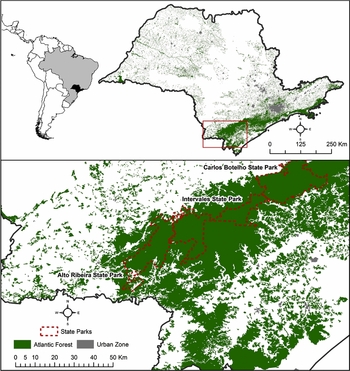
The Juçara Network spans seven states in southern and southeastern Brazil; however, we limited research locations for this study to the state of São Paulo, where commercialization success varies widely among communities. We focused our study on two communities in the vicinity of Intervales State Park and Carlos Botelho State Park, in the Vale do Ribeira region (Fig. 1). While the Vale do Ribeira is the poorest region of São Paulo State, it harbours the largest conserved block of Atlantic Forest, highlighting the antagonism between socioeconomic development and biodiversity conservation (Wunder Reference Wunder2001). The municipalities of this region have the lowest Inequality-adjusted Human Development Index (IHDI) of the state, at 0.673 in the study's research locations, compared with 0.783 for the state of São Paulo and 0.727 for Brazil.
Research locations, Vale do Ribeira, São Paulo State.

The region is dominated by dense moist tropical forest, small-scale family agriculture focused on banana and peach palm (Bactris gasipaes Kunth) heart of palm production, and a social profile that includes ‘family farmers,’ heart of palm poachers, and traditional peoples such as caiçaras (peoples of mixed indigenous, Portuguese and African heritage who practice subsistence agriculture and artisanal fishing) and quilombolas (descendants of escaped slave communities also practicing subsistence agriculture; Begossi Reference Begossi1999; Penna-Firme & Brondizio Reference Penna-Firme and Brondizio2007). Family farmers are the dominant group in all study sites.
In addition to fieldwork in the Vale do Ribeira, a field visit was also made to the Vale do Paraíba region on the northern coast of São Paulo State to interview NGO and government project coordinators, attend a regional Juçara Network meeting and visit another community engaged in pulp production. These two research locations represent two different ‘centres’ of the Juçara Network, the Vale do Ribeira Centre and the Northern Coast Centre (Litoral Norte). Data from the Northern Coast Centre inform our discussion; however, results presented primarily reflect challenges currently faced in the Vale do Ribeira.
Interviews and ethnographic observation
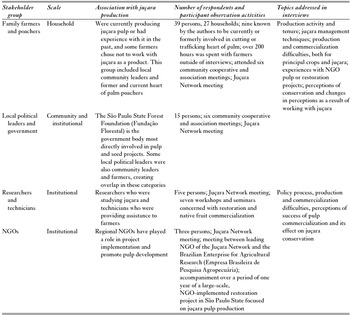
This study relied on an inductive approach and ‘case-study logic,’ in which findings become evident through a sequential process of saturation of information obtained from informants, in turn causing research and interview questions to evolve (Small Reference Small2009). Fieldwork was undertaken between October 2012 and October 2013. We conducted 56 in-depth, semi-structured interviews in total with four stakeholder groups associated with juçara pulp production: family farmers and poachers, local political leaders and government, researchers and technicians, and NGOs (Table 1). Potential interviewees were first indicated by key informants in each community, themselves identified due to their extensive prior engagement with the Juçara Network. Once in communities, additional interviewees were identified through snowball sampling (Wright & Stein Reference Wright, Stein and Kempf-Leonard2005), with producers currently managing juçara for pulp production or who had prior experience with managing juçara for pulp production prioritized. A total of 100% of producers currently managing juçara for pulp production in the communities were interviewed. We identified researchers and technicians both through our contacts at the ‘Luiz de Queiroz’ College of Agriculture, University of São Paulo, and by attending regional meetings and workshops.
Stakeholders interviewed, with some individuals considered in more than one stakeholder group.

Some individuals categorized as ‘farmers’ formerly lived exclusively from poaching heart of palm but are now engaged in agricultural activities and, in some cases, earn a living from both agriculture and poaching. Nine of our informants were known to be currently or formerly involved with heart of palm cutting and trafficking, but due to the illegal nature of the activity, we did not ask interviewees if they were currently or had been poachers. This information was either provided willingly by informants without prompting, or confirmed by other individuals. Thus, we could neither determine an exact percentage of informants currently or formerly engaged in poaching, nor access a greater number of poachers to obtain a more accurate sampling of opinion. Informants estimated that under 50% of people in one community and over 80% in another were engaged in poaching.
Beyond interviews, this study relied heavily on ethnographic observations and participant observation, including time spent with farmers in fields – which resulted in multiple interviews of some individuals – and participation in meetings and workshops. Review of documents such as NGO and government project proposals and reports, promotional material, and community harvest and commercialization data further contributed to data collection and analysis, and return visits were made to communities to verify and cross-check results. Finally, interviews and field notes were coded by hand to identify recurring themes (Thomas Reference Thomas2006).
RESULTS
Efforts to stimulate juçara pulp production and commercialization
Only about six families in one community (of 170) and seven families in the other (of 105) were currently managing juçara for pulp, but the practices and experiences of these farmers offer rich insight into typical management techniques and the relationship between pulp production, engagement with civil society and perceptions of conservation. Many more families grow juçara seedlings to replant on their own property or to sell, in addition to selling seeds to restoration projects, and other interviewees had formerly worked with pulp but no longer do so. Management is concentrated in home gardens and cultivated areas, where juçara is intercropped with banana, although management also occurs in secondary forests.
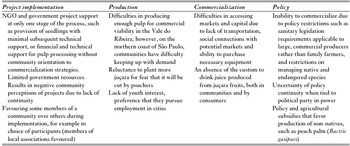
Since 2008, the Juçara Network has played a crucial role in exposing communities to the practice of juçara pulp production, in providing technical assistance, and in evaluating the federal and state-level policy relevant to all stages of management, processing and commercialization. The member organizations, including producer associations, have also been instrumental in designing and promoting the State Resolution (SMA 105/2013) that defines management regulations for juçara and other native Atlantic Forest fruit and in improving smallholder access to government programs that purchase family farmer products, such as school lunch programs (Programa Nacional de Alimentação Escolar or the National School Meal Program). Yet, all interviewees from every stakeholder group (farmers, local leaders, government, NGOs, and researchers and technicians) cited difficulties in the stimulation of juçara pulp production, which we divide into the categories of project implementation, production, commercialization, and policy at the state and federal levels (Table 2).
Difficulties reported in development of juçara pulp as a product.

Most frequently cited difficulties fall under the related categories of commercialization and policy, and success in one category does not preclude difficulties in another. For example, farmers may be successful at one or several stages of the process, such as production and processing, but are unable to find markets for pulp or have difficulty complying with necessary sanitary standards for legal commercialization. According to a government project leader, ‘We stimulate production but don't teach people how to be businessmen’ (A.A. Ball, personal communication 2013). Farmers who chose not to get involved in juçara pulp production cited the ongoing legal uncertainty around management and commercialization, lack of time to invest in management of species with uncertain economic return and slow growth (the species typically only becomes reproductive after 7–15 years) and reluctance to plant more juçara for fear that it will be cut by poachers.
Furthermore, farmers lose faith in NGO and government projects, and in the economic viability of pulp production, after repeated experiences with projects that do not ‘bear fruit.’ Projects that seemed successful in the first few years ultimately failed due to lack of continuity, intra-community and community–government conflict, corruption in community associations and lack of real leadership in the case of one community, and isolation from the influx of ideas and assistance from outside the community. Both farmers and government and NGO employees cited the discouragement that farmers face after years of attempted commercialization of juçara pulp, or even of seeds when current restoration projects are saturated.
The allure of fast and guaranteed income from heart of palm and a culture of extractivism were also cited as major social barriers to adopting new production methods, as poachers can earn over twice as much per month from illegal heart of palm poaching as from other production or service activities, working fewer days (A.A. Ball & P.H.S. Brancalion, unpublished data 2013), and most poachers interviewed felt they had no other options beyond dependence on heart of palm extraction. While a few poachers interviewed did not express interest in other livelihood options, the majority would like to cease poaching and/or for their children to have other options, claiming that ‘there's no future here’ and ‘people don't understand what we go through to get to that point [of having to poach]’ (A.A. Ball, personal communication 2013). Most individuals who depend on extraction begin poaching at a very young age, and many do not own land and thus cannot cultivate juçara; however, they do have the opportunity to earn some income during other phases of production such as fruit harvest and processing. These are also often the people prioritized for employment with restoration projects for both planting and monitoring phases in adjacent state parks, as park managers know they will engage in less poaching activity while employed. Community leaders heavily stressed the historical marginalization and lack of opportunity experienced by extractivists.
While the Juçara Network suggests that income from pulp and seeds can rival that of illegal heart of palm, producers and poachers interviewed in the Vale do Ribeira claim that ‘juçara pulp doesn't provide a profit’ (A.A. Ball, personal communication 2012–2013). Due to large variations in juçara fruit production from year to year and difficulties selling both pulp and seeds, most producers who work with juçara consider it a minor product that supplements their income from banana and peach palm. In fact, producers in the Vale do Ribeira sell so little juçara pulp that they have begun to consume it at home and even to sell the unprocessed fruits to açaí processing plants to be mixed in with, and sold as, açaí. Individuals not engaged in other forms of production would thus not be able to shift their primary economic activity from poaching to pulp production without access to land and credit to begin production. By contrast, several strong local NGOs, proximity to a coastal tourist market and demand for pulp from local restaurants all contribute to greater commercial success of juçara in the Northern Coast Centre.
The most effective activity to stimulate interest in juçara pulp production observed in this study was the practice of inter-community workshops, in which members of one community travel to another either to give workshops, such as in harvesting and de-pulping methods, or to participate in workshops as trainees. The majority of both trainers and trainees are women, who are involved in all stages of harvesting and processing. Informants claimed that attendance at workshops, meetings and seminars addressing juçara management or other sustainable practices such as agroforestry exposed them to new concepts and in some cases changed their perspective on agriculture and conservation, for example, according to one poacher, ‘their outlook is really changed when they work with the pulp’ (A.A. Ball, personal communication 2013). In fact, leaders in the Juçara Network from both the Vale do Ribeira and Northern Coast Centres stressed that working with juçara pulp is just a ‘launching point’ and a ‘point of departure’ to explore other sustainable development options and create a community and social identity aligned with principals of sustainable agriculture.
Juçara poaching and farmer and poacher perceptions of conservation
Despite heightened awareness of the threatened status of juçara, efforts to restore populations and to redirect poacher activity to pulp production have met with limited success. The palm continues to be extracted at high rates, especially from protected areas, due to the continued market demand for heart of palm, the economic dependence of many communities on extraction and the weak monitoring of illegal harvesting. Furthermore, the long-term proscription on management of the species due to environmental legislation that restricts management of native and endangered species, and weak institutional support for farmers to encourage working with the species, have hampered sustainable development of juçara pulp as a viable commercial product.
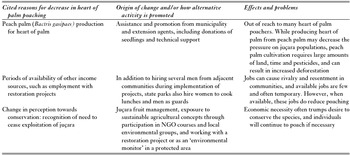
Although extraction continues, all but one respondent cited a general decrease in heart of palm poaching both in communities and in adjacent state parks in recent years (Table 3). A community leader claimed a 90% reduction in extractivism, but juçara ‘robbing’ is still a disincentive to cultivate the species for its fruit or heart of palm on private property. Instead of pulp production, the most cited reason for this decrease was the introduction of peach palm for heart of palm production, an effort highly promoted by regional policy and supported by extension services. However, each reason for a decrease in heart of palm poaching had associated problems or undesirable effects. With regard to perceptions of conservation, changes in perception were not always associated with changes in behaviour; one respondent, a former poacher working for a restoration project in a state park, claimed that, if necessary to sustain himself and his family, he would in the future cut the very palms whose survival and growth he is now monitoring. According to a community leader, perceptions of conservation will not change without demonstrating that conservation can offer a good source of income.
Reasons reported for decrease in heart of palm poaching in recent years.

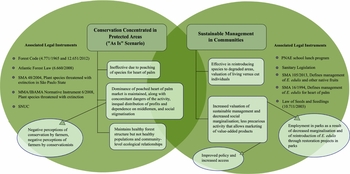
When asked if juçara is better preserved on farmer property versus in parks, all farmers were unhesitant in their conviction that the species has better conservation potential in communities than in protected areas, referred to by a farmer as the territory of ‘everyone and of no one’ (A.A. Ball, personal communication 2013). Several cited the violence between different groups of poachers as well as the increased distances that poachers must walk into state parks to find a stand of juçara suitable for heart of palm exploitation, indicating the existence of few healthy populations: ‘when my father cut heart of palm, he went half an hour into the forest, now it takes 7 or 8 hours’ (A.A. Ball, personal communication 2013). Recent research also reveals a much higher density of commercial-grade juçara individuals for heart of palm (diameter at breast height >9 cm) in community-managed agroforests (515 individuals/ha) and secondary forests managed for fruit production (477 individuals/ha) in comparison with protected areas (34 individuals/ha), where the last conserved populations usually have a naturally high density of juçara individuals (over 200/ha; Chagas Reference Chagas2015; conserved populations, Brancalion et al. Reference Brancalion, Vidal, Lavorenti, Batista and Rodrigues2012). This juxtaposition of the dysfunctional conservation of juçara in protected areas with potential positive outcomes of conservation in communities is shown in Fig. 2.
Comparison of two models for conservation of Euterpe edulis, with some social effects of conditions of these models (arrows). The Juçara Network identifies 28 pieces of federal legislation and ten pieces of state legislation (São Paulo) relevant to management and commercialization of juçara fruits, seeds and seedlings; a selection is shown here. IBAMA=Instituto Brasileiro do Meio Ambiente e dos Recursos Naturais Renováveis (Brazilian Institute of Environment and Renewable Natural Resources); MMA=Ministério do Meio Ambiente (Federal Department of the Environment); PNAE=Programa Nacional de Alimentação Escolar (National School Meal Program); SMA=Secretaria do Meio Ambiente (São Paulo State Department of Environment); SNUC=Sistema Nacional de Unidades de Conservação (National System of Conservation Units).

DISCUSSION
The barriers to successful commercialization of juçara pulp and improved conservation of juçara in the Vale do Ribeira indicate that producers lack necessary forms of access to fully benefit from these initiatives (Ribot & Peluso Reference Ribot and Peluso2003). Furthermore, the primary target population for these projects – heart of palm poachers – is benefiting the least. However, engagement with pulp production causes poachers and former poachers to gain an awareness of the need to conserve juçara, in some cases resulting in behavioural changes, and links producers with networks that promote sustainable agriculture and the land rights of small producers. In this sense, the indirect social capital benefits of juçara pulp production may ultimately be more impactful than the income generated directly from pulp production and contribute to improved livelihoods and to conservation of juçara over the long term.
Access
Governance challenges encountered in the process of promoting juçara pulp as a sustainable product are a function of community access, defined as a ‘bundle of powers’ that facilitates not only the right, but also the ability to derive benefits from things (Ribot & Peluso Reference Ribot and Peluso2003). In their concept of access, Ribot and Peluso stress the ‘wider range of social relationships that constrain or enable benefits from resource use than property relations alone’ and identify the structural and relational mechanisms determining degree of access to resources: access to technology, to capital, to markets, to labour and labour opportunities, to knowledge, to authority, access through social identity, and access via the negotiation of other social relations, in addition to rights-based mechanisms such as property holding. As ‘strands’ of bundles of power, these mechanisms can be used to evaluate ability to benefit from resources, as discussed below.
Similarly, the UK's Department for International Development (DFID) Sustainable Livelihoods Framework characterizes access to five kinds of capital – natural, financial, physical, social and human – as indicators to assess the effect of historical processes and ‘other external forces’ on the ability of communities to benefit from conservation initiatives (Igoe Reference Igoe2006). Historical processes have resulted in extreme marginalization of the small farmers in this study, and of heart of palm poachers in particular, straining their access to land and to a positive social identity that gives them authority in institutional negotiations (the compromised access of the communities of small farmers involved in this study has many underlying and complex reasons beyond the scope of this article).
For example, because individuals sustaining themselves through heart of palm extraction are widely viewed as criminals, especially by conservationists, dialogue between state parks and adjacent communities where many heart of palm poachers reside is minimal. This limits the possibilities for the state to engage communities with conservation by expanding pulp projects, by providing courses in environmental monitoring, or by developing tourism projects that could provide employment for communities, as done in other regions of the Atlantic Forest (Mesquita et al. Reference Mesquita, Holvorcem, Lyrio, de Menezes, da Silva Dias and Azevedo2010). As mentioned above, the occasional hiring of poachers to work on restoration projects within parks is an exception, but such employment is sporadic, and most individuals return to poaching once a project has been completed. Furthermore, poachers must be a member of the local producers’ association in order to be considered for these positions, which, because of local politics and conflict, precludes access to these jobs for many individuals.
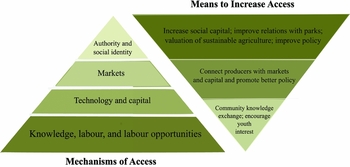
Marginalization and poverty have also strained intra-community coherence and a positive sense of identity. Lack of access to financial capital such as loans, to physical capital such as vehicles to access markets, and to natural capital such as land (also noted by Ambrose-Oji Reference Ambrose-Oji2003), or even to the former abundance of juçara from which to extract heart of palm, contribute to farmers’ dependence on external assistance. Farmers who work with juçara pulp have access to family labour, to their own knowledge of the species, to the natural capital of seeds and seedlings, and, in some cases, to technical assistance through NGOs and municipalities, but lack of authority to influence policy and of certain features of social capital, such as trust, are among the barriers that continue to impede successful development (Laird et al. Reference Laird, Wynberg, McLain, Laird, McLain and Wynberg2010b ; Fig. 3).
Inverse relationship between degree of access present in study communities and required investment to increase that access (after Ribot & Peluso Reference Ribot and Peluso2003). At present, communities have greatest degree of access to knowledge about juçara pulp production and to labour to manage juçara, and the least degree of access to authority and a positive social identity.

Again, many poachers do not have access to land to pursue production activities, though members of one study community have established an agrarian reform settlement that provides opportunities for extractivists to begin cultivating on plots of land. But initially, those who benefit most from juçara pulp projects are the more privileged members of communities – those with land and other means of production – as shown in other cases (Arnold & Ruíz-Pérez Reference Arnold and Ruíz-Pérez2001; Ambrose-Oji Reference Ambrose-Oji2003; Belcher et al. Reference Belcher, Ruíz-Pérez and Achdiawan2005; Rigg Reference Rigg2006). The Juçara Network's assumption that poachers could replace income acquired via one NTFP strategy with that obtained from another strategy, shifting from subsistence, specialized extraction to integrated cultivation, according to the categories of NTFP use strategies described by Belcher et al. (Reference Belcher, Ruíz-Pérez and Achdiawan2005), is flawed, though parallel land-reform efforts and capacitation could promote a shift from extraction to production (Kusters et al. Reference Kusters, Achdiawan, Belcher and Ruiz-Pérez2006). Assuming the success of a new product based on its similarity with another – açaí pulp – may also be a flawed assumption, as market demand for juçara pulp has thus far been low.
Integration of different stages of production and commercialization, and creation of associated policy to facilitate these processes, is a common challenge faced in NTFP supply chains, with health and safety regulations the ‘most onerous of all’ (Pierce & Bürgener Reference Pierce, Bürgener, Laird, McLain and Wynberg2010). While producers may benefit from the expansion phase of a production system, such as NTFP projects, their social, economic and political marginalization prevents their ability to benefit from the commercialization or marketing phases – exactly the trajectory witnessed with juçara pulp projects in the Vale do Ribeira (Brondizio Reference Brondizio2008 describes this trajectory with açaí commercialization). Policy can improve potential for management of native species, differentiate between large and small producers and account for their differing realities, and support the movement of family farmer products to local and regional markets; however, while policy is crucial, the capacity for farmers and communities to benefit from policies depends on improved smallholder access to intended benefits. Policy and access are complementary.
Ongoing legal complexity around production and processing has been cited in other studies as a major barrier to NTFP commercialization (Granich et al. Reference Granich, Purata, Edouard, Pardo, Tovar, Laird, McLain and Wynberg2010), but good policy alone is not sufficient to sustainably manage forest products. For example, regulations for juçara heart of palm have existed for years, largely a result of reactive policy-making (Laird et al. Reference Laird, Wynberg, McLain, Laird, McLain and Wynberg2010b ), but the illegal market still dominates. Good policy for management of juçara fruits similarly cannot be relied on to result in sustainable management and must be integrated with efforts to improve access, in turn improving governance. Legality may be the ‘door to commercialization’ (Granich et al. Reference Granich, Purata, Edouard, Pardo, Tovar, Laird, McLain and Wynberg2010), but policy without strong governance is ineffective.
The institutional members of the Juçara Network, including NGOs, have addressed some gaps in farmer access while continuing to play a major role in influencing the implementation of better policy. Acting as capacitators, NGOs and extension agencies can strengthen community ‘bundles of power’ and vertical linkages by linking farmers with material, technical and legal resources. In the Northern Coast Centre of the Juçara Network in São Paulo State, NGOs have assisted communities in accessing both markets and a more positive social identity, while the Vale do Ribeira remains more isolated from both markets and wider social networks than other regions of the state. If providing an alternative income source for individuals who rely on heart of palm as a means to reduce poaching is the primary and immediate objective, NGO and government projects in this region should focus efforts on products with existing markets, such as providing technical support for native seedling production (including juçara) for restoration projects. However, project designers may recognize that juçara pulp attracts attention and funding for projects (Belcher et al. Reference Belcher, Ruíz-Pérez and Achdiawan2005), if not a market. If treated simply as a product, the intended social and conservation benefits of juçara pulp could be overlooked, even while promotion of these benefits may be hindering actual market success.
Conservation and improved social capital
Positive perceptions of conservation can often be associated with behavioural norms and practices conducive to sustainable resource use. However, this is not a hard-and-fast rule, as economic necessity also influences farmer choices about resource use and can override desire to conserve a resource, as seen in the statement by the individual working on a restoration project that he would poach the plants he is currently monitoring if necessary. While our findings did not indicate a direct relationship between pulp production and improved conservation of the species, association with the Juçara Network exposed farmers to sustainable modes of production and sometimes fostered beneficial relationships with other members of the community, with other communities and with civil society organizations, which improved their access to knowledge, employment with restoration projects and workshops teaching sustainable agricultural techniques. Inter-community workshops that disseminate these techniques create valuable horizontal linkages among communities of different municipalities and provide the opportunity for exchange of knowledge and experience (Olsson et al. Reference Olsson, Folke and Berkes2004), enhancing social capital. This increased access may decrease reliance on heart of palm poaching for income and promote sustainable management of juçara and other crops, thus improving both the conservation status of juçara and opportunities for farmers to benefit from pulp products over the long term.
With so few mature stands remaining in protected areas, community management of juçara may offer a crucial alternative to the as-is conservation scenario, a concept supported by prior research (Gobeze et al. Reference Gobeze, Bekele, Lemenih and Kassa2009; Porter-Bolland et al. Reference Porter-Bolland, Ellis, Guariguata, Ruiz-Mallén, Negrete-Yankelevich and Reyes-García2012). Because protected area land is public and largely unguarded, it exists as a kind of open-access territory in which resources are unmanaged (Feeny et al. Reference Feeny, Berkes, McCay and Acheson1990; Ostrom Reference Ostrom1999; Sunderlin et al. Reference Sunderlin, Angelsen, Belcher, Burgers, Nasi, Santoso and Wunder2005). By contrast, poachers are less likely to exploit juçara on farmer property, suggesting a ‘right to exclude’ (MacPherson Reference MacPherson and MacPherson1978) or superior monitoring potential within communities as opposed to within protected areas. Similarly, incentives to sustainably manage rather than poach NTFPs in other tropical regions could alter local perspectives of conservation, connect local stakeholders with civil society and influence policy, though previous research has warned that success of NTFP commercialization is contextual (Pierce Reference Pierce, Laird, McLain and Wynberg2010; Marshall et al. Reference Marshall, Schreckenberg and Newton2006). Even within the state of São Paulo, success of pulp commercialization varies across communities, a consequence of differing geographic and social conditions.
Along with improved conservation of juçara, enhancing community access should also increase farmer control over all stages of management, processing and commercialization. Producer associations and cooperatives, leadership and community-led versus government- and NGO-led project development are key elements to securing local authority. In order for producers to maintain control over the benefits of commercialization and respond to the call to identify where NTFP conservation and development conflict, and where they coincide (Arnold & Ruíz-Pérez Reference Arnold and Ruíz-Pérez2001), a delicate balance must be struck between ‘success’ and ‘failure’ of juçara pulp as a product to avoid large-scale demand that would cause a shift to production by large companies, or even further degradation of the species and ecosystem that ‘sustainable use’ was meant to avoid (Wunder et al. Reference Wunder, Angelsen and Belcher2014). Finally, because women are heavily involved in all stages of fruit harvesting and pulp processing, increased engagement with juçara pulp can also provide women with more economic and social opportunities than are available in dominant forms of production such as banana and peach palm cultivation or in the entirely male activity of illegal heart of palm harvesting and processing.
By managing juçara for its pulp, farmers are not only experimenting with a new production method, they are linking themselves to future possibilities for sustainable development. Because of current NGO and researcher attention on juçara pulp and conservation of the palm, juçara acts as a nexus around which communities can explore options for resilience and sustainability, and even attract national and international funding for projects. In this sense, the Juçara Network exists more as a social movement to strengthen family farming, to secure land rights, and to create relationships among stakeholders – between communities and across local and institutional levels – than simply as an effort to develop and promote a new NTFP for conservation purposes. Ultimately, these relationships become the key elements driving sustainable development of native species that also contribute to community opportunity and resilience. The positive effect of policy and improved access on the conservation status of juçara is somewhat indirect: working with juçara pulp strengthens the juçara ‘social movement,’ which values sustainable agriculture over extraction and capacitates farmers to produce and commercialize native species. Smallholders and poachers who become involved in this movement come to value the sustainable use of the species, and their perspectives and priorities become more aligned with those of conservation (Agrawal Reference Agrawal2005).
FINAL REMARKS
Although the effectiveness of ‘community-based conservation’ continues to be debated and is highly contextual, conservation practitioners should not overlook the indirect effects on conservation of efforts to improve social capital and local authority, nor should they discount the complex social and policy barriers to management of threatened species. Due to the barriers described in this article, we have not yet seen the full potential of juçara pulp to contribute to conservation and development. Good policy, land reform, strong networks, production diversity, and strengthening of local civil society and social relations within communities and between communities and institutions can give communities the authority to overcome marginalization and the security to further experiment with this new product, providing alternatives for individuals who subsist on extraction of heart of palm. However, while improved policy may make management less uncertain, the most disadvantaged members of communities will not benefit from juçara pulp production or other development initiatives unless access is improved, and extraction will continue. Rather than act as a panacea of sustainable development for rural communities, NTFP production can provide supplementary income and, perhaps more importantly, provide a focal point around which broader visions for sustainable development and poverty reduction can be articulated.
In light of these conclusions, we offer recommendations at institutional, community and household levels for projects focused on NTFP development in rural, tropical regions:
-
• Policy supporting the sustainable management, processing and distribution of products by smallholders should be in place, but this policy should not be over-regulatory to the extent that it is stifles small producer ability to engage in the market. Policy favoring land reform for landless peasants also enhances security to experiment with different production systems.
-
• Local leadership and ownership is key to project success and continuity, especially for projects introduced by parties from outside the community such as NGOs or government agencies. NTFP projects should be integrated with other diversified production activities such that they complement rather than detract from other income-generation activities.
-
• Thorough understanding of historical and current social conditions of communities and regions is indispensible to designing projects that will not exclude the most disadvantaged members of communities. This understanding can be improved using participatory research methodologies prior to and throughout project implementation.
-
• When improved conservation of a species and ecosystem is an objective, long-term community-based monitoring plans should be in place to assess any change in conservation status. Monitoring can improve ownership over projects as well as provide supplemental income.
ACKNOWLEDGEMENTS
The authors wish to thank The Laboratory of Tropical Silviculture of the Escola Superior de Agricultura ‘Luiz de Queiroz’ (University of São Paulo) for institutional support. The authors extend their gratitude to G.F. de Aguiar, G. Ohta, W. Portilho and all of the farmers who participated in this research. Special thanks to Dr R. Chazdon, Dr A. Agrawal, and two anonymous reviewers for their comments on drafts of this article. This study was undertaken as part of the Fox International Fellowship, an award of the Whitney and Betty MacMillan Center for International and Area Studies, Yale University.