Architects make architecture, historians make history and what they both make is myth. (Charles Jencks)
Toward the end of 1955, the architectural historian and critic Nikolaus Pevsner gave the annual Reith Lectures on BBC radio. “The Englishness of English Art” argued that there was a characteristically English approach to architecture, one that placed a premium on rationality and reasonableness rather than on mere decorative show. It was this approach that made him so optimistic about the future of English architecture, for it suggested, Pevsner concluded, that “England seems predestined to play a leading part in modern architecture.”Footnote 1 Pevsner's lectures were just the latest in a long debate about Englishness and its relationship to the modern movement in architecture, perhaps even the last gasp of an argument that went back three decades.Footnote 2 The arrival of modernism in England had been firmly resisted by those who saw it as a foreign invasion. By contrast, those like Pevsner, who advocated the adoption of the modern movement, made a concerted attempt to establish its English identity. They sought to show that modernism and Englishness were entirely compatible. More than this, they came to argue that modernism was in fact indigenous to England. In Charles Jencks's terms, they created a myth of English modernism: one that was to prove highly persuasive and hugely important. It was this myth that not only helped enable the acceptance of modernism in England but also shaped architecture itself. It was this myth, too, that reshaped architectural historiography and helped to inspire the preservation movement. Perhaps most important, it was this myth that allowed many to reimagine Englishness itself and, in the years between 1927 and 1957, come to articulate a modern and modernist version of England.
The year 1927 is a big one in the history of English modernism. The first English translation of Le Corbusier's Vers une Architecture appeared.Footnote 3 Peter Behrens's New Ways, in Northampton—acknowledged at the time as the first great statement of English modernist design—was unveiled to the public.Footnote 4 And also, perhaps even more memorably, Evelyn Waugh wrote Decline and Fall and in the process immortalized the nascent modern movement.Footnote 5 The house he described was called King's Thursday. Replacing an older, Tudor mansion, it was a symphony of plate glass, Vita glass, aluminum, and vulcanite. The architect was Otto Friedrich Silenus and the client Margot Beste-Chetwynde. She wanted—as she put it—“something clean and square.” Otto Silenus gave it to her. The result no doubt resembled a Punch cartoon of 1936 in which the proud new owner of a perfect new modernist house exclaimed to passersby, “Do tell me you loathe it.”Footnote 6
By contrast, 1957 is a somewhat less remarkable year in English architectural history. Admittedly, it was then that the Victorian Society began to take shape and then that the Modern Architectural Research (MARS) Group—that pioneering caucus of modernists—finally extinguished itself.Footnote 7 More generally, by then it was also becoming increasingly clear that the first wave of modernism was being overtaken by new influences and new ideas; a new generation of architects was creating a new approach to architecture. But in reality, 1957 saw few major or memorable architectural milestones. It was, as John Summerson put it in his unpublished autobiography, “a dull year.”Footnote 8
Nonetheless, for many like John Summerson, the years between 1927 and 1957 did possess some sense of historical cohesion. They made up a thirty-year period—a generation that witnessed the rise, consolidation, and transformation of a particular approach to architecture—of the modern movement in England. Summerson, himself a pioneering architectural historian and propagandist for modernism, traced the process. In the six or so years after 1927, he wrote, “The Modern Movement in England was mostly talk: talk, travel and illustration.” By the mid-1930s, houses were being built that could be called modernist, and modern architecture was becoming well known. By 1945, he asserted, “A revolution in public opinion had been accomplished.” It was a revolution that would be confirmed in 1951 when, as he recalled, “the new architecture swept suddenly into full public view with the Festival of Britain and the South Bank exhibition.”Footnote 9 The 1950s were subsequently characterized by modernism, as schools and colleges as well as councils and corporations all embraced a self-consciously modern architectural approach.Footnote 10 By the end of the 1950s, architecture was changing again, and Summerson was one of many in his generation who felt left behind. Indeed, he formally abandoned architectural criticism in 1957.Footnote 11 The approach for which he had argued had been superseded. His version of modernism had had its day.
The slow and different birth of English modernism is now relatively well documented.Footnote 12 The stylistic battles of the 1930s and the modernist achievements of the 1950s have been investigated in a number of important accounts.Footnote 13 The Festival of Britain, Coventry Cathedral, the Royal Festival Hall, and other great monuments of the modern movement have all been the subject of articles, essays, and monographs.Footnote 14 The relationship between national identity and the development of architecture, however, has received less sustained attention. While writers on fine art, photography, fashion, and design have all explored this theme, architectural historians have tended to be rather less interested in it.Footnote 15 Given the origins of the modern movement in architecture, this seems particularly odd.
Although some writers have sought to trace the English origins of modernism—looking back to pioneering buildings of the 1910s and 1920s—it is undeniable that the form of modernism practiced in England between 1927 and 1957 owed much to continental example.Footnote 16 This has led many to see the arrival of modern architecture in England as a sort of continental invasion. J. Mordaunt Crook encapsulated this account in a typically memorable phrase: “Rejected in Germany, the country of its birth; spurned in Russia, the country of its adoption, the Modern Movement was reduced to waging aesthetic war in the liberal democracies of the West.”Footnote 17 Other writers have pushed this argument even further. For Gavin Stamp, the success of the modern movement simply reflects “that typical English inferiority complex which always prefers a foreign name to a native one.”Footnote 18 For James Stevens Curl, “Philistine, uncertain, intellectually idle England” was merely conned and bullied into accepting modernist “nonsense.”Footnote 19 For Timothy Mowl, the horror is perhaps even greater. Writing of the influential architectural historian Nikolaus Pevsner, he asks, “Should a man with no English social background have been encouraged so quickly to a position where he could exert an unwise and, in a very real sense, an ‘alien’ influence?”Footnote 20 This analysis presents us with an important question: could such a “foreign” style ever be domesticated? Could modernism ever become English? Understood in these terms, the relationship between modernism and Englishness is inevitably oppositional, as a clearly defined and perhaps unchanging notion of Englishness is challenged by an alien and assertive modernism.
Recent authors—particularly Becky Conekin, Alan Powers, and Elizabeth Darling—have been more sympathetic to modernism and keener to establish its English identity.Footnote 21 They have traced the development of what they see as an authentically English modernism and situated it within discussions of modernity, citizenship, and social reform. They have also identified moments when questions of national identity and architectural practice intersected. They have not, however, explored the evolution of a discourse about the Englishness of modernism nor explored the way in which modernists sought to defend and define modernism as English.Footnote 22 This is entirely understandable. Such a study would divert their focus away from their primary interests, requiring—as it does—an emphasis on books as well as on buildings, on texts as well as on building practices. But a review of these sources reveals that the architects and architectural critics of the English modern movement were preoccupied with national identity—and, more particularly, with establishing an English pedigree for modern architecture. They did this in response to critics who saw modernism as inherently un-English but also because their own understanding of architecture dictated that buildings should reflect the place where they were built.
Modernism or Modernismus?
“Whether it is possible to ‘Go Modern’ and ‘Be British’ is a question vexing quite a few people to-day,” observed the artist Paul Nash in a famous article from 1932.Footnote 23 A problem for artists, this was a very serious difficulty for architects. Modernism was itself problematic; whether it was a new way of doing architecture or just another style often seemed unclear. The modern movement evolved through time and changed from place to place.Footnote 24 It is, as Sarah Williams Goldhagen has noted, perhaps best understood as a discourse—as “a set of arguments”—rather than as a style of architecture or way of building.Footnote 25 The Britishness of architecture was also hard to grapple with. For one thing, the difference between Britishness and Englishness was regularly elided.Footnote 26 As Cheryl Buckley puts it, “Mainly Britain meant England,” but sometimes the reverse was true.Footnote 27 Still more important, the question of how architecture might embody or express national identity or national character was a vexed one. In Alan Powers's words, “England has been a net importer of architectural ideas at almost all times.”Footnote 28 How, then, could any architecture prove to be authentically English?
The modernism that came to England in the years after 1927 was a discourse animated by a number of core assumptions and was embodied in the work of men like Walter Gropius, Mies van der Rohe, and the Swiss visionary Le Corbusier. Although they differed in detail and disagreed about much, these men shared a common approach. They argued that humanity was living in a new age and that this new age required a new architecture.Footnote 29 New materials, such as concrete and steel; new social circumstances, such as the rise of the working class; and a new aesthetic—the aesthetic of the machine—all inspired a new vision of architecture. For these pioneers, building was “a science not an art.”Footnote 30 A house, as Le Corbusier so famously observed, was simply a “machine for living in.” A town was a complex social system that needed to be planned. A factory should look like a factory, and a school should look like a school. The result was a self-consciously spare style: stripped of all ornament, expressing its construction in its façade, and revealing its function in its form. It was a case, as J. Mordaunt Crook later joked, of architects who always put “drains before beauty.”Footnote 31
Changing times brought with them changing approaches to the modern movement. While the analysis, with its emphasis on modernity and on the need to create a truly modern architecture, remained the same, the terms of the debate itself changed, and the discourse about modernism mutated. Even the pioneers of modernism were not immovable in their attitudes, while the generation that came to prominence after the Second World War brought new ideas to bear. Increasingly, the emphasis on functionalism and on constructing a “scientific” architecture came to seem crude and perhaps inhuman.Footnote 32 The late 1940s and 1950s saw several moves toward a more “situated Modernism,” an architecture that would “situate the users of their buildings socially and historically, in place and time.”Footnote 33 To succeed, wrote one prominent modernist in 1946, the modern movement “must keep in touch at all costs with the people it serves.”Footnote 34 This meant an increased willingness to take account of popular taste, of the lives and lifestyles of those whom the architects sought to house. It also meant battles within the modern movement, as a whole variety of different approaches to modernism were proposed.Footnote 35 It was this debate that produced—inter alia—the Brutalism of the 1960s, with its emphasis on monumentality, its use of rough-cast concrete, and its utopian visions of the future.Footnote 36 Summerson and his peers found this shift hard to accept, and the fierceness of this debate ultimately forced Summerson from the field of architectural criticism.Footnote 37
For English modernists, of course, there was no getting away from a central fact: they “were propagating what was an essentially European idea,” as one author put it.Footnote 38 Their inspiration and their discourse originated abroad—particularly in Germany, France, and the Netherlands. The modern movement was international. It was even called the International Style.Footnote 39 Initially, some enthusiasts rejoiced in this internationalism. “The more scientific architecture becomes,” wrote John Summerson and Clough Williams-Ellis in 1934, “the more international it must be.”Footnote 40 Cosmopolitanism was a mark of difference—just like the black hats that the English modern architects of the 1930s wore, which marked them out as “intellectuals, persons apart, detached.”Footnote 41 More than this, the modern movement in England—at least initially—depended on foreign architects and writers. As Alan Powers puts it, “while it might have been possible to have a completely home-grown Modernism,” this was an architecture that, to begin with at least, “depended largely on people who had come from elsewhere.”Footnote 42 Many—indeed most—of its initial advocates in England were continental or colonial.Footnote 43 This, too, could be seen as a benefit. John Summerson recalled that the founders of the influential modernist MARS Group were almost all from abroad—only one of them, the architect Maxwell Fry, “was a Britisher.” But this, as he went on to say, “certainly helped to give the group a freshness of outlook.”Footnote 44
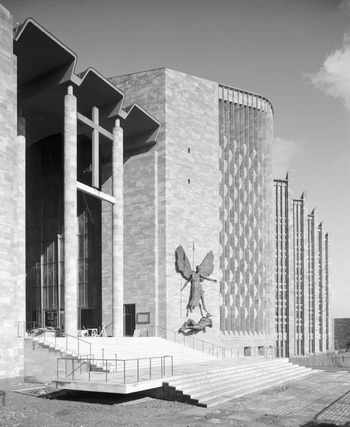
Nonetheless, this internationalism also proved highly problematic. The British Union of Fascists wrote to the Architects’ Journal in 1934 to express their outrage at the employment of “alien architects.”Footnote 45 Others also asserted—as the otherwise unknown Keith Jenkins of Cardiff did in 1935—that the British must be on their guard “against too readily drinking in Jewish-Communist doctrine, even when it is disguised in the most seductive of concrete and glass clothes.”Footnote 46 Even the development of indigenous English modernists did not halt these attacks, while the employment of foreign architects regularly revived the claim that modernism was the product of alien influences. Basil Spence's Coventry Cathedral (1956–62) was condemned as a “cosmopolitan challenge to our traditions” (fig. 1).Footnote 47 The appointment of the Danish Arne Jacobsen as architect of the new St. Catherine's College in Oxford was greeted at least by some as “the greatest slap in the face to English architects since William of Sens was brought in to rebuild the choir of Canterbury Cathedral.”Footnote 48 “If general architectural standards in England since the war are considered to be low,” wrote another correspondent, “the fault may be due to the influence of foreign architects who obtained teaching posts here during the war. Thereafter we suffered from a Continental prefabricated type of influence which was most unfortunate for the proper development of what had become traditional English architecture.”Footnote 49
“A quiet design in the English tradition” (Basil Spence, Phoenix at Coventry [London, 1962], 35). Basil Spence's Coventry Cathedral (1956–62), with Jacob Epstein's St. Michael and the Devil. RIBA10454: Eric de Mare/RIBA Library Photographs Collection.

The debate about the Englishness of modern architecture was a real one because the nationality of architecture mattered. As Peter Mandler has recently argued, this was a period in which discussions about national identity and national character were extremely important.Footnote 50 Like their Victorian predecessors, the architects and architectural critics of this period assumed an axiomatic association between culture and architecture and between the spirit of the age and the buildings of the period.Footnote 51 For some, this reflected the impact of continental art history, with its pronounced Hegelian inheritance. Others were more influenced by late nineteenth- and early twentieth-century English writers like Banister Fletcher and T. G. Jackson.Footnote 52 But if they differed in inspiration, they agreed on their conclusion. As Sigfried Giedion argued in his influential Space, Time and Architecture, “However much a period may try to disguise itself, its real nature will still show through in its architecture.”Footnote 53 Moreover, and perhaps still more important, it was also argued that each nation produced its own authentically national form of building. Writing in 1947, A. E. Richardson, for one, was entirely clear that “architecture … provides a sure index to the character of a nation.” “The masterpieces of English architecture,” he went on, “be they Gothic, Renaissance, classic or contemporary, appear as emanations of national genius.”Footnote 54 Time and place, period and nation: all these factors, it was argued, irresistibly influenced architecture. From Fletcher to Pevsner, the link between the nation and its architecture was simply unquestioned.Footnote 55 “There is the spirit of the age,” Pevsner declared in The Englishness of English Art, “and there is national character. The existence of neither can be denied, however averse one may be to generalizations.”Footnote 56 This assumption made the modernists’ attempt to import a new and foreign style all the more difficult. A true architecture for England—both they and their critics agreed—must be a truly English architecture.Footnote 57
The belief that modernism was foreign and that it was the tool of foreign architects was consequently very important and widely held. In 1927, the president of the Architectural Association denounced modern architecture as essentially ridiculous and as inherently un-English: “A French proponent of Modernism has built a concrete and plate-glass box to form one of these new abodes—one could not conceive it as a home for anyone save a vegetarian bacteriologist.”Footnote 58 Throughout the 1930s, modernism was attacked as ugly, as alien, as a “German invasion,” and as a weed choking the English garden.Footnote 59 In the mid-1940s, Lionel Lindsay criticized modern art and architecture as cosmopolitan, Jewish, and explicitly antinational: a product of “the age of speed, sensationalism, jazz, and the insensate worship of money”—a contributing factor to the fall of France and a threat to Britain and her empire.Footnote 60
This attitude found its apotheosis in the writings of Sir Reginald Blomfield. Blomfield was an architectural grandee. A grandson of the reforming bishop and nephew of a distinguished architect, he was a Royal Academician, a Royal Institute of British Architects (RIBA) Gold Medallist, and quite definitely one of the great and the good.Footnote 61 Trained in the arts and crafts tradition, he had embraced the architectural idiom of seventeenth-century English classicism and was an important figure in the Edwardian Wrenaissance, that is, the rebirth of Christopher Wren. At the Royal Academy and at the Royal Historical Society, he dismissed the “New Architecture” as quintessentially continental, a by-product of Bolshevism.Footnote 62 And he followed these denunciations with further, even more furious attacks, which culminated in his 1943 book Modernismus.Footnote 63 The book also mocked the pretensions of contemporary sculptors, painters, artists, musicians, and avant-garde writers. But the horrors of the modern movement's incursion into building formed a central focus of the study. “Since the war,” Blomfield argued, “Modernism, or ‘Modernismus,’ as it should be called on the German precedent, has invaded this country like an epidemic.” The style, he maintained, was foreign, unfamiliar, and un-English. “In point of fact,” he continued, modern architects had “drawn their inspiration from the creations of contemporary French, German, Austrian and American architects. Whatever merits they may have are alien to the English tradition and temperament.” In place of this internationalism—this cosmopolitanism—Blomfield called for nationalism, for truly English architecture. “The modernists,” he concluded, “seem to be unaware that they are up against instincts which have been gradually built up through many generations, and that whatever may be the case with peoples with no historic past—those ‘lesser breeds without the law,’ as Kipling very unkindly calls them—these instincts have to be reckoned with.”Footnote 64
Blomfield's analysis has not been treated kindly by historians. Even those who agree with him—even writers like the architectural historian and convinced classicist David Watkin—have tended to downplay his importance and influence.Footnote 65 Yet although there were few who couched their arguments in quite these terms, it is clear that Sir Reginald's position was shared by many.Footnote 66 The Builder and the BBC, for example, both showed real interest in his cause, with the former, at any rate, convinced that “Sir Reginald had by far the better of the argument.”Footnote 67 Perhaps most important, the modernists themselves were rattled and responded with outrage to his outbursts.Footnote 68 In the RIBA Journal, one reviewer compared him to Hitler.Footnote 69 In the Architects’ Journal, Maxwell Fry denounced him even more fiercely.Footnote 70 Blomfield remained a modernist bogeyman for the next thirty years. Indeed, as late as 1967, John Summerson was still referring back to him.Footnote 71 More than anything else, these writers objected to his suggestion that in arguing for modernism they were arguing for a profoundly unpatriotic architecture. “Why should I be an internationalist,” asked the modernist Maxwell Fry, simply “because I accept the structural outcome of materials in common use everywhere? As well call Wren an internationalist for casting eyes towards Paris and Rome. Wren, whose every work was personal and English.”Footnote 72
Even before Blomfield, the modernists had begun to construct a more patriotic apologetic for their style. As early as 1930, the success of the modernist Stockholm Exhibition had led the Architectural Review to argue—and in the most reductive terms—for England's adoption of modernism. “We are no longer being invited to follow the erratic lead of French petits bourgeois and German Geheimeraten,” one writer declared.Footnote 73 “It is no longer necessary for us to look to the past and to the southern countries for models of good art,” chimed another. “Sweden has shown a distinctive style more suitable to our climate and conforming more closely to the natural inclinations of our race.”Footnote 74 Sweden was appealing because its architects were also attempting to construct a national style, a modernism that was not a “feeble imitation” of continental work but rather “built in Swedish climate, by Swedes, and for Swedes.”Footnote 75 Sweden was also attractive because it was not France or Germany. The Swedish could be pictured as sharing an ethnicity with the English: “May our own Viking blood, the only blood in us that matters,” declared P. Morton Shand, “rouse itself to join in the massacres of those traitors to our age … [who] daily pronounce anathema on reinforced concrete, chromium steel, and plywood.”Footnote 76 Increasingly, too, the link between Sweden's social democracy and modernism appealed to English modernists, who looked across the North Sea to a welfare state that embodied its ideals in the most modern buildings.Footnote 77 Yet, this argument about a common Scandinavian inheritance did not really get the modernists very far. If the International Style was to be naturalized, they needed to go further and develop a proper English pedigree for it. The myth of English modernism needed to be spun.
The Avant-Garde Gambit
It would not be quite correct to say that in spinning this myth, the English modernists invented a tradition. For one thing, as modernists, they had no time for tradition in and of itself. Although they were not afraid to use the word to their rhetorical advantage, what united them throughout this period was a rejection of “tradition qua tradition.”Footnote 78 That, after all, was the unifying heart of their discourse. For another, this process resembles less the self-conscious historicization set out in The Invention of Tradition than the sort of “Avant-Garde Gambit” analyzed by Griselda Pollock in her essay of the same name.Footnote 79 The avant-garde in art, she argues, is a subculture, “a structure for the production of art based on a series of chess-like moves.”Footnote 80 It was this sort of gambit that the English modernists played. Rejecting conventional contemporary architecture, they looked for earlier exemplars. They deferred to their example, stressed their impeccable Englishness, and then went on to argue that modernism reflected a revival of their principles. There was no attempt here to recreate this older architecture: having deferred to it, modernists sought also to stress their difference from it.Footnote 81 But this gambit allowed the advocates of the modern movement to emphasize modernism's English identity. This attempt shaped modernism, modern architectural history, and contemporary ideas about Englishness irrevocably. It was a strikingly successful move.
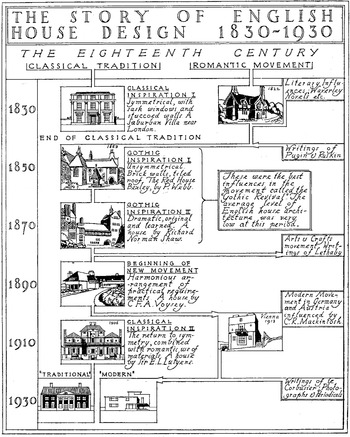
In the end, two overlapping narratives were developed (fig. 2). The first traced English modernism back to the eighteenth century, to what was called “The Golden Age of English design.”Footnote 82 “Our tradition,” wrote Maxwell Fry in 1934, “is the mental outlook of late Georgian architecture before its disintegration by nineteenth-century industrialization.”Footnote 83 “The truth is,” wrote J. M. Richards in 1956, that “architects have to-day to go back, in a sense, and pick up the threads of a common architectural language at the point where they became unrecognizably entangled by the break-up of eighteenth-century society.”Footnote 84 This was not just about style. Modernists also advocated eighteenth-century building practices. As Fry recalled, “My own feelings were strongly influenced by Georgian London, [by] the success with which the Georgians housed the various classes of society.”Footnote 85 This convinced him that apartments rather than houses represented the solution to England's housing problems.
The other version of the story of English modernism traced its origins back to the arts and crafts movement. This account was repeated again and again from about 1931 onward, and it became canonical after the publication of Nikolaus Pevsner's
“The Story of English House Design 1830–1930,” from Clough Williams-Ellis and John Summerson, Architecture Here and Now (London, 1934). “This table,” the original caption reads, “shows only the main current of intelligent architecture during the period. There were many backwaters that led nowhere, and various disturbing little whirlpools that only slightly affected the real direction.”

Pioneers of the Modern Movement in 1936.Footnote 86 Pevsner, a convinced modernist and propagandist for modernism, argued that the modern movement was English both in inspiration and in inheritance. His pioneers were people like William Morris, C. R. Ashbee, and C. A. Voysey. With their emphasis on craftsmanship, on overcoming the gap between the arts and crafts, Pevsner saw them as protomodernists. True, the line had died out. The impetus had gone abroad. But Nikolaus Pevsner was convinced that modernism had an English pedigree, that it had a place in English life, and that it was a truly English architecture.Footnote 87 As he put it a year later in his Enquiry into Industrial Art in England, “The Modern Movement cannot be un-English, if it originated in England. In finally adopting the modern style as it was developed abroad, England is only recovering what she once gave to the world.”Footnote 88
Both the Georgian and the arts and crafts accounts of English modernism had a number of things in common. In the first place, they completely agreed on the horrors of recent building and most early twentieth-century architecture. As John Summerson recalled, he and his contemporaries believed that “history stopped in 1830, then there was chaos.” “It is difficult to recall,” he continued, “the nausea we felt against the recent past.”Footnote 89 In the second place, as this suggests, there was a consensus that the Industrial Revolution had destroyed English taste: “The eyes of the English people died some time between 1830 and 1880,” argued John Gloag.Footnote 90 Third, there was agreement that this crisis had occurred because mechanization had opened up a gap between producer and designer.Footnote 91 Finally, it was suggested that this gap could be closed by the adoption of the modernist architectural approach.Footnote 92 In that respect, admiration for Georgian architecture and for the arts and crafts was completely consistent. Both could be represented as an attempt to keep pace with the zeitgeist. Both could be seen as authentically English. Both, therefore, could act as an inspiration and as a justification for the adoption of the modern movement by the English.Footnote 93 This was a highly intelligent avant-garde gambit.
The modernists’ emphasis on these two architectural traditions undoubtedly affected the direction of English architectural history for the next two generations.Footnote 94 Tellingly, John Summerson simultaneously advocated for the modern movement and wrote his study on John Nash (1752–1835), his book on Georgian London, and a history of British architecture up to 1830.Footnote 95 Although a younger scholar, and one who approached the subject in a very different way, Howard Colvin—both an enthusiastic proponent of modernism and a significant influence on later architectural history—similarly concentrated on the period before the Victorians and was unwilling to extend his pioneering Dictionary of English Architects beyond 1840.Footnote 96 It is striking, for example, that even in the 2008 edition of the Dictionary, he still wrote that the influential Victorian Charles Barry “cannot be absolved from contributing to the coarsening of architectural taste that is apparent in the 1840s.”Footnote 97 Likewise, Pevsner and those who followed him continued to search for the apostolic succession of modernists and protomodernists.Footnote 98 When studying the Victorians, therefore, he looked for “possibilities for a twentieth century future.”Footnote 99 Those who did not conform to this model were dismissed as “smugly satisfied with the imitation of the past.”Footnote 100 They were consequently ignored or disparaged by a generation of architectural historians.Footnote 101 Indeed, the effects of this historiographical tradition can still be felt today.Footnote 102
The growth of the preservation movement was similarly shaped by these enthusiasms. It was no coincidence that several of the leading figures of the Georgian Group, founded in 1937, were also influential modernists, nor that the Victorian Society was equally attractive to supporters of the modern movement and ultimately chaired by Nikolaus Pevsner himself.Footnote 103 At the same time, too, the rise of interest in rural conservation was also strongly associated with modernism. As W. A. Eden put it in 1935, the decay of the countryside could “only be solved by a general return to the improving tradition of the English landscape—the tradition which was for the time being swamped by the developments of the nineteenth century.”Footnote 104 What this meant, as the modernist town planner Thomas Sharp argued, was that only rigorous planning of both town and country could save England or English identity: “The need for the future is to re-establish something of the traditional physical antithesis between town and country, so that each may be pure of its own kind.”Footnote 105 High-density, high-rise, high-tech townscapes would be contrasted with the perfectly preserved beauty of rural England.Footnote 106 In Sharp's world—that is, in the world of the modernists—cities should be extended, expanded, and made more modern, while the countryside was to be compulsorily protected.Footnote 107 Little wonder, then, that modernists approved of—and were involved in—organizations such as the Campaign for the Protection of Rural England.Footnote 108 As Robert Colls has noted, “Up in the Downs, in West Ilsey or East Hendred perhaps, English nationalism and English Modernism found common cause.”Footnote 109
Modern Englishness
As the English modernists grew in number, in strength, and in persuasive power, two further changes occurred. First of all, their vision of Englishness became increasingly widely accepted. Second, their vision of modernism became increasingly and ever more idiosyncratically English. Not everyone accepted this, of course. Nikolaus Pevsner's repeated assertion that the modern movement “harmonizes to perfection with the English tradition” would have been unnecessary without a continuing chorus of criticism.Footnote 110 Modernism remained highly controversial—and even unpopular among the general public.Footnote 111 It was never a stable or unproblematic category. Nonetheless, it can also be argued that the modernists’ account of England and of Englishness was highly influential, a central aspect of the postwar settlement. What Elizabeth Darling calls the “ultimate hegemony” of modernism in postwar Britain owes much to the modernists’ ability to convince influential people that modernism was English and that Englishness was modern.Footnote 112 Likewise, their account of modernism shaped the way in which modern architecture was seen, was defended, and was even designed. Thus, the move made by the modernists in the 1930s continued to influence debates about architecture and national character well into the 1940s and 1950s.
The modernist gambit did not just involve a redefinition of English architectural history. It also implied a new understanding of English national character.Footnote 113 In the Architectural Review and Country Life, on the BBC, and in the pages of innumerable books, the modernists articulated a clear and quite self-consciously progressive idea of Englishness.Footnote 114 To be English, they argued, was to be pragmatic, reasonable, rational, and forward thinking. It was, in other words, to be modern. “The underlying spirit of the English ideal,” wrote Herbert Read in 1933, “is active and dynamic … capable of adaptation to the growing complexity of our civilization.”Footnote 115 “The English tradition,” declared Ralph Tubbs in 1942, “is one of good workmanship and of the honest expression of materials and structure. It is also one of change.”Footnote 116 True, as Bruno Taut recognized in 1929, England was a country that seemed “to be pausing for breath, so far as creative architecture is concerned.”Footnote 117 True too, as Nikolaus Pevsner acknowledged, that “English sobriety” and “Britain's conservatism” might frustrate modernist progress.Footnote 118 But ultimately, the modernists concluded, there was hope. England, after all, was the home of the modern world: the cradle of the Industrial Revolution and the birthplace of liberty.Footnote 119 Architects could confidently look forward to a future “when a new England will be ours for the making.”Footnote 120
This belief in the English progressive ideal was further encouraged by the experiences of the Second World War. The modernist project was everywhere: in the posters of Abram Games, in the Royal Institute of British Architect's 1943 exhibition Towards a New Britain, in the BBC's 1945 broadcasts Homes for All, and in a variety of other media.Footnote 121 In almost all cases, modernism was associated with Englishness—with English pragmatism, English progressivism, and English common sense. “Hitler hates flat roofs,” wrote John Summerson in 1944. “An increasingly unimportant fact, I admit, but a fact which stands for something. It stands for the bitter hatred of perverse and unteachable men for the new pattern of life which is everywhere emerging out of the old—to our imminent peril if we do not comprehend and direct it. This queer little phobia against flat roofs symbolizes opposition to knowledge, a blind refusal to understand.”Footnote 122 This defense of the modern movement was also articulated in purely patriotic terms. “England is a pioneer country,” wrote Maxwell Fry in the Picture Post in 1941. It was part of its “national genius,” he went on, to pioneer modern architecture.Footnote 123 “We must go back in order to look forward,” he argued three years later, “and tell the story of the struggle of the English people to their right way of living, the fight for an English culture which has been going on for a century and a half and is still to be won.” The answer, he concluded, was modernism: “For modern architecture is in tune with the skill of machine craftsman, in scale with the car and aeroplane, equal to every performance, and belongs to us as no art form has done for a century. What an instrument this is then! To have an architecture of our own and the opportunity to make it the background of English life!”Footnote 124
As this suggests, the modernists’ account of Englishness differed greatly from that of their opponents. For writers like Blomfield, England was insular, resistant to change, and closed to foreign influences. “It is forgotten that, unlike those countries in which the new movement is most popular, ours is a very old civilization,” he wrote. “We are not likely to part company with our birthright for a mess of pottage.” Blomfield, it is clear, also saw England as pastoral rather than progressive. “What might be endurable in a suburb of Paris or Berlin is quite intolerable on the Chilterns and the English countryside,” he declared.Footnote 125 Other popular and influential writers similarly suggested that the real England was rural and retrospective.Footnote 126 For many historians and literary critics, too, it is this version of Englishness that became dominant in the period between 1930 and 1945.Footnote 127 With few exceptions, both between the wars and afterward, most writers have tended to stress a culture that was “frequently conservative, backward looking and increasingly located in a frozen and stereotypical national ideal of English culture.”Footnote 128 In this view, Blomfield won—and modernism's alternative vision of Englishness was essentially a foil against which traditional English values could be more sharply defined.Footnote 129 Instead of progress there was nostalgia, instead of modernity there was history, instead of the future there was the past, instead of the town there was the country. This was the real England.
By contrast, it can be shown that not only was the modernists’ understanding of England influential, but after the war, it was in the ascendant.Footnote 130 The modernists, as they cheerfully observed, came to “occupy key positions in many Government Departments and other influential organizations.”Footnote 131 Their rhetoric of reconstruction, of rational planning, and of progress was highly attractive and extremely popular.Footnote 132 “Now,” wrote E. J. Carter in 1941, “a speaker or writer has only to mention ‘reconstruction’ to excite response throughout the country from … all the people of Britain whose physical need and ideals drive them to conceive this New England which we must build.”Footnote 133 More important still, it clearly influenced policy makers, politicians, and planners. When, in 1947, Clement Attlee addressed the students of the Architectural Association, he told them that it was their duty to seek the “soul” of “modern” England.Footnote 134
Nor was this “modern,” this “new” England radically divorced from the old.Footnote 135 Repeatedly, the modernists played the avant-garde gambit, stressing that they were simply drawing on authentically English antecedents. “Once again,” declared the Architectural Review in 1947, “this is an opportunity to maintain the continuity of tradition and show that historical precedent can be used constructively, not as an escape.”Footnote 136 But this continuity of tradition was nothing like Blomfield’s: it was the English progressive tradition; indeed, the Review's declaration was preceded by a standard modernist chronology showing that England had once pioneered the modern movement and could pioneer it again. “Let us state boldly our belief that a large majority of those who inherit the English tradition and temperament … are potential radicals,” asserted the Architectural Review in 1949.Footnote 137 Of course, there were still doubters. And the propagandists for modernism did not cease in their propaganda. As late as 1958, J. M. Richards was still seeking to persuade his readers that modernism was a far from “revolutionary creed”—that in fact it grew out of a “tradition that permeates the whole of English architecture.”Footnote 138 Nonetheless, the success of the modernists in the 1940s and 1950s is well known. This owed much to the modernist reinterpretation of Englishness and of English architectural history.
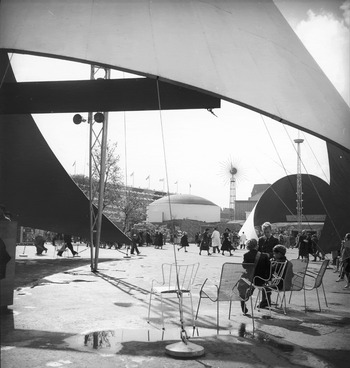
The apotheosis of this approach came in 1951 with the Festival of Britain—which was, in many ways, in fact the Festival of England.Footnote 139 (See fig. 3.) Here was “the largest display of the modern architectural idiom that the British public [had] seen.”Footnote 140 Here Englishness and modernism were synonymous.Footnote 141 The only sign of interwar conservatism or of interwar architecture was “Gremlin Grange”: a Mock Tudor house intended to illustrate “how many things may go wrong when scientific principles in building are ignored.”Footnote 142 As one of the organizers of the festival, the architect Sir Misha Black, later recalled, the festival “suddenly proved that Modern
The entrance to the Land of Britain at the Festival of Britain (1951). RIBA4151: Colin Westwood/RIBA Library Photographs Collection.

Architecture with a capital M was in fact acceptable.”Footnote 143 And it was acceptable in patriotic as well as purely modernist terms. As Black went on, the festival “vanquished, at least for the time being, those who claimed that modern architecture … was unacceptable to the tradition-conscious British.”Footnote 144 In many respects, of course, the architecture on show was far from new. It essentially reworked a number of themes that would have been familiar to the modernists for more than a decade.Footnote 145 Nor was it uniquely English, owing much, as it did, to the inspiration of the Stockholm Exhibition of 1930.Footnote 146 Both events, as Becky Conekin points out, were driven by a similar, Social Democratic “vision of an enlightened citizenry, enjoying better housing.”Footnote 147 It was for this reason, of course, that the festival was swiftly closed by the incoming Conservative government.Footnote 148
Nonetheless, the festival proved to be highly influential, and its attempts to make England modernist seemed to work.Footnote 149 Its first fruits could be seen in the Lansbury Estate, built to coincide with the festival and an attempt to reconcile the “housing traditions of the East End” with the most progressive architectural ideals.Footnote 150 Soon there were others—and these were still more advanced: new buildings at Heathrow, new towns throughout the country, at Stevenage and Peterlee, in the Royal Festival Hall; the festival style, which is to say a self-consciously English modernism, spread out across the country.Footnote 151 The festival style even influenced the ornaments at the Coronation in 1953.Footnote 152 This avowedly national variant of the International Style found its strongest expression in Coventry and its lasting monument in Coventry Cathedral.Footnote 153 This, as its architect asserted, was “a quiet design in the English tradition.”Footnote 154 As we have seen, not everyone agreed, but his apologia was now at least plausible—and it was undoubtedly accepted by many. Such was the confidence and rhetorical power of the postwar English modernists.
What, though, was postwar English modernism? What made it English? What made it modernist? Without a doubt, the avant-garde gambit played by its advocates shaped and reshaped the style. The idea was to create an architecture that was true both to the times and to the national character. This, as the modernists had argued, was to be evolutionary, not revolutionary—an authentic development, an expression of the English progressive spirit rather than a sharp break with the past.Footnote 155 So architects sought inspiration from the squares and terraces of eighteenth-century London, using them to legitimate modernist designs.Footnote 156 In the late 1930s, Ernö Goldfinger, for example, had argued that his Hampstead houses represented “an attempt to reintroduce … the conception of the terraced houses of the eighteenth and early nineteenth centuries modified by modern ways of living and new means of construction, equipment and materials.”Footnote 157 He was soon just one of many. So too, the picturesque tradition of planning was rediscovered and strongly promoted.Footnote 158 Informal, additive, attractive, and progressive, this, they argued, was “one of Britain's major contributions to European art.”Footnote 159 In a series of articles, the Architectural Review renamed it sharawaggi, after the Georgian approach to garden design.Footnote 160 It was, argued its advocates, a uniquely English approach, and it was one that Nikolaus Pevsner defended in the 1940s and strongly supported in his 1955 Reith Lectures.Footnote 161 “If English planners forget about the straight axes and the artificially symmetrical facades of the academy,” he argued, “and design functionally and Englishly they will succeed.”Footnote 162 Picturesque planning proved particularly popular: seen at the Festival of Britain, in innumerable housing estates, and in the slew of new universities founded in the 1950s and 1960s.Footnote 163 It was, claimed Pevsner, “far the greatest contribution England has made to aesthetic theory.”Footnote 164 Certainly, it was the biggest contribution that the English made to the international modern style.
For many modernists and particularly for the generation that dominated British architecture after 1957, this apparent concession to tradition represented a betrayal of the modernist ideal.Footnote 165 Subsequent writers have similarly seen the adoption of picturesque planning and indigenous architectural idioms as a retrograde step.Footnote 166 Just as art historians have criticized the modern artists’ turn to romanticism and overtly nationalist inspirations in this period, so commentators on architecture have suggested that the development of an explicitly English modernism marks yet another example of England's inability to absorb foreign influences or keep up with contemporary trends.Footnote 167 For Reyner Banham, the Festival of Britain represented a missed opportunity in which a “flimsy,” “effeminate,” and essentially outdated style was imposed on an unimpressed nation.Footnote 168 For Robert Hewison, the architecture of the Festival of Britain was a “lightweight framework for yet another exploration of ‘Deep England’”: that is, an exploration of backward-looking, backward-thinking, backward-building Britain.Footnote 169 In this view, the architecture of the postwar world was nothing more than another missed opportunity for England.Footnote 170
It must be acknowledged that, even at the time, many modernists had their doubts. The modern movement, wrote Richards in 1957, had not succeeded in transforming the English architectural scene completely.Footnote 171 In his mind, there was still too much shoddy, thoughtless, unmodern architecture being built.Footnote 172 Similarly, not all architects were seen as equally successful in developing an authentically English modernism. Powell and Moya's pioneering Churchill Gardens estate was, in John Summerson's words, not English modernism but rather “pure German housing.”Footnote 173 Many modernists were concerned about iconic buildings like Coventry Cathedral; while far from seeing the Coronation as a triumph of modernism, the Architectural Review saw it as a tremendous failure.Footnote 174 Even when praising the Lansbury Estate for its attempt to reconcile English customs with modern materials, critics also expressed their concern that the result was rather too traditional for its own good.Footnote 175
Yet to focus on these criticisms alone rather misses the point. The self-conscious cultivation of English idioms was the inevitable consequence of the avant-garde gambit that the modernists had played. Having invented an English way of building, it was unsurprising that they should seek to follow it. Nor was this an abandonment of principle or an adulteration of modernist ideals. For the Englishness of architecture was also a fundamental assumption that they all held in common. As we have seen, from the very first, the modernist project was predicated on the twin assumptions of zeitgeist and Kuntsgeographie.Footnote 176 Put simply, the modernists believed that an authentic architecture would be true both to time and to place. As early as 1934, A. D. Connell had argued, against Reginald Blomfield, that the International Style would inevitably develop an “essentially national inflection.”Footnote 177 In 1937, too, Anthony Bertram had prophesied that there “would be a nationalist variation of the European style, as there were English Gothic and Renaissance.”Footnote 178 In 1942, Ralph Tubbs had declared that “our own character, climate and materials will, as before, mould our architecture. The technique will be international, the architecture English.”Footnote 179 An authentically English modernism, then, was always envisaged by the English modernists.
Conclusion
The English modernists were not alone. In Sweden, the architecture of the 1940s closely paralleled the English rediscovery of the picturesque.Footnote 180 In the United States, modernism was used as a symbol of liberty and opportunity. Just as abstract expressionism in art became synonymous with the American way, so modernist architecture became an embodiment of the American dream.Footnote 181 There were even a
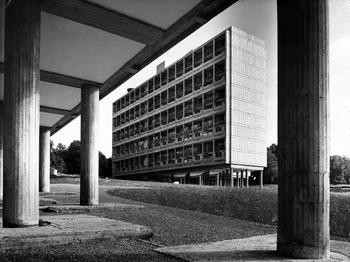
“Eminently English” (Nikolaus Pevsner, “Roehampton: LCC Housing and the Picturesque Tradition,” Architectural Review 126 [July 1959]: 35). The Alton West Estate, Roehampton (1959). RIBA28672: Architectural Press Archive/RIBA Library Photographs Collection.

variety of Zionist modernisms.Footnote 182 What distinguished these national variants from the English approach to modernism, however, was the attempt to claim an authentic English inheritance for this architecture and to argue that modernism was both true to the times and native to the place. By the late 1950s, the modernists had succeeded in creating an English pedigree for the International Style. They had naturalized modernism and narrated a new history of English architecture. This achievement shaped both the historiography of the period and its built environment. It allowed politicians and planners to sell their ideas as authentically English. Above all, it inspired a way of seeing, of experiencing, and of describing architecture, which would influence critics for decades to come. Thus, Reyner Banham could describe Park Hill, Sheffield, as authentically English, and Nikolaus Pevsner could celebrate the Alton Estate in Roehampton as “eminently English.”Footnote 183 For Banham, the street decks of Park Hill were part of an “English tradition” that ran back hundreds of years.Footnote 184 For Pevsner, the picturesque disposition of the Alton Estate similarly naturalized the architecture (fig. 4).
Both men were, of course, quite right. In the way they were described and in the way they were designed, these very different buildings showed how the discourse of modernism had been reshaped by the search for a truly English architecture. A genuinely cosmopolitan group of architects, critics, and commentators had created a new way of understanding modernism—and a new way of conceptualizing Englishness. This was a move that reshaped the study of architectural history, the practice of architectural conservation, and the debate about British buildings for the next generation. It was not always popular, and it was never unchallenged. But by 1957 it was arguably the dominant assumption for a group of highly influential people, for politicians and policy makers, as well as for architects and planners. English modernism and modern Englishness were thus no longer just the dream of a few able propagandists. Modernism now had its monuments, its histories, and its own particular rhetoric. England, it was clear, could now claim to possess a genuinely national International Style.