Introduction
Vitamin A can be taken in human diets in the form of provitamin A carotenoids such as α-carotene, β-cryptoxanthin or β-carotene. However, their non-availability or very low concentration in major staple foods such as maize has led to vitamin A deficiency (VAD) among many pre-school children and women of reproductive age in sub-Saharan Africa (Christian et al., Reference Christian, West, Khatry, Kimbrough-Pradhan, LeClerq, Katz, Shrestha, Dali and Sommer2000). VAD constitutes a major public health problem, and it has affected 100 million children (UNICEF, 2005), sometimes leading to night blindness, depressed immune system which increases susceptibility to childhood diseases such as measles and diarrhoea or death (Christian et al., Reference Christian, West, Khatry, Katz, Shrestha, Pradhan, LeClerq and Pokhrel1998, Reference Christian, West, Khatry, Kimbrough-Pradhan, LeClerq, Katz, Shrestha, Dali and Sommer2000; Sommer, Reference Sommer2008). About 6.2 million women are also affected by xerophthalmia (West, Reference West2002).
Food fortification and supplementation methods have been used to combat VAD. Biofortification can potentially be used to enhance β-carotene content in tropical maize through conventional breeding. Maize is one of the most important staple cereal crops in sub-Saharan Africa. It has been suggested that β-carotene content is a valuable quality trait that can be considered in plant breeding systems (Simpson, Reference Simpson1983). Breeding of high β-carotene maize lines (about 13–15 μg/g of provitamin A) can be achieved (Kurilich and Juvik, Reference Kurilich and Juvik1999; Harjes et al., Reference Harjes, Rocheford, Bai, Brutnell, Kandianis, Savinski, Stapleton, Vallabhaneni, Williams, Wurtzel, Yan and Buckler2008). Maize lines contain varying amounts of provitamin A carotenoids that can be used to improve adapted crops (Kurilich and Juvik, Reference Kurilich and Juvik1999).
Genetic diversity assessment among breeding lines reveals genetic relationship, which is an important tool in maize breeding system design and parental selection. It is also useful for the establishment of distinct heterotic groups, which will contribute to the development of new lines (Russell et al., Reference Russell, Fuller, Macaulay, Hatz, Jahoor, Powell and Waugh1997; Enoki et al., Reference Enoki, Sato and Koinuma2002; Xia et al., Reference Xia, Reif, Melchinger, Frisch, Hoisington, Beck, Pixley and Warburton2005). Molecular markers have been proven to be effective for the assessment of genetic diversity among maize inbred lines (Senior et al., Reference Senior, Murphy, Goodman and Stuber1998; Melchinger, Reference Melchinger, Coors and Pandey1999; Lu and Bernardo, Reference Lu and Bernardo2001; Xia et al., Reference Xia, Reif, Hoisington, Melchinger, Frisch and Warburton2004). They have been used for understanding detailed genetic relationships between maize inbred lines and assigning lines into heterotic groups (Messmer et al., Reference Messmer, Melchinger, Boppenmaier, Herrmann and Brunklaus-Jung1992; Smith et al., Reference Smith, Chin, Shu, Smith, Wall, Senior, Mitchell, Kresovich and Ziegle1997).
Simple sequence repeat (SSR) loci are co-dominant and have been shown to have high levels of polymorphisms (Smith et al., Reference Smith, Chin, Shu, Smith, Wall, Senior, Mitchell, Kresovich and Ziegle1997), and SSR-based groupings of lines have consistently reflected pedigree information (Pejic et al., Reference Pejic, Ajmone-Marsan, Morgante, Kovumplick, Castiglioni, Taramino and Motto1998; Senior et al., Reference Senior, Murphy, Goodman and Stuber1998). The assessment of genetic diversity in the first set of lines of 38 tropically adapted yellow endosperm maize inbred lines used in breeding programmes has been reported (Adeyemo et al., Reference Adeyemo, Menkir, Gedil and Omidiji2011). Broadening the genetic base of breeding material in the International Institute of Tropical Agriculture (IITA), new tropically adapted yellow endosperm maize lines were bred from crosses based on tropical genetic background and exotic maize germplasm.
The present study was carried out to evaluate the extent of genetic diversity among the newly developed inbred lines. The lines will be used for further improvement of provitamin A content in maize. The main objectives of this study were to assess the extent of genetic diversity among the selected yellow endosperm maize inbred lines using SSR markers and to assess corresponding marker-based groupings of the lines with carotenoid composition-based groupings.
Materials and methods
Plant materials
A set composed of 122 tropically adapted yellow endosperm maize inbred lines were selected for this study (Supplementary Table S1, available online). This set was composed of newly inbred lines (121) and included one line from a previous study (Adeyemo et al., Reference Adeyemo, Menkir, Gedil and Omidiji2011). This set represented a wide range of genetic backgrounds, derived from bi-parental crosses of adapted lines with high provitamin A content, and backcrosses containing temperate germplasm as sources of high provitamin A content were selected for genetic diversity assessment (Menkir et al., Reference Menkir, Liu, White, Maziya-Dixon and Rocheford2008). Lines were selected because they have shown favourable genes for adaptation such as resistance to diseases, lodging and temperature and superior agronomic performance useful for breeding programmes. They also possess characteristics such as good grain yield and stable performance and could be selected as breeding materials to improve tropical maize for an increased level of provitamin A. The provitamin A carotenoids in maize endosperm are β-carotene that contains two provitamin A structures, β-cryptoxanthin and α-carotene one each.
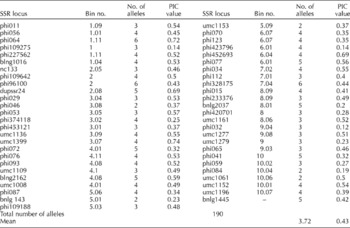
Bin numbers, allele numbers and polymorphic information content (PIC) values for simple sequence repeat (SSR) loci used in genotyping the 122 tropically adapted yellow endosperm maize inbred lines

SSR-based diversity assessment of yellow endosperm maize inbred lines
The inbred lines were grown in a nursery at Ibadan in single rows of 5 m long spaced 0.75 m apart with a 0.25 m spacing between plants within a row for 3 weeks. Fresh leaf tissues were harvested from six to eight plants from each inbred line and stored in Eppendorf tubes at − 80°C for bulk genomic DNA extraction. DNA extraction was based on the modified method of Dellaporta et al. (Reference Dellaporta, Wood and Hicks1983). The quality and quantity of DNA was determined using a NanoDrop spectrophotometer (NanoDrop Technologies, Wilmington, DE, USA). A total of 62 SSR maize primers were used for genotyping of the 122 inbred lines. The SSR markers were selected from the MAIZEGDB database (http://www.maizegdb.org) and of these, 52 core SSR primers were identified, as described previously by Warburton et al. (Reference Warburton, Xia, Crossa, Franco, Melchinger, Frisch, Bohn and Hoisington2002), based on bin locations in order to provide a uniform coverage of the genome. Primer names and chromosome loci (bin number) of the SSR loci evaluated are included in Table 1. PCR conditions using variable ‘touchdown’ PCR profiles and annealing temperatures were performed as described by Senior et al. (Reference Senior, Murphy, Goodman and Stuber1998). SSR alleles were resolved using superfine resolution agarose gels and scoring in a binary form of 1 or 0.
Carotenoid composition-based diversity assessment
Carotenoid composition, including trans-β-carotene and cis-β-carotene, zeaxanthin, total provitamin A, lutein, β-cryptoxanthin and α-carotene, were measured from seed samples of a large number of yellow inbred lines harvested from trials conducted in at least one location using HPLC, as described previously (Menkir et al., Reference Menkir, Liu, White, Maziya-Dixon and Rocheford2008) (Supplementary Table S2, available online). The carotenoid composition of these lines was used for the assessment of carotenoid diversity.
Data analysis
Polymorphic information content (PIC) values were calculated at each locus using the formula of Smith et al. (Reference Smith, Chin, Shu, Smith, Wall, Senior, Mitchell, Kresovich and Ziegle1997). PIC values give an estimate of the discriminatory power of a marker by taking into account not only the number of alleles at the locus but also the relative frequencies of these alleles. The allelic richness, total number of alleles in each SSR locus and the mean number of alleles were calculated to estimate the genetic variability among the 122 inbred lines. The genetic diversity between the pairs of the inbred lines i and j was computed based on the modified Roger's (Reference Rogers1972) distance for the SSR data. For the SSR data, genetic distances were computed with Winboot software. Of the polymorphic SSR markers, 18 (bnlg 143, dupssr24, phi056, phi064, phi077, phi109188, phi109642, phi123, phi227562, phi233376, phi328175, phi96100, umc1109, umc1136, umc1153, umc1161, umc1279 and umc1399) were annotated to the B73 RefGen_v1 genome. For the carotenoid data, Euclidean distance estimates among the inbreds were calculated. We first standardized all mean carotenoid values of the lines using SAS (1999) (version 8, Cary, NC, USA) before using them to calculate the Euclidean distance (Sneath and Sokal, Reference Sneath and Sokal1973). Genetic distance matrices generated from the SSR and carotenoid composition datasets were used for cluster analysis and principal coordinate analysis (PCA). The cophenetic correlation coefficient was calculated to test the correspondence between original distances and the distances defined in the dendrogram. The significance of cophenetic correlation was determined by the Mantel (Reference Mantel1967) test based on 1000 permutations. The unweighted pair group method with arithmetic mean (UPGMA) and PCA and Mantel's test were performed with version 2.01 of the NTSYS-pc package (Rohlf, Reference Rohlf1997; Exeter Software, Setauket, NY, USA). The relationships between the Euclidean distance matrix and the genetic distance matrices obtained using SSR markers were analysed using Mantel's test (Reference Mantel1967).
Results
Grouping of inbred lines using SSR markers
The SSR data were used to reveal the genetic diversity among the 122 tropical yellow endosperm maize inbred lines. In the 122 inbred lines, 190 alleles were detected with an average of 3.72 alleles per locus for the 51 polymorphic SSR. The range in the allele number was 2–6, with three markers showing the highest number of alleles (phi064, phi328175 and phi96100). The average PIC value was 0.43, ranging from 0.12 (phi032) to 0.74 (umc1399). Approximately 63% of these markers had more than 0.43 PIC values. The number of alleles detected among the 122 inbred lines using SSR markers and PIC values for polymorphic loci are presented in Table 1. The estimates of the MRD between all pairs of the inbred lines varied from 0.02 to 0.61, with an average of 0.41. The 122 inbred lines were grouped into three major groups (group I, group II and group III) based on the UPGMA cluster analysis of SSR-based genetic distance (GD) estimates (Supplementary Fig. S1, available online). Group I included the lines derived from 9450, KU1409 or pop66SR. Group II comprised the inbred lines derived from the backcrosses of two common recurrent parents (KU1409 and KU1414), and it represents the major group. Group II can be subdivided into five heterotic subgroups, each having any of eight exotic donor parents in their pedigree. The lines that have a similar exotic parent are found together in the same subgroup within group II. Group III consists of the lines derived essentially from two broad-based populations (SYN-Y-STR and pop66SR). The SSR-based clustering result is consistent with the pedigree data. The cophenetic correlation coefficient between the dendrogram constructed using the UPGMA and the calculated GD (r= 0.78) indicated that the clusters accurately represented the GD estimates. The principal component analysis of SSR-based GD estimates clearly separated the lines into three main groups, which is consistent with the cluster analysis.
Carotenoid composition-based assessment
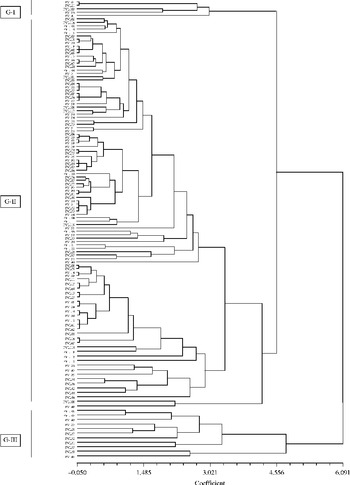
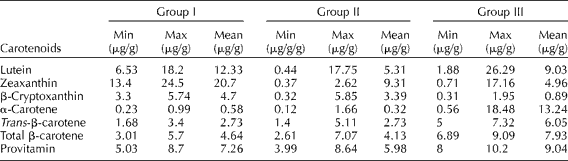
The Euclidean distances between the pairs of the inbred lines varied from 1.00 to 9.97 with an average of 3.81. The dendrogram was constructed from the Euclidean distance of the carotenoid composition-based data. The 122 lines were grouped into three main groups (Fig. 1). The first group consists of five inbred lines derived from four backcrosses containing four temperate lines as sources of high β-carotene. This group has high concentrations of all carotenoids, except for α-carotene. The second group is composed of 106 lines with diverse genetic backgrounds. Most of these lines share KU1414SR and KU1409 as recurrent parents. They have low concentrations of lutein and zeaxanthin. The third group has 11 inbred lines derived from two backcrosses containing DE3 and SC55 as donors of high β-carotene. This group has the highest concentrations of α-carotene, β-carotene and provitamin A, but has the lowest concentration of β-cryptoxanthin (Table 2). The lines found in groups I, II and III have a mean content of provitamin A (7.26, 5.98 and 9.04 μg/g), respectively, which is the average compared with the daily dietary intake of maize with about 13–15 μg/g of provitamin A carotenoids (Table 2).
Dendrogram of the 122 tropically adapted yellow maize inbred lines obtained using the carotenoid data. G-I, group I; G-II, group II; G-III, group III.

Minimum, maximum and mean carotenoid values for the 122 tropically adapted yellow endosperm maize inbred lines separated into three groups based on the carotenoid data

The cophenetic correlation coefficient was strong (r= 0.87), showing a positive representation between the dendrogram and the genetic distance matrix. Furthermore, the genetic relationship among the 122 yellow endosperm inbred lines was determined using the PCA of the carotenoid-based GD estimates that divided the inbred lines into three distinct groups, which are in concordance with the results of the cluster analysis.
Comparison of SSR-based groupings with carotenoid-based groupings of the 122 inbred lines
The cophenetic correlation of SSR-based groupings with carotenoid-based groupings was − 0.06. The grouping of the 122 inbred lines using the SSR-based data and carotenoid concentration-based data grouped the lines into three main groups each. The grouping among the inbred lines as revealed by the SSR-based data was very different from the grouping revealed by the carotenoid concentration-based data.
Discussion
In sub-Saharan Africa, the presently grown maize has a low level of provitamin A. Genetic diversity assessment of maize inbred lines with a broad genetic background and tropically adapted germplasm will provide opportunity for breeders to develop new maize lines with increased levels of provitamin A compounds in the provitamin A biofortification efforts. In this study, core SSR markers that were well distributed on the ten maize chromosomes were majorly used to assess the genetic relationships among 122 tropical maize inbred lines. In the 122 maize inbred lines, the average number of SSR alleles per locus (3.72) for the 51 polymorphic loci was comparable with the 3.96 alleles per locus for 75 polymorphic SSR loci in 38 tropically adapted yellow inbred lines (Adeyemo et al., Reference Adeyemo, Menkir, Gedil and Omidiji2011). The average number of alleles per locus (4.44) for 43 SSR primers in the sample of 15 Chinese maize inbreds reported by Xu et al. (Reference Xu, Liu and Liu2004) was higher than the present result. Lu and Bernardo (Reference Lu and Bernardo2001) found an average of 4.9 alleles per locus in 40 US maize inbreds across 83 markers. The close relatedness among the evaluated inbred lines may have accounted for this range of allelic variation in this study. Furthermore, differences in the average number of alleles reported for each study may be caused by the types of SSR makers used and varying genetic composition of the inbreds. The high allelic diversity of some SSR markers is due to the strand slippage during DNA synthesis and high mutational rates at SSR loci.
In the present study, the discriminatory power of the markers used to evaluate the genetic diversity was measured as PIC, showing an average value of 0.43. The PIC value revealed the existence of a substantial level of genetic variation among the 122 maize inbred lines. Information on the genetic diversity of tropically adapted maize lines using the 51 SSR markers will be quite useful for maize hybrid breeding programmes. This confirms that SSR variations are highly informative. Generally, the domestication process in maize germplasm has resulted in a reduction of genetic diversity (Doebley et al., Reference Doebley, Goodman and Stuber1984; Vigouroux et al., Reference Vigouroux, Mitchell, Matsuoka, Hamblin, Kresovich, Smith, Jaqueth, Smith and Doebley2005).
The grouping based on the SSR data in the cluster analysis and PCA was consistent and the inbred lines were clearly distinguished. The maize inbred lines were separated with respect to their common genetic origin as well as known pedigree information. This result supports SSR markers to be generally efficient in detecting the genetic diversity among closely related genotypes (Smith et al., Reference Smith, Chin, Shu, Smith, Wall, Senior, Mitchell, Kresovich and Ziegle1997; Senior et al., Reference Senior, Murphy, Goodman and Stuber1998). SSR markers are highly reproducible, reliable and have been promisingly consistent in the discrimination of maize inbred lines into groups based on pedigree data (Legesse et al., Reference Legesse, Myburg, Pixley and Botha2007).
The overall genetic diversity (0.41) among all the pairs of the tropical maize inbred lines using the 51 SSR markers revealed a substantial level of genetic diversity assessment for the present study. The level of genetic diversity found among the 122 tropical maize inbred lines provides important information for the development of maize lines with enhanced provitamin A content. The selection of two parental lines that are genetically distant between groups by maize breeders should facilitate hybrids with genetic gain in breeding efforts. Nutritionally, the 122 maize inbreds also vary considerably in carotenoid content. The maize inbred lines were separated into three groups based on the carotenoid data. Each of the carotenoid-based UPGMA dendrogram for groups I, II and III consisted of inbred lines with higher or lower concentrations for all carotenoids and lines belonging to diverse genetic backgrounds in each group.
The SSR-based markers separated the inbred lines into groups based on their common origin and parentage more efficiently than the carotenoid-based data. Lines with either high or low carotenoid concentrations were included in all groups based on SSR markers. Overall, the grouping results by SSR-based data revealed the genetic relationship among the inbred lines compared with the carotenoid-based data. In addition to the genetic results presented in this study, cultural acceptance of yellow maize in the sub-Saharan Africa needs to be promoted in the overall biofortification efforts so as to actualize the potential of provitamin A biofortified maize.
In conclusion, SSR markers have provided important information about the genetic diversity among the 122 tropical maize inbred lines, and the grouping of lines will facilitate the selection of parental lines for making crosses to develop new lines with enhanced provitamin A content.
Supplementary material
To view supplementary material for this article, please visit http://dx.doi.org/10.1017/S1479262113000294
Acknowledgements
IITA provided facilities for this research.