

Introduction
This article examines women's investment in urban property in nineteenth-century England. The notion that women invested their carefully squirrelled savings or fiercely protected inheritances in bricks and mortar has often been viewed as one of the key ways widowed and unmarried women – including of the lower middling sort – could make a financial investment that would be largely protected from the volatility of the marketplace whilst also providing a place to call home. Yet this article challenges that paradigm by uncovering the investment activities of women on the urban land market. It shows that some women did not just own town houses to live in or generate income from their lodgers, a gendered concept of genteel economic activity and one that was quintessentially domestic. Instead, the article interrogates quantitative and qualitative sources for men's and women's investment in the urban property market, examining gendered investment strategies and providing important new evidence for the scale of women's urban property ownership. Hannah Barker's Family and Business during the Industrial Revolution emphasizes the importance of local ownership as a financial strategy of small business owners and their families.Footnote 1 Here, we offer a revision of this idea by examining how women owned property in three towns with differing economies, opening up questions about the relationship – if any – between gender and local economic structures and suggesting a model of investment that was not just local and parochial in intent. We interrogate the sources to determine the composition of female-owned property portfolios, questioning first whether women tended to own retail, manufacturing or domestic spaces, and secondly whether the blurred definitions between home and work observed by Barker can be also been seen in the lives of these female property owners.Footnote 2
The story of women and their money has been explored in some depth in recent years, including important work on women's economic agency in eighteenth- and nineteenth-century urban Britain and on women's financial investments. Hannah Barker, Nicola Phillips, Alison C. Kay, Stana Nenadic and Jennifer Aston have collectively demonstrated that women owned and operated business enterprises in a wide range of trades and industries using the same advertising methods, business placements and trading practices as men.Footnote 3 Research on women's investment in the first banks and securities markets has also produced rich results on the topic of female agency.Footnote 4 Amy Froide has called female investors the ‘silent partners’ of the financial revolution and has shown that alongside men they bought gilts, stock and shares, in part because there were fewer employment opportunities open to women.Footnote 5 Investment in the newly emerging instruments of a changing economy was immediate and steady, not least because – as Froide points out – capitalism was gender blind.Footnote 6 While women were often more risk averse than men, the stalwart investments of property, railway stocks and government bonds did appeal to them, as Janette Rutterford, Josephine Maltby, David Green and Alistair Owens have demonstrated.Footnote 7
Women's investment behaviour can be traced back at least to Bess of Hardwick in the sixteenth century and her multiple properties. By the seventeenth century, women were moving their money in and out of mixed portfolios according to need, as accounts of Joyce Jeffreys and her land-and-lending portfolio, Hester Pinney and her business affairs, and Anne Clifford and her land expansions and improvements, have all shown. The application of these investment strategies to stocks and shares reveals continuity of practice and has been shown in the cases of Catherine Willoughby and Betty Hastings – both women were willing to extend their already mixed portfolios of investment in landed property to stock in ‘that nasty South Sea affair’ in the early eighteenth century.Footnote 8 In other words, they understood risk and knew that investment was not always about safe return. Wealth expansion over and above simply buying a home is what makes all of these female property owners stand out. Thus, the ‘gentlewomanly capitalism’ observed by Green and Owens in the nineteenth century was preceded by at least two centuries of women's management of urban businesses, rural small holdings, and landed estates.Footnote 9 Moreover, Rutterford, Green, Maltby and Owens also discovered that ‘investors consisted of an ever-growing proportion of women’ in the nineteenth century; something that they argue was linked to the Married Women's Property Acts and the expanding stock market.Footnote 10
In other words, the evidence for the long period between 1550 and 1850 overwhelmingly demonstrates that women thought it important to manage their own finances in order to survive.Footnote 11 This component of female experience sits alongside what is now known, from the work of Hannah Barker, Margaret Hunt and others, about the diversity of ways in which women made money or were consumers in eighteenth- and nineteenth-century urban society.Footnote 12 Alexandra Shepard's recent argument that when women spoke of their ‘creditworthiness’ in society they meant an economic reputation that spoke to their whole reputation is important. Shepard suggests that ‘we can learn as much about the early modern economy from women as we can about women from the early modern economy’.Footnote 13 The argument that gender and the historical process can only be explained together is one that this article seeks also to make in relation to the economy. Women did not just participate in shaping the fashions, politics and social concerns of society, they also played an integral role in shaping urban institutions such as Magdalen homes and the foundling hospitals, even as recipients of charity.Footnote 14
Women's urge to be expansionary in their business affairs should not surprise and has been under-explored in the historiography with the notable exception of research by Christine Wiskin, Hannah Barker and Karen Harvey.Footnote 15 That women not only protected money but wanted to make it grow arose from their training for financial management, which was an integral component of gender construction. Far from femininity precluding the role of financial manager, these skills were learnt through numeracy training from cheap manuals while girls higher up the social scale learnt from both parents and other kin how to manage the rentals of tenants, and conduct business with creditors, debtors, stewards and other partners in business.Footnote 16 Doing one's sums was a way of imagining numbers that got bigger and bigger. Whether doing actual labour or not, women's work in business was a way of making a living and, therefore, of making a difference in their families and communities, but the economy itself was also reflective of the difference that gender made.Footnote 17
The interaction between gender and the development of social and economic urban life has been challenged from several perspectives by contributors to The Routledge History Handbook of Gender and the Urban Experience, yet what we, arguably, still know the least about in relation to women and the urban economy is the way women in urban centres used the property market consciously to develop both specialized and diverse property portfolios.Footnote 18 This is perhaps surprising, given the burgeoning research on women's engagement with business and finance outlined above, and on women's legal position in relation to property of various sorts. This latter body of work has demonstrated the complexities of single, married and widowed women's engagement with property (including land, buildings, mortgages, credit and chattels), arguing that there were significant divergences between legal theory and everyday practice as it applied to women's property ownership and that despite the implications of coverture and primogeniture, women actually owned far more property than was once thought.Footnote 19 The passing of the Married Women's Property Acts of 1870 and 1882 had the potential to change radically the way that married women were able to engage in the property market and create a financial portfolio in their own name during marriage. Evidence suggests that female shopkeepers, for example, did start to adopt different investment strategies after the Married Women's Property Acts were passed, but change appears to have been gradual rather than dramatic.Footnote 20
Yet despite critically important work on women's relationship with diverse types of property, relatively little work has focused on quantifying women's landownership in either urban or rural settings. Medievalists and early modernists using rentals and leases to examine female landholding in small groups of manors or parishes have demonstrated that female tenants rarely made up more than 10 to 20 per cent of landholders. Meanwhile, Sylvia Seeliger suggests that women held up to one fifth of land in many Hampshire parishes in the period between the middle of the sixteenth and the middle of the nineteenth centuries.Footnote 21 Research on the hearth taxes of the 1670s by Beatrice Moring and Richard Wall demonstrates that between 7.5 and 14.7 per cent of hearths assessed were registered to women.Footnote 22 There is less data on landownership than landholding, however, although recent work by Briony McDonagh demonstrates that just over 10 per cent of land allotted in a sample of 150 parliamentary enclosure awards for 10 English counties was held by women.Footnote 23 This broadly concurs with Janet Casson's study of nineteenth-century railway companies books of reference which suggested that around 12 per cent of plots were owned by women, either alone or with others.Footnote 24 Crucially, however, neither McDonagh's nor Casson's studies focus specifically on urban property.
Female transactions of urban property in the mid-nineteenth century therefore fits into a much longer story of women's engagement in local economies and the shaping of agricultural and built landscapes. However, it is a less familiar part of the tale, especially women's concentration on property in urban centres as a financial opportunity to be exploited, and their conscious development both of specialized and diverse property portfolios consisting of residential and commercial properties. A focus on women in the towns therefore sheds further light on the importance of women's economic decision-making and investments, not least because ‘women formed the majority of urban populations’ and it was the towns that were the ‘chief omens and agents of change’ in nineteenth-century Britain.Footnote 25
Using the mid-nineteenth-century rate book returns of the three economically and socially diverse English towns of Beverley, Halifax and Scarborough, this article will argue that women owned a far greater proportion of urban property than has previously been assumed and acknowledged. Property, and the act of owning a property, is the physical representation of a complicated financial, political, social and emotional relationship, and something which – for women in particular – could mean the difference between economic security, (limited) enfranchisement and a safe space, and financial destitution and homelessness. What, therefore, was the extent and significance of women owning multiple urban properties? Of cultivating not just a place to call home, but a means to generate income, social status and a greater level of participation in urban economies?
Evidence presented below will show that women engaged in property ownership in very different ways than has been previously assumed, most notably that even those women who only owned one property frequently chose to rent it out, using it as an economic asset rather than as a means of securing domestic security. More importantly, however, we will argue that women in nineteenth-century English towns were able to engage in the property market in such a way that constitutes a deliberate economic strategy, one that had the ultimate aim of securing their financial future through the generation of rents and the increasing intrinsic value of the property and the land it sat on (providing the property was freehold). The arguments and evidence presented in this article form a very small part of the story of middling and elite women in the long nineteenth century. As well as shedding light on the economic agency and social implications of female property ownership, this article also aims to analyse and assess the usefulness of rate books as a source for understanding the physical structure of English towns in the long nineteenth century, arguing that they can provide invaluable quantitative data that serves to bridge any potential divide between urban and rural historiographies of property ownership in its broadest sense.
Sources and methodology
Rate books are a curious source. On one hand, they are referred to – along with trade directories, insurance company records, maps and photographs – in passing by a number of historians and geographers as a key way of identifying the individuals and properties that made up the nineteenth-century urban environment.Footnote 26 Conversely, however, aside from a brief flurry of interest in the 1960s and 1970s, presumably in response to contemporary urban renewal projects, there has actually been little academic attention paid to their usefulness as a historical source, particularly with regard to how they might be used to examine the gendered economic and social structure of towns and cities across Britain.
Rate books as a means of calculating and extracting money from property owners for the assistance of the poor and the maintenance of municipal and communal facilities existed as early as the fourteenth century, and compulsory payment of the adjudicated rates was enforced from 1601 under the Act for the Relief of the Poor.Footnote 27 However, in terms of the number of rate assessments that were undertaken, the survival rate of these volumes, and the information contained within them, rate books dating from the early nineteenth century onwards represent the most complete bank of data. This completeness, however, should not be overstated. Although the Parochial Assessment Act of 1836 stated that the name of the owner and the occupier of each property should be recorded, this was not always carried out and, as will be explored shortly, the lack of uniformity between rate books compiled in different towns means – as R.S. Holmes has pointed out – that a comprehensive data set of historic property valuations along with their owners and occupiers remains a pipe dream.Footnote 28
Yet, as Martin Daunton observed in 1976, careful analysis of rate books offers more certain statistics concerning the nature of the nineteenth-century housing market and also the social categories of people who owned and occupied the properties.Footnote 29 Holmes argued that rate books show that 80 per cent of properties in Ramsgate, Kent, were leased, and more than half of these leased properties were owned by landlords who held five properties or less.Footnote 30 This is a useful reminder that in the period prior to the later twentieth century, most people did not own their own homes.Footnote 31 Holmes suggested that it is unlikely that the majority of these landlords relied on their property investments as a primary source of income. However, he said little about gender and we would argue that for women, while their property investments were frequently part of a wider portfolio, their leased properties did represent a primary income stream.Footnote 32
The mid-nineteenth-century rate books from the towns of Beverley, Halifax and Scarborough were chosen to represent, so far as possible, the three potentially diverse economic structures and heritages of market, industrial and seaside townships. All three lay in Yorkshire – one in the East, one in the West and one in the North Riding – but their landscapes and economies were markedly different. Situated on the River Hull, Beverley was a market town serving both the southern Yorkshire Wolds and the lower lying townships of the Hull Valley. It had a municipal population of 8,915 at the time of the 1851 census, which had grown steadily but not dramatically throughout the first half of the nineteenth century. The arrival of the railway in 1846 brought greater connectivity for industry but in 1848 – the year of the rate book used here – it was still primarily a market town serving an agricultural hinterland. It was by then no longer just the home of genteel spinsters, country gentry and professional men, having also many tanners, blacksmiths, wheelwrights and machine workers as well as the usual mix of brewers, dressmakers, milliners and confectioners: but the town had not yet witnessed the greater social and economic changes that were to follow as industry arrived in the period after 1850.Footnote 33
The other two towns studied here witnessed rather more dramatic changes in population and economy over the course of the early nineteenth century. The largest of our three urban centres, Halifax, was first and foremost a mill town; its economic development intrinsically linked to the canal development of the River Calder. Wool had dominated local trade since at least the fifteenth century, but hand-loom weaving in this corner of the south-eastern Pennines was replaced by the water-powered mills spinning worsted and cotton after the opening of the first canal link under an Act of 1810.Footnote 34 By 1832, Halifax had become the administrative centre of Calderdale and by 1850 there were 24 mills along the Calder including the huge mill complex at Dean Clough, just north of the town centre. The town's population which had stood at c. 6,000 in 1750 grew by 50 per cent by 1800, but by 1851 Halifax had a population of 33,582 including a growing middle class who built new mansions that rubbed shoulders uncomfortably with back-to-back slums. Its rapidly growing population profile was continued right up until 1901.Footnote 35
Scarborough had a very different economy again. The town's medieval fair had gradually lost prominence in the post-Reformation period, but the discovery of a fresh water spring by Thomasin Farrer (d. 1655) helped underpin the town's economic recovery. The castle – reduced to a romantic semi-ruin during a siege of the Civil War – and a new pier built in 1732 attracted visitors and helped establish the town as a fashionable spa and England's first seaside resort.Footnote 36 Fishing was also a key element of the town's economic activity, as later were other maritime industries including ship building. The arrival of the railway to the town in 1845 underpinned a boom in the trawling industry and further boosted visitor numbers.Footnote 37 By 1851, the municipal population stood at 12,915 with a major occupational focus on the provision of food and lodgings for the town's many visitors. There were also lots of drapers, tailors and dressmakers, as well as fishermen, seamen, farmers, agricultural labourers and professionals, and by 1881 a huge number of bricklayers, carpenters and glaziers presumably employed to build the new houses by then going up in ribbons of new property development north and west of Scarborough spa.Footnote 38
Taken together, Beverley, Halifax and Scarborough offer the opportunity for the examination of female property ownership across three towns with very different economic structures. The economic characters of the three towns shaped occupational structures and the workforce, in turn, determined the extent and composition of female property ownership, a key theme we interrogate further in this article. The decision concerning the particular towns selected was also in part dictated by the availability of the rate books, as despite pleas by historians and archivists in the early 1970s, many rate book collections – including those for important locations such as Leeds – were either wilfully destroyed due to a lack of space, or accidently ruined through unsuitable storage.Footnote 39
The three rate books are rather different in appearance and layout. Beverley only contains the name of the owner, the street location of the property, a brief description of the type of property, for example, ‘house’ or ‘stable’, the valuation of the property and finally the rates payable. Halifax in stark contrast contains the name of the owner, the name of the tenant and any sub-tenant, the street address, a description of the property and then a detailed breakdown of the number of storeys in the property and dimensions of each, followed by financial breakdowns of the estimated annual rentals and finally the rateable values. Scarborough lies somewhere in the middle of the two, with the name of owner and occupier given, the address, a description of the property and then financial information on the annual value of the property and its rateable value.
Each township carried out rate assessments for their own purposes as and when they saw fit, meaning that the purpose and year of the rate books that have survived cover a wide time period and give a valuable insight into the issues that concerned the municipal governments. In Beverley, the rate book was compiled by elected assessor John Foxall on 25 September 1848 for the purpose of assessing the ‘act of lighting, watching and regulating the streets, lanes and public passages’ in the town.Footnote 40 Meanwhile, the Halifax rate book was carried out by George Crosland, a valuer from Sheffield on 1 October 1851 for the rather vague purpose of ‘parochial assessments’ in the township.Footnote 41 Finally, the townspeople of Scarborough were visited by three overseers and one church warden on 16 June 1848 as ‘an assessment for the relief of the Poor, of the Township of Scarborough’.Footnote 42
There were also differences in the ways that the various enumerators recorded the information, for instance in Halifax a property with a ‘House, Garden, Stable’ had each of these components listed separately, whereas the assessors in Beverley and Scarborough tended to record them as a single line of data. We suggest that one reason for this is the density of population in Halifax; properties were frequently split into individual rooms or areas which were let to different tenants, meaning that the enumerator had to rate each room separately. Each of the rate books examined here occasionally includes comments about the nature or condition of the properties, tenants or owners, but these are not frequent enough to allow further analysis. The books do not record age or marital status of property owners, though this can sometimes be reconstructed from other records, including the census. The information gathered by the enumerator varied from book to book depending on the purpose of the tax that they were collecting and, as with census returns, they only show a snapshot in time. Despite their differences, rate books afford researchers the opportunity to examine the physical structure of urban centres from a unique perspective; that of ownership.
The data for all property owners, male and female, was transcribed and then the Halifax data on ‘property type’ aggregated so that it matched that of Beverley and Scarborough. This produced almost 12,900 lines of data. The data from all three towns was then coded according to the owner's gender (Female/Male/Unknown) and according to the ‘type’ of property that was owned (Domestic/Commercial/Manufacturing/Land/Mixed).Footnote 43 These categories were devised after examination of the data from the three towns showed that the properties within the sample townships – and specifically those owned by women – were by no means limited to domestic dwellings. Rather, the properties identified included a variety of industries employing both cottage and factory production methods, as well as commercial enterprises and pockets of land that were variously laid out for development and used for arable and grazing livestock. This basic level coding enabled us to analyse the data from Beverley, Halifax and Scarborough in order to determine female property ownership in the context of the entire town – and thus compare it with male property ownership – revealing for the first time the role that gender played in the structure of property ownership in three diverse towns.
Women and urban property
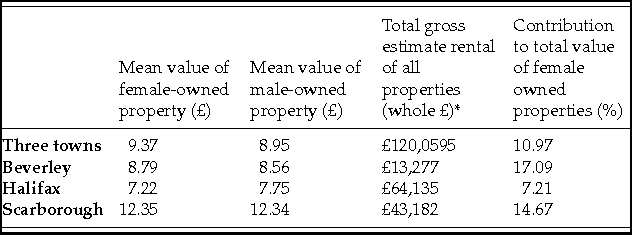
Analysis of female urban property holding allows us to contribute to the growing literature on women in the urban landscape. The data from the rate books demonstrates that 11 per cent of properties across the three towns were owned by women. The range of female property ownership across the three towns was between 7.9 and 17.8 per cent of all properties (see Table 1.1). Thus, while men owned more than four-fifths of urban properties in all three towns, women made up a significant minority of urban property owners. This was most clearly the case in Beverley and Scarborough where more than 15 per cent of individually enumerated urban properties were female-owned. This is broadly comparable both with the findings of the small number of studies examining the ownership of rural property in the same periodFootnote 44 and with evidence of other female economic activity such as urban business ownership.Footnote 45
Property ownership by gender in Beverley, Halifax and Scarborough

Sources: East Riding Archive, BC/IV/10/5, Rate Assessment Book 1848; Township of Halifax Valuation 1852, West Riding Archive Service, OR80; An Assessment for the Relief of the Poor in the Township of Scarborough 1848, North Riding County Record Office, DC/SCB.
Not only did women make up a significant minority of urban property owners, but the rates on their properties made a significant contribution to urban finances. In the case of Scarborough, the only one of the three towns for which this information was explicitly recorded, women's contributions to the tax – in this case, for poor relief – accounted for 16 per cent of the total due. Much the same was almost certainly true in the other towns, though the enumerators here did not record the totals owed or collected. It is also notable that the mean values of women's and men's property were closely aligned in all three towns (see Table 1.2). Thus, even whilst female property owners were less numerous overall than male property owners, individual property-owning women did not hold smaller or less valuable properties than their male peers. As a result, the contribution to total property value made by female-owned properties was broadly in line with the proportion of property owned by women in each of the three towns (see Tables 1.1 and 1.2).
Rateable value of property by gender

*Gross estimated rental was not given in the Beverley rate books. Total value is used here instead.
Sources: East Riding Archive, BC/IV/10/5, Rate Assessment Book 1848; Township of Halifax Valuation 1852, West Riding Archive Service, OR80; An Assessment for the Relief of the Poor in the Township of Scarborough 1848, North Riding County Record Office, DC/SCB.
At the same time, the data presented in Tables 1.1 and 1.2 also suggests that the opportunities for women to own urban property varied across different urban environments. The data from Beverley and Scarborough demonstrates that women occupied a much more significant position as property owners outside of industrial urban centres. The late eighteenth and early nineteenth centuries undoubtedly saw the development of industrial, factory-based production methods, but as Maxine Berg, Hannah Barker and others under the editorship of Andrew Popp and John F. Wilson have so skilfully argued, industrialization was experienced by individual men, women and businesses in very different ways depending upon their geographic location.Footnote 46 Our data contributes to this debate and helps to break down the popularized notion of urban Britain as smoky, grimy and factory-based by 1850, at the same time as revealing the full extent of the role that women played in the urban property market.
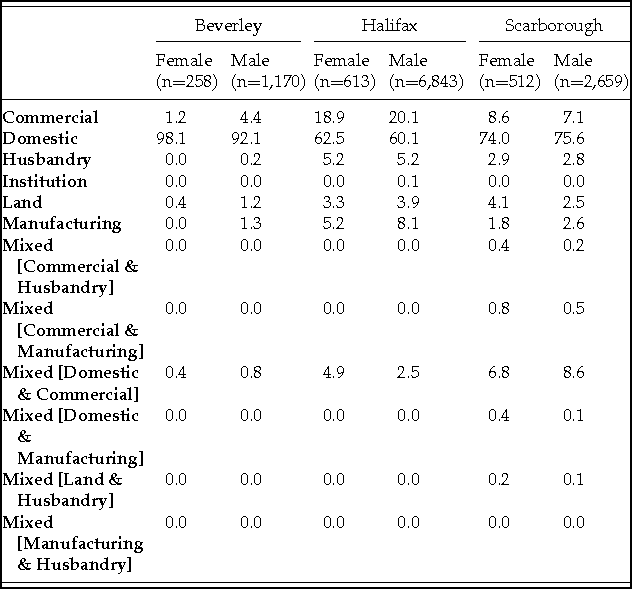
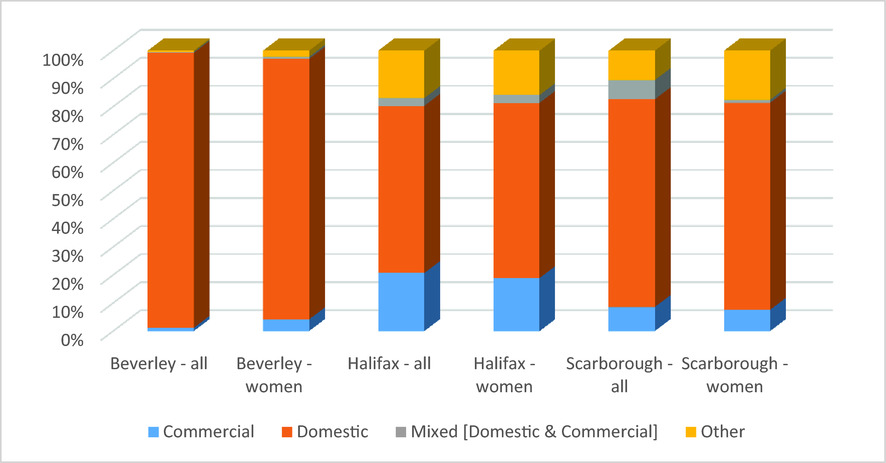
Examining the different types of properties that men and women owned supports this argument. Table 2 shows that regardless of the economic structure of the town where they lived, the vast majority of property owned by both men and women can be classified as ‘domestic’. The effects of the local economy on the types of property owned by both women and men can also be seen clearly in analysis of the Mixed [Domestic & Commercial] category in Figure 1. In Beverley, for instance, a small rural market town with a focus on small-scale manufacturing and minimal pressure or restriction on the construction of new building, very few properties were both residences and places of business, although the broad level of description in the Beverley rate book may have simplified the true complexity of property usage. In contrast, an average of 8.2 per cent of all rated property in Scarborough was coded as ‘Mixed [Domestic & Commercial]’ with a significant proportion of these being various inns, hotels and hostelries that reflect the town's status as a spa and holiday town. In both Beverley and Scarborough, a greater proportion of men than women owned property classified as ‘Mixed [Domestic & Commercial]’. However, this position was reversed in Halifax where a greater percentage of properties classified in this way were owned by women than men.
Percentage of properties owned by gender and property type

Sources: East Riding Archive, BC/IV/10/5, Rate Assessment Book 1848; Township of Halifax Valuation 1852, West Riding Archive Service, OR80; An Assessment for the Relief of the Poor in the Township of Scarborough 1848, North Riding County Record Office, DC/SCB.
Percentage of properties in Beverley, Halifax and Scarborough categorized as Commercial, Domestic or Mixed [Domestic & Commercial]

The extent to which domestic and commercial properties dominated the physical landscape of each of these three towns can be seen very clearly in Figure 1. Strikingly, so too can the way that the property ownership patterns of women mirrored the overall structure of ownership in the individual towns. Thus, while female property owners were undoubtedly under-represented when we consider that women constituted at least 50 per cent of the adult general population, those women who did own property did so (in the main) according to the economic structure of their town, not simply according to their gender. This point is developed further in the next section in relation to women's ownership of multiple properties across the three towns.
Urban property portfolios
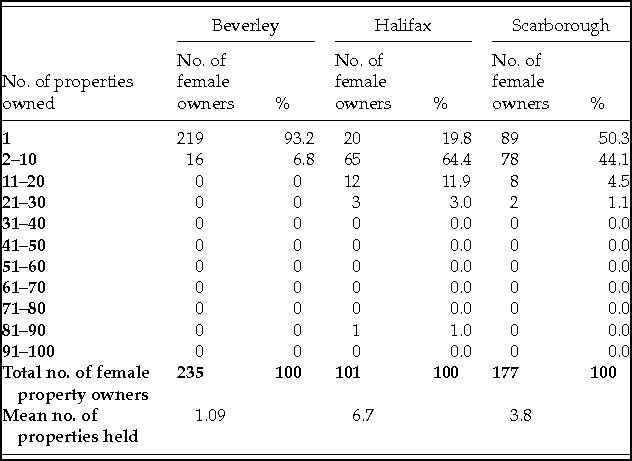
Table 3 shows the number of female property owners in the three towns along with the number of properties they held. This again reveals significant differences between the three towns, indicating once more that local economic structures and opportunities shaped female property ownership. While there were far fewer female property owners in Halifax than in the other two towns, those women who did own property in the town tended to own two or more properties. Thus, while 93.2 per cent of Beverley's female property owners held only one property, just 19.8 per cent of Halifax's were in the same position. In Beverley, female property owners holding two or more properties were not numerous, though there were more than 80 in each of Halifax and Scarborough accounting for 80.3 and 49.7 per cent of female property owners, respectively. The most common number of properties for the female multiple property owners of Halifax to own was 3 and the mean number owned 6.7. All the women (barring the exceptional Ann Walker whose story will be explored further below) owned fewer than 30 properties, with most owning under 20. Much the same was true in Scarborough, indicating that access to capital may have limited the size of property portfolios for many middling men and women. The rate books do not give information of sources of wealth, but studies exploring access to capital amongst upper-class women suggest that this was mostly achieved via either inheritance or provision for widowhood, and that cash sums might then be ploughed back into land or buildings, often in addition to government securities, stocks and other financial instruments.Footnote 47 At the same time, research has shown that the majority of female business owners in nineteenth-century Birmingham and Leeds inherited their firms, although some did establish themselves in trade or buy an ongoing concern.Footnote 48 The detailed case-studies below suggest much the same was true in relation to middle-class urban property owners.
Number of women owning one or more properties in the three towns

Sources: East Riding Archive, BC/IV/10/5, Rate Assessment Book 1848; Township of Halifax Valuation 1852, West Riding Archive Service, OR80; An Assessment for the Relief of the Poor in the Township of Scarborough 1848, North Riding County Record Office, DC/SCB.
These were women who held what we might recognize as property portfolios, the income from which provided them with security as well as opportunities to improve the economic and social status of themselves and their children. The figures given in the charts and tables in the article thus far do not distinguish between owner-occupied and tenanted properties, but the existence of so many multiple property owners makes it clear that not all female-owned (or indeed male-owned) property was owner-occupied. Instead, much of it was almost certainly rented out. A more detailed examination of the Halifax and Scarborough data allows us to demonstrate this more clearly, although the data from the Beverley rate book unfortunately does not allow us to distinguish between tenanted and owner-occupied properties.
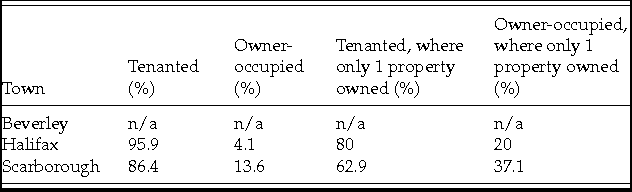
Data contained within Table 4 reveals that only a small percentage of female property owners in both Halifax and Scarborough were actually living in the properties that they owned. In fact, in Halifax more than 95 per cent of female-owned properties were tenanted by others. While one might expect that women owning only one property would have been owner-occupiers seeking domestic security for themselves and their families, the majority of women in both Halifax and Scarborough were not resident in their properties, choosing instead to rent them to others. This means that although a woman who owned one rental property was undoubtedly operating on a smaller scale than her counterparts who had more, she was still making decisions over locations of investment and management of tenants, rents and property maintenance.
Percentages of female-owned properties that were tenanted or owner-occupied

Sources: East Riding Archive, BC/IV/10/5, Rate Assessment Book 1848; Township of Halifax Valuation 1852, West Riding Archive Service, OR80; An Assessment for the Relief of the Poor in the Township of Scarborough 1848, North Riding County Record Office, DC/SCB.
Table 4 provides clear evidence of the existence of female-owned property portfolios. Looking carefully through the rate books for the three towns reveals hundreds of women using property ownership as part of a complex strategy to generate financial income for themselves and their families. Yet the quantitative data tells us only so much, and in the final section of the article, we turn to a series of case-studies in order to illustrate the different ways that women from across the social spectrum developed and utilized property portfolios. The women featured here were chosen in part because of their visibility in the existing sources. In this sense, they were exceptional. Yet, they are carefully selected to represent propertied women from across the lower middle, middle and upper classes, and taken together their life stories offer a window into the experiences of the less easily recoverable individuals represented in the quantitative data sets. In what follows, we examine how property ownership fitted within women's wider life stories, using probate records, census returns and other sources to ask questions about how women came to own multiple urban properties, where they were living if not in the property or properties they owned, and how property ownership might offer opportunities not just for income generation but as a means to generate social capital, provide the resources for multi-generational inheritance planning and on occasion, facilitate geographical mobility.
Property, inheritance and family
As has been demonstrated elsewhere, women could acquire property in a number of different ways, including as an inheritance, as provision for widowhood or via purchase.Footnote 49 Examination of these property owners suggests that in some cases it is likely that the property was the result of an inheritance. For example, married woman Ellen Roberts let a house at 15 St Thomas Street, Scarborough, to a Mr McConnell for £6 6s 0d per year, whilst living with her husband Stephen Roberts, a joiner, at 4 North Terrace in Scarborough.Footnote 50 Interestingly, Stephen does not appear in the rate book as a property owner himself, only as the tenant of 4 North Terrace in the 1851 census. It is important to note that this occurred more than three decades before the Married Women's Property Act of 1882 would legally recognize Ellen's property and, most importantly, the income as being hers and hers alone, separate from the interference of her husband. It is possible that 15 St Thomas Street was bequeathed to Ellen in a trust which named her as sole owner, but she still made the choice to record herself as ‘Ellen Roberts’ rather than ‘Mrs Roberts’ or even ‘Mrs Stephen Roberts’, both of which were styles followed by other women registering their properties in the rate books. Ellen and Stephen were married until his death in 1883 and although the marriage was childless, the 1881 census shows that they had a nine-year-old boarder called Betsy Pearson living with them.Footnote 51 Ellen died on 8 July 1894 and left a relatively modest personal estate worth £95 1s 0d, suggesting that her activities as a property owner and landlord remained limited but afforded her a reasonable standard of living.Footnote 52
Family, be it by marriage or blood, was central to those women who rented their properties to others, with many living in multi-generational households both as guests and as heads of household. Although the case of Ellen Roberts shows that married women were able to hold and manage property under their own name, the vast majority of women who appear in the pages of the three rate books were widowed. In some cases, the link between property ownership and lifecycle stage can be seen very clearly. Ann Porritt was born in Seamer, Yorkshire, in 1777. She later married George Porritt and the couple went on to have seven children. George worked as a chemist and druggist from the couple's home at 64 Newborough Street, Scarborough, until his death in 1850. After this, his business was taken over by his and Ann's eldest son (also called George) who had assumed his father's position as head of the household at 64 Newborough Street by the time of the census return of 1851.Footnote 53 Ann's occupation in the 1851 census is listed as ‘Proprietor of Houses’; an occupation that she did not hold in the 1841 census and, importantly, was not ascribed to her husband. Despite this, the 1848 rate book shows that Ann was the registered owner of two warehouses, three houses, a house, shop, warehouse and yard, and six tenements; a portfolio that generated an annual rental income of approximately £90 (equivalent today to nearly £100,000). One of these properties – the house, shop, warehouse and yard – was 64 Newborough Street, the location of her husband's (and later, her son's) business for over two decades, which the rate book shows was owned by Ann and rented by George. Although it is impossible to tell whether Ann was genuinely charging her husband and then son the £58 10s 0d rental that the enumerators thought the premises was worth, the fact that she had established her position as a property owner in her own right before the death of her husband is important as it demonstrates the active construction of a secondary and independent income stream to the family business, which provided Ann with economic security.
Although Ann Porritt owned a comparatively large number of properties, it has still been difficult to discover much information about her life and actions; as with so many ‘ordinary’ men and women, she has left only the faintest of footprints in the archives. There were women in the three rate books, however, who are better described as belonging to the upper or elite classes and as such it has been possible to uncover much more about their acquisitions, motivations and the strategies they employed. Ann Walker was born on 28 May 1803 to a provincial landed family in Halifax, West Yorkshire. Contemporary accounts describe her as having a shy and retiring personality, and she suffered from frequent and severe bouts of depression throughout her life. She never legally married, had no children, and her story might well have been lost to history were it not for the fact that between 1832 and 1840 Walker was the partner of Anne Lister.
The life of Anne Lister and her lesbian relationship with Ann Walker has been the subject of much popular interest as well as several academic works. Anne Lister's biographer Jill Liddington points to Lister having a varied portfolio of investments including the income from the farms and cottages on the estate, shares in canals and railways, collieries, as well as properties in the town of Halifax.Footnote 54 Less is known about her partner Ann Walker's property but the analysis of the 1851 Halifax rate book reveals that Walker owned 89 properties in Halifax town in her own right (with others recorded as being under the control of Anne Lister's executors). These properties are varied in type, although were predominantly commercial and domestic, and would have brought in an annual rental income of approximately £500 (equating to somewhere in the region of £500,000 today). Ann Walker owned the highest number of properties of any man or woman in any of the three rate books examined here, and her portfolio was also unusual in that a number of these are classified as ‘Manufacturing’ and ‘Husbandry’. This is in contrast to the majority of the other female property owners of Halifax and Scarborough who primarily owned domestic and commercial properties (see Table 5).
Uses of female-owned properties that were tenanted out (%)

Sources: Township of Halifax Valuation 1852, West Riding Archive Service, OR80; An Assessment for the Relief of the Poor in the Township of Scarborough 1848, North Riding County Record Office, DC/SCB.
Ann Walker's property investments in Halifax town were only a small part of a much wider investment portfolio that she had inherited and cultivated. She and Anne Lister both made wills that gave the other a lifetime interest in their estates so when Anne Lister died in West Georgia in 1840, Ann ostensibly took control of their home of Shibden Hall and its estates, although the extent to which she was able to enjoy this was perhaps limited by further episodes of depression and treatment as an inpatient at a York asylum. She died (possibly of tuberculosis) in 1854. Her will shows that she bequeathed her church pew to John Lister (Anne Lister's nephew) but her freehold properties were bequeathed to the woman who was to all intents and purposes her sister-in-law, Marian Lister, and there were other bequests that went to her own nieces.Footnote 55 Frustratingly, however, her property portfolio is not itemized within the will so it is not possible to compare her property portfolio at death with her Halifax holdings in 1848.
Although Ann Walker's property portfolio was larger and more diverse than many of the other women in the rate books, she was not unique in using her investments to provide for a family member. Mary Aked is recorded in the 1851 Halifax rate book as the owner of 20 predominantly domestic properties in Aked's Yard and St James Road. Mary was born in Halifax in 1774, her maiden name was Lister although there is no direct link between her and the more famous Anne. She married Christopher Ibbotson Aked on 20 October 1792 in York and the couple appear to have had up to eight children, of whom three – Robert (b. 1794), Lucy (b. 1811) and Susan (b. 1816) – remained unmarried and living at home.
Christopher was a card maker, a trade that was central to the textile trades of Halifax, and worked from Cabbage Lane, which was not one of the properties later shown to be owned or occupied by Mary. The majority of the properties owned were located in Aked's Yard: the name suggesting that Mary's ownership of the properties was simply one stage in a much longer pattern of ownership that spanned multiple generations. Significantly, Christopher died in December 1829 when their son Robert was already 35 years old. Yet Robert did not acquire the Aked property portfolio; it was instead held by Mary who retained control of it for the 23 years until her death in 1852. Unfortunately, Mary did not leave a last will and testament – or no copy of it has survived – but the probate records of her three unmarried children strongly indicate that the portfolio was used to provide an income first for Mary – who was described in the 1841 census as ‘Independent’ and the 1851 census as ‘Proprietor of Houses’ – then her children. Robert, Lucy and Susan continued to live together at St James Road, Halifax, until their respective deaths, indicating that their mother Mary had most likely made some provision for them to be able to remain in their home together after her decease.
Susan Aked died in 1865 and her personal estate of £800 gross was presented to the probate court for Letters of Administration by her brother Robert because she had not left a will.Footnote 56 Robert himself died in 1888 – aged an impressive 94 – and although he did leave a last will and testament in which he left all of his personal and real estate to sister Lucy, who was also his sole executrix, his personal estate was only valued at £196 gross.Footnote 57 This seems low for a retired surgeon but especially so when one considers that his younger sister had left £800 two decades earlier. Significantly though, when Lucy died in 1891 she left a personal estate worth £26,503 10s 10d gross (the equivalent of several million pounds today), which was to be converted into trusts and divided equally between a large number of her nieces and nephews.Footnote 58 The large number of properties held by Mary Aked, together with the relatively low estate valuations of Susan and Robert and very high value of Lucy's estate, indicates that we are seeing an accumulation of income and wealth which can be attributed (in part at least) to the trusts derived from Mary's property portfolio, but which was only free to be disposed of upon the death of the last unmarried sibling. Although this might appear at first glance to support the idea of women having little to no control over their financial destiny, it is important to note that Robert was also held to these conditions, that it was entirely possible for the trustee to take an active role in managing the portfolio, even if they could not dispose of it, and moreover any income derived from it was theirs and theirs alone.Footnote 59 By tying the portfolio into a trust, the Aked family created an economic base and secure separate stream of income for future generations.
As far as we know, Mary Aked's property portfolio was geographically limited to Halifax town itself. However, there were other female property owners who appeared in the pages of the rate books and who owned property in both rural and urban areas at different times. One such woman was the widow Jane Walker of Beverley who was the daughter of John Porter, an important merchant, and his wife Jane who was a member of the influential and wealthy Blaydes family of Hull. Although the Porter family initially lived in the centre of Hull, they moved to a peaceful country estate of around 14 acres in nearby Swanland, and after the deaths of John Porter Snr and John Porter Jnr in 1793 and Jane Porter in 1812, it was Jane Walker and her husband James who inherited the Swanland estate. Jane and her husband sold Swanland Hall in 1818, moving to James Walker's home town of Beverley. James died in 1829 and the Beverley rate book of 1848 shows that Jane Walker owned two houses – one of which was Beverley Hall, a property with the highest rateable value in the town – stables and a portion of land at Minster Moorgate. Town directories show that Jane resided in Beverley Hall, but the house and stable at Toll Gavel and the land at Minster Moorgate were tenanted out. She was a well-known wealthy resident, dying at the age of 93 in 1854 and being buried in the nave of Beverley Minster.Footnote 60
Jane Walker moved from rural to urban ownership but Mary Cockcroft of Scarborough used her urban property speculation to fund a move from town to country, and also between social classes. Mary Cockcroft (née Henderson) was born in Scarborough in 1799. She did not marry her husband Doctor John Cockcroft until she was 41 years old and, possibly as a result of this, the couple remained childless. John died intestate in 1844 after only four years of marriage, and cross-referencing the 1848 Scarborough rate book with the 1851 census shows that Mary lived alone with three servants in one of the 14 properties she owned in Scarborough. Her properties were all located in the very desirable Cliff area of the town and consisted of 13 houses with appurtenances, plus a parcel of land that seems to have been laid out ready for development. The rental value of these properties was more than £830 per annum, and in 1865 Mary mortgaged these properties to fund the purchase of the Oswaldkirk estate in North Yorkshire, which was approximately 683 acres and included the village of Oswaldkirk as well as surrounding forest and farmland.Footnote 61 Mary died in 1866, just a year after she bought the property. Her last will and testament provides insight into a remarkable level of posthumous financial planning and long-term, multi-generational control over her descendants most commonly associated with the landed gentry and aristocracy.
As mentioned above, the marriage of Mary and John Cockcroft did not produce any children and therefore the vast majority of Mary's beneficiaries are, unsurprisingly, the families of her nieces and nephews. The first version of Mary's last will and testament bequeathed all her domestic articles, including furniture, books, pictures, prints, carriages and horses, plate, linen and wine, to her great-nephew Robert Henry Page and all her wearing apparel, including clothes, jewel and trinkets, to her great-niece Helena Ingall. There were also a large number of cash bequests ranging from £100 to her loyal servant and the children of close friends, to £1,000 to be shared between the children of a deceased niece. All of the bequests made to women were given ‘on her own receipt’ meaning that the trustees and executors had no control over what the money was spent on. Interestingly, none of these relatives were from Mary Cockcroft's husband's family: they were all related to Mary through her brothers and sisters.
The most significant and complex bequest contained within the last will and testament dealt with Mary's real estate, namely the Oswaldkirk estate and properties in Scarborough. The first instruction given by Mary to her executors was that they should sell all her Scarborough real estate (with the exception of 11 Cliff, Scarborough, which was her town residence) to pay off the mortgage that currently existed on the Oswaldkirk estate. When this was realized, a lifetime tenancy was bequeathed to her great-nephew Robert Henry Page giving him the right to all income from the estate on the proviso that he kept it in good order and insured, but without the power of disposal. After Robert's death, the lifetime tenancy would be transferred to his eldest son and, failing that, other male relatives of Mary Cockcroft; only if no male descendants could be found would the tenancy be inherited by a female relative. There were two important conditions that Mary attached to this bequest: the first was that anyone who accepted the lifetime tenancy must formally adopt Mary's maiden name of Henderson as their own, and the second was that no male beneficiary was permitted to charge a marriage settlement on the estate worth more than £150 per annum. The first of these conditions was not unusual among Britain's gentry and aristocracy: a century earlier, Elizabeth Wallop, countess of Portsmouth, insisted that her nephew and heir adopt her maiden name of Griffin before he could inherit her fortune, resulting in a curious duplication of middle name and surname for John Griffin Griffin, as he came to be known.Footnote 62
The combination of these conditions was specifically designed by Mary Cockcroft and her solicitors to keep the Oswaldkirk estate intact and free from the financial burdens of ill-advised investments and relationships. Mary further limited the freedoms of Robert and his descendants by writing a codicil shortly before her death. This took her initial bequest of all her domestic chattels and changed it from being for Page's ‘absolute use and enjoyment’ to another lifetime gift without the ability of disposal. The codicil provides further details of the household contents, such as five portraits by Sir Joshua Reynolds, including one of Mary as a child titled ‘Miss Henderson’ and another of her brother Francis, which hung in the dining room. Although one might have some sympathy for Robert who lost his absolute gift, Mary's probate strategy aped the behaviour of the aristocracy, resurrected and perpetuated ‘her’ family name and, in theory at least, established a substantial country house – and crucially the appropriate furnishings – that would secure the socio-economic advancement of her descendants from the middle-class professions up into the provincial gentry.Footnote 63
Conclusion
This article has made use of local tax records in order to examine – in new ways and for the first time – the gendered dimensions of urban property ownership in mid-nineteenth-century England. In all three towns, women owned a significant minority of urban properties and the rates they paid on these properties made a significant contribution to town rates. Rigorous quantitative analysis of almost 13,000 lines of data drawn from the rate books shows that the overall extent of female property ownership observed across the three towns was 11 per cent and that even in an industrial economy like Halifax – where women might not have been expected to own property in any numbers – almost 8 per cent of properties were owned by women. Crucially, while female property owners were under-represented in relation to the female population of towns as a whole, those women who did possess property, owned land and buildings of comparable value to their male peers. Indeed, the analysis offered here reveals that many female property owners held more than one property and that the majority of these properties were tenanted out, generating income for owners who lived elsewhere. These urban property portfolios varied in size and value, but as the case-studies clearly show, their owners were drawn from across the social hierarchy, from joiner's wife Ellen Roberts to middling and gentle women like Ann Walker and (the unrelated) Jane Walker.
Property ownership offered women of a certain level of wealth more than simply an opportunity for income generation: it also offered opportunities to advance social status and capital both for themselves and their families, and to facilitate geographical and social mobility in a way that aped aristocratic women and their middle-class male counterparts alike. In a world in which women did not have access to many of the vectors for social advancement open to men – such as serving as an urban official, justice of the peace or as a member of parliament – property ownership was hugely important for them as a way of generating economic and social capital. And, as both Mary Cockcroft's and Jane Walker's cases remind us, women might own both urban and rural properties, and even use this property to fund a move from town to country or vice versa. In this respect, they were no different from socially ambitious men.
Just revealing the extent of urban property ownership by women yields powerful results. However, when the results of this research are added to those on women's landed property ownership, new and even more exciting questions emerge that alter our view of nineteenth-century English society, its economy and its landscapes. Drawing on large databases of enclosure records and railway company purchases respectively, McDonagh and Casson have both recently suggested that roughly 10 to 12 per cent of land in late eighteenth- and early nineteenth-century rural England was owned by female landowners. The data from our three case-study towns indicates that much the same was true in urban areas. While the existing historiography largely ignores women as a category of either rural or urban landowner, our findings suggest that the figure of the property-owning woman was by no means rare in either the towns or the countryside.Footnote 64
Indeed, as it seems likely that many women held property portfolios containing both urban and rural properties, historians and historical geographers interested in women's engagements in the business and finance of land and property might usefully think beyond an urban–rural divide in future studies. The contribution to the data available on female urban property holding that we offer here from analysis of the rate books has been designed to prompt further research into local tax records, enclosure and tithe awards, all of which also offer invaluable quantitative data that can bridge the divide between urban and rural historiographies of property ownership. Therefore, in its broadest sense, this article has sought to ask new questions about how gender intersected with economic change and growth in the rapidly changing world of nineteenth-century England. Perhaps even more significantly, the potential to bring this data and these findings together with what gender historians have done for women's rural landholding and investment in the emerging ‘financial revolution’ opens up new vistas for analysis of the changing English economy over time.