Introduction
Every weekday at 5 p.m., about ten monks arrive at Wat Suan Dok, Chiang Mai, Northern Thailand, eager to discuss Buddhism with the 30 to 40 curious tourists who filter through the space for the next two hours as part of a programme called ‘Monk Chat’. A Chinese tourist is suspected of kicking a temple bell in Wat Prathat Doi Suthep, the most famous temple in Chiang Mai, to the anger of Thai Buddhists.Footnote 1 At Wat Benjamobophit—an important temple in Bangkok and tourist attraction—a monk posted a call on his Facebook page for the Thai government to burn a mosque for every Buddhist monk killed in Southern Thailand.Footnote 2 These are all aspects of the complexity of Buddhist attitudes to religious and cultural others. Through an analysis of 20 interviews with monks who interact with tourists in the city of Chiang Mai through a Monk Chat programme, this article contextualizes these Buddhist responses to religious and cultural others in Northern Thailand within wider state, regional, and transnational influences and identifies the determining factors in these attitudes.Footnote 3 Along with interviews, through living in Chiang Mai from 2009 to 2017, I have had many opportunities to interact with the Monk Chat programmes as a researcher and teacher. In my teaching role, I regularly facilitate meetings between my international students, who are part of a study-abroad programme, and Monk Chat participants. I use this study of Buddhists interacting with tourists in Chiang Mai in order to argue that attitudes towards religious others are determined by which groups of people are considered possible candidates for missionization, or spreading Buddhism.Footnote 4
Among scholars of Buddhism, the importance of studying real-life practices has been attracting increased significance as a main focus of attention. Rejecting approaches that conceive of Buddhism as bound to its own textual and doctrinal ideals, Buddhist studies scholars have been assigning heightened visibility to wider dimensions of Buddhism outside of texts and doctrines for several decades. This intensified consideration of lived practice has opened up a variety of topic avenues such as how contemporary Buddhists view religious others. Scholarship has investigated the effects of Thai Buddhist nationalism towards groups of Muslims.Footnote 5 However, broader attitudes and responses to religious and cultural others have not been explored, particularly towards tourists. Limitations persist in conceptualizing tourism as superficial or irrelevant to the study of religion; however, tourism continues to be significant for understanding attitudes towards religious and cultural others.
Thailand is an interesting location in which to situate this study as a majority Buddhist nation with a large tourism economy where we can see responses of indifference, avoidance, and Buddhist nationalism as well as an impulse to be in dialogue with, teach, and missionize, depending on the particular religious and cultural other. More specifically, Chiang Mai is a significant space to find intersections of the monastic life and tourism. As Thailand's second city, Chiang Mai is often depicted in Thai movies, TV, music, and art as a place away from the urban sprawl of Bangkok—a place where international and domestic tourists can be immersed in the ancient Buddhist history that remains.Footnote 6 Because of this, Buddhist monks within Chiang Mai temples that host a Monk Chat programme are making strategic decisions to enhance the ways that tourists understand Buddhism. Furthermore, they are taking advantage of the curiosity of tourists and the popular and positive image of Buddhism internationally. This article focuses on three groups of tourists: Western, Chinese, and Muslim. I use these categories of nationality for Western and Chinese groups and religion for Muslim because these are the ways the monks I interviewed identify these groups. Particularly Westerners in Thailand are thought to embody the modern, as they bring with them advanced technologies and represent an opportunity to practise the global language of English. Asian, especially Chinese, and Muslim tourists do not offer these benefits and therefore are not seen as positively as Western tourists. Because of this, in order to characterize relations with these groups, I have labelled Westerners as ‘the beneficial other’, Chinese as ‘the familiar other’, and Muslims as ‘the distant other’. Although the monks considered here encounter Westerners to a large extent more than other groups, including Chinese and Muslim groups allows us to understand another major factor in determining attitudes towards religious others—Buddhist ideas of missionization.
Through an analysis of responses to these groups, this article seeks to answer the following questions: Why are certain attitudes towards religious and cultural others chosen out of a range of responses? What are the factors that determine attitudes towards particular others? It is impossible to locate one unified mode of Buddhist relations towards the religious and cultural other, as the tradition is situated within particular times and places and within specific historical and economic circumstances. Birgit Meyer, in her edited volume about aesthetics and media in religion, argues for the importance of studying ‘the rearticulation of religion in specific contemporary settings’,Footnote 7 while paying attention to religious expressions and practices. She further argues that this rearticulation of religion includes the shape of the religious message, its relation to the state and market, structures of authority, and modes of belonging.Footnote 8 When religions assert themselves within the presence of other religious or non-religious persons, specific presentations and repertoires are used.Footnote 9
My aim is to draw attention to the ways Buddhist monks who interact with tourists as part of the Monk Chat programme assert their religion to others. The monastic participants in this programme are all affiliated with one of two Buddhist universities in Chiang Mai.Footnote 10 Because Monk Chat monks are, for the most part, students, their ideas and responses to the religious other are part of what Peter Jackson has recently labelled the ‘ascendant doctrinalism’ as opposed to ‘resurgent magic’.Footnote 11 Jackson describes the doctrinalist position as text-based, orthodox, fundamentalist, and upholding a disenchantment of rational modernity.Footnote 12 Because of this doctrinal frame, the monks in this study have a particular view of the ‘good’ Buddhist that contributes to their attitudes towards religious others. I argue that crucial factors shaping these attitudes not only concern individual Buddhists and their socio-cultural affiliation, but also the particular religious other—their power dynamic in relation to the Buddhist majority nation state of Thailand, as well as their potential to practise and be committed to Buddhism. Before analysing the transnational social spaces and contexts in which these attitudes are enacted, this article first examines the scholarly conversation around Theravāda Buddhist attitudes to the religious other and the ethnographic setting of Buddhism in Northern Thailand.
Theravāda Buddhist attitudes to the religious other
Elizabeth Harris articulates five attitudes of Buddhists throughout the tradition's history toward religious others:
adherence to a code of conduct predicated on respectful, non-violent yet rigorous debate; robust teaching of ideas that opposed or challenged those taught by other groups; ridicule of the practices/beliefs of the ‘other’; the demotion or subordination of these practices/beliefs; the appropriation and modification of practices/symbols from the religious ‘other’.Footnote 13
She argues that all five were present throughout Buddhist history; however, which became dominant and which were sublimated ‘was conditioned by socio-economic factors and power relations’.Footnote 14 When examining historical Buddhist attitudes beyond the Buddha's lifetime, Harris produces a sixth attitude: that of ‘peaceful coexistence between religions through mutual respect in the interests of societal harmony’.Footnote 15 Under colonial rule, we can also see the attitude of ‘skilled pragmatic decision-making about survival under imperialism’.Footnote 16 In this way, Buddhist attitudes towards religious others were determined by the power dynamics between the other and the Buddhists as well as the larger societal issues of the time period.
David Chappell has listed six methods Buddhists used to interpret and respond to religious differences. These include ‘1) separate and superior to other religions 2) compassionately engaged with other religions 3) other religions are early stages of development 4) Buddhism and other religions are complementary 5) all religions are historically relative and limited 6) Buddhism and other religions share the same essence’.Footnote 17 Chappell uses examples from the Pali Canon as well as more recent examples to demonstrate this variety of attitudes towards other religions. I am not interested in creating a new list or testing these lists, but rather using them to show the variety of responses possible in Thailand towards religious and cultural others.
In studying Theravāda Buddhist encounters with religious and cultural others, most studies focus on philosophical and historicalFootnote 18 or theological approaches.Footnote 19 However, anthropological approaches of Buddhist responses and attitudes are seldom used, so scholars are not aware of the variety of modern Theravāda responses to the religious and cultural other. A few examples of this include Michael Jerryson, who offers an ethnographic account of Theravāda Buddhists’ relations with Muslims in Southern Thailand.Footnote 20 In addition, Alexander Horstmann has also analysed Buddhist–Muslim relations in the Songkhla region, bordering the Deep South of Thailand (Patani, Yala, and Narathiwat provinces).Footnote 21 Kenneth Fleming has conducted fieldwork on Thai Buddhist–Christian relations through case studies that reveal the complexity of this encounter.Footnote 22 Charles Keyes and Sean Ashley use anthropological approaches to discuss the relationships between central Thai Buddhism and its peripheries, including upland peoples.Footnote 23 These accounts, for the most part, depict these relations as marked by processes of exclusion through discourses of a particular kind of Buddhist national identity that distinguishes starkly between highland and upland, Buddhist and Muslim, Buddhist and Christian. There have been even fewer ethnographic accounts regarding Buddhist relations with English-speaking temporary visitors to mainland Southeast Asian countries. John Holt includes a chapter on novice monks’ encounters with tourists in Luang Phrabang, Laos.Footnote 24 Holt is more concerned with how Lao Buddhists are responding to changes in their social environment than Buddhist attitudes towards international visitors.Footnote 25 These anthropological perspectives have started to open up new possibilities to characterize Theravāda Buddhism in relation to religious and cultural others. Yet, in contemporary Thailand, there is much more to analyse within these encounters.
Buddhist tourism in Northern Thailand
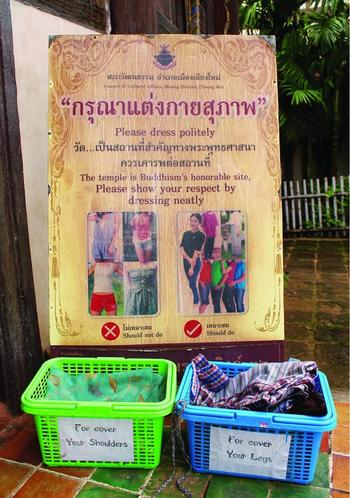
Tourism is an important component of the Thai economy. As a country, Thailand relies heavily on tourism, which accounts for about 10 per cent of its GDP, and in 2015 received almost 30 million visitors.Footnote 26 Millions of visitors from all over the world visit Thai Buddhist temples on a daily basis. Tourism has become a critical financial contribution to important Buddhist sites, and this can be seen especially within Chiang Mai's Buddhist temples. In fact, on the Tourism Authority of Thailand website, under the article ‘Religion’, Chiang Mai is highlighted for tourists as a place that allows ‘visitors to chat with monks in order to gain general knowledge about Buddhism or to study Buddhism more seriously’.Footnote 27 Signs within temples popular with tourists often demarcate how to behave with pictures of appropriate dress and behaviour. Travellers to Thailand may have an interest in Buddhism, even if little knowledge. Learning about Buddhism and the monastic life is part of a broader outreach to educate travellers in Chiang Mai. Because of this desire, abbots of temples popular with tourists have initiated ‘Monk Chats’ for such groups of international travellers, particularly those seeking to learn more through speaking with monks about meditation and the monastic life (Figure 1).
Sign and clothes for tourists, Wat Phan Tao.

Cities that are hubs for education and tourism are ripe for such opportunities for exchange within mainland Southeast Asia. Some cities, such as Mandalay, Myanmar, have an informal Monk Chat on top of Mandalay Hill, with novices hoping to engage in conversation with the many tourists who visit at dusk each day. Other cities, such as Phnom Penh, Cambodia, have programmes arranged for volunteers to teach English in Buddhist temples. And yet other cities, such as Bangkok, Thailand, have not yet capitalized on the conjunctures of tourism and Buddhist monastic schools with no formal opportunities for exchange. Therefore, Monk Chat programmes are all locally produced and do not emerge out of formal sangha structures.
There is a large tourist infrastructure in Chiang Mai city, where hundreds of temples dot the city, making most tourists curious about the Buddhist religion. Within the city, there are two Buddhist universities, and middle and high schools for novice monks are also abundant. Further north on the border between Thailand and Myanmar, there are members of ethnic minority groups in Thailand such as the Shan, Karen, Palaung, and others who take advantage of the education ordaining as a monk affords. Also, monks come from disadvantaged backgrounds in Bangladesh, Cambodia, Laos, Myanmar, Nepal, Thailand, and Vietnam, among others, to study in Chiang Mai for the low cost of education. Because of this, there are many Thai, ethnic minority, and international monks receiving education in English who are eager to practise in conversation with international visitors. In this way, Northern Thailand is host to a diverse population of Theravāda Buddhists.
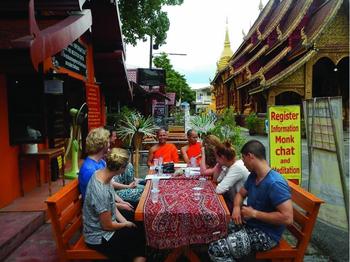
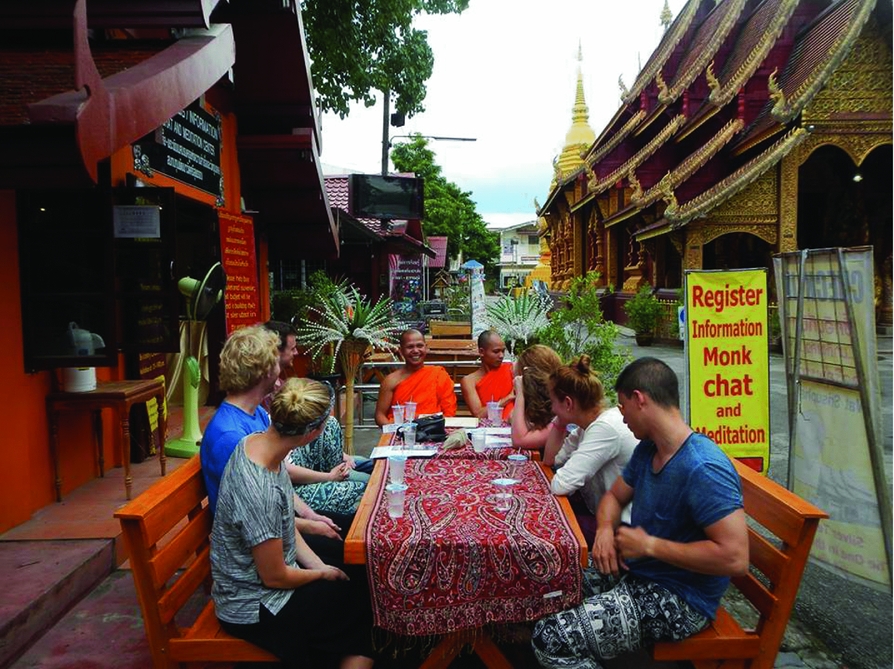
The Monk Chat programme is available for tourists interested in learning about Buddhism from monks, the majority of whom are college students, in three locations: Wat Suan Dok, Wat Chedi Luang, and Wat Srisuphan. Monk Chat began in 2000 at Wat Suan Dok's branch of the Buddhist monastic university, Maha Chulalongkorn Rajavidyalaya (MCU). Phra Saneh Dhammavaro, one of the founders of Monk Chat along with foreign teachers at MCU, began the programme based on a perceived need. According to Phra Mong, Advisor to Monk Chat, the founders observed many foreigners coming to Chiang Mai who were curious about Buddhism.Footnote 28 Also, MCU had just begun to receive international monks studying in English. For the purposes of sharing Buddhist teachings and way of life with foreigners as well as improving the English of these monks, the idea of Monk Chat was conceived.Footnote 29 The conditions of tourism within the city of Chiang Mai, international interest in Buddhism, and Buddhist universities that offer monks the possibility of obtaining their bachelor's degrees in English all facilitate and create conditions for cultural exchange (Figure 2).Footnote 30
Monk Chat, Wat Srisuphan.
In order to understand the monk participants’ goals and motivations further, I offer some biographical snapshots of the monks who are the focus of this article. International and Thai monks come to Chiang Mai to study and practise Buddhism because they see educational opportunities and support for Buddhism here that they cannot access in their hometowns and countries. The president of Monk Chat, Phra Thet, is a fourth-year college student who moved to Thailand from Myanmar in order to enrol in the English programme at MCU, Wat Suan Dok campus. He heard from his Burmese monk friends living in Thailand that Chiang Mai has a degree programme where you can learn about not only Buddhism, but other subjects in English. In Myanmar, monks typically do not learn much English, have foreign teachers, or study subjects outside of Buddhism. Another monk, Phra Mitra from Nepal, moved to Thailand in 2009. He began learning Thai for one year and then entered high school for three years in a Thai temple school before entering the bachelor's degree programme at MCU, Wat Suan Dok campus. Phra Trilok from India has been living in Thailand for eight years. He left India when he was 17 because he wanted to live in a Buddhist country and has lived in Bangkok and Southern Thailand before coming to study for a bachelor's degree in Chiang Mai two years ago.
Thai monks are also part of the Buddhist university system and the Monk Chat programmes. However, Thai monks are a minority of Monk Chat participants because many of them choose to study in Thai, instead of the English track. This of course limits their English-speaking ability and hinders possibilities to benefit from Monk Chat. Although more members of Monk Chat are foreign, the Thai monks studying in English consistently participate. Phra Arthit and Phra Day are both from Chiang Mai province and are first-year students in Mahamakut Buddhist University located in Wat Chedi Luang. They have been novice monks since they were 11 and 13, respectively. They ordained at first for the ability to gain an education but now are interested in learning more about Buddhism in order to spread the teachings. One of the reasons Phra Vin, a Thai monk from Chiang Rai, a province farther north of Chiang Mai, chose to study at the Wat Suan Dok campus of MCU was the Monk Chat programme and the ability to learn about the lives and religions of foreign tourists. Indeed, other international monks I have spoken to who originally began their study in Ayutthaya's Wangnoi campus transferred to Chiang Mai also for this reason as well. These snapshots represent the diversity of monks who speak and interact with tourists, becoming the public face of Buddhism. Although they are not all Thai, international monks are operating within the Thai Buddhist sangha and have spent many years living in a Thai Buddhist setting. This does not make them Thai Buddhist monks, but certainly the environment has affected their responses and attitudes towards the religious and cultural others they interact with in their daily life in Chiang Mai. In the following sections, I discuss their responses and attitudes towards the different groups of tourists they encounter, focusing on wider societal influences and individual responses which reveal that attitudes towards religious others are connected to possibilities of missionizing.
Religious encounters with tourists in Chiang Mai
Monks who live or study at temples popular with tourists feel they have a responsibility to meet the needs of those interested in learning about their tradition. A significant way they do this is through answering tourists’ questions in the Monk Chat programme. The information in this section draws from interviews with monks who have regularly participated in the Monk Chat programme for two or more years. I situate the encounters of these monks with Western, Chinese, and Muslim tourists in relation to the economic, social, and political power structures that are part of Thai society, which help to shape these attitudes.
I have divided the following sections into attitudes towards different groups, using nationality for Western and Chinese tourists and religion as the main identifier for Muslim tourists. Even though most monks see Westerners as Christian and Chinese as Mahayana Buddhist, they primarily understand them as Westerners (farang in Thai) and Chinese people (khon jin in Thai). The monks I interviewed identify Muslims not by nationality or ethnicity, but primarily by their religion, as people from the Middle East, Asia, or the West who are not Buddhist or Christian and whom they refer to as Muslim (khon musalim in Thai). All of the international monks I interviewed have lived in a Thai Buddhist community for at least three years, some many more, and most speak Thai with a good level of fluency but are usually more fluent in English. I spoke with the international monks in English and Thai monks in Thai, with conversations ranging from a half-hour to an hour between January and May 2016. Important factors in the range of attitudes towards tourists, described in detail below, include the tourists’ perceived interest in Buddhism, the particular aspects of Buddhism they are interested in, as well as perceived commitment possible to Buddhism.
Attitudes towards Western tourists (the beneficial other)
Monks in the Monk Chat programme, over time, become comfortable conversing in English and speaking with international visitors. Because the majority of these international visitors are English-speaking Westerners from North America, Europe, and Australia,Footnote 31 they are part of ‘the allure of the West as a charismatic and appealing cultural site’.Footnote 32 I have labelled this group the ‘beneficial other’ because their presence is seen to bring not only possibilities of English conversational practice, but also prestige to a temple community in which foreigners would travel to and be interested to visit. Whiteness is favoured in Thailand as a consequence of imperialism and racial ideologies that derive from both national and international sources.Footnote 33 Dipesh Chakrabarty describes Thailand as experiencing ‘the gravitational pull of Europe over all its questions and agitations to do with becoming “modern”’Footnote 34 and that ‘the very imagination of modernity and modern institutions in Thailand was over-determined by a certain cultural dominance of Europe’.Footnote 35 This explicit connection between the European colonizer and the modern must, of course, have a significant impact on how we conceptualize intercultural exchanges in the post-colonial period. However, at the same time, Thais of all ideological statuses and backgrounds have criticized blind imitation of the West. In this way, the West is viewed as a ‘superior but suspicious Other’.Footnote 36 Pattana Kitiarsa describes the superiority of farang as ‘ambiguous objects of those elites desiring to be modern and civilized’Footnote 37 and as ‘a cultural signifier of cosmopolitanism’.Footnote 38 These ideas provide part of the context of the encounter between monks taking part in Monk Chat and the Western tourists.
The Monk Chat monks I interviewed all agreed that Westerners are the majority of international tourists who take part in their programme. Their impression is that most of the Western tourists they meet are Christian, and that they benefit from being able to compare their tradition with Buddhism. They see their main task as explaining Buddhism to curious tourists who know little to nothing about the religion. However, Monk Chat monks generalize about Westerners they encounter based on these tourists’ knowledge of Buddhism more than their religion. Monk Chat monks characterize the Western participants as mostly friendly and open, but some are more interested in learning about Buddhism than others. Because of this, the Monk Chat monks I spoke to typically divided the Western tourists into two groups: those who do not know anything about Buddhism and those who have some knowledge. The first group of Western tourists have little knowledge, being mostly curious about what they see around them in the temple, including the Buddha statues and other structures within the space, asking about their meaning and significance. They are also curious about the monastic life, wanting to know how close it is to their own lives in North America, Europe, and Australia. Phra Udom from Lao commented: ‘Mostly the people who come are friendly and open but some don't care and look here and there.’ The second group of Westerners who know something about Buddhism usually ask the monks to explain more about Buddhist doctrines, specifically asking about rebirth and kamma, and the relationship of Buddhism to science. Phra Trilok from India, who has participated in Monk Chat at Wat Chedi Luang for two years, would rather have a conversation about these doctrines, as he finds they are ‘rational’ concepts.Footnote 39 This was a word I encountered often in interviews, always used in a positive connotation and in reference to the Western tourists, demonstrating this group of monks’ preference for discussions of Buddhist doctrine and meditation over what they consider to be ‘irrational’ ideas of magic.
Indeed, most of the Monk Chat monks I interviewed were more interested in discussing the Buddha's teachings in English with knowledgeable Western tourists. They prefer to discuss the teachings for a number of reasons. First, these Buddhist teachings are something that the tourists can continue to think and learn about. Second, these monks are studying Buddhist concepts in their college classrooms and are happy to practise their grasp of these ideas in English. Third, they are proud of these Buddhist doctrines, characterizing them as unique and deep. Fourth, most tourists are not going to integrate the monk's life into their lives, so discussing this has less value. As Phra Thet put it: ‘Very few of these tourists will be ordained so this kind of talk has little benefit for them.’ The most prominent response towards the Western tourists who come to Monk Chat are that they are interested in learning about Buddhism and can follow little by little.
A number of the monks, such as Phra Thu Thach, a Khmer KromFootnote 40 monk who has been participating in Monk Chat at Wat Srisuphan for three years, were excited to talk about their development in being able to explain the Buddhist teachings and strategies for memorizing English words for these concepts. He showed me his cheat sheet of Buddhist terms and lists in English, containing the Three Defilements (greed, anger, delusion) and Three Marks of Existence (suffering, non-self, impermanence),Footnote 41 which he practised writing many times while waiting for the next foreign participant to arrive. He stated: ‘When I wait for the next tourist, I practice and remember what I want to share with them.’ Phra Mitra from Nepal, recounted how, during his first year with the programme, he would begin conversations with the most complex Buddhist ideas such as non-self in order to impress the Westerners, assuming they would automatically become Buddhist once they heard these teachings. But he soon found they were not ready. He stated, laughing:
As I was trying to explain these Buddhist ideas, the foreigners just looked at me like they were so confused. I think many Monk Chat monks start like this, with the highest teaching. But they [the foreigners] cannot understand nibbana [Enlightenment] . . . some ideas are better not spoken about and stick with the basics that relate to their lives and the level the foreigner is at. Then they can gradually increase understanding. We have to teach basic first otherwise its useless. We have to start with an easy topic, step by step, and put in the right order.
Instead, he now begins to talk about Buddhist teachings with more basic ideas of morality for lay people, such as the Five Precepts.Footnote 42 Although these monks most enjoy discussing these deep topics, they believe that making the teachings understandable is the main priority. In this way, Westerners are ‘beneficial others’ because they are interested in learning about the Buddhist religion, and the monks not only enjoy talking with this curious population, but they also learn how to spread Buddhism. However, this was not always the case when discussing the minority of Chinese and Muslim tourists who visit these temples popular with tourists. As we will see later in the article, the ability to spread Buddhism is a major determining factor in Buddhist attitudes towards religious and cultural others.
Encounters with Chinese tourists (the familiar other)
In contrast to positive attitudes towards curious Westerners, monks who interact with tourists in Monk Chat have less enthusiasm for Asian tourists, especially Chinese, whom I call here the ‘familiar other’. This group has some knowledge of Thailand and Buddhism, although it is this familiarity that puts them at a disadvantage vis-à-vis the curiosity the Western tourists display. While Chinese tourists from Malaysia, Singapore, Taiwan, and Hong Kong have seen Thailand as a tourist destination for many decades, only recently has Thailand witnessed a dramatic influx of mainland Chinese tourists.Footnote 43 Following the huge success of China's 2012 blockbuster comedy Lost in Thailand, part of which takes place in Chiang Mai, as well as recently eased visa rules between Thailand and China,Footnote 44 Chiang Mai has seen a rapid increase in Chinese tourism. Many Chinese tourists seek to follow the locations of the film, and Chiang Mai's temples are certainly included in this itinerary.Footnote 45 These temple visits can be a point of tension, as mentioned above; an alleged Chinese man was recorded kicking a temple bell at Wat Doi Suthep much to the consternation of Thai authoritiesFootnote 46 and Chinese were almost banned from the architecturally stunning Wat Rong Khun in Chiang Rai after the artist and owner, Chalermchai Kositpipat, complained about the state of the bathrooms after a visit by a Chinese group.Footnote 47 An article in the Asian Correspondent argues that these Thai reactions constitute racism, as Westerners also commit cultural crimes daily that do not become viral videos discussed through social media.Footnote 48 Whether this can be considered racist or not, the perceptions of Chinese and Western tourists are quite different.Footnote 49
Although efforts have been made in many Chiang Mai temples to post signs in Chinese to inform these tourists, about proper dress and behaviour, monks participating in Monk Chat, for the most part, do not see Asian tourists, especially Chinese, as being curious or interested in learning about Buddhism. They noted similar traits that Chinese have been criticized for as tourists in Thailand, such as staying with their big tour group, not engaging with the culture, and being most interested in taking photos.Footnote 50 Most Chinese, stated Phra Jaya, a Khmer Krom monk who has been taking part in Monk Chat at Wat Srisuphan for four years, ‘visit the temple not to pay respect to the Buddha, but to take a picture with the Ganesh statue or silver ordination hall in the temple’. The Chinese come to sit and chat on rare occasions but they mostly walk by in a big group, leaving them fewer opportunities to discuss and learn.
The monks at Monk Chat recalled a few times when Chinese men came to consult a monk because of a problem in their lives. They also ask questions comparing Theravāda Buddhism in Thailand with Mahayana Buddhism in China. Part of the monks’ responses to these questions includes a perceived Theravāda superiority to Mahayana. Phra Aakash from Nepal, who has lived in Thailand for four years and regularly participates in Monk Chat at Wat Suan Dok, said that ‘the Theravāda tradition is from the time of the Buddha, but the Mahayana Buddhists have added their own new rules and scriptures’ and he believes this has resulted in decreased purity. However, by and large, Monk Chat monks see other Asians as those who already practise one form of Buddhism and consequently are not interested in learning more. Phra Thet, from Myanmar, came to the conclusion that ‘when Chinese people come to Thailand they are not interested in Buddhism because they see monks everyday and are used to it’. Besides the lack of difference of Buddhism for Chinese tourists, other Monk Chat monks pointed to the fact that most do not know English very well and that they are not interested in discussion or practice.
Monk Chat monks find that, when they do venture beyond the tour group, Chinese seem to be most interested in devotional activities. Unlike Western tourists for whom devotion is not important, the Chinese tourists participate in chanting, circumambulating the pagoda and bowing. Phra Dipankara, a Bangladeshi monk who has been involved in Monk Chat at Wat Suan Dok for four years, finds that ‘Chinese sometimes give donations and bow in their way to pay respect’. In contrast, when I asked about the devotional practices of Westerners, he stated that very few Westerners practise any kind of worship with the Thais, but mostly focus on meditation, often asking about meditation centres. Because Western tourists want to know about meditation, Buddhist cosmology, and the nature of Enlightenment, from the Monk Chat monks’ points of view, even though they do not involve themselves in merit-making, Western tourists display more interest in Buddhism.
While Askew demonstrates that Thai tourism officials do not mind the Chinese orientation to Thai Buddhism that seeks holy objects for protection and blessings,Footnote 51 monks studying for a bachelor's degree in a Buddhist university express a preference for ‘rational’ interpretations of the teachings. Phra Trilok stated that the Chinese tourists, if they do interact, ask for an amulet or blessing, which he explained is a preoccupation of the Chinese he does not agree with. Phra Day and Phra Arthit, Thai monks at Wat Chedi Luang's Monk Chat, believe that an interest in amulets ‘can help to remind [chūai tư̄ančhai] people of a monk or the Buddha’.Footnote 52 However, amulet owners often think these objects ‘can protect them even though they do not maintain their morality [mai chūai raksā sīnlatham]’. These ideas of Buddhism support an understanding of Buddhist teachings learned in their college classes that includes doctrine as above and more important than what they perceive to be magical practices. In this way, the monks have a particular idea of the good Buddhist in mind—a rational person interested in meditation, Buddhist doctrines, and open to new ideas and curious about Buddhist teachings. The monks who participate in Monk Chat did not characterize this ‘familiar other’ as having any of these qualities. Western tourists, then, seem to fulfil this ideal more than Chinese.
Encounters with Muslim tourists (the distant other)
Theravāda Buddhists in Northern Thailand are eager to interact with those religious and cultural others who participate in Buddhist tourism programmes. However, a different attitude can be displayed toward those of other religions living in the same region or nation state, who some Theravāda Buddhist leaders feel are a threat or danger to their religion. Although Monk Chat monks do not follow these extremes, because they have less interaction with Muslims and view their religion as more different than Christianity or Mahayana Buddhism, I label Muslim tourists as the ‘distant other’.
Theravāda Buddhists’ doctrine of impermanence and decline of the Buddha's teachings creates a discourse of the religion as in constant need of protection against signs of decay.Footnote 53 Historically, these ideas have become central during threats of colonial subjugationFootnote 54 or, more recently, in the midst of sexual and financial scandals involving Buddhist monks.Footnote 55 In the case of Muslims in Southern Thailand, this rhetoric of protecting Buddhism from decline is again invoked.Footnote 56 In an article for Lion's Roar, Michael Jerryson quotes a Southern Thai monk he interviewed on the topic of the presence of military monks on duty in temples located in conflict zones (the three southern provinces of Yala, Pattani, and Naratthiwat): ‘Military monks in the three southern provinces of Thailand are like guardians that protect Buddhism from deterioration.’Footnote 57 This need to protect the Buddha's teachings from decline is still felt, as both internal as well as external threats are real and possible for some Thai Buddhists. Because of this, Thai Buddhist monks and laity have formed groups to spread their message of Buddhist nationalism.
Buddhist nationalist groups like the Buddhism Protection Center of Thailand (BCT) have existed since 2001. This group, made up of laity and monks, devote their time to ‘defending Buddhism’, mostly through political means and dispensing information to people about threats to Buddhism.Footnote 58 They are most interested in lobbying for increased representation of Buddhism in the government and to name Buddhism as the national religion in the constitution.Footnote 59 This group feels this is necessary, as they understand Buddhism to be in a state of decline, descending in influence and in need of restoration, especially in response to the growing presence of foreign religions in Thai society.Footnote 60 Kulabkaew Katewadee writes that, in particular, the BCT is concerned with what they perceive to be increased Muslim influence combined with the relative weakness of Buddhism in Thai society.Footnote 61 Therefore, the domestic decline in reverence to Buddhist institutions is imagined as a major part of the problem for the BCT.Footnote 62
As we can see from the above example, in Thailand, where the dominant ethnic group's religion has been closely connected to the state, the presence of minority religious populations has led to reactions affirming Buddhism as a religion. This setting has stimulated the response of defensive opposition.Footnote 63 Michael Jerryson, in his ethnographic account, describes the situation in Southern Thailand where the reification of Thai Buddhist identity with the Thai state has caused alienation of Malay Muslims.Footnote 64 Martial law in the three southern-most provinces since 2004 and several violent attacks ending in deaths of both Buddhists and Muslims illustrate the extremes of this intolerance of the religious other. Jerryson argues that a strong national and religious identity ‘requires the distinction between those within and outside the imagined community’.Footnote 65 In addition, Duncan McCargo reminds us that ‘It is important to appreciate that some local Thai Buddhists are victims of violence, while also recognizing that the structures of power and legitimacy that state Buddhism promotes can actually condone violence in the name of the Thai nation’.Footnote 66 In contrast to tourists, interactions with religious others living in the same nation state carry with them sources of tension, including religious and national identity, and political and economic competition for resources.
Muslim populations in Thailand do not have the cache of a powerful religious or cultural other, but are distinguished and displaced from the majority population through their non-Buddhist identities. Monks who participate in Monk Chat, for the most part, do not discuss Muslim tourists as a threat to Buddhism, but do acknowledge their differences from other kinds of tourists. In my discussions with monks from the Monk Chat programme about Muslim tourists, they related that they rarely encountered any at their temples, which contributes to their feeling of distance and otherness. There is no way to know the actual number of Muslims who attend Monk Chat, as the programmes in all three temples record the participants’ names and countries, not religion. Therefore, as I was told by Phra Chandra from Nepal at Wat Suan Dok Monk Chat, if the foreign participant does not reveal their religion, only by identifying factors such as a headscarf on a woman or a man who has a name like Mohammed would they know they were talking to a Muslim. Phra Mong, a Bangladeshi monk and Advisor to Monk Chat at Wat Suan Dok, stated: ‘There are very few Muslims who come to Monk Chat that we know about. The majority who come are American Muslims, British Muslims, Canadian Muslims, like this, and a very little from Indonesia or Malaysia.’ When I asked about Muslims attending Monk Chat, the Thai monks at Wat Chedi Luang stated that none attend these programmes like other groups of tourists. President of Monk Chat at Wat Chedi Luang, Thai monk Phra Ruang confirmed this when he stated: ‘I have never seen Muslims come to Monk Chat.’
When I asked why they thought this was the case, many of the monks stated that it was because Muslims already have a religion that they are committed to. Therefore, for these monks who participate in Monk Chat, Muslims are not interested in learning about Buddhism, unlike Christians. Christians are seen as less committed to their religion or at least interested in applying some aspects of Buddhism into their lives. However, Phra Jiu, a Thai monk at Wat Chedi Luang who has been participating in Monk Chat for three years, stated that Muslims do not come to the temple because ‘they are dangerous [antharāy]’ and ‘their parents told them not to enter [mai hai khao wat] the Buddhist temple’. In contrast, Phra Jor, a Thai monk at Wat Chedi Luang taking part in Monk Chat for two years, stated that domestic and regional Muslims of high-school age occasionally come to learn about Buddhism, but not adults. In addition, Indonesian Muslims have been known to attend the Monk Chat at Wat Srisuphan and Phra Thu Thach described an enjoyable conversation comparing Buddhism and Islam, calling them ‘very gentle people’. At Wat Suan Dok, Phra Chandra related how he had just spoke with two Muslims—a brother and sister from England, whose parents are from Pakistan—just a few days ago. He said this about his experience:
They asked totally normal questions like other Western people. They asked about our monk life and what we can do. In our understanding, Muslims are fighting and don't like to talk to other religions. But these two were not like that. I could learn about Islam too, what they can eat and drink. They also told me only a few Muslims are like terrorists and think killing is ok if they are saving many people. It was a good exchange. I did not know this about Muslims. I am grateful. Now I can also have a good experience the next time Muslims join.
This was a positive exchange that resulted in increased understanding. However, Phra Mong also recalled that one time ‘there was problem with Muslims I could hear near me during Monk Chat when some of them [Muslims] have strong belief in their religion and don't want to listen to the monks’. There is a range of attitudes towards Muslims from indifference to avoidance to interest in learning and comparing religions. Because this group does not often enter temples, there are fewer experiences to draw from and fewer opportunities to create any generalizations about this group, based on experiences in Monk Chat conversations. However, the Monk Chat monks’ characterizations revealed a feeling of distance from Muslims partly because they are perceived to be so committed to their religion that they are not interested in learning about Buddhism. This reveals an important factor when thinking about Buddhist attitudes towards religious others—the possibility of missionizing.
Missionizing possibilities
As described above, contributing factors to positive Buddhist responses to religious and cultural others include commitment to their religion and interest in Buddhist doctrines. The nature of the population itself and the ability to speak English well are also important. But one important factor that should be considered in detail is which groups are potential missionizing fields. In speaking with Monk Chat monks who interact with tourists daily, they stated that their programmes are good opportunities to spread the dhamma or Buddhist teachings. They see this as a major part of their role and as a major motivation for improving their English—to explain Buddhism to the international community clearly and effectively.
In order to elicit responses to various cultural and religious groups, I asked Monk Chat monks where they would most like to travel to. Peter van der Veer points to this technique in his recent work on urban aspirations. He states that ‘By paying attention to the aspirations of people, communities, classes, experts, and institutions, one can get away from the static connotations of the concept of identity that tends to fix people to what and where they are rather than to what and where they aspire to be’.Footnote 67 The monks’ answers to my question about imagined travel destinations reveal their aspirations to see developed countries as well as missionize Buddhism.
Phra Day, a Thai monk studying and living at Wat Chedi Luang, wants to travel to Europe in order to see technology and be able to watch football. He is intrigued by this region because he does not know about their rules or way of life. Besides these reasons, which evoke a fascination with visiting what he considers to be a developed region, he quickly transitioned to speaking about Buddhism. He stated: ‘I want to teach Buddhism in Europe because I can help spread teachings [phoēi phrǣ sātsanā] there more than in Thailand or Mahayana Buddhist countries.’ To indicate this, Phra Day motioned vaguely to the Thai people on the street, stating that they do not appreciate all the opportunities to learn about Buddhism around them. This is because, he has concluded:
In Buddhist countries, lay people already know the basic [phư̄n thān] Buddhist teachings and are not interested in learning more. However, for Europeans even the basic teachings of the Five Precepts are interesting. Europeans are interested more than Thais because many of them don't have a religion and so are more open [poēdčhai] and have many questions.
Another benefit of Europeans from Phra Day's perspective is that they do not strictly follow their religion and are smart enough to understand complex Buddhist teachings. In this way, Europeans can be characterized as the ‘beneficial other’, as they take on the features of good Buddhists from these monks’ perspectives: rational, wise, interested, open, and curious. Buddhist monks involved in Monk Chat are most interested in others whom they deem to be more other than the familiar (Chinese) but not so other as to be out of reach (Muslim).
Phra Jor, another Thai monk living and studying at Wat Chedi Luang, said he ‘wants to go to England to spread teachings because they have a community of Buddhist people but it is not too big’. Therefore, there is potential there but still much more work to be done. Phra Jiu, a Thai monk, would go to New Zealand to share the Buddha's teachings because of its good environment as well as its Western population. He described Westerners as ‘not knowing much about Buddhism but they are curious to learn more and want to practice [patibad tham]’. He characterized Westerners this way: ‘when they think of the Buddha, they think of meditation.’ He thinks this is a good start but that there is much more to teach them. Phra Jaya, a Khmer Krom monk from Wat Srisuphan, stated: ‘Europe is a good place to travel to spread Buddhism because their governments will welcome new ideas unlike Asian governments.’ These monks see Western countries as an important and emerging field for missionizing Buddhism not only because they are developed countries, but, more importantly, they observe Western people as being curious and interested in learning more about Buddhism.
Venerable Phra Maha Wutthichai Vajiramedhi, a Thai scholar-monk popular with middle-class Thais and a prolific writer on topics related to Buddhism in Thai society, has similar opinions of Westerners potential for understanding Buddhism. He writes:
Most Westerners I know see Buddhism more as teaching the art of living than as a strict and elevating indoctrination. In their view, Buddhism is a lively, lovable religion and, most importantly, it can be applied to their lives readily and is not too far-fetched or unreachable in the realms of idealism.Footnote 68
From his words, it is clear that Westerners who follow other religions can add Buddhist practice to their lives. In The Miracle of Suffering, he describes his experience attending a retreat in France led by the Vietnamese monk, Thich Nhat Hanh, who has many Western disciples. Vajiramedhi writes:
During the practice, in the midst of the foreigners, I looked back, contemplating my own country, Thailand. Were there so many people there interested in dhamma like this? If monks merely gave sermons to teach dhamma, without the distribution of amulets, charms or keepsakes, would people be this interested and involved? This was on my mind all the time.Footnote 69
Monk Chat monks similarly look down on what is described here as magical practices as seen in their reaction to Chinese tourists. Vajiramedhi discusses the behaviour of the Western Buddhist disciples in contrast to the habits of Thai people, who, when they see a monk, ask him to sprinkle holy water or tell fortunes.Footnote 70 He continues:
A true Buddhist must aim for insight meditation . . . Thai Buddhists like to go to the temple to make merit, to circumambulate in candlelight, to give material offerings to the monks and then go home feeling as if they have performed their pious part as Buddhists. Little do they know that they are superficially touching on the Buddha's dhamma. Only when they practice the way of dhamma can they realize how wonderful the true dhamma is.Footnote 71
In this way, Westerners are seen as embodying the practices of ‘true Buddhists’ through their primary orientation towards meditation practice. In contrast, Thai Buddhists are seen as layering over the dhamma with fruitless magical practices, as perceived by these student and scholar monks who articulate a doctrinalist position. This is echoed in media discussions of Thai Buddhism, where a text-based, doctrinal position also dominates, that Thai Buddhists have lost their way.Footnote 72
From analysing the opinions of Monk Chat monks, Westerners, the ‘beneficial other’, are deemed an important field for sowing the seeds of Buddhist teachings. They are interested and curious about Buddhism because it is new and different for them. They also are seen to not have a religion or have one that is open to adding Buddhist practices, and lastly because they are from developed countries and so are seen to be rational, smart enough to understand the deepest of the Buddhist teachings, and focused on meditation practice over devotional ones. In contrast, Chinese tourists and even Thai Buddhists represent fields that have already been harvested and have not yielded much. These Chinese tourists, the ‘familiar other’, are depicted as not curious about Buddhism—even though they have all the teachings available to them, they have not taken advantage of this, and do not have the interest to try to understand the deeper Buddhist teachings. Instead, they are focused on magical practices. Additionally, people who are seen to be committed to another religion are not part of the mission field. Although the Monk Chat monks’ responses do not reflect the nationalist discourse of chauvinism in the context of religious violence in the south of Thailand, the few Muslim tourists who participate in these programmes are still regarded as the ‘distant other’. They are seen to be dedicated to Islam and not interested in learning about other religions.
Conclusion
This article has illuminated responses to Westerners as the ‘beneficial other’, Chinese as the ‘familiar other’, and Muslims as the ‘distant other’, within a context of broader Thai societal dialogues concerning these groups. These responses reveal mostly positive responses to Western tourists, from the perspective of student monks who represent the doctrinal position, because they are an important group for spreading the Buddhist teachings. They are perceived to have important qualities for understanding and practising Buddhism: curiosity, rationality, intelligence, and an interest in meditation. Reflecting Orientalist dichotomies of East and West, Siamese rulers have maintained that farang (Westerners) are superior in secular and worldly matters but Siamese (Thai people) are superior in the religious and moral matters.Footnote 73 This is part of the historical context of Westerners as an important missionary field. They are seen to be smart and interested in Buddhism, but they need the East for wisdom and spirituality. Here we can also see a shift in the Western Orientalist vision, where, instead of wisdom and spirituality being placed in ‘Eastern’ religious texts, the agency is located with Asians as representatives of Buddhism. In contrast, Mahayana and Thai Buddhists are characterized as not curious, rational, or interested in meditation, instead focused on magical and devotional practices. Also, Muslims are not interested or curious about Buddhism. Although these monks do not take on the Thai Buddhist nationalist perspective, their religion is seen as too different to apply Buddhist practices. Monks who frequently interact with tourists display attitudes towards religious and cultural others that are informed by their own observations of interactions with these groups as well as experiences in Thailand and broader global discourses about each population.
Buddhist attitudes and responses to religious and cultural others are determined by their relation to different others, the particular contexts of the encounters, and the advantages each other would bring to Buddhists and Buddhism. In order to understand what determines these various responses, it is important to analyse the conjunctures in which they are employed as well as the factors that are most significant in producing particular responses. Scholars’ observations of Theravāda Buddhism have not sufficiently interpreted contemporary Theravāda Buddhist attitudes and responses to the religious and cultural other. The intersection of education and tourism has created opportunities for exchange with religious and cultural others. Buddhist tourism programmes, such as Monk Chat, offer a lens through which to view Buddhism in the global sphere.