Implications
Research into the ante-mortem changes in semen quality after immunocastration in rams is scarce. However, such information provides an indication of how rapidly semen quality is influenced and at what stage producers may confidently maintain the lambs within a mixed-sex flock. The results of this study also profile the changes in semen quality and serum testosterone levels of pubertal Dohne Merino rams, information on which is limited, but may be of use to stud breeders.
Introduction
Immunocastration is considered a suitable alternative to physical castration in the livestock industry for the finishing of male animals for meat production (Thompson, Reference Thompson2000; Needham et al., Reference Needham, Lambrechts and Hoffman2017). The application and effects of immunocastration have been predominantly investigated in swine and cattle, with commercial vaccination protocols and schedules established for both species. However, little has been researched in terms of developing a commercial vaccination schedule to immunocastrate ram lambs. The effective immunocastration of male livestock relies on a vaccination schedule that not only elicits a strong suppressive response in terms of androgen production but also maintains low androgen concentrations until slaughter. A two, three or four-week interval between first and second immunocastration vaccination, and a four-week interval between second vaccination and slaughter, decreased scrotal circumference in male lambs (Needham et al., Reference Needham, Lambrechts and Hoffman2016). However, the interval between second vaccination and slaughter of immunocastrated lambs also needs to be flexible, considering the wide range of breeds, slaughter ages and lamb production systems used, with unpredictable levels of nutrition such as natural grazing affecting the finishing period of slaughter lambs. Thus, prolonging the vaccination-to-slaughter interval on reproductive functioning and androgen suppression needs to be investigated to ensure an effective flexible vaccination schedule for lamb production.
The influence of immunocastration on testis development and histology has been investigated in ram lambs using various vaccines, showing success in decreasing testes growth and seminiferous tubule development (Kiyma et al., Reference Kiyma, Adams, Hess, Riley, Murdoch and Moss2000; Ülker et al., Reference Ülker, Gökdal, Temur, Budağ, Oto, de Avila and Reeves2002; Ülker et al., Reference Ülker, Kanter, Gökdal, Aygün, Karakus, Sakarya, De Avila and Reeves2005; Needham et al., Reference Needham, Lambrechts and Hoffman2019). Although Improvac® decreases testicular growth for at least 3 months after the second vaccination in lambs (Janett et al., Reference Janett, Lanker, Jörg, Hässig and Thun2003), the effect of decreased scrotal circumference on the semen quality and viability of immunocastrated lambs over time has not yet been established.
Not only has Burdizzo-castration been shown to cause pain in lambs despite the use of pain mitigation (Melches et al., Reference Melches, Mellema, Doherr, Wechsler and Steiner2007), its efficacy has been questionable (Hosie et al., Reference Hosie, Carruthers and Shepard1992). The effect of Burdizzo-castration on both ante-mortem semen quality as well as post-mortem testis histology needs to be evaluated, as Burdizzo-castration has shown to have severe degenerative effects on testis tissue (Melches et al., Reference Melches, Mellema, Doherr, Wechsler and Steiner2007; Martins et al., Reference Martins, Gonçalves, Tavares, Gaudêncio, Santos Neto, Dias, Gava, Saito, Oliveira, Mezzalira and Vieira2011) and thus a possible cause for prolonged physiological stress in lambs.
The aim of this study was therefore to evaluate the efficacy of an extended vaccination-to-slaughter interval on suppressing serum androgen secretion, and the subsequent effects on ante-mortem semen quality, sperm viability and morphology, as well as post-mortem testis tissue histology of immunocastrated lambs. Second, this study aimed to compare immunocastration to Burdizzo-castration regarding these parameters. The null hypothesis being that immunocastration does not influence serum testosterone production in pubertal lambs, and thus sperm quality and testis tissue histology remain comparable to intact rams.
Materials and methods
Animals, feeding and experimental design
The animals used to collect data for this study formed part of the growth study and thus information regarding dietary nutrient composition, live weight, scrotal circumference and reactions to vaccination can be found within Part I of this two-part manuscript series. A total of 40 Dohne Merino ram lambs (45.4±3.68 kg; ~6.5 months old) were stratified by initial weight (±SD) into four weight-groups of 10 animals each, then randomly allocated to four treatment groups: intact control rams (R; 45.9±3.48 kg), Burdizzo-castrated lambs (B; 44.0±3.11 kg) and lambs immunocastrated with either a four (ICS4; 45.9±4.42 kg) or six-week (ICS6; 45.6±3.78 kg) interval between second vaccination and slaughter. A two-week interval was used between primary and secondary vaccination of a gonadotropin-releasing hormone analogue-protein conjugate vaccine (Improvac®; Reg. no. G3643, Act 36/1947; Zoetis Animal Health, Sandton, South Africa) for both immunocastrated treatments. Thus, ICS6 lambs were injected on day 1 (D1) and D15 of the trial, whilst ICS4 lambs were vaccinated on D15 and D29. Burdizzo-castration was performed on D2 using two applications of a Burdizzo-clamp per lamb. Metacam® (20 mg Meloxicam/ml; Boehringer Ingelheim Vetmedica, Inc., Georgia, USA) was administered at 0.25 ml/10 kg BW, 15 min before the castration treatment. Each clamp application lasted 30 s per testis, with the second application being approximately 0.5 cm below the first. Three more doses of Metacam® were administered to the Burdizzo-castrated lambs after castration, at three-day intervals. Sheep were maintained on kikuyu pasture from 0800 to 1600 h, after which they were housed indoors overnight and fed a supplementary commercial lamb finisher pelleted diet (16.36 MJ/kg gross energy; 139.6 g/kg CP) at 500 g per sheep per day with lucerne and water available ad libitum.
Semen collection and quality evaluation
Semen was collected weekly from a sub-sample of five lambs per treatment from D15 onwards, to allow time for wound-healing of the Burdizzo-castrated animals and at which time they would no longer produce viable semen samples. The assumption was also made that the primary vaccination does not significantly influence serum testosterone levels, according to the vaccine manufacturer’s information, and thus D15 and D29 represented the baseline semen quality for ICS6 and ICS4, respectively. However, comparison for semen quality of immunocastrates was made with both the negative (intact rams) and positive (Burdizzo-castrated lambs) controls. Semen was collected each week from the same animals using the electro-ejaculation method, without sedation. Sampling was only performed once a week to allow for animal recovery between sampling. Lambs were placed in lateral recumbency and the prepuce was wiped clean before the penis was exteriorised. The penis was held with a piece of gauze and placed within a sterile plastic collection tube. A manual pulse electro-ejaculator (Bailey, Western Instrument Company, Colorado) probe was inserted into the rectum and the area of the pelvis where the accessory glands and nervous system controlling ejaculation were massaged. The electro-ejaculator has both a high and low setting, varying between 10 and 15 V, so that the experienced operator could choose both the necessary setting and the stimulation frequency for each individual animal. During massaging, electrical pulse stimulation was performed for 2 to 3 s followed by a 5-s rest period, for a maximum of five stimulations per lamb.
Semen samples were analysed immediately after collection, before the next animal was electro-ejaculated. First, appearance quality was assessed on a five-point scale, according to Hafez and Hafez (Reference Hafez and Hafez2008) and Ramsem (2017), with 0 being unsatisfactory and 5 being excellent (Supplementary Table S1). Subsequently, 50 µl of raw semen was pipetted onto a clean microscope slide and viewed using a light microscope (Zeiss, West Germany) and mass motility was accessed on the same five-point scale as appearance (Supplementary Table S1). This slide was then immediately stained with nigrosine-eosin to determine the sperm viability for a minimum of 100 sperm cells per animal (Rouge, Reference Rouge2004b). The number of total alive and total dead sperm were determined per sample and the sperm were further analysed for basic normal or abnormal morphology (detached heads, curled tails, cytoplasmic droplets). Sperm concentration was determined using the haemocytometer method (Rouge, Reference Rouge2004a).
Blood collection and androgen analysis
Blood samples were collected before vaccination and physical castration events, then further three times within the same week after the treatment’s respective castration procedures. Weekly sampling was performed for the remainder of the study period, from late winter to early spring. Thus, ICS6 animals were sampled on D1 (before primary vaccination), 3, 5, 8, 15 (before secondary vaccination), 17, 19, 22, 29, 36, 43, 50; ICS4 on D1, 8, 15 (before primary vaccination), 17, 19, 22, 29 (before secondary vaccination), 31, 33, 36, 43, 50; B on D1 (day before castration), 3, 5, 8, 15, 29, 36, 43, 50; and R on D1, 3, 5, 8, 15, 17, 19, 22, 29, 31, 33, 36, 43, 50. The blood from each animal was collected at 0900 h, from the jugular vein into 6 ml Z Serum Clot Activator Vacuettes®. After 45 min, the blood samples were centrifuged (1500 RCF, 15 min, 4°C), serum was aliquoted into 2 ml microtubules and then stored at −20°C. Testosterone was extracted from 500 µl of serum, after the addition of an internal standard (1.5 ng testosterone-1, 2-d2), by adding 1.5 ml of ultra HPLC-grade tert-methyl butyl ether (Sigma-Aldrich, Steinheim, Germany), vortexing (1000 RPM, 10 min) and freezing at −80°C for 60 min. The non-frozen phase was then transferred, dried under nitrogen gas (55°C), reconstituted in 50 µl 50% methanol (ROMIL, Cambridge, England) and stored at −20°C.
The extracted samples were analysed using ultra-performance convergence chromatography tandem MS according to Quanson et al. (Reference Quanson, Stander, Pretorius, Jenkinson, Taylor and Storbeck2016). The Acquity UPC2-MS/MS was fitted with an Acquity UPC2 BEH 2-EP column (3 mm×100 mm; 1.7 µm particle size; Waters Corporation, USA) with carbon dioxide modified with methanol as the mobile phase. The extracted steroids were separated using a 4-min linear gradient (2% to 9.5% methanol) with a constant flow rate of 2.0 ml/min and an injection volume of 2 µl. The column temperature was set at 60°C and the automated back pressure regulator at 2000 psi. The steroids were quantified using a Xevo TQ-S triple quadrupole mass spectrometer (Waters, Milford, USA), supplying 1% formic acid in methanol at 0.2 ml/min. The multiple reaction monitoring mode was used, with an electrospray probe in positive ionization mode under the following conditions: 3.8 kV capillary voltage, 120°C source temperature, 500°C desolvation temperature, 1000 l/h desolvation gas and 150 l/h cone gas. The steroids separated and quantified were testosterone (T), androstenedione (A4), 5α-androstanedione (5α-dione), 5α-dihydrotestosterone (DHT) and 11-ketoandrostenedione (11KA4). Androstenone concentration was also evaluated, using 5α-androst-16-en-3-one as a standard for quantification. Standard curves were established for testosterone using testosterone-1, 2-d2 in 50% methanol at the following concentrations: 0, 0.05, 0.10, 0.25, 1.00, 10.00 and 50.00 ng/ml. The standard curve for testosterone-1, 2-d2 indicated a R 2 of 0.9953 (y = 0.8268x+0.7091) and the limit of detection was 0.01 ng/ml. All samples were quantified within a single and continuous batch. Raw data were analysed using MassLynxTM software (Waters Corporation, USA). The accuracy (intra-assay variation) was determined by repeated analysis of the six standard curve samples and expressing their SD as a percentage of the mean values for the repeated analyses. The accuracy at low concentrations (0.05 to 1 ng/ml) ranged from 2.6% to 7.2%, while the accuracy at high concentrations (10 to 50 ng/ml) ranged from 0.4% to 7.5%. The precision of this methodology (inter-assay variation) is 1% to 14% at low concentrations and 2% to 15% for high concentrations.
Testes histology
At slaughter (52.6±4.73 kg; ~8.5 months old), testes were collected, trimmed of all excess tissue and epididymites, and weighed as a pair. The testes were then cut in half, perpendicular to the longitudinal axis of the testis. The cut surface colour of the testis tissue was measured using a color-guide 45°/0° colorimeter (aperture diameter size: 11 mm; illuminant/observer angle: D-65/10°; Catalogue number 6801; BYK-Gardner GmbH, Geretsried, Germany). These CIE colour values indicate the ‘lightness’ (L*; 0 indicates black, whereas 100 indicates diffuse white), ‘redness’ (a*) indicating green (negative a* values) to red (positive a* values), and ‘yellowness’ (b*) from blue (negative b* values) to yellow (positive b* values).
Tissue samples (1 cm×1 cm) were taken from this middle section of the testis and preserved in 10% buffered formalin for histology preparation according to Bai et al. (Reference Bai, Sun, Zhao, Xiang, Cheng, Li, Jia and Jiang2017). Testis tissue samples were washed with water, dehydrated in a graded alcohol series, embedding in paraffin and sliced 5 µm thick. These tissue sections were placed onto microscope slides and stained with haematoxylin and eosin. The seminiferous tubule circumference and epithelium thickness of 100 seminiferous tubules were analysed per lamb, at 40× magnification using an Olympus IX70 microscope and Olympus Image Analysis Software (Olympus Corporation, Tokyo, Japan).
Statistical analysis
Statistical analysis was performed following the variance estimation, precision and comparison procedure in STATISTICA 13 (StatSoft Inc.) for continuous data collected over the study period. Residuals were tested for normality and homogeneity of variance using Levene’s test. In the case where these assumptions were met, Fisher’s LSD was the chosen post-hoc test to compare treatment means. When the assumption of homogeneity was not met, Games-Howel post-hoc tests were used (testis surface colour). When the assumption of normality was not met, as in the case with sperm concentration, a log transformation was used. The mixed-model ANOVA method was used to determine treatment differences over the study period (serum androgen concentrations, semen and sperm quality). The grouping variables were Animal, Treatment and Day; fixed effects were Treatment, Day and the interaction between Treatment and Day, and the random effect was Animal nested in Treatment. For data collected post-mortem, one-way ANOVAs were used to compare treatments (testis cut surface colour, testis histology). Significant differences were reported as such at a significance level of 5%.
Results
Semen quality, sperm concentration and sperm viability
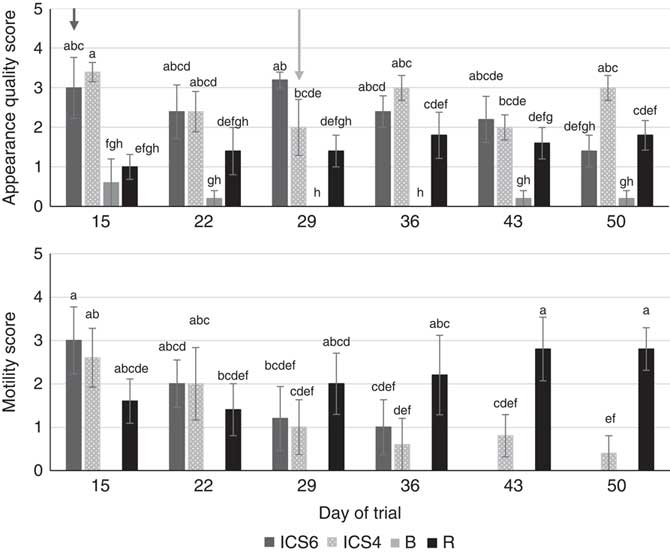
Subjective semen appearance scores were fairly consistent within each treatment but differed between treatments (P⩽0.05) for the duration of the collection period (Figure 1). The semen samples from ICS6 showed a decline in appearance score over the study period (P⩽0.05) and on the final day of semen collection (D50), their appearance scores were on average lower than ICS4 samples (P⩽0.01). At the end of the collection period, semen appearance scores for B samples were also lower than ICS4 (P⩽0.001) and R samples (P⩽0.05). Appearance scores did not differ between ICS4 and R samples on D50 (Figure 1).
Mean (±SE) semen appearance quality scores (top) and mass motility scores (bottom) for intact control Dohne Merino rams (R; n = 5), Burdizzo-castrated lambs (B; n = 5) and lambs immunocastrated with their second vaccination either four (ICS4; n = 5) or six (ICS6; n = 5) weeks before slaughter. Arrows indicate the second vaccination for respective treatments. Sample collection started at 45.5±3.65 kg. Means with different superscripts indicate significant differences both within and between treatments (P⩽0.05).

Semen mass motility scores showed less fluctuation over the study than appearance scores and differed between treatments (P⩽0.001). The mass motility score for R samples improved over the trial period (Figure 1), while scores decreased for both ICS6 and ICS4 samples after the administration of their respective second vaccinations. Motility scores for ICS4 samples were lower than R on D36 (P⩽0.01) and ICS6 reached lower scores than R on D43 (P⩽0.001). Scores for ICS6 and ICS4 semen declined further and at D50 they both no longer differed from the motility scores of B samples, showing very poor to unsatisfactory semen mass motility. The semen samples from B showed no mass motility throughout the trial (Figure 1).
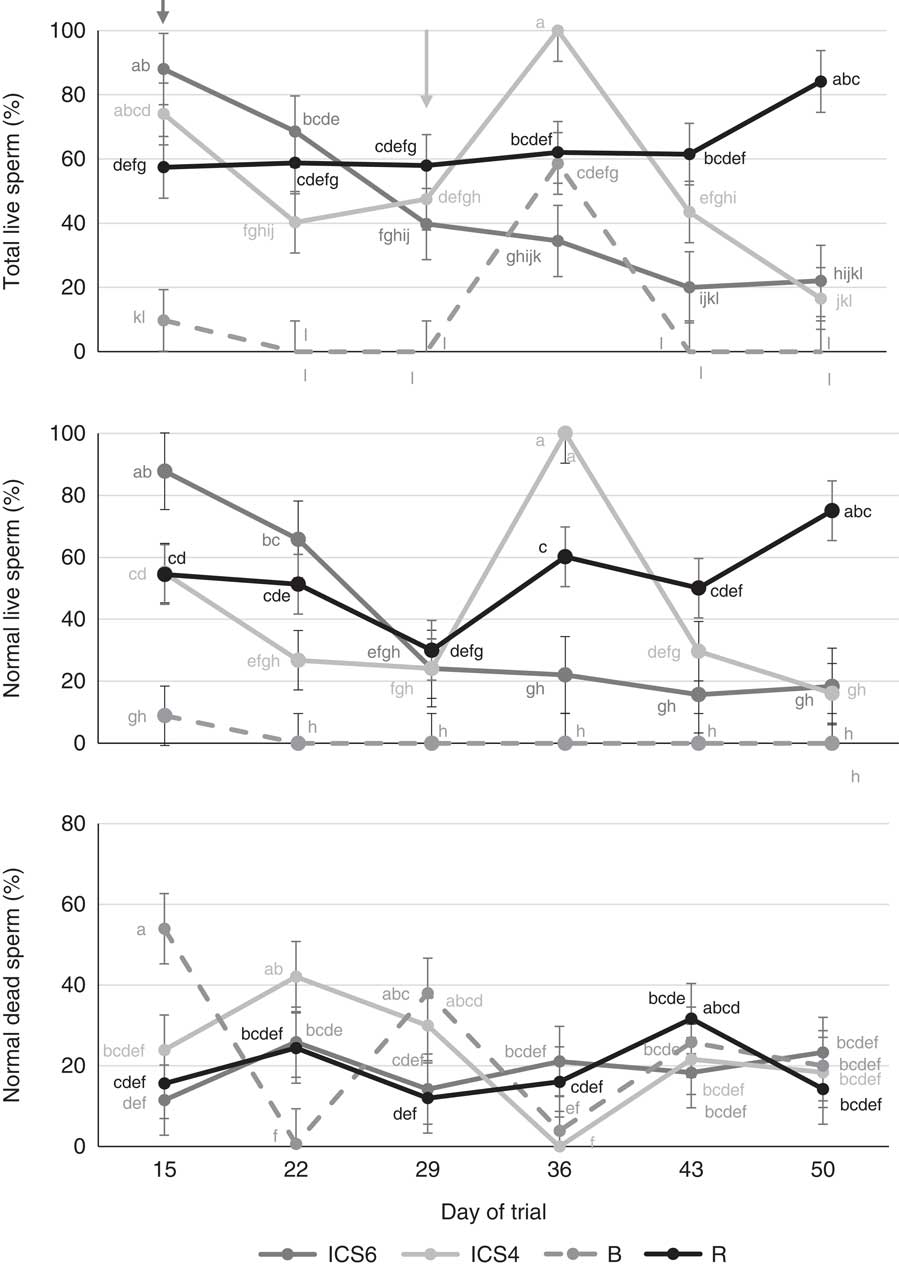
The average sperm concentrations (±SD) did not change within treatments over the trial period and were as follows: 0.9×10⁸±17.85 (R), 7.9×10⁸±5.10 (ICS4), 2.4×10⁸±80.03 (ICS6) and 146.4±1142.9 (B) sperm cells per millilitre. Sperm concentration was lower in B semen than ICS6, ICS4 and R semen samples for the entire growth period (P⩽0.001); however, ICS6, ICS4 and R semen samples did not differ from each other. Although sperm concentrations did not differ between immunocastrated and intact control rams, the total percentage of live sperm differed between all treatments over time (Figure 2). Over the trial period, the intact control rams showed a fairly constant mean (±SD) percentage of live sperm of 62.9±28.31% throughout the trial until D50 (Figure 2). From D15 to D36, B lambs had a lower percentage of live sperm compared to ICS6, ICS4 and R samples (P⩽0.001). The ICS6 lambs showed a decrease in percentage live sperm from D15 (P⩽0.05), until they had a lower percentage of live sperm than R samples on D36 (three weeks after the second vaccination) and were no different to B lambs from D43. The ICS4 semen samples showed an increase in percentage live sperm on D36 (P⩽0.001), the week after second vaccination, followed by a sharp decrease in live sperm (P⩽0.001) until they had lower percentages of live sperm than R at D43, two weeks after the second vaccination.
Percentage (±SE) of total live sperm, live sperm with normal morphology and dead sperm with normal morphology within semen samples collected from lambs immunocastrated with their second vaccination at six (ICS6; n = 5) or four weeks before slaughter (ICS4; n = 5), intact control rams (R; n = 5) and Burdizzo-castrated Dohne Merino lambs (B; n = 5). Sample collection started at 45.5±3.65 kg. Secondary vaccinations are indicated by arrows. Means with different superscripts indicate significant differences both within and between treatments (P⩽0.05).

The distribution of percentages of live sperm with normal morphology, as well as percentages of normal dead sperm, differed over the study period for the various treatments (Figure 2). The ICS6 lambs showed a decrease in percentage normal live sperm (P⩽0.001) from D15 to D29, after which it remained unchanged. At D36, ICS6 semen samples had lower percentages of normal live sperm compared to R (P⩽0.01) and ICS4 (P⩽0.001) but was only equivalent to that of B on D43 (Figure 2). The percentage of dead sperm with normal morphology remained relatively stable over the trial period for ICS6.
The viability of sperm cells in semen samples from ICS4 lambs did not follow the same trend as ICS6 after castration, having a peak in the percentage of normal live sperm the week after the second vaccination on D36 (P⩽0.001; Figure 2). The Burdizzo-castrated lambs had very low sperm concentrations in their semen samples, the majority of which were dead throughout the trial (Figure 2) explaining the poor motility scores (Figure 1). At the end of the collection period (D50), all castrated treatments had lower percentages of normal live sperm compared to intact controls (P⩽0.001; Figure 2).
Testis size, colour and histology
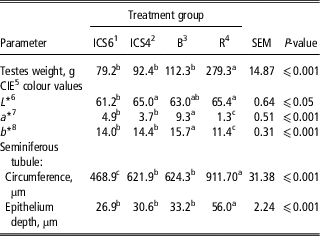
Immunocastration and Burdizzo-castration decreased trimmed testes weights compared to intact controls (P⩽0.001; Table 1). The cut surface colour values differed between treatments, with ICS6 lamb testes having lower L* (lightness) values than ICS4 (P⩽0.05) and R testes (P⩽0.001), as thus being darker than ICS4 and R testis tissue. Owing to the high variation around the mean L* values for B testes caused by tissue necrosis and abscessing (Supplementary Figure S1), testis L* values for B did not differ from all treatments (Table 1). However, Burdizzo-castrated lambs had the greatest a* (P⩽0.001) and b* (P⩽0.01) testis colour values (most red and yellow in colour) while R testes had the lowest (least red and yellow tissue), with both immunocastrated treatments being intermediate for a* and b* colour values (Table 1). The intact control rams had a greater seminiferous tubule circumference (P⩽0.001) and thicker seminiferous tubule epithelium (P⩽0.001) compared to all castrated treatments. The ICS6 lambs had the smallest seminiferous tubule circumferences relative to ICS4 (P⩽0.05) and B (P⩽0.05) testis tissue samples but did not differ from the other castrated lambs for seminiferous tubule epithelium depths (Table 1).
The mean effect of immunocastration vaccination interval (six or four weeks between second vaccination and slaughter) and Burdizzo-castration on the testes weight, CIE Lab* colour space values and seminiferous tubule parameters of Dohne Merino male lambs (52.6±4.73 kg). Ten animals were sampled per treatment group

a,bLS means with different superscripts within rows are significantly different.
1 ICS6 = lambs receiving their second vaccination six weeks before slaughter.
2 ICS4 = lambs receiving their second vaccination six weeks before slaughter.
3 B = lambs physically castrated on day 2 using a Burdizzo clamp.
4 R = intact ram controls.
5 CIE = Commission internationale de l'éclairage defined colour space, describing all colours visible to the human eye.
6 L* = ‘lightness’; 0 indicates black, while 100 indicates diffuse white.
7 a* = ‘redness’; green (negative values) to red (positive values).
8 b* = ‘yellowness’; blue (negative values) to yellow (positive values).
Androgen serum concentrations
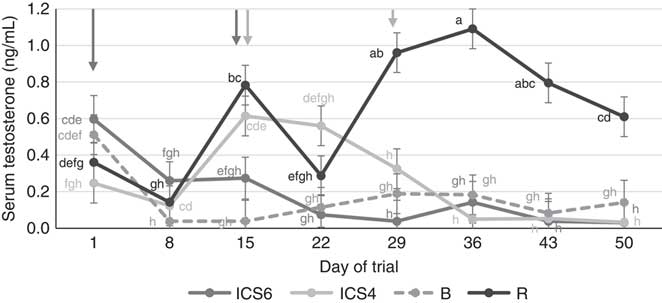
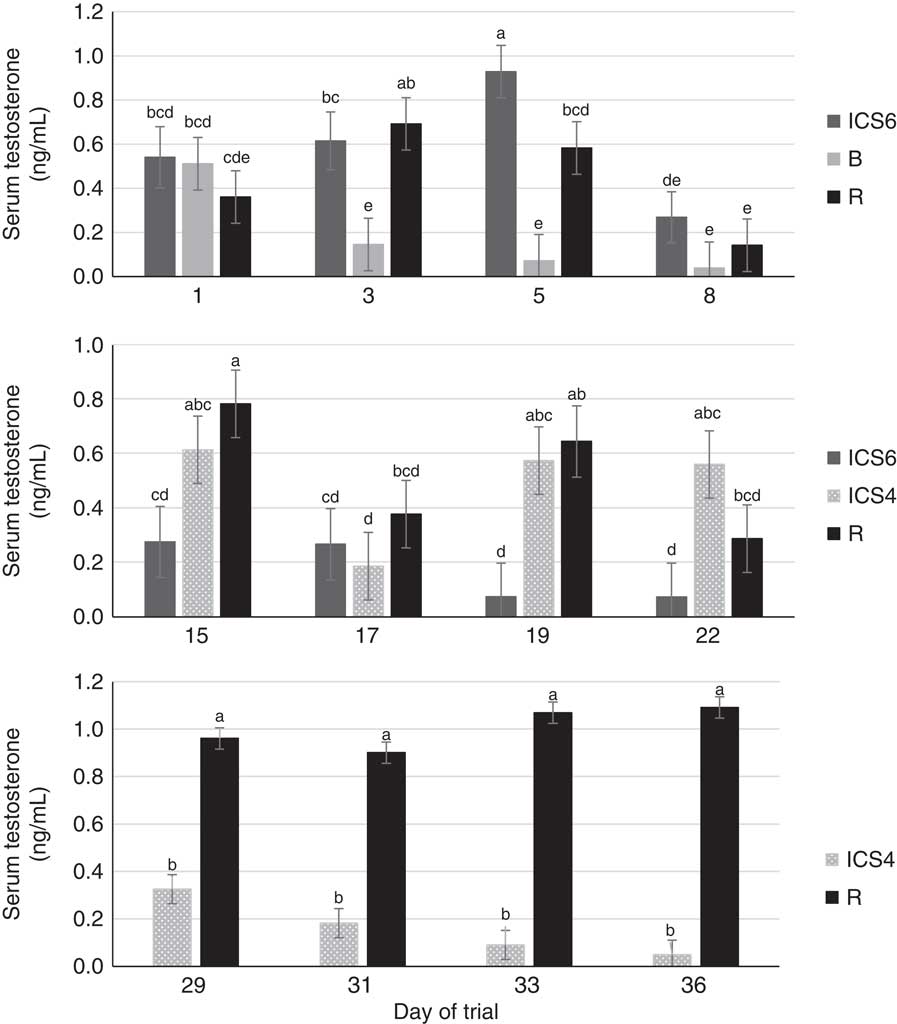
Concentrations were under the detection limit for 5α-androstanedione (5α-dione; 0.25 ng/ml), 5α-dihydrotestosterone (DHT; 0.25 ng/ml) and 11-ketoandrostenedione (11KA4; 0.01 ng/ml) for all serum samples. Testosterone concentrations [T] varied over the trial period for intact control males (Figure 3). However, from D29 to D50, [T] for R lambs was higher than all castration treatments (P⩽0.001).
The average (±SE) serum testosterone concentration (ng/ml) measured in Dohne Merino lambs immunocastrated with either six (ICS6; n = 10) or four (ICS4; n = 10) weeks between second vaccination and slaughter, Burdizzo-castrated lambs (B; n = 10) and intact control rams (R; n = 10). Vaccinations are indicated by arrows. Letters indicate significant differences between means at a significance level of 5%.

The [T] for ICS6 lambs after primary vaccination increased from D3 to D5 (P⩽0.05) and then decreased from D5 to D8 (P⩽0.001) with significant changes seen again after second vaccination (Figure 4). However, [T] for R lambs was low until D15, at which point ICS6 lamb [T] was lower (P⩽0.001) than R lambs and remained so until slaughter (Figure 3). The B lambs’ [T] decreased from D1 to D3 (P⩽0.01; Figure 4) and remained unchanged for the study (Figure 3). The ICS4 lambs received their first vaccination on D15, after which [T] decreased on D17 (P⩽0.05), followed by an increase (P⩽0.05; Figure 4) such that there was no overall change in [T] between D15 and D22 (Figure 3). Serum [T] then decreased from D22 to D36 (P⩽0.001) and remained unchanged for the duration of the study for ICS4 lambs (Figure 3).
The average (±SE) serum testosterone concentrations (ng/ml) of immunocastrated lambs vaccinated on D1 and D15 (ICS6; n = 10), immunocastrated lambs vaccinated on D15 and D29 (ICS4; n = 10), lambs Burdizzo-castrated on D2 (B; n = 10) and intact control rams (R; n = 10) for the more frequent blood sampling periods D1-8 (top), D15-22 (middle) and D29-36 (bottom). Letters indicate significant differences between means at a significance level of 5%.

The ICS4 lambs showed no significant changes for [T] after secondary vaccination (Figure 4). Serum [T] for ICS4 and B lambs were lower than R lambs on D29 (P⩽0.001) and D3 (P⩽0.001) (Figure 4). Thus, both ICS6 and ICS4 treatments had [T] lower than R within two weeks after their primary vaccinations.
Serum androstenedione (A4) was higher for ICS6 than all other treatments on D1 (P⩽0.01) and again on D36 (P⩽0.01; Supplementary Figure S2). However, ICS6 did not differ from R for A4 concentration on D36. On D15, ICS4 and R lambs had higher A4 concentrations than B and ICS6 (P⩽0.05).
Discussion
The lambs used in this study entered the trial at the age when Dohne Merino ram lambs are selected out of the breeding flock, should they have any cull-defects, and are too old for physical castration before finishing for slaughter. Also, using older male lambs for this study allowed for the monitoring of serum testosterone levels and sperm quality to ensure the efficacy of immunocastration.
Semen collection for this study was performed two weeks after Burdizzo-castration to allow for wound-healing, as well as to focus on the period after second vaccination for the immunocastrated lambs, as this is when the large decrease in serum testosterone is expected. Both castration treatments produced semen samples considered fair to unacceptable in appearance quality and mass motility throughout the study, likely due to a decrease in secretory activity of the accessory sexual glands (Gofur et al., Reference Gofur, Hossain, Khaton and Hasan2014). The functionality of the accessory sexual glands which produce seminal plasma depends on testosterone secretion (Gofur et al., Reference Gofur, Hossain, Khaton and Hasan2014) and decreased accessory gland development was reported when recombinant ovalbumin-GnRH vaccines were used for immunocastration of goats (Ülker et al., Reference Ülker, Küçük, Yilmaz, Yörük, Arslan, deAvila and Reeves2009). Semen motility scores for immunocastrates continued to decrease after secondary vaccination and thus even though serum testosterone concentrations begin to decrease after the primary immunocastration vaccination, either a lower testosterone concentration (as seen after second vaccination) is required to influence sperm mass motility, or perhaps a lag period exists between onset of reduced testosterone concentrations and decreased sperm motility. The poor appearance and motility scores of the intact control rams for the duration of the current trial indicate that although Dohne Merino ram lambs over 40% to 60% of their mature BW (~40 kg) are considered post-pubertal, semen quality may still be sub-optimal.
According to Bedford-Guaus (Reference Bedford-Guaus2016), acceptable motility scores for rams are >30%, while the acceptable standard for sperm cell concentration is between 2.5 and 6×10⁹ sperm cells per millilitre raw semen. The intact control rams also showed improvement in the proportion of total live sperm of normal morphology from 54.5% at the start of the collection period (D15) to 75% five weeks later, verging on the ‘exceptional’ standard of 80% normal live sperm for breeding rams (Bedford-Guaus, Reference Bedford-Guaus2016). For semen samples to be considered acceptable, more than 50% of the sperm cells need to be of normal morphology (Bedford-Guaus, Reference Bedford-Guaus2016). Although both vaccination intervals were successful in decreasing sperm viability, the ICS6 treatment showed more consistent results with up to 80% of the total sperm cells being dead at the end of the study and it had the most pronounced reducing effect on seminiferous tubule circumference. The spike in total live sperm percentage within the week after second vaccination for ICS4 lambs (D36) may thus be due to incomplete clearance of stored sperm within the epididymis, as the [T] may have been significant enough to maintain them until electro-ejaculation. However, due to the overall low sperm concentration and poor motility scores of both immunocastration treatments, the fertility potential of immunocastrated lambs is questionable throughout the study period. As the vaccination schedules used in this study were successful in interrupting the reproductive capacity of lambs older than 6 months of age, immunocastration may successfully prevent younger rams attaining puberty. The increase seen in total live sperm for B semen samples may indicate incomplete shearing of the spermatic chords and thus questionable efficacy of the selected technique. The technique of using only one application of the Burdizzo-clamp per testis was selected in an attempt to reduce the pain and trauma of the physically castrated lambs in the current study. However, applying two crushing events per testis per crushing event should improve its efficacy but to the further detriment of animal welfare. By applying two crushing events per testis, the risk of incomplete shearing of the spermatic chords is decreased and greater trauma is elicited to the surrounding tissue.
The testis cut surface colour was evaluated as an indication of decreased tissue activity and thus vaccination success in immunocastrates (Lealiifano et al., Reference Lealiifano, Pluske, Nicholls, Dunshea, Campbell, Hennessy, Miller, Hansen and Mullan2011). However, testes cut surface colour not only differed in castrated treatments compared to intact controls but also between castration treatments within the current study such that both immunocastration treatments had redder and more yellow testes than intact control rams. Immunocastration has also been shown to cause more yellow testicles in swine compared to intact controls; however, they are also less red than intact boars and thus lambs and swine appear to differ in this regard (Lealiifano et al., Reference Lealiifano, Pluske, Nicholls, Dunshea, Campbell, Hennessy, Miller, Hansen and Mullan2011). The Burdizzo-castrated lambs had a high variation in colour values due to tissue necrosis and overall the reddest and most yellow testes. This tissue necrosis and high serum cortisol concentrations reported within Part I of this manuscript series indicate compromised welfare of Burdizzo-castrated animals, despite the intensive use of pain mitigation. This castration method was also ineffective in some cases and therefore the use of Burdizzo-castration in older rams should be reconsidered, not only to improve their welfare but also to ensure effective control of reproduction.
Similar to the results from Needham et al. (Reference Needham, Lambrechts and Hoffman2019), A4 concentrations fluctuated over the collection period within this study but it is recommended that androgen metabolite extraction be performed from adrenal and testis tissue for future studies on the effects of immunocastration on androgen-synthesis pathways. Although the use of multiple blood samplings per day improves the accuracy of the determination of serum hormone levels due to their pulsatile secretion, previous studies have also made use of once-per-day blood sampling to assess the efficacy of immunocastration on testosterone suppression (Kiyma et al., Reference Kiyma, Adams, Hess, Riley, Murdoch and Moss2000; Ülker et al., Reference Ülker, Kanter, Gökdal, Aygün, Karakus, Sakarya, De Avila and Reeves2005; Ülker et al., Reference Ülker, Küçük, Yilmaz, Yörük, Arslan, deAvila and Reeves2009; Gökdal et al., Reference Gökdal, Atay, Ülker, Kayaardi, Kanter, de Avila and Reeves2010). Within the current study, the time of day for blood sampling was standardized and serum testosterone concentrations measured were comparable to those reported in lambs by Kiyma et al. (Reference Kiyma, Adams, Hess, Riley, Murdoch and Moss2000), Ülker et al. (Reference Ülker, Kanter, Gökdal, Aygün, Karakus, Sakarya, De Avila and Reeves2005) and Gökdal et al. (Reference Gökdal, Atay, Ülker, Kayaardi, Kanter, de Avila and Reeves2010), with all concentrations being under 2 ng/ml for intact control rams. In cattle, immunocastration is considered effective when testosterone concentrations reach concentrations below 5 ng/ml (BoprivaTM Veterinary Guide, Zoetis (Pfizer Animal Health) 2010). However, D’Occhio and Brooks (Reference D’Occhio and Brooke1982) showed that low concentrations of testosterone are needed in sheep to display mounting behaviour (0.32 to 0.65±0.01 ng/ml) and mating with intromission and ejaculation (1.26±0.13 ng/ml). The ICS6 lambs reached serum testosterone concentrations under 0.3 ng/ml within one week after primary vaccination, while ICS4 lambs reached this concentration one week after second vaccination. The likely reasoning for the difference in time to reach basal testosterone concentrations between immunocastration treatments may be due to the increase in testosterone seen in ICS4 lambs just before primary vaccination. This increase in testosterone may also explain why a high percentage of normal live sperm where still found in ICS4 semen samples after secondary vaccination. Considering the low testosterone concentrations exhibited in immunocastrated male lambs, mounting behaviour should not be exhibited allowing them to be kept together with ewes without the stress of such behaviours and subsequent detrimental effects on welfare and consequently meat quality.
Conclusion
Dohne Merino rams between 45 and 53 kg live weights may be considered pubertal regarding sperm viability and testis development. Post-mortem evaluation of the testes of Burdizzo-castrated lambs confirmed suspicions of physical stress while its efficacy remains questionable. Immunocastration was successful in interrupting the reproductive functioning and testosterone production of pubertal ram lambs and can thus be considered an alternative to Burdizzo-castration. The use of a two-week inter-vaccination period with a six-week interval between second vaccination and slaughter appears to be preferred regarding decreased sperm viability and serum testosterone concentrations. For behavioural control, testosterone concentrations indicate that lambs will be under the threshold for mounting and sexual behaviours within one week after the primary vaccination. Although the sperm viability was unacceptable throughout the study for immunocastrated lambs, it may be beneficial to administer the first vaccination earlier, before puberty, in a commercial production system. Extending the interval between second vaccination and slaughter interrupted reproductive functioning for the duration of the trial; however, its effect on carcass and slaughter traits needs to be investigated.
Acknowledgements
The authors thank the Meat Industry Trust and Supporting the Development of International Mobility of Research Staff at CULS Prague (CZ.02.2.69/0.0/0.0/16_027/0008366) for their financial support, Prof. Martin Kidd for his assistance with the statistical analyses, Jonathan Quanson, Prof. Karl Storbeck and Dr Marietjie Stander for assistance with the androgen laboratory analyses. This research is supported by the South African Research Chairs Initiative (SARChI) and funded by the South African Department of Science and Technology (UID: 84633), as administered by the National Research Foundation (NRF) of South Africa. The financial assistance of the NRF towards this research is hereby acknowledged. Opinions expressed, and conclusions arrived at, are those of the authors and are not necessarily to be attributed to the NRF.
Declaration of interest
Permission to publish the results from this study was obtained from ZoetisTM. The opinions and conclusions regarding this extra-label use of Improvac® are those of the authors and not necessarily attributed to the manufacturer.
Ethics statement
Ethical clearance was obtained from the Research Ethics Committee: Animal Care and Use of Stellenbosch University (SU-ACUD15-00073) and animal husbandry was in accordance with the specifications of the South African National Standards 10386: 2008.
Software and data repository resources
None.
Supplementary material
To view supplementary material for this article, please visit https://doi.org/10.1017/S1751731118003609