Introduction
Cohort studies of offspring exposed to periods of famine early in life and those born in circumstances of socioeconomic disadvantage reveal that many chronic diseases in adulthood closely associate with poor perinatal growth, the basis for the idea of developmental programming. Of the data reported on various organ systems, the results on ischemic heart disease are most striking. For instance, with a cohort of 4630 men, the Helsinki study reported a negative correlation between incidence of coronary heart disease and both birth weight and size index at birth. Reference Eriksson, Forsen, Tuomilehto, Osmond and Barker1 A Swedish study with a cohort of 15,000 male and female subjects found that the association between birth size and ischemic heart disease is evident at the mortality level. Reference Leon, Lithell and Vagero2 In our baboon model of intrauterine growth restriction (IUGR) induced by moderate (30%) global maternal nutrient reduction (MNR), we have reported in adult IUGR baboons biventricular cardiac dysfunction, Reference Kuo, Li, Li, Huber, Nathanielsz and Clarke3,Reference Kuo, Li, Huber, Schwab, Nathanielsz and Clarke4 abnormal lipid handling, Reference Kuo, Li and Mattern5 as well as regional specific macrovascular changes, Reference Kuo, Li, Li, Huber, Nathanielsz and Clarke6,Reference Kuo, Li, Huber, Clarke and Nathanielsz7 which may contribute to the life course known cardiovascular dysfunction associated with IUGR.
Although myocardial ischemia is traditionally considered largely in the setting of obstructive coronary artery disease, more recent investigations call attention to microvascular health effects on the development and evolution of ischemic heart disease. Myocardial capillaries are the primary determinant of coronary flow reserve. Coronary capillary dropout (rarefaction) has been reported in coronary artery disease and heart failure. Even in the presence of significant stenosis of the epicardial coronary arteries, the bulk of myocardial vascular resistance during stress arises from the capillaries. Reference Jayaweera, Wei, Coggins, Bin, Goodman and Kaul8 After coronary artery occlusion or ligation, placement of endothelial progenitor cells via either intramyocardial transplantation or intravenous injection promotes angiogenesis, increases myocardial capillary density, and improves left ventricular systolic function. Reference Kocher, Schuster and Szabolcs9
The difficulty of studying myocardial microvasculature in vivo is somewhat alleviated by studies that indicate the microvessel derangement in ischemic heart disease is at least partially systemic. In ischemic heart disease, there are decreased migratory activity, reduced number, and functional impairment of the endothelial progenitor cells that are evident in the systemic circulation. Reference Vasa, Fichtlscherer and Aicher10 Extracardiac microvascular abnormality has been documented in the nailbed, skin, skeletal muscle, and oral mucosa of subjects with increased coronary heart disease risk, such as diabetes mellitus, Reference Scardina, Cacioppo, Pisano and Messina11 pre-hypertension, Reference Antonios, Singer, Markandu, Mortimer and MacGregor12 hypertension, Reference Antonios, Singer, Markandu, Mortimer and MacGregor13 and dyslipidemia. Reference Keulen, Schaper and Houben14 Changes in oral mucosal microcirculation are, for example, visible in patients with diabetes, which correlates with disease duration and treatment. Reference Scardina, Citarrella and Messina15 These findings suggest systemic microcirculation abnormality that plays an essential role in early pathogenesis of myocardial ischemia.
The adult IUGR cohort has thus far demonstrated increased apical pericardial fat deposition in the males, subcutaneous fat thickness in the females, and elevated low-density lipoprotein/total cholesterol levels, which are currently undergoing further study and may also result in microvessel abnormality. Reference Kuo, Li and Mattern5 Based on our previous findings and the known association between perinatal maternal undernutrition and ischemic heart disease, we hypothesized reduced systemic capillary density occurs with IUGR and examined the oral mucosal capillaries in middle-aged baboons. We should note that while examination of the dermal and nailbed capillaries was also considered, the dark pigmentation of the baboon skin precluded reproducible assessment of the capillary density at these locales.
Materials and methods
Ethical approval
All procedures were approved by the Texas Biomedical Research Institute Institutional Animal Care and Use Committee (IACUC) and conducted in facilities approved by the Association for Assessment and Accreditation of Laboratory Animal Care.
Animal model
Baboons (Papio spp.) were housed and maintained in a group social environment and fed using an individual feeding system. Reference Schlabritz-Loutsevitch, Howell and Rice16 Healthy gravid female baboons were randomly assigned to either an ad libitum diet during pregnancy and lactation (controls) or a globally reduced diet regimen consisting of 70% of feed eaten by control mothers, weight adjusted, from 0.16 gestation to the end of lactation (MNR). Mothers were of similar age (control 11.18 ± 0.53 years; MNR 10.77 ± 0.78 years; p = 0.66) and weight (control 14.14 ± 0.41 kg; MNR 14.96 ± 0.54 kg; p = 0.24) at the start of study. The diet was Monkey Diet 5038 (Purina LabDiets, St Louis, MO) containing 13% calories from fat, 18% calories from protein, 69% calories from carbohydrates, mineral, and vitamin additives and a metabolizable energy content of 3.22 kcal/g.
Male offspring of the MNR mothers had birth weight 13% lower than offspring of control mothers, so were considered intrauterine growth restricted (IUGR). The offspring were fully weaned at 9 months of age and fed ad libitum diet thereafter.
Capillaroscopy
To determine the effects of IUGR on capillary density, capillaroscopy was performed on two groups of offspring baboons, IUGR (7 males, age = 10.7 ± 1.6 yr; mean ± standard deviation (SD); human equivalent ~40 yr) and age-matched controls (control (CTL), 7 males, age = 10.5 ± 1.1 yr). To assess capillary density, in vivo high-power light microscopy was performed. Using the Dino-Lite handheld digital microcirculation scope AM4113-N5UT R4 (Dunwell Tech, Inc, Torrance, CA), color micrographs of the oral mucosa at 500x magnification and resolution of 1280 pixels × 1024 pixels were obtained, each covering an area of approximately 0.8 mm × 0.6 mm.
Two regions were examined, including the lateral buccal mucosa (buccal/maxillary artery territory) and inferior oral labial mucosa (labial/facial artery territory). At least 25 color capillaroscopic images of each region were obtained by random sampling. Regions adjacent to visible areas of recent trauma and areas containing visible arterioles were avoided. The studies were conducted in the morning (9 am–11 am) after overnight fast, to control for potential diurnal and prandial effects on vascular regulation. Anesthesia was induced with ketamine hydrochloride (12 mg/kg, i.m.). The study was conducted indoors with room temperature monitored and controlled at 74–75°F.
Image processing
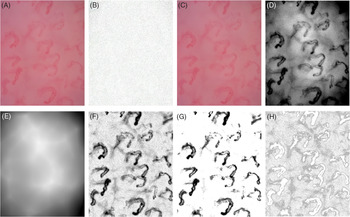
ImageJ 1.52a (National Institute of Health, Bethesda, MD) was used for capillary density analysis. The raw image (Fig. 1A) first underwent noise removal (Fig. 1B). The resultant color image (Fig. 1C) was then converted into 16-bit grayscale format (Fig. 1D). Bias field removal (Fig. 1E) was achieved using the background subtraction (Fig. 1F). Finally, thresholding was performed on the final image to obtain the regions of interest (Fig. 1G), allowing for quantification of capillary density by both fractional area and optical density. The raw image, threshold regions of interest, and residual image (Fig. 1H) were visually inspected to ensure adequate estimation.
Processing of the capillary micrographs. The raw color image (A) underwent noise removal (B). The resultant image (C) underwent gray-scale conversion (D) and bias field (E) removal. Following bias field correction (F), thresholding was performed (G). The residual image (H) was visually inspected to confirm appropriate estimation.

Variability and reproducibility
To characterize the variability and reproducibility of the technique, 30 capillaroscopic images were obtained from the lateral buccal mucosa of a human volunteer for 5 consecutive days. Using 30 sorted data points, the standard deviation was reduced to 3% change in fractional area at 25 replications, the standard error of the mean reduced to 1% change in fractional area at 13 replications, and the standard error of the mean (SEM) to mean ratio reduced to less than 5% at 22 replications. At 25 replicates as used in this experiment, the SD, SEM, and SEM/mean are estimated at 3.0%, 0.6%, and 4.4%, respectively. Reproducibility testing over 5 days showed the variability range to be about ±1% change in fractional area.
Statistical analysis
Data were analyzed using GraphPad Prism 8. Grubbs’ test (extreme Studentized deviate) was used to evaluate for statistical outliers for exclusion. Normality of distribution was assessed by the d’Agostino-Pearson test. Two-tailed Student’s t-test was used to evaluate the null hypothesis that there was no difference between the groups. Given no statistically significant differences were found, power analysis was performed using the obtained values from the control group to estimate the power for detection of a decrease of 2.5% fraction area and seven optical density units (based on differences reported in similar studies on other cardiovascular risk factors such as hypertension Reference Antonios, Singer, Markandu, Mortimer and MacGregor13 and hyperlipidemia Reference Eriksson, Forsen, Tuomilehto, Osmond and Barker14 ). Significance was set at p < 0.05.
Results
MNR and capillary density
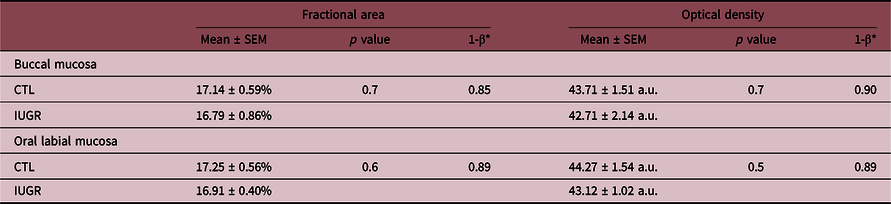
Results are summarized in Table 1. Two-tailed t-test revealed no difference between CTL and IUGR buccal mucosal capillary density by fractional area (p = 0.7) or optical density (p = 0.7). Similarly, no difference was seen in the oral labial mucosal capillary density by fractional area (p = 0.6) or optical density (p = 0.5).
Results summary

* Power estimation is based on detection of 2.5% fractional area change and 7 optical density units.
Power analysis indicated that given the sample size and standard deviation, the power (1-β) for detecting 2.5% decrease in capillary density was estimated at 0.85 in the buccal mucosa and 0.89 in the labial mucosa. Similarly, the power for detecting 7 optical density units was estimated at 0.90 in the buccal mucosa and 0.89 in the labial mucosa.
Discussion
Epidemiologic studies indicate that perinatal maternal undernutrition is closely associated with offspring cardiovascular dysfunction. In this study, we report no difference in capillary density of the oral mucosa in two preductal vascular territories in the MNR-induced IUGR offspring adult baboons compared to contemporaneous controls at rest. It remains to be investigated whether the lack of differences is due to the region examined, conduction of the study at rest, compensatory mechanisms at play, small size of the difference that is below the detection threshold, or a combination of these factors.
The association between poor prenatal growth and microvascular abnormality was first thoroughly studied in the retina of children. In the eyes, associations between low birth weight and capillary rarefaction have now been shown across the lifespan, from children (5–6 years of age) Reference Hellström, Hård, Chen, Niklasson and Albertsson-Wikland17 to older adults (64–74 years of age). Reference Kistner, Jacobson, Jacobson, Svensson and Hellström18 Outside of the eyes, however, the results on association between IUGR and capillary rarefaction are less consistent. Study on low birth weight children (6–16 years of age) and young adults (mean age 24 years) found that low birth weight predicts higher systolic blood pressure but not dermal capillary density of the finger, another vascular bed that is preductal in fetal life. Reference Irving, Shore, Belton, Elton, Webb and Walker19 A study on birth size index in middle-aged women (mean age 55 years) similarly reported no difference in forearm muscle capillary density. Reference Thompson, Sanderson and Sandeman20
Given that macrovascular changes with IUGR we previously reported were regionally specific, Reference Kuo, Li, Huber, Clarke and Nathanielsz7 we suspect there may be similar regional sparing of the microvasculature. In the prior study, we found that decreased size and distensibility were seen in the IUGR lower extremity vessels and the thoracic aorta just above the diaphragm, but not the upper extremity arteries. These changes were thought to represent sequelae of the cerebral perfusion conservation effort made in utero, preserving flow through the cranially directed preductal vasculature. Our findings in this study question the presence of analogous long-lasting consequences at the microvascular level. We note that decreased microvessel branching and density documented with IUGR in animal studies were predominantly found in post-ductal tissues, including the mesentery, Reference Khorram, Khorram and Momeni21 jejunum, Reference Meyer, Neville and Reed22 kidneys, Reference Mitchell, Louey, Cock, Harding and Black23 and leg muscles, Reference Pladys, Sennlaub and Brault24 but less consistently in the brain. Reference Pladys, Sennlaub and Brault24 This hypothesis may be tested via comparison of nailbed capillary density of the upper vs lower extremity. Unfortunately, this is not possible in the baboon due to the substantial coloration of the baboon nailbed, precluding adequate assessment of the nailbed capillaries.
Since our data were obtained at rest, we did not test the reactivity of the capillaries to different challenges. In a study on 3-month-old infants, changes in dermal capillary density with IUGR were not seen, but functional impairment in the form of decreased hyperemic response was evident. Reference Goh, Shore, Quinn and Tooke25 Animal studies in hypertension implicate a stepwise progression from initial reversible functional rarefaction that is only detectable in the presence of a challenge to later irreversible structural rarefaction with progression of disease that is detectable at baseline. Reference Prewitt, Chen and Dowell26 These findings suggest that IUGR microvascular disturbance may be mild early on and only detectable with increased demand at this time. A stress study or other functional analysis would provide useful information in this context. Stepwise progression might help explain why retinal microvasculature is found to be abnormal early in childhood with IUGR despite being a part of the preductal system. Low peripheral resistance blood flow is seen in the retina and brain at rest normally, allowing for continued perfusion of these organs throughout diastole, indicative of their high functional demand at baseline. This flow pattern is distinct as compared to the high resistance blood flow normally seen in the gastrointestinal track and musculature that only becomes low resistance with increasing demand/stress. Given the literature on retinal vascular rarefaction with IUGR, fundoscopic evaluation of the cohort may provide insight, which is currently deferred due to the need for technical expertise in avoiding procedure-related complications.
It is also possible that the lack of differences found in this study may be in part due to the presence of compensatory mechanisms. Our study differs from others in that capillary density was determined by area quantification, as opposed to number of branching points, Reference Khorram, Khorram and Momeni21 number of capillaries, Reference Pladys, Sennlaub and Brault24 or capillary surface and length. Reference Mitchell, Louey, Cock, Harding and Black23 Given that vessel morphology was previously noted to be abnormal with IUGR, Reference Hellström, Hård, Chen, Niklasson and Albertsson-Wikland17 it is plausible that the abnormal capillary morphology previously reported occurs as compensation for decreased capillary number to allow for maintenance of overall capillary density. Unfortunately, due to the normally irregular morphology of the mucosal capillaries, this hypothesis is not readily tested in our animals.
We acknowledge that by only studying the male animals at this time, we are unable to comment on the possible sex dimorphism of our findings. This decision originates from known earlier development of coronary artery disease and the generally higher susceptibility of cardiovascular dysfunction of the male sex. Given the lack of differences seen in males, it is thought that presence of significant finding in females is unlikely. However, this possibility remains to be conclusively verified, especially in light of our previous finding of sex-dimorphic fatty deposition. Reference Kuo, Li and Mattern5 Similarly, given we did not reject the null hypothesis, significant anesthesia effects are not thought to be likely. We also note that ketamine has been shown to have less effects on cardiovascular function and vascular autoregulation compared to other anesthetics, such as propofol. Reference Stowe, Bosnjak and Kampine27
In conclusion, we report no oral mucosal capillary density difference at rest in middle-aged male baboons who were IUGR at birth. In the overall context of our prior findings as well as literature reports, vascular dysfunction that occurs asymmetrically in the preductal compared to post-ductal tissues with IUGR should be considered. In the preductal vascular territory, we contend there may be relatively mild dysfunction that only emerges with increasing functional demand and further aging. In contrast, the more severely impacted post-ductal territory tissues may demonstrate structural rarefaction at rest, as previously reported in other animal models. The examination of the post-ductal tissues, retina, and function is thus warranted.
Acknowledgments
The authors thank Dr. Robert Lanford and the Southwest National Primate Center Staff for their ongoing support of the baboon research program described in this article. The authors also acknowledge the animal technical support of the Texas Biomedical Research Institute staff, as well as the administrative support of Karen Moore.
Financial support
This study was conducted with the support from the Julio C. Palmaz Endowment for Excellence in Radiology Research Pilot Grant – AHK. Furthermore, this work was in part supported by the National Institutes of Health 5P01HD021350 – PWN, 1U19AG057758-01A1-PWN, 5R24OD011183 – PWN, OD P51 OD011133, 1R25EB016631 – AHK, and EU FP 7/HEALTH/GA No.: 279281: BrainAge – Impact of Prenatal Stress on BRAINAGEing.
Conflicts of interest
The authors have no potential conflict of interest, financial, or otherwise to disclose.
Ethical standards
The authors assert that all procedures contributing to this work comply with the ethical standards of the Association for Assessment and Accreditation of Laboratory Animal Care and have been approved by the Texas Biomedical Research Institute Institutional Animal Care and Use Committee (IACUC).