Introduction
Ancyracanthus Diesing, Reference Diesing1838 (Gnathostomatidae: Ancyracanthinae) is a genus of nematodes parasitic in vertebrates from the Neotropical region (Gomes & Kohn, Reference Gomes and Kohn1970; Moravec, Reference Moravec1998; Anderson et al., Reference Anderson, Chabaud and Willmott2009). Currently, it allocates two nominal species namely, Ancyracanthus pinnatifidus Diesing, 1839 (type species) parasitic in the gastrointestinal tract of chelonians (Testudines: Podocnemididae) from Brazil and Peru (Diesing, Reference Diesing1838; Gomes & Kohn, Reference Gomes and Kohn1970; Sánchez et al., Reference Sánchez, Tantaleán, Vela and Méndez2006) and Ancyracanthus schubarti Kohn, Gomes & Motta, Reference Kohn, Gomes and Motta1968 parasitic in the stomach and intestine of anostomid fish (Characiformes: Anostomidae) from Brazil (Kohn et al., Reference Kohn, Gomes and Motta1968; Gomes & Kohn, Reference Gomes and Kohn1970; Moravec, Reference Moravec1998). None of these species have been studied using scanning electron microscopy (SEM) or characterized genetically, making Ancyracanthus a poorly known taxon, with an unknown phylogenetic position within the Gnathostomatidae.
The fauna of freshwater fish along with their nematode parasites have high biodiversity potential in the Neotropical region, although parasitological studies pertaining to these organisms remain proportionally incipient (Luque et al., Reference Luque, Pereira, Alves, Oliva and Timi2017). In this sense, only one species of Amazonian electric eel has been analysed for parasites namely, Electrophorus electricus (Linnaeus, 1766), from which a new species of apicomplexan haemoparasite was proposed (see Lainson, Reference Lainson2007).
During the present parasitological study, specimens of nematodes were found in nodules on the stomach mucosa of the electric eel Electrophorus varii de Santana, Wosiac, Crampton, Sabaj, Dillman, Mendes-Júnior & Castro e Castro, 2019, collected in the Brazilian Amazon. Detailed morphological observations revealed that these parasites represent a new species of Ancyracanthus, which is described herein based on morphological and genetic characterization.
Materials and methods
Collection and examination of the nematodes
One fish (weight 32 kg; total length 3 m) was collected using fishing nets in the River Juruá, municipality of Cruzeiro do Sul, State of Acre (7°37′13″S 72°16′49″W), Brazilian Amazon, and analysed fresh for parasites using standard techniques. Taxonomic identification of fish was according to Santana et al. (Reference Santana, Crampton and Dillman2019), while nomenclature and classification follow Froese & Pauly (Reference Froese and Pauly2022). All procedures involving animals were authorized by the Sistema de Autorização de Informação em Biodiversidade (process 59642-2/2019), in strict accordance with ethical standards on animal use and manipulation. Nematodes were found alive, washed in saline, fixed in warm 70% ethanol and stored in the same solution until analyses. For morphological and morphometric study using light microscopy, the specimens were cleared in glycerine and observed in a microscope Nikon Eclipse Ei (Nikon Instruments Inc., Melville, New York) with a digital camera Prime Cam Intervision Plus 12 (Prime Life Science Corp., Doral, Florida) attached. Drawings were made using a light microscope Olympus CH2 (Olympus Life Science Solutions, Tokyo Japan) with a drawing tube attached. For SEM, one male and one female were dehydrated through a graded ethanol series, dried in hexamethyldisilazane, mounted on stub, coated with gold and observed in a Shimadzu SS-550 scanning electron microscope (Shimadzu Solutions for Science, Kyoto, Japan), at an accelerating voltage of 20kv. Measurements are given in micrometres, unless otherwise stated. Type specimens were deposited in the Coleção Helmintológica do Instituto Oswaldo Cruz (CHIOC).
Genetic procedures
The mid-body part of a male specimen was excised and preserved in 96–100% molecular grade ethanol for genetic procedures. The genomic DNA was isolated using the DNeasy Blood & Tissues kit QIAGEN (QIAGEN, Germantown, Maryland), according to the manufacturer's instructions, and preserved at −22°C. The DNA was subjected to polymerase chain reaction (PCR) assays using two sets of genetic markers, one for amplifying a fragment of the mitochondrial cytochrome c oxidase subunit I (cox1) consisting of the primers LCO1490 and HCO2198 (Folmer et al., Reference Folmer, Black, Hoeh, Lutz and Vrijenhoek1994), and one for amplifying the domains D2 and D3 of the nuclear large subunit (28S) of the ribosomal DNA gene consisting of the primers D2A and D3B (De Ley et al., Reference De Ley, De Ley and Morris2005). PCR reactions were carried out in a final volume of 25 μl, consisting of 2.5 μl of 10× PCR buffer minus MgCl2+, 1.5 μl of MgCl2+ (50 mm), 0.5 μl of dNTPs (10 mm), 0.5 μl of each oligonucleotide primer (10 μM), 0.2 μl of recombinant Taq DNA polymerase (5 U/μl) (Invitrogen, Carlsbad, California), 1.25 μl of bovine serum albumin (10 μg/μl), 16.05 μl of ultrapure H2O and 2.0 μl of genomic DNA (c. 50–100 ng). PCR cycling conditions were according to Pereira et al. (Reference Pereira, Tavares, Scholz and Luque2015), except by the primer annealing temperature for the cox1 that was 48°C. PCR products were visualized using agarose gel (1.5%) electrophoresis, the positives were purified following the protocol described by Rosenthal et al. (Reference Rosenthal, Coutelle and Craxton1993), and sent for sequencing at ACTGene Análises Moleculares LTDA (Ludwig Biotec, Rio Grande do Sul, Brazil), using the same PCR primers. Contiguous sequences were assembled in Geneious Prime by Dotmatics (https://www.geneious.com/prime/), their consensus extracted, used for phylogenetic analysis and deposited in the GenBank database (see taxonomic summary). Access to the Brazilian genetic heritage was authorized by the Sistema Nacional de Gestão do Patrimônio Genético e do Conhecimento Tradicional Associado (process number AE2177E).
A preliminary Basic Local Alignment Search Tool (https://blast.ncbi.nlm.nih.gov/Blast.cgi) was run to confirm that the obtained sequences were similar to those of parasitic nematodes belonging to related taxa. In order to evaluate the phylogenetic position of Ancyracanthus within Gnathostomatidae, sequences of representatives of this family were retrieved from GenBank for phylogenetic reconstructions forming two datasets each for 28S and cox1 sequences, and are listed in table 1. The sequences were aligned using M-Cofee (Notredame et al., Reference Notredame, Higgins and Heringa2000) and evaluated by the transitive consistency score, in order to verify the reliability of aligned positions and trim ambiguous sites (Chang et al., Reference Chang, Di Tommaso and Notredame2014). Phylogenies were inferred based on maximum likelihood (ML) and Bayesian inference (BI) using PHYML and MrBayes software, respectively (Huelsenbeck & Ronquist, Reference Huelsenbeck and Ronquist2001; Guindon & Gascuel, Reference Guindon and Gascuel2003). The best-fit nucleotide substitution models for each dataset and their respective parameters were chosen using JModelTest2 (Guindon & Gascuel, Reference Guindon and Gascuel2003; Darriba et al., Reference Darriba, Taboada, Doallo and Posada2012). Bayesian posterior probability values were determined after running the Markov chain Monte Carlo (two runs, four chains) for 4 × 10⁶ generations, with sampling frequency every 4 × 10³ generations, discarding the initial one-quarter of sampled trees (1 × 10⁶) as bur-in; chain convergence was evaluated based on potential scale reduction factor value and the parameter sampling by the estimated sample size values. For ML, bootstrap resampling was performed with 1000 non-parametric replications. The outgroup chosen for the phylogenetic reconstructions was Meloidogyne arenaria (Neal, 1889) based on the broad phylogeny for Nematoda provided by Blaxter et al. (Reference Blaxter, Koutsovoulos, Jones, Kumar, Elsworth, Cotton, Hughes and Olson2014).
Genetic sequences of nematodes belonging to Gnathotomatidae, retrieved from GenBank and used in the present phylogenetic reconstructions, associated with their hosts, geographical origin, accession numbers and references.

Superscript numbers make correspondence of information on host, geographic origin, genetic sequence and reference ragarding each parasite species.
a Sequence based on larval form.
b DNA was isolated from larvae and adult parasites reared in pigs from these larvae.
Results
Systematics
Superfamily: Gnathostomatoidea Railliet, 1895
Family: Gnathostomatidae Railliet, 1895
Subfamily: Ancyracanthinae Yorke & Maplestone, 1926
Genus: Ancyracanthus Diesing, Reference Diesing1838
Species: Ancyracanthus electrophori Virgilio & Pereira n. sp.
Description
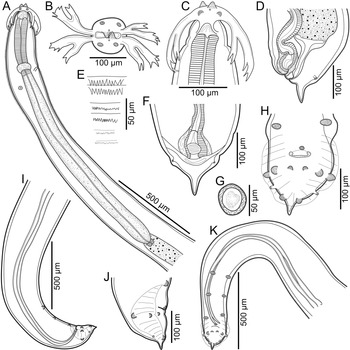
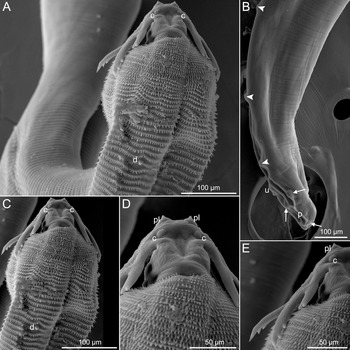
Robust, whitish nematodes, broadly variable in length. Cuticle thick, with transverse rings of posteriorly directed spines covering the anterior two-thirds of body. Larger cuticular spines ranging from anterior level of muscular oesophagus to end of anterior two-thirds of glandular oesophagus, and gradually reducing size to serrated pattern beginning at anterior region of intestine (figs 1A, E and 2A). Cephalic end formed by two large, lateral, dome-shaped pseudolabia, and four long and broad cuticular ramified appendages, posteriorly directed (two subdorsal and two subventral) (figs 1B, C, and 2A, C–E). Each appendage bifurcating somewhat at its distal half; slightly smaller branch with two spine-like points at distal end, and slightly larger branch with four spine-like points at distal end, of which one subterminal and three terminal (figs 1B, C, and 2A, C, E). Oral aperture dorso-ventrally elongated, with two lateral, triangular pseudolabial expansions, asymmetrically placed, surrounded by four sublateral large cephalic papillae and a pair of lateral, very small amphidial pores at pseudolabial expansion base (figs 1B, C, and 2A, C–E). Stoma forming conspicuous cavity, followed by oesophagus divided in short anterior muscular and long posterior glandular parts (fig. 1A). Nerve ring encircling muscular oesophagus near its posterior end (fig. 1A). Excretory pore inconspicuous, at level of nerve ring; deirids conspicuous slightly posterior to muscular oesophagus (figs 1A, and 2A, C). Tail of both male and female ending in conical process. Sexual dimorphism evident at caudal region of specimens, with males having vesicular caudal alae and conspicuous papillae, and females having conical tail and protruded vulva near anus (fig. 1D, F, H–K).
Ancyracanthus electrophori n. sp.: (A) anterior end, lateral view; (B, C) cephalic end, apical and lateral views, respectively; (D) posterior end of female, lateral view; (E) spines of cuticular rings from anterior to posterior pattern; (F) posterior end of female, ventral view; (G) egg; (H) posterior end of male, ventral view; (I, J) posterior end of male, lateral views; and (K) posterior end of male, ventral view.

Scanning electron microscopy micrographs of Ancyracanthus electrophori n. sp.: (A) anterior end, lateral view; (B) posterior end of male, specimen slightly twisted from subdorsal to lateral view (arrowheads indicate precolacal papillae, arrows indicate postcloacal papillae); and (C–E) cephalic end, lateral view. Abbreviations: c, cephalic papilla; d, deirid; p, phasmid; pl, pseudolabia expansion; u, unpaired caudal papilla.

Male (based on holotype and two paratypes; measurements of holotype inside parentheses). Body length 6.83–16.40 (8.55) mm, maximum width 268–455 (278). Cuticular spines on anterior rings 8–13 long, on posterior rings 4–6 long. Larger branch of cephalic appendage 124–194 (129) long, smaller branch 73–137 (94) long, common trunk 20–50 (35) long. Pseudolabial expansion 10–12 (12) heigh. Excretory pore, deirids and nerve ring at 398–484 (432), 453–656 (459) and 330–482 (347), respectively, from anterior end. Entire oesophagus 1.52–2.17 (1.61) mm long, representing 13–22 (19%) of body length. Muscular oesophagus 242–344 (269) long and 43–54 (53) wide. Glandular oesophagus 1.28–1.83 (1.34) mm long and 109–149 (111) wide. Muscular oesophagus representing 18.8–20.1 (20%) of glandular. Spicules equal in size and shape, distal end pointed, 1.11–2.55 (1.42) mm long, representing 13.0–21 (17%) of body length (fig. 1K). Gubernaculum absent. Posterior end of body with small vesicular caudal alae, beginning slightly anteriorly to third pair of precloacal papillae and ending at mid-length of caudal appendage (fig. 1H–K). Seven pairs of sessile caudal papillae, arranged as follows: three pairs subventral and precloacal equidistant to each other; and four pairs postcloacal, of which three anterior pairs almost at same level, slightly posterior to cloaca, one lateral, one subventral and one ventral, fourth pair posterior, sublateral and near caudal appendage (figs. 1H–K and 2B). Unpaired ventral sessile papillae slightly anterior to cloaca present (fig. 1H, J, K). Phasmids pore-like and lateral, slightly anterior to last pair of postcloacal papillae (figs 1H–K and 2B). Tail 111–300 (191) long, ending in conical appendage 20–38 (23) long (figs 1H–K and 2B).
Female (based on gravid allotype and two paratypes; measurements of allotype inside parentheses and of one non-gravid paratype inside brackets). Body length 13.58 (11.13) [6.44] mm, maximum width 620 (395) [347]. Cuticular spines on anterior rings 12 (11) [8] long, on posterior rings 9 (5) [5] long. Larger branch of cephalic appendage 143–188 [111] long, smaller branch 113 (101) [89] long, common trunk 59 (37) [30] long. Pseudolabial expansion 17 (16) [13] height. Excretory pore, deirids and nerve ring at 546 (493) [376], 791 (589) [440] and 523 (442) [316], respectively, from anterior end. Oesophagus 1.81 (1.61) [1.47] mm long, representing 16 (12) [23%] of body length. Muscular oesophagus 373 (343) [237] long and 75 (52) (42) wide. Glandular oesophagus 1.46 (1.25) [1.23] mm long and 136 (114) [107] wide. Muscular oesophagus representing 30 (19.0) [27%] of glandular. Vulva slightly anterior to anus, 250 (159) [141] from tail tip, at 98 (99) [98%] of body length. Region slightly anterior to vulva protruded, forming flap-like structure (Fig 1D, F). Vagina muscular, anteriorly directed, outlined by striated muscular ligaments and separated from muscular ovijector by sphincter (fig. 1D, F). Didelphic, prodelphic uterus. Uterine branches full of eggs in gravid females; eggs oval, thick-walled, shell with small rounded protuberances, non-embryonated, 53–66 × 42–49 (n = 10) (fig. 1G). Tail conical 145 (110) [100] long, ending in conical appendage 66–78 [63] long. Phasmids pore-like and lateral, slightly posterior to anal level (fig. 1D, F).
Taxonomic summary
Type host. Electric eel Electrophorus varii de Santana, Wosiacki, Crampton, Sabaj, Dillman, Mendes-Júnior & Castro e Castro, 2019 (Actinopterygii: Gymnotidae).
Site of infection. Stomach mucosa, inside large nodules.
Type locality. River Juruá, municipality of Cruzeiro do Sul, State of Acre (7°37′13″S 72°16′49″W), Brazil.
Specimens deposited. Holotype male and allotype female (CHIOC 39381a, b); two female and two male paratypes (CHIOC 39382).
Genetic data (GenBank accession numbers). 28S rDNA (OP765583), cox1 mtDNA (OP765585).
Etymology. The specific name refers to the genus of the type host.
Remarks
The present specimens were assigned to Ancyracanthus mainly because they have long ramified cephalic appendages growing from the two dome-shaped pseudolabia (Gomes & Kohn, Reference Gomes and Kohn1970; Moravec, Reference Moravec1998). As previously commented, this genus currently allocates only two nominal species, A. pinnatifidus parasitic in chelonians of the genus Podocnemis Wegler, and A. schubarti parasitic in anostomid fish of the genera Leporinus Agassiz, 1829, Leporellus Lütken, 1875 and Hypomasticus Borodin 1929 (Diesing, Reference Diesing1838; Gomes & Kohn, Reference Gomes and Kohn1970; Moravec, Reference Moravec1998), which differ them from the new species based on host taxa (parasite of gymnotid fish).
In addition, the new species clearly differs from its congeners based on the morphology of the cephalic appendages, which are bifurcated at their distal half ending in one branch with two spine-like points and the other with four spine-like points, contrasting with A. schubarti that has cephalic appendages with rami irregular in number and shape, ending in bifid or single tips, as well as with A. pinnatifidus that has cephalic appendages feather-shaped (see Gomes & Kohn, Reference Gomes and Kohn1970; Moravec, Reference Moravec1998). Moreover, A. electrophori n. sp. is the only congener currently described with seven pairs of caudal papillae and one unpaired papillae slightly anterior to cloaca, thus differing from A. schubarti that has five pairs of caudal papillae and A. pinnatifidus that has four pairs of caudal papillae, all with different arrangements (see Gomes & Kohn, Reference Gomes and Kohn1970; Moravec, Reference Moravec1998).
Regarding the morphology of female specimens within Ancyracanthus, the vulva tends to be situated far posterior, near the anus; this characteristic is very evident in females of A. electrophori n. sp. that have vulva closest to anus in comparison with the other congeners (see Gomes & Kohn, Reference Gomes and Kohn1970; Moravec, Reference Moravec1998). Moreover, eggs of A. schubarti and A. pinnatifidus are described as smooth shelled (Diesing, Reference Diesing1838; Gomes & Kohn, Reference Gomes and Kohn1970; Moravec, Reference Moravec1998), differing from those of A. electrophori n. sp. that have shell with irregular rounded protuberances.
Molecular characterization and phylogenetic analysis
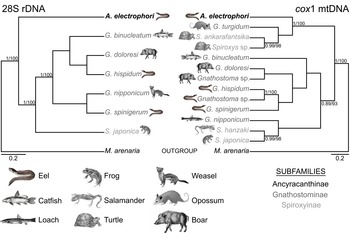
Partial sequences of the 28S rDNA (687 base pairs (bp)) and cox1 mtDNA (477 bp) were obtained for the new species. Among representatives of Gnathostomatidae nematodes present in GenBank, it was possible to retrieve sequences from species of Gnathostoma and Spiroxys for phylogenetic reconstructions. Based on the alignments, genetic similarity of the 28S (550 bp final alignment length) sequences was overall low between A. electrophori n. sp. and the other gnathostomids (36.3–40.4%), as well as between species of Spiroxys and Gnathostoma (37.4–38.6%); the closest to the new species were Gnathostoma doloresi Tubangui, 1925, Gnathostoma binucleatum Almeyda-Artigas, 1991 and Gnathostoma hispidum Fedtschenko, 1872 (genetic similarity of 40.4%). Genetic similarity of cox1 sequences (380 bp final alignment length) indicated that the new species was closer to Spiroxys sp. (82.2%), Spiroxys ankarafantsika Roca & Garcia, 2008 (81.3%) and Gnathostoma turgidum Stossich, 1902 (75.7%), respectively; the genetic similarities between A. electrophori n. sp. and the other gnathostomids were lower than 48%.
Phylogenetic reconstructions using both ML and BI showed similar results regarding topology and nodal supports; therefore only the trees generated by BI were provided. In the phylogeny inferred from 28S sequences, A. electrophori n. sp. appeared as a basal group within Gnathostomatidae, the genus Gnathostoma and, consequently, the subfamily Gnathostominae appeared as monophyletic, with full supports (fig. 3). However, in this tree only one representative of Spiroxys and, consequently, of the subfamily Spiroxyinae was included in the dataset (fig. 3). In the phylogeny inferred from sequences of cox1, which included higher diversity of gnathostomids, A. electrophori n. sp. formed a fully supported clade with G. turgidum, S. ankarafantsika and Spiroxys sp.; the monophyly of the genera Gnathostoma and Spiroxys and, consequently of the subfamilies Gnathostominae and Spiroxyinae was not supported (fig. 3). Additionally, in the tree of cox1 it was possible to observe that some lineages were grouped sharing similarities on host taxa or geographical origin, for example Spiroxys japonica Morishita, 1926 and Spiroxys hanzaki Hasegawa, Miyata & Doi, 1998 parasitic in amphibians from Southeaster Asia, and Gnathostoma hispidum, Gnathostoma spinigerum Owen, 1836 and Gnathostoma sp. parasitic in freshwater fish in the same region (see also table 1). However, nodal supports related to these observations were generally low (fig. 3).
Phylogenetic reconstructions inferred from 28S rDNA and cox1 mtDNA using Bayesian inference (BI), with subfamilies of Gnathostomatidae and hosts depicted. Sequences generated in the present study are in boldface type. Nodal supports are posterior probability of BI followed by bootstrap of maximum likelihood.

Discussion
Ancyracanthus electrophori n. sp. is the first species in the genus that has been genetically characterized and observed using SEM. In fact, the other two congeners remain poorly described requiring revaluation. For example, males of both A. schubarti and A. pinnatifidus have been represented, and most likely observed, only in lateral view (see Diesing, Reference Diesing1838; Gomes & Kohn, Reference Gomes and Kohn1970; Moravec, Reference Moravec1998). In the present study, it was possible to conclude that the accurate arrangement of male caudal papillae is better observed only in ventral view, due to optical interference of the vesicular caudal alae. Even though the current number and arrangement of caudal papillae in A. schubarti and A. pinnatifidus may not be completely correct and such characters were used in the present differential diagnosis, A. electrophori n. sp. is easily recognized based on the morphology of the cephalic appendages and parasitizes a host far related with those of the other congeners. These evidences are sufficient for supporting the proposition of this new species.
Still regarding the poor knowledge about species of Ancyracanthus, A. electrophori n. sp. is the only one described possessing cuticular rings of spines. Even though these structures are relatively conspicuous in the anterior region of the body, it cannot be discarded that they may have been overlooked in A. schubarti and A. pinnatifidus. Based on this possibility, we decided not to use the cuticular spines in the differential diagnosis of A. electrophori n. sp.
Despite the low sampling used for describing A. electrophori n. sp., it was possible to conclude that the specimens may show wide morphometric variations, but consistent and constant morphology. For example, adult males showed almost 10 mm of variation in body length, which exerted influence in the wide range observed for measurements of other structures. However, the morphological features with taxonomic importance, such as number and arrangement of caudal papillae, structure of cephalic appendages, and excretory pore slightly posterior to nerve ring and deirids slightly posterior to excretory pore, were the same in all specimens. Similarly, the same characters were constant in both gravid and non-gravid females (except caudal papillae that are absent in female nematodes). Therefore, due to the suggested wide morphometric variations of A. electrophori n. sp., we decided not to use measurements as diagnostic characters.
Since this is the first genetic characterization of a species of Ancyracanthus, it is not possible to comment about the monophyly of the genus and of the Ancyracanthinae. However, A. electrophori n. sp. appeared as the most basal taxon among the present samples, used in phylogenetic reconstructions. The results according to cox1 sequences also suggested that Gnathostoma and Spiroxys and, by consequence Gnathostominae and Spiroxyinae, are not monophyletic. It could be an indication that the morphological diagnosis of these two subfamilies, based on a cephalic bulb present in Gnathostominae and absent in Spiroxyinae (Anderson et al., Reference Anderson, Chabaud and Willmott2009), is artificial. However, such preliminary results must be interpreted with extreme caution, since the present database was limited to small genetic fragments, only two genetic markers and low diversity of taxa. In this sense, phylogenetic clustering according to host taxa and geographical origin of these gnathostomid nematodes could not be well elucidated due to generally low nodal supports.
With the first genetic characterization and observations using SEM in Ancyracanthus, resulting in the discovery of a new species and in the expansion of the geographical occurrence of the genus to Amazonian fish, an important step towards a better understanding of these nematodes has been taken.
Acknowledgements
The authors thank the Instituto de Ciências Biompedicas, Universidade de São Paulo, Campus Avançado em Monte Negro, State of Rondônia and the Laboratório de Medicina Tropical, Universidade Federal do Acre, Rio Branco, State of Acre, Brazil, for providing reagents and equipment during the research.
Financial support
This work was partially funded by Conselho Nacional de Desenvolvimento Científico e Tecnológico (CNPq Universal, process number 404083/2021-8 A/C).
Conflicts of interest
None.
Ethical standards
The authors assert that all procedures contributing to this work comply with the ethical standards of the relevant national and institutional guides on the care and use of animals, and were approved by the Sistema de Autorização de Informação em Biodiversidade (process 59642-2/2019).