The U.S. invasion of Iraq has rekindled debate about the impact of military intervention on democratic nation-building and, particularly, the extent to which it depends on the character of the intervener. Some leaders, such as French President Jacques Chirac, have argued that military intervention and democracy building is best advanced in states such as Kosovo when it is carried out by a broad multilateral coalition of democratic—in this case European—states. Others, such as U.S. President George W. Bush, have implicitly dismissed the necessity of a broad-based coalition and stress the importance of the unity of command that can often be most effectively achieved by a single democratic state acting alone or in concert with a small coalition. Leaders from the developing world and those closely identified with international institutions, such as Kofi Annan, the secretary general of the United Nations (UN), argue that the greater legitimacy that the UN possesses provides it with a variety of advantages in comparison with individual nation states.
Surprisingly, given the political salience of these issues, there is relatively little research on the extent to which intervention facilitates the process of democratization or the degree to which this depends on the character of the intervening state. One group of studies dealing with the impact of intervention generally suggest that democratic interveners succeed in promoting democratic reform in the short term but that the target states end up with unstable political systems.1
A second group of studies focusing on the more limited issue of the impact of intervention by the United States is generally critical and has produced a growing consensus that American interventions do not typically lead to democracy.2Lowenthal 1991.
Less clear in both cases is why interventions have the effect that they do. Much of the broader literature as well as some of those who have examined the record of U.S. intervention play down the impact of democratic commitment on the part of the intervener or issues of strategic inadequacy and argue that adverse domestic conditions in the target country would operate to overwhelm the positive efforts of any intervener.3
This selection effect argument is also prominent as an explanation for the difficulties confronted by the UN in ending hostilities and sustaining peace.4Some scholars5
point to U.S. military interests as a reason that American interventions tend to fail to lead to democratization, sometimes even reversing it.6A consequence of working with a small set of cases in which the outcomes have been disappointing has been the tendency in the literature to emphasize the overwhelming significance of domestic conditions on the ground in the target state as the explanation for the failure of democracy to take hold. While this is certainly an understandable conclusion given the small number of cases and relative absence of positive outcomes, it is no more defensible from a statistical standpoint than the conclusion that the United States is somehow at fault. The problem is basically indeterminate.
See Herman and Broadhead 1984; O'Donnel, Schmitter, and Whitehead 1986; Karl 1990, 1–23; and Whitehead 1991.
See Meernik 1996, 391–402; Hermann and Kegley 1998; Wantchekon and Neeman 2002; and Enterline and Greig 2003.
Although the extant literature contributes importantly to the growing understanding of the linkages among interventions, domestic considerations in target countries, and peacekeeping, we believe that its contribution to understanding the impact of interventions on democracy generally has been limited by a lack of theorizing about how the motives of the intervener shapes its institution-building aspirations in the target state and by its failure to estimate adequately the counterfactual degree of democratic change expected in the absence of an intervention. We hope to improve on both of these dimensions. In the pages that follow we suggest a theoretical explanation of the linkage between third-party intervention and subsequent democratization, identify specific hypotheses focused on comparisons to the counterfactual expected degree of democratization in the absence of an intervention, and test them against a broad data set.
Theory: Nation-Building and the Agency Problem
Our theoretical point of departure for explaining the postintervention prospects of democratization are drawn from Bueno de Mesquita and colleagues' selectorate theory.9
Bueno de Mesquita et al. 2003.
Democracies are generally characterized by a large selectorate and a large winning coalition, although there are systematic differences in the size of the winning coalition in different types of democracies.10
Because of data limitation, we are not able to exploit these within-democracy differences here.
The key feature of the theory for our purposes lies in Bueno de Mesquita and colleagues' demonstration that in equilibrium small-coalition leaders primarily rely on the provision of private goods to stay in office, while leaders in large winning coalition systems can most efficiently maintain their hold on power by providing public goods.11
Bueno de Mesquita et al. 2003; see especially chaps. 3–5.
It follows that as agents of their own domestic selectors who can depose them, both autocratic and democratic leaders engaged in external nation-building are motivated to take actions that, at the margin, maximizes their political survival prospects back home. This means that leaders of democracies will be attracted to interventions which will be perceived by their selectorates as directly tied to the provision of a public good (for example, safeguarding national security) or that is likely to effect a significant portion of the population (for example, increased access to energy resources, protecting trade routes, and so on). Leaders of autocratic states are more likely to focus on the acquisition of resources that can be converted to private goods for their narrower selectorate.
Citizens of the country targeted for intervention, of course, are not part of the intervener's selectorate, but actions taken by the target-country's leadership can, at the margin, enhance or diminish the prospects that the intervener's constituents are satisfied with the consequences of their leader's foreign policy. This means that the leader of the intervening state possesses a vested interest in ensuring that the target state possesses an institutional structure that will be responsive to his or her interests.
Democratic Interveners
To see how these incentives are likely to affect the impact of an intervention on the democratic prospects of a target state consider the domestic political survival problem of a democratic intervener. Reelection (of the individual incumbent or the incumbent's party) depends on delivering policy benefits to core constituents—the winning coalition—that are sufficient to make the coalition members prefer to retain the incumbent rather than choose a rival. This means that leaders of democracies will be attracted to interventions that will be perceived by their selectorates as directly tied to the provision of a public good (for example, safeguarding national security) or that is likely to effect a significant portion of the population (for example, increased access to energy resources or protecting trade routes).
Does the creation of democracy in another country as a public good fall in either of these categories? Some might argue that because the citizens of a democracy regard their form of government and its associated freedoms as public goods, they will also regard their provision to a second state as public goods. However, it is clear that the two actions are not remotely equivalent. The citizens of a democratic intervener receive direct consumption benefits from living under a democracy and from exercising the political and civil rights that come with it. They do not receive these direct benefits when their state successfully promotes democracy abroad (for example, they do not vote in the state's election). This does not mean that the citizens of a democratic intervener place no value on the creation of democracy in another state, but it does mean that they place considerably less value on its existence abroad than they do at home.12
Goldsmith and Posner 2005, 218. Goldsmith and Posner make much the same point in connection with their discussion of the relationship between democracy and cosmopolitan charity.
Alesina and Dollar 2000, 33–63.
Given these incentives, we believe that the leaders of intervening democracies will view the governmental structure of a target state instrumentally. That is, the value that they assign to it will have less to do with its intrinsic characteristics than with the impact that its policies are likely to have on the leader's political survival. While this does not rule out the possibility that democratic leaders will support a democracy in the target state, it does mean that a necessary condition for doing so is that the leader of the intervening state will have to believe that the resultant democracy is likely to adopt policies that are regarded as desirable by the intervening leader's winning coalition. Given that the intervening state is a democracy, these will usually involve issues such as security, trade, and access to resources.
Generally, an intervening democratic state is most interested in reversing the policies that precipitated its intervention in the first place. In some cases, the creation of a democracy is viewed as the best way to accomplish this. For example, one of the main reasons that the design of democratic institutions was a major U.S. goal in connection with its postwar occupations of Germany and Japan was a belief that their citizens would not politically support the reemergence of militarism in these states. In most cases, however, establishing a truly liberal democracy possesses a number of drawbacks as a means for ensuring that the target state will adopt policies that are consistent with the preferences of the intervener.
The biggest such drawback is uncertainty. The costs of military intervention are usually large enough that a failure to obtain the promised policy goals in the aftermath will threaten the political survival of the leader of the intervening state. Holding a fair and competitive election is an inherently uncertain process that places that political survival at considerable risk, especially in unstable states or those torn by civil war between large segments of the population. In a free and fair election, there is no guarantee that a candidate sympathetic to the policy goals of the intervener will even be running much less be victorious, and even if that person is elected he or she may not be successful in pushing through the policy change desired by the intervening leader's winning coalition.
There are rival agency problems at work here. The elected leader of the new democracy is preeminently the agent of his or her domestic winning coalition and can only survive by implementing something close to its preferred policy agenda—an agenda that is likely to involve public goods such as security and foreign policy, natural resource policy, and trade policy. To the extent that the leader of the target state operates as the agent of the intervening state's winning coalition, the leader undermines his or her survival unless the goals of the two constituencies are identical, which they are unlikely to be because each is primarily interested in the provision of public goods within its borders.
Knowing the inherent conflict of interests that exists, we believe that the democratic leader of the intervening state will choose the safer and less costly strategy of supporting the establishment (or continued existence) of an autocracy or a rigged election democracy in the target state with a small winning coalition. Such a regime will be less concerned with delivering to its citizens public goods–related policies that might conflict with the goals of the intervener and more concerned with private goods (for example, foreign aid and military assistance) that the intervening leader will be willing to supply in exchange for permitting it to achieve the policy goals that motivated the intervention in the first place. The regime in the targeted state may well be given some of the trappings of democracy for symbolic purposes, but it will lack the institutional arrangements that are essential for authentic party competition and the basis for the creation of a genuine liberal democracy (for example, freedom of speech and assembly, the existence of a free and independent media, fair elections). Collectively, these shortcomings operate to ensure that the leadership in the targeted state will be able to deliver desirable policy concessions.
To see how this logic operates in practice, consider the characteristic aftermath of French military intervention. France, as with all North Atlantic Treaty Organization (NATO) members, advocates democracy as the preferred form of government. In fact, French colonies routinely participated in French Assembly elections, sending freely elected delegates. Yet in the postcolonial era, France's colonies have shifted away from democracy toward personalist, autocratic rule. France has been and continues to be a frequent military intervener, especially in its former colonies. The French, for instance, have actively committed troops to preserve or restore peace in such countries as Lebanon, Chad, Angola, and Laos. Lebanon, once the most democratic country in the Middle East other than Israel, saw peace restored following a multilateral democratic intervention (including France, the United States, Italy, and the United Kingdom) in the early 1980s but did not experience a serious effort to restore democratic sovereignty to the people of Lebanon for nearly a quarter of a century. Instead, with the tacit approval of the international community, Syria, a decidedly nondemocratic state, maintained its free rein over Lebanese affairs.
In Chad through much of the 1980s, France acted aggressively to protect the government of Hissein Habré against Libyan incursions. Habré had declared his intention to promote democracy in Chad on numerous occasions and yet, as is so often the case, failed to do so. Instead, Chad made minor strides in adding some trappings of democracy (for example, expanded factional party competition) and even held a legitimate multiparty election in 1992 after Habré had been deposed by the military. However, Chad quickly returned to the more authoritarian end of the political spectrum. Habré's successor, for instance, recently had the constitution revised so that he may succeed himself for a third term. Thus French intervention did little—perhaps nothing—to promote democratic reform in Chad, although it did secure and preserve strong economic ties. France remains one of Chad's most important trading partners and the leading importer of Chadian products.
Would a genuinely democratic Chad be beneficial for French interests? It is difficult to say, but it is clear that there are strong anticolonial sentiments in Chad and that ethnically and culturally much of the country has a natural affinity for Libya—the very country against which France intervened to protect Habré's regime—rather than for France. French (and American) business interests and investments are, then, probably more secure under a tightly ruled Chadian state than they would be if the country were a full-fledged democracy.
The story of Chad can be retold a hundred times for different targets and for different democratic interveners. It is much the same as the story of the U.S. liberation of Kuwait from Iraq in 1991, which was accompanied by promises of democratic reform but only modest actual political change—again a few trappings of democracy rather than substantive change. Indeed, in circumstances such as Chad's or Kuwait's it probably is not antidemocratic (though whether it is morally acceptable or not is a separate question) for a democratic intervener to bypass the opportunity to erect democratic institutions in the target state, nor is the failure to do so peculiarly an attribute of any particular intervener. Quite the contrary, if democratic—or more appropriately, republican government—is expected to reflect the wishes of its voters, then building democracy elsewhere against the interests of domestic voters is both antidemocratic and it is contrary to the reelection ambitions of an incumbent leader or party. Therefore, if, as the selectorate theory claims, leaders are motivated to retain office, we should not expect democratic interveners—except under the two unusual conditions we mentioned—to advance democratic institutions wherever and whenever they intrude themselves into the affairs of another state.
Nondemocratic Interveners
Now consider the calculations of nondemocratic interveners. The survival of their leaders depends on their ability to deliver rent-seeking opportunities to the members of their small winning coalition that sustain them in office. Such rents can be extracted domestically from those outside their coalition or externally from the citizens of a target state following military intervention.14
Bueno de Mesquita et al. 2003, chap. 9, argues that modern-day autocrats are more likely to seek territorial acquisitions following foreign interventions than are democrats. We say “modern-day” autocrats because in earlier periods, especially in the medieval ages and before, autocratic interveners were more likely to seek the sustained payment of tribute in addition to territorial acquisition than appears to be true for the post–World War II world.
The Soviet experience may be an exception to this claim given the American containment policy that encouraged the Soviet leaders to stretch their security zone by maintaining friendly regimes in states that shared borders with the Soviet Union and with its NATO adversaries. In those cases where continued extraction of resources is sought by the intervener from the target, autocracy should be expected to suppress the prospects of democratization.
Thus while the selectorate argument tells us that there are fundamental differences in the domestic goals of democratic and nondemocratic leaders, they share an interest in avoiding the creation of democratic institutions in target states. This is not because their foreign policy goals are the same. As we have noted, democratic interveners are usually preoccupied with ensuring that the target state alter its foreign policies so that they are compatible with their own and provide public goods to their citizens at home. In the case of nondemocratic interveners, their goal is usually to deliver a one-time surrender of land or exploitable resources. In either case, the selectorate argument tells us that these goals can be best attained by imposing or maintaining a government in the target state in which the leader is sufficiently unconstrained at home (that is, W is small, democracy is weak or absent, and there are significant restrictions on political competition) that he or she will be able to satisfy the policy objectives of the intervening state (or coalition of states) without having to jeopardizing his or her political survival.
Of course, the victor may not need to make any changes in the target state's institutions if the institutions of the defeated state already give the new leader the latitude to ignore domestic pressures to revise the status quo, either to gain policy ends or private benefits. Because most states that experience intervention are not democratic to begin with, we can expect that much of the time there is little or no change in institutions. But when they do occur, we expect the changes to be small, more symbolic than a dramatic change in institutional form, and they favor freeing the incumbent in the target state to make choices that favor the intervener rather than a broad portion of his or her domestic population.
While autocrats and democratic interveners share a common interest in preferring to deal with nondemocratic target states, the fact that the former tends to be interested in a one-time acquisition of territory or resources rather than reshaping the foreign policy goals of the target state leads us to believe that that they are likely to be less institutionally ambitious than democratic interveners. As a consequence, democratic interveners may actually do more in the long term to restrict meaningful democratic reform than will nondemocratic interveners.
UN Security Council as Intervener
The case for the UN as an intervener is no less bleak. If UN interventions were authorized by a vote of the General Assembly, it is possible that interventions might embody the ambitions of the many weak states against the interference of the very strong. That might lead the General Assembly's majority to consistently promote democratic reform following intervention.16
Voeten 2004, 729–54.
Fortna 2004a, 269–92.
Given our earlier arguments that neither democratic nor nondemocratic interveners generally possess any incentive to establish a democracy in the target state, there is little reason to be optimistic that they will do so collectively as members of the UN Security Council. However, Voeten even suggests that in those relatively rare cases when one or even several permanent members would prefer to establish a democracy, that the nature of the Security Council's collective decision-making rules are likely to undermine the idea.18
Voeten 2001, 845–58, and 2005, 527–58.
Voeten argues that all things are rarely equal in the Security Council. He contends that for a state to pursue unilateral action—the outside option—is politically costly.19
The political costs of unilateral action can be avoided through Security Council endorsement but at the price of compromising on policy goals or ideal points. Because the Security Council consists of a mix of democratic and nondemocratic states this creates the expectation that the resultant outcome will provide a mixture of public goods benefits for the constituencies of democratic members of the Council and private goods for the constituencies of the nondemocratic members. The selectorate theory tells us that this sort of outcome is most consistent with a relatively small W system whose constituency will allow it to make policy compromises in exchange for private goods. It is not the sort of outcome that is likely to result from the creation of a liberal democratic state since the selectorate theory tells us that its citizens are likely to be unwilling to supply the private goods that are necessary to secure the participation of the nondemocratic members.20It is worth noting that such an outcome is perfectly in keeping with Fortna's results regarding the UN's peacekeeping success. Civil wars create security costs for bordering democratic and nondemocratic states alike and for the international organizations to which they both belong. Successful peacekeeping efforts provide benefits for the constituencies of both.
Given that several subsections of Article 2 of the UN Charter preclude UN intervention in the domestic political affairs of member states; and given Voeten's results, it is difficult to imagine circumstances in which the permanent members of the Security Council would be aligned in strong support of using UN peacekeepers to promote democratization.21
Data and Measurement
To summarize, we hypothesize that following foreign intervention the degree of democracy in the target state (1) does not improve and may get worse relative to comparable states that do not experience intervention when the intervener is the UN; (2) converges on promoting symbolic, external manifestations of democracy without the array of freedoms found in all full-fledged democracies when the intervener is itself a liberal democracy (meaning that nearly democratic states that experience democratic intervention become less democratic relative to comparable states that do not experience intervention while states that are not remotely democratic may add democratic trappings faster or at the same rate as comparable states that do not undergo intervention); and (3) is no different and may be worse following intervention by an autocrat than is the democratization experience of comparable states that do not undergo intervention.
We evaluate our theory by examining the impact of military interventions on the level of democratization that has evolved in the wake of civil wars and intrastate disputes, militarized interstate disputes, and interstate wars between 1946 and 2001. We include third parties as interveners if they made a physical military commitment in the arena of fighting whether in the form of peacekeepers or as active participants in a dispute. Interveners include individual third-party states, groups of states, and the UN between 1946 and 2001. We compare the record of subsequent democratization of states that have experienced third-party intervention with those that have not, thereby creating the opportunity to estimate the counterfactual democratization expectations in the absence of intervention for those states that did undergo a military intervention.
We include all countries in our analyses while constructing a dummy variable milyn, the details of which are explained shortly, to distinguish cases that experienced a military intervention (milyn = 1) from those that did not (milyn = 0). We rely on several data sets to identify interventions and interveners. Regan has assembled a widely used data set of civil war related military interventions.22
Regan 2000.
Fortna, 2004a.
Our results do not change if we only count as interventions those cases that Fortna codes as 2.
In some instances of intervention there was more than one intervener; for instance, the majority of UN military interventions also included military intervention by one or more members of the Security Council. Our analyses code each intervener separately in each event.
Dependent Variables
We examine three institutional variables: (1) democracy, measured as the twenty-one-point scale resulting from calculating the difference between the Polity IV Democracy score and the Polity IV Autocracy score for each country, recoded to fall between 0 and 1, with higher values indicating greater degrees of democracy; (2) participation competition, a six-point scale taken from Polity IV. We recode this variable so that its maximum score is 1 and 1 indicates a competitive party system, with lower values indicating less and less participation and competition; and (3) Bueno de Mesquita et al.'s variable W, a five-point index of coalition size (and here labeled as coalition size), with 1 being the value of systems with the largest coalition and 0 the smallest.25
Bueno de Mesquita et al. 2003, 134–35.
Each dependent variable is made up of the score for the relevant institutional variable ten years later than the year of observation for each of the independent variables and the lagged dependent variable. A ten-year lead provides ample time for institutional effects to take hold and be observed.26
We replicate our analyses as well with a five-year lead. To conserve space, the five-year results are not reported here, but are available at 〈http://www.nyu.edu/gsas/dept/politics/faculty/bdm/Intervention_and_Democracy/〉. They are substantively equivalent to the ten-year results we report in the body of the text.
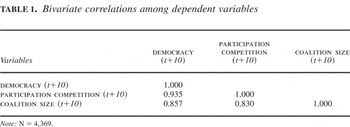
Bivariate correlations among dependent variables

Independent Variables
Observations are country-years. A variable milyn is constructed that is coded as 1 for each country for the year that it experienced an intervention and for each of the next ten years. For instance, there was a U.S. military intervention in Grenada in 1983. milyn for Grenada is 0 before 1983, 1 each year from 1983–92, and 0 for years after 1992 (assuming that there has not been another military intervention in the interim), while the dependent variable for Grenada in 1983 is the value of the relevant institutional variable in 1993 or the change in the institutional variable between 1993 and 1983, in 1984 the dependent variable is the relevant institutional variable for 1994 or its change between 1984 and 1994, and so on throughout the time series.27
For the replication based on five-year periods, all variables are adjusted accordingly to reflect the appropriate time line such that the dependent variable is always observed five years later than the independent variables.
We create three dummy variables, un, usa, and democrat, referring respectively to the UN, the United States, and any additional democracy (for example, France, UK, Belgium, and India) that participated as a military intervener in a given country in a given year. We assign a 1 to this variable, as with milyn, for each year up to and including ten years after the intervention, scoring it as 0 in all other circumstances.
The distinction between the United States and other democratic interveners, as discussed in more detail later, is made primarily for interpretive purposes rather than for theoretical reasons. We anticipate that democratic interveners facing comparable circumstances respond comparably in altering the target's institutions to create malleable, policy-compliant regimes that have little more than the symbolic trappings of democracy. Because the United States is the most frequent and most powerful democratic intervener and because it is the intervener that readers of this journal have the best prospect of influencing, we highlight U.S. patterns of action.
The statistical effect of autocratic interveners on the dependent variables is estimated by the coefficient for milyn. The effect of other interveners is the sum of the coefficients for milyn plus the dummy variable or variables representing the specific interveners. In this way we can directly assess the relationship between each type of intervener and subsequent movement in the target state toward or away from democracy, a central concern of our hypotheses. For cases that did not undergo a military intervention, the value of each of these dummy variables is, of course, zero.
Our concern is with the democratization aftermath of foreign interventions and not their causes or ex ante stated objectives. To gauge the impact of interventions, however, we must control for the counterfactual expected change in institutions in the absence of an intervention. This is a tricky problem because it is likely that there are selection effects influencing when and where interventions occur28
We attempt to correct for these general selection effects by including country-specific fixed effects to correct for characteristics of each country that do not change over time. We correct for any secular trends in democratization by controlling for the year of the observation. The control elements form the baseline against which we estimate the marginal impact on democratization created by different interveners. Those marginal effects represent the tests of our three hypotheses.The basic structure of the models we use to test our argument is as follows:

The design of the tests ensures that we can see the effect of specific interveners and compare that effect to the counterfactual expected degree of democratization in the absence of an intervention. The effect of democratic interventions, for instance, is simply the sum of the regression coefficients for milyn + democrat. Adding the coefficient for the United States to these two coefficients gives the effect of U.S. interventions on democratization. Positive coefficients are associated with an improvement in the degree of democracy over the time horizon we assess while negative coefficients indicate an erosion of democracy. The coefficients have a natural substantive interpretation as well. Because each of the dependent variables has an upper bound of 1, the coefficients from our regression analyses for the dummy variables for intervention can be interpreted approximately as the percentage increase or decrease in the degree of democracy predicted for a country as a result of intervention by the nation or organization identified by the dummy independent variable. Thus smaller coefficients are associated with nominal changes in the degree of democracy (up or down depending on the sign of the coefficient) while larger coefficients indicate more substantial and meaningful institutional change. With the model specification we use, we can assess the marginal effects of a UN intervention, a unilateral American action, an intervention by any democracy or any autocracy, as well as multilateral combinations that include, for instance a joint UN-U.S. or joint UN-Democracy intervention. When we summarize our findings we will draw attention to these marginal effects.
Analysis of Interveners and Institutional Change
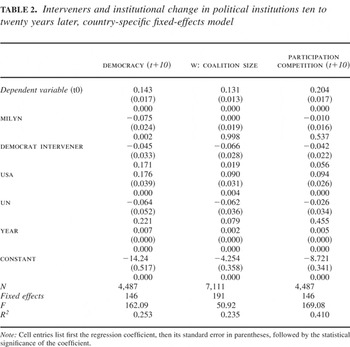
Table 2 summarizes the country-specific fixed effects analyses that allow us to assess key features of institutional changes that occur after a military intervention. Recall that we hypothesized that following foreign intervention the degree of democracy in the target state is likely to be unchanged or to have declined when the UN intervenes as compared to the counterfactual expectation for democratic change if no intervention had occurred. When autocrats intervene we expect to observe an initial shock but relatively little if any meaningful long-term impact on the target state's political institutions. After ten years we expect to see the target state pursuing democracy at a pace that is comparable to or somewhat slower than is observed for equivalent states that did not experience intervention.
Interveners and institutional change in political institutions ten to twenty years later, country-specific fixed-effects model

When democrats intervene, the prediction is more complicated because it depends on the degree to which the state had democratized at the time of intervention. If the target was relatively democratic at the outset of the intervention, say above 0.7 or 0.8 on our 0 to 1 normalized Polity Democracy-Autocracy scale, then we anticipate a decline (or at least no increase) in the target's degree of democracy.29
These values are equivalent to scores of 4 to 6 on the nonnormalized, +10 to −10 Polity Democracy-Autocracy scale. A value of 0.50 on our normalized scale is equivalent to a value of 0 on the standard −10 to +10 scale. Values above 0.50 on the normalized scale, then are countries that, on balance, are more democratic than autocratic. Values below 0.50 indicate countries with more autocratic than democratic governance. Full-fledged democracies score +10 on the Polity index, or 1 on our normalized scale. The literature typically treats countries with scores above 6; that is, 0.80 when normalized, as being democratic.
One might object that the democratic trappings installed by democratic interveners are a form of cheap talk and therefore are not credible and so reap no domestic benefits for the intervener. However, such a view assumes that intervener's constituents can distinguish ex ante between genuine reforms that put the country on the path to full democratization (for example, as in post–World War II Germany) from institutional changes that prove, ex post, to be mere symbolic gestures (for example, promised reform in Kuwait). Who, for instance, can say with certainty whether recent Iraqi elections are a harbinger of greater democratic change in the future or that they will prove to be an empty exercise in democratic symbolism? Even in those cases where it quickly becomes apparent that institutional changes are only symbolic, voters in the intervening state have to untangle an informational agency problem of determining whether the faux institution was meaningless from the outset or corrupted by the target state politicians who took over. In such cases, the intervening state's leader probably will scapegoat the target state politicians.
To summarize, the lower the democracy score at the outset, the more likely that a democratic intervener will raise it modestly and symbolically relative to comparable states that do not experience intervention; the higher the degree of democracy before an intervention, the more likely that the intervener will unravel substantively important aspects of democracy, leaving symbolic trappings but no more than that.
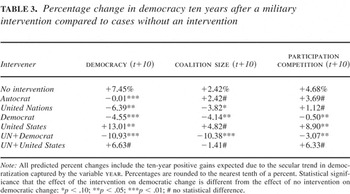
Table 2 presents the statistical results while Table 3 shows the expected percentage change in democracy over the ten-year period following intervention based on the results reported in Table 2.
Percentage change in democracy ten years after a military intervention compared to cases without an intervention

With regard to the first hypothesis, that is, the effects when the UN is the intervener, one-tailed tests of significance are appropriate because we predicted the direction of change. Those generally show reductions in democratic reform relative to the counterfactual base case of no intervention. For change in democracy as measured by Polity, the probability that the relationship is due to chance is 0.007; for coalition size, it is 0.050; and for participation competition, 0.17. As expected, targets of intervention by the UN fare no better and generally do worse than would have been expected had they not suffered an intervention. Table 3 indicates that UN interventions results, on average, in a 6.40 percent decline over ten years in democracy (as measured by Polity) relative to comparable states that did not experience intervention.31
This and comparable ten year calculations are made as follows. The predicted change in democracy is equal to 10(Year Coefficient) + MilYN Coefficient + UN Coefficient = 10(0.00744) −0.07456 − 0.06380 = 0.06396 based on the statistical output reported at 〈http://www.nyu.edu/gsas/dept/politics/faculty/bdm/Intervention_and_Democracy/〉 and rounded to three places in Table 2.
The third hypothesis, that autocratic interveners either do not alter the counterfactual expected change in democratization or slow democratization down compared to the counterfactual expectation, is also supported by the evidence. In the case of coalition size and participant competition there is no difference between the counterfactual change in democracy and the experience of those targeted for intervention by autocrats. In the case of the estimate based on Polity's democracy-autocracy index, there is a statistically significant decline in democracy relative to the counterfactual. The small coefficient in Table 2 might mislead one into thinking that there is no effect, but the real difference between those undergoing an autocratic intervention and those not experiencing intervention, as seen in Table 3, is that the latter enjoy a 7.45 percent secular trend improvement in their extent of democracy, while the targets of autocrats experience no change whatsoever (−0.01 percent); they just stay as they were. Thus autocrats either do not alter the counterfactual expected pace of democratic reform based on secular trends or they counteract the secular trend, leading to no improvement whatsoever in the institutional arrangements of their targets.
The second hypothesis is perhaps the most important and most complex. It predicts that democratic interveners retard the rate of democratic reform relative to the expected secular trend in the absence of an intervention, when targets are fairly democratic, but may improve the symbolism of democracy when intervening in especially nondemocratic countries. The hypothesis makes no distinctions among democratic interveners, although it does distinguish expectations as a function of the prior institutional circumstances of their targets.
At first glance Tables 2 and 3 might lead one to infer that this hypothesis is supported with regard to most democratic interveners but that it is refuted with respect to the United States. The coefficients associated with the United States are invariably positive, relatively large compared to other coefficients, and statistically significant, while the coefficients for other democratic interveners are generally significantly negative. There is, however, a selection effect operating that needs to be considered.
Recall that the second hypothesis states the expectation that democratic interveners are motivated to create regimes in the target state that possess the trappings but not the substance of liberal democracy. What this means in a given instance depends on the target's starting point. This raises the possibility that the difference between the coefficients for the United States and for other democratic interveners is the consequence of selection regarding the choice of states in which to intervene. If the United States intervenes in states that are initially more autocratic than those in which other democracies intervene, then it would have less occasion to reduce the level of democracy that presently exists; this could explain the difference in the average level of democracy eventually achieved by their respective target states.
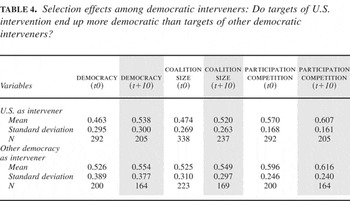
To learn whether this was the case we create Table 4, which shows the mean and standard deviation for the three lagged dependent variables (democracy-autocracy, coalition size, and participation competition) split by whether the intervener was the United States or was some other democracy. It also shows the same summary statistics for the dependent variables, measured ten years after the lagged dependent variable, again with the samples split by whether the United States or some other democracy was the intervener.
Selection effects among democratic interveners: Do targets of U.S. intervention end up more democratic than targets of other democratic interveners?

Table 4 confirms that a selection bias exists. The United States, on average, targets less democratic states for intervention than do other (mostly European) democracies.32
The source of this selection effect is beyond the scope of this study. It may be a consequence of differences in the military capabilities of the United States compared to other democratic interveners, or to the more extensive ties to former colonies among other democratic interveners, or to some other factors that we leave for future research.
It is also worth noting that ten years after an intervention, the degree of democracy in states that were U.S. intervention targets and in states that were the targets of intervention by some other democracy (or democracies) are statistically the same. The relevant t-statistics and probabilities are as follows: for the difference in the means for U.S. targets and targets of intervention by a different democracy based on the Polity index for democracy ten years after an intervention, t = −0.568, p < 0.60; for coalition size ten years after the intervention, t = −1.009, p < 0.40; and for participation competition, t = −0.429, p < 0.70. That is, all democratic interveners, as expected, tend to restrict the extent of democratic freedoms for their targets to comparable levels of symbolism without democratic substance. The absolute scores of democratic target states are also revealing. The standard cut-point in the literature for defining democracies based on the Polity index is equivalent to a score of 0.80. Contrast this with the mean democracy scores ten years after a democratic intervention which are only 0.538 (U.S.) and 0.554 (other democracies), well below the standard threshold and roughly equivalent to between 0 and +1 on the Polity −10 to +10 scale; that is, the scores for such countries as Zambia and Liberia in the late 1990s. The same is true for the other two dependent variables, highlighting the fact that neither the United States nor other democratic interveners create democratic polities.
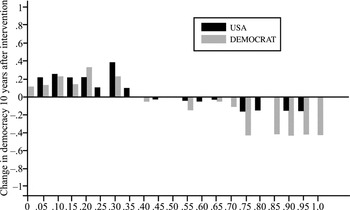
How does the United States behave relative to other democracies when their intervention targets are comparable? Figure 1 provides a way to see that comparison. Because we want to examine and compare comparable interventions by the United States alone and by other democrats alone, we redefine the variable democrat that appears in Table 2 so that it only includes democratic interveners other than the United States. By doing so we create a coefficient for usa that with milyn—rather than also summed with the coefficient for democrat—measures the impact of U.S. interventions on subsequent democratic reform. Additionally, in this analysis we exclude the cases of UN intervention as we are only interested in the comparison between the United States and other democracies when they instigate interventions without each other.

Democratic interveners foster the symbolism but not the substance of democracy in target states
To correct for the observed bias in selecting targets, we split our data set into three separate groups for analysis: one in which the democracy scores for the targets at the time of intervention were at or below 0.35; at or above 0.70; and between 0.35 and 0.70. The 0.35 threshold, recall, is the median score of a U.S. target of intervention and 0.70 is the median score for a target of a democratic intervener other than the United States. Naturally, there are cases of American and of other democratic interventions in each of the three groupings. We save the predicted democracy values when the usa is the intervener in each set and separately when a democracy other than the usa is the intervener. These predicted values are the basis of the comparisons in Figure 1.
The fixed-effects regression analysis from which Figure 1 is constructed evaluates the change in democracy over rolling ten-year periods, focused now on the ten-year first-difference between the democracy indicator and its value a decade later. So, rather than the dependent variable being the democracy score ten years later as in Table 2, it is now the change in that score. This is much easier to interpret graphically than the structure used in Table 2.
The independent variables are milyn, usa, and democrat, plus a control for year as before and country fixed effects. Because we are now looking at the actual change in democracy, there is no reason to include a lagged dependent variable. We also exclude cases in which the UN was a participant as that inevitably means participation by some democratic interveners and so muddies the separation we seek to achieve here.
In order for our second hypothesis to be supported, we should observe comparable patterns of democratic change as a function of the target's initial democratic conditions regardless of which democratic intervener was involved in the case. The vertical axis in Figure 1 plots the mean change over ten years in the normalized Polity score, while the horizontal axis locates that mean change according to each initial democracy value among the set of targets. As is evident from the figure,33
Confirmed by the regression analysis at 〈http://www.nyu.edu/gsas/dept/politics/faculty/bdm/Intervention_and_Democracy/〉.
Conclusions
While leaders of intervening states frequently assert that the democratization of the target state is one of their main goals, this article has presented evidence suggesting that this goal is rarely achieved. More often than not leaders of intervening states are faced with the choice of trying to satisfy the policy interests of their constituents to remain in office or promoting the democratic aspirations of the citizens in targeted states. Because the citizens in a transformed democratic target state are likely to have different policy priorities than those of the intervener's winning coalition back home, the intervening state will tend to pass up the opportunity to establish a liberal democracy in favor of establishing an autocratic or rigged election polity that it expects will be more willing to agree to implement the policies it desires. As a result, intervention does little to promote democracy and often leads to its erosion and the substitution of largely symbolic reforms, a fact that is clear for democratic interveners from Figure 1.
This outcome is not particularly surprising in the case of autocratic interveners, but in the case of democratic interveners many are likely to find it to be disappointing. While it is tempting to blame the failure of the quality of leadership that exists in connection with democratic interveners, we believe that it is more indicative of the limitations of democratic institutions themselves and the nature of democratic representation. Democratic leaders are constitutionally charged with being agents of their domestic constituencies and their voters' policy priorities are rarely identical with those of citizens in the target state. The fault, if there is one, lies less in the motives of the democratic executive than in the policy priorities of democratic voters and the incentives created by democratic institutions.
Appendix
We estimate the size of W as a composite index based on the variables regtype, xrcomp xropen, and parcomp. When regtype is not missing data and is not equal to codes 2 or 3 in the Polity data set, so that the regime type was not a military or military/civilian regime, we award one point to W. When xrcomp, that is, the competitiveness of executive recruitment, is larger than or equal to code 2 then another point is assigned to W. An xrcomp code of 1 means that the chief executive was selected by heredity or in rigged, unopposed elections, suggesting dependence on few people. Code values of 2 and 3 refer to greater degrees of responsiveness to supporters, indicating a larger winning coalition. xropen, the openness of executive recruitment, contributes an additional point to W if the executive is recruited in a more open setting than heredity (that is, the variable's value is greater than 2).
Finally, one more point can be contributed to the index of W if parcomp, competitiveness of participation, is coded as a 5, meaning that “there are relatively stable and enduring political groups which regularly compete for political influence at the national level”34
Gurr 1997, 18.
democracy, participation competition, and W are all normalized so that they fall between 0 and 1. Higher values reflect respectively more democracy, a more competitive party system, a larger selectorate, and a larger winning coalition.