Introduction
Many topics within the information and communication technologies (ICT) sector demand a detailed, historical assessment.Footnote 1 This article provides insight into the evolution of computer technologies in the commercial sector. The main purpose is to examine the adoption and use of information processing in retail banking, and more specifically, through the prism of one of its industries, the savings bank industry, as it has taken shape in western Europe since the 1950s. The need for this study lies in the fact that works of this type are not commonplace, in spite of the importance these technologies have had in shaping business practices in the late twentieth century.
The ground-breaking study by James W. Cortada, The Digital Flood, provides us an integrated view of western Europe’s experience with IT. It concludes that ICT in Western Europe during Wave One and part of Wave Two had an intense impact on the economic growth and investments as a whole.Footnote 2 Adopting this framework, this article follows the guidelines set by JoAnne Yates in her study on the life insurance industry in the United States.Footnote 3 The industry as a whole is therefore emphasized over any one specific company, thus focusing on the corporate users of these technologies and their role in shaping computing history as opposed to the traditional focus on producers. The literature on savings banks seldom considers the issue of technological change from the perspective of the industry as a whole and in a wide range of competitive environments.Footnote 4 To broaden this vision, this research considers twelve western European countries.
The role played by knowledge dissemination in the development and adoption of IT has been sufficiently corroborated, and it is within this framework that industrial organizations are important.Footnote 5 The savings banks offer us a similar scenario. The national savings bank industry associations and the sector’s worldwide association (the International Savings Banks Institute [ISBI])Footnote 6 play an important role in facilitating the sharing of information among their members, aggregating industry data, lobbying, and other specialized initiatives. This profile is accentuated by an institutional culture deeply rooted in the collaboration between “sister institutions” and a strong impact on civil society.Footnote 7
A review of the history on an industry level makes it possible to discriminate which specific elements are detected in the dissemination of office automation within this industry, as well as the mechanisms that drive the process of adoption, use, and technological dissemination. As has been indicated repeatedly in the literature, involved in this dynamic, at different levels and different intensity, are users, vendors, governments, industry associations, specific firms, and engineers and scientists.Footnote 8 This focus reveals the reciprocal influence of IT and its use and the influence of past practices on the adoption and use of new technologies. In short, the study of savings banks enables us to make comparisons between the insurance and savings bank industries. We can also observe whether an incremental technology migration path occured in the latter as it had in the insurance industry, or whether there are indications of disruptive processes in the dissemination of technology.
Along similar lines, the study of an industry within the framework of western Europe offers a unique vision of transnational cooperation in the old continent. Echoing the recently presented pan-European approach to IBM’s business in Europe,Footnote 9 this paper permits us to observe a pan-European user network and the diffusion of information technology.Footnote 10 In a certain sense, these can be effective steps to deal with the problems that prevent compiling a pan-European history of IT, difficulties that, as indicated by Cortada, are the consequence of a certain national exceptionalism, that is to say, the philosophy that “my country is unique.”Footnote 11
The savings banks were late adopters of technology, but as an industry, they followed certain original guidelines of their own in the adoption of computers. As a result, they offer an unprecedented perspective that suggests new points of view on the processes of technology adoption by business users.
In terms of documentation, this paper incorporates unpublished primary sources that have a solid foundation in the proceedings, publications, minutes, and reports of the ISBI international committees on automation and related associations between 1950 and 1995. The research has been based on firsthand material from the organizations themselves, including interviews with the individuals involved in the creation and development of this technological transformation. To avoid the inclusion of a massive amount of descriptive material from primary sources, the most illustrative cases have been selected, based on a balanced criterion that has enabled me to consider only those countries that were the most involved in the processes being discussed. On a similar note, the tables also contain some information not discussed in the text.
I address the proposed topic in the following manner: the second section highlights the collaborative bases of these institutions, the third investigates the transition of savings banks to the computer era, the fourth addresses the late adoption of computers in the industry, the fifth deals with the impact of teleprocessing, and the sixth considers the role of electronic fund transfers and new services; finally, in the last section, this article draws some conclusions.
Institutional and Cultural Bases for Collaboration in Savings Banks
As noted, the approach taken here highlights the role of trade and industry associations in mediating the spread of ideas and techniques. In this regard, collaborative processes are important to understanding the adoption and diffusion of computers in the industry. Savings banks had special conditions, having begun as nonprofit banks founded as private and charitable trusts, their capacity to amass savings and make use of funds deposited by the public converted them into the largest retail intermediaries in the Western world in the twentieth century.Footnote 12
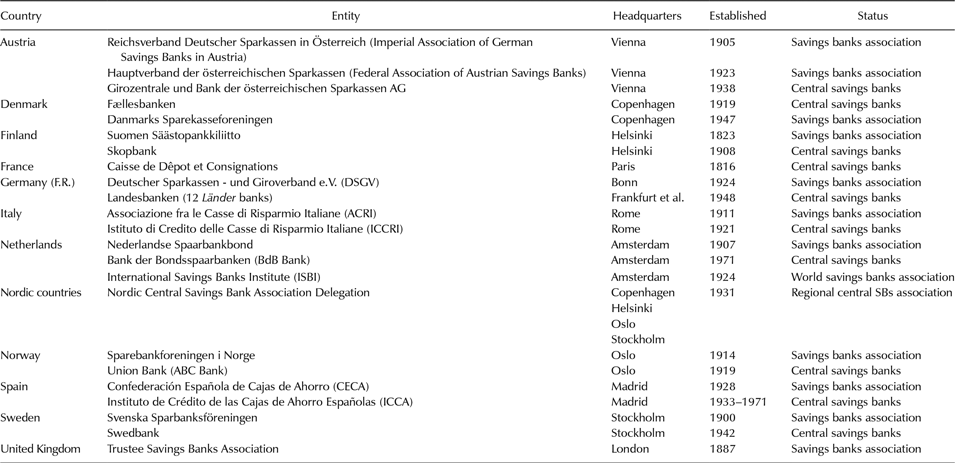
The associative framework of savings banks and some mutual institutions revealed characteristics that were very different from those of the industry associations formed by commercial bank groups and related institutions.Footnote 13 The competitive pressure experienced by the latter was greater; however, mutual and nonprofit banks either did not compete with one another (or were exposed to less competitive pressure) or, as in most cases, complied with their territorial boundaries until approximately the end of the 1980s.Footnote 14 In Europe these nonprofit institutions and some of the mutual institutions participated in an ideology and culture that identified their business as a quasi-public service.Footnote 15 As a result, during the interbellum period, the associative and organizational capacities of the savings banks were sufficiently mature for them to strengthen their position in the face of banking regulatory policies; they could compete with other financial intermediaries,Footnote 16 and they could further develop their technological, marketing and managerial strategies. This momentum gained force along two courses of action: one involving the development of industry associations, and the other implementing central savings banks that operated as wholesalers of retail finance with clearing functions (see Table 1). A key development in the phenomenon of association among savings banks was the inauguration of the First International Thrift Congress (Milan, October 1924), which would lead to the birth of the ISBI, a body consisting of a significant portion of savings banks worldwide.
Savings banks associations and central savings banks in Europe

Source: ISBI, Automation in Savings Banks, Situation Report at the beginning of 1969, Results of an Investigation (mimeo) (Amsterdam: International Savings Banks Institute, 1969); ISBI, International Savings Bank Directory (Amsterdam: International Savings Banks Institute,1987); and author’s own elaboration.
Some authors have noted the fundamental role played by technology committees in implementing IT processes at companies in the banking industry.Footnote 17 The ISBI structure provided a solid framework for these committees. Under the auspices of their corporate bodies, they established five permanent committees: the Savings Banks Central Banks Committee, the Development Cooperation Committee, the Business Organization and Automation Committee (BOAC), the Marketing and Publicity Committee, and the Education Committee. Supervised by these permanent committees, different ad hoc working groups built a collaborative structure for ISBI members.Footnote 18
This collaborative mentality was deeply rooted in the savings bank tradition. The words of ISBI president Per Olov Rimvall of Sweden in the early 1970s attest to this fact: “The Chairman stressed that co-operation is vital for savings banks to express their own opinion as distinct from those of commercial banks, so that their own ideas are taken into consideration in international negotiations in the banking field.”Footnote 19 The savings banks established an open and flexible system of technical collaboration that allowed each entity to opt for certain projects, according to its own interests, and to participate in different committees and groups.
Savings Banks Transition to the Computer Era
In Europe, during the interbellum years, the technological transformation in the banking sector was led by the commercial banks. Banks incorporated mechanical calculating machines, book-keeping machines, and other electromechanical devices, such as punched-card systems for back-office management. They expanded the use of European- and American-style tabular bookkeeping (Astra, Rheinmetal, Borroughs, NCR, Remington, and MADAS).Footnote 20 Savings banks adopted these processes sometime later, during the postwar period. This comparative delay allowed some companies to incorporate the next generation of machines, which are now considered to be the first forays into the field of digital computing technologies.Footnote 21
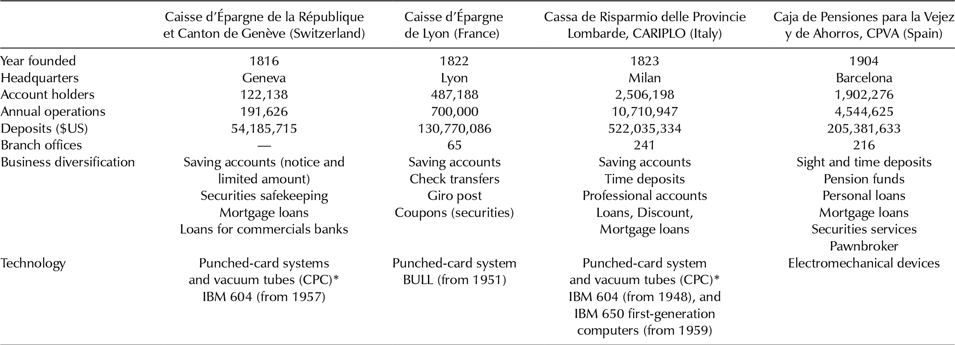
Table 2 presents the case of four European banks, which are representative of the mechanization processes in the savings banks of the postwar years. These banks were located in Italy, Switzerland, France, and Spain, and each had a great historical tradition and a strong impact on its areas of influence.Footnote 22 The board of directors of Caja de Pensiones para la Vejez y de Ahorros (CPVA) ordered a visit to the three banks in Italy, Switzerland, and France because of their degree of technological implementation at a time when the CPVA (known as “la Caixa” in 1975, and as CaixaBank today) proposed a shift in its technological structure, which was just as antiquated as that of other Spanish banks (which relied on traditional mechanical-based technology).Footnote 23
An approach to European savings banks business and technology in 1957

Sources: AHC, report to the board of directors about the visit to Europe by the commissioners of the board on January, 7, 1959; Ruiz Kaiser interview; and author’s own elaboration.
* CPC, card-programmer calculator.
The Cassa de Risparmio delle Provincie Lombarde (CARIPLO), one of the largest savings banks in the world, is a good illustration of the dynamics of technological options for larger companies before the computer era (see Table 2). In 1948, CARIPLO installed an IBM 604 (electronic calculating punch) machine in its home office in Milan. The IBM 604 was the height of tabulating technology, which was introduced shortly before the appearance of the early commercial computers.Footnote 24 The choice of any specific model was a matter of trial and error. Indeed, one decade after the arrival of the IBM 604, the accounting branch of the bank was highly dysfunctional. It suffered bottlenecks in its administrative and accounting processes that derived from only partially implementing the electronic system (i.e., the data-entry processes were not mechanized). Moreover, the core services lacked the organizational capacity necessary to centrally manage branch office operations. In 1959, this situation reached critical mass, and the bank chose to install new equipment, with the understanding that this option would allow it to take a step forward and overcome this critical situation. Note that this implementation occurred with the first generation of computers, the IBM 650 (card-and-drum-based computer), which were perfectly adapted to the preexisting facilities and favored an overhaul of the administrative and accounting operations of the company itself. Footnote 25
However, other banks, such as the smaller Caisse d’Épargne de la République et Canton de Genève in Switzerland, were more cautious. It was not until 1958, a decade after the CARIPLO, and once this model had already been proven at different market levels, that this particular entity also opted for the IBM 604. In this case, it created a completely integrated and mechanized system. The IBM electronic calculating punch was installed along with two National 2000 (NCR) models using a five-channel teletype, which allowed data entry for every operation via an alphanumeric keyboard.Footnote 26 This system eliminated the manual perforation that continued to be used in other banks, thus enabling the bank to have the end-of-year balances ready in five days’ time, with the help of only five employees (the previous Burroughs system had demanded a workload of forty-five days for twenty-five employees).
In France, the Caisse d’Épargne de Lyon had begun mechanization in 1951, using the French-made system produced by the Compagnie des Machines Bull (punched cards). This bank was much smaller than either the CARIPLO or the CPVA, and its business model was as basic as that of the rest of the French savings banks (Table 2).Footnote 27 According to its director, Léon Rigot-Muller (1945–1973), in 1957, “The punched-card system […] solves the serious problem of the volume of operations, specifically the problem of small-amount impositions.”Footnote 28 In addition, there were few doubts when it came time to select the equipment. End-users suggested that there were no large differences between the performance of the IBM machine and the Bull machine. For example, the opinion of the director of the savings bank in Geneva, Mr. Rangemont, was that, given the similar options, the board of directors opted for the IBM machine because it “offered quicker guarantees for cleaning service, repairs, and obtaining replacement parts.”Footnote 29
This timeline repeats itself for the rest of Europe. German savings banks, which had been early technology users before the war, resumed their progress along the same path after the war—despite the terrible consequences of the conflict. In 1948, the District Savings Bank Kreissparkasse Saarbrücken (DSB) incorporated punched cards into its bookkeeping equipment supplied by Dehomag (a German subsidiary of IBM). Its local competitor, Stadtsparkasse Saarbrücken (CSB), did not do so until 1955, and other banks waited even longer. Some years later, in 1957, the DSB was already combining punched-card machines and first-generation computers. As noted by Paul Thomes, German banks benefited from their staffs’ know-how, and some of these banks became leaders in change processes, but others maintained a traditional reliance on mechanical-based machines.Footnote 30 Throughout the 1950s, some Swedish banks, such as the banks in Stockholm and the bank in Gothenburg, implemented the mechanization process; the rest did so toward the end of that decade.Footnote 31 The bank in The Hague (Netherlands), for example, installed electronic accounting in 1957.Footnote 32
In observing the delay between savings banks and commercial banks, the documented cases seem to confirm how, after the war, there was a two-part trend in the modernization patterns of the savings bank industry: first, a traditional mode that supported the mechanical-based systems (such as what occurred in the Spanish CPVA and some German savings banks) until the end of the 1950s; and second, an innovative mode that incorporated punched card–based bookkeeping and even some machines that served as a bridge to the first generation of computers, the latter being introduced at the end of the decade (the CARIPLO and some German and Nordic banks). With regard to the factors that motivated these changes, the cases presented suggest that they occurred regardless of the size of the banks, the increased volume of small-amount impositions, and the diversity of their operations, since mechanization was introduced, with greater or lesser speed, indistinctly in the different institutions. However, as reflected in the literature, a series of common factors existed during the postwar period that provided incentives for the mechanization of the savings banks and the use of punched card–based systems. These factors were, on the one hand, the result of rapid growth of the business, and on the other hand, the existence of a very tight labor market (labor shortages).Footnote 33
The results obtained also suggest that the larger savings banks (in terms of savings volume and number of branches) at the end of the 1950s obtained access to the first digital computers. As a result, in spite of having adopted tabulating devices late in the game, they enthusiastically accepted the arrival of the computer era. Likewise, it also seems that this was not the general rule; most of the savings banks adopted them in the 1960s, once second-generation computers appeared on the market, as we will see later. In general terms, the introduction of electromechanical systems, and later, the newest advances in tabulating device technology and the early commercial computers, shows a gradual trend according to which the savings banks adopted new systems that were adapted to and integrated with previous practices and processes. Consequently, the available data suggest that the savings banks industry followed an incremental technological migration path, as indicated by Yates for the insurance industry.Footnote 34
Late Adoption of Computers: Owning Computers versus Shared Data Centers
Generally speaking, the savings banks were late adopters of computers compared with the commercial banks and other financial industries, such as the insurance sector, which incorporated these devices at much faster rates. Nonetheless, as we have seen, some savings banks were adopters of the first generation of computers, especially certain Italian, German, and Swedish institutions. The meetings of the ISBI’s Study Group on Automation in the early 1960s reflected intense interest among the European savings banks in exploring the advantages of the new computers, with special attention given as to how to implement the migration to the new computers from previous practices based on the use of electromechanical devices. During this era, some European savings banks started to incorporate second-generation computers, a trend that was firmly established by the middle part of the decade.Footnote 35 Among their advantages were faster processing speeds and a magnetic-core memory that could store information and program instructions written ad hoc. They fully incorporated third-generation computer languages (such as Formula Translator, or FORTRAN, and Common Business-Oriented Language, or COBOL, among others).Footnote 36 This boosted their use by savings banks, which began to use them to manage customer account files (initially, saving accounts).
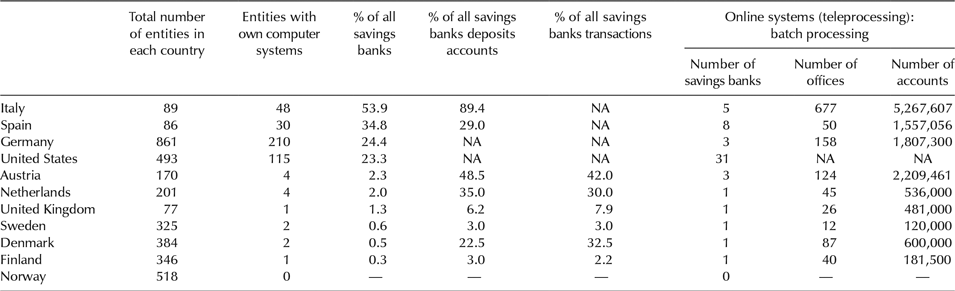
Tables 3 and 4 show the situation and the impact that computers had on savings banks in Europe and the United States. They refer to a dynamic moment at the end of the 1960s: most computers were second-generation machines, while approximately 20 percent were third-generation (see Table 4).Footnote 37 The introduction of computer resources in the European savings banks industry occurred in two different ways: some banks developed their own infrastructures, with their own computers (Table 3), while others shared resources through savings bank data center companies (Table 5). Through one method or the other, by the end of the decade, nearly 40 percent of European savings banks had computer systems. These large-scale computers needed to be located within appropriate infrastructures: the so-called data centers.Footnote 38 The first banking data centers in Europe opened thanks to second-generation computers. These movements were led by the large banks, which implemented their own computing resources. In 1961, Barclays activated the first financial data-processing center in the United Kingdom, installing an IBM 1401 computer.Footnote 39 Shortly thereafter, a few German savings banks launched their first shared data center, and in 1962, the CPVA opened its first computer center in Barcelona, which housed an IBM 1410.Footnote 40
European and U.S. savings banks with their own computer systems (listed in order of the percentage of total savings banks) at the beginning of 1969*

Source: ISBI, Automation in Savings Banks, Situation Report at the beginning of 1969, Results of an Investigation (mimeo) (Amsterdam: International Savings Banks Institute, 1969); . Ibid., appendix, Report of Spain.
* Including the imminent implementation of new computers in 1969.
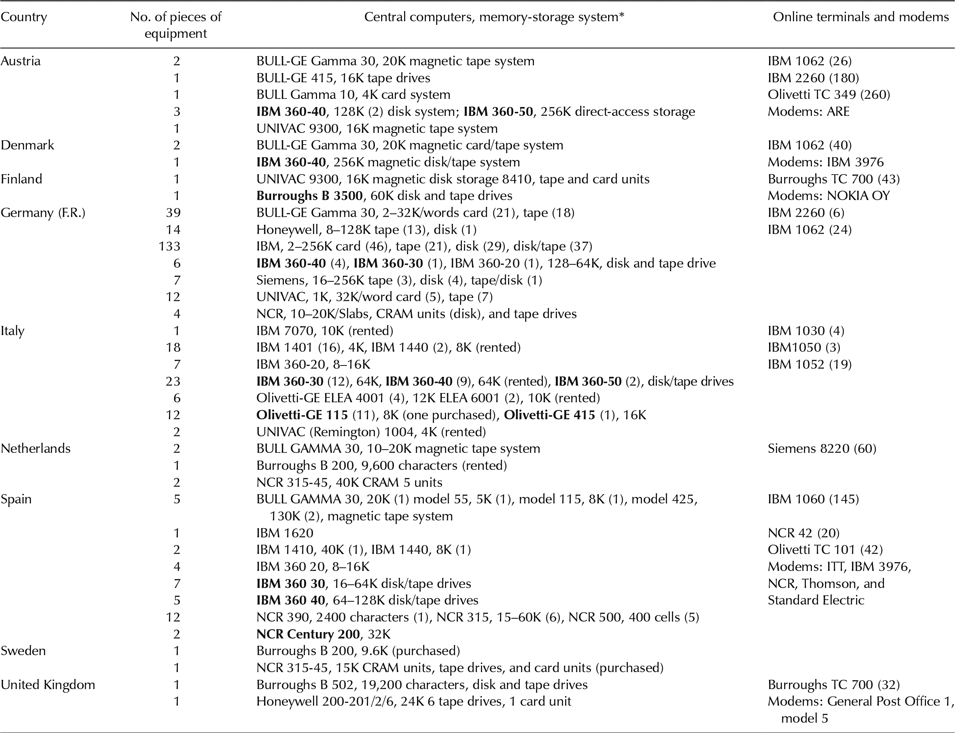
Computer equipment in European savings banks in 1969 (their own computer systems)

Sources: ISBI, Automation in Savings Banks, Situation Report at the beginning of 1969, Results of an Investigation (mimeo) (Amsterdam: International Savings Banks Institute, 1969); Ibid., appendix Report of Spain; ISBI, State and Prospects of Automation (Amsterdam: International Savings Banks Institute, 1969).
* The equipment with the capacity to support teleprocessing systems (third-generation machines) is shown in bold type, including the imminent implementation of new computers in 1969. The number of units in given in parentheses. 1K (kilobyte) is equal to 1,000 bytes and represents 1,024 memory positions.
Data center companies serving European savings banks in 1969

Source: ISBI, Automation in Savings Banks, Situation Report at the beginning of 1969, Results of an Investigation (mimeo) (Amsterdam: International Savings Banks Institute, 1969); and author’s own elaboration.
* The largest bank in the group acts as contractor, and the other banks have agreements with the main bank.
** Excluding Eight Bank Group.
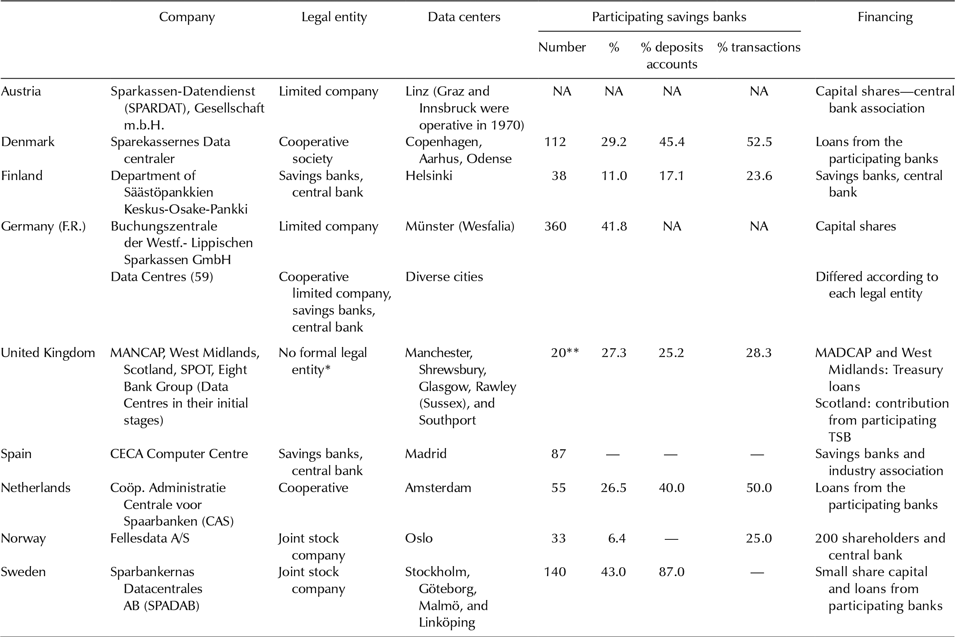
Table 3 shows that beginning in 1969, the countries with the largest concentrations of savings banks with their own computer systems were Italy, Spain, Germany, and the United States (between 23.3 percent and 53.9 percent of the institutions). In the case of Italy, for example, the level of computerization reached 89.4 percent of the deposit accounts. Other countries show a lower number of institutions with their own computer resources; however, the percentage of accounts managed using computers is high. This is the case in Austria (48.5 percent), the Netherlands (35 percent), and Denmark (22.5 percent); in all three cases, the savings banks with their own computer resources are large institutions that concentrate the largest number of customers. In other words, from a total of 3,550 institutions in Europe and the United States, 417 had their own computer resources (11.7 percent, or 9.9 percent if only Europe is considered). The computerization process soon accelerated; by 1971, 70 percent of Italian and Spanish savings banks and 75 percent of American savings banks already had their own computer resources at their disposal.Footnote 41
In 1969, the rest of the countries studied had a lower percentage of banks with their own computer resources. However, this does not imply that these banks were averse to the adoption of new technologies, but rather their computer services were being provided to a larger extent by savings bank data center companies, most of which operated on a regional level. In fact, of all the savings banks with computing resources in Europe, 73 percent accessed them through shared computer centers (see Table 5). Danish savings banks particularly stand out: 52.5 percent of their transactions and 45.4 percent of their accounts were managed through computer centers. Something very similar occurred in the Netherlands and Germany; however, the most developed case is that of Swedish savings banks, in which 87 percent of their savings accounts were managed using this method.
Worthy of special attention are the German and Austrian cases, in light of the difficulties faced by the small local savings banks, which are abundant in both countries, in assuming the costs of adopting computers. In Germany, the support provided by the Institut für Automation proved essential, along with the support of the German savings bank industrial association, which spearheaded the setting up and development of different regional data centers. In 1974, eleven data centers had been established, with 81.4 percent of German savings banks (all small in size) affiliated with them. In Austria, the problem was similar, and the creation of SPARDAT (Austrian Savings Banks Computer Center) in 1968 was a collective solution that was able to be implemented, thanks to the support of the large savings banks, which had acquired great experience in the use of computer resources.Footnote 42
Consequently, European savings banks showed a preference for adopting computer resources through shared computer centers, with the interested savings banks themselves participating in their financing and support (see Table 5). However, other countries failed to adopt this system (e.g., Spain, whose savings banks developed their own data centers), while most European countries adopted a combined system in which large institutions with their own computer resources existed alongside small banks that contracted computer services through savings bank data center companies. As the Austrian SPARDAT representative argued: “It was realized that institutes too small to justify the use of their own electronic data-processing department had the same need for information as the large-scale institutions.”Footnote 43 In short, the shared computer centers ended up being the most efficient option in terms of investment and results for the smaller savings banks, which saw them as an answer to their demand for installations with batch-processing mechanization. An intermediate option was to rely on a manufacturer’s service bureau or a non–savings bank institution. Their function was similar to that of the others, but their services were less in demand from savings banks.Footnote 44
Table 4 shows the consolidated introduction of second-generation computers in savings banks in the 1960s. It also reflects that a rapid transition to third-generation machines occurred. The ISBI survey presented a total of 344 central computers belonging to savings banks in nine European countries, of which approximately 20 percent were third-generation machines. The survey reflects the moment when the transition to the third generation of computers, the IBM System 360, and the development of actual operating systems (the OS 360) occurred. The new architecture offered tremendous advantages with its commercial applications. Of particular interest for the banking industry were the multitasking function and the installation of remote terminals that could access the central computer, providing direct-access storage and inquiry capacities—a crucial step toward managing the savings bank branch network, as we will see in the next section. These advances favored the development of software and made collaboration between vendors and bank users more flexible in terms of the implementation of new applications.Footnote 45
This stage appears much more closely linked to IBM than the previous one, in which the variety of brands was more noticeable (including the North American brands Burroughs, General Electric, Honeywell, NCR, and UNIVAC, and the European brands BULL and Siemens; Table 4). Around 1968, an important percentage of savings banks opted for different models of IBM’s 360 series and, to a lesser extent, for equivalent models from other brands, such as Burroughs and Olivetti-General Electric, and models from NCR’s Century series. There was little doubt about the leadership of the North American brand in the European savings bank third-generation computer market.
A New Milestone: Teleprocessing
European savings banks offer us new ideas about a controversial topic, namely, the introduction and adoption of online business systems. The analysis of these topics, like many others concerning technological innovations in the computer era, have often been influenced by trends of opinion that project a certain vision of the future.Footnote 46 As a result, a brief overview of the literature regarding online and real-time computing may contribute to contextualizing the contribution presented here.
In the 1960s, a mistaken opinion emerged that speculated with hypothetical horizons that opened the door to corporate real-time computing (e.g., the Air Force Logistic Command in the United States and totally integrated managerial information systems).Footnote 47 In the banking sector, a well-known example is the failure of Barclays in the same decade.Footnote 48 Some authors suggest that the interest in real-time computing in banking originated with the cash dispensers and ATMs and as a result of the previous experiences with batch-oriented accounting methods that anticipated real-time accounting in the 1970s.Footnote 49 In a general sense, a commonly accepted vision in the literature on the computerization of retail finance presents this problem as a step-by-step process in which several phases occurred, characterized by batch processing in the 1960s and a progressive adoption of online and online real-time processing in the 1970s and 1980s.Footnote 50
The insurance industry in the United States offers us a solid point of departure. These companies established connections that joined their home offices with the agencies to coordinate the national billing processes in the late 1960s. Technically, they combined a central computer with telecommunications equipment to allow remote access, but not yet providing full-time sharing.Footnote 51 In the area of online accounting systems, the savings banks also obtained very good results, even a little ahead of the commercial banks. Therefore, the study of some significant cases could illustrate the gradual introduction, adoption, and use of this combination of computers and telecommunication in the savings banks. From the early stages of banking information transfers until the end of the 1980s, experts most often referred to this technology as “teleprocessing.” We will consider three examples: the teleprocessing network used by “la Caixa,” the leader in the Spanish savings bank system; the Nordic Terminal Project (Datasaab), which gives us a very insightful view of the teleprocessing initiatives in the Nordic countries; and the case of computer centers in the United Kingdom and Germany.
Before this, as a general overview, the survey reflected in Tables 3 and 4 shows the impact of online terminal-based systems and services in the savings bank industry.Footnote 52 In 1968, 31 European and 50 North American savings banks were in the midst of adopting teleprocessing, a system that in Europe affected a total of 606 bank offices and 7.94 million customer accounts (Table 3). Along these same lines, the ISBI survey underscores the impact of the new online teller terminals (Table 4). These were still first-generation machines, referred to as “dumb terminals,” since they had no processing or data-storage capacities.Footnote 53 Although only a partial sample, it includes a total of 904 teller terminals that were installed in savings bank offices, accompanied by an impressive collection of modems (analog-to-digital signal decoders and vice versa) needed to connect the terminals to the central computers.
The technological base of “la Caixa” in the 1950s was reduced to the use of electromechanical accounting machines. Following the introduction of the first computer in 1962, the computer center in Barcelona processed on a daily basis the punched cards that were the result of the mechanization of the daily savings transactions of the 250 branch offices in Catalonia and the Balearic Islands.Footnote 54 The automation of files from the securities accounts, loans, and the institution’s staff payroll were gradually incorporated.Footnote 55 The practice during this first stage involved what Thomas Haigh defined as a “file management system,” which more closely resembled office automation than the integration and management of the corporate data as a whole.Footnote 56 In short, file management was based on ad hoc programming that required a good sync between the corporate computing services and the vendor (in this case, the IBM laboratory in Barcelona).Footnote 57
Teleprocessing took its first steps forward in late 1965, with the installation of the IBM 360-30. The new hardware was accompanied by the first-generation IBM 1062 teller terminals that were installed in the home office. Based on the experiences previously acquired with the off-line processes, in January 1967, the new system began to process front-office operations. The teller terminals were connected online to the central computer and had access to a disk with the file containing the account balances for the savings and current accounts of the home-office customers (all 270,000 of them). Logically, the back-office operations were carried out via batch-processing solutions, a field in which the former IBM 1410 continued to provide services. The online system expanded very quickly, incorporating first the urban offices in Barcelona, using dedicated point-to-point lines, and then progressing to encompass the rest of the offices belonging to the institution. By 1978, all 547 offices had teleprocessing capacity, with an average of 1.85 teller terminals per office.Footnote 58
This expansion was made possible thanks to the incorporation of the new IBM 370, with its more evolved architecture, and the IBM 2970 teller terminals, which had alphanumeric keyboards that could be connected to regular toll lines that were much cheaper than the private leased lines used previously.Footnote 59 The incorporation of new mainframes proceeded through the incremental migration path. In the field of teleprocessing software, ad hoc programming continued to be the norm, especially in relation to the management of data-transmission lines, an area that was still experimental, and one in which vendors were very interested in collaborating with “la Caixa.”Footnote 60 In general, banking operation support continued to be based on an electronic data file structure. Thus, in the 1970s, in spite of the expansion of teleprocessing, the base of the file-management system remained unchanged, although more complex transaction-processing systems were gradually being developed.Footnote 61
One unique element in the Spanish setting was the functioning of a data-transmission network after 1972, operated by the public telephone company (the High-Level Secondary Network, known as RSAN in its Spanish acronym). This network permitted many Spanish financial institutions, among them “la Caixa,” to access what was one of the first public packet-switching networks in Europe.Footnote 62 These infrastructures gave a strong impetus to the online banking giro/message-switching networks in Spain and also enabled “la Caixa” to begin a new era in teleprocessing, adopting high-speed lines that improved its performance.Footnote 63
The years around the turn of the decade were when strong technological momentum was really observed in teleprocessing as a result of the pressure stemming from the intense organizational change within the institution and its business expansion. It was at this time that quicker progress was made toward teleprocessing systems that were much more integrated, systems in which certain critical aspects of operations were progressively processed in real time. Applications were being implemented that were aimed at new financial instruments, intermediation products to capture funds, and applications that were intended to provide support for ATM operations.Footnote 64
This was accompanied by more powerful hardware, especially in the case of the IBM 3090, with which IBM began a new cycle from the 360 and 370 series,Footnote 65 and teller terminals with greater management capacity, the so-called intelligent terminals, with characteristics similar to those of a minicomputer. Between 1979 and 1983, the adaptation of DOS applications to the multiple virtual storage system (MVS), the new operating system that offered multitasking capacities when running programs, was completed.Footnote 66 Likewise, the new teleprocessing management systems and IBM’s proprietary databases (IMS FastPath for the MVS operating system) were also adopted in a comprehensive manner. Consequently, in the second half of the 1980s, a system became standard in which data were manipulated via a database management system DBMS interface rather than by directly manipulating the files themselves.Footnote 67 This decision must be contextualized in the environment of the reciprocal influences that had habitually been established between vendors and users, and keeping in mind that “la Caixa” was a strategic client for IBM in Barcelona, due to the carryover effects it had on other financial clients of the American multinational company in Spain.Footnote 68
The Nordic financial terminal project, Datasaab (Saab-Facit), is another excellent example that illustrates the synergies that were generated surrounding the adoption of computers and teleprocessing in the savings bank industry in Europe.Footnote 69 The Datasaab teller terminal (which came out in the market in 1972), was one of the first common projects by Nordisk Spardata (Nordic Savings Data, NS), the Nordic savings banks’ joint company for new technological projects founded in 1969. The managers of the Swedish and Danish savings banks were familiar with the North American experiences with teleprocessing, although their challenges were different, since the Nordic office networks were more numerous and dispersed than the branch networks in the United States. The need to develop online systems and the related high cost of their development, which depended on the available equipment (especially teller terminals), were considered obstacles to isolated national solutions in both Sweden and Denmark.Footnote 70 The project was well implemented by the Swedish manufacturers Saab-Scania and Facit between 1972 and 1975. As a result, approximately 15,000 terminals were installed in the Nordic countries and in Spain, the United States, France, the United Kingdom, Austria, Belgium, and Holland, both in savings banks and in other banking institutions.Footnote 71
There is little doubt that the Nordic teller terminal generated value for customers and savings banks alike: the new systems provided a central information file from which the savings banks could acquire a picture of the customer’s relations with the bank; the online system facilitated savings bank activities, such as updating entries; the data-processing centers would be able to process transactions more quickly; a customer’s account could be automatically adjusted via the central system, and the answer would be then displayed in a few seconds; and the installation of the new equipment created the necessary infrastructure to develop and apply the new products that were installed in the payment systems.Footnote 72 In short, this case shows the impact that some of the initiatives by the savings banks had, which went beyond the savings banks industry itself.
Throughout the 1970s, in most of the computer centers belonging to European savings banks, online processes took on greater importance. As an example, we will consider the case of the UK and German savings banks. In the United Kingdom in the early 1970s, the Trustee Savings Bank (TSB) was involved in implementing two solutions, one based on batch-processing systems, while other TSBs opted to install online teller terminals in their branches, connected to the computer center. Altogether, this amounted to 7 regional centers that managed 9.96 million accounts (of which 6.6 million had online access, covering around 750 branches).Footnote 73 In Germany in 1974, 22.3 percent of the savings banks belonging to one of the 11 existing data centers had online teller terminals connected to the computer center.Footnote 74 Years later, in 1982, the online coverage, with real-time access to certain operations, already amounted to 91.9 percent through 18,100 online teller terminals.Footnote 75
The case of the Nordic countries, “la Caixa,” and the German and UK computer centers illustrate the role that the adoption of online computing played in the European savings banks industry as a basis for developing online business systems. The Nordic savings banks exemplify the intense collaboration that occurred between national industry associations and the savings banks themselves, a pattern that extended throughout western Europe and is a sign of the synergies created by the introduction of computer technologies on the entire continent. Similarly to the case of “la Caixa,” it gives us an idea about the establishment of an incremental migratory path in relation to teleprocessing from off-line to online procedures; it also provides valuable information about the active participation by the savings bank industry in the adoption of computers and software for commercial use. In short, it allows us to see the reciprocal influence between users and vendors referred to in the literature.
In brief, the concept and application of the online processes in the savings banks industry stemmed early on from the need to automate and centralize the information exchange processes between the branch and the main office balance sheets. The objective was to obtain centralized “daily” data on transactions in every customer account.Footnote 76 Savings banks led this movement, because they had a greater need for online processing of passbook savings account transactions that tellers performed at their windows in their office networks.Footnote 77
A Networked World: Electronic Funds Transfers and the New Retail Services
The banks had used computer technologies to greatly reduce paper-based transactions; however, at the dawn of the 1970s, a new practical horizon had already opened up for the use of computers with regard to electronic funds transfer (EFT) systems. The savings banks did not remain on the sidelines of this trend; as indicated in the literature, the use of computers beyond back-office batch processing offered financial institutions new ways to participate in the area of cash dispensers, ATMs, and EFTs at the point of sale (EFTPOS), as well as in a wide range of financial services that they would gradually consolidate.Footnote 78 According to David L. Stearns, initiatives such as VISA changed the ways in which banks and consumers related to one another. A payment instrument like credit cards, which initially consisted of a simple credit vehicle of a local nature, was transformed into an instrument that provided access to a “global electronic value exchange network.”Footnote 79 The bank card companies integrated multiple competitors that, through them, could offer services that they were not individually in any condition to offer, due to their high cost of implementation.
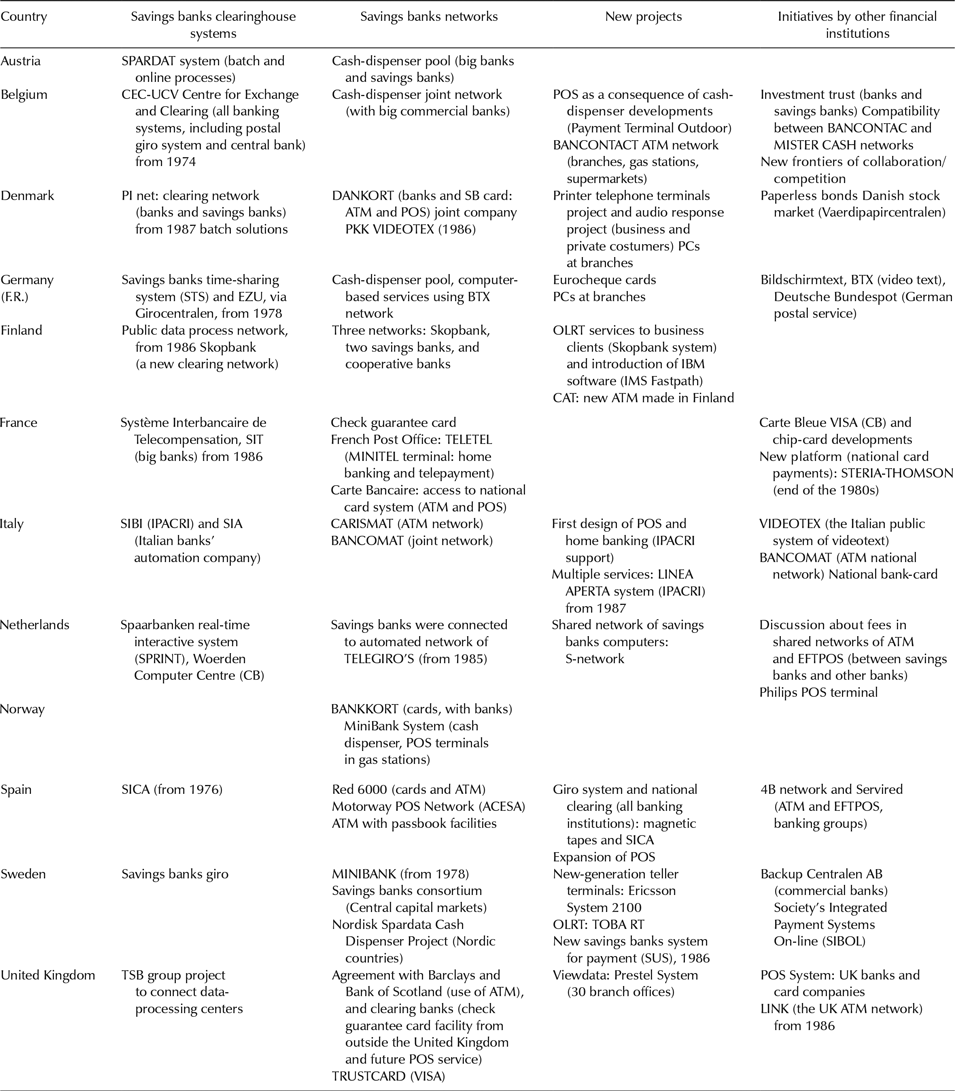
In fact, there was sufficient evidence in the 1970s and 1980s, especially in the United States, Europe, and Japan, to confirm the role the savings banks were playing in the area of EFT and new retail services (Table 6).Footnote 80 Consequently, their analysis in terms of the industry offers new perspectives on the use and application of computers in the banking business. Many of the central savings banks and savings banks data center companies were interested in developments in savings bank clearinghouse systems (see Table 6). These systems were created as message-exchange networks to provide services for exchange processes among the different affiliated institutions. They were normally centralized and were under the technical control of the central savings banks or the industry association itself.Footnote 81 Simultaneous with the establishment of these clearing structures, the industry also saw, first, the expansion of networks supporting cash dispensers, and second, EFTPOS.
Payment and clearing system services in savings banks and other financial institutions in Europe, circa 1980–1985

Sources: ISBI Archive, minutes of working groups and meetings of BOAC, 1970–1990.
The first banks in Europe to experience these related events were the Nordic savings banks, and the resulting collaborative experience of NS throughout the Scandinavian countries encouraged new projects.Footnote 82 Another case of an expanding bank-owned network was the Spanish Tarjeta 6000, supported by the savings bank industry association (CECA) and the savings bank giro/message-switching network (SICA), which in 1978 had distributed 230,000 cards and had 110,000 businesses registered on the system.Footnote 83 However, a short time later, the savings bank network reached strategic agreements with the other Spanish credit card networks: 4B and Servired (headed by different banking groups). Finally, the German savings banks had online systems that provided support for a growing ATM network in Munich, Stuttgart, and Hamburg. In the early 1980s, the German savings bank association created a nationwide savings bank time-sharing system, following the model in the Rhineland region.Footnote 84 Throughout the decade, the cash-dispenser pool gradually built up an interbank network on a national level.Footnote 85 During the same period of time in the rest of Europe, countries such as Belgium, France, Italy, and the United Kingdom saw similar developments (see Table 6).
In short, the overview presented shows that by around 1987, the savings banks were fully immersed in maintaining their position in a world dominated by several major payment systems groups. These groups had forged strategic alliances with the major financial institutions in most developed countries.Footnote 86 EFT services were unquestionably becoming a real competitive weapon used among the different banking constituencies (commercial bank groups, savings banks, postal giro, and mutual banks). A representative example of this is the UK Barclaycard, which in 1969 could be used as a credit card and a check guarantee card;Footnote 87 gradually more services were added, including a cash-dispenser card in 1976.Footnote 88 Meanwhile, the German post office provided support in the mid-1980s to a Videotex network, Bildschirmtex, which was subscribed to by the savings banks (see also Table 6, “Initiatives by Other Financial Institutions”).Footnote 89 This forced the savings banks to review their positions and analyze their perspectives, expanding their collaborative strategies beyond their own industry. This change in position occurred especially intensely in those areas in which there was a high cost associated with implementing EFT, such as in the case of credit cards, ATMs, and EFTPOS networks.
In the mid-1980s, retail banking was characterized by a strong trend toward service banking. In both the United States and Europe, pressure from non-banks was shrinking the competitive market for payment systems and other services targeting banking customers. The landscape for IT had changed, and the banking strategy was evolving; consequently, the new competitive framework generated a fierce dispute over consumer services between the financial and nonfinancial intermediaries. The result was two sides of the same coin: collaboration to reduce network costs and strong competition in the area of direct services to consumers.
The most advanced developments in banking services occurred in United States and Europe. Many savings banks considered various ideas related to Videotex and Home Banking. These institutions considered multiple solutions, including telephone services (i.e., telephone bill pay in the United States), television use (United States, West Germany, and Prestel in the United Kingdom), computer use (United States and Belgium), and Minitel (France and United States), all of which had their pros and cons. The information networks operated as public utilities and opened up a new market sector, supported by economies of scale in mass markets.Footnote 90 As a result, and with regard to these developments, in the decade before the advent of the Internet, savings banks pondered their role within the retail banking industry.
One significant case is the Italian IPACRI, which offered banks a franchise arrangement that gave them technological access to a multiservice, online, real-time system beginning in 1987. The so-called Conto Reale (real-time account) was the first service provided that included both home banking and cash management, focusing not only on the savings banks themselves, but also on their business clients in particular.Footnote 91 However, the corporate electronic banking services (CEBS) option was not widespread. German, Austrian, Swedish, and Finnish savings banks showed only passing interest in the service, because they already considered that “cash management did not offer as many advantages to the firm. It was only a little quicker than waiting for the daily statement, and more convenient to consolidate accounts.”Footnote 92 Similar reactions came from the UK TSBs, as Jack M. Large, head of financial services development for the TSB Group PLC, London, and editor of Cash Management News, warned in 1987:
“What’s new is best” is a silly and dangerous idea. Yet it dominates many banks’ ideas on CEBS. The wrong use of CEBS can cost you millions and produce little or no benefit in terms of either new customers or extra revenue.Footnote 93
He therefore insisted on extrapolating the banks’ strategic knowledge of the corporations’ internal cash and treasury systems, as well as the costs and realities of payment processing in corporations.Footnote 94
New product lines were created to attract more customers (both household and business). Belonging to payment networks had its benefits, but it also implied a loss of identity for traditional savings banks. It was difficult for any bank to go it alone; the savings banks’ know-how played in their favor, despite the pressures of deregulation and strong competition.Footnote 95 As noted by B. Hedberg of Sweden, vice president of Svenska Sparbanksförenigen, at the 1984 International Automation Conference in Tokyo, “The technology that is about to change the world—also the banking world—is a mix of computer hardware, communication systems, and decision support models.”Footnote 96 Savings banks at this juncture had to decide how best to serve their customers, and how to manage technological investments; all in all, this contributed to growing uncertainty. Ultimately, there is evidence that in the years before the explosion of the Internet, IT affected not only how banks operated, but also what services they offered and where those services were provided. ICT were creating trends that would later become hegemonic, while also determining which banking services were being offered.
Conclusions
The study of a particular industry, European savings banks, has provided us with new insights about the processes of adoption and dissemination of computers in the commercial sector. Following the path of Yates, we have opted to study a set of users forming part of a single industry and located in a specific territorial setting, western Europe, during an intense period between the postwar years and the introduction of the Internet. In institutional terms, this industry has its own specific traits, of which we should emphasize two aspects: first of all, the strong integrative and pan-European nature of the savings banks studied; second, we have been able to define a complex framework of relationships—to date, relatively unknown—in terms of a pan-European network of corporate IT users.Footnote 97 This was a very participative network, woven around a base consisting of individual savings banks and their national industry associations and articulated through technological committees under the supervision of the ISBI’s corporate bodies. Many of the technological and organizational results outlined in this work can only be understood within this institutional framework, which takes on special relevance with regard to other cases studied in the literature on industry and trade associations.
The European savings banks were late adopters of electromechanical resources for back-office operations, with the commercial banks accessing electromechanical devices well before the savings banks did. The documented cases suggest that the forces that led the change in the postwar period had more to do with the general economic conditions and the situation of the labor market than the operational characteristics of each particular savings bank. After the war, the European savings banks held a dual position, some maintaining traditional technology (mechanical-based systems), while others adopted punched card–based bookkeeping. The large savings banks manifested greater momentum, and in exceptional cases, accessed the early commercial computers at the end of the 1950s. The results obtained suggest the existence of an incremental migratory path in the processes of technology adoption by the savings banks, introducing gradual improvements that favored the mechanization of back-office processes. In this sense, unlike the practices previously experienced by industries such as the life insurance industry in the United States, there were no signs of what Yates terms “co-evolution” (in other words, the reciprocal interaction between tabulation technology and its use).Footnote 98 The cases presented here suggest that no special interaction occurred with the vendors, because the savings banks were late adopters of said technologies. As a result, once they started using them, they were able to benefit from the prior experience of other financial intermediaries.
Access to computers occurred late, with savings banks adopting second-generation computers. In 1968, 40 percent of the European savings banks had access to computers, and by the beginning of the next decade, more than half already had them. This new process was marked by a strong dimorphism in the European savings bank system, wherein large savings banks coexisted with a large number of small local savings banks. This article documents that the large mass of small savings banks showed a greater propensity to access computer resources via shared data centers, while large savings banks were self-sufficient and had their own computers. The great success of the savings banks was to opt for an efficient manner of accessing IT. Data centers as shared infrastructures reduced costs and made the investments more efficient, being built with the financing of the affiliated savings banks, the support of industry associations, and the technological assistance of the central savings banks.
The savings bank industry offers us a suggestive approximation to the adoption and use of online business systems in retail banking. This research documents the results of the savings banks in the field of online accounting systems, extending their use before some commercial banks and in a way that was less disruptive, through an incremental migratory path. This leadership is quantified at the end of the 1960s, when the industry begins to act as an early adopter in the European region, as acknowledged by contemporary authors such as Richard E. Sprague. As the ISBI reports highlight, at this point in time, the start-up of online processes should be understood as an evolution in office automation, alongside batch-oriented accounting, an aspect that has not been sufficiently stressed in the literature. These roots are evidenced in the transition from the off-line processes to teleprocessing (online processes), and the implementation of teleprocessing at “la Caixa” cannot be understood without the prior experience acquired with off-line processes before the arrival of the IBM System 360. File management through ad hoc programming and the use of point-to-point lines owes a lot to this experience and the need to have centralized access to the customer balance files for every office. The cases studied, including the aforementioned cases of the Nordic teller terminals and the German computer centers, show no evidence the need to manage the customer and branch accounts in a centralized manner was not the primary motive for establishing the online procedures. However, as indicated by the literature and documented by this work, the teleprocessing networks were a solid base for the development of the EFT networks.Footnote 99
Ultimately, the development of teleprocessing in the saving banks arena clearly reflects the predominance of an incremental migration path in the industry, from its initial steps in the 1960s until its development in the 1970s and 1980s. The research conducted makes it possible to point out three aspects that confirm this hypothesis, both from the point of view of hardware and software. First, a good example of incremental progress was the coexistence of old and new mainframes during their service life until the oldest ones were retired and the cycle was renewed. Second, the development of customer file management programs and the development of teleprocessing line control programs was represented by a succession of applications that demanded different adaptations to the new operating systems (DOS and MVS) and the new mainframe architecture. Finally, in the mid-1980s, the arrival once and for all of the DBMS and the growth of real-time processes as the result of the diversification of banking services and business expansion demanded successive adaptations. The coevolutionary factor was also very present in beginning in the early moments of teleprocessing (extending the concept of the computer era), as reflected by the case of “la Caixa”: users and vendors reciprocally feed into one another, an aspect that is also perceived in other cases in the European environment.Footnote 100 The savings banks confirm the hypothesis by Yates: the reciprocal influence of technology and its uses was at work over long periods of time and throughout the technological changes.Footnote 101 If the life insurance association in the United States dealt with processes such as teleprocessing in the 1970s, including management science and database applications, the evidence revealed suggests that the European savings banks were not far removed from these concerns.Footnote 102
The savings banks gradually implemented a technological base that favored the development of savings bank EFT networks. This was an area in which the European savings banks were not starting from scratch, and therefore they were in a position to be able to compete and contribute added value to increasingly extensive networks, thanks to the early developments associated with the online savings bank giro/message-switching networks and computer centers. These infrastructures favored the newly established ATM and EFTPOS networks from the European savings banks and offer us a glimpse of a little-known aspect of the introduction of IT in Europe. The documented cases offer evidence that the savings banks lacked the long-term capacity to support their own networks in an environment of high maintenance costs and growing competition. As a result, they were forced to revise their traditional strategy, moving away from intraindustry positions to interindustry collaboration, participating in joint banking networks to develop ATM and EFTPOS networks. This phenomenon was evident in the 1980s, with the development of a services bank that polarized the trend: interbank collaboration to implement the network infrastructures through joint companies and fierce competition in the offering of new services.