I. INTRODUCTION
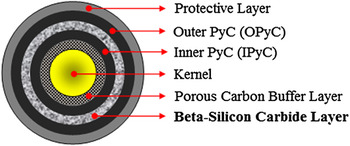
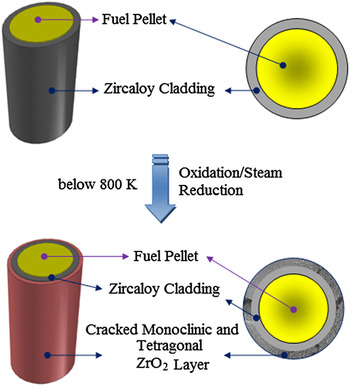
Due to the excellent properties and stability under harsh environments, silicon carbide (SiC) and its composite materials are proposed as a structural component in various nuclear reactors. Per se, it is of interest for use as a layer in tristructural isotropic (TRISO) fuels, layer on Zircaloy, insulating material in nuclear fusion systems such as separators, or insulating flow channel inserts, between tritium breeding and neutron multiplier materials composing Li–Pb blanket modules.Reference Katoh and Cozzi1–Reference Carpenter, Ahn, Kao, Kao, Heizlar and Kazimi7 In addition, properties such as high thermal conductivity, high hardness and stiffness, mechanical strength at elevated temperature, low coefficient of thermal expansion, good dimensional stability under irradiation, small neutron capture cross sections, low density than other ceramics, and resistance to wear and abrasion make SiC ideally suited for a vast number of applications, especially in nuclear reactors.Reference Kordina, Saddow, Saddow and Aggarwal8–Reference Andrievski10 Of note, here is that SiC-coated TRISO particle-based fuel offers a path to reach very high burnup and extended core lifetimes. It is favored because there is a wealth of experience in relation to high temperature reactor (HTR) fuels in the world: Germany (HTGR), United States (NP-MHTGR), Japan (HTTR), Russia (HTGR), China (HTR-10).Reference Acır and Altunok11–Reference Nabielek, van der Menwe, Fachinger, Verfondern, von Lensa, Grambow and de Visser-Tynova14 These particles are designed to withstand at high temperatures (∼1873 K) and not to crack due to the stresses from differential thermal expansion or fission gas pressure. TRISO concept is based on a microfuel particle with a porous carbon buffer surrounded by a dense inner pyrolytic carbon (IPyC), SiC, followed by an outer pyrolytic carbon (PyC) (Scheme 1).Reference Krueger and Ivens15–Reference Boer, Sen, Pope and Ougouag18 The investigations of the Three Mile Island, United States and Fukushima, Japan accidents found that a stronger cladding material would have better handled the incident’s core melting conditions and might have averted some of the problems that arose during shutdown. The unique properties and good record of accomplishment of the zirconium-based metal Zircaloy facilitate its use as a standard fuel cladding in various nuclear reactors. While it has a good record of accomplishment, Zircaloy becomes more liable to failure as its time in service increases, so fuel rods are withdrawn from service preventively despite having substantial remaining capacity to produce energy.19 For instance, the heat of a solution of hydrogen, produced by the strong exothermic zirconium-steam reaction, in zirconium relative to 1 mol H2 is about half the enthalpy of the strong exothermic oxidation reaction by steam and may therefore influence the energy balance during severe accident transients at least temporarily (Scheme 2). During the oxidation process, the formation of a cracked monoclinic outer and an inner tetragonal layer of ZrO2 with porosity, where oxygen transport is controlled primarily by the number of oxygen vacancies, over Zircaloy tube was reported by Causey et al.Reference Causey, Urbanic and Coleman20 It is believed that SiC coatings applied to the Zircaloy cladding can drastically reduce this corrosion and degradation, due to its resistance to corrosive environments at high temperatures and order of magnitude less chemical reactivity with water or steam.Reference Baney, Tulenko and Butt21, Reference Chenga, Baneya and Tulenkob22Recent reports recommend SiC and SiC/SiC as promising materials for supplementing or replacing Zircaloy cladding and are expected to offer improved safety features, reduced contamination of the primary circuit, and a simplified disposal process.Reference Krueger and Ivens15, Reference Jiang, Jiao and Wang23
Lateral view of TRISO layers deposited on kernel.

Pictorial view: Steam reaction on Zircaloy tube (cladding or fuel tube).

SiC is a wide-band gap semiconductor material with high breakdown electric field strength, high-saturated drift velocity of electrons, and high thermal conductivity. Due to the combination of the above said properties and his findings, Shockley,Reference Shockley24, Reference Fraga, Pessoa, Maciel, Massi and Oliveiria25 the inventor of the bipolar transistor, recognized that SiC is essential to the development of microelectronic devices. Further, the device can withstand harsh environmental conditions (extremes of pressure, temperature, shock, radiation, and chemical attack) where silicon cannot be used at such high temperatures and intense applications. SiC is more successful in resistance than Si or diamond-like carbon with chemical, wear, mechanical, and oxidation. Myers et al.Reference Myers, Cheng, Jamshidi, Azevedo, Senesky, Wijesundara and Pisano26 reported that polycrystalline 3C–SiC sensor resonates in air and can operate at 873 K in dry steam. The development of advanced ceramic (e.g., SiC) semiconductors has enabled a new class of sensor and electronics that can operate in hostile conditions and is also believed to contribute to increased fuel efficiency, increased operation lifetime, and reduced emission (in aircraft propulsion, industrial gas turbines, and automotive engines). A small amount of research has been devoted on SiC thin films as a material for micro-electro-mechanical system (MEMS) in high-temperature or severe environment (e.g., car engines, auto tires, nuclear reactors, and nuclear waste storage facilities). Recently, Jia et al.Reference Jia, Zhuang and Wang27 studied the possibility of using SiC nanotubes (SiCNTs) with an external electric field as a potential gas sensor for SO2 detection using first-principles density functional theory and found that SiCNTs can effectively be used as sensors for detecting SO2. In our nuclear applications, SiC detectors have now been verified for high-resolution α-particle and x-ray energy spectrometry, β-ray detection, γ-ray detection, thermal and fast neutron detection, and fast neutron energy spectrometry. For SiC detector development, the presence of many research groups worldwide augur well for the future of SiC detector applications.Reference Franceschini and Ruddy28
The most common SiC polytypes are 2H–, 4H–, 6H–, and 9R–SiC, as well as 3C–SiC (H: hexagonal; R: rhombohedral; C: cubic). SiC polytypes are differentiated by the stacking sequence of each tetrahedrally bonded Si–C bilayer. By referencing the possible positions as A, B, and C, we can begin constructing polytypes by arranging the sheets in a specific repetitive order. Thus, only 3C–SiC has the stacking sequence of ABCABC…. 2H–, 6H–, and 4H–SiC have stacking sequences ABAB…, ABCACBABCACB…, and ABCBABCB…, respectively.Reference Kordina and Saddow29 In fact, the distinct polytypes differ in both band gap energies and electronic properties. Due to its smaller band gap,Reference Choyke and Pensl30 high surface area, and low density, 3C–SiC has many advantages compared to the other polytypes. Besides, the electron Hall mobility is isotropic and higher compared to those of 4H– and 6H–SiCs.Reference Pensl, Bassler, Ciobanu, Afanas’ev, Yano, Kimoto, Matsunami, Agarwal, Skowronski, Cooper and Janzén31, Reference Polychroniadis, Andreadou and Mantzari32 The chemical bonding in SiC is not only covalent but also slightly ionic due to the differential electronegativity between silicon and carbon. Therefore, the stable SiC is obtained only at the stoichiometric composition of Si to C. The cubic form of β-SiC is believed to be more stable than the α-SiC below 2373 K, although some studies dispute this finding. Thanks to Snead et al.Reference Snead, Nozawa, Katoh, Byun, Kondo and Petti2 for the recent review on properties and applications of SiC. Moreover, the SiC research findings reveal that the growth techniques and crystalline size of SiC play an important role in electronics and nuclear applications. In support of this, computational studies have shown that the decrease in the grain size of SiC to the nanoscale can considerably increase the toughness and strength of the material. The results suggest that under lower energy irradiations, nanocrystalline (nc-) SiC has superior radiation resistance than micrometer-scale grains.Reference Snead, Nozawa, Katoh, Byun, Kondo and Petti2In the present review, the main perspective is devoted to the presentation of general considerations about the development techniques, mainly by chemical vapor deposition (CVD), relevant chemistry, and material properties for nuclear reactor applications.
II. SiC: DEVELOPMENT AND TECHNIQUES
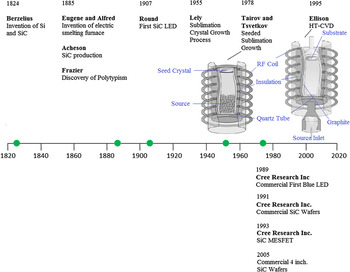
Berzelius is known for his invention of silicon (Si) and he was the first person who more than likely synthesized SiC. In 1824, he published a paper where he reported that there was a chemical bond between Si and carbon (C) in one of his samples. Years later, Acheson produced a crystalline, hard, refractive, and infusible compound of carbon and silicon material by mixing coke and silica in a high temperature furnace.Reference Kordina and Saddow29 As one may see in Fig. 1, the activity has varied over years with development and production. In the late 1970s, an important invention—the seeded sublimation growth—was made by Tairov and Tsvetkov. The larger diameter with high growth rate and length of SiC was developed, which could be sliced and polished. In 1995, a novel technique, called high temperature CVD, was presented for the growth of SiC. This technique uses gases/vapors instead of a solid/powder as source material.Reference Kordina and Saddow29 Currently, several different types of CVD reactors and processes exist. Aside from the CVD process, other techniques such as sintering, direct conversion, and polymer pyrolysis are used for the synthesis of SiC. The sintering process is further classified based on the sintering agents used, consolidation mechanisms, and methods of pressurization. For instance, the developed β-SiC particles by pressure-less sintering process (2293–2373 K) do not work well under neutron irradiation due to the large cross section of the 10B isotope (Boron used as sintering aid).Reference Snead, Nozawa, Katoh, Byun, Kondo and Petti2
Research and development on SiC over years.

The CVD process has the advantage of producing high-quality surface coatings, with high densities, excellent adhesion, and nanocrystalline structures. Besides, the technique such as thermal spraying or plasma spraying is used to produce SiC at atmospheric pressure. The resulting deposits by thermal/plasma spraying tend to suffer in terms of adhesion, density, fracture toughness, hardness, composition homogeneity, uniformity, and surface smoothness. The physical vapor deposition technique suffers from the drawback that it is a line of sight process and is not suitable for coating on complicated geometries. The sputtering process needs to be performed under a “hard” vacuum and usually requires expensive and complex equipment. The sol–gel-produced SiC presents rather low density compared to other synthesis methods. Indeed, the deposit is highly porous in nature due to the evolution of gases during carbonization and carbothermic reduction of gel precursors. Consequently, there remains a need for a deposition process that can deposit relatively thick coatings at high rates, yet still produce high-quality surface coatings. Additional advantages could be realized if the deposition process is carried out at atmospheric pressure and with relatively inexpensive equipment. Based on different deposition features used to obtain films, a number of forms of CVD are widely used. For example, plasma-assisted/-enhanced CVD utilizes plasma as the source material to enhance the deposition at lower temperatures. Low-pressure CVD allows depositions at subatmospheric pressure. Low pressures tend to reduce unwanted gas phase reactions and improve film uniformity across the substrate materials.
Usually in the CVD process, the substrates are laid on a support and do not present all their faces to the reactive gas simultaneously. If deposition is required on all sides on the substrates (coating on particles or powder or complex geometry), the most efficient way to achieve the same is through the adoption of the fluidized bed (FB) technique using a gas stream flowing from the bottom of a vertical reactor. In the past, the development of micronuclear fuel element was demonstrated by CVD reaction using FB CVD. FB CVD is a unique technique to coat nuclear fuel particles for high temperature nuclear reactors, which was developed in the late 1950s. The advantage of a FB reactor with its fast heat and mass transfer permits heating the particles or any object to be coated at uniform temperature, and the result is a uniform coating all over the faces. Interestingly, the deposited SiC by other possible methods shows the absence or inadequate formation of pyrolytic SiC. The variant of the FB process—the so-called, spouted bed reactors—has been in use since the 1960s to coat radioactive particles with PyC and SiC. Considerable progress was achieved in the 1980s in this field driven by the need to obtain spherical fuel elements with high qualification yield. The representative microstructure of the FB SiC material is summarized elsewhere.Reference Selvakumar and Sathiyamoorthy33Scheme 1 shows the microstructure of multiple coatings on a UO2 kernel fabricated using the FB CVD process. The low-density buffer layer of PyC is obtained by the decomposition of acetylene (C2H2) at temperatures ranging from 1573 to 1673 K with the density controlled by the gas concentration and temperature. The dense pyrolytic layers are obtained by the decomposition of a mixture of acetylene and propylene (C3H6) at temperatures ranging from 1573 to 1673 K. The deposition rate is lower compared to the buffer layer. The SiC layer is also obtained by a CVD process involving the decomposition of methyltrichlorosilane (MTS, CH3SiCl3) with H2 at 1873 K.Reference Petti, Buongiorno, Maki, Hobbins and Miller34–Reference López-Honorato, Meadows, Tan and Xiao37 Among these layers, the SiC coating has received particular attention since it provides the mechanical stability to the fuel and serves as the main diffusion barrier to the release of fission products. A very peculiar feature in the production of this type of coating is that the grain size grows considerably with thickness. Since the grain size has an important effect on the diffusion of fission products and on the mechanical properties of ceramic materials, changes in the grain size could be detrimental to the properties of SiC.Reference Lopez-Honorato, Tan, Meadows, Marsh and Xiao6 Another problem currently faced in the production of coated particles is the effect of heat treatment suffered by the IPyC because of the deposition of SiC at 1723 K, which results in an increase in coating density and anisotropy.Reference López-Honorato, Boshoven, Meadows, Manara, Guillermier, Juhe, Xiao and Somers38This increase in anisotropy could also seriously reduce the performance of these coatings since higher anisotropies would produce a higher coating failure probability. Early generation of FB materials often contain micropores at grain boundaries. As mentioned earlier, such intergranular micropores potentially have a significant influence on the physical, thermal, and mechanical properties at elevated temperatures and neutron irradiation.
III. DESIRED STRUCTURE OF SiC FOR NUCLEAR APPLICATIONS
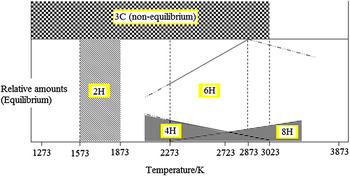
The microstructure of the deposits has been the subject of several studies. In most of the reports, MTS was used as the source. The deposition temperature falls in the range of 1473–2073 K. The structure of the deposit mainly depends on the temperature, growth rate, and concentration of the organosilane. In the whole range of deposition parameters, the predominant phase is cubic (β-) SiC, which is believed to be more stable than the α-SiC below 2373 K.Reference Snead, Nozawa, Katoh, Byun, Kondo and Petti2, Reference Slusarenko39 However, few studies contradict this finding.Reference Weltner40, Reference Griffiths41 The SiC structure is composed of identical polar layers of Si4C or C4Si coordination tetrahedrals linked through their vertices to form the SiC framework. The possibility of polytypism in SiC structures is due to the formation of various stacking sequences in the Si–C close-packed atomic planes. The primary concern on SiC at high temperature applications is the polytype transformations since their microstructure or properties change. Despite intense research, the transformations in SiC are still not properly understood. For example, the common β → α (cubic to hexagonal) transformation at above 2373 K is noted. In contrast, Krishna et al.Reference Krishna, Marshall and Ryan42 reported that 2H–SiC (α-SiC) can be easily transformed to 3C–SiC (β-SiC) on annealing in argon at a temperature above 1673 K. Together with temperature dependence, the effect of impurities or deviation from C:Si stoichiometry also plays a role in polytype stability. To bring SiC into real-time applications, it is essential to control polytypes during crystal or film growth. Various growth experiments were conducted using vapors or liquids as sources to define the stability region for SiC polytypes. Mostly, the resultant polytype was observed to depend on both the rate of growth and the temperature. Jepps and PageReference Jepps and Page43 stated the possible formation of β-SiC with high supersaturations/nonequilibrium conditions in the temperature range 1273–3023 K and subsequent transformation to α-SiC. In addition, they derived the stability diagram of polytype as a function of temperature (Scheme 3) and suggested that β-SiC is the initial polytype to appear during growth at almost all temperatures, no transformation inclination in the temperature range 1673–1873 K, and more stability than other polytypes.
Stability diagram of polytype as a function of temperature.

Commonly, the use of high temperatures in developing SiC results in defects (e.g., micropipes and stacking faults) in the layers. The research is still open to develop defect-free SiC materials for high temperature applications. In addition to the TRISO fuel context, the temperature range in which stoichiometric SiC layer is produced would depend on the temperature, coater characteristics, and particle loading. The crushing strength of SiC-coated particles decreases with increasing coating temperature and the strength is correlated with grain size. Xu et al.Reference Xu, Zhou, Yang and Zhang44 studied the effect of coating temperature on the microstructure, density, strength, and Young’s modulus of SiC layer at temperatures ranging from 1450 to 1923 K. They found that the highest strength and Young’s modulus were achieved at 1500–1873 K and the properties decreased significantly at temperatures lower or higher than the optimum conditions.Reference Xu, Zhou, Yang and Zhang44 In addition, low-temperature deposits often contain silicon: up to ∼8% free silicon was reported in a 1523 K deposit using MTS as source.Reference Chollon and Naslain45, Reference Chollon, Vallerot, Helary and Jouannigot46For example, TRISO coating on the German fuel never exhibited debonding under irradiation but occurred in U.S. fuel, suggesting that the strength of the IPyC/SiC interface leads to stress intensifications in the SiC layer resulting in failure. The German process resulted in small equiaxed grains, whereas the U.S. process produced larger columnar grains of SiC. The difference in microstructure is assumed to result from the varying temperatures utilized during the SiC coating phase, with the U.S. coater producing SiC at a higher temperature in some or all regions of the coater compared to the German process. These differences are important from a performance perspective because the small-grain German SiC, with its higher tortuosity, should in principle retain metallic fission products better than the large through-wall columnar U.S. SiC.Reference Petti, Buongiorno, Maki, Hobbins and Miller34
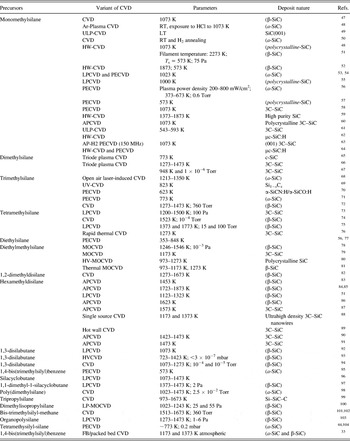
Fortunately, most of the CVD processes produce β-SiC using various gas phase sources and deposition parameters. Commonly, monocrystalline silicon is adopted as the substrate of choice for the growth of cubic SiC thin films because of the availability of silicon with purity. The reduction of the mismatches in the coefficients of thermal expansion (∼8%) and the lattice parameters (∼20%) via the initial reaction of the Si(100) surface with the carbon-containing gas followed by the successful epitaxial deposition of crack-free β-SiC was reported by numerous groups. Various research groups have also developed high quality β-SiC using halogen-assisted or halogen-free vapor phase as source gas on different substrate materials. Some literature and used CVD parameters are summarized in Table I.Reference Habuka, Ohmori and Ando47–Reference Jeong, Na, Choi, Hwang, Kim and Bahng102 The gas phase thermodynamics and kinetics of few selected precursors and deposits are reported elsewhere. Still, the research is open for the reaction mechanism of halogen-free vapor sources and relevant transport properties. The relevant properties of the polytype, including CVD-grown β-SiC, are reviewed elsewhere and confirmed that CVD-grown β-SiC is a better candidate than SiC derived from other techniques.Reference Snead, Nozawa, Katoh, Byun, Kondo and Petti2, Reference Chiu and Wu103–Reference Price106 When considering nuclear applications based on the strength of the SiC, it is important to differentiate between stoichiometric and nonstoichiometric ceramics. As aforementioned, the SiC forms include reaction-bonded, sintered, and pressure-less sintered reaction of graphite with molten Si or silicon monoxide, from polymer precursors, and from the decomposition of gases such as MTS or ethyltrichlorosilane. The literature shows that, in each case, impurities are present at some levels within the SiC grains. As has already been mentioned, the free silicon in deposited SiC layers has inferior high-temperature strength and creep properties, is more permeable to metallic fission products, and is subjected to recrystallization with gross pore generation during operation at high temperatures. The sintering aids (B, Si, or Al) used in the sintering process of SiC have a great influence on strength and other mechanical properties of irradiated SiC. In contrast, the large volume fraction of grain boundaries in nanocrystalline materials is expected to have a significant impact on the resistance to radiation. Shen et al. and Zhang et al.Reference Shen, Feng, Tang, Valdez, Wang and Sickafus107–Reference Swaminathan, Kamenski and Morgan109 reported that nanocrystalline materials have an enhanced resistance to radiation-induced amorphization, which was attributed to the migration of defects to the grain boundary sinks. However, Jiang et al.Reference Jiang, Wang, Kim, Bae, Li, Nachimuthu, Zhu, Zhang and Weber110 found no improvement in the resistance to amorphization of nc-SiC for heavy ion bombardment at room temperature. The effect of radiation is largely controlled by the concentration of point defects, which are introduced during displacement cascades. Price reported that, during both low temperature and high temperature irradiation process (fluences up to 5 × 1026 n/m2), single-phase SiC was not found to affect structural integrity. SiC also shows negligible irradiation-induced creep in the temperature range from 923 to 1403 K. However, he strongly recommended that the behavior of insignificant void formation and swelling in irradiation at 1273 K need to be considered when SiC is applied to fuel cladding and core structures of gas-cooled reactors in which the fuel temperature exceeds 1273 K.Reference Price111 A recent high temperature neutron irradiation study by Snead et al. implied the substantial void swelling of high purity monolithic SiC at ∼1573 K. The report also reveals that a microstructure control will be effective in suppressing/delaying the void swelling.Reference Snead, Nozawa, Katoh, Byun, Kondo and Petti2 Other primary issues on MTS-derived SiC with a laminated microstructure containing free silicon or porosity are the permeation by metallic fission products and chemical attack. Here it is good to remember that the integrity and property behavior of the SiC layer of the TRISO-coated particle for HTRs is very important. Since, SiC is the main barrier for gaseous and metallic fission product release. However, recent literaturesReference van Rooyen, Neethling, Henry and Janzen112 reveal that the formation of different isotopes of Si on the SiC crystal structureReference Descotes and Ortensi113 during the CVD manufacturing process and after transmutation due to irradiation may affect the integrity of the SiC layer. Among them, when 28Si or 29Si atoms absorb a thermal neutron, they are changed into other stable silicon atoms. The absorption of a fast neutron leads to the direct or indirect (via decay) production of Al or Mg isotopes. The probability of this type of absorption is lower by two orders of magnitude.114 For 30Si, thermal neutron capture leads to the unstable isotope 31Si, which undergoes β-decay. The product of this process is 31P, resulting in the n-type impurity doping in silicon material. The process is as follows without accounting for the associated antineutrino emission:
 $${}^{30}\rm{Si + n \to {}^{31}Si \to ({\rm{\beta }}^ - ){}^{31}}P.$$
A review on CVD of SiC from halogen-free (alkylsilane) sources.

ULP: Ultralow pressure; HW: hot wire; LP: low pressure; PE: plasma enhanced; AP: atmospheric pressure; UV: ultravacuum; MO: metallorganic.
In addition, the formation of free silicon during the CVD manufacturing process using Si–H or Si–Cl and carbon as gaseous CVD sources, a portion will also transform to phosphorous during neutron bombardment. Phosphorous in SiC makes the material brittle and is undesirable. Removing the two heavier isotopes in Si (28Si) makes the probability for getting (n,γ)-reactions leading to 31P unlikely. The challenge has therefore been to develop a low cost enrichment process for 28Si. Producing material from only one silicon isotope (28Si) and only one carbon isotope (12C) dramatically improves its characteristics for electronics, spintronics, and insulation for nuclear fuel applications. In addition, it is also believed that the perfect crystal structure averts Pd, Ag, and Cs interactions and maintains integrity achieved when isotope pure (only made up with 28Si) SiC used as TRISO layer. To avert the aforementioned issues, the use of halogen-free single-source SiC precursors and better understanding of their gas phase properties and the innovation of efficient growth process are encouraged for the growth of high-purity and isotope pure SiC with the desired properties.
IV. APPLICATIONS OF SiC FIBERS AND COMPOSITES
SiC composites are the primary material being evaluated and developed for fusion applications. These composites are reinforced with high-strength continuous fibers, with near-stoichiometric SiC composition. Typically, SiC fibers are developed using a carbon fiber core by CVD or using rice hulls or using spun polymer precursors. The advantage of SiC/SiC composites as fusion reactor materials comes mainly from their exceptional radiation stability, high temperature performance, and low activation properties intrinsic to SiC. In addition, metal matrix ceramic composites (SiC/Al, C/Al) and ceramic matrix ceramic composites (SiC/SiC) have found great interest in nuclear and aerospace areas including important fusion/fission reactor collaboration programs all over the world. For instance, international research programs on fusion energy, such as ITER, ITER-TBM, and BA, are actively involved in the development of SiC and SiC/SiC materials.Reference Katoh and Cozzi1, Reference Katoh, Snead, Nozawa, Morley and Windes3, Reference Kohyama, Singh, Lin and Katoh115–Reference Hayner, Shaber, Mizia, Bratton, Sowder, Wright, Windes, Totemeier, Moore, Corwin, Burchell, Corum, Klett, Nanstad, Snead, Rittenhouse, Swindeman, Wilson, McGreevy, Jones and Gardner117 In addition, the innovative SiC/SiC and tungsten-embedded SiC/SiC (W/SiC/SiC) heaters for multipurpose materials testing Belgian Reactor 2 (BR2) irradiation were fabricated using the Nano Infiltration and Transient Eutectic method and evaluated for their resistance under oxidative environments and liquid metal compatibility.Reference Kohyama118, Reference Park, Jung, Ooi, Kishimoto and Kohyama119 Although SiC/SiC composites are very attractive for advanced fusion/fission plants, high material cost and degradation by the recession of weak carbon/fiber/matrix interface as well as the formation/volatilization of silica on external surfaces caused by oxidative environments including oxygen and moisture have been the major issues that need to be addressed. Internationally, there are many R & D programs, such as CVD-SiC deposit and environmental barrier coating, to increase their environmental resistivity. Recently, Udayakumar et al.Reference Udayakumar, Balasubramanian, Gopala, Sampathkumaran, Seetharamu, Babu, Sathiyamoorthy and Reddy120 reported that the SiCfiber/SiC composite with carbon interface shows superior mechanical and tribological properties. To avert the above said environmental issues, the multilayer SiC/SiC concept was implemented by Park et al.Reference Park, Jung, Ooi, Kishimoto and Kohyama119and found to be better than SiC/SiC with a PyC interface. Thus, the use of SiC/SiC with a PyC interface in atmospheric condition is limited by its recession (significant loss of the PyC interface). The accumulated technical knowledge is under consideration for the investigation of high temperature nuclear reactors.Reference Park, Jung, Ooi, Kishimoto and Kohyama119
V. CALL FOR ALTERNATIVE CVD SOURCES FOR SiC DEPOSITION
The CVD process can produce a solid SiC from a gas phase reactant at comparatively low temperature (∼1673 K) without the use of a sintering aid or additive. The CVD-SiC material is typically synthesized by
 $$\rm CH_3 SiCl_3 \buildrel {heat} \over \hscale150%\longrightarrow SiC + 3HCl\quad,$$
 $$\rm C_2 H_5 SiCl_3 + H_2 \buildrel {heat} \over \hscale150%\longrightarrow SiC + 3HCl + CH_4 \quad.$$
Still, the high deposition temperature results in introducing structural defects in the layers and results in difficulties to work with the reactor in the field. Besides the above constraint, the industrially/commercially accepted SiC precursor MTS decomposes under typical CVD conditions producing corrosive HCl, SiHCl3, SiCl3, SiCl4, and CH4, as well as other silanes and hydrocarbons.Reference Nozaki, Kitazoe, Horii, Umemoto, Masuda and Matsumura121–Reference Allendorf and Melius127 More importantly, the MTS CVD gas phase products of chlorine can attack the nuclear fuel kernel and result in uranium dispersion into the surrounding buffer. The primary failure mechanism in TRISO-coated particles is a metallic fission product attack of SiC. In fact, under a thermal gradient, rare earth metals move toward the cold side of the particle, concentrate and degrade the SiC. The traces of chlorine that originate from the MTS act as a path for the penetration of metallic products through the coating. In addition, the reactivity of chlorinated organosilane differs from simple organosilanes because Si–Cl bonds are stronger than both Si–H and Si–C bonds.Reference Becerra and Walsh128 To date, it is regular to grow 3C–SiC films heteroepitaxially on carbonized Si substrates by CVD using separate Si and C source gases, such as SiH3Cl (or SiHCl3, SiH4) and C3H8 (or CH4, CH3Cl) with a carrier gas (H2), usually at temperatures higher than 1473 K and under reduced pressure (100–200 mbar). The process requires independent flow control of each source and the use of dangerous source chemicals. In the above process, the particulate formation is started by the homogeneous nucleation of liquid silicon droplets. Accordingly, these liquid droplets react with the carbon precursors to generate a SiC layer over the Si core. While the pure Si droplets [Eq. (5)] can reevaporate at a favorable temperature, the SiC-coated ones cannot. One of the carbon sources, propane, is a more stable compound but still poses a hazard as combustible gas.
 $$\rm 3SiH_4 + C_3 H_8 \buildrel {heat} \over \hscale150%\longrightarrow 3SiC + 6H_2\quad ,$$
 $$\rm SiH_4 \buildrel {heat} \over \hscale150%\longrightarrow Si_{(s)} + 2H_2 \quad.$$
On the other hand, MTS is more favored because it is liquid, inexpensive, has a favorable C to Si stoichiometric ratio, and is inherently safer than silane. It has an added advantage of containing chlorine, which can improve epitaxial growth. The disadvantage of MTS is its fixed ratios of Cl/Si = 3 and Si/C = 1. Since, the optimized growth of thin film may require independent control of these ratios. The thermal decomposition of MTS at temperatures above 1400 K occurs via Eqs. (1) and (2). However, there are nearly 100 different possible side reactions when decomposing MTS thermally in the presence of hydrogen at temperatures above 1400 K; the formation of trichlorosilane and methyl radicals are most thermodynamically plausible.
 $$\rm CH_3 SiCl_3 \buildrel {above \,1400 K} \over \hscale370%\longrightarrow SiCl_3^* + CH_3^* \quad,$$
 $$\rm SiCl_3^* + CH_3^* \buildrel {above\, 1400 K} \over \hscale370%\longrightarrow SiC + 3HCl\quad.$$
The presence of chlorine during decomposition and nucleation is believed to suppress unwanted terrace growth, decreases gas phase nucleation of SiC, reduces the formation of silicon droplets on the surface, and improves the quality of the film. However, as summarized earlier, MTS has the disadvantages such as the formation of toxic gas phase intermediate, releasing and handling of by-products, possible chlorine migration and reaction with kernel, and requires high temperature for thermal decomposition. In addition, hydrogen chloride production and adsorption on the surface at high temperature may increase the porosity in the films. The chlorine codeposition with SiC observed when using MTS as source even at 1373 K. Further, the sharp line at ∼200 eV in electron energy loss spectrum after heat treatment reveals that the chlorine formed as Cl−contains sheath shell between surface (silicon) and SiC crystallites.
 $${\rm{SiC}}_{{\rm{2, \,surf}}} \, + \,{\rm{CH}}_{{\rm{2, \,surf}}} \to {\rm{SiC}}_{{\rm{(s)}}} \, + \,{\rm{2HCl}}{\rm{.}}$$
The interaction of HCl with the SiC surface is of particular interest since this species is a major by-product of the deposition process. In addition, several studies provide evidence that HCl inhibits the deposition-based etching mechanism. On the other hand, at high temperatures (∼1497 K), the effect of HCl disappears. Few reports suggest that Cl bonds to Si atom sites on the SiC surface and the major etching product is SiCl4 with smaller amount of CCl4 at high temperatures. Despite the advantages of HCl in SiC deposition, it drastically reduces the SiC growth rate at temperatures between 1310 and 1450 K.Reference Allendorf and Melius126As of interest in the present review and in nuclear materials development programs, it is better to avoid halogen-containing chemicals for any reaction.
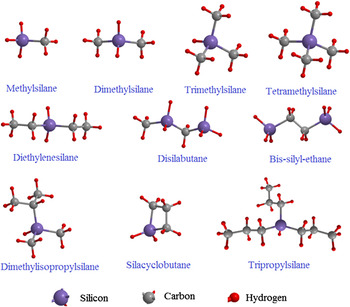
Consequently, it is worthy to use a source that is not pyrophoric, halogen free, and contains both silicon and carbon atoms as single molecules and decomposes at low temperatures into the film of stoichiometric SiC. To date, various alkylsilane precursors (Fig. 2) have been reported, including monomethylsilane (CH3SiH3), dimethylsilane [(CH3)2SiH2], trimethylsilane [(CH3)3SiH], tetramethylsilane [(CH3)4Si], tripropylsilane [(C3H7)3SiH], hexamethyldisilane [(CH3)6Si2], dimethylisopropylsilane [(CH3)2CHSiH(CH3)2], 1,2-bis(dimethylsilyl)ethane, H3SiCH2CH2SiH3, 1,3-disilabutane (CH3SiCH2SiH2CH3), and silacyclobutane (c-CH6SiH2). For example, the pyrolysis reaction of 1,2-diethyl-1,2-dimethyldisilane at 1250 K in SiC deposition can be described as:
 $$\rm{Si_2 (CH_3 )_2 (C_2 H_5 )_2 H_2 \to 2SiC + C_4 H_{10} + 4H_2} .$$
Semiempirically (using PM3 Hamiltonian) optimized molecular structures of alkylsilane: used as a SiC sources in various CVD experiments (Table I).

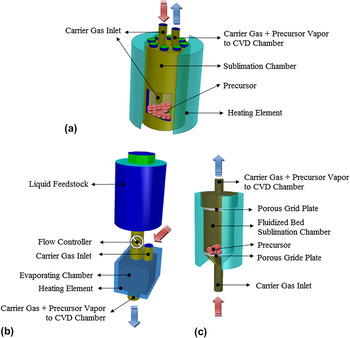
The aforementioned alternative CVD process for depositing SiC is under consideration, operating at both atmospheric and subatmospheric pressure. More interestingly, the halogen-free single sources (Fig. 2) are producing as good quality film as MTS does. However, the properties and functions of the layer from halogen-free sources need further investigation before being recommended for use. Moreover, in every CVD technique, the precursor is either a gas (e.g., SiH4) or a liquid (e.g., SiCH3Cl3) at ambient temperature. There are no issues in the case of gaseous reactants because their flow rates can be controlled using conventional mass flow controllers, but with liquid or solid compounds, evaporation/sublimation and transport parameters have to be optimized through the choice of the feeding system and of the maximum amount of chemical carried. Generally, solid sources are not suitable for providing gas phase concentrations, which creates problems in CVD processing. To date, the significant development in the CVD process is the replacement of the conventional bubbler sublimator or evaporator with an efficient process, such as liquid deliverer, whereas liquid sources are allowed to the evaporator chamber under vacuum as fine spray; evaporators are schematically presented in Schemes 4(a)–4(c). However, we found a few drawbacks in the liquid injection process [Scheme 4(b)], such as poor solubility of solid sources (e.g., metalorganic or organometallic) and contamination due to the solvent in the deposits (e.g., carbon or chlorine).Reference Selvakumar, Raghunathan and Nagaraja129, Reference Selvakumar, Raghunathan and Nagaraja130 Presently, the perspective is devoted to the gas phase deposition of thin films using the FB-based sublimator [Scheme 4(c)] due to its temperature homogeneity, fast mass and heat transfer, and better transport phenomena in gas particle systems. Recently, we have successfully demonstrated SiC deposition with the combined approach of FB sublimator and fluidized/packed bed CVD process using solid 1,4-bis(trimethylsilyl)benzene as single source.Reference Selvakumar and Sathiyamoorthy33 The FB technique confirmed that the 1,4-bis(trimethylsilyl)benzene vapor of the solid source can be effectively carried with high precursor flux in a consistent and controlled manner for CVD use. The obtained orientations, degrees and size of crystallinity, good uniformity, and better thickness with growth rate of the SiC film reveal that the above selected single source may be an ideal candidate in industrial applications. The coating and surface morphology of the as-deposited SiC films on zirconox spherical particles show that the coatings are free from structural defects and reconfirm that they have potential for technological applications [Figs. 3(a)–3(c)]. In addition, the selected precursor and developed process to deposit SiC coatings prove that there exists no chlorine-etching problem, and the higher hydrogen concentration may help in getting pure SiC free from amorphous carbon. The resulting properties of the produced β-SiC thin film, such as near-stoichiometry, low growth temperature, and low defects, make it suitable for nuclear applications. To address the chemical degradation, corrosion, and related rapid propagation of crack issues of the cladding material, a uniform layer of SiC was deposited (at 1023 K) and found to be stable than an uncoated Zircaloy-4 tube in an oxidation environment [Fig. 3(c)]. However, of note, here is that the understanding of fundamental irradiation effects phenomena, including irradiation creep, various transmutation effects, and void swelling, and the underlying physical processes are the key to further advance the science and technology of ceramic composites for fusion and advanced nuclear applications. A detailed investigation on the presently developed SiC layers by FB CVD using 1,4-bis(trimethylsilyl)benzene is underway.
SiC protective layer development using a halogen-free CVD source (a) modified CVD experimental setup and processes; (b) SiC on zirconia particles (surrogate material): uncoated and coated (at 1373 K) zirconia particles and surface morphology; (c) SiC coating on Zircaloy tube (cladding): uncoated and coated (at 1023 K) Zircaloy tubes and surface morphology.

Potentially identified CVD source sublimator/evaporators: (a) conventional solid sublimator; (b) liquid evaporator; and (c) efficient FB sublimator.

VI. CONCLUSIONS
The following conclusions can be drawn:
(i) SiC is a promising candidate material in nuclear reactors to maintain the structural integrity of high temperature components.
(ii) Among the polytypes, β-SiC is an ideal candidate for nuclear applications, due to its smaller band gap, high surface area, good stability, Si:C stoichiometry, irradiation stability, and low density.
(iii) To date, nuclear research findings and reports reveal the better choice of SiC when it is monocrystalline or nanocrystalline in nature.
(iv) CVD technique seems to be suitable for nuclear applications especially for growing β-SiC on different surfaces.
(v) Primary issues on MTS-derived SiC films are the formation of laminated microstructure containing free silicon or porosity, which facilitates/enables permeation by metallic fission products and chemical attack. More importantly, the MTS-CVD gas phase products of chlorine can attack the nuclear fuel kernel and result in uranium dispersion into the surrounding buffer. The primary failure mechanism in TRISO-coated particles is a metallic fission product attack on the SiC. In fact, under a thermal gradient, rare earth metals move toward the cold side of the particle, concentrate and degrade the SiC. The traces of chlorine that originate from the MTS act as a path for the penetration of metallic products through the coating. Hence, chlorine-free nontoxic precursors are to be developed.
(vi) Reports on the development of nanocrystalline SiC using halogen-free sources by our R & D and from few other research groups in the globe show a new path for the birth of an ecofriendly deposition process as well as to enhance the long-term use of the deposit on various applications, especially in nuclear reactors.
(vii) However, the understanding of fundamental irradiation effects phenomena, including irradiation creep, various transmutation effects, and void swelling, and the underlying physical processes of the ecofriendly CVD-derived deposit are the key to further advance the science and technology of SiC-based ceramic composites for fusion and advanced nuclear applications. Future SiC-based devices or materials need to be grown using halogen-free solid/liquid sources to avert the low/high temperature corrosion and relevant damages to the materials and to enhance the lifetime of the materials. In nuclear applications, the scientist should be able to generate and make available the properties of deposits for implementation in real-time applications.