Introduction
There is increasing awareness of the limitations of current diagnostic systems developed in psychiatric settings for classifying psychological distress in the medically ill, particularly when somatic symptoms are considered to be initiated, exacerbated or maintained by psychosocial factors (Fava & Sonino, Reference Fava and Sonino2010). The emphasis in psychiatry is in fact about assessment of symptoms resulting in syndromes identified by diagnostic criteria using the Diagnostic and Statistical Manual of Mental Disorders (DSM). In the medical patient a classification system of psychosocial variables is expected to assist understanding and managing distress and illness behavior. Such distress may encompass psychological symptoms that do not reach the threshold of a psychiatric disorder and manifestations of illness behavior that are not included in the DSM classification system. The DSM-5 work group on somatoform disorders has brought together the DSM-IV diagnoses of somatization disorder, undifferentiated somatoform disorder, hypochondriasis and pain disorder under a single heading: complex somatic symptom disorder (Dimsdale & Creed, Reference Dimsdale and Creed2009). The hallmarks of this disorder are the patient's difficulty in tolerating physical discomfort, misattributions and excessive concerns, and increased health care use (Dimsdale & Creed, Reference Dimsdale and Creed2009). Other forms of psychosocial distress associated with medical disease may be subsumed under the psychiatric rubrics for mood or anxiety disorders, the category of psychological factors affecting medical conditions (PFAMC) and adjustment disorders. Another proposal (Fava & Wise, Reference Fava and Wise2007; Fava et al. Reference Fava, Fabbri, Sirri and Wise2007) supported the elimination of the chapter on somatoform disorders in DSM-5, expanding the DSM-IV category of PFAMC with syndromes derived from the Diagnostic Criteria for Psychosomatic Research (DCPR; Porcelli & Sonino, Reference Porcelli and Sonino2007): disease phobia, persistent somatization, conversion symptoms, illness denial, demoralization, irritable mood. The DCPR were developed by an international group of investigators to translate the large body of evidence accumulated in psychosomatic medicine to operational tools (Porcelli & Sonino, Reference Porcelli and Sonino2007; Wise, Reference Wise2009; Porcelli & Rafanelli, Reference Porcelli and Rafanelli2010). The DCPR allow to translate in clinical terms illness behavior (the ways in which individuals experience, perceive, evaluate and respond to their health status), the various modalities of somatization and constructs such as demoralization, irritable mood and alexithymia. Whenever the DCPR have been used in conjunction with the DSM, they have been found to carry additional clinical information, such as effects on quality of life and prognostic implications (Picardi et al. Reference Picardi, Pasquini, Abeni, Fassone, Mazzotti and Fava2005, Reference Picardi, Porcelli, Pasquini, Fassone, Mazzotti, Lega, Ramieri, Sagoni, Abeni, Tiago and Fava2006; Porcelli et al. Reference Porcelli, Bellomo, Quartesan, Altamura, Iuso, Ciannameo, Piselli and Elisei2009; Porcelli & Rafanelli, Reference Porcelli and Rafanelli2010).
The aim of this investigation was to use both the DSM and DCPR for examining the feasibility of subtyping psychosocial variables in a highly heterogeneous group of medical patients, encompassing both ‘functional’ and ‘organic’ medical disorders, by means of a cluster analysis technique. It was hypothesized that such subtypes might be identified across medical settings and may shed some light on the differential diagnosis of psychosocial variables in the medically ill.
Method
Design, procedures and subjects
Patients were recruited from different medical settings in an ongoing multicenter project concerned with the psychosocial dimensions of medical patients (Porcelli & Sonino, Reference Porcelli and Sonino2007). Although studies involved in the research project had different aims and sample sizes, they shared a common methodology in the assessment of psychopathology and psychosocial syndromes. Patients were recruited consecutively, with the intent of being representative of their respective patient populations, by clinical psychologists, who screened all the available patients and identified those who met the inclusion criteria:
(1) Consecutive out-patients with functional gastrointestinal disorders (n=190, 12.2% of the total sample) from the Functional Gastrointestinal Disorders Outpatient Clinic of the Scientific Institute of Gastroenterology at Castellana Grotte, Italy. Patients with organic disease were excluded.
(2) Consecutive out-patients with heart diseases (n=351, 22.5%) from three different sources: (1) 198 patients who underwent heart transplantation at the Heart Transplantation Unit of the Institute of Cardiology, S. Orsola Hospital, Bologna, Italy; (2) 61 consecutive patients with a recent (within 1 month) first myocardial infarction diagnosis from the Cardiac Rehabilitation Program of the Bellaria Hospital in Bologna, Italy; and (3) 92 consecutive patients with a recent (within 1 month) first myocardial infarction diagnosis, from the Institute of Cardiology of University Hospital, Modena, Italy. There were no medical exclusion criteria.
(3) Consecutive out-patients with endocrine disorders (n=162, 10.4%) from the Division of Endocrinology of the University of Padova Medical Center, Padova, Italy. There were patients with pituitary disease, thyroid disorders, adrenal gland diseases (e.g. Cushing's syndrome), hirsutism, diabetes insipidus and hyperthyroidism. The patients were remitted according to endocrine standards.
(4) Consecutive out-patients who had received a diagnosis of cancer within the past 18 months (n=104, 6.7%) from the S. Anna University Hospital in Ferrara, Italy. The exclusion criterion was the presence of cognitive impairment.
(5) Consecutive out-patients with skin disorders (n=545, 34.9%) from the Dermopathic Institute of the Immaculate (IDI-IRCCS), Rome, Italy. Dermatological diagnoses encompassed psoriasis, urticaria, non-atopic dermatitis, connective tissue disease, skin tumors, bullous disease, skin ulcers and atopic dermatitis.
(6) Consecutive in-patients referred for psychiatric consultation in two large university-based general hospitals (n=208, 13.3%) from the University of Perugia and University of Foggia, Italy. Exclusion criteria were the presence of cognitive impairment or psychotic, delusional or significant pain symptoms.
The study was approved by the appropriate institutional review boards and local ethics committees, and written informed consent was obtained from all patients, after the procedures were explained to them. A total of 1700 patients were approached of which 140 (8.2%) declined to participate. The most common reason for refusal was lack of time. The total sample, therefore, included 1560 patients (712 men, 45.6%, and 848 women, 54.4%), with a mean age of 45 (s.d.=15.02) years, and a mean of 10.6 (s.d.=3.85) years of education. There were no significant differences in terms of sociodemographic variables between the patients who accepted and those who refused.
Assessment
All patients underwent two detailed semi-structured interviews by clinical psychologists or psychiatrists with extensive experience, including psychosomatic research. Psychiatric disorders were investigated with the Structured Clinical Interview for DSM-IV (First et al. Reference First, Spitzer, Gibbon and Williams2000). Diagnoses were grouped according to diagnostic categories such as mood disorders, anxiety disorders, somatoform disorders, adjustment disorders and other disorders (including psychotic disorders, eating disorders, sexual dysfunctions and substance use-related disorders). Psychosomatic syndromes were diagnosed with the Structured Interview for DCPR (Porcelli & Sonino, Reference Porcelli and Sonino2007). The DCPR encompass various diagnostic rubrics: abnormal illness behavior (disease phobia, thanatophobia, health anxiety, illness denial), somatization syndromes (persistent somatization, functional somatic symptoms secondary to a psychiatric disorder, conversion symptoms, anniversary reactions), irritability (irritable mood, type A behavior), demoralization and alexithymia. The interview for DCPR consists of 58 items scored in a yes/no response format evaluating the presence of one or more of 12 psychosomatic syndromes. The interview has shown excellent inter-rater reliability, construct validity, and predictive validity for psychosocial functioning and treatment outcome (Galeazzi et al. Reference Galeazzi, Ferrari, Mackinnon and Rigatelli2004).
Data analysis
Data were entered in SPSS (SPSS Inc., USA), after which descriptive statistics were calculated. Two-step cluster analysis was performed to organize observations into two or more mutually exclusive groups, where members of the groups shared properties in common (Kaufman & Rousseeuw, Reference Kaufman and Rousseeuw1990). The following variables were included in the analysis: DSM mood disorders, anxiety disorders, somatoform disorders, adjustment disorders, other disorders (psychotic disorders, eating disorders, sexual dysfunctions and substance-use disorders), absence of any DSM disorder, DCPR abnormal illness behavior, somatization, irritability, demoralization, alexithymia and absence of any DCPR syndrome.
The two-step cluster method is a scalable cluster analysis algorithm designed to handle very large datasets. It can handle both continuous and categorical variables. The two steps are: (1) pre-cluster the cases into many small subclusters; and (2) cluster the subclusters resulting from the pre-cluster step into the desired number of clusters. The log-likelihood distance measure was used, with subjects assigned to the cluster leading to the largest likelihood. No prescribed number of clusters was suggested. The Bayesian information criterion was used to judge adequacy of the final solution. Differences in sample characteristics were compared according to cluster membership using univariate analyses of variance and χ2 tests for continuous and categorical variables, respectively. For all tests performed, the significance level was set at 0.05, two-tailed.
Results
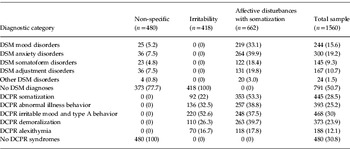
Frequencies for each of the diagnostic categories of psychiatric disorders and psychosomatic syndromes are shown in Table 1. Two-step cluster analysis yielded three clusters, with no exclusion of cases. The composition of the clusters and the importance of variables within a cluster were then examined. The first cluster included 30.8% (n=480) of the total sample and was mainly characterized by the patients who did not fit with any DCPR syndrome. The majority of them did not fit with any DSM-IV categories as well (n=373, 77.7%); this cluster was named ‘non-specific psychological distress’.
Frequencies of diagnostic categories of psychiatric disorders and psychosomatic syndromes within each cluster and the total sample
DSM, Diagnostic and Statistical Manual of Mental Disorders; DCPR, Diagnostic Criteria for Psychosomatic Research.
Data are given as number of patients (percentage).
The second cluster had 26.8% of the cases (n=418) and contained primarily DCPR irritability (i.e. irritable mood and type A behavior) in the absence of any DSM-IV diagnoses; this cluster was named ‘irritability’.
In the third cluster (n=662, 42.4%), DCPR somatization syndromes (i.e. persistent somatization, functional somatic symptoms secondary to a psychiatric disorder, conversion symptoms, anniversary reactions) were predominant, as well as both DSM-IV anxiety and mood disorders. Demoralization and abnormal illness behavior were also represented to a moderate degree, as well as DSM-IV somatoform and adjustment disorders; this cluster was thus named ‘affective disturbances with somatization’.
The frequency and the importance of the remaining variables (e.g. other disorders listed in DSM, DCPR alexithymia) were comparable among the groups, indicating that these diagnostic categories did not make a substantial contribution to cluster formation.
When differences among the cluster groups were examined, significant gender differences were found, with a greater proportion of female patients in the cluster characterized by affective disturbances with somatization (n=393, 46.3%, χ2 2=11.645, p<0.01). With respect to age, patients in the irritability cluster were significantly older (mean age 47.9 years, s.d.=0.7 years, F 2,1548=15.876, p<0.001), while those in the non-specific cluster were the youngest (mean age 42.3 years, s.d.=0.7 years). Years of education also differed among the clusters (F 2,1128=3.816, p<0.05), with patients in the non-specific cluster having received the most years of education (mean 10.9 years; s.d.=0.2 years), and those in the affective disturbances with somatization cluster the least (mean 10.2 years; s.d.=0.2 years). However, these differences, even though reaching statistical significance, were quite small.
As to specific medical settings, a greater proportion of patients with skin diseases was found in the non-specific cluster (n=288, 52.8%), a substantial number of patients with heart disease in the irritability cluster (n=156, 44.4%), and the vast majority of in-patients from psychiatric consultation services (n=133, 70%) and from the Functional Gastrointestinal Disorders Outpatient Clinic (n=166, 79.8%) in the affective disturbances with somatization cluster. Patients with endocrine disorders and those who had received a diagnosis of cancer within the past 18 months were mainly represented in the affective disturbances with somatization cluster (n=77, 47.5% and n=46, 44.2%, respectively), even though the former were also present in the non-specific cluster (n=56, 34.6%) and the latter in the irritability cluster (n=38, 36.5%). A considerable number of patients with heart disease were also present in the affective disturbances with somatization cluster (n=128, 36.5%).
Discussion
This study has suggested that psychological distress and illness behavior in the medically ill may be usefully classified into three clusters.
The first cluster (named non-specific psychological distress) encompassed about 30% of cases and was not characterized by DCPR syndromes or DSM disorders. This group had a younger age and was highly represented among patients with skin disorders. If patients who were included in the first cluster displayed psychological distress, this could not be subsumed under specific rubrics.
The second cluster included a quarter of cases and encompassed primarily DCPR irritable mood and type A behavior. Irritability refers to a feeling state that may be experienced as brief episodes in particular circumstances, or may be prolonged and generalized. It requires an increased effort of control over temper by the individual or may result in irascible verbal or behavioral outbursts (Porcelli & Sonino, Reference Porcelli and Sonino2007). Type A behavior refers to the presence of at least five of nine characteristics that were described in coronary artery disease: excessive degree of involvement in work and other activities; steady and pervasive sense of time urgency; display of motor-expressive features; hostility and cynicism; irritable mood; tendency to speed up physical activities; tendency to speed up mental activities; high intensity of desire for achievements and recognition; high competitiveness (Porcelli & Sonino, Reference Porcelli and Sonino2007). These patients were older and, as expected, mainly suffering from heart disease. The findings thus support the large body of literature pointing to these variables in cardiovascular illness (Shah et al. Reference Shah, White, White and Litter2004). The role of type A behavior as an etiological factor in cardiovascular disease has not been conclusive established in the literature (Schulman & Stromberg, Reference Schulman and Stromberg2007) and the importance of hostility as its distinctive feature has been repeatedly indicated (Schulman & Stromberg, Reference Schulman and Stromberg2007; Lemogne et al. Reference Lemogne, Nabi, Zins, Cordier, Ducimetière, Goldberg and Consoli2010). Our findings confirm how type A behavior and hostility/irritability are inextricably linked.
The third cluster (affective disturbances with somatization) included about 42% of patients and was mainly characterized by DCPR somatization syndromes (i.e. persistent somatization, functional somatic symptoms secondary to a psychiatric disorder, conversion symptoms, anniversary reactions) and DSM-IV mood and anxiety disorders. Demoralization and abnormal illness behavior (i.e. disease phobia, thanatophobia, health anxiety and illness denial), as well as DSM-IV somatoform and adjustment disorders were present. This cluster was particularly represented in patients for whom a psychiatric consultation was requested and a diagnosis of functional gastrointestinal disorder or endocrine condition or cancer was made. This cluster was also common in cardiology settings. The findings concerning this group are in line with the available literature (Porcelli & Sonino, Reference Porcelli and Sonino2007). Several studies found a high lifetime prevalence of depressive and anxiety disorders among patients with either full-blown or subsyndromal somatoform disorders (Barsky et al. Reference Barsky, Wyshak and Klerman1992; Noyes et al. Reference Noyes, Kathol, Fisher, Phillips, Suelzer and Woodman1994; Lieb et al. Reference Lieb, Pfister, Mastaler and Wittchen2000, Reference Lieb, Meinlschmidt, Araya, Dimsdale, Xin, Kleinman, Patel, Narrow, Sirovatka and Regier2009; Fröhlich et al. Reference Fröhlich, Jacobi and Wittchen2006; Beutel et al. Reference Beutel, Bleichner, von Heymann, Tritt and Hardt2010; Leiknes et al. Reference Leiknes, Finset and Moum2010). Co-morbidity also occurred in patients who were diagnosed with a DCPR syndrome (Porcelli & Rafanelli, Reference Porcelli and Rafanelli2010). Patients with DCPR but not DSM diagnoses (29%) were 3.6 times more prevalent than those with DSM but not DCPR diagnoses (8%) in a variety of medical settings (Porcelli & Rafanelli, Reference Porcelli and Rafanelli2010).
This cluster analysis-derived grouping has several implications. The first is concerned with the concept of somatization, defined by Lipowski (Reference Lipowski1988) as the tendency to experience and communicate psychological distress in the form of physical symptoms and to seek medical help for them. In the DSM-IV and the upcoming DSM-5 (Dimsdale & Creed, Reference Dimsdale and Creed2009), the diagnosis of somatoform disorders may be established only when an organic medical condition is missing. This does not reflect clinical reality, where organic factors were found to predispose to somatization (McKegney, Reference McKegney1967; Lipowski, Reference Lipowski1988; Härter et al. Reference Härter, Baumeister, Reuter, Jacobi, Höfler, Bengel and Wittchen2007). The underlying assumption is that, whatever biological abnormalities are found, they should be able to explain the entire spectrum of the observed symptoms, whereas different symptoms in the same patient may have different causes (Fava & Sonino, Reference Fava and Sonino2009). The DCPR system operates independently of the organic/functional dichotomy. The most common DCPR syndrome related to somatization was found to be persistent somatization (Mangelli et al. Reference Mangelli, Bravi, Fava, Ottolini, Porcelli, Rafanelli, Rigatelli and Sonino2009), that describes psychophysiological symptoms that may involve different organ systems, indicating low sensations or pain thresholds and high suggestibility (Kellner, Reference Kellner1994). In the majority of cases, persistent somatization is not associated with DSM-IV somatoform disorders (Mangelli et al. Reference Mangelli, Bravi, Fava, Ottolini, Porcelli, Rafanelli, Rigatelli and Sonino2009).
A second clinical implication of the findings is that mood and anxiety disorders are intertwined with somatization processes (Fava & Sonino, Reference Fava and Sonino1996). The DSM view that somatic symptoms should not be secondary to other psychiatric disorders lacks hierarchical organization (somatoform symptoms are placed at the same level of other axis I syndromes).
An additional issue is the fact that, even though in DSM classification the concept of abnormal illness behavior (Pilowsky, Reference Pilowsky1997) is alluded to, but never precisely defined, the DCPR provide its operational translation. In addition to hypochondriasis, that is already available in DSM-IV, the DCPR system includes disease phobia, a persistent unfounded fear of suffering from a specific disease, that does not change with time and entails specific therapeutic strategies (Fava & Grandi, Reference Fava and Grandi1991; Noyes et al. Reference Noyes, Carney and Langbehn2004), and illness denial, the persistent denial of having a physical disorder and of the need for treatment (Goldbeck, Reference Goldbeck1997). Illness denial has been described in several clinical settings (Goldbeck, Reference Goldbeck1997). It may affect the course of medical diseases by preventing therapeutic adherence and follow-up. The third cluster suggests the need of simultaneously assessing mood/anxiety disturbances and somatization/abnormal illness behavior syndromes with operational tools that are wider and more specified than those available in DSM.
The construct of alexithymia (Taylor, Reference Taylor2010) was not found to characterize any specific cluster, though its prevalence was relatively high, pointing to the presence of impaired emotional regulation in somatization processes.
This study has limitations due to its cross-sectional nature. We have no way to know the longitudinal course of these clusters. Nonetheless, cluster analysis in fields such as depression (Paykel, Reference Paykel1971) has yielded results that have survived the test of time and were found to be predictive of treatment response (Baumeister & Parker, 2010; Bech, Reference Bech2010; Lichtenberg & Belmaker, Reference Lichtenberg and Belmaker2010). Further, the patient population was very heterogeneous both in terms of setting (in-patient, out-patient, etc.) and type of disease. The fact, however, that the same clusters occurred in very different settings and types of morbidity, even though their distribution varied, may be seen as a strength of the study. Another limitation is the fact that the clusters we obtained need to be verified in independent studies using both DSM and DCPR criteria. Finally, symptoms of somatization related to a medical illness can often be extremely difficult to tease apart from symptoms related to the illness itself (Fava & Sonino, Reference Fava and Sonino2009).
The findings of this investigation indicate that, in the setting of medical disease, a discrimination between general psychological distress and specific clusters worthy of clinical attention is feasible. The clusters that have been obtained were found to be consistent with the available literature and indicate the need of broadening the assessment targets of psychiatric evaluation in the medically ill in DSM-5. Even though by doing this we run the risk of overestimating and overdiagnosing somatization, such information may demarcate prognostic and therapeutic differences among groups of patients who otherwise seem to be deceptively similar because they share the same medical diagnosis.
Acknowledgements
This study was supported in part by a grant from Compagnia di San Paolo, Torino, Italy to C.R.
Declaration of Interest
A.B. has been sponsored as a speaker at meetings and congresses by Eli-Lilly, Janssen-Cilag, AstraZeneca, Bristol-Myers Squibb, Lundbeck, Pfeizer and GlaxoSmithKline in the previous year.