INTRODUCTION
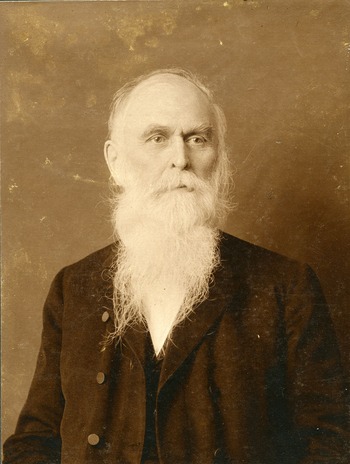
Benjamin Smith Lyman (1835–1920) was living proof of the benefits to health and well-being of the lifestyle he advocated in his Vegetarian Diet and Dishes, a collection of 1,001 recipes prefaced by a scholarly disquisition on the rationale for vegetarianism. Published in 1917, when he was eighty-one years old, it marked the culmination of a lifelong dedication to a meatless diet. Lyman was an eminent mining geologist, in which field he published more than 150 articles, and a noted Japanologist (Figure 1).Footnote 1 Vegetarianism was critical to his identity. It guided his outlook and behavior with respect to morality, health, and economy. It shaped and reflected his lifestyle, work, and relationships both at home and abroad – in Northampton, Massachusetts, where he grew up and lived following his return in 1881 from eight years as a mining engineer under contract to the Japanese government; in India, where he carried out surveys in the Punjab for the British colonial government between 1869 and 1870; and in Philadelphia, where he lived from 1887 until his death in 1920. When his cookbook appeared, there were already more than twenty English-language vegetarian cookbooks in print by affiliates of the International Vegetarian Union. Alongside these there was a growing number of publications by other proponents of dietary reform, running the gamut from William Alcott's Vegetable Diet: As Sanctioned by Medical Men and by Experience in All Ages (1838, 1849) to Maria Parloa's Preparation of Vegetables for the Table (1906), commissioned by the United States Department of Agriculture. Such publications speak to the increasingly important place of vegetables in the American diet over the course of Lyman's long lifetime.
Benjamin Smith Lyman, c.1909. Benjamin Smith Lyman Papers (MS190), Special Collections and University Archives, University of Massachusetts, Amherst Libraries.

Existing literature views vegetarianism in the United States between the Civil War and World War I primarily through the prescriptive, nativist lens of its most charismatic and influential advocates, ignoring the often monotonous realities of its daily practice.Footnote 2 In The Vegetarian Crusade:The Rise of an American Reform Movement 1817–1921, Adam D. Shprintzen delineates with eloquent clarity the development of vegetarianism in the United States, focusing on proponents of dietary reform, including Sylvester Graham, Bronson Alcott, leaders of the American Vegetarian Society, John Harvey Kellogg, and Bernarr MacFadden. Iacobbo's American Vegetarianism: A History likewise emphasizes key proponents to challenge the view that vegetarianism was a fringe movement. Tristram Stuart's excellent The Bloodless Revolution: A Cultural History of Vegetarianism from 1600 to Modern Times addresses the influence of Indian vegetarianism but says little about the role of imperialism in the cultivation, procurement, and preparation of ingredients used in vegetarian cooking. This article draws on the cookbook and the voluminous verbal and visual record of Benjamin Lyman's life and activities housed in the archives of the University of Massachusetts, Amherst (UMA), the Historical Society of Pennsylvania (HSP), and the American Philosophical Society in Philadelphia (APS), to shed light on the day-to-day culinary world of a man who bought soy sauce by the gallon and whose daily diet ranged from macaroni and cheese to rice and vegetable curry. In so doing, it brings more clearly into play the way that American interventions in Asia set in motion changes in vegetarian diets.
Although Lyman's foodways were idiosyncratic in some respects, they speak to the growing cosmopolitanism of vegetarianism between the Civil War and World War I. Cosmopolitan, literally “citizen of the world,” is a term that in vernacular usage refers to those who are worldly, well traveled, and open to the cultures of other places and traditions. During the period under consideration here, all Americans became more cosmopolitan as a result of advances in science, technology, transportation, and communications. Imperialism in the Pacific and immigration from China and Japan also provoked growing consciousness of global interconnectedness. As a participant in and supporter of American expansion in the Pacific, Lyman endorsed culinary difference within an imperialist framework.Footnote 3
While experienced unevenly, cosmopolitanism was not the exclusive purview of urban sophisticates, however. In the late nineteenth and early twentieth centuries, American agriculture was closely bound up with geopolitics: as Kristin Hoganson has shown in Heartland: An American History, farmers in the rural Midwest searched the world for the best seeds and most productive livestock.Footnote 4 American consumers throughout the United States, often unknowingly, enjoyed new nonnative varieties and hybrids of fruits, vegetables, and nuts, many of them Asian imports. Immigrants introduced new foodstuffs as well as ways of preparing them. “Cosmopolitan,” used in this general sense, is a characterization that also helps to bring into focus the overlooked developments in vegetarian foodways that are the focus of this article.
BECOMING A VEGETARIAN
Benjamin Lyman became a vegetarian in May 1864, when the nation was riven by civil war and grappling with the effects of industrialization and technological change.Footnote 5 As an ardent abolitionist, member of the New England elite, and world-traveling mining engineer charged with exploring for coal, oil, and mineral deposits in the United States, the Punjab region of India, and Hokkaido, Japan's northernmost island, Lyman was both product and producer of these changes. In some respects, the adoption of a meatless diet represented a critique of the very processes of modernization of which he himself was an agent.
American vegetarianism was, in the words of its leading historian, Adam Shprintzen, a “crusade.”Footnote 6 Its practice should be distinguished from the abstinence from meat imposed by poverty or geography, because it implies a choice. Although 1817 marked its introduction to the United States by William Metcalfe of the Bible Christian Church, the term only came into common usage with the founding in 1850 of the American Vegetarian Society, in which members of this church played a central role. Linked as it was to a desire to return to a prelapsarian world where a harmonious relationship prevailed between man and nature, other religious movements, including the Swedenborgian and Seventh-Day Adventist churches, also advocated a meatless diet. New England Transcendentalists, for whom the campaign against flesh-eating was bound up with abolition, temperance, and women's suffrage, were also influential in helping to spread the ideal if not the actual practice. For most of its early followers, meals consisted primarily of simply prepared vegetables, grains, and fruits.
In 1864, just two years after the completion of his formal education (Harvard, followed by study at the world's leading mining schools in Paris and Freiburg), with the ongoing financial support and mentorship of his uncle J. Peter Lesley, one of the country's leading geologists, Lyman's career was taking off. The first months of that year saw him in California, making periodic outings from San Francisco to survey the mercury mines in the arid Santa Clara mountains. Notes in his diary about visits in San Francisco to a “Chinese joss house” (temple) and to Chinese and Japanese shops, and about tasting California wines, testify to his wide-ranging curiosity and openness to new gustatory experiences at the time.Footnote 7 His interest in Asia was long-standing: as early as 1856, he had written to his Harvard classmate and lifelong friend, the social activist and journalist Franklin Benjamin Sanborn, of “a chance for a China voyage.” In his reply, Sanborn, who had close ties with the Transcendentalists, reported that he had talked to Ralph Waldo Emerson about Lyman's plans.Footnote 8 To the Transcendentalists, the Orient was the object of deep interest.
For Lyman, who took a systematic, scientific approach to all his endeavors, the decision to abstain from meat was surely not made without careful deliberation. He provided no reasons for adopting a vegetarian diet in May 1864, but ill health is likely to have been a catalyst. A letter from his mother dated 5 January 1864, complaining that he was “too far off even to hear from … with regularity” and praying that his “life and health may be preserved,” speaks to concerns about his well-being. Later that year or early in 1865, she developed this theme further: “In giving your bill of fare, you say nothing about meat of any kind. I hope you have not given up eating it entirely. I can't believe it is good for your health, and it will make you a very inconvenient boarder or visitor.”Footnote 9 Living outdoors, often subsisting on canned foods, mining engineers endured considerable physical hardships in the course of their work. As Lyman himself wrote on 2 April of that year from Virginia City, Nevada: “If I ever desired to experience hardships from the love of adventure, I have nearly or quite lost that desire.”Footnote 10
Growing up in Northampton in a social world that brought him into contact with members of the Transcendental movement may have triggered Lyman's decision to try a meatless diet. Although Lyman's Unitarian family were not members, they were acquainted and socialized with Emerson and Thoreau, who was, for a short time, a vegetarian.Footnote 11 There is no evidence that Lyman's Transcendentalist friend Sanborn abstained from meat, but he must have been sympathetic to the practice, for in 1864 he sent his wife for hydropathic treatment, which advocated a healthy diet that included fresh air, physical exercise, and abstinence from flesh and seasonings.Footnote 12 A printed advertisement for a Paris gymnasium with hydrotherapy in Lyman's scrapbook suggests that he too had an interest in exercise and water treatment, which was fashionable in both Europe and the United States in the 1860s.Footnote 13 Exercise as well as a meatless diet remained central to Lyman's regimen throughout his life. In 1902, when he was sixty-seven, he wrote to a friend, “My panacea is exercise, chiefly walking, at least five miles a day, and by means of this my health continues excellent, notwithstanding my adherence still to the experiment of vegetarian food.”Footnote 14 Even as an octogenarian, he maintained an impressive regimen of gymnastics, involving jumping rope every morning.Footnote 15
By August of 1864, Lyman seems not only to have settled into his new dietary regime, but also to have begun trying to cook for himself. We are “all highly amused by your account of your cooking experiments, and I think you know more about cooking than I do,” declared his sister Mary.Footnote 16 The nineteenth-century domestic kitchen was a rigidly gendered space, one where it was assumed that women cooked in a manner that was conventional and unimaginative, but Mary's reference to “cooking experiments” implies that her brother brought to his activities a scientific approach and even superior knowledge. Although Lyman does not seem to have cooked for himself on a regular basis, his ongoing culinary experimentation and his cosmopolitan outlook towards food were assertions of masculine authority and privilege through which he sought to demonstrate his independence from that feminine sphere.
Vegetarianism was an appealing option for those who suffered from chronic ailments such as “dyspepsia” (indigestion) or who were fearful of succumbing to cholera, whose symptoms include diarrhea, vomiting, and stomach cramping. Sylvester Graham's crusade against “dietetic intemperance and lewdness” had won many converts because his public lectures coincided with and addressed the cholera epidemic that swept the Northeast in 1832. At a time when germ theory did not yet exist, his singling out of meat and alcohol consumption as primary causes of the disease was widely accepted. Only by adhering to “natural” dietary laws and with frequent bathing, exercise, and fresh air, he assured his listeners and readers, could they avoid the dreaded illness. While not all of Graham's ideas gained traction, he made a name for himself by drawing attention to the loss of nutritional value of flour made white by removing the bran from the wheat before milling, a practice used in commercial breadmaking. In so doing, he became recognized as an early critic of industrialized food production.Footnote 17 He also gave diet a moral imperative by connecting “individual well-being with the well-being of the nation, both of which were to be produced in the home kitchen.”Footnote 18 His vision of the virtues of a simple life through wholesome food produced by good wives and mothers underlay his Treatise on Bread and Bread-Making (1837).
Lyman shared Graham's outlook in many, but not all, respects. An advocate of unprocessed foods, he disdained canned goods as well as the commercialized vegetarian products of Kellogg's Sanitas Company. Although he devoted considerable space to home baking in his own cookbook, and included a recipe for Graham bread, he was receptive to foreign breads such as “the East Indian chuppatee” and the “Passover bread of the Jews.”Footnote 19 Graham, by contrast, dismissed all foreign foods as unhealthy and even decadent. If Graham's moralistic dietary philosophy contributed to Lyman's chosen lifestyle, there is no evidence that he ever identified himself as a “Grahamite” or, indeed, as a follower of any other recognized vegetarian movement. Secure in his social status because of his distinguished family tree, intellectually self-confident, and a firm believer in personal discipline over body and mind, Lyman saw his choice as consistent with a modern scientific understanding of the world. He did not need an external support system to remain a vegetarian. Choosing what to eat and how to prepare it gave him a sense of control over his destiny and reassurance that he was on the side of good.
INDIAN CURRY
Writing to Lesley following his year-long stint in the Punjab and return home via China and Japan, Lyman declared himself “fairly bitten with orientalism and a desire to spend ten years in studying Chinese and Persian and traveling through Central Asia.”Footnote 20 His uncle and mentor would have sympathized with his enthusiasm, for he too took a keen interest in that part of the world, possibly owing to influence of the Transcendentalists. Although Lesley belonged to the Unitarian Church, he counted Emerson among his acquaintances, and hosted him on several occasions.Footnote 21 Lesley also shared his nephew's love of languages, and in the 1850s took up the study of Sanskrit.Footnote 22 In addition, in 1859, he hosted a Mr. Gangouly, a “Brahmin, who has embraced Unitarian Christianity.”Footnote 23 Gangouly was apparently a follower of Rammohun Roy, who had founded in 1828 the Brahmo Samaj branch of the Indian Unitarian Universalists, and whose writings influenced the Transcendentalists’ interest in Indian religions. Later, in Philadelphia, Lyman too would befriend men of different ethnic backgrounds and classes.
Hindu and Buddhist belief and practice informed the thinking of Transcendentalists in many ways, but most significantly in the context of vegetarianism, by promoting the idea that divinity resides in all sentient beings, including animals. The recognition that animals had value independent of their usefulness to humans helped to arouse concerns among Americans about their ethical treatment. An extreme example of this was Bronson Alcott's refusal to harness draft animals for farming, likening it to slavery, which contributed to the failure of the Fruitlands commune a mere six months after its founding. In his reply to a letter from his sister criticizing his eccentric diet, Lyman made his position clear: “I still think of meat a barbarism and if you choose to keep up merely for identification [with society at large] of the impalatable [sic], disgusting custom of slaughtering animals with all its revolting accompaniments … you must excuse me from going quite so far.”Footnote 24 A further statement can be found in seven pages of the forty-one-page introduction to his cookbook under the subtitle “The Sentimental Bearings of Vegetarianism.” That it comes last and is comparatively short indicates that a “sentimental” rationale was of less importance to him than practical, nutritional, and economic considerations. In his view, “the unquestionable sufficiency of the vegetable diet removes all necessity for butchering animals for food.” And yet, “kindliness towards animals being a highly important feature of human nature,” this trait should discredit “flesh-eating [as] a harmful, as well as needless, relic of savagery.”Footnote 25 For Lyman, rejection of the brute impulses of a carnivorous diet was emblematic of the civilizing process, but perhaps also of control of the sexual appetite. Having suffered several failed marriage proposals, Lyman remained a bachelor throughout his life.
In his correspondence from India, Lyman makes only passing reference to his vegetarian diet. “I am convinced,” he wrote to his aunt, Susan Lesley, “that beef, beer, and brandy wine have more to do with the numerous sunstrokes of the British here than hats or umbrellas have.” This British diet, dependent on meat and costly foreign imports, was in sharp contrast to his own more frugal one:
I keep, counting the groom, six servants and feast on a large variety of vegetables and fruits, apricots, peaches, bananas, nuts, and raisins in hopes of regaining some of the lost flesh; and all of this bodily comfort costs only 2 dollars and a half a day, or something less.Footnote 26
Of curry, which in 1870 defined Indian food in the eyes of most Euro-Americans, however, he says nothing.
By 1870, curry, which may refer to either a blend of ground spices and herbs including cumin, coriander, turmeric, ginger, and chili or the dishes made with it, had spread around the world through British colonialism.Footnote 27 Advertisements for curry powder were appearing in the British press as early as 1784, and popular cookbooks, such as Mrs. Beeton's Cookery Book, first published in 1861, included recipes for beef, cod, prawn, and rabbit curries.Footnote 28 Reactions to curry were not uniformly enthusiastic across the Atlantic, however. Pierre Blot, the author of an American cookbook published about the same time, declared, “We think that curry is very good and necessary on the borders of the Ganges River, and for that very reason we also think that it ought to be eschewed on the borders of the Hudson, Delaware, Ohio, and thereabouts.”Footnote 29
Lyman seems to have been extremely fond of curry. A typewritten weekly menu plan shows him eating either julienne, pea, or lentil soup daily, followed by curried vegetables for five days (string beans and potatoes, peas and potatoes, flageolets and potatoes, mushrooms and potatoes), and macaroni with tomatoes for the other two days.Footnote 30 Lyman's friend Albert Edmunds, a fellow vegetarian, also noted in his diary that Lyman chose an eight-vegetable Indian curry with chutney to celebrate his “fiftieth vegetarian anniversary” in 1914.Footnote 31 While Lyman's daily diet was, by contemporary standards, lacking in variety, Americans of the times, especially those of limited means, as Lyman was after his retirement, had very different expectations of their food choices.
Lyman also included considerable information on the subject of curry in his cookbook. For its preparation, his cook may have used the recipe Lyman had received in 1890 from a certain Vinaak Sing, which he included, unacknowledged, in his publication. Sing's recipe is for an onion and potato curry, to which other vegetables could be added.Footnote 32 The recipe in Lyman's Vegetarian Diet and Dishes instructs that these vegetables might include “asparagus cut in short bits, or any other shoots, or mushrooms; spinach, or other leaves; any kind of pulse; eggplant cut in small pieces, tomatoes, okra, cucumbers, pumpkin or squash; in short any vegetables rich in protein but not sweet, and very starchy ones in addition to the potato.” Although Lyman was not a fan of canned food, he allowed that, if used, canned vegetables “should be put in after the potato has cooked for fifteen minutes.” He even instructed readers, “For eating you should use a dessert-spoon and fork to mix the curry with boiled rice.” In conclusion, no doubt hoping to overcome local prejudices, he observed, “It is a great mistake to suppose that very hot spicing is essential to curries; though it is true that Europeans living in the tropical East, with little bodily exercise, and consequently with torpid stomachs, are apt to excessively crave such a stimulant.”Footnote 33
In addition to dishes using prepared curry powder, Lyman also provided recipes for making the spice mix at home by pounding in a marble mortar and rubbing through a fine sieve coriander, turmeric, black pepper, mustard, ginger, allspice, cardamom, and cumin. Lyman's source for this procedure was the Georgian gourmand William Kitchiner's The Cook's Oracle … Being the Result of Actual Experiments Instituted in the Kitchen of a Physician, a best-selling cookbook reprinted many times on both sides of the Atlantic.Footnote 34 Kitchiner was recognized for his role in bringing French gastronomy to England, but it is more likely that Lyman was attracted to his book because it brought to cooking physiological knowledge and applied science. Lyman, unlike Kitchiner, was not an epicure who appreciated food as an art form.
Prepared curry powder and the spices from which it was made were readily available in American grocery stores such as S. S. Pierce in Boston by 1886, but it is impossible to know how widely they were actually used.Footnote 35 For some vegetarians, rejection of highly seasoned foods went hand in hand with advocacy of a meat-free diet. R. T. Trall, the author of The New Hydropathic Cook-Book (1853) attributed to them “dyspepsia, and constipation, and hemorrhoids, and biliousness of every degree, and nervousness of every kind.” Graham believed in simple food “not compounded and complicated by culinary processes,” and “not dressed with pungent seasonings and condiments.” Dr. John Harvey Kellogg, the food reformist behind the influential Battle Creek Sanitarium and author of The Hygienic Cookbook, likewise regarded them as “disease-producing agents.”Footnote 36 Yet A. G. Payne's Cassell's Vegetarian Cooking: A Manual of Cheap and Wholesome Diet, published in London in 1891, under the auspices of the London Vegetarian Society, and also available in an American edition, included mulligatawny soup, curried eggs, lentils, rice, and other vegetables.Footnote 37 President of the Philadelphia chapter of the American Vegetarian Society Henry Clubb's Unpolished Rice: Staple Food of the Orient also included a recipe for curry.Footnote 38 As these publications testify, views on the constituents of a vegetarian diet were not monolithic. By the end of the century, even as the movement became distanced from its roots in religion and social activism, so too did the diets associated with it become more varied and cosmopolitan.
In promoting curry – a metonym for Indian foodways – Lyman was running up against the pervasive belief that it was not only too spicy for American stomachs, but also unmanly and even un-American. To challenge such prejudices, he opined, “It has lately been argued that a vegetarian diet cannot be so favorable to muscular strength as a meat diet, because the vast population of India, where a vegetarian diet prevails, is kept in subjection by a comparatively very small number of meat-eating Europeans.”Footnote 39 “The argument is almost obviously fallacious,” he continued, asserting that British superiority follows from access to modern firearms, the lack of political unity in India, the caste system, and avoidance of physical exercise among the rich owing to the climate. Drawing on his own experience, he insisted that “a Hindoo porter unconcernedly take[s] a huge heavy box of luggage upon his back, and sturdily start[s] off on a march of over a mile up hill,” in a way that few European men could.Footnote 40 Hindoos, he concluded, are not deficient in muscular strength.
Lyman's assertion that meat was not essential to strength and virility was a hard sell in the United States, where the vast majority of the population were carnivores. In 1874, when the first surveys of working-class standards of living were conducted in Massachusetts, diets consisted, with monotonous regularity, primarily of salted meats, potatoes, and cabbage. Until the end of the century, among those who could afford to do so, it was commonplace to eat meat three times a day.Footnote 41 By the mid-1880s, advances in meat processing and refrigerated transportation had both lowered the cost and made beef from packing houses in Chicago available across the country. Scandals surrounding the meat-packing industry at the end of the century led to modest reductions in meat consumption, but even campaigns to promote vegetables by influential home economists such as Sarah Tyson Rorer, and the discovery in 1907 of their valuable mineral contents, did not alter the view that meat-eating upheld ideals of American masculinity. Many Americans persisted in believing, as did the British in India, that consuming meat and liquor “was essential if one was to avoid melting into the feeble effeminacy of the natives.”Footnote 42 Effeminacy was attributed not only to Indians, but to Chinese and Japanese as well. Only the Japanese, by demonstrating the power of brain over brawn by their victory in the Russo-Japanese War of 1904–5 – the first time an “oriental” had overcome a Western nation – managed to dispel this stereotype.Footnote 43
A PLANT-BASED DIET IN JAPAN
“I have lived on rice, sweet potatoes, eggplant and fish for two weeks and I would give all my old shoes and new ones too for a good slice of bread,” wrote despairingly Edward Morse, a zoologist in Japan between 1877 and 1882.Footnote 44 A Handbook for Travellers in Japan, first issued in 1889 and reprinted many times, warned,
Except at a few of the larger towns and favorite hill or seaside resorts, meat, bread, and the other forms of European food are unknown. Even chickens are but rarely to be obtained; for though plenty may be seen in almost every village, the people object to sell them – partly because they keep them for the sake of their eggs, partly on account of a lingering Buddhist dislike of taking life.Footnote 45
Buddhism had deep roots in Japan, and although the taking of animal life was discouraged, most Japanese were pescatarian; vegetarianism was only practiced by Buddhist monks. Although Lyman's meatless diet may have surprised his Japanese associates, it no doubt was viewed as just another example of the strange habits of an alien minority that was already separate from the surrounding majority.
Lyman was one of about three thousand foreign experts in fields ranging from engineering and architecture to ship design and agronomy hired by the Meiji government between 1868 and 1912 to bring Western technology to Japan in order to save the country from foreign domination. He was among a small cohort of Americans, principally from New England, charged with helping to develop the northern island of Hokkaido, which Japanese authorities saw as a frontier much like the American West.Footnote 46 Daily life for these hired technicians, most of whom were single or left their wives at home, was a challenge in every way due to the unfamiliar language and foodstuffs, not to mention the lack of even the most basic American equipment – an oven – since Japanese foodways did not involve baking. Of necessity, those like Lyman whose work required long stays outside Tokyo and Yokohama became accustomed to some local dishes.
By 1872, when he left for Japan, Lyman was already a seasoned traveler, accustomed to roughing it and to accommodating his diet to the foods at hand. It helped that over the course of his nine-year stay he also studied the language, achieving a level of oral and written fluency in Japanese that enabled him to identify local ingredients and learn about their preparation.
Despite his keen interest in vegetables and fruit, however, Lyman had surprisingly little to say on the subject compared to other Americans in Japan at the time. Edward Morse, who was a particularly keen observer of daily life in Japan between 1877 and 1882, though not a vegetarian, opined that the vegetable market in the Tokyo neighborhood where he lived was poorly supplied with tomatoes, peaches, pears, and peas, all of inferior quality compared to what he was accustomed to in New England.Footnote 47 He was also sensitive to the seasonality of Japanese fruits and vegetables, commenting favorably, for instance, on the persimmons, onions, and turnips available in the fall, as well as on their cleanliness and presentation.Footnote 48 For Lyman, by contrast, taste and seasonality seem to have been subordinated to cost.
Their high salaries gave Americans in Japan the financial power to indulge in expensive local and imported goods, most notably beef. Beef-eating had developed a small following among connoisseurs in Tokyo in the 1840s, and grew more widespread after 1868 when the Meiji government began promoting it to increase Japanese strength and stature.Footnote 49 Cattle, horses, sheep, pigs, and machinery, including a grist mill, were imported from the United States for a test farm established first in Tokyo and then in Sapporo, the newly designated capital city of Hokkaido. The mill was to grind wheat to be grown there, obviating the need to import flour from the United States. (The flour was chiefly to make bread for foreign consumption.) Cattle were raised both for beef and for milk. Although Lyman did not eat meat himself, his correspondence and the account books of his cook, Kotaro, testify that he bought roasting and stewing beef and even turkey for guests.Footnote 50 The Lyman archive at the American Philosophical Society also holds a bilingual broadsheet dated 15 November 1880,Footnote 51 no doubt intended for the use of foreigners’ cooks, with a price list for different cuts of beef, veal, and mutton along with the names and locations of six suppliers in various parts of Tokyo.Footnote 52 The prices, ranging from twenty-five to forty-five sen a pound, often amounted to more than Lyman's entire daily food expenses.
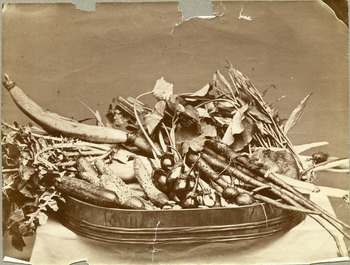
Vegetables were long part of Lyman's diet, but in Japan he was introduced to varieties with which he was entirely unfamiliar. He had learned to use a camera and develop and print photographs as part of his profession as surveyor, and among those he took in Japan is an unusual vegetable still life (Figure 2). A relic of a process of self-education, even a self-portrait of sorts, this photograph captures a time, a place, and the very stuff of Lyman's somatic existence through the lens of a scientist in the habit of itemizing every aspect of his life. At first glance, it is the very ordinariness of the subject that makes the photograph so striking. Lyman has carefully assembled commonplace Japanese vegetables in a large container bound with bamboo, with long burdock (gobo), leeks, daikon beneath, cucumber, arrowhead (kuwai), and eggplants scattered over them, with, on the far right, wild chervil (mitsuba) used as an herb in soup. The most arresting feature of the scene, however, is the small rat perched just beneath the stalks and leaves of the chervil. How are we to read the presence of this rat? Does the photo record a chance event? Is it intended as a commentary on Lyman's belief in the importance of living in harmony with animals? Or might it be his way of recording the year of the rat, which fell in 1876? Mice and rats often figured in New Year's greetings for that zodiac year since they had auspicious connotations owing to their congregation in places where there was abundant rice, emblematic of wealth. Although this monochromatic photograph captures Lyman's rather joyless vegetarianism, viewed in the context of Japan, it also speaks to the way in which he immersed himself in local culture and foodways.
Vegetable still life photographed by Lyman, 1873–81. Benjamin Smith Lyman Papers (MS 190), Special Collections and University Archives, University of Massachusetts, Amherst Libraries.

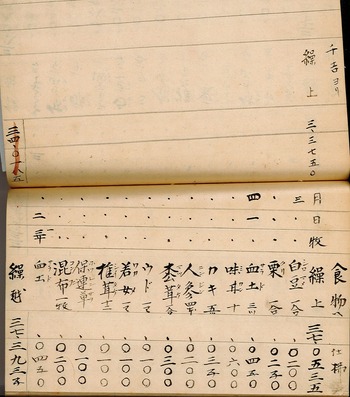
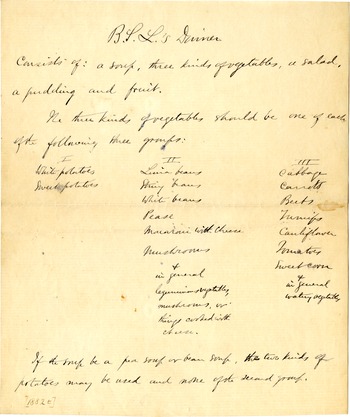
Like most expatriates Lyman did not cook for himself, but hired a Japanese cook named Kotaro. Some cooks learned to cook Western food, but Kotaro, like most, however, seems to have primarily prepared Japanese dishes adapted to Lyman's taste using local ingredients. While no menus survive, the ledgers (senchō) kept by Kotaro between 1874 and 1879 provide a revealing daily accounting of the range of foodstuffs and their prices. For instance, on 1 April 1874, Kotaro purchased white beans, salad greens, Japanese tangerines, persimmons, carrots, two varieties of mushrooms (matsutake and shiitake), udo, a vegetable with a taste like asparagus, and two varieties of seaweed used in soup (wakame and konbu) (Figure 3). Each item in the account book is inscribed in neat Chinese characters with phonetic kana reading aids alongside so that Lyman could check Kotaro's report for accuracy. The daily purchases recorded in Kotaro's account book testify that Lyman's diet varied little from day to day. In this respect, it was no different than his diet in the United States. According to a neatly penned page of instructions for his dinner from 1882, he had a fixed menu consisting of “a soup, three kinds of vegetables, a salad, a pudding and fruit” (Figure 4). The vegetables are arranged in three columns: potatoes, followed by legumes and pulses (plus macaroni), and assorted “watery vegetables,” an arrangement suggestive of his effort to create nutritional balance.
Page from Lyman's cook's account book, 1 April 1874. Benjamin Smith Lyman Papers (MS 190), Special Collections and University Archives, University of Massachusetts, Amherst Libraries.

Benjamin Smith Lyman's dinner, c.1882. Benjamin Smith Lyman Papers (Mss. B.L982), American Philosophical Society, Philadelphia.

Rice, which Kotaro bought in quantities sufficient for a month, remained a staple of Lyman's diet throughout his stay, but in the account book for 1879 there are more Western goods, such as, butter, jam, and bread, perhaps because they were more readily available at a lower cost than in the early 1870s. Also figuring often among Kotaro's expenses in that year is asparagus. Dutch traders had introduced it as an ornamental plant in the 1780s, but Lyman may have been the beneficiary of the results of the cultivation trials being carried out under American auspices in Hokkaido in the 1870s. Asparagus, like many of the vegetables and fruits introduced from the United States at this time, did not catch on among Japanese until well after the turn of the twentieth century. In Japan, as in the United States, the presence of foreigners, the growth of agronomy, and participation in the global market economy increased the availability of both new locally grown and imported processed foods, but habitual foodways changed only slowly.
VEGETARIAN DIET AND DISHES
In 1887 Lyman secured a post as assistant geologist of Pennsylvania and moved to Philadelphia, the birthplace of American vegetarianism. He plunged into writing the cookbook after his retirement in 1895, at times spending as many as five hours a day working on it.Footnote 53 During this period, he led a very active social life, attending meetings of the many professional organizations to which he belonged, getting together with Japanese living in or passing through Philadelphia, and dining with other vegetarians. Wilfred Harvey Schoff and Albert Edmunds, with whom he dined most often, were both of a cosmopolitan scholarly bent like himself. Schoff was a well-known classical and orientalist scholar and translator of Periplus of the Erythraean Sea, an account of travel and trade in the Indian Ocean by a merchant of the first century. Edmunds, a British American Buddhist sympathizer, though little-known today, was an important agent in transnational exchanges between the United States and Japan and a prolific writer on religion.Footnote 54 Edmunds, like Lyman, was a bachelor, and during the last years of Lyman's life the two men ate together almost daily.Footnote 55 More than twenty years his junior, Edmunds seems to have been devoted to Lyman, and upon his death coordinated the disposal of many of his personal papers, including a draft of the cookbook now in the Historical Society of Pennsylvania, where he was a cataloguer.
Cookbooks by definition involve the coproduction of knowledge, and Lyman devoted more than a decade to carrying out research on developments in dietary science and collecting recipes. He drew on publications ranging from E. Dumont's La bonne cuisine (1875) to bulletins issued by the US Department of Agriculture.Footnote 56 Whether he acquired recipes or information from acquaintances other than the above-mentioned Vinaak Sing is unknown, since he only acknowledged the authors of published works. When the cookbook was finally published in 1917, it had undergone much revision and expansion, reaching 1,001 extensively annotated entries. The section on mushrooms gives a sense of the depth of Lyman's research. It begins with advice on choosing and cleaning them, followed by a selection of recipes, including broiled, fried, and stuffed mushrooms; stewed mushrooms in the Provençal fashion; mushroom pie; mushroom catchup; and canned mushrooms. There are recipes for cepes, chanterelles, and morels, and for truffles, many of them culled from Dumont's La bonne cuisine. (One wonders whether Lyman himself had ever tasted any of these French delicacies.) For the final paragraphs on other mushrooms, he drew on personal knowledge to comment on three varieties he had eaten in Japan: shiitake (live-oak mushroom), matsudake (pine mushroom), and yanagidake (willow mushroom), and to observe that good-quality dried mushrooms were available in both Chinese and Italian shops in America.Footnote 57
Vegetarian Diet and Dishes was written by and for persons who didn't cook for themselves on a regular basis. Lyman was not a hands-on cook and assumed that his readers, like him, were well educated and curious about the wider world, and had a housekeeper to take care of their day-to-day needs. Lyman himself had a succession of housekeepers ranging from an older woman to a sixteen-year-old girl.Footnote 58 It is hard to know to what extent these cooks would have been open to the cosmopolitan varieties of vegetarian foods he recommended, especially since their preparation is often described in such vague terms. Of bamboo shoots, for instance, he wrote, “In Japan, China, and Java and perhaps other warm countries, the very young shoots of the bamboo are eaten, after being sliced into small pieces, and cooked (say, by stewing).”Footnote 59 As food historian Katharina Vester and others have argued, a lack of practical instructions is one of the characteristics that distinguishes cookbooks written by and for men, who thereby demonstrated their innate superiority in the kitchen.Footnote 60
By 1917, female home economists had made the principles of nutrition based on carbohydrates, proteins, fat, minerals, and calories a feature of many cookbooks. Lyman enhanced the masculine authority of his by providing an intimidating wealth of scientific data in support of the vegetarian diet, with frequent reference to foreign food and foodways. His lengthy introduction presents chemical data on the body and diets, statistics on the various diets of mankind, including such matters as fat in American diets and the Chinese diet in America, and the composition of various classes of food, all drawing on the writings of leading experts of the day.Footnote 61 The modern system of measuring the relationship between food intake and energy output in calories had been popularized in the United States in the 1890s through the efforts of W. O. Atwater, a professor of chemistry at Wesleyan University, following experiments and surveys of American eating habits conducted under the auspices of the US Department of Agriculture.Footnote 62 To demonstrate their protein, fat, carbohydrate, and ash (mineral) values relative to meat, Lyman included a chart with the composition of forty-two vegetables, thirty-two cereals, twenty-one fruits and twenty-two nuts, all readily available, concluding that based on their nutritional composition “a wholly satisfactory, varied standard diet can evidently be composed of vegetable foods alone.”Footnote 63
Exceptional at the time, Lyman's scholarly cookbook also includes, for purposes of comparison, the nutritional composition of natto, a form of fermented soybeans; fresh tofu; two varieties of soybeans, red and white; and “Swiss” miso, all soy-based foodstuffs suited to a vegetarian diet that were still little-known among Caucasians in the United States.Footnote 64 Lyman, of course, would have been familiar with these from his years in Japan, although he may not yet have known that soybeans are among the best sources of plant-based protein and fat and also contain valuable vitamins and minerals. He names Mary Hinman Abel, the author of Beans, Peas, and Other Legumes as Food, a brochure issued by the USDA in 1904, as the source of this information.Footnote 65 It is likely, however, that her data derived from the investigations of Kintaro Oshima, director of the Hokkaido Agricultural Experimental Station in Sapporo. Oshima worked with Atwater at Wesleyan for six months in 1903, investigating the nutritional properties of the Japanese diet.Footnote 66 His report on the chemical composition and nutritional value of the Japanese diet was also published by the USDA in 1905.Footnote 67 At the time, soybeans were not yet an important crop in the United States; serious interest in their potential as economical and nutritious meat substitutes only developed around World War I.Footnote 68 Atwater, Abel, and Oshima's research findings speak to international cooperation in the dissemination of knowledge about nutrition.
Although Lyman did not include recipes using Protose or Nuttolene, among the processed “health foods” that Dr. J. H. Kellogg, his wife Ella, and his brother W. K. Kellogg had introduced, first for the Battle Creek Sanitarium and later for wider consumption through the Sanitas Nut Company, he shared the Kelloggs’ advocacy of nuts as protein-rich alternatives to animal-based foodstuffs.Footnote 69 Carrying out his own experiments in the kitchen, he developed what he called terralac, or peanut milk, describing in precise detail how to make it by crushing the nuts in the “Universal Food Chopper.” (Introduced in 1897, this best-selling appliance became as indispensable to the early twentieth-century kitchen as the Cuisinart food processor is today.) He also explained that terralac could be used, like cow's milk, to make custards, sauces, soups and other dishes.Footnote 70 He was dissatisfied with the results of his efforts to make artificial milk and cream using oats, however. In a diary entry, he notes, “I did not well succeed today in producing an emulsion by stirring with a spoon but perhaps can do so with an eggbeater.”Footnote 71 Consequently, the drink he proposed calling cerilac did not make it into the cookbook. Today Terralac is a Pfizer-trademarked condensed-milk substitute for infant domesticated animals, while oat milk, consumed by vegans and those who are lactose-intolerant, is a global multi-billion-dollar industry.
Cookbooks tell us what is possible in a particular place at a particular time, but they do not tell us what is actually cooked. It is important to keep this in mind with respect to Lyman's Vegetarian Diet and Cookery. Self-published in a print run of a thousand, and in the absence of reviews, there is little evidence that it found a readership beyond Lyman's friends and associates.Footnote 72 Lyman himself presented the copy in the Harvard University Library to Edwin H. Abbot, 1855 class secretary, and his Japanese students purchased one hundred copies.Footnote 73 Successful or not, the rational, scientific, and moralistic approach Lyman brought to his cookbook was in keeping with the conviction among many Americans at the time that food reform was a matter of urgency. As historian Helen Veit has written of the first decades of the twentieth century: “To many Americans, indeed, a comprehensive overhaul of U.S. food offered answers to a host of social questions, including physical health, wage strife, women's roles, racial fitness, Americanization, international welfare, and world peace.”Footnote 74
COSMOPOLITAN VEGETARIANISM
Cookbooks are never just about recipes. Kristin Hoganson observes in Consumer's Imperium that, although these are often perceived as symbols of domesticity, they are not necessarily intended for domestic use; they could also be a source of opinionated popular geography, “a geography that prompted homemakers to buy into the consumers’ imperium.”Footnote 75 While Lyman's Vegetarian Diet and Dishes may not have actually inspired homemakers to buy the ingredients necessary to prepare the dishes described, its wealth of ethnographic information, particularly about Asian foodways, acquired through travel, research, and personal encounters with visitors and immigrants to the United States, speaks to a growing consciousness of the global interconnectedness of food and foodways. By the same token, it also throws into relief the cosmopolitan socioeconomic and geopolitical contexts in which vegetarian diets became enmeshed.
The first decades of the twentieth century saw wider public acceptance of a more vegetable-based diet and nationwide diffusion of vegetarianism on the grounds of nutritional, health, and economic benefits. While initially vegetarianism was a niche practice linked to American Protestantism largely confined to the East Coast, in the 1880s its practice began to spread to other regions through the efforts of the Vegetarian Society of America, created in Philadelphia under the guidance of Reverend Henry Clubb, a leader in Philadelphia's Bible Christian Church.Footnote 76 Its monthly magazine Food, Home and Garden (later renamed the Vegetarian Magazine) had 3,750 subscribers in 1900, but by 1911 subscriptions had reached 15,000, with a readership no longer linked to the church. Between 1897 and 1916, as the cost of living rose by almost a third, women social activists promoted a more vegetable-based diet as a solution to American food precarity.Footnote 77 Vegetarianism took on a gendered dimension when the celebrated bodybuilder Bernarr Macfadden stressed its benefits to building masculine strength, muscle tone, and vitality. His magazine Physical Culture, first published in 1898, sought to convince its male readers that it was possible to achieve great feats of strength and endurance without eating meat. He monetized his convictions by founding the country's first chain of vegetarian restaurants. By 1908, these extended from New York, Philadelphia, and Boston to Pittsburgh, Buffalo, and Chicago.Footnote 78 Lyman observed that in Philadelphia even some ordinary restaurants were prepared to accommodate vegetarians.Footnote 79
By the time Vegetarian Diet and Dishes appeared in 1917, nutritional science had clearly demonstrated that protein-rich pulses and legumes were economical substitutes for meat and that fruits and vegetables were critical sources of vitamins essential to good health. There was also newfound recognition of the economical and nutritional value of dishes such as spaghetti with tomato sauce and “chop suey” introduced by immigrants from Europe and China. Rejection of foreign dishes was based on unfamiliarity with their ingredients and on the fact that, often, these mingled meat and vegetables in pungent sauces. Many Americans, vegetarians included, believed that mixed foods – as opposed to meat, potatoes, and vegetables, each served separately in its “natural” state – were more difficult to digest. Such beliefs played into racial theories holding that “white people's stomachs actually could not digest combinations of mixed foods, while the stomachs of other, less civilized people could.”Footnote 80 Nonetheless, Italian pastas – Lyman mentions macaroni, spaghetti, vermicelli, and “lazane” – gained popularity because sauced dishes made with them could help stretch family meals.Footnote 81 Inexpensive chop suey likewise gained a following throughout the United States.Footnote 82
Prejudices against some immigrant foods, however, were hard to overcome. When shortages developed after the United States entered World War I in 1917, the government promoted, with mixed success, soybeans and rice as substitutes for bread and potatoes. Lyman was an early proponent of tofu, a curd made of coagulated soy milk, an economical, protein-rich staple of the East Asian diet:
The Chinese and Japanese make a highly digestible and nourishing white curd from beans; and it might probably be very advantageously produced in western countries, and could perhaps be made more palatable to us than it is in its simplest conditions in the Far East, as in some of its forms it is already delectable.Footnote 83
Lyman chose his words carefully, and it is rare to find such fulsome praise for the taste of any food in his writings. Although he does not mention it, by 1917 there were Chinese grocery stores in many parts of the United States where tofu could be procured, including, no doubt, Yee Long & Co. of Philadelphia, whose business card is in Lyman's scrapbook.Footnote 84
Soy sauce was another soy-based condiment of which Lyman seems to have been especially fond. According to Yasuko Fukumi, there is among his records an invoice from Katagiri Brothers, one of the first Japanese grocery stores in the country, still in operation today on 224 East 59th Street in New York City.Footnote 85 Lyman's order was for four gallons of soy sauce and two pounds of dried shiitake mushrooms. Although he did not include recipes for Chinese or Japanese dishes in his cookbook, he must have indulged in them himself, or added these ingredients to flavor familiar dishes. Readily available at many general grocery stores, soy sauce was an intrinsically East Asian condiment that became easily disassociated from its ethnic origins because it could be added, like Worcestershire sauce, to add piquancy to bland dishes.Footnote 86
Surprisingly, Lyman makes no mention of Chinese cabbage, water chestnuts, lotus root, or other vegetables used in Chinese and Japanese tofu dishes that, from the turn of the century, Chinese farmers were cultivating and trucking into New York City, and perhaps Philadelphia as well.Footnote 87 Chinese cabbage, mustard grass, melons, yard-long beans, and coriander were of sufficient commercial interest in the United States that they were also grown experimentally at Cornell University's agricultural station.Footnote 88 Many seeds and plants were imported from Japan under the auspices of the USDA, as well as American and Japanese commercial enterprises. An article in the Vegetarian Magazine, announcing the introduction and sale of the first Japanese walnut (Juglans sieboldiana) to the United States is evidence that new varieties of fruits and vegetables were of special interest to vegetarians.Footnote 89 The varieties of Japanese persimmon and their modes of preparation in that country detailed in Lyman's cookbook speak to an interest in fruit-bearing trees as well.Footnote 90 In noting that the sweeter kind of Japanese persimmon “has been introduced to the warmer part of the United States,” he confirms what readers could have learned already in newspapers including the New York Times, from an article with the catchy title “Puckerless Persimmons”Footnote 91 It describes a Japanese technique for making this tart fruit more palatable, as well as the new hybrids produced with Japanese grafts. Americans consumed many varieties of fruit without knowing their exotic origins. The eponymous Burbank, Chabot, and Santa Rosa plums, for instance, are all hybrids that were developed at the turn of the century by botanist Luther Burbank from Japanese cultivars.Footnote 92 Immigrants from Japan also popularized satsumas, an especially juicy variety of mandarin orange that thrived in eastern Texas. Saburo Arai, a friend of Lyman's who, before his move to Texas in 1906, had managed a nursery business and designed Japanese gardens from a base in Atlantic City, New Jersey,Footnote 93 specialized in growing figs and satsumas, of which the state became a major producer.Footnote 94
Rice did not figure prominently in the diet of early New England vegetarians. Although it had been grown in the South since colonial times, most notably in the Carolinas, it was generally identified as a foreign food. Its popularization required overcoming the racialized hierarchy of grains that held wheat to be superior to all other grains, and even necessary for white people.Footnote 95 Japan's victory in the 1904–5 Russo-Japanese War, which was partly attributed to the simple, healthful, rice-based diet of its soldiers, however, contributed to more favorable attitudes towards its cultivation and consumption in the United States.Footnote 96 Capitalizing on this moment, in 1905 Henry Clubb published a hundred-recipe booklet entirely dedicated to vegetarian dishes made with unpolished rice, recommending these as alternatives to bread and potatoes. Like Sylvester Graham before him, Clubb insisted that milling to remove the outer bran layer affected the nutritional quality of grains. “Polishing removes more than three-fourths of the flavor and about one-fourth the fiber material,” he declared, adding (incorrectly) that “in Japan, China, and India polishing is not done, except for foreign markets.” Seeking to ground his arguments about oriental rice in science, Clubb even consulted S. A. Knapp of the USDA requesting analysis of the nutritional differences between Carolina rice and unpolished Japanese rice, a sample of which he had procured in Philadelphia. American milling companies, he was told, did not sell rice “in the unpolished state for the simple reason that it is not salable. Rice is an article that is sold entirely on its appearance, although we are candid to say that the unpolished rice contains more nutriment.”Footnote 97
Lyman recommended rice for its nutritional value and digestibility. Although he offered practical advice about its preparation, it is set within an ethnographic framework reflecting his personal experience of Asian foodways as well as serious scholarly research. He distinguished between the way it is cooked in China and Japan so that the grains stick together, making it easy to eat with chopsticks, and in India, where rice made to accompany curries is made loose since it is eaten with a spoon. He further distinguished these from “Cochin China boiled Rice,” where by “smothered cooking” (using a small amount of water turned into steam) the grains remain separate, information he acquired from an article in a French anthropology journal.Footnote 98
Japanese migrants to Texas and California were active in the development of the American rice industry. At the turn of the century, the Houston Chamber of Commerce invited Japanese to settle in the region, hoping their skills in horticulture and agriculture would help to bring prosperity to the still underdeveloped state. Seito Saibara was among those who moved there, carrying with him seeds of shinriki, variety of short-grained Japonica rice that proved to be well suited to the climate and soil on the Gulf Coast.Footnote 99 Some immigrants failed because they lacked a farming background, others because they had difficulty adapting to commercial-scale production methods in use in the United States, still others because of natural catastrophes, but Saibara flourished, transforming Texas into one of the country's leading producers of rice. Keisaburo Koda arrived in California in 1908, and took up rice cultivation after other business ventures had failed. The medium-grain Kiushu variety he introduced proved well suited to the California climate and soil. His business was so successful that the Japanese American community dubbed him the “rice king.”Footnote 100 Such Japanese successes, however, shifted power relations with the local white majority. Immigrant farmers were seen as threats, provoking the xenophobia that led to the kind of racial fearmongering promoted by the Asiatic Exclusion League in their 1908 publication Meat vs. Rice: American Manhood against Asiatic Coolieism; Which Shall Survive?.
Rice gains and loses value and meaning depending on the framework in which it is defined. The dynamics of its reception in the United States followed not only from its association with Asian immigrants, but also from its earlier introduction by slaves. Within this multilayered framework, as noted above, rice was deemed a grain inferior to “American” wheat. Extending this racialized hierarchy to Asia was arguably a form of orientalism, a way of controlling the alien bodies and cultures of which rice was perceived to be a part. This complex process reveals how a food identified as manifestly foreign, even as it was increasingly integrated into American diets, could simultaneously become part of anti-immigrant rhetoric.
CONCLUSION
American vegetarian diet and dishes were not static but evolved considerably between 1864 and 1920. These changes took shape under specific historical conditions and in relation to specific geopolitical power relations. As vegetarianism spread, it embraced new cosmopolitan foods and foodways of European and, especially, Asian origins. Receptivity to foreign foods, however, did not necessarily imply respect or concern for the people or cultures of which they were a part. Benjamin Lyman and fellow vegetarians represented a tiny minority of the American population who saw themselves as resisting the forces of unhealthy, carnivorous, commercial food production. They were intent on ensuring that what they ate reflected what they believed. He was especially determined to prove on a scientific basis that a vegetable-based diet was both morally and nutritionally correct. By drawing on evidence from Asia in support of his claims, he demonstrated a cosmopolitanism that underscored his masculinity. Bound up as it was with questions of race, gender, and national identity, cosmopolitan vegetarianism was filled with ambiguities, contradictions and conflicts well illustrated by the Asiatic Exclusion League's stark vision of American meat versus Asian rice. Many Americans adopted a few exotic ingredients, such as curry and soy sauce, combining them in various ways with familiar dishes, but other imports from East Asia, most notably tofu and other protein-rich soy-based meat substitutes, would not find a place on American tables until the 1970s. The situation was different for rice, fruits, and vegetables of Japanese origin which often insinuated themselves into American diets without their consumers’ knowledge. While the introduction of these new foodstuffs did not undermine the dominant order, it did contribute to culinary expansion and diversification. Benjamin Lyman's activities and writings help to envision an alternative mapping, at once more granular and more expansive, of late nineteenth- and early twentieth-century American vegetarianism. They throw into relief the way that Japan and India have contributed to the modern recognition that plant foods can provide all the nourishment needed to live.