Introduction
Pachnoda interrupta Oliver (Coleoptera: Scarabaeidae: Cetoniinae) is a widely distributed and economically important insect pest in East and West Africa (Grunshaw, Reference Grunshaw1992; Jago, Reference Jago and Youm1995; Krall et al., Reference Krall, Youm, Kogo, Nwanze and Youm1995; Ratnadas and Ajayi, Reference Ratnadas, Ajayi, Nwanze and Youm1995). It is polyphagous and causes severe damage to various staple crops such as pearl millet and sorghum (Loch et al., Reference Loch, Mahmoud and Sidibe1988; Grunshaw, Reference Grunshaw1992; Sastawa and Lale, Reference Sastawa and Lale2000). Pachnoda interrupta is univoltine and survives the dry season in the soil as quiescent adults that emerge synchronously with the first rains of the following year (Grunshaw, Reference Grunshaw1992; Seneshaw and Mulugeta, Reference Seneshaw and Mulugeta2002; Dejen and Merene, Reference Dejen and Merene2014).
Current control methods of the sorghum chafer rely on the use of synthetic insecticides (Sastawa and Lale, Reference Sastawa and Lale2000; Jembere et al., Reference Jembere, Getahun, Negash and Seyoum2005). However, the associated problems of chemical insecticides, such as environmental contamination, pest resistance and effects on non-target organisms, have spurred the search for biologically based alternatives for insect pest management. Of the environmentally friendly alternatives, the use of entomopathogenic fungi has been recognized as a viable option for insect pest control (Lacey et al., Reference Lacey, Martins and Ribeiro1994; Inglis et al., Reference Inglis, Goettel, Butt, Strasser, Butt, Jackson and Magan2001; Charnley and Collins, Reference Charnley, Collins, Kubicek and Druzhinina2007; Ekesi et al., Reference Ekesi, Dimbi, Maniania, Ekesi and Maniania2007). However, their field application is limited due to the problems related to their dissemination into the target insect pest population, and most have broad host ranges, including beneficial insects (for a review, see Roberts and St Leger, Reference Roberts and St Leger2004). Devices such as traps containing both entomopathogens and host-specific attractants can potentially deliver the pathogen to the target pest population, and have been shown to be effective for different insect groups (Klein and Lacey, Reference Klein and Lacey1999; Furlong and Pell, Reference Furlong and Pell2001; Maranga et al., Reference Maranga, Hassanali, Kaaya and Mueke2006; Toledo et al., Reference Toledo, Campos, Flores, Liedo, Barrera, Villaseñor and Montoya2007; Quesada-Moraga et al., Reference Quesada-Moraga, Martin-Carballo, Garrido-Jurado and Santiago-Álvarez2008). In previous studies, we identified multiple semiochemicals that were effective in attracting P. interrupta (Wolde-Hawariat et al., Reference Wolde-Hawariat, Seyoum, Jembere, Negash, Hansson and Hillbur2007; Bengtsson et al., Reference Bengtsson, Wolde-Hawariat, Khabaish, Negash, Jembere, Seyoum, Hansson, Larsson and Hillbur2009, Reference Bengtsson, Satya, Wolde-Hawariat, Negash, Seyoum, Hansson, Schlyter, Schulz and Hillbur2010). We hypothesized whether the integration of semiochemicals with entomopathogenic fungi might be a useful strategy in the management of P. interrupta. Therefore, we isolated entomopathogens from the target pest, determined the efficacy on larvae by dipping them in the spore suspension and on adults by using the combined semiochemical attraction and infection technique, and then determined whether the attracted and infected beetles were able to pass the entomopathogen identified as Metarhizium sp. to healthy beetles using an autoinoculation device.
Materials and methods
Isolation and production of entomopathogenic fungi
Dead P. interrupta adults (100 in total) were collected from a field site known as Rasa (09°54′N, 40°03E) located 255 km northeast of Addis Ababa, Ethiopia. To isolate entomopathogenic fungi, the dead beetles were surface-sterilized with 70% ethanol for approximately 3 s and incubated on Petri dishes individually at room temperature on moistened filter paper. Growth of entomopathogenic fungi was checked after 7 days. Whenever entomopathogenic fungi were found on the dead insects, a small part of mycelium was smeared on Sabouraud dextrose agar (SDA) media until a pure culture was obtained. Conidial suspensions for the experiments were prepared by scraping conidia from at least 7-day-old, well-sporulated entomopathogens from SDA agar into an aqueous solution of 0.2% Tween-80. Suspensions were filtered through several layers of cheesecloth to remove the mycelium and vortexed to homogenize the inoculum. The concentration of conidia was determined using a haemocytometer at 400 × magnification. For field application, entomopathogenic fungi were grown on partially ground sorghum by inoculating 1 ml of 1 × 10⁸ conidia/ml spore suspension of the isolate in 200 g boiled and sterilized sorghum. In our preliminary experiment, we tested both rice and sorghum as media for growing the fungus, and found that when sorghum was partially ground, it was as good as rice. The sorghum was put in an Erlenmeyer flask and sterilized in an autoclave using steam heated to 121 °C for 15 min. The treated sorghum was incubated at 26 °C for at least 7 days until the conidia were fully grown on the sorghum.
Effect of the entomopathogen on adult beetles under field conditions
Field experiments were carried out at Rasa (the site where the insects were collected, see above). To investigate the pathogenicity of Metarhizium sp. under field conditions, 50 g of the sorghum on which the entomopathogenic fungi had been grown was placed in the bucket of Japanese beetle traps (Trécé, Palo Alto, California, USA). The experiment was repeated during two flight periods of the beetle, October and July, with five replicates in each season. During the flight period in October 2005, 100 μl of neat methyl salicylate (Sigma-Aldrich, Germany) applied to dental cotton rolls (No. 3; Q-dent, Germany) were used as an attractant (Wolde-Hawariat et al., Reference Wolde-Hawariat, Seyoum, Jembere, Negash, Hansson and Hillbur2007; Bengtsson et al., Reference Bengtsson, Wolde-Hawariat, Khabaish, Negash, Jembere, Seyoum, Hansson, Larsson and Hillbur2009), while during July 2006, about 30 g of fresh, mashed banana placed inside the bucket were used as an attractant to maximize trap catch, as the number of beetles in the field was lower during this period. After 24 h, 20 of the beetles caught in each trap were randomly selected for further mortality study, and afterwards kept in a 20 × 10 cm plastic cage, which was perforated for aeration. The cage was placed indoors at room temperature and ambient humidity. The beetles were fed fresh banana every morning and mortality was recorded every day over 20 days. When the dead insects were encountered, they were kept on moistened filter paper to observe any fungal outgrowth.
Autodissemination device development
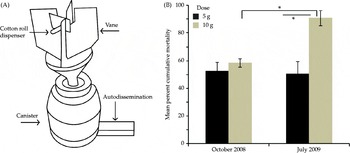
To investigate the feasibility of disseminating the pathogen using the target pest itself, an autodissemination device was developed, into which the beetles were attracted using semiochemicals, and infected with entomopathogen. The device was developed from locally available materials, modified from Wolde-Hawariat et al. (Reference Wolde-Hawariat, Seyoum, Jembere, Negash, Hansson and Hillbur2007). It had a vane (8.6 × 4.6 cm), a canister (12.2 × 22 cm) and an autodissemination device, which was a rectangular tube (16 × 4 cm) with a layer of Metarhizium sp. sorghum culture (Fig. 1A) on its bottom, connected to the canister of the trap, with a 0.5 cm high wax wall at the exit, to prevent the entomopathogen from falling out when the trapped insect left the autodissemination device (for details, see Fig. 1A). Methyl salicylate (100 μl neat) loaded on a cotton dispenser and placed on the vane of the trap was used as an attractant.
Field application of Metarhizium sp. in an autodissemination device. (A) Schematic of the autodissemination device; (B) mean percent cumulative mortality over 15 days for 100 beetles infected using the autodissemination device in October 2008 and July 2009. The error bars represent the standard error of the mean; * P< 0.05.

Field trial of Metarhizium spp. using the autodissemination device
Two fungal treatments of the entomopathogen (5 and 10 g of Metarhizium spp. sorghum culture) were tested in the autodissemination device in October 2008 and July 2009. As a control, an autodissemination device loaded only with sorghum was used. The autodissemination device was placed in a sorghum field during October 2008 and in an acacia woodland during July 2009, to test its performance on sorghum chafer populations. Methyl salicylate (100 μl neat) loaded on a cotton dispenser was used as an attractant, and the traps were placed in the field before 09.00 h. Each treatment of Metarhizium spp. was replicated five times. The beetles leaving the trap were collected in a perforated plastic bag connected to the autodissemination device. From these beetles, 20 were selected for entomopathogenic investigation. The beetles were transferred into a 20 × 10 cm plastic cage and kept indoors, and provided with fresh banana every day. Mortality was checked on a daily basis over a 20-day period.
Survival of Metarhizium spp. in the autodissemination device
The viability of the fungal spores in the autodissemination device was checked before the experiment, and then after 3, 6, 24, 48 and 98 h application of conidia in the field. The block technique of Seyoum and Negash (Reference Seyoum and Negash2007) was used to test the fungal viability by placing 10 sorghum seeds from the autodissemination device on which the fungus had been grown on a Petri dish with SDA medium, and thereafter incubating it at room temperature for 24 h, after which the growth of the fungus was observed and quantified.
Horizontal transmission bioassay
To test the potential for the horizontal transmission (autodissemination) of conidia from beetles caught and infected in the field using the autodissemination device, infected beetles were mixed with uninfected beetles (10 per group, with an equal proportion of both sexes). Uninfected beetles were marked with nail polish, and the two groups were kept together for two durations: 2 and 24 h. Each treatment was replicated five times. After exposure, they were separated and kept in different cages, and mortality was checked as before.
Effect of the entomopathogen on Pachnoda interrupta larvae under laboratory conditions
Metarhizium sp. isolate was tested on the second- and third-instar larvae of P. interrupta. Three concentrations were applied: 1 × 10⁶, 1 × 10⁷ and 1 × 10⁸ conidia/ml. Each larva was dipped in the spore suspension separately for about 2 s. Each concentration was replicated three times with five larvae, as we had a limited number. Control larvae were dipped in water. After treatment, larvae were placed in Petri dishes containing soil mixed with cow dung manure, and mortality was checked daily over 20 days.
Mycosis experiment
To investigate whether the cause of death was the entomopathogen, dead beetles were surface-sterilized with 70% ethanol for about 3 s, and incubated on moist filter paper at room temperature to check for the outgrowth of fungal spores.
Data analysis
Mortality in the fungal treatments was corrected for their respective control mortality using Abbot's formula (Abbot, Reference Abbot1925). To compare mortality between different treatments of the entomopathogen, ANOVA followed by Tukey's post hoc test was performed. Normality of variance was checked using Levene's test (P>0.05). The independent t test was used to compare between seasons at a given date of the same treatment. Data were analysed using SPSS 17 (SPSS Inc., Chicago, Illinois, USA).
Results
Isolation, production and identification of the entomopathogenic fungus
Of the 100 dead P. interrupta adults collected in the field, 25.2% showed growth of entomopathogenic fungi. More than 10 fungal isolates were made from the dead beetles; however, we focused our efforts on isolate AAU-D, since it was the most frequent entomopathogen observed from dead beetles (in about 72% of the dead beetles). Furthermore, it was easy to produce in culture, and proved virulent in a preliminary experiment. The AAU-D entomopathogen was identified as Metarhizium sp., based on the shape of the conidia, which were cylindrical and slightly central narrowing, forming long laterally adherent chains, and based on the colour of the conidia, which are initially white and green when mature (Humber, Reference Humber and Lacey1997; Bischoff et al., Reference Bischoff, Rehner and Humber2009). For field application, it was grown on sorghum.
Pathogenicity of Metarhizium sp. on Pachnoda interrupta adults under field conditions
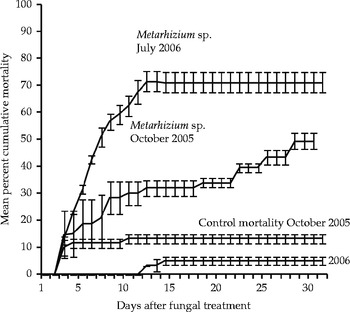
Starting from day 7, the entomopathogen caused a higher mortality rate than the control treatment (t= 3.791, df = 8, P= 0.005) during October 2005. In the Metarhizium sp. treatment, 49% mortality was observed, while for the control treatment, it was 13.3% within 30 days (Fig. 2). However, during July 2006, 71% of the attracted and infected beetles were dead within 15 days after treatment, while only 5% of the control beetles died (Fig. 2). Furthermore, from day 3 onwards, the entomopathogen caused a higher mortality rate than the control treatment (Fig. 2). Of the dead beetles, 50% in October and 80% in July showed mycosis, while none of the beetles from the control treatment showed mycosis. Furthermore, from day 8 onwards, higher mortality was observed in July 2006 compared with October 2005 (t= 4.152, df = 8, P= 0.003 for day 8; Fig. 2).
Pathogenicity of Metarhizium sp. to Pachnoda interrupta adults under field conditions. Mean percent cumulative mortality of 100 P. interrupta adults under field conditions in two different years. The error bars represent the standard error of the mean.

Mortality of Pachnoda interrupta in the autodissemination device
Sorghum seed culture of Metarhizium sp. was placed in the autodissemination device (Fig. 1A), which was placed in a sorghum field during October 2008 and in an acacia woodland during July 2009. Metarhizium sp. survived for more than 98 h in the autodissemination chamber under field conditions, at which point 69% of conidia were grown. Significantly higher mortality was observed when the beetles passed through either the 5 or 10 g fungal treatment in the autodissemination device, compared with the control (F= 11.44, df = 2, P< 0.001; ANOVA followed by Tukey's post hoc test) during October 2008. However, there was no significant difference between the 5 and 10 g treatments. Of the beetles subjected to the 10 g treatment, 58.6% were dead on day 21, at which time 52.5% of the beetles subjected to the 5 g treatment were dead, and control mortality was 3%. Higher efficacy was obtained during July 2009, where 90.9% mortality was observed in the 10 g treatment and 50% mortality in the 5 g treatment, while control mortality was 3% in October and 1% in July. Furthermore, in July, significantly more beetles died in the 10 g treatment compared with the 5 g treatment (F= 150.6, df = 2, P< 0.05; ANOVA followed by Tukey's post hoc test; Fig. 1B). The pathogen caused higher mortality during July 2009 compared with October 2008 in the 10 g treatment (t= 2.99, df = 8, P= 0.017). However, no difference was observed for the 5 g treatment between the two seasons.
Horizontal transmission of Metarhizium anisopliae
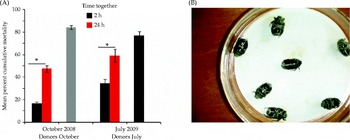
To test whether the infected beetles could transmit the pathogens horizontally (for autodissemination), we allowed the contaminated beetles (donors) to stay in the same feeding container with untreated beetles (recipients) for two time durations, 2 and 24 h. Of the donors, 84% died within 15 days. For recipients, 47.4% mortality was recorded within 15 days. However, for the 2 h treatment, only 17% of the recipients died within 15 days during the October field season (Fig. 3A). In July, 77% of the donors and 59% of the recipients were dead within 15 days of the 24 h treatment. For the 2 h treatment, again, lower mortality was observed: 34.4% of the recipients were dead within 15 days (Fig. 3A). In both seasons, the longer duration (24 h) caused higher mortality compared with the 2 h duration (t= 9.953, df = 8, P= 0.001 for October 2008; t= 3.578, df = 8, P= 0.007 for July 2009).
Horizontal transmission of Metarhizium sp. under field conditions. (A) Percent cumulative mortality over 15 days for beetles exposed to horizontal transfer (autodissemination) during October 2008 and July 2009. The error bars represent the standard error of the mean; * P< 0.005. (B) Sample of dead beetles showing mycosis.

The presence of mycosis on the dead beetles confirmed the cause of death to be fungal infection (Fig. 3B). However, control mortality was 5% during October and 4% during July, and in no cases was fungal growth observed on the dead control beetles.
Pathogenicity of fungal isolate on the larvae of Pachnoda interrupta under laboratory conditions
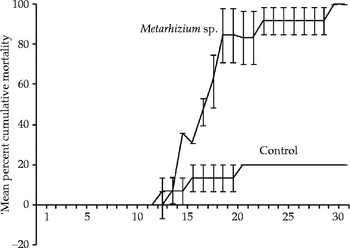
The mortality of P. interrupta larvae was concentration dependent, where a higher concentration of the entomopathogen produced a higher mortality rate than a lower concentration (F= 21.867, df = 3, P< 0.001; ANOVA followed by Tukey's post hoc test). However, 1 × 10⁶ and 1 × 10⁷ conidia/ml failed to cause significant mortality compared with the control treatment, except where the application of 1 × 10⁷ conidia/ml did cause higher mortality than the control treatment at day 26.The treated larvae started dying at day 12, and more than 84.6% were dead at day 18 after the application of 1 × 10⁸ conidia/ml (Fig. 4).
Pathogenicity of Metarhizium sp. to Pachnoda interrupta larvae. Cumulative mortality of second- and third-instar larvae of the sorghum chafer treated with aqueous formulation of Metarhizium sp. isolate under laboratory conditions at 1 × 10⁸ conidia/ml. The error bars represent the standard error of the mean.

Discussion
We isolated and grew the entomopathogen identified as Metarhizium sp., for laboratory and field studies. In this study, we show that Metarhizium sp. is an effective pathogen of the scarab beetle P. interrupta, an important pest insect on sorghum and pearl millet, and develop a proof-of-concept protocol for autodissemination of this fungus, producing high mortality for both directly infected and indirectly (horizontally) infected beetles. We incorporated the autodissemination device containing the attractants of P. interrupta to obtain a high degree of species specificity. Combined in an attract-and-infect system, the strategy increased species specificity of the transmission of fungal infection and facilitated the transmission of fungi to conspecifics, which is a desirable trait in the sustainable control of pest insects.
The Metarhizium sp. isolate tested in our study can infect and kill both the adults and larvae of the target insect pest (Figs 1–4). Similar to earlier studies of entomopathogen–insect interaction, it took approximately 15 days to achieve ≥ 50% mortality (Klein and Lacey, Reference Klein and Lacey1999; Gindin et al., Reference Gindin, Levski, Glazer and Soroker2006; Dembilio et al., Reference Dembilio, Quesada-Moraga, Santiago-Álvarez and Jacas2010; Maniania and Ekesi, Reference Maniania and Ekesi2013). Furthermore, increased mortality rates were observed during July rather than October. Larval mortality was dose dependent, and it took more than 10 days to induce mortality; similarly, variations in pathogenicity have been observed between developmental stages such as eggs, larvae and adults in other studies (Meissle et al., Reference Meissle, Pilz and Romeis2009; Dembilio et al., Reference Dembilio, Quesada-Moraga, Santiago-Álvarez and Jacas2010). Many factors influence the susceptibility of a host to a fungal pathogen, including the biology of the target insect (e.g. cuticle hardiness), its behaviour, the pathogenicity of the entomopathogen, as well as environmental factors, such as temperature and humidity (Grosscurt, Reference Grosscurt1978; Fargues et al., Reference Fargues, Ouedraogo, Goettel and Lomer1997; Ekesi et al., Reference Ekesi, Maniania and Ampong-Nyarko1999; Tefera and Pringle, Reference Tefera and Pringle2003; Dimbi et al., Reference Dimbi, Maniania, Lux and Mueke2004). From an autodissemination standpoint, delayed mortality might be advantageous, as it gives time for growth of the pathogen and time for the target insect to disperse the pathogen in the target population. In addition, fungal infection has also been shown to reduce lifespan, fecundity, fertility and mobility of infected insects, while also inducing reduced feeding behaviour before death (Moore et al., Reference Moore, Reed, Le Patourel, Abraham and Prior1992; Seyoum et al., Reference Seyoum, Moore and Charnley1995; Ekesi et al., Reference Ekesi, Maniania, Mohamed and Lux2005; Gindin et al., Reference Gindin, Levski, Glazer and Soroker2006; Quesada-Moraga et al., Reference Quesada-Moraga, Ruiz-García and Santiago-Álvarez2006). Our findings suggest that mortality data should not be the only parameter to be considered in evaluating biological control. Under these circumstances, the slow speed of kill may not be a limitation. We thus observe the potential for the biological control of P. interrupta using the attract-and-infect technique, also over the longer term.
Our results show that horizontal transmission of Metarhizium sp. in P. interrupta is possible and a promising avenue for pest management, inducing 50–60% mortality in adult beetles exposed through indirect contact. In addition, the high degree of observed sporulation on dead beetles (Fig. 3B) could facilitate the dispersal of the Metarhizium sp. to places otherwise difficult to reach, e.g. aestivation and breeding sites. Horizontal transmission and the resulting mycosis may spread the pathogen to the next generation, as the entomopathogen is also pathogenic to the larvae of P. interrupta. Furthermore, P. interrupta forms aggregations both on host plants and in aestivation sites, which could further facilitate the horizontal spread of the pathogen among conspecifics (M.N. Getahun, unpublished data).
Selecting fungal species tolerant of the environmental conditions found in the target agricultural ecosystem is essential for pest management programmes (Bugeme et al., Reference Bugeme, Knapp, Boga, Wanjoya and Maniania2009). The fungal pathogen used in our study survived for over 3 days in the environmental conditions in our field site, suggesting its suitability as a biological control agent. The isolation of the entomopathogen from the study site as well as from the target insect pests might make it well adapted to the agroecological zone and more able to overcome the physiology of the sclerotized target beetle, which could necessitate a higher production of cuticle-degrading protease.
Conclusion
Our results show that the isolated Metarhizium sp. has potential as a biological control agent against P. interrupta. Our application method, using the attract-and-infect technique, enables a high degree of species specificity in the dissemination of the entomopathogen. The proof of horizontal transmission, together with the high degree of sporulation on cadavers, also shows promise for future control efforts based on autodissemination of the entomopathogen. Our results may be a starting point for further entomopathogen-based control incorporating semiochemical-based lure for a higher degree of target specificity in insect pest and vector management.
Acknowledgements
This project was funded by the Agricultural Research Fund of the Ethiopian Institute of Agricultural Research and the Ministry of Science and Technology of Ethiopia. The authors thank the Department of Zoological Sciences of Addis Ababa University for logistics support.