Implications
Methane (CH4) mitigation in ruminants is possible through various strategies. Today, the feeding management approach is the most developed. Other strategies (biotechnologies, additives) are promising but the diversity and plasticity of functions of the rumen bacterial and methanogenic communities may be a limiting factor for their successful application. A possible selection of animals on CH4 production and more likely on digestive processes is evocated. In any case, before practical solutions are proposed for field application more research in vivo is needed. The sustainability of CH4-suppressing strategies is also an important issue and they might be considered over the entire lactation or fattening period and even over the whole animal’s career. Their complete evaluation should consider the consequences on animal performances, safety for the ruminant and the consumer, and economical viability. An integrated approach that considers the rumen microbiota, the animal and the diet seems the best approach to find a long-term solution for reducing enteric CH4 production by ruminants. Environmental impacts of strategies should also take into consideration a global vision of production systems that considers all greenhouse gases emissions from the animal up to the farm scale as well as grassland use. We have to keep in mind that farmers will adopt the solution only if there is a positive economic impact on animal production and farm profitability.
Introduction
Methane (CH4) is one of the three main greenhouse gases (GHG), together with carbon dioxide (CO2) and nitrous oxide (N2O). The production of GHG from livestock and their impact on climate changes are a major concern worldwide (Steinfeld et al., Reference Steinfeld, Gerber, Wassenaar, Castel, Rosales and de Haan2006). The contribution of these three gases to the different activities involved in livestock farming has been estimated using the life cycle assessment method. It has been reported that enteric CH4 is the most important GHG emitted (50% to 60%), at the farm scale, in ruminant production systems (Ogino et al., Reference Ogino, Orito, Shimadad and Hirooka2007). Methane represents also a significant energy loss to the animal ranging from 2% to 12% of gross energy (GE) intake (Johnson and Johnson, Reference Johnson and Johnson1995). So, decreasing the production of enteric CH4 from ruminants without altering animal production is desirable both as a strategy to reduce global GHG emissions and as a means of improving feed conversion efficiency.
Most of the enteric CH4 produced by ruminants has its origin in the rumen (∼90%; Murray et al., Reference Murray, Bryant and Leng1976). Rumen digestion of feed components by the microbiota (bacteria, protozoa, fungi), under anaerobic conditions, results in the production of volatile fatty acids (VFA), mainly acetate, propionate and butyrate used by the animal as source of energy, and the production of gases (CO2 and CH4) eliminated through eructation. Fermentation is an oxidative process, during which reduced cofactors (NADH, NADPH, FADH) are re-oxidised (NAD+, NADP+, FAD+) through dehydrogenation reactions releasing hydrogen in the rumen. As soon as produced, hydrogen is used by methanogenic archaea, a microbial group distinct from Eubacteria, to reduce CO2 into CH4 according to the following equation: CO2 + 4H2→CH4 + 2H2O. Methane in the rumen is predominantly produced via this metabolic pathway. Methanogenesis is essential for an optimal performance of the rumen because it avoids hydrogen accumulation, which would lead to inhibition of dehydrogenase activity involved in the oxidation of reduced cofactors. The microbial fermentation of substrates produces different end products that are not equivalent in terms of hydrogen output. Acetate and butyrate production results in a net release of hydrogen and favours CH4 production, while the propionate formation is a competitive pathway for hydrogen use in the rumen. It was established that CH4 production can be calculated from stoichiometry of the main VFA formed during fermentation (review of Demeyer and Fievez, Reference Demeyer and Fievez2000).
The metabolic pathways involved in hydrogen production and utilisation, as well as the methanogenic community are important factors that should be considered when developing strategies to control CH4 emissions by ruminants. Any given strategy has to address one or more of the following goals:
• a reduction of hydrogen production that should be achieved without impairing feed digestion;
• a stimulation of hydrogen utilisation towards pathways producing alternative end products beneficial for the animal; and/or
• an inhibition of the methanogenic archaea (numbers and/or activity). This should ideally be done with a concomitant stimulation of pathways that consume hydrogen in order to avoid an increase in the hydrogen partial pressure in the rumen and its negative effect on fermentation as described above.
In the last few years, many reviews on the different strategies to mitigate enteric CH4 production by ruminants have been published (i.e. Moss et al., Reference Moss, Jouany and Newbold2000; Boadi et al., Reference Boadi, Benchaar, Chiquette and Masse2004; Newbold and Rode, Reference Newbold and Rode2006; Beauchemin et al., Reference Beauchemin, Kreuzer, O’Mara and McAllister2008; McAllister and Newbold, Reference McAllister and Newbold2008). Owing to the importance and the rapid evolution of knowledge in this research area, we present in this paper an updated review of proved and some potential mitigation options, together with their known mode of action. Mitigation through biotechnologies and additives are introduced. Nutritional strategies, being the most developed and ready to be applied in the field, are presented in a more detailed and critical way, followed by the presentation of the options related to the animal phenotype. In the last section, the evaluation of such strategies in terms of total GHG budget at the farm scale is discussed. Although it is recognised that the totality of GHG should be considered in any mitigation strategy, there is a dearth of information in this area. This paper stressed the importance of this approach and highlights aspects where more research is needed.
Mitigation through biotechnologies
Immunisation and biological control
Several biotechnological strategies are currently being explored. A vaccine against three selected methanogens decreased CH4 production by nearly 8% in Australian sheep (Wright et al., Reference Wright, Kennedy, O’Neill, Toovey, Popovski, Rea, Pimm and Klein2004). However, vaccines prepared with a different set of methanogen species or tested in other geographical regions did not elicit a positive response (Wright et al., Reference Wright, Kennedy, O’Neill, Toovey, Popovski, Rea, Pimm and Klein2004). The highly diverse methanogenic community present in animals reared under different conditions (Wright et al., Reference Wright, Auckland and Lynn2007) and the replacement of the ecological niche left by the targeted species by another methanogens (Williams et al., Reference Williams, Popovski, Rea, Skillman, Toovey, Northwood and Wright2009) might account for immunisation failures. The recent completion of the complete genome sequence of Methanobrevibacter ruminantium by New Zealand scientists (http://www.pggrc.co.nz) opens the way for the identification of specific immunological targets that could be common to other methanogens found in the rumen. This information could be used for the development of second-generation vaccines (Attwood and McSweeney, Reference Attwood and McSweeney2008).
Passive immunisation was also recently assayed using antibodies, which were produced in laying hens, against three common methanogens present in the digestive tract of animals. Treatments using whole eggs decreased transiently CH4 production in vitro but the effect was lost at the end of the 24-h incubation (Cook et al., Reference Cook, Maiti, Chaves, Benchaar, Beauchemin and McAllister2008). Up to now, immunisation has not delivered a clear, positive answer in reducing CH4 emissions by ruminants, highlighting the difficulties of this approach.
Some bacteriocins are known to reduce CH4 production in vitro (Callaway et al., Reference Callaway, Carneiro De Melo and Russell1997; Lee et al., Reference Lee, Hsu, Mantovani and Russell2002). Nisin is thought to act indirectly, affecting hydrogen-producing microbes in a similar way to that of the ionophore antibiotic, monensin (Callaway et al., Reference Callaway, Carneiro De Melo and Russell1997). There is a single in vivo result reporting a significant 10% decrease of CH4 emissions in sheep with this bacteriocin (Santoso et al., Reference Santoso, Mwenya, Sar, Gamo, Kobayashi, Morikawa, Kimura, Mizukoshi and Takahashi2004). In contrast, the expected effect of nisin on the improvement of nitrogen metabolism was not observed in other in vivo reports (Russell and Mantovani, Reference Russell and Mantovani2002; Santoso et al., Reference Santoso, Mwenya, Sar and Takahashi2006) implying that the same may happen if CH4 was measured. These data indicate that more information is needed on the stability and effect of nisin in animals before considering its application. In addition, nisin is widely used in the food industry as a conservative and fears of microbial cross-adaptation might prevent its approval as a feed additive. A bacteriocin obtained from a rumen bacterium, bovicin HC5, decreased CH4 production in vitro up to 50% without inducing methanogens’ adaptation (Lee et al., Reference Lee, Hsu, Mantovani and Russell2002). The reported inhibitory effect on methanogenesis of spent culture from Lactobacillus plantarum 80 is also probably induced by a bacteriocin or a similar compound (Nollet et al., Reference Nollet, Mbanzamihigo, Demeyer and Verstraete1998). The compound(s) in question reduced numbers of methanogens, but, like many other inhibitors that are efficient in vitro, the effect was lost in sheep after continuous administration for a few days (Nollet et al., Reference Nollet, Mbanzamihigo, Demeyer and Verstraete1998). Klieve and Hegarty (Reference Klieve and Hegarty1999) also suggested the use of archaeal viruses to decrease the population of methanogens, but, to our knowledge, no bacteriophages active against rumen methanogens have been isolated so far.
Probiotic (acetogens, yeasts)
The use of probiotics or the stimulation of rumen microbial populations capable to decrease CH4 emissions remains a potentially interesting approach.
Reductive acetogenesis is a natural mechanism of hydrogen utilisation that coexists with methanogenesis in the gastrointestinal tract of many animals. This pathway is the dominant one in several hindgut-fermenting mammals (human, rabbit, hamster, rat) but also in foregut fermenting such as kangaroos (Klieve and Joblin, Reference Klieve and Joblin2007). The final product of the reaction, acetate, has the additional advantage of being a source of energy for the animal. However, in the rumen environment, acetogens are less numerous and less efficient than methanogens in the competition for reducing equivalents. This is probably because acetogens need a higher concentration of hydrogen in the medium to reduce CO2 into acetate than that required for methanogens to reduce CO2 into CH4. In addition, the former reaction is thermodynamically less favourable (Weimer, Reference Weimer1998). Attempts to increase the natural rumen population of acetogens have been assayed but without success (Demeyer et al., Reference Demeyer, Fiedler and DeGraeve1996). The use of acetogens as probiotics has also been tested by several authors with and without the addition of methanogen inhibitors to favour competition (Nollet et al., Reference Nollet, Mbanzamihigo, Demeyer and Verstraete1998; Lopez et al., Reference Lopez, McIntosh, Wallace and Newbold1999). Results, so far, have been either unsatisfactory or not conclusive. The recent isolation from diverse gut environments of new species (Klieve and Joblin, Reference Klieve and Joblin2007) with presumably a higher affinity for hydrogen than previously tested acetogens could offer a renewed prospect for this approach.
Live yeast, the most commonly used probiotic in ruminant production, has not been extensively tested for their effect on CH4 production (Chaucheyras-Durand et al., Reference Chaucheyras-Durand, Walker and Bach2008). The few reports available used strains selected for effects other than CH4 reduction and the results are contradictory with increases, decreases or no effects reported (Doreau and Jouany, Reference Doreau and Jouany1998; Chaucheyras-Durand et al., Reference Chaucheyras-Durand, Walker and Bach2008). A meta-analysis showed no effect of yeasts on CH4 production (Sauvant, Reference Sauvant2005). However, yeasts are capable to show great functional and metabolic diversity and some strains have been reported to decrease CH4 production in vitro (review of Newbold and Rode, Reference Newbold and Rode2006). These results have yet to be confirmed in vivo. The mechanisms by which yeasts decrease methanogenesis has been proposed to be by increasing microbial synthesis (review of Newbold and Rode, Reference Newbold and Rode2006) and by stimulating reductive acetogenesis (Chaucheyras et al., Reference Chaucheyras, Fonty, Bertin and Gouet1995).
Elimination of protozoa
Hydrogen is the key element to consider for reducing CH4 production (Joblin, Reference Joblin1999). In the rumen ecosystem, the ubiquitous protozoa are large producers of this metabolic end product. In addition, a physical association between protozoal cells and methanogens exist in the rumen ecosystem that favours hydrogen transfer. The methanogens found both attached and inside ciliate protozoal cells have been estimated to contribute between 9% and 37% of the rumen methanogenesis (Finlay et al., Reference Finlay, Esteban, Clarke, Williams, Embley and Hirt1994; Newbold et al., Reference Newbold, Lassalas and Jouany1995). Some lipids, saponins, tannins and ionophores are toxic to protozoa. The use of feed supplements and additives as a mitigation strategy is described in another section of this review as their mechanism of action is multifactorial. However, it is worth highlighting that many of the most effective ones have, in common, the ability to reduce protozoal numbers. In addition, the restoration of CH4 emissions to pre-treatment levels seen for some products has been associated to an adaptation and recovery of protozoal numbers. Indeed, the removal of protozoa from the rumen (defaunation) has been shown to reduce CH4 production by up to 50% depending on the diet (reviewed by Hegarty, Reference Hegarty1999). However, reduction in emissions is not systematic as recently reported by the same authors (Hegarty et al., Reference Hegarty, Bird, Vanselow and Woodgate2008). The effect of rumen protozoa on CH4 production and on methanogens has been recently investigated by molecular biology. The decrease in CH4 production of 26% per kg of dry matter intake (DMI) in protozoa-free lambs was related to a decrease in the proportion of methanogens in the total bacterial population of the whole ruminal content (reviewed by McAllister and Newbold, Reference McAllister and Newbold2008). In another study, whereas CH4 production significantly decreased by 20% in protozoa-free sheep, from 41 l per animal per day in the presence of protozoa to 34 l per animal per day (Morgavi et al., Reference Morgavi, Jouany and Martin2008), the quantity of methanogens estimated by quantitative PCR as well as their diversity estimated by PCR–denaturing gradient gel electrophoresis was not different between faunated and defaunated animals (Mosoni et al., Reference Mosoni, Rochette, Graviou, Martin, Forano and Morgavi2008a), suggesting that the decreased methanogenesis might be due to a reduction in the amount of hydrogen substrate. In the study of Morgavi et al. (Reference Morgavi, Jouany and Martin2008), the lower CH4 emission in defaunated animals was maintained for more than 2 years indicating that the changes induced are stable. The elimination of the rumen protozoal population to mitigate methanogenesis appears interesting, but this option should be carefully evaluated in terms of livestock performances. The absence of protozoa from the rumen can have diverse effects on animals that can be either negative or positive depending on the diet and the type of production targeted. Up to now, however, practical defaunation techniques are not available.
Mitigation through additives
Ionophores and organic acids
Among feed additives, ionophore antibiotics such as monensin and lasalocid, typically used to improve efficiency of animal production, are known to decrease CH4 production (reviewed by Beauchemin et al. (Reference Beauchemin, Kreuzer, O’Mara and McAllister2008)). These ionophores at the doses prescribed do not affect methanogens (Chen and Wolin, Reference Chen and Wolin1979); their effect on other microbes, inducing a shift in fermentation towards propionogenesis, is the most likely mode of action. Ionophores also affect protozoa; the reduction and subsequent recovery in protozoal numbers perfectly matched CH4 abatement – up to 30% – and restoration to previous level in a cattle trial (Guan et al., Reference Guan, Wittenberg, Ominski and Krause2006). The effect on emissions range from no changes to up to ∼25% reductions with persistency being also variable among studies, from long- to short-term (e.g. up to 6 months to a few days, respectively; Rumpler et al., Reference Rumpler, Johnson and Bates1986; Odongo et al., Reference Odongo, Bagg, Vessie, Dick, Or-Rashid, Hook, Gray, Kebreab, France and McBride2007a). This family of additives is not permitted in many countries including the European Union. A wide variety of other chemical additives, of which neither the efficacy nor the innocuity has been proven, are not described here.
Organic acids (malate, fumarate and acrylate) have been assayed as diet additives (reviewed by Newbold and Rode, Reference Newbold and Rode2006). Fumarate and acrylate has been shown to be the most effective in vitro (Newbold et al., Reference Newbold, Lopez, Nelson, Ouda, Wallace and Moss2005). In contrast to the well-documented CH4 production response to organic acids in vitro, responses to dietary supplementation in vivo remain inconclusive and highly variable. For example, no changes were reported in beef heifers (Beauchemin and McGinn, Reference Beauchemin and McGinn2006), whereas up to ∼16% decreases were reported in beef cattle (Foley et al., Reference Foley, Kenny, Callan, Boland and O’mara2009), although in this last study feed intake for organic acid-supplemented animals was also reduced. An exceptional decrease in CH4 production, up to 75%, has been shown with 10% encapsulated fumarate in the diet of lambs without negative effect on animal growth (Wallace et al., Reference Wallace, Wood, Rowe, Price, Yanez, Williams and Newbold2006). In contrast, encapsulated fumarate had no significant effect in another trial in dairy cows (McCourt et al., Reference McCourt, Yan, Mayne and Wallace2008). Further research is needed with such a product as additive. It has been suggested by Martin (Reference Martin1998) that the high malate content in fresh forages at early growth stage, especially lucerne, could lead to significant changes in rumen microbial fermentation (see further).
Plant extracts (condensed tannins, saponins, essential oils)
There is growing interest in the use of plant secondary compounds as a CH4 mitigation strategy (reviewed by Jouany and Morgavi, Reference Jouany and Morgavi2007). Preparations from plants are seen as a natural alternative to chemical additives that have been banned or that may be negatively perceived by consumers. Most trials with plant extracts have been done in vitro and the response of these molecules on methanogenesis is highly variable. Most positive reports concern the chemical families of tannins and saponins, and the heterogeneous group of compounds known as essential oils.
For tannin-containing plants, the antimethanogenic activity has been attributed mainly to the group of condensed tannins. Hydrolysable tannins, although they also affect methanogens (Field et al., Reference Field, Kortekaas and Lettinga1989), are usually considered more toxic to the animal (McSweeney et al., Reference McSweeney, Palmer, McNeill and Krause2001) and have not been extensively tested. Two modes of action of tannins on methanogenesis have been proposed in vitro by Tavendale et al. (Reference Tavendale, Meagher, Pacheco, Walker, Attwood and Sivakumaran2005): a direct effect on ruminal methanogens and an indirect effect on hydrogen production due to lower feed degradation. Many plants contain tannins, and these are often tropical shrub legumes. Animal trials with plants or extracts of condensed tannin-containing Lotus corniculatus, Lotus pedunculatus and Acacia mearnsii reduced CH4 production in small ruminants (sheep, alpaca, goats) by up to 30% without altering digestibility (Pinares-Patiño et al., Reference Pinares-Patiño, Ulyatt, Waghorn, Lassey, Barry, Holmes and Johnson2003c; Carulla et al., Reference Carulla, Kreuzer, Machmüller and Hess2005; Puchala et al., Reference Puchala, Min, Goetsch and Sahlu2005). More recently, Tiemann et al. (Reference Tiemann, Lascano, Wettstein, Mayer, Kreuzer and Hess2008) reported that the inclusion of the tannin-rich shrub legumes species Callinadra calothyrsus and Fleminga macrophylla in the diet reduced CH4 emissions in growing lambs by up to 24%, but this was associated with reduced organic matter and fibre digestibility. Notwithstanding, the effect of condensed tannins cannot be generalised and testing is necessary as high-tannin sorghum silage (De Oliveira et al., Reference De Oliveira, Berchielli, Pedreira, Primavesi, Frighetto and Lima2007) or condensed tannin extract from Schinopsis quebracho-colorado (Beauchemin et al., Reference Beauchemin, McGinn, Martinez and McAllister2007b) seem not to be effective in cattle.
Saponins are glycosides found in many plants that have a direct effect on rumen microbes. Saponins decrease protein degradation and favour at the same time microbial protein and biomass synthesis (Makkar and Becker, Reference Makkar and Becker1996), two processes that result in reduced availability of hydrogen for CH4 production (Dijkstra et al., Reference Dijkstra, Bannink, France and Kebreab2007). However, the mode of action of saponins seems to be mostly related to their anti-protozoal effect (reviewed by Newbold and Rode, Reference Newbold and Rode2006). Recently, Guo et al. (Reference Guo, Liu, Lu, Zhu, Denman and McSweeney2008) studied in vitro the effect and mode of action of tea saponin on the rumen microbial community and CH4 production. Tea saponin decreased methanogenesis (−8%) as well as the protozoal abundance (−50%). The activity of methanogens, as measured by the mcrA gene expression, also decreased (−76%) with tea saponin addition whereas numbers of methanogens numbers were not affected. However, the antiprotozoal effect of saponins may be transient (Koenig et al., Reference Koenig, Ivan, Teferedegne, Morgavi, Rode, Ibrahim and Newbold2007) and is not always accompanied by a decrease in CH4 production (Pen et al., Reference Pen, Sar, Mwenya, Kuwaki, Morikawa and Takahashi2006; Goel et al., Reference Goel, Makkar and Becker2008) indicating that other modes of actions are also important. Similar to tannins, the source of saponins is important. Effective preparations can reduce emissions by 15% to 40% depending on the dose and experimental setting (Hess et al., Reference Hess, Beuret, Lotscher, Hindrichsen, Machmüller, Carulla, Lascano and Kreuzer2004).
Many biologically active molecules present in essential oils have antimicrobial properties that are capable to affect rumen fermentations. Among them, it has recently been shown that garlic oil and some of its components decreased CH4 production in vitro (Busquet et al., Reference Busquet, Calsamiglia, Ferret, Carro and Kamel2005; Macheboeuf et al., Reference Macheboeuf, Lassalas, Ranilla, Carro and Morgavi2006). This was attributed to the toxicity of organosulphur compounds such as diallyl sulphide and allicin on methanogens. This effect was corroborated for allicin by quantitative PCR (McAllister and Newbold, Reference McAllister and Newbold2008). Additional research in vivo is required to determine the optimal dose of the active compounds, to consider the potential adaptation of rumen microbes, the presence of residues in animal products as well as the potential anti-nutritional side-effects of such molecules (reviewed by Calsamiglia et al., Reference Calsamiglia, Busquet, Cardazo, Castillejos and Ferret2007). Palatability of these compounds could represent a practical issue. It has to be noted that sulphur-containing compounds are responsible for the described haemotoxic effects of onion and garlic on domestic herbivores (Rae, Reference Rae1999; Pearson et al., Reference Pearson, Boermans, Bettger, McBride and Lindinger2005).
Mitigation through feeding
Forages (species, maturity)
Forage type influences enteric CH4 emissions in ruminants. According to the prediction model of Benchaar et al. (Reference Benchaar, Pomar and Chiquette2001), the substitution of timothy hay by lucerne decreases CH4 emissions by 21% (expressed as % of digestible energy). In a direct comparison, McCaughey et al. (Reference McCaughey, Wittenberg and Corrigan1999) observed on grazing beef cattle a 10% decrease in CH4 production by unit of product when grasses were replaced by a mixture of lucerne and grasses (70 : 30). The authors concluded that this was due to the higher intake observed for lucerne-fed animals, which was related with a higher digestibility rate and an increased passage of feed particles out of the rumen. Furthermore, assuming an increased concentration of malate up to 3% of DMI, the decrease in CH4 observed with the lucerne might also be explained by this organic acid. This effect on methanogenesis is not a characteristic of all legumes; for instance, clover (white and/or red) did not differ from ryegrass on CH4 emissions of growing cattle (Beever et al., Reference Beever, Thomson, Ulyatt, Cammell and Spooner1985) or dairy cows (Van Dorland et al., Reference Van Dorland, Wettstein, Leuenberger and Kreuzer2007). Several authors have shown that including tannin-rich legumes (sainfoin, lotus, sulla) and shrubs in the diet contribute to a decrease in methanogenesis due to the presence of condensed tannins (see review by Waghorn, Reference Waghorn2007) as mentioned above.
Robertson and Waghorn (Reference Robertson and Waghorn2002) observed that CH4 production from grazing dairy cows increased with forage maturity (from 5% to 6.5% of GE intake in spring and summer, respectively). This was not observed in other experiments, for example, for cows grazing a monospecific pasture of timothy at four stages of maturity over the grazing season (Pinares-Patiño et al., Reference Pinares-Patiño, Baumont and Martin2003a). A putative decrease in CH4 with young fresh forages may be explained by a higher content of soluble sugars and linolenic acid (see subsequently). More generally, the correlation between forage quality and CH4 emissions is low (Pinares-Patiño et al., Reference Pinares-Patiño, Waghorn, Machmüller, Vlaming, Molano, Cavanagh and Clark2007b).
Forage preservation and processing also affect enteric CH4 production but limited information with regard to these effects is available in the literature. Methanogenesis tends to be lower when forages are ensiled than when they are dried, and when they are finely ground or pelleted than when coarsely chopped (see reviews of Boadi et al. (Reference Boadi, Benchaar, Chiquette and Masse2004) and Beauchemin et al. (Reference Beauchemin, Kreuzer, O’Mara and McAllister2008)). However, these nutritional strategies need additional research.
Concentrates (level, nature)
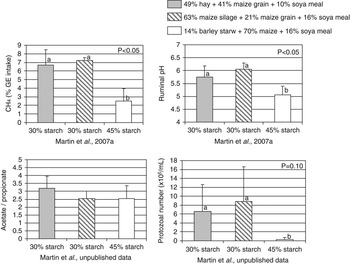
It is well established that increasing the level of concentrate in the diet leads to a reduction in CH4 emissions as a proportion of energy intake or expressed by unit of animal product (milk and meat). A meta-analysis of the bibliography showed that the relationship between concentrate proportion in the diet and CH4 production is curvilinear (Sauvant and Giger-Reverdin, Reference Sauvant and Giger-Reverdin2007). Methane losses appear relatively constant for diets containing up to 30% to 40% concentrate (6% to 7% of GE intake) and then decrease rapidly to low values (2% to 3% of GE intake) for diets containing 80% to 90% concentrate (Lovett et al., Reference Lovett, Lovell, Stack, Callan, Finlay, Conolly and O’Mara2003; Beauchemin and McGinn, Reference Beauchemin and McGinn2005; Martin et al., Reference Martin, Dubroeucq, Micol, Agabriel and Doreau2007a). Replacing structural carbohydrates from forages (cellulose, hemicellulose) in the diet with non-structural carbohydrates (starch and sugars) contained in most energy-rich concentrates is associated with increases in feed intake, higher rates of ruminal fermentation and accelerated feed turnover, which results in large modifications of rumen physico-chemical conditions and microbial populations. A shift of VFA production from acetate towards propionate occurs with the development of starch-fermenting microbes. This results in a lower CH4 production because the relative proportion of ruminal hydrogen sources declines whereas that of hydrogen sinks increases. However, this low acetate : propionate ratio may not be always observed in high-concentrate fed animals, that is, young bulls fed maize grain-based diets containing 30% or 45% starch had a similar ratio (2.50 v. 2.88, respectively; C. Martin et al., unpublished data). The lower CH4 emissions from bulls fed the diet containing 45% starch compared to those fed other two diets containing 30% starch (2.5% v. 6.9% of GE intake, respectively) could be better explained by a lower ruminal pH (5.06 v. 5.90, respectively; Martin et al., Reference Martin, Dubroeucq, Micol, Agabriel and Doreau2007a) and a decrease in protozoal number (28 × 103 v. 743 × 103/ml, respectively; C. Martin et al., unpublished data; Figure 1). The low ruminal pH might also inhibit the growth and/or activity of methanogens (reviewed by Hegarty, Reference Hegarty1999) and of cellulolytic bacteria (Brossard et al., Reference Brossard, Martin, Chaucheyras-Durand and Michalet-Doreau2004). A positive correlation between cellulolytic bacteria and methanogens in the rumen of different species (cattle, sheep, llamas, deer) has been shown (Morvan et al., Reference Morvan, Bonnemoy, Fonty and Gouet1996), except in buffalos. This exception was explained by the fact that F. succinogenes, a non-hydrogen-producing cellulolytic species, was the major cellulolytic bacteria of this animal species.
Methane output, fermentative parameters and protozoal number from bulls fed different high-concentrate diets (Martin et al., Reference Martin, Dubroeucq, Micol, Agabriel and Doreau2007a and unpublished data).

Concerning the effect of the nature of concentrate on methanogenesis, few direct comparisons have been carried out. Concentrates rich in starch (wheat, barley, maize) have a more important negative effect on CH4 production than fibrous concentrates (beet pulp). Substitution of beet pulp by barley in a high concentrate diet (70%) fed to dairy cows reduced CH4 emissions by 34% (Beever et al., Reference Beever, Cammell, Sutto, Spooner, Haines and Harland1989). Lovett et al. (Reference Lovett, Stack, Lovell, Callan, Flynn, Hawkins and O’Mara2005) reported that this was not the case when fresh forages were the main ingredients of the basal diet. Beauchemin and McGinn (Reference Beauchemin and McGinn2005) measured CH4 emissions from feedlot cattle fed backgrounding and finishing diets containing maize (slowly degradable starch) or barley grain (rapidly degradable starch). Effect of grain source on CH4 emissions was conditioned by the production phase. Expressed on the basis of GE intake, CH4 emissions during the backgrounding phase were not affected by grain source, whereas emissions were surprisingly less for the maize finishing diet than for the barley finishing period. The authors suggested that this was mediated through the lower ruminal pH observed with the maize diet rather than a shift in the site of digestion from the rumen to the intestines.
Lipids (level, nature, presentation)
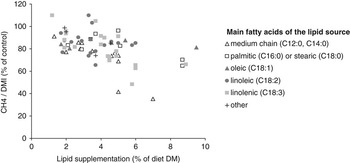
Dietary fat seems a promising nutritional alternative to depress ruminal methanogenesis without affecting other ruminal parameters. Their effect has been assessed by equations provided by Giger-Reverdin et al. (Reference Giger-Reverdin, Morand-Fehr and Tran2003) and by Eugène et al. (Reference Eugène, Massé, Chiquette and Benchaar2008) who reported a mean decrease in CH4 of 2.2% per percentage unit of lipid added in the diet of dairy cows, independently of the nature of fatty acid (FA) supply. In their review paper based on 17 studies, Beauchemin et al. (Reference Beauchemin, Kreuzer, O’Mara and McAllister2008) reported a larger enteric CH4 reduction (5.6% per 1% addition of lipids) for cattle and sheep. In a similar way, we have summarised all publications in which CH4 emissions were measured in vivo and where different lipids sources and forms of presentation were supplied to the diet. A total of 67 diets supplied with lipids, taken from 28 publications were kept for analysis; 29 results were obtained in open-circuit calorimetry chambers, 31 by the SF6 method and six by other methods; 33 were obtained on dairy cows, 13 on growing cattle, 16 on sheep at maintenance and five on growing lambs. Other data (28 diets supplied with lipids taken from six publications and two abstracts) have been discarded because of an insufficient description of methods or data, or because the control diet was rich in lipids supposed to be inert. The relationship obtained between level of added fat (% of DMI) and the CH4 decrease (g/kg DMI) relative to the control diet is presented in Figure 2. We observed a mean decrease in CH4 of 3.8% with each 1% addition of supplemental fat. It clearly appears that the effect of FA is largely dependent on their nature. Medium-chain FA, mainly provided by coconut oil, is the more depressive (7.3% decrease per percentage unit of added lipids; 12 data). According to Dohme et al. (Reference Dohme, Machmüller, Wasserfallen and Kreuzer2001), lauric acid (C12:0) and myristic acid (C16:0) taken alone have similar effects, but a combination between these two acids has a synergistic effect leading to a sharp decrease in CH4 (Soliva et al., Reference Soliva, Meile, Cieslak, Kreuzer and Machmuller2004). Supplements rich in polyunsaturated FA such as linoleic acid (C18:2 from soybean and sunflower) and linolenic acid (C18:3 from linseed) also have a negative effect on CH4 production (4.1% and 4.8% decrease per percentage unit of added lipids, 19 and 20 data, respectively). A decrease by 52% has been shown with a supplement of 5.8% linseed oil (Martin et al., Reference Martin, Rouel, Jouany, Doreau and Chilliard2008), whereas a decrease by 37% has been observed with 6% soybeans lipids (Jordan et al., Reference Jordan, Kenny, Hawkins, Malone, Lovett and O’Mara2006a). Data are less numerous for monounsaturated FA such as oleic acid (C18:1 from rapeseed; five data) and saturated fats (C16 and C18 from tallow; eight data), but these supplements result in decreases by 2.5% and 3.5% per percentage unit of added lipids, respectively. A decrease of 30% has been observed when 12% tallow was added to the diet (Van der Honing et al., Reference Van der Honing, Tamminga, Wieman, Steg, van Donselaar and van Gils1983). However, the abatement effect of FA supplementation on CH4 production was not observed in some studies on dairy cows (Johnson et al., Reference Johnson, Kincaid, Westberg, Gaskins, Lamb and Cronrath2002; Woodward et al., Reference Woodward, Waghorn and Thomson2006) and on sheep (Cosgrove et al., Reference Cosgrove, Waghorn, Anderson, Peters, Smith, Molano and Deighton2008).
Effect of lipid supply on methane production in ruminants: review of available literature. Data from Czerkawski (Reference Czerkawski1966), Czerkawski et al. (Reference Czerkawski, Blaxter and Wainman1966), Jentsch et al. (Reference Jentsch, Wittenburg and Schiemann1972), Schiemann et al. (Reference Schiemann, Jentsch and Wittenburg1972), Van der Honing et al. (Reference Van der Honing, Wieman, Steg and van Donselaar1981 and Reference Van der Honing, Tamminga, Wieman, Steg, van Donselaar and van Gils1983), Jilg et al. (Reference Jilg, Susenbeth, Ehrensvärd and Menke1985), Sauer et al. (Reference Sauer, Fellner, Kinsman, Kramer, Jackson, Lee and Chen1998), Holter et al. (Reference Holter, Hayes and Urban1992), Machmüller and Kreuzer (Reference Machmüller and Kreuzer1999), Machmüller et al. (Reference Machmüller, Ossowski and Kreuzer2000 and Reference Machmüller, Soliva and Kreuzer2003), Johnson et al. (Reference Johnson, Kincaid, Westberg, Gaskins, Lamb and Cronrath2002), Lovett et al. (Reference Lovett, Lovell, Stack, Callan, Finlay, Conolly and O’Mara2003), McGinn et al. (Reference McGinn, Beauchemin, Coates and Colombatto2004), Beauchemin and McGinn (Reference Beauchemin and McGinn2006), Jordan et al. (Reference Jordan, Kenny, Hawkins, Malone, Lovett and O’Mara2006a, Reference Jordan, Lovett, Hawkins, Callan and O’Mara2006b and Reference Jordan, Lovett, Monahan, Callan, Flynn and O’Mara2006c), Woodward et al. (Reference Woodward, Waghorn and Thomson2006), Odongo et al. (Reference Odongo, Bagg, Or-Rashid, Kebreab, France and McBride2007b), Martin et al. (Reference Martin, Ferlay, Chilliard and Doreau2007b, Reference Martin, Rouel, Jouany, Doreau and Chilliard2008 and Reference Martin, Ferlay, Chilliard and Doreau2009), Cosgrove et al. (Reference Cosgrove, Waghorn, Anderson, Peters, Smith, Molano and Deighton2008), Beauchemin et al. (Reference Beauchemin, McGinn and Petit2007a and Reference Beauchemin, McGinn, Benchaar and Holtshausen2009) and Grainger et al. (Reference Grainger, Clarke, Beauchemin, McGinn and Eckard2008).

Few direct comparisons between different lipid sources have been performed. Linolenic acid has been shown to have a higher effect on CH4 than linoleic acid in vitro (Jouany et al., Reference Jouany, Papon, Morgavi and Doreau2008) and linseed oil had the same effect as coconut oil in vivo (Newbold et al., Reference Newbold, Moss and Mollinson1996). On the contrary, sunflower seed (rich in linoleic acid) had a similar depressive effect as coconut oil on CH4 production, and this effect was higher than rapeseed (rich in oleic acid), and especially than linseed (rich in linolenic acid), in vitro (Machmüller et al., Reference Machmüller, Ossowski, Wanner and Kreuzer1998) and in vivo (Machmüller et al., Reference Machmüller, Ossowski and Kreuzer2000). Recently, Beauchemin et al. (Reference Beauchemin, McGinn, Benchaar and Holtshausen2009) reported that CH4 production in dairy cows was more affected by linseed and rapeseed (−17% on average) than by sunflower seeds (−10%). Other FA present in fish oil or in some algae also have a negative effect on methanogenesis. Hexadecatrienoic acid (C16:3; Ungerfeld et al., Reference Ungerfeld, Rust, Burnett, Yokoyama and Wang2005), eicosapentaenoic acid (C20:5) and docosahexaenoic acid (C22:6) (Dong et al., Reference Dong, Bae, McAllister, Mathison and Cheng1997; Fievez et al., Reference Fievez, Dohme, Danneels, Raes and Demeyer2003 and Reference Fievez, Boeckaert, Vlaeminck, Mestdagh and Demeyer2007) had a strong CH4-supressing effect when tested in vitro. Woodward et al. (Reference Woodward, Waghorn and Thomson2006) investigated in vivo the effect of fish oil, rich in C20:5 and C22:6, in association with other oils and reported a minor effect on methanogenesis. Present data are scarce and there is a need of further research on the effect of these different lipids sources on animals.
In vivo trials clearly show that the effect of lipids on methanogenesis is proportional to their level of supply (Figure 2). This was confirmed by dose-response trials by Martin et al. (Reference Martin, Ferlay, Chilliard and Doreau2007b and Reference Martin, Ferlay, Chilliard and Doreau2009) with three levels of extruded linseeds (rich in polyunsaturated FA) given to dairy cows, and by Jordan et al. (Reference Jordan, Lovett, Hawkins, Callan and O’Mara2006b) with three levels of coconut oil (rich in medium-chain saturated FA) given to heifers. The form of lipid supply has been studied but inconsistent results have been obtained: CH4 decrease was higher for whole sunflower seeds than for sunflower oil in a trial by Beauchemin et al. (Reference Beauchemin, McGinn and Petit2007a) but higher for soybean oil than for whole soybeans (Jordan et al., Reference Jordan, Kenny, Hawkins, Malone, Lovett and O’Mara2006a) and for linseed oil than for rolled or extruded linseed (Martin et al., Reference Martin, Rouel, Jouany, Doreau and Chilliard2008). In practice, the use of seeds is preferred to that of refined oil because they are easier to use and less expensive.
The effect of lipid supply on methanogenesis may partly depend on the type of diet, but results are not definite. Methane decrease was more pronounced for a hay diet than for a maize silage diet supplemented with linseeds in dairy cows (Martin et al., Reference Martin, Ferlay, Chilliard and Doreau2009), and for a concentrate diet than for a forage diet supplemented with coconut oil in beef heifers (Lovett et al., Reference Lovett, Lovell, Stack, Callan, Finlay, Conolly and O’Mara2003) or with myristic acid in sheep (Machmüller et al., Reference Machmüller, Soliva and Kreuzer2003).
The modes of action of lipids are multiple. A common effect for all lipid sources is that unlike other feed constituents such as forages and cereals they are not fermented in the rumen, and thus the decrease in fermented organic matter leads to a decrease in CH4. In addition, medium-chain FAs are known to affect methanogen numbers (Machmüller et al., Reference Machmüller, Soliva and Kreuzer2003) but not long-chain FAs such as linolenic acid (Mosoni et al., Reference Mosoni, Rochette, Doreau, Morgavi, Forano, Ferlay, Chilliard and Martin2008b). Polyunsaturated FAs also contribute to CH4 decrease through a toxic effect on cellulolytic bacteria (Nagaraja et al., Reference Nagaraja, Newbold, Van Nevel and Demeyer1997) and protozoa (Doreau and Ferlay, Reference Doreau and Ferlay1995). This effect, observed with all long-chain FAs, is probably through an action on the cell membrane particularly of Gram-positive bacteria (Sheu and Freese, Reference Sheu and Freese1973). Linolenic acid is toxic to cellulolytic bacteria (F. succinogenes, R. albus and R. flavefaciens) by disrupting their cell integrity, and to the cellulolytic fungus Neocallimastix frontalis grown in vitro (Maia et al., Reference Maia, Chaudhary, Figueres and Wallace2007). This negative effect of linseed supplementation on cellulolytic bacteria has not been confirmed in vivo in dairy cows by Mosoni et al. (Reference Mosoni, Rochette, Doreau, Morgavi, Forano, Ferlay, Chilliard and Martin2008b). These microbial changes favour a shift of ruminal fermentation towards propionate, and thus to an increase in hydrogen utilisation by this process. These multiple actions may impair digestion, if the number and activity of primary microbial fermentors is affected or if the negative effect on methanogens leads to an accumulation of hydrogen in the rumen. Biohydrogenation of polyunsaturated FAs results in an uptake of hydrogen. However, its influence on methanogenesis is low since the complete hydrogenation of 1 mol of linolenic acid spares 0.75 mol of CH4. As an example, a dairy cow diet supplied with 600 g oil from linseed will reduce methane production by less than 20 g (approximately 4% to 5% of daily CH4 production), if all fatty acids supplied were totally hydrogenated.
Almost all experiments carried out with lipid supplements were short-term experiments. Woodward et al. (Reference Woodward, Waghorn and Thomson2006) found no effect on CH4 in a long-term trial suggesting that the lipid effect is transitory in dairy cows. This result could be explained by an adaptation of rumen microbes to a diet rich in fat, but this has to be confirmed. Among common sources of lipids, coconut oil suffers from a possible negative effect of medium-chain FA on human health, due to an increase in myristic acid in milk. In contrast, polyunsaturated FA are considered beneficial on human health and their use in diets, which results in a limited increase of these FAs in milk and meat, could thus be proposed as a way for CH4 abatement provided that supplementation levels do not decrease feed efficiency or performance of animals. A research priority is to evaluate the long-term effect of these different lipid sources.
Between animal variations in methane production
The decrease in emissions through low-CH4 producing animals has been debated in the last few years. It has been established by several research groups that between-animal variability, at the same level of performance and using similar diets, is high. Differences in intake explain only a part of the variability: in sheep consuming the same amount of DM, Lassey et al. (Reference Lassey, Ulyatt, Martin, Walker and Shelton1997) noted extreme daily CH4 emissions of 14.6 and 23.8 g between animals. When successive measurements are made, the ranking of animals in CH4 production per kg DM intake differs between physiological stages with a change in diet (Pinares-Patiño et al., Reference Pinares-Patiño, Waghorn, Machmüller, Vlaming, Molano, Cavanagh and Clark2007b) or between successive measurements with diet changes at a same physiological stage (e.g. Goopy and Hegarty, Reference Goopy and Hegarty2004; Münger and Kreuzer, Reference Münger and Kreuzer2008; Vlaming et al., Reference Vlaming, Lopez-Villalobos, Brookes, Hoskin and Clark2008). These latter authors evaluated the repeatability (i.e. between animals/total variation) as 47% and 73% according to the diets.
Collectively, these results suggest that the genetic component of CH4 production is low. However, data obtained on fattening cattle show that animals having a high feed efficiency, measured as the residual feed intake, produced ∼20% less CH4 than the less efficient ones (Nkrumah et al., Reference Nkrumah, Okine, Mathison, Schmid, Li, Basarab, Price, Wang and Moore2006; Hegarty et al., Reference Hegarty, Goopy, Herd and McCorkell2007). Differences between these animals could be due to individual differences in rumen microorganisms associated to the rate of degradation processes and fermentation parameters and/or to intrinsic animal characteristics such as retention time of particles in the rumen. Recently, Guan et al. (Reference Guan, Nkrumah, Basarab and Moore2008) reported a link between the diversity of the rumen bacteria and VFA pattern with the feed efficiency in cattle. In addition, it has been shown by Pinares-Patiño et al. (Reference Pinares-Patiño, Ulyatt, Lassey, Barry and Holmes2003b and Reference Pinares-Patiño, Waghorn, Machmüller, Vlaming, Molano, Cavanagh and Clark2007b) that cows with a low retention time of particles in the rumen for a same intake produce less CH4. Such approach is promising but further research is needed to consider a possible selection of animals on CH4 production and more likely on microbial and digestive processes. It is important to underline that criteria of selection of cattle are numerous. They are principally orientated towards criteria of productivity or production efficiency of milk or meat. The genetic component, the heritability of the trait, as well as the cost-benefit has to be evaluated before recommending a possible genetic selection of low CH4-emitting animals.
Although no relationship has been shown between cow milk potential and the ability to produce CH4, high-yielding animals produce less CH4 per kg milk mainly due to their high feed intake and their diet rich in concentrates. Selection for milk yield or weight gain and thus intensification of production could result in lower CH4 production per kg product, although daily emissions per animal increase. An equation between CH4 production and milk yield has been calculated from numerous measurements of CH4 production in dairy cows of different milk yields and fed according to their requirements (Kirchgessner et al., Reference Kirchgessner, Windisch and Muller1994). From this equation, CH4 production per kg milk has been calculated by Vermorel (Reference Vermorel1995) on a year scale: 41 and 25 l CH4 per kg milk for cows producing 3400 and 6500 kg milk per lactation, respectively. Extrapolation of this relationship results in 17 l CH4/kg milk for 10 000 kg milk per lactation. This calculation takes into account the part of CH4 related to non-productive requirements for maintenance and pregnancy. A more accurate estimation could be made, by taking into account the whole career of the cow. High-producing dairy cows have lower fertility and shorter productive careers, so that the difference in the part of non-productive requirements between high-producing cows and low-producing cows is reduced (Garnsworthy, Reference Garnsworthy2004); an increase in fertility should decrease CH4 emissions by cows at career’s scale. Using today’s current calculation practices, it can be concluded that the increase in cow productivity results in a decrease in CH4 emission per kg milk, due to cow nutrition in present dairy systems. However, it should be noted that CH4 emissions during a cow career should be split between milk and meat productions. The meat produced should take into account not just the cow but also that from the (male) offspring. New models that include these factors need to be developed to better evaluate the most environmentally efficient type of cow for a given production system.
Intensification of livestock production through better breeding and/or feeding to decrease GHG emissions needs to be carefully assessed and will remain a hot debate in the foreseeable future. The society and producers’ requests in terms of welfare and health of animals, environment and economic viability are sometimes contrasting and have to be globally considered (Gill et al., Reference Gill, Smith and Wilkinson2009). For instance, reduction in CH4 emissions in intensive systems of production could be offset by the potential negative consequences of using high concentrate diets on animal health (e.g. acidosis) and, thus, farm profitability. Grain utilisation in ruminant feeding risk needs also to be more critical with the increased needs of grains for human consumption. In the future, ruminants should still play a key role in the valorisation of land under pasture. Furthermore, intensification of ruminant production as a CH4 mitigation strategy requires a complete evaluation in terms of total GHG emissions at the farm scale.
Variations in total GHG emission
Strategies for mitigation of CH4 enteric emissions will be recommended, independently of the cost, only if they do not result in an increase in the emission of other GHGs such as CO2 and N2O. When additives or lipid supplementation are used to decrease enteric CH4, it can be thought that their use does not modify to a large extent the emission of non-enteric CH4 and that of other GHG related to animal production. On the contrary, the change in production system (e.g. from a forage-based to a concentrate-based system and/or from low-producing animals to high-producing animals) results in simultaneous variation of all GHG. A well-known demonstration had been made for dairy cows by Johnson et al. (Reference Johnson, Phetteplace and Ulyatt2000), who compared a grass system with low-producing cows to a winter feeding system based on concentrates with high-yielding cows. This latter system produced 37% less enteric CH4 than the first one, but this difference was compensated for by a much higher CH4 emission from slurry, compared to the very low emission from urine and faeces on pasture.
To take into account all GHG emissions related to livestock farming systems, different methods are used, either derived from the life cycle assessment technique or using farm-scale dynamic models. Integrative national and supra-national models are not described in this paper. Coefficients of the different equations of the models may originate from Intergovernmental Panel on Climate Change (IPCC) guidelines that are regularly updated, from primary publications for each coefficient, or from a combination of these two ways. Calculations may include or not off-farm emissions (i.e. related to the production of inputs as concentrates or fertilisers). Results of on-farm calculations help for farmer strategy; results of on-farm and off-farm calculations allow a better comparison between livestock systems. Data can be collected on actual farms or means of farms, but they can also be calculated by simulation on virtual farms. To our opinion, this latter method is questionable, because results depend on the hypotheses chosen by the author, which may reflect a priori reasoning.
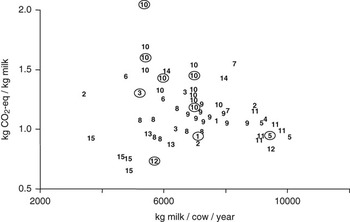
Figure 3 summarises the publications in which two or more dairy production systems have been compared. Publications in which GHG emissions per kg milk were not provided and could not be calculated have been discarded. The main statement is that the variation in GHG emissions, expressed in equivalent-CO2, was not correlated to yield and it was highly variable for same milk yield. A large part of this variation can be explained by differences in methodology. Results obtained by the life cycle assessment technique depend on the software and on the equations used. For example, emissions are often calculated from general equations provided by IPCC, which sometimes are not adapted to specific diets or management conditions (Dijkstra et al., Reference Dijkstra, Bannink, France and Kebreab2007). Results also depend on the assumptions made by the scientist and on the accuracy of input data when they are estimated. As a consequence, results are to be taken carefully, and between-experiments comparisons are not reliable.
Evaluation of greenhouse gases emissions by dairy cows managed under different systems of production. Each number is associated to a reference. Numbers within a circle indicate organic systems. Carbon sequestration is not taken into account. Most references are derived from life cycle assessment methodology. 1: Cederberg and Mattsson (Reference Cederberg and Mattsson2000); 2: Johnson et al. (Reference Johnson, Phetteplace and Ulyatt2000); 3: Haas et al. (Reference Haas, Wetterich and Köpke2001); 4: Phetteplace et al. (Reference Phetteplace, Johnson and Seidl2001); 5: Cederberg and Flysjo (Reference Cederberg and Flysjo2004); 6: Casey and Holden (Reference Casey and Holden2005); 7: Schils et al. (Reference Schils, Verhagen, Aarts and Sebek2005); 8: Hacala et al. (Reference Hacala, Réseaux and Le Gall2006); 9: Lovett et al. (Reference Lovett, Shalloo, Dillon and O’Mara2006); 10: Weiske et al. (Reference Weiske, Vabitsch, Olesen, Schelde, Michel, Friedrich and Kaltschmitt2006) and Olesen et al. (Reference Olesen, Schelde, Weiske, Weisbjerg, Asman and Djurhuus2006); 11: Vergé et al. (Reference Vergé, Dyer, Desjardins and Worth2007); 12: Kanyarushoki et al. (Reference Kanyarushoki, Van der Werf, Roger and Corson2008); 13: Lovett et al. (Reference Lovett, Shalloo, Dillon and O’Mara2008); 14: Thomassen et al. (Reference Thomassen, van Calker, Smits, Iepema and de Boer2008); 15: Basset-Mens et al. (Reference Basset-Mens, Ledgard and Boyes2009).

The level of milk production is not a major determinant of GHG emissions. From most studies it is concluded that when milk production is increased, the decrease in CH4 emission per kg milk is counterbalanced by an increase in nitrous oxide and carbon dioxide emissions, due to higher off-farm emissions related to production and transport of concentrates and fertilisers (e.g. Haas et al., Reference Haas, Wetterich and Köpke2001; Hacala et al., Reference Hacala, Réseaux and Le Gall2006). This statement leads to qualify the recommendations of UNFCCC (2008) for GHG abatement strategies: it is mentioned that reduction in enteric CH4 emissions can be achieved by the improvement of animal performance, but nothing is said about the effect on N2O and CO2. Low input systems result in a lower global warming potential than high input systems. For example, Schils et al. (Reference Schils, Verhagen, Aarts, Kuikman and Sebek2006) found a decrease in GHG emission when improving N management in Dutch intensive dairy farms; Basset-Mens et al. (Reference Basset-Mens, Ledgard and Boyes2009) found for a grass-based system in New Zealand a lower global warming potential than in European more intensive systems. Although it has not been clearly shown, the use of legumes produced on-farm probably reduces GHG emission due to the absence of N fertilisers, although IPCC considers that legumes contribute to nitrous oxide emissions. Variations within same system are high. From an analysis of French farms, Hacala et al. (Reference Hacala, Réseaux and Le Gall2006) showed the absence of relationship between the GHG emissions, expressed in CO2-equivalent, and the productivity, expressed in kg of milk per cow, but emissions are highly variable for the same milk yield, ranging between 0.6 and 1.4 kg equivalent-CO2/kg milk. A similar absence of relationship between GHG emissions and milk yield has been reported by Lovett et al. (Reference Lovett, Shalloo, Dillon and O’Mara2006), who compared cows with different milk potential fed different concentrates. In contrast, Capper et al. (Reference Capper, Cataneda-Guttierez, Cady and Bauman2008) calculated that an increase in milk yield caused by the use of bovine somatotropin (which is forbidden in many countries) decreases the emissions not only of CH4 per kg milk but also of CO2 and N2O. This result is surprising because the increase in milk yield is generally accompanied by an increase in concentrates and/or a more intensive management, which increases CO2 and N2O emissions.
In most publications, the high variability in GHG emissions for same milk yield does not reflect possible differences in CH4 emission between feeding systems, because most equations of prediction of CH4 emission are global, and do not take into account the effect of specific feedstuffs, as lipid sources, or additives. Schils et al. (Reference Schils, Verhagen, Aarts, Kuikman and Sebek2006 and Reference Schils, Olesen, del Prado and Soussana2007) stressed the strong positive relationship between GHG emissions and the amount of N surplus. It is likely that the main source of variability is related to N input and management, but these authors were focusing on N. Other mitigation strategies can be efficient; it has been shown that GHG emissions can be decreased by several means which correspond to systems currently described as ‘environmental friendly’: Haas et al. (Reference Haas, Wetterich and Köpke2001) showed that CO2 emission could be twice lower in extensive systems than in intensive systems, due to a large decrease in energy consumption. Sparing energy can be achieved through adapting material to needs, reducing feed transport, improving management practices, etc. Numerous recent publications describe various mitigations strategies, but this paper does not aim to analyse them.
Organic farming, which requires less inputs from concentrate feeds and fertilisers, results in minor variation of global warming potential (+5% to −10% according to six different publications). For example, in a trial by Cederberg and Mattsson (Reference Cederberg and Mattsson2000), CH4 emission was 10% to 15% higher due to low concentrate feeding, but CO2 and N2O production were decreased. In most experiments, the difference between conventional and organic systems is a consequence of a lower productivity of organic systems; however Weiske et al. (Reference Weiske, Vabitsch, Olesen, Schelde, Michel, Friedrich and Kaltschmitt2006) did not find a difference in global emissions per kg milk between these two systems for same milk production. According to De Boer (Reference De Boer2003), practices aiming to limit environmental pollution in non-organic systems (‘environmental friendly’) but with a high animal productivity may result in lower emissions per kg milk than organic system. Capper et al. (Reference Capper, Cataneda-Guttierez, Cady and Bauman2008) are the only authors who have shown that organic farming increased GHG emissions compared to a conventional system. However, these authors made a theoretical approach and, apparently, did not take into account that the supply of fertilisers and concentrates produced off-farm is reduced and the use of forages is maximised with organic farming.
Greenhouse gases emissions are often calculated per hectare. Comparison between publications is not easy, because, in addition to the methodological biases already mentioned, there are two major differences from one author to another. Some authors consider the number of hectare on-farm, whereas other authors consider the sum of on-farm and off-farm including the surface on which bought concentrates are grown. Some authors do not take into account the carbon sequestration by pastures and crops, but others do; when carbon sequestration is considered, estimates are very rough because of the small number of reliable data. Nevertheless, within a study, general trends are found. When conventional farming is compared to organic farming, the organic system always results in less emissions than the conventional system per hectare, due to differences in grass management (Haas et al., Reference Haas, Wetterich and Köpke2001; Olesen et al., Reference Olesen, Schelde, Weiske, Weisbjerg, Asman and Djurhuus2006). According to these latter authors, total emissions are related to N surplus, but other factors are likely. When animals at pasture are considered and pasture carbon sequestration is measured, the total GHG balance calculated as emissions minus sequestration can be negative. Intensive pastures for heifers with a high stocking rate have been compared to extensive pastures with a low stocking rate on three consecutive years. Methane production per kg live-weight gain was the same in the two systems; CH4 per hectare was much higher with the intensive system because of a higher stocking rate and thus more feed fermented in the rumen per hectare (Pinares-Patiño et al., Reference Pinares-Patiño, D’Hour, Jouany and Martin2007a), but GHG balance was more negative with the extensive system (Allard et al., Reference Allard, Soussana, Falcimagne, Berbigier, Bonnefond, Ceschia, D’hour, Hénault, Laville, Martin and Pinares-Patiño2007). However, carbon sequestration decreased along the 3-year period with the extensive system, so that the sustainability of this system is questioned.
Very few data deal with beef production systems. The calculation of GHG emissions per kg live weight integrates the total emissions by the system. When beef is produced from the suckler herd, the emission by the cow has to be taken into account, and is often higher than the emissions due to the young bull or steer. When beef is produced from the dairy herd, the share of emissions between milk and beef production can be made either according to the cumulated economical value of products, or according to a mass allocation. When the unit of product is taken as a reference, differences between a conventional system, a system aiming to minimise environmental impact but non-organic, and an organic system are low: 13.0, 12.2 and 11.1 kg CO2 per live weight per year; when the unit of surface is taken as a reference, the emission is much higher for the conventional system than for the organic system (Casey and Holden, Reference Casey and Holden2006b). Contrary to dairy systems, the ‘environmental-friendly’ system does not result in lower emissions in these conditions. A major factor of variation of emissions is the fattening length that is positively correlated to emissions per kg of product (Ogino et al., Reference Ogino, Kaku, Osada and Shimada2004). Other major factors of variation are N fertilisers and concentrates (Casey and Holden, Reference Casey and Holden2006a). In beef systems, the share of GHG emission between gases shows, as in dairy systems, a major contribution of CH4: 50% to 70% in Irish grass-based systems (Casey and Holden, Reference Casey and Holden2006b), more than 50% for Canadian conditions; on the contrary, N2O is the main contributor in feedlot systems (Phetteplace et al., Reference Phetteplace, Johnson and Seidl2001).
Acknowledgements
This invited review has been built from the associated text and presentation given at the international meeting on Livestock and Global Climate Change organised by the British Society of Animal Science (BSAS) in Tunisia in May 2008.