Introduction
Cystidicolidae Skrjabin, 1946 (Spirurina: Habronematoidea) is a family of nematodes parasitic in marine and freshwater fish with a rather complicated taxonomy and classification (Moravec & Sobecka, Reference Moravec and Sobecka2012). This taxon includes a high number of genera (26 in total) and its taxonomic system is often based upon subtle cephalic structures, which are only visible through the use of scanning electron microscopy (Moravec & Justine, Reference Moravec and Justine2010; Moravec & Sobecka, Reference Moravec and Sobecka2012). Moreover, molecular data on cystidicolids are still scarce (Černotíková et al., Reference Černotíková, Horák and Moravec2011) considering the diversity of the family, which makes the integrative approaches aimed at evaluating their relationships difficult.
Within the Cystidicolidae, Cystidicoloides Skinker, 1931 is a genus that strictly includes parasites from freshwater fish in the Neotropical region, currently represented by four valid species: C. fischeri (Travassos, Artigas & Pereira, 1928), C. izecksohni (Fabio, 1982), C. dlouhyi Petter, 1984 and C. vaucheri Petter, 1984 (see Moravec et al., Reference Moravec, Santos and Brasil-Sato2008).
During recent examinations of fish from the River Acre, Brazilian Amazon, nematodes were collected from the stomach of the redtail catfish Phractocephalus hemioliopterus (Bloch & Schneider, 1801) (Siluriformes: Pimelodidae). After detailed examination, it was concluded that the specimens belong to Cystidicoloides vaucheri, a proposed taxon based only on the description of females. Thus, the species is redescribed herein, along with the first description of males. Additionally, C. vaucheri was genetically characterized for the first time and a phylogenetic study was performed to evaluate the relationships within Cystidicolidae and among other loosely related taxa.
Materials and methods
Collection and examination of nematodes
One adult specimen of P. hemioliopterus (total body length 87 cm) was caught by local fishermen. Host nomenclature and classification follows Froese & Pauly (Reference Froese and Pauly2017). The stomach and the intestine were immediately examined with aid of a magnifying glass. Nematodes were found alive, washed in saline, fixed in hot 4% formalin and preserved in 70% ethanol. For morphological examinations, nematodes were cleared in glycerine. The middle body parts of one male specimen were excised and fixed in molecular-grade 96–99% ethanol for genetic studies; the anterior and posterior parts were fixed for morphological identification, i.e. hologenophores (the voucher specimens from which the molecular sample is directly derived; see Astrin et al., Reference Astrin, Zhoun and Misof2013 for more details).
Drawings were made using a drawing tube attached to a microscope (Olympus BX51; Olympus, Center Valley, Pennsylvania, USA). Measurements are given in micrometres, unless otherwise stated. Specimens used for scanning electron microscopy (SEM) were dehydrated through a graded ethanol series, dried by evaporation with hexamethyl disilazane, coated with gold and examined in a JEOL JSM 6460-LV scanning electron microsope (JEOL Inc., Peabody, Massachusetts, USA), at an accelerating voltage of 15 kV. Parasite classification was according to Anderson et al. (Reference Anderson, Chabaud and Willmott2009), Moravec & Justine (Reference Moravec and Justine2010) and Moravec & Sobecka (Reference Moravec and Sobecka2012). Newly collected specimens were deposited in Coleção Helmintológica do Instituto Oswaldo Cruz (acronym CHIOC).
Molecular and phylogenetic analyses
Genomic DNA was isolated from small tissue samples, using DNeasy Blood & Tissue Kit (Qiagen, Hilden, Germany), following the manufacturer's instructions. The small subunit (SSU) rRNA gene (18S) was amplified in polymerase chain reactions (PCR), total volume 25 μl consisting of 2.5 μl of 10× PCR buffer minus Mg, 1.0 μl of MgCl2 (50 mm), 2 μl of deoxynucleoside triphosphates (dNTPs) (2.5 mm), 0.25 μl of each oligonucleotide primer (10 mm), 0.2 μl of Platinum Taq DNA polymerase (5 U/μl) (Invitrogen, Carlsbad, California, USA), 0.25 μl of bovine serum albumin (BSA), 16.5 μl of water and 2.0 μl of genomic DNA, using the PCR conditions and the primers Philonema F + PhilPCRr described in Černotíková et al. (Reference Černotíková, Horák and Moravec2011). The large subunit (LSU) rRNA gene (28S) was amplified in PCR reactions (25 μl) consisting of 2.5 μl of 10× PCR buffer minus Mg, 1.5 μl of MgCl2 (50 mm), 2 μl of dNTPs (2.5 mm), 0.25 μl of each oligonucleotide primer (10 mm), 0.2 µl of Platinum Taq DNA polymerase (5 U/μl) (Invitrogen), 0.25 μl of BSA, 16.0 μl of water and 2.0 μl of genomic DNA, using the PCR primers D2A (5′-ACA AGT ACC GTG AGG GAA AGT-3′) + D3B (5′-TGC GAA GGA ACC AGC TAC TA-3′) of Nunn (Reference Nunn1992) and cycling conditions of Pereira et al. (Reference Pereira, Tavares, Scholz and Luque2015). PCR products were purified through an enzymatic treatment with ExoProStar™ (GE Healthcare, Little Chalfont, UK), prepared for sequencing with BigDye Terminator Cycle Sequencing Kit (Thermo Fisher Scientific, Waltham, Massachusetts, USA) and sequenced in a Genetic Analyzer 3500xL (Applied Biosystems®, Foster City, California, USA), using the PCR primers and two internal primers in the case of the 18S (WF760 + WR800, see Černotíková et al., Reference Černotíková, Horák and Moravec2011). Contiguous sequences were assembled in Geneious (Geneious ver. 9.1.5 created by Biomatters, available from http://www.geneious.com/) and deposited in the GenBank database under accession numbers KY558630 (18S rDNA) and KY558631 (28S rDNA).
Phylogenetic analyses were based on two different datasets: one consisting of representatives from Cystidicolidae and another including representatives from Habronematoidea, Physalopteroidea and Thelazioidea. Due to restricted data, only the 18S rDNA sequences were used to infer the phylogenies, being chosen according to the following criteria: sequence length >1600 bp, product of previously published papers and close relatedness with Cystidicolidae according to previous phylogenetic studies (Černotíková et al., Reference Černotíková, Horák and Moravec2011; Vidal et al., Reference Vidal, Ortiz, Diaz, Zafrilla, Bonete, Ruiz De Ybañez, Palacios, Benzal, Valera, De La Cruz, Motas, Bautista, Machordom and Barbosa2016). The two datasets were aligned separately using the E-INS-i algorithm of the program MAFFT (Katoh et al., Reference Katoh, Misawa, Kuma and Myiata2002) implemented in Geneious. The transitive consistency score was used to evaluate the reliability of aligned positions and, based on score values, ambiguous aligned positions were trimmed (Chang et al., Reference Chang, Di Tommaso and Notredame2014). Datasets were then subjected to maximum likelihood (ML) and Bayesian inference (BI) analyses, generating trees under the GTR + I+ G model of evolution using PHYML (Guindon & Gascuel, Reference Guindon and Gascuel2003) and MrBayes (Huelsenbeck & Ronquist, Reference Huelsenbeck and Ronquist2001) Geneious plug-ins, respectively. The model of evolution was chosen under the Akaike informative criterion using jModelTest 2 (Guindon & Gascuel, Reference Guindon and Gascuel2003; Darriba et al., Reference Darriba, Taboada, Doallo and Posada2012), and the fixed parameters were generated with the same program. Bayesian posterior probability values were determined after running the Markov chain Monte Carlo (2 runs, 4 chains) for 4 × 10⁶ generations, with sampling frequency every 4 × 10³ generations and discarding the initial ¼ of sampled trees (1 × 10⁶) as burn-in. For ML analysis, bootstrap resampling was performed with 1000 non-parametric replications. Trees were rooted by Philonema oncorhynchi Kuitunen-Echbaum, 1933 based on previous phylogenies of Spirurina (Černotíková et al., Reference Černotíková, Horák and Moravec2011).
Results
Cystidicolidae Skrjabin, 1946; Cystidicoloides Skinker, 1931; Cystidicoloides vaucheri Petter, 1984
Description
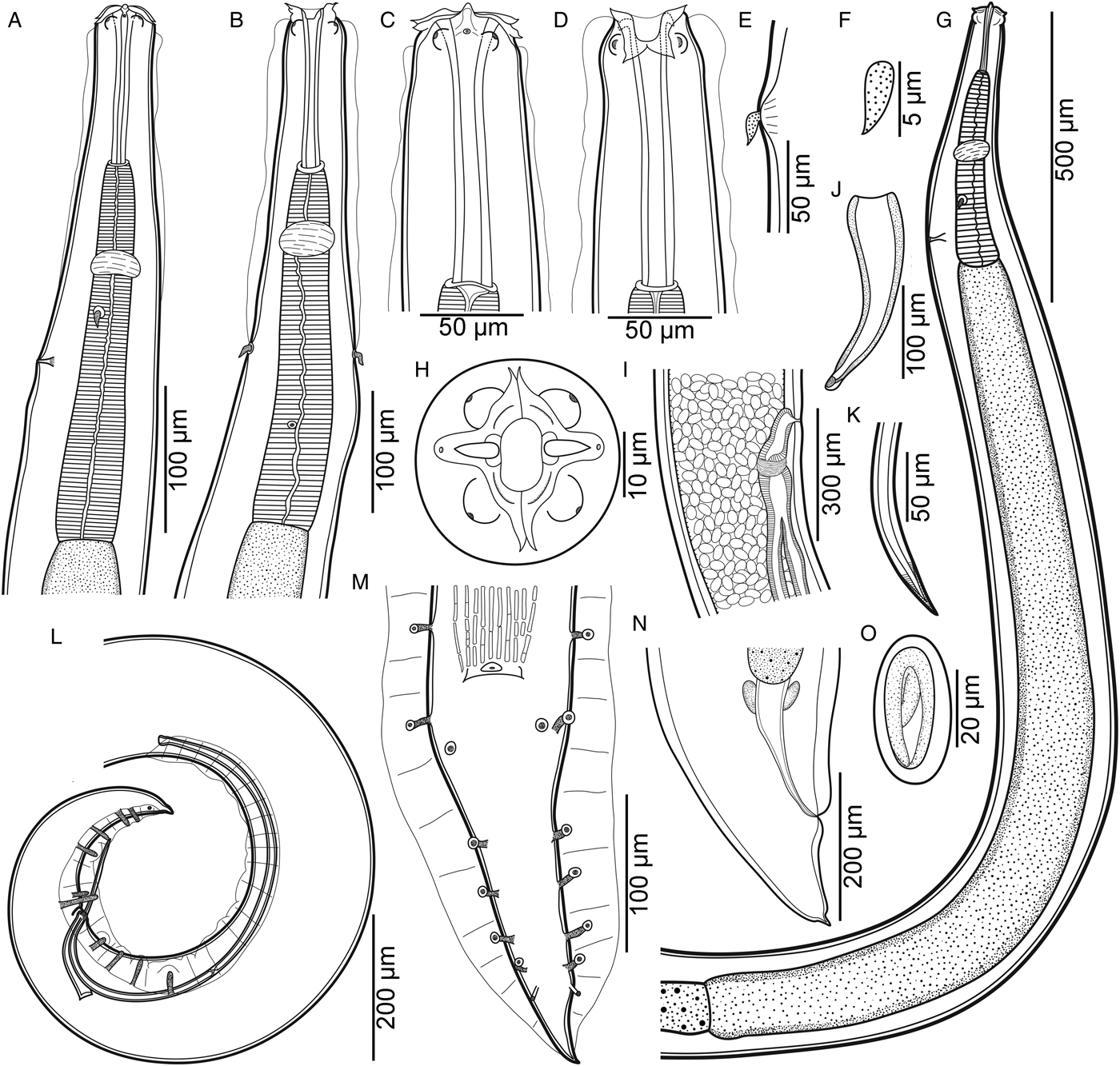
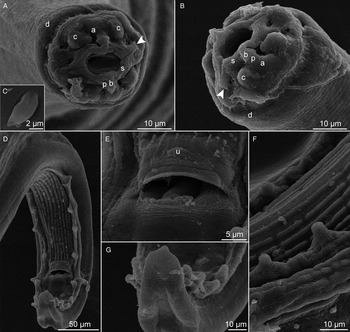
Small-sized, whitish nematodes. Cuticle thick with fine transverse striations throughout body. Cuticle on cephalic end inflated, forming distinct cephalic vesicle (collarete) (figs 1A–D, 2A, B); inflation beginning at level of deirids more developed in females (fig. 1A–D). Oral aperture oval, dorsoventrally elongate, flanked by two lateral pseudolabia provided with large conical structures with pointed distal ends, laterally projected; inner part of pseudolabia partially lining mouth (figs 1H, 2A, B). Cephalic protrusions somewhat cross-shaped, bearing four submedian sublabia-like elevations, joining dorsally and ventrally to form dorsal and ventral cephalic projections with forked tips (figs 1H, 2A, B). Cephalic protrusions fused with pseudolabia base (figs 1H, 2A, B). Four submedian, rather large cephalic papillae and pair of lateral small amphidial pores (figs 1H, 2A, B). Vestibule (stoma) long and narrow, with ill-defined proximal prostom, better observed in lateral view; ending in conspicuous distal cuticular ring (fig. 1A–D). Proximal end of prostom with laterally bent walls, visible in dorsoventral view (fig. 1D). Oesophagus rather long, proportionally longer in males, divided into shorter anterior muscular part and longer posterior glandular part (fig. 1G). Nerve ring encircles muscular oesophagus on its first third (fig. 1A, B). Excretory pore always anterior to junction of muscular/glandular oesophagus (fig. 1A, B, G). Deirids large, symmetrical, simple with sharp distal end, anterior to excretory pore (figs 1A, B, E, F, 2C).
Cystidicoloides vaucheri Petter, 1984 showing (A) male and (B) female anterior ends, lateral and ventral views, respectively; (C) male and (D) female cephalic ends, lateral and dorsoventral views, respectively; (E) and (F) deirid, lateral and apical views, respectively; (G) anterior region of male, lateral view; (H) cephalic end of male, apical view; (I) region of vulva, lateral view; (J) right spicule; (K) distal tip of left spicule; (L) and (M) posterior end of male, lateral and ventral views, respectively; (N) tail of female, lateral view; (O) egg.

SEM micrographs of Cystidicoloides vaucheri Petter, 1984 showing (A) and (B) cephalic end, apical and subapical views, respectively (arrowheads indicate forked tip of cephalic projections); (C) deirid; (D) tail and (E) cloacal region of male, ventral views; (F) area rugosa and (G) tail tip of male, sublateral and ventral views, respectively. Abbreviations: a, amphid; b, conical elevation of pseudolabia; c, cephalic papilla; d, cephalic vesicle (collarete); p, pseudolabium; s, sublabium-like cephalic protrusion; u, unpaired papilla.

Male (based on seven adult specimens). Body length 7.0–8.0 mm, maximum width 223–242. Pseudolabium 7–10 height, in lateral view. Vestibule including prostom 114–120 long; prostom 27–35 long and 9–11 wide, in lateral view. Muscular oesophagus 316–411 long, maximum width 51–64; glandular oesophagus 2.2–2.3 mm long, maximum width 155–173; length ratio of muscular and glandular portions 1:5.4–6.7. Entire oesophagus and vestibule representing 34–39% of total body length. Nerve-ring, deirids and excretory pore 232–262, 291–344 and 392–434, respectively, from anterior end. Posterior end of body ventrally coiled, provided with thin membranous lateral alae (fig. 1L, M). Precloacal papillae: four pairs subventral and pedunculate, first pair of which slightly laterally displaced compared to others (figs 1L, 2D). Large unpaired papilla slightly anterior to cloacal opening (figs 1M, 2E). Postcloacal papillae: six pedunculate pairs, first pair of which subventral and laterally displaced, second pair subventral and ventrally displaced with peduncle sometimes indistinct depending upon position; first and second pairs close to each other; remaining pairs subventral disposed in two rows; pair of lateral minute phasmidial pores straight after last postcloacal pair (figs 1L, M, 2D, E, G). Ventral cuticular elevations (area rugosa) just anterior to unpaired papilla, consisting of about nine longitudinal discontinuous rows (figs 1M, 2D, F). Spicules unequal (fig. 1L). Large (left) spicule 668–827 long, slender with weak proximal outgrowth and thin distal end (fig. 1K, L), its shaft 269–336 long or 39–41% of spicule length. Small (right) spicule broad 112–148 long, with concave distal end and rounded broad proximal extremity (fig. 1J). Length ratio of spicules 1:5.3–6.8. Tail conical, 279–327 long, with small terminal pointed constriction (figs 1L, M, 2D, G).
Female (based on seven gravid specimens). Body length 8.9–11.1 mm, maximum width 284–356. Pseudolabium 8–12 height, in lateral view. Vestibule including prostom 110–138 long; prostom 18–27 long and 12–19 wide, in lateral view. Muscular oesophagus 300–424 long, maximum width 65–76; glandular oesophagus 1.6–2.5 mm long, maximum width 190–200; length ratio of muscular and glandular portions 1:5.2–6.7. Entire oesophagus and vestibule representing 22–30% of total body length. Nerve-ring, deirids and excretory pore 201–245, 279–360 and 321–409, respectively, from anterior end. Vulva slightly pre-equatorial in small specimens, slightly post-equatorial in large ones, 4.3–5.4 mm from anterior end, at 47–54% of body length; vulval lips not elevated (fig. 1I). Vagina posteriorly directed from vulva; short ovejector present, with constriction ring of striated musculature at its mid length (fig. 1I). Amphidelphic. Uterus filled with numerous eggs, occupying most part of body, reaching posterior end of glandular oesophagus. Eggs thick-walled with smooth shell, ellipsoid, containing fully developed larva in ovejector and without filaments (fig. 1O), 33–38 × 19–22 (n = 10). Tail conical, short, ending in small pointed constriction (mucron) (fig. 1N); phasmidial pores not visualized.
Taxonomic summary
Host. Phractocephalus hemioliopterus (Bloch & Schneider, 1801) (Siluriformes: Pimelodidae).
Site of infection. Stomach.
Locality. River Acre, municipality of Xapuri, State of Acre, Brazil (GPS data not available).
Voucher specimens deposited. Seven males and seven females, including one hologenophore CHIOC 38372.
Remarks
Cystidicoloides vaucheri was originally described based only on female specimens parasitizing Oxydoras kneri Bleeker, 1862 (Siluriformes: Doradidae), in the River Paraguay (Petter, Reference Petter1984), and it has not been reported since. Even though the newly collected females were biometrically smaller than the holotype of C. vaucheri, the relative location of important features, e.g. deirids, excretory pore and vulva, as well as the length ratio of oesophagus/entire body length and of its muscular/glandular parts were similar, comparing both materials. Thus, based upon the morphological similarity and the fact that the present specimens were collected in a catfish from closely related river basins, there is no strong evidence that differentiates the newly collected material from C. vaucheri.
This is the first description of the male of C. vaucheri, which strengthens the validity of the taxon, since the morphology of females may be quite homogeneous among some closely related species. Moreover, SEM micrographs revealed slight differences in the cephalic structures from those described by Petter (Reference Petter1984). Cystidicoloides vaucheri, like many cystidicolids, has a very slender cephalic region with minute, complex structures that are not well visualized using only light microscopy. This is the probable explanation for such differences (e.g. the real structure of pseudolabia and of the cephalic protrusions that were not well detailed by Petter, Reference Petter1984).
Cystidicoloides dlouhyi, a parasite of the gymnotiform Sternopygus macrurus (Bloch & Schneider, 1801) (Sternopygidae) collected in the same locality as C. vaucheri (i.e. River Paraguay), differs from it in the structure of spicules (with membraneous projections vs. without them), by the absence of the area rugosa, in the relative position of the vulva (far post-equatorial vs. equatorial) and in the structure of the female tail (with strong ventral bend without pointed mucron vs. straight conical with pointed mucron) (Petter, Reference Petter1984).
Cystidicoloides fischeri, parasitic in several species of characiform fish from south-eastern Brazilian rivers, is the only congener that has been studied using SEM (Moravec et al., Reference Moravec, Santos and Brasil-Sato2008). This species differs from C. vaucheri in the small cephalic papillae (vs. large ones), and by having dorsoventral median pointed projections and submedian cephalic spikes that are absent in C. vaucheri (Moravec et al., Reference Moravec, Santos and Brasil-Sato2008). Moreover, the left spicule of males of C. fischeri has a ventral membraneous outgrowth absent in those of C. vaucheri (Moravec et al., Reference Moravec, Santos and Brasil-Sato2008).
Cystidicoloides izecksohni (= Heliconema izecksohni), a parasite of trahira Hoplias malabaricus (Bloch) (Erythrinidae), also from Brazil, was transferred to Cystidicoloides based on the presence of a long, well-sclerotized vestibule (stoma) (Moravec et al., Reference Moravec, Santos and Brasil-Sato2008). However, the drawings of Fabio (Reference Fabio1982) are inconclusive in respect of this feature and, unfortunately, deposited material of C. izecksohni is not available for loan. Nevertheless, this species differs from C. vaucheri by having a smaller left spicule (430–490 vs. 668–827), larger eggs (65–72 × 43–49 vs. 33–38 × 19–22) and in several other biometrical features (Fabio, Reference Fabio1982).
Based upon the new data, C. vaucheri is confirmed as a valid species, and P. hemioliopterus and River Acre represent new host and locality records for this nematode.
Molecular characterization and phylogenetic analyses
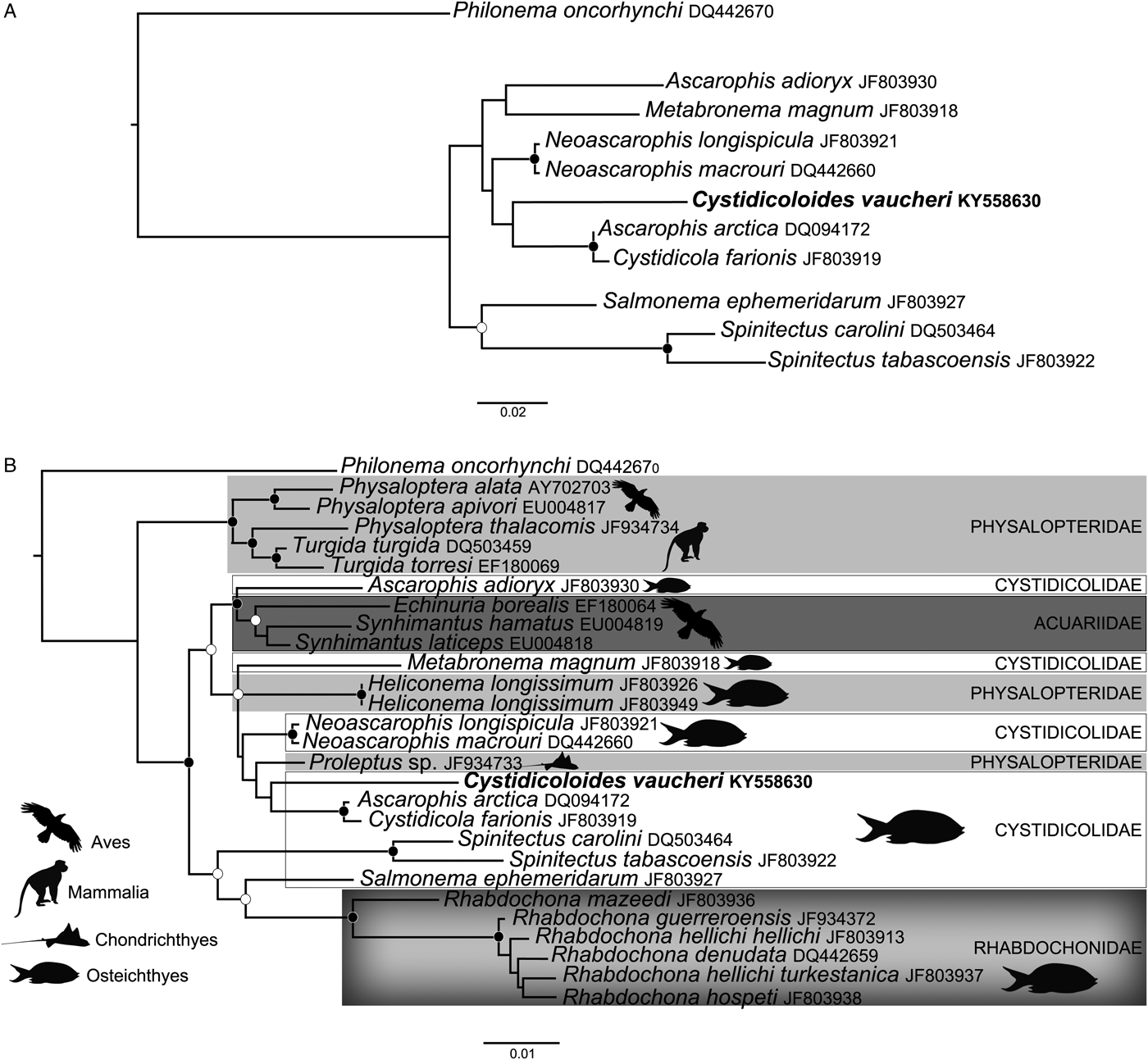
Partial sequences of the 18S and 28S rDNA were obtained for C. vaucheri (1640 bp and 925 bp, respectively). Only the 18S sequences were used for genetic comparison due to data availability in GenBank. In both phylogenetic trees, this species formed an independent branch, thus confirming its generic and specific validity (fig. 3A, B). Within Cystidicolidae, C. vaucheri was genetically most similar to Neoascarophis macrouri Moravec, Klimpel & Kara, 2006 (sequence identity 97.59%); when other taxa were included (i.e. Acuariidae, Physalopteridae, Rhabdochonidae) the former were most similar to Proleptus sp. (sequence identity 97.68%). The topology of the trees generated using ML and BI showed slight differences.
Bayesian trees from phylogenetic analyses of the sequences of 18S rRNA from representatives of Cystidicolidae (A) and along with those from representatives of families belonging to Habronematoidea, Physalopteroidea and Thelazioidea (B), associated with their GenBank accession numbers. Full and empty circles represent high and moderate nodal support, respectively, i.e. Bayesian posterior probability = 1.00 and 0.80–0.99, respectively (4 × 10⁶ generations, sampling frequency = 4 × 10³, burn-in = 1 × 10⁶), and maximum likelihood bootstrap values >96% and 90–95%, respectively (1000 replications). The specimen shown in bold type is from the present study.

Phylogenetic reconstructions using sequences of the 18S rDNA in both datasets showed the following features: (1) paraphyly of the family Cystidicolidae and Physalopteridae and of the genus Ascarophis van Beneden 1871; and (2) monophyly of the families Acuariidae and Rhabdochonidae and of the genera represented by more than one species: Neoascarophis Machida, 1976, Rhabdochona Railliet, 1916, Spinitectus Fourmet, 1884, Synhimantus Railliet, Henry & Sisoff, 1912 and Turgida Travassos, 1919 (fig. 3A, B). The main assemblages of nematode families exhibited moderate to high nodal support; supports were slightly improved when representatives of taxa other than Cystidicolidae were included in the analysis (fig. 3A, B).
Discussion
Up to now the taxonomy of cystidicolids has been complicated; a clear example is the genus Ascarophis, which is a type of catch-all taxon (Ferrer et al., Reference Ferrer, Aznar, Balbuena, Kostadinova, Raga and Moravec2005; Moravec, Reference Moravec2007), having many cases of wrong assignation of species (see Ferrer et al., Reference Ferrer, Aznar, Balbuena, Kostadinova, Raga and Moravec2005; Moravec, Reference Moravec2007; Moravec & González-Solís, Reference Moravec and González-Solís2007; Moravec & Justine, Reference Moravec and Justine2007). Indeed, the boundaries between some genera within Cystidicolidae are unclear and based upon minute differences that are difficult to observe. Furthermore, several intermediate features are usually interpreted as intraspecific rather than intergeneric (see Moravec et al., Reference Moravec, Klimpel and Kara2006 for details). The molecular approach will probably help in the resolution of such problems, but unfortunately few data are available on sequenced genes of cystidicolids (Černotíková et al., Reference Černotíková, Horák and Moravec2011).
It seems that the cephalic structures within species of Cystidicoloides show some degree of interspecific variation. Common features shared by C. fischeri and C. vaucheri are the pseudolabial protrusions with pointed distal ends. However, the submedian cephalic spikes, the dorsoventral and the submedian cephalic elevations described for C. fischeri (see Moravec et al., Reference Moravec, Santos and Brasil-Sato2008) are fused in C. vaucheri, forming different structures. Conversely, features such as the relative position of deirids and excretory pore, structure of the female genital organ (i.e. vulva, vagina and ovijector) and the number of pedunculate caudal papillae in males are constant within the congeners, even though an exceptional situation of asymmetry of caudal papillae was observed once in C. fischeri (Moravec et al., Reference Moravec, Santos and Brasil-Sato2008).
To date, molecular data on cystidicolids are mainly based on sequences of the 18S rRNA gene and, so far, the phylogenetic relationships among its taxa have been poorly resolved. Based upon the present results, Cystidicolidae and Ascarophis are clearly not monophyletic, which reinforces the premise that the genus is a type of catch-all taxon, needing detailed revision; related results have been demonstrated previously (Černotíková et al., Reference Černotíková, Horák and Moravec2011). Salmonema and Spinitectus, currently placed in Cystidicolidae, formed a moderately supported assemblage with representatives of Rabdochonidae. This phylogenetic proximity might be explained by biological traits of a plausible common ancestor, rather than the morphology, since Salmonema ephemeridarum (Linstow, 1872), Rhabdochona spp., Spinitectus carolini (Holl, 1928) and, most likely, S. tabascoensis Moravec, García-Magaña & Salgado-Maldonado, 2002, using mayflies as intermediate hosts, are all parasitic in the intestines of freshwater fish (Jilek & Crites, Reference Jilek and Crites1982; Moravec, Reference Moravec1998; Moravec et al., Reference Moravec, García-Magaña and Salgado-Maldonado2002, Reference Moravec, Salgado-Maldonado, Caspeta-Mandujano and González-Solís2009). Cystidicoloides vaucheri was a sister group of the cystidicolids Ascarophis arctica Polianski, 1952 and Cystidicola farionis Fischer, 1798; however, its assemblage was a component of a major clade, including representatives of Acuariidae, Cystidicolidae and Physalopteridae. Thus, the relationships among these parasites are still unclear, e.g. the acuariids are parasitic in birds and were inserted between parasites of fish belonging to Cystidicolidae. In a similar situation are the physalopterids Heliconema longissimum (Ortlepp, 1923) and Proleptus sp.
The Physalopteridae being split into three different branches was not monophyletic: a well-supported separate branch including parasites of mammals and birds, and two others including parasites of fish, which were placed among species of Cystidicolidae and Acuariidae. There is no solid explanation for this phylogenetic reconstruction based on the current database. It is worth mentioning that the species of Acuariidae, Cystidicolidae and Rhabdochonidae share an elongate funnel-shaped buccal capsule (sometimes subdivided into prostom and vestibule), but in Heliconema and Proleptus this structure is rather reduced or absent, complicating the explanation for this phylogenetic arrangement even further.
Based on the present results it is clear that Physalopteridae and Cystidicolidae are not monophyletic. Moreover, the inclusion of Salmonema and Spinitectus within Cystidicolidae should be reviewed. In fact, based mainly on molecular data from different genes, the traditional classification of some taxa belonging to Habronematoidea, Physalopteroidea and Thelazioidea should be re-evaluated.
Acknowledgements
The authors are thankful to Dr Juan Tomás Timi from the Universidad Nacional de Mar del Plata, Mar del Plata, Argentina, for support and for covering costs and performing SEM observations.
Financial support
F.B.P. and J.L.L. were supported by a postdoctoral fellowship from PNPD-CAPES (Programa Nacional de Pós-Doutorado-Coordenação de Aperfeiçoamento de Pessoal de Nível Superior-CAPES, Brasil) and a research fellowship from CNPq (Conselho Nacional de Desenvolvimento Científico e Tecnológico do Brasil), respectively.
Conflict of interest
None.