Introduction
Dioscorea japonica Thunb. belongs to the family Dioscoreaceae. It is an herbaceous, viney, perennial plant that reproduces by allogamy or vegetative propagation (Bousalem et al., Reference Bousalem, Viader, Mariac, Gomez, Hochu, Santoni and David2010). The major yam food species are distributed among three isolated centres: West Africa, Southeast Asia and tropical America, which are also the sites of independent yam domestication and represent considerable diversity (Tamiru et al., Reference Tamiru, Mass and Pawelzik2008). Yams have substantial diversity at inter- and intra-specific levels, and their diversities are being exploited for the ongoing domestication of wild yams in tropical and subtropical countries (Scarcelli et al., Reference Scarcelli, Tostain, Mariac and Agbangla2006). Various Dioscorea species have been domesticated and widely cultivated as edible resources and medical materials. Of the more than 600 Dioscorea species in the world, ten are staple yams (Lebot, Reference Lebot2009). In Taiwan, six of 14 found species are cultivated, including D. japonica, Dioscorea alata, Dioscorea batatas, Dioscorea bulbifera, Dioscorea persimilis and Dioscorea esculenta (Huang and Hsiao, Reference Huang, Hsiao and Huang2000; Lay et al., Reference Lay, Liu, Liao, Chen, Liu and Sheu2001). Taiwan's yam diversity is represented by a number of endemic species, including D. japonica Thunb. var. pseudojaponica (Hayata) Yamamoto, var. oldhamii R. Knuth in Engl., and var. japonica, that are grown on the Coastal Plain and low altitude regions of Taiwan (Huang and Hsiao, Reference Huang, Hsiao and Huang2000). Most D. japonica species are sparsely distributed in the nature lands; however, only a few clones are grown by indigenous people in Taiwan. These three varieties are different in tuber and leaf traits, but their phylogenetic relationships and genetic diversity are still unknown. The diversity and species identity of Taiwanese yams are both still obscure. The extent of genetic diversity in yam species and their relationships are yet to be investigated in detail.
Yam taxonomy is complex and further groupings could emerge based on recent molecular biology techniques. The efficient use of genetic heterogeneity can only be optimized if diversity is systematically evaluated, quantified and classified. A large number of molecular markers are available to detect genetic diversity and variability in natural populations, among which inter-simple sequence repeats (ISSR) were developed to explore microsatellite repeats without needing to sequence DNA (Zietkiewicz et al., Reference Zietkiewicz, Rafalski and Labuda1994). The ISSR markers are very stable, dominant, present good reproducibility and generate a large number of polymorphic fragments (Reddy et al., Reference Reddy, Sarla and Siddiq2002). Several genetic diversity studies based on ISSR markers have been performed on Dioscorea, finding that ISSR provides a good assessment of yam genetic diversity (Zhou et al., Reference Zhou, Zhou, Yao, Liu and Tu2008; Wu et al., Reference Wu, Leng, Tao, Wei and Jiang2009; Nascimento et al., Reference Nascimento, Rodrigues, Koehler, Gepts and Veasey2013; Wu et al., Reference Wu, Li, Lin, Jiang, Tao, Mantri and Bao2014). However, little information is available on the genetic diversity of Taiwanese yams. The goals of this study were to investigate the genetic structure and diversity, as well as the relationship among three D. japonica varieties originated from different locations in Taiwan. To our knowledge, this is the first report on the assessment of genetic diversity of D. japonica accessions.
Materials and methods
Plant material
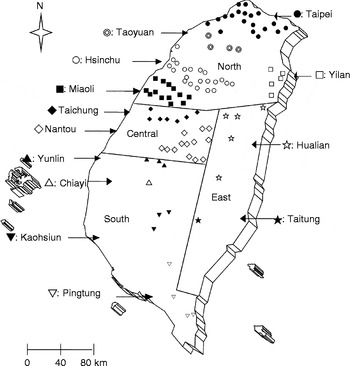
A total of 99 accessions of three varieties of D. japonica were collected from 13 counties within four geographic regions of Taiwan during 2010–2011. These comprised 72 pseudojaponica (Hayata) Yamamoto, 17 japonica and 10 oldhamii R. Knuth in Engl. accessions. The four regions have significant variations in soils and climate with diverse agro-ecologies: northern region (24°20′N~25°17′N, 120°45′E~121°55′E, 6~1587 m), central region (23°34′N~24°17′N, 120°44′E~121°08′E, 295~1185 m), southern region (22°12′N~23°37′N, 120°31′E~120°53′E, 120~1467 m) and eastern region (23°09′N~24°18′N, 121°05′E~121°45′E, 2~652 m) (Fig. 1 and Table S1 (available online)). We collected 46 var. pseudojaponica, 7 var. japonica, and 9 var. oldhamii from the northern region; 15 var. pseudojaponica and 5 var. japonica from the central region; and 6 var. pseudojaponica and 5 var. japonica from the southern region. Another six accessions (five var. pseudojaponica and one var. oldhamii) were obtained from the eastern region. Population codes, accessions and localities of origin for each entry are listed in online Supplemenatry Table S1. One D. alata accession was used as an outgroup check in this study.
Map of collection sites, counties and regions of Dioscorea japonica in Taiwan.

DNA extraction and ISSR-polymerase chain reaction (PCR) procedure
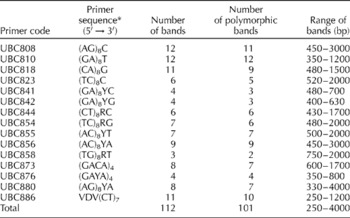
Young leaves from the 99 D. japonica accessions were detached from each plant and frozen at − 70°C. DNA extraction followed the method of Helen (Reference Helen1995). Briefly, DNA from about 50 mg dried leaves was extracted using cetyltrimethylammonium bromide. DNA quality was checked on a 1.0% (w/v) agarose gel, and concentrations were measured by UV–visible spectrophotometer (GeneQuant Pro, Amersham Biosciences, Cambridge, UK). All the DNA samples were diluted to 20 ng/μl and stored at − 20°C prior to PCR amplification. A total of 100 ISSR primers (UBC nos. 801–900, primer set 9) were purchased from the University of British Columbia Biotechnology Laboratory, Vancouver, Canada. From the preliminary screening, 15 ISSR primers (listed in Table 1) that could amplify strong and polymorphic bands were selected for further examination. Different annealing temperatures were examined to optimize amplification conditions for the 15 selected primers. Each PCR contained 20 ng of the genomic DNA template, 1 unit of Taq DNA polymerase (Gibco-Life Technologies, Carlsbad, CA, USA), 200 mM of each deoxy-ribonucleoside triphosphate (dNTP), 0.2 μM of each primer, and a PCR buffer with a final concentration of 3 mM MgCl2, in a final volume of 20 μl. PCR was performed in an Eppendorf Mastercycler Gradient Thermal Cycler set with the following thermal program: initial denaturation at 94°C for 2 min followed by 40 cycles of 94°C for 50 s, 48–55°C (depending on the primer used) for 90 s, and 72°C for 90 s; with a final extension at 72°C for 5 min. Amplified products were separated by electrophoresis on 2% agarose gels in a TBE buffer (90 mM Tris–borate buffer and 1 M EDTA) at 80 V and gels stained with ethidium bromide and visualized by UV light using an image analysis system (Vilber Lourmat, France). Only the most intense and clear bands were used for the analysis. In addition, we used a reference sample, D. alata L. (coded 100), as a check (CK).
List of 15 ISSR primers producing polymorphic bands in Dioscorea japonica accessions

* Single letter abbreviations for mixed-base positions: Y = (C, T), R = (A, G), D = (non C), V = (non T).
Data analysis
ISSR marker band patterns were scored as present (1) or absent (0), generating data matrices that were subjected to the statistical programs listed below. NTSYS-pc 2.1 (Rohlf, Reference Rohlf2000) was used to assess genetic similarity and genetic distance (GD). GD ij =(N i +N j )/(N ij +N i +N j ), where N i is the number of bands present in i and absent in j; N j is the number of bands present in j and absent in i; and N ij is the number of bands present in both i and j. Genetic similarity between accessions = 1 − GD ij (Jaccard, Reference Jaccard1908). NTSYS software version 2.10 was used to perform cluster analysis based on Jaccard's similarity coefficients and the unweighted pair-group method with arithmetic mean (UPGMA). In order to identify the proportion of genetic variation among regions, among counties and within counties, a molecular variance of analysis (AMOVA) was carried out with the Arlequin version 3.5 software (Excoffier and Lischer, Reference Excoffier and Lischer2010). POPGENE software version 3.2 (Yeh et al., Reference Yeh, Yang, Boyle, Ye and Mao1999) was used to calculate parameters such as Nei's gene diversity (H), Shannon information index (I), the coefficient of genetic differentiation (G st) and gene flow (N m), using the formula N m= 0.5 (1 − G st)/G st (Shannon and Weaver, Reference Shannon and Weaver1949; Nei, Reference Nei1973; Slatkin and Barton, Reference Slatkin and Barton1989).
Results
Genetic diversity analyses
After screening 100 ISSR primers, 15 primers producing clear and reproducible banding profiles were selected for the amplification of the 100 samples. A total of 112 bands were amplified, and 101 bands (90.2 %) were found to be polymorphic (Table 1). The highest (12) and lowest (2) number of bands were generated by primers 810 and 858, respectively. Two to twelve polymorphic bands ranging from 250 to 4000 bp were produced by the 15 primers, with an average of 6.73 polymorphic bands per primer.
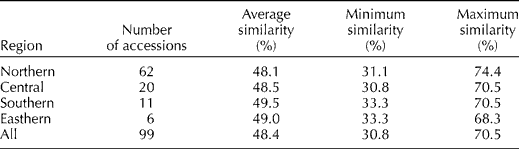
The average genetic similarity of D. japonica accessions within each of the four geographic regions varied from 48.1% (northern region) to 49.5% (southern region) (Table 2). Genetic similarity ranged from 30.8 to 74.4% for all 99 accessions, averaging 48.4% and indicating high genetic variation in D. japonica in Taiwan. On the other hand, the average genetic similarity between D. alata (check) and 99 D. japonica accessions was only 28.3%.
Genetic similarity of Dioscorea japonica accessions collected from four geographic regions in Taiwan

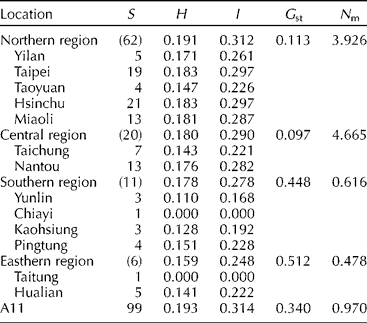
Based on ISSR marker estimates, the overall Nei's genetic diversity value (H) was 0.193, whereas northern, central, southern and eastern regions were 0.191, 0.180, 0.178 and 0.159, respectively (Table 3). The overall Shannon index was 0.314. In addition, the highest and lowest Shannon's diversity index (I) values were observed in the northern (0.312) and eastern (0.248) regions, respectively. The average genetic differentiation value (0.340) was higher than that (0.143) of general wind-pollinated plant species (Hamrick et al., Reference Hamrick, Godt and Sherman-Broyles1992). The highest value was found in the eastern region (G st= 0.512), followed by southern (0.448), northern (0.113) and central (0.097) regions. The N m values were >1.00 in central (4.665) and northern (3.926) regions, indicating large gene flows within them, but only limited gene flows were observed in the southern (0.616) and eastern (0.478) regions.
Genetic diversity parameters for different populations/subpopulations of Dioscorea japonica

S= number of accessions; H= Nei's gene diversity; I= Shannon's information index; G st= the coefficient of genetic differentiation; N m= estimate of gene flow from G st.
Genetic structure analyses
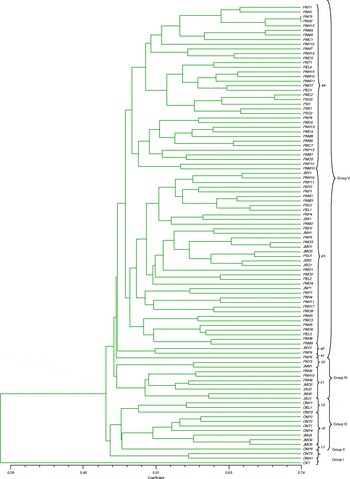
Based on a genetic similarity of 0.46, accessions were separated into five distinct groups (Fig. 2). Single-accession D. alata was isolated in an outgroup (Group I), Group II included two accessions of var. oldhamii (ONT3 and ONH1), and Group III consisted of eight var. oldhamii and three var. japonica accessions. Three monophyletic branches corresponded to Group III based on a genetic similarity of 0.48: c1 (ONP5), c2 (ONP2, 5; ONT1, 2; JNH3; JMC4, 5), and c3 (ONP1, 3; OEL1). Group IV was composed of nine accessions of varieties pseudojaponica and japonica, and was further divided into two subgroups: d1 (PNH6, 9, 10; JMC2; JSU1, 2; JNH2), and d2 (PNY3 and JNM1). The remaining 77 accessions formed Group V, including subgroups e1 (PNP6), e2 (JNY2 and PNP9), e3, and e4 of varieties pseudojaponica and japonica. Thirty-eight accessions consisting of 30 var. pseudojaponica and eight var. japonica clustered in e3. Subgroup e4 contained 36 closely clustered accessions of pseudojaponica. This large group was a mixture of accessions from different geographical regions, indicating that genetically highly related accessions were distributed within different regions.
UPGMA dendrogram of genetic similarity based on 101 ISSR markers for 99 Dioscorea japonica and Dioscorea alata accessions.

AMOVA results for the 99 D. japonica accessions showed significant differences in genetic variation among and within counties, but not among regions (Table 4). The majority of genetic variation was concentrated within counties (95.94%), indicating abundant genetic diversity in each county. Variation among counties (3.63%) was larger than among regions (0.43%). On the whole, the genetic variability among D. japonica populations collected from four geographic regions in this study varied from 0.76% (eastern region) to 12.22% (central region) (Table S2, available online). Variation within counties accounted for the highest percentage in each region.
AMOVA for Dioscorea japonica accessions collected in Taiwan

Discussion
Polymorphism of ISSR marker
In this study, ISSR DNA markers were used to evaluate genetic diversity in a collection of D. japonica accessions from different regions of Taiwan. A mean value of 6.73 polymorphic bands per primer (Table 1) suggested that the ISSR markers were suitable for detecting genetic variability in these collections. In particular, the primers UBC 808, 810, 818, 856 and 886 showed high numbers of polymorphic bands per primer among collections analysed. The high percentage of polymorphism observed for ISSR markers was also reported by Nascimento et al. (Reference Nascimento, Rodrigues, Koehler, Gepts and Veasey2013), analysing 53 accessions of Dioscorea trifida based on 16 ISSR primers, which had a total of 100 fragments (75.8% polymorphism) with an average of 6.25 polymorphic bands per primer. Moreover, Zhou et al. (Reference Zhou, Zhou, Yao, Liu and Tu2008) analysed 28 cultivars of Dioscorea opposita using seven ISSR primers and obtained a total of 65 bands with 83.1% polymorphism (average of 7.71 polymorphic bands per primer). Wu et al. (Reference Wu, Li, Lin, Jiang, Tao, Mantri and Bao2014) assessed genetic diversity in 21 yam landraces from seven cultivated populations, including D. opposita, D. alata, D. persimilis and D. fordii, and observed a high level (95.3%) of polymorphism among them using ISSR. In this study, a high level (90.2%) of polymorphism revealed a relatively high level of genetic diversity among yam accessions of D. japonica in Taiwan.
Noticeable differences in accession numbers and varieties were collected from four regions. The northern region contained three kinds of varieties, while the other regions contained only two kinds of varieties. Based on ISSR markers, relatively low genetic similarity (ranging from 30.8 to 74.4%) among the 99 D. japonica accessions was found. Although 12 markers are adequate to distinugish 99 accessions completely (data not shown), all the 101 polymorphic markers were used to obtain more representative evaluation of genetic diversity. With the same type of markers, Nascimento et al. (Reference Nascimento, Rodrigues, Koehler, Gepts and Veasey2013) and Wu et al. (Reference Wu, Leng, Tao, Wei and Jiang2009) reported that the similarity coefficient among accessions of D. trifida and D. alata ranged from 0.66 to 0.97 and 0.67 to 0.99, respectively. However, a large range of genetic similarity coefficients (0.33 to 0.96) among D. opposita accessions have also been observed (Zhou et al., Reference Zhou, Zhou, Yao, Liu and Tu2008), indicating that the maximum genetic distance values of D. japonica (69.2%) and D. opposita (67.0%) germplasm were higher than those of D. trifida (34.0%) (Nascimento et al., Reference Nascimento, Rodrigues, Koehler, Gepts and Veasey2013) and D. alata (33.0%) (Wu et al., Reference Wu, Leng, Tao, Wei and Jiang2009). Leaf and tuber shapes are similar between D. japonica and D. opposita; they are close relatives and both reproduce sexually. Consequently, higher genetic diversity was observed in populations of both species. The highest genetic similarity (74.4%) among the 99 accessions of D. japonica was found between accessions PNP3 and PNH2, which were collected from different counties (New Taipei city and Hsinchu city) in the northern region. They also have similarly shaped sagittate leaves. The second highest similarity (70.5%) was observed between accessions PMC2 and PSG3, both of which have short, broad, cordate leaves and were collected at similar altitudes (559 and 526 m) in the central and southern regions, repectively. The lowest genetic similarity (21.5%) was found between the outgroup CK1 (D. alata) and D. japonica accession ONP5 (collected from New Taipei city). The average genetic similarity between 99 D. japonica accessions and the outgroup CK1 was only 28.3%, indicating a genetically distant relationship or reproductive isolation between the two taxa.
A phylogenic tree (Fig. 2) having five main groups was constructed based on a genetic similarity value of 0.46. Notably, accessions of varieties oldhamii (distributed only in Groups II and III) and pseudojaponica (distributed only in Groups IV and V) were separated. However, accessions of var. japonica were mixed in with the same group containing varieties oldhamii (in the subgroup c2 of Group III) and pseudojaponica (in Groups IV and V), indicating that the var. japonica is a phylogenetic intermediate of the other two varieties. In addition, it may be inferred that var. japonica was derived from natural hybridization between the two varieties. Araki et al. (Reference Araki, Harada and Yakuwa1983) obtained two hybrids from open pollination, resulting in the chromosome number of both being the average (110) of the two parents (2n= 80 for D. japonica and 2n= 140 for D. opposita). Despite the fact that floral character and tuber length of the two hybrids were similar to D. opposita, leaf type and tuber thickiness were somewhere between the parents, providing evidences on the occurrence of natural hybridization between the two Dioscorea species. Accession PED1 in the e4 subgroup of Group V was the first historic collection in Taitung County because of the long dry season, which makes it difficult for wild yams to survive. We suggest that more wild yams could be found at higher altitudes having frequent precipitation.
Genetic structure analyses
The variation of D. japonica populations within county was 95.94% (Table 4), higher than 66.47% found in American yam cultivars (D. trifida) (Nascimento et al., Reference Nascimento, Rodrigues, Koehler, Gepts and Veasey2013) and the average (23.83%) within each population of four species: D. opposita, D. alata, D. persimilis and D. fordii (Wu et al., Reference Wu, Li, Lin, Jiang, Tao, Mantri and Bao2014). This is probably because different varieties (up to three varieties) coexisted in one county or natural hybridization occurred between populations of neighbouring counties in Taiwan. Moreover, because higher variation among four yam species (among populations) accounted for 40.39%, the lower variation within a population was found in the study of Wu et al. (Reference Wu, Li, Lin, Jiang, Tao, Mantri and Bao2014). Percentage variation of D. japonica in the northern, central, southern and eastern regions of Taiwan were 97.31, 87.78, 97.73 and 99.24%, respectively, indicating a high genetic diversity within each region. Muthamia et al. (Reference Muthamia, Morag, Nyende, Mamati and Wanjala2013) used SSR markers to assess Kenya's yam accessions and, similarly, found that variation within populations or provinces was the most important component (accounting for 88%). This indicates that genetic diversity of a germplasm bank could be effectively enriched when wild yam germplasm is collected in a region, followed by adding a few rare or diverse germplasm from other regions.
Genetic diversity analyses
D. japonica is an allogamous species that is mainly propagated vegetatively in the field. The accessions analysed in our study showed high genetic variability, with an overall genetic diversity (H) of 0.193 and a Shannon information index of 0.314, indicating relatively high genetic diversity in its germplasm. However, higher genetic diversity (H= 0.21) and similar Shannon information index (I= 0.32) values were found in D. trifida (Nascimento et al., Reference Nascimento, Rodrigues, Koehler, Gepts and Veasey2013) and D. opposite (Zhou et al., Reference Zhou, Zhou, Yao, Liu and Tu2008), respectively. Although the germplasm investigated in the above studies belongs to the genus Dioscorea, it is hard to discern the difference among species from varied geographical regions. The highest H (0.191) and I (0.312) values were observed in the northern region, perhaps because more varieties exist there and large numbers of seeds are disseminated by the northeast monsoon annually during winter. Taipei and Hsinchu counties in this region are especially noticeably affected by the northeast monsoon. In addition, the N m (3.926) of the northern region was >1.0, indicating frequent gene flow among populations. Accordingly, we suggest that the northern region may be the centre of genetic diversity of D. japonica. Nevertheless, the largest N m (4.665) was found in the centre region, implying that mountainous areas (altitudes of 300–1200 m) are conducive to long-distance seed dispersal and genetic exchange between sub-populations (counties). The N m values of Taiwan's southern and eastern regions were 0.616 and 0.478, respectively, indicating the existence of gene flow barriers between subpopulations, presumably because of the dispersed distribution of wild yams. Because accessions at an inter-species taxonomic level (D. opposita, D. alata, D. persimilis and D. fordii) were investigated by Wu et al. (Reference Wu, Li, Lin, Jiang, Tao, Mantri and Bao2014), the N m value (0.108) was much less than 1.0. In contrast, since accessions at an intra-species (or variety) level were analysed, higher N m values were found in our study.
Conclusions
The genetic diversity and phylogenetic relationships of wild yam (D. japonica) variety germplasm in Taiwan were evaluated by ISSR DNA markers in this study. Germplasm from var. oldhamii and var. pseudojaponica were clearly separated into different groups and the phylogenetic role of var. japonica was identified as a possible intermediate variety between var. oldhamii and var. pseudojaponica. AMOVA results revealed that genetic variation was high within counties and subpopulations (95.94%) and low among counties (3.63%) and regions (0.43%). The northern region is proposed as the genetic diversity centre of the species due to the greatest number of varieties and high genetic diversity (H), Shannon information index (I) and gene flow (N m) values found in this region. The results of this study are useful for collecting and utilizing wild yam (D. japonica) germplasm in Taiwan.
Authors' contributions
TLK carried out all the experimental works and wrote the manuscript. KHL contributed suggestions, discussions and editorial assistance. SFL provided guidance and editorial assistance for the manuscript.
Supplementary material
To view supplementary material for this article, please visit http://dx.doi.org/10.1017/S147926211500026X