

Introduction
In our first paper, we considered the impact of niche-filling in determining the evolutionary development of life on a habitable planet (Stevenson and Large, Reference Stevenson and Large2017). Here, the abiotic and biotic conditions in different locations determine the kinds of niches and the biological potential of each. An important but largely untested consideration is whether the planet is tidally-locked to its parent star: i.e. it is synchronously rotating so that it completes one axial revolution per orbital revolution (Joshi, Reference Joshi2004). Tidal-locking will mean that approximately half of the planet's surface will be in perpetual darkness, while the other is perpetually lit and non-seasonal (Heath et al., Reference Heath, Doyle, Joshi and Haberle1999; Joshi, Reference Joshi2004). While these worlds are undoubtedly habitable in a traditional sense, it remains unclear what the implications are of these conditions on the evolutionary potential of these planets. Will synchronous rotation stifle or enhance the development of biological complexity, both on organismal and ecosystem scales? Here, we apply simple ecological theory to synchronously-rotating planets with some interesting outcomes.
Using terrestrial observations as a guide, in this first instance, we apply basic ecological parameters to our hypothetical world to get a flavour of how life may be affected: temperature; humidity and net primary productivity (NPP) – which is dependent on light intensity. Gatti has shown that we can adequately model a parameter called the niche amplitude, using only these three parameters (Gatti, Reference Gatti2016). This, in turn, forms a simple yet viable proxy for understanding species diversity on Earth. In this capacity, niche amplitude makes a viable proxy for species richness, which describes the number of different species in one area at one time. While species richness does not take into account the abundance of each species, it remains useful, if incomplete, a measure of biodiversity.
Terrestrial niche amplitude and species richness vary directly with latitude, making a straightforward comparison with synchronously-rotating planets. Two alternative and far more rigorous measurements of terrestrial biodiversity are the Simpson Biodiversity Index (D) and the Shannon Diversity Index (H′). These provide parameters that vary in a similar manner on Earth to species richness but provide far more data as to the sustainability of the ecosystem (Barthlott et al., Reference Barthlott, Mutke, Rafiqpoor, Kier and Kreft2005; Kiera et al., Reference Kiera, Krefta, Leeb, Jetzb, Ibischc, Nowickic, Mutkea and Barthlotta2009; Ifo et al., Reference Ifo, Moutsambote, Koubouana, Yoka, Ndzai, Nucia, Bouetou-Kadilamio, Mampouya, Jourdain, Bocko, Mantota, Mouanga-Sokath, Odende, Mondzali, Emmanue, Wenina, Jenkins, Pimmb and Joppac2013; Gillman et al., Reference Gillman, Wright, Cusens, McBride, Malhi and Whittaker2015; Ricklefs and Heb, Reference Ricklefs and Heb2016; Proença et al., Reference Proença, Martin, Pereira, Fernandez, McRae, Belnap, Böhm, Brummitt, García-Moreno, Gregory, Honrado, Jürgens, Opige, Schmeller, Tiago and van Swaay2017). These are inapplicable in this study, as they clearly require knowledge of the numbers of each species, as well as the numbers of the types of each species – parameters that are impossible to determine in this or any other analysis, without detailed observation of such planets.
Therefore, to circumvent this problem we examine the niche amplitude which is dependent on three parameters: temperature, humidity and NPP. The simple relationship of temperature, light and humidity to one another makes synchronously rotating planets amenable to simple ecological dissection. In its simplest incarnation, such analysis does not require prior knowledge of the geography of the planet nor does it require an understanding of its biology. For we assume that life, irrespective of its nature will follow simple physical rules: the availability of nutrients, water and energy. For an ‘eyeball’ planet – one in which there is no topographical or regional meteorological overprint of the simplest climatological pattern – humidity, temperature and light intensity will follow the same concentric pattern around the sub-stellar point (SSP). However, for a realistic planet, this is unlikely and we then are forced to modify the ‘eyeball’ into a viable pattern that reflects topography and the proximity to surface water.
If our assumptions regarding life's response to these variables are valid - and we have no evidence to suggest otherwise – then the niche amplitude model is applicable. This allows us to interpret geographical influences on biology that are universally applicable to the kinds of life we know are possible. Therefore, while the output of this analysis remains qualitative, the results are universally applicable for biological systems that follow terrestrial rules. Moreover, with improved precision of climate models in the future, we may be able to refine this to produce fully quantitative models that incorporate humidity in a realistic climate scenario. To this end in the discussion, I suggest how this qualitative approach may be refined to reflect environmental (information) entropy.
Method and model parameters
Instellation
On synchronously rotating worlds the light intensity varies with angular distance from the SSP by equation 1, where θ is the angular separation of the location from the SSP; I is the instellation intensity at that point and Ilat is the angular separation.
 $$I_{{\rm lat}} = I\cos {\rm \theta }$$
For ectothermic species, environmental temperature is a good predictor of species richness (Rosenzweig, Reference Rosenzweig1968; Šímová et al., Reference Šímová, Violle, Kraft, Storch, Svenning, Boyle, Donoghue, Jørgensen, McGill, Morueta-Holme, Piel, Peet, Regetz, Schildhauer, Spencer, Thiers, Wiser and Enquist2015). For photoautotrophic species, light intensity is the key factor, with an additional effect of humidity, which influences gas exchange, as well as the overall availability of water (Gaston, Reference Gaston2000; Gatti, Reference Gatti2016). Conversely, the richness of endothermic species is primarily affected by the NPP of the region in which they live (Kay et al., Reference Kay, Madden, Van Schaik and Higdon1997). Various analyses demonstrate the applicability of this methodology to the terrestrial biosphere, demonstrating similarities in the distribution of plant and animal life across latitudinal bands irrespective of the mathematical model that is chosen (Ifo et al., Reference Ifo, Moutsambote, Koubouana, Yoka, Ndzai, Nucia, Bouetou-Kadilamio, Mampouya, Jourdain, Bocko, Mantota, Mouanga-Sokath, Odende, Mondzali, Emmanue, Wenina, Jenkins, Pimmb and Joppac2013; Jenkins et al., 2013; Gillman et al., Reference Gillman, Wright, Cusens, McBride, Malhi and Whittaker2015). This allows us to make a simple predictive measure on biological richness based on these astrophysically-defined parameters (light, temperature and humidity).
Instellation, biological productivity and richness
The effect of light is primarily on the rate of photosynthesis. Photosynthesis may be defined by the parameter gross primary productivity (GPP). However, not all of the usable carbon fixed by photosynthesis is available to the plant as biomass, or subsequently to organisms that feed upon these. A more usable parameter is the NPP, which is related to GPP through equation 2.
 $${\rm NPP} = {\rm GPP} - {\rm RL}$$
Here, RL symbolizes respiratory losses – the amount of chemical energy liberated by respiration that is required for viability.
How can we relate these parameters to biological richness or diversity? A standard method is to use a hypervolume (Blonder, Reference Blonder2017). This is a mathematically-defined space bounded by a minimum of three axes, each of which provides a factor required for or related to the survival of the species concerned. The hypervolume, in this instance, is quantified by the expression niche amplitude, V n. Here the term niche amplitude refers to the kinds of organisms that can occupy the niche's conditions. Generalists have larger niche amplitudes than specialists because they can occupy and survive in a broader range of conditions. Consequently, areas with a greater niche amplitude will have more species than those that do not.
While this is not a perfect match for biodiversity, it does give a broad indication of how easy it will be for life-forms to inhabit a planet's available geographical niches. Most importantly, niche amplitude can be related to temperature, humidity and NPP through equation 3.
 $$V_{\rm n} = \sqrt {(T^2 + H^2 + {\rm NP}{\rm P}^2)} $$
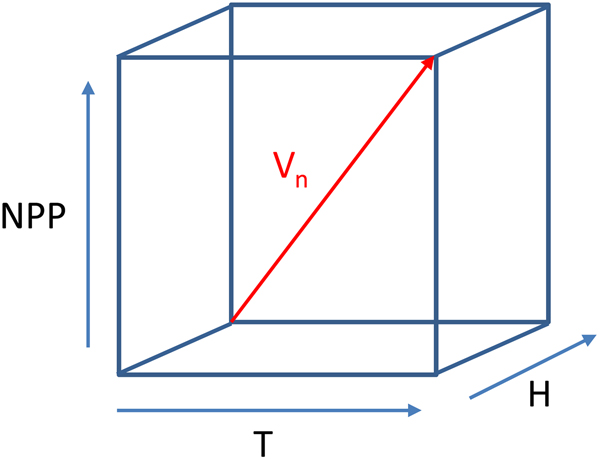
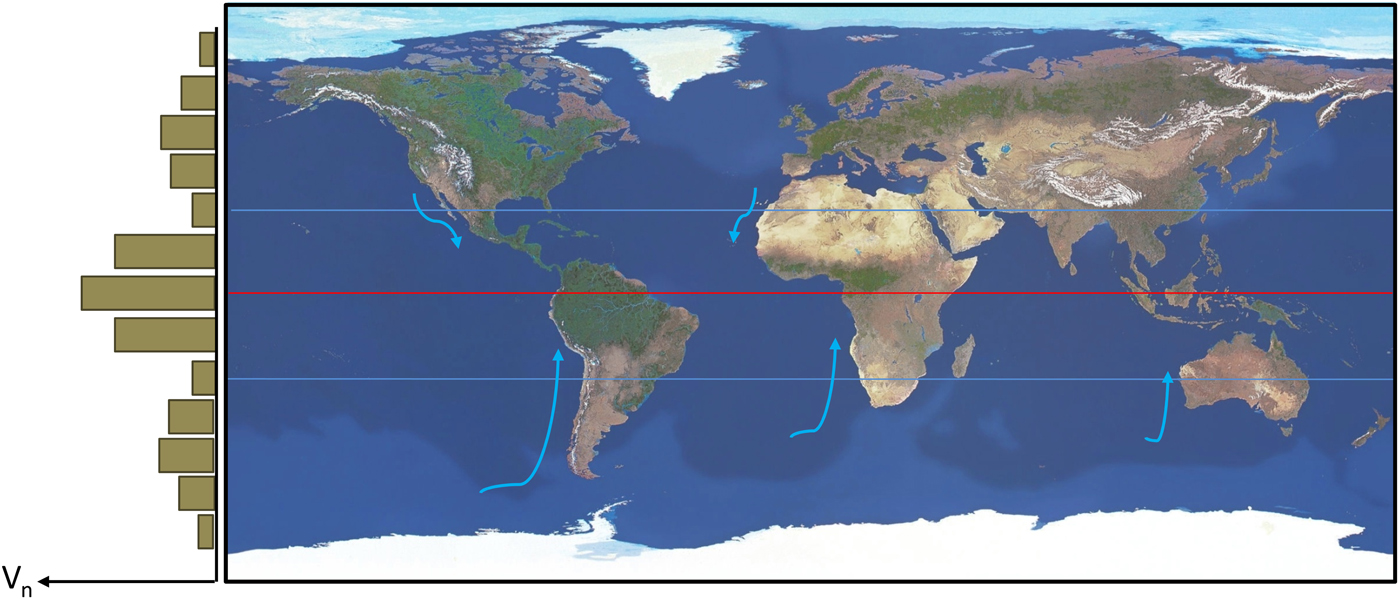
The beauty of this approach is that we can define each of these parameters using astronomical measurement or relatively straightforward calculations. In this case, these parameters provide an over-arching volume in which the sub-aerial landscape becomes populated with varying species, the root of which is photosynthetic life (Fig. 1). While these hypervolume models have their limitations, they make a useful starting point for further discussion (Gatti, Reference Gatti2016; Blonder, Reference Blonder2017) and allow us to investigate the evolutionary potential of our planets.
Hypervolumes and Niche amplitude. Terrestrial biology has a latitudinal gradient of biodiversity that is most simply explained using the concept of niche amplitude (Vn) and a fractal dimension (not shown here). The three axes, Temperature (T), Humidity (H) and Net Primary productivity (NPP) have continuous variables and define three axes of a hypervolume (ref). A hypervolume, in this context, is merely a mathematical tool that can be used to define the “living space” or niche of the organism, with the boundaries of the shape defining the conditions that permit the growth and reproduction of the species.

Stellar mass and rotation period of habitable planets
Equation 4 comes from Kopparapu et al., Reference Kopparapu, Wolf, Haqq-Misra, Yang, Kasting, Meadows, Terrien and Mahadeva2016 (equation 3 in their paper). This relates the orbital period, P, the incident flux, F, the stellar mass, M and the stellar luminosity, L, relate to one another for planets orbiting near the inner edge of the habitable zone (Kopparapu et al., Reference Kopparapu, Wolf, Haqq-Misra, Yang, Kasting, Meadows, Terrien and Mahadeva2016; Wolf, Reference Wolf2017; Wolf et al., Reference Wolf, Shields, Kopparapu, Haqq-Misra and Toon2017).
 $$P = \left[ {{\left( {\displaystyle{{L_{\rm \star }/L_ \odot } \over {F_{\rm \star }/F_ \odot }}} \right)}^{3/4}} \right]. \surd (M_{\rm \star }/M_ \odot )$$
This determines the rotation period for any tidally-locked (synchronously rotating) planet, which in turn affects atmospheric and ocean circulation by altering the Coriolis parameter, f (Cullum et al., Reference Cullum, Stevens and Joshi2014). The strength of oceanic heat transport will affect the delivery of moisture to the SSP, through alterations in the temperature of the water underlying it (or adjacent to it) and this will impact on precipitation. Equation 5 strips down the parameters, defined by Cullum affecting oceanic transport of heat, Q, while equation 6 indicates all of the relevant parameters used by Cullum. Heat transport, Q, varies directly with the temperature gradient, T, between the poles and the equator, but inversely with the Coriolis parameter, f, which is a function of the orbital period, P (Cullum et al., Reference Cullum, Stevens and Joshi2014). Therefore, planets with the shortest orbital periods have, ironically, the weakest poleward transport of heat, with a greater zonal flow.
 $$Q\,{\rm \alpha }\; 1/f$$
 $$Q = {\rm \rho} _{\rm o}C_{\rm p}\left( {\displaystyle{{k^2{\bi g}{\rm \alpha} L^4\Delta T^4} \over f}} \right)^{1/3}$$
Where, k is thermal diffusivity, f is the Coriolis parameter, α is the coefficient of thermal expansion, ΔT is the temperature gradient between the poles and equator, g the acceleration due to gravity, L the horizontal scale length, ρo the reference density of the ocean and C p the specific heat capacity. Cullum's work suggests that the longer the rotation period, the shallower the thermocline (the boundary layer between deep, cold water and surface water), larger horizontal velocities of ocean water, stronger overturning of the ocean and more efficient transport of heat between the equator and pole.
 $$f = 2P\sin {\rm \varphi }$$
Coriolis Parameter, f is twice the orbital period, P, (that is equivalent to the rotation rate) multiplied by the sine of latitude φ. Substituting equation 8 into 7 gives us a final equation 8, that links orbital period, P, with heat transfer, Q, for a synchronously-rotating planet.
 $$Q = \rho _{\rm o}C_{\rm p}\left( {\displaystyle{{k^2{\bi g}{\rm \alpha} L^4\Delta T^4} \over {2P\sin {\rm \varphi}}}} \right)^{1/3}$$
Finally, Cullum's and co-worker's analysis also partly quantifies the effects of continental and other barriers to the poleward transport of heat. Unsurprisingly, the presence of undersea barriers enhances the transport of energy from the tropics to the polar regions for tidally-locked and other planets. This work is corroborated by analysis of the effects of undersea topography on terrestrial ocean overturning (de Lavergne et al., Reference de Lavergne, Madec, Roquet, Holmes and McDougall2017). Here, the presence of seamounts also greatly influences the mass transport of energy in the oceans, clearly emphasizing the role of continental crust and other undersea topographic barriers in modifying or enhancing energy transport through the oceans.
Atmospheric circulation varies with an orbital period as planets with the shortest orbital periods that are in synchronous rotation with their stars, will have the largest Coriolis parameter (Haqq-Misra et al., Reference Haqq-Misra, Wolf, Joshi, Zhang and Kopparapu2017). For planets with orbital periods less than 5 days, Haqq-Misra et al. show that the atmosphere shows strong superrotation along the equator, with additional zonal flow at high latitudes. This may be applicable to the inner planets of the TRAPPIST-1 system (Gillon et al., 2017); as well as Ross 128b, which has an orbital period of 9.9 Earth days (Bonfiles et al., Reference Bonfils, Astudillo-Defru, Díaz, Almenara, Forveille, Bouchy, Delfosse, Lovis, Mayor, Murgas, Pepe, Santos, Ségransan, Udry and Wünsche2016).
Planets with periods spanning 5–20 days fall into a transitional regime, with some superrotation and zonal flow, but the broadly spherical inflow of air towards the SSP, which is particularly strong across the poles. These Rhines Rotators may include Proxima b, with a period of 11.2 days (Anglada-Escude et al., Reference Anglada-Escudé, Tuomi, Gerlach, Barnes, Heller, Jenkins, Wende, Vogt, Butler, Reiners and Jones2013), as well as TRAPPIST-1 d and e.
Finally, the majority of potentially habitable planets that orbit red dwarfs will have orbital periods in excess of 20 days. Atmospheric circulation on these worlds is expected to follow a radial inflow from the Anti-Stellar Point (ASP) towards the SSP. These include Gleise 667Cc, with its 28-day period (Anglada-Escudé, et al., Reference Anglada-Escudé, Tuomi, Gerlach, Barnes, Heller, Jenkins, Wende, Vogt, Butler, Reiners and Jones2013).
Planets with the shortest orbital periods exhibit strong superrotation in their lower atmospheres (Merlis and Schneider, Reference Merlis and Schneider2010; Kopparapu et al., Reference Kopparapu, Wolf, Haqq-Misra, Yang, Kasting, Meadows, Terrien and Mahadeva2016). This is particularly evident in planets with periods less than 5 days but has an influence in Rhines rotators with longer orbital periods. Indeed, even at 20–30 days, there is still evidence of enhanced convergence in the equatorial band (Kopparapu, Reference Kopparapu, Wolf, Haqq-Misra, Yang, Kasting, Meadows, Terrien and Mahadeva2016; Haqq-Misra et al., Reference Haqq-Misra, Wolf, Joshi, Zhang and Kopparapu2017). While there is no direct evidence of convection and precipitation in these models, they do show cloud cover extending to modest depths in the troposphere and these would be expected to produce orographic precipitation on windward coasts; or to deposit moisture as fog.
In this study, we have used the circulation models of Haqq-Misra et al and applied them to a terrestrial (geographical) setting. This allows us to include crude determinations of temperature as well as humidity, where we use cloud cover as a proxy for humidity. However, for the latter parameter, we also modify the likely humidity to reflect the effect of ocean currents as well as the source of the airmass. Areas impinged by cold currents will have a lower relative humidity than those adjacent to regions where the ocean is warm and, therefore, able to surrender moisture and latent heat. Similarly, air flowing from the antistellar point over the terminator is expected to be cold with a low relative humidity as is the case on Earth for polar continental air. However, we note that if the cold air flows over warmer water, it will pick up moisture and could, therefore, produce greater levels of orographic precipitation than I assume here.
One must emphasize that these parameters are strictly-speaking qualitative, as they are empirical estimates that are based on observations of terrestrial temperature and humidity in the context of ocean circulation. A key issue, here, is the lack of realistic ocean circulation models for synchronously-rotating planets. Cullum provides broad models based on terrestrial and hypothetical geography but do not illustrate these in a directly applicable sense (Cullum et al., Reference Cullum, Stevens and Joshi2014). Therefore, necessity inference is drawn, rather than specific model data.
Continental crust and orography
The presence of continental crust introduces a number of modifications to airflow and temperature that need to be considered. Continental crust has a considerably lower specific heat capacity than sea water: 899.5 and 3985 J kg−1 K−1 at 0 °C, respectively. As a point of reference, at 20 °C water's specific heat capacity is only marginally more at 3993 J.kg−1.K−1. Of course, rock is solid, rather than fluid and, therefore, will warm to an equilibrium temperature under constant irradiation, while water will not as its ability to move laterally and mix in three dimensions means that its temperature is unlikely to be in equilibrium with overlying air. Therefore, regions of maximal convection will tend to lie on any landmasses close to the SSP, rather than at the SSP – except where there is a large expanse of water between land and the SSP.
Continental crust also reduces airflow velocities at the surface, relative to oceans because of a greater frictional coefficient. For the sake of the primary models we use here, the SSP is located over a continent, but there is a relatively short route to neighbouring sources of moisture (oceans). This allows active, moist convection over the continent. If we increase the area of the continent and move the moisture source further away from its interior, the intensity of convective rainfall will subside, even if convection is vigorous.
In this regard, we should consider two situations. Ahead of the Indian summer Monsoon, near-surface temperatures regularly exceed 40 °C, pressure is relatively low, but there is very limited and sporadic precipitation because the middle and upper troposphere has not responded and the area is overlain by subsiding air (Akter and Tsuboki, Reference Akter and Tsuboki2017). Similarly, over West Africa, the advance of the summer monsoon trough is restricted by prevailing dry, north-easterly winds. Thus despite, western Africa becoming as hot, if not hotter than India during the early summer, there is relatively little precipitation until later in the season when surface winds (facilitated by changes in the upper atmosphere) bring moisture inland (Messager, et al., Reference Messager, Parker, Agusti-Panareda, Taylore and Cuesta2010). Moreover, during the peak of the West African monsoon, onshore winds bring cooler surface waters towards the coast, which suppress convection and rainfall along the coastal margin (Nguyen et al., Reference Nguyen, Thorncroft and Zhang2011). Therefore, even where continental heating is high and there exists a moisture source nearby, the temperature of the source is critical in determining rainfall. The models presented here incorporate these effects (Figs. 2 and 3).
Idealised Vn with latitude for subaerial Earth. The bars indicate how Vn varies with latitude, using an arbitrary scale: highest at the equator (red line) where light, temperature and humidity are optimal; low around the Horse Latitudes (blue lines) where descending, dry air causes desertification; higher again, but less so than at the equator in the temperate regions, where humidity is high but seasonal temperatures are lower on average; then lowest at the poles where humidity, light and temperature are always limited. Mountains clearly distort this pattern; as do cold, ocean currents (blue arrows) that bring low humidity along the coastlines of western Australia, Southern Africa, South America, western North America and North Africa. Base image: NASA.
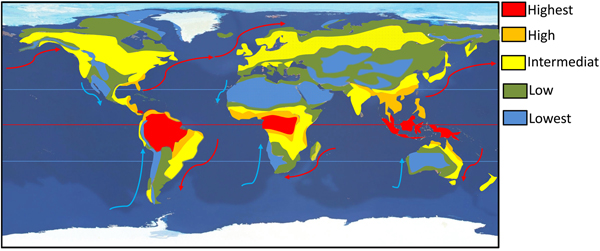
A more realistic depiction of land Vn with latitude for subaerial Earth. This takes into account the mass movement of air that affects the distribution of land plants and the food chains that depend upon them. Colour coding is used to illustrate different levels of niche amplitude (and in this case, biodiversity). The Coriolis effect results in mid-latitude westerly winds that bring moisture into the continental interior, as well as directing flow in the oceans. Base image: NASA.

On an idealized, smooth, synchronously rotating planet, over continental landmasses this latitudinal pattern of light and temperature would form an eyeball-pattern, centred on the SSP [Fig. 4(a)]. Likewise, as the region of greatest convergence will be where temperatures are highest, the humidity will be similarly displaced assuming that the planet has a source of moisture, with the effect varying with rotation period. Modelling suggests that cloud cover, near to the SSP evolves from a broadly circular pattern, centred on the SSP in slow-rotating planets, to one resembling more of a crab-claw or elongated pattern on planets nearest the inner edge of the habitable zone of the lowest mass red dwarfs (above). At the shortest, conceivably habitable periods, which occur around the lowest mass stars, the pattern begins to morph into the terrestrial pattern, with a broader zone of convergence along the equator (Haqq-Misra et al., Reference Haqq-Misra, Wolf, Joshi, Zhang and Kopparapu2017). While models do not constrain changes in precipitation caused by this equatorial convergence if we extrapolate to the terrestrial environment one would expect some additional precipitation in this belt. This will be particularly true where convergence is enhanced by orographic effects.
Variation in Vn for idealised, synchronously-rotating planets: (a, left) with and (b, right) without modest equatorial superrotation. Planets with the lowest mass stars will have strong equatorial superrotation (left), with periods of 4-5 days. Planets with orbital periods in excess of 20 days will be in the slow-rotating regime (right). Slow rotators show the classic “eyeball” distribution of niches around the SSP as temperature, light intensity and humidity vary in a simple pattern. The lower the mass of the star, the greater the degree of superrotation, for planets lying at the inner edge of the habitable zone. These planets experience the greatest elongation of regions with differing Vn downwind from the SSP. The terminator (red line) provides a natural barrier to the development of niches that depend on daylight. For both these planets there is a smooth sub-aerial surface with an unspecified source of atmospheric moisture.

These are illustrated in the context of an Earth-like planet, later in this paper.
Orbital period, orography and cloud cover
Planets that orbit closest to the inner edge of the habitable zone and/or around the lowest mass stars will have atmospheres that superrotate to the greatest extent (Merlis and Schneider, Reference Merlis and Schneider2010; Edson et al., Reference Edson, Lee, Bannon, Kasting and Pollard2011; Penn and Vallis, Reference Penn and Vallis2012; Haqq-Misra et al., Reference Haqq-Misra, Wolf, Joshi, Zhang and Kopparapu2017). Superrrotation introduces cooler air from the antistellar hemisphere to the hemisphere upwind of the SSP, meaning that the highest temperatures (on a smooth surface, bereft of continents) will be found to the east of the SSP. Consequently, equatorial superrotation is likely to introduce colder air over warmer water with potential for convective instability and shower activity far removed from the SSP.
Planets lying marginally within the inner edge of the conventional habitable zone may also be habitable if they have much of their moisture sequestered on the cold hemisphere (Leconte et al., Reference Leconte, Forget, Charnay, Wordsworth, Selsis, Millour and Spiga2013). These worlds will have even shorter rotation periods and have atmospheres that are subject to superrotation for the lowest stellar masses (Kopparapu et al., Reference Kopparapu, Wolf, Haqq-Misra, Yang, Kasting, Meadows, Terrien and Mahadeva2016; Reference Kopparapu, Wolf, Arney, Batalha, Haqq-Misra, Grimm and Heng2017).
Generally, cloud cover is expected to be dominated by cumuliform convective clouds closest to the SSP but by mid-high-level stratiform clouds as you move away, downwind from it (Kopparapu et al., Reference Kopparapu, Wolf, Haqq-Misra, Yang, Kasting, Meadows, Terrien and Mahadeva2016). Stratiform clouds will likely be at increasing altitude, as you move away from the SSP along the equatorial band. However, topographic barriers may introduce areas of thicker orographic cloud that punctuate this pattern. In the case of planets with modest to strong degrees of superrotation, this stratiform cloud cover extends to the anti-stellar hemisphere and in extreme cases may enshroud the entire antistellar hemisphere and back around to the SSP (Kopparapu et al., Reference Kopparapu, Wolf, Haqq-Misra, Yang, Kasting, Meadows, Terrien and Mahadeva2016). Moreover, such planets may exhibit modest uplift along much of their equator, driven by low level convergence, rather than through convective forcing (Kopparapu et al., Reference Kopparapu, Wolf, Haqq-Misra, Yang, Kasting, Meadows, Terrien and Mahadeva2016).
Terrestrial cloud cover is very heterogeneous along the equator, varying both in a diurnal pattern and in regional manners dictated by the movement of Kelvin waves, equatorial Rossby waves and by variations in surface humidity and temperature that are dictated by oceanic circulation (Wolf, Reference Wolf2017; Wolf et al., Reference Wolf, Shields, Kopparapu, Haqq-Misra and Toon2017). Thus, it is rather difficult to determine whether cloud cover at the SSP will be permanent or vary over timescales dictated by the passage of atmospheric waves, or from the effects of other regional geographical features (Gerbier et al., Reference Gerbier, Koschmieder and Zierep1960; Tafferner, Reference Tafferner1990; Davis and Emanuel, Reference Davis and Emanuel1991; Basa, Reference Basa2007; Geerts and Linacre, Reference Geerts and Linacre2017). For the sake of argument, we assume that the thickness or permanence of cloud-cover does not limit the photosynthetic rate and, therefore, has a negligible impact on NPP.
The extent of cloud cover at the SSP will be influenced by its distance from sources of moisture and orography. Indeed, where the region of greatest convergence lies inland, it is likely that lower levels of absolute humidity will lead to the formation of mesoscale convective complexes (Fritsch and Velasco, Reference Fritsch and Velasco1987). These consist of clusters of thunderstorms that are fed by low-level influxes of warm, humid air from adjacent ocean basins: this is evident over central and northern Africa during their rainy seasons and over the Mid-Western States during the summer rainy season. Here, the humidity will follow the path of low-level winds from the basin, towards the SSP, or region of maximum convective instability. This zone becomes progressively elongated along the equatorial region as the orbital period decreases (Haqq-Misra et al., Reference Haqq-Misra, Wolf, Joshi, Zhang and Kopparapu2017).
The geographical location of the SSP, therefore, has an effect on precipitation. If the SSP is far removed from large bodies of water, cloud cover is likely to be sporadic, localized and of a more limited vertical extent than if copious amounts of moisture are available. Precipitation is likely to be localized in areas that favour uplift.
Airflow over mountains alters precipitation in a number of ways. Topographic barriers, such as windward coasts and mountains cause uplift, enhanced precipitation and lower temperatures compared with leeward slopes (Basa, Reference Basa2007). More subtly, changes in vorticity (effectively the angular momentum of the air as it flows up and over ranges) cause variation in wind direction and can induce Rossby waves (Gerbier et al., Reference Gerbier, Koschmieder and Zierep1960; Vanneste, Reference Vanneste1990; Xiong et al., Reference Xiong Jian-gang, Fan and Jun1994). While these changes in motion are facilitated by planetary rotation, one expects that even with slow rotating planets, changes in vorticity may be achieved by bulk motion (ASP-SSP) around and over obstacles. Over mountain peaks, westerly airflow turns poleward, then equatorward as it descends on the less. This can induce the formation of areas of low pressure in the lee trough (Basa, Reference Basa2007). Elsewhere, partial blocking of airflow over east-west orientated ranges can cause the pooling of cold air behind the range. In the Alps, cold air escapes through the Rhone Valley as the Mistral but also induces the formation of lee low-pressure areas (lee cyclogenesis) over Northern Italy (Basa, Reference Basa2007). Likewise, we expect similar phenomena on a tidally-locked planet, where airflows over and around mountain chains. During the last ice age, moisture was directed northwards from the Mediterranean Basin towards Western Europe in part through topographic effects (Luetscher et al., Reference Luetscher, Boch, Sodemann, Spötl, Cheng, Edwards, Frisia, Hof and Müller2015).
While we are unaware of any modelling in this regard, we presume that such lee-cyclones will propagate towards the SSP in the general air flow. These would likely enhance precipitation, by increasing convergence and by the introduction of pockets of colder air that would enhance air mass instability near the surface as they move over the progressively warmer ground. This effect would be particularly evident where such air flows over warm seas.
A final complication, unique to synchronously-rotating planets, is the gross Walker circulation (Walker, Reference Walker1923). This is the gross airflow from the SSP vertically then horizontally towards the ASP at altitude. Cold air which descends from this general flow is likely to introduce a temperature inversion downwind of the SSP. Such an inversion will lower in elevation with increasing distance from the SSP. Such an inversion should suppress convection, generally. However, in the surface counter-flow towards the SSP, the presence of topographic rises will favour localized cooling and precipitation. The presence of shorelines may also be sufficient to trigger localized convective rainfall if the land is sufficiently warm and the air moist. While not resolved in these model planets, onshore breezes may bring sufficient moisture for the fog to form over topographic rises. This may mean that there is a greater niche amplitude along windward coastlines than is apparent in these figures. However, this will be limited in geographical extent.
Summary of model parameters
To produce these first generation gedankenexperiments, we have taken into account orbital period, P; the stellar irradiation (or flux, F) and made some appropriate determinations regarding the humidity and the effect of ocean currents that are driven by temperature gradients and rotation period – the orbital period. These are extrapolated, in a qualitative form from the models of Kopparapu et al. (Reference Kopparapu, Wolf, Haqq-Misra, Yang, Kasting, Meadows, Terrien and Mahadeva2016), Haqq-Misra et al. (Reference Haqq-Misra, Wolf, Joshi, Zhang and Kopparapu2017), Wolf (Reference Wolf2017) and Wolf et al. (Reference Wolf, Shields, Kopparapu, Haqq-Misra and Toon2017). We use their temperature data and assumptions of humidity, which are based on cloud cover and continental area. This is combined with realistic determinations of NPP, which we assume will follow terrestrial patterns, given the dependence of photosynthetic rate on these readily determinable quantities. This allows us to produce three qualitative model planets, each with a different rotation period. This describes the global distribution of potential productivity, producing a definable quantity, the niche amplitude, V n, which is given by equation 3.
In this regard, equation 3 is modified to produce equation 9, where temperature, humidity and NPP follow determinable patterns. Here, k 1–k 3 are constants relating to (1) the optical density of the atmosphere; the abundance of greenhouse gases and the transport of heat; (2) the availability and transport of moisture; and (3) the overall efficiency of photosynthetic processes. In this instance, NPP is reduced to a single variable that incorporates the effect of light intensity (which varies with angular separation from the SSP) and respiratory losses that incorporate the relative rate of respiration, which is partly determined by temperature. This allows us to apply the concept of niche amplitude to synchronously rotating planets. NPP is given by the total irradiation minus the respiratory losses, RL.
 $$V_{\rm n} = \cos \theta \sqrt {\left( {k_1^2 + k_2^2 + k_3^2} \right)} $$
The term ‘cos θ’ has the same meaning as in equation 1. While this equation is a simplification, it does allow us to determine, for the first time, a simple biological relationship with astrophysically-definable quantities. In this regard, equation 9 should be regarded as a ‘best fit’ that is most suitable for slow-rotating planets – those with an orbital period exceeding 20 days. Superrotation grossly modifies the distribution of humidity for those planets with the shortest orbital periods, rendering the inclusion of the term for angular separation, irrelevant, with respect to humidity. At decreasing orbital separations (and hence periods) angular separation from the SSP should be replaced with angular separation from the equator. However, one notes that this is only relevant for very low mass stars, where planets in the circumstellar habitable zone will have an orbital period less than or equal to 5 days. In order to incorporate this effect, we have simply followed the projected cloud cover in the models of Haqq-Misra et al. (Reference Haqq-Misra, Wolf, Joshi, Zhang and Kopparapu2017) as a proxy for humidity, noting also the substantial decrease in cloud cover in more polar latitudes in these models.
Caveats
In this work we have neglected the other limiting factors for photosynthesis. These include carbon dioxide concentration and nutrient availability (Lebauer and Treseder, Reference Lebauer and Treseder2008). Therefore, for the sake of simplicity, we assume that nutrients and carbon dioxide are not limiting factors. This allows us to model terrestrial (subaerial) niche amplitude with readily definable parameters. Light intensity determines GPP, while temperature determines both the rate of respiration and the rate of enzymatic carbon fixation. As such, we will assume that life on a synchronously-rotating planet – lacking a diurnal cycle – will follow the terrestrial photosynthesizing autotrophs. We exclude chemosynthetic life, in part because it likely follows geothermal output, which is beyond the scope of this paper; and because a complex multicellular biosphere is unlikely to be driven by chemotrophic life. Such life is unlikely to be able to convert chemical energy into usable forms to sustain a complex (multicellular) biosphere.
The efficiency of the light-dependent reactions can be broadly linked to light intensity (Wilson and Cooper, Reference Wilson and Cooper1969), while temperature and to a degree, the humidity will affect the process of carbon capture. Temperature affects the rate of enzyme-catalysed reactions, while humidity modulates the rate of transpiration and conceivably the periods of time through which carbon dioxide is able to diffuse into and out of the plant – or plant-like autotroph (Hew et al., Reference Hew, Krotkov and Canvin1969). Photosynthetic microbial life will be unaffected by the latter assuming there is sufficient water to avoid desiccation.
Finally, while not considered here, over geological time periods, the area of continental crust is assumed to grow over time as the result of plate tectonics and extraction of granitoid melt from the mantle and/or lower crust (Kite et al., Reference Kite, Manga and Gaidos2009; O'Neill et al., Reference O'Neill, Lenardic, Weller, Moresi, Quenette and Zhang2016). While this is of no consequence at any given moment, over geological time the growth of continental crust is expected to increase the number of available niches for the colonization or life and also alter the transport of heat and moisture across the planet. This will be considered in a separate paper. Moreover, continental crust is expected to be mobile, resulting in the migration of conditions across the landmass over geological periods.
Results
In order to make sense of these varying parameters and to make models tractable, we use the Earth as a base model. This planet has a characteristic layout of continents that we can use to constrain some of the effects we have described above. Figures 5 and 6 illustrate possible atmospheric and ocean circulation and niche amplitude for slow rotating planets, respectively. Figures 7 and 8 illustrate the corresponding features for planets in the Rhines-rotation regime; while Figs. 9 and 10 show the effect of rapid rotation. The colour-coding is qualitative but consistent with terrestrial biodiversity, as measured by Shannon Diversity Index, the Simpson Index or simpler measures of species richness (Kiera et al., Reference Kiera, Krefta, Leeb, Jetzb, Ibischc, Nowickic, Mutkea and Barthlotta2009; Ifo et al., Reference Ifo, Moutsambote, Koubouana, Yoka, Ndzai, Nucia, Bouetou-Kadilamio, Mampouya, Jourdain, Bocko, Mantota, Mouanga-Sokath, Odende, Mondzali, Emmanue, Wenina, Jenkins, Pimmb and Joppac2013; Gillman et al., Reference Gillman, Wright, Cusens, McBride, Malhi and Whittaker2015; Ricklefs and Heb, Reference Ricklefs and Heb2016; Proença et al., Reference Proença, Martin, Pereira, Fernandez, McRae, Belnap, Böhm, Brummitt, García-Moreno, Gregory, Honrado, Jürgens, Opige, Schmeller, Tiago and van Swaay2017). Therefore, while we apply qualitative measures here, these are consistent with quantitative assessments.
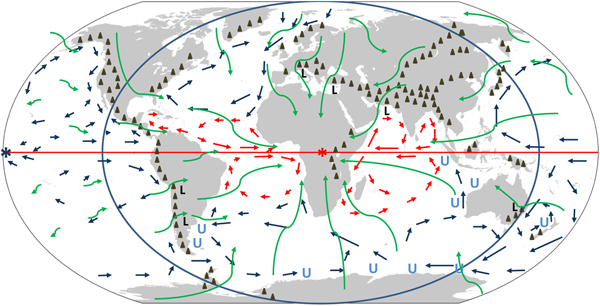
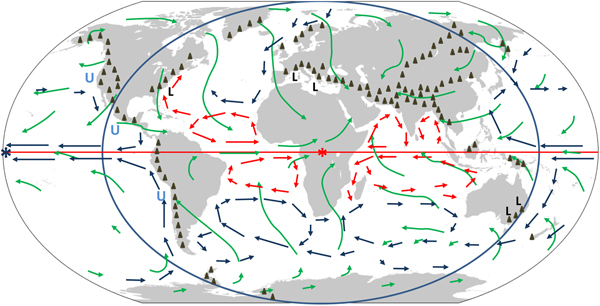
A gedankenexperiment where the Earth is a slow, synchronously-rotating planet, showing ocean circulation and airflow. The orbital period exceeds 20 days for an Earth-sized planet and this limit increases with planetary radius. The SSP is indicated by a red asterisk; the ASP by a blue asterisk; the terminator by a dark blue line and the equator by a red line. Simplified terrestrial mountains are shown by arêtes. Areas distal to the SSP and in the lee of mountains will be in permanent shade. Waving, green arrows indicate likely airflow, which is strongest to the east of the SSP. Straight arrows in the oceans indicating likely ocean currents, with blue indicating cold and red, warm. Zones of coastal upwelling, driven by topography and offshore winds are indicated with a “U”. Oceanic productivity is likely to be highest, here. Areas of “lee cyclogenesis” are shown with “L”. Here, precipitation is likely if air is suitably moist and unstable. Base Map: creative commons, Wikipedia.

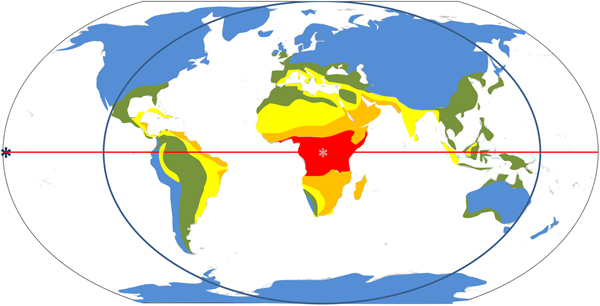
Vn with landscape for a slow rotating (>12 days) tidally-locked Earth, with the SSP over Africa and the ASP in the mid-Pacific. The SSP is indicated by a pink asterisk; the ASP by a blue asterisk; the terminator by a dark blue line and the equator by a red line. Coastal areas receiving onshore winds, particularly where ocean currents are warm, may receive orographic rainfall. Other warm areas with onshore winds may have limited convective rainfall. However, the extent of this is likely to depend on the level and strength of any atmospheric temperature inversion caused by air descending away from the SSP. Compared with the fast rotating planet, areas of low Vn are more extensive and the highest Vn is confined to Africa where high temperatures and light intensity are matched by convective rainfall. Base Map: creative commons, Wikipedia.

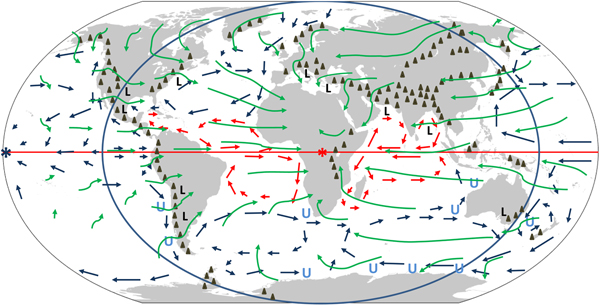
In this gedankenexperiment, the Earth is a moderately fast (east-west) synchronously-rotating planet, with an orbital period of 5-20 days. This falls into the Rhines regime as described in Haqq-Misra et al, 2017. The SSP, ASP, terminator, equator, mountains, areas of upwelling and lee cyclogenesis are indicated in the same manner as before. The major differences relate to enhanced east-west zonal flow at high and equatorial latitudes, particularly in the eastern hemisphere in both the atmosphere and oceans, but far weaker flow in the western hemisphere. Convergence proximal to the SSP is also distorted into a more north-south elongated region. However, the drier air from the northern hemisphere may suppress convection north of the equator. Changes are indicated by differences in the length and direction of the green, blue or red arrows. These changes redistribute the areas of precipitation onto windward coastlines and hence alter the pattern of niche amplitude. Base Map: creative commons, Wikipedia.

Vn with landscape for a moderately-fast rotating, tidally-locked Earth with a rotational period of 5-20 days. The SSP, ASP, terminator and equator are shown as before. SSP temperatures are lower than with the slower rotating planet, giving rise to weaker convection. The faster rotation rate enhances convergence along the equatorial band, where air flows over land from neighbouring ocean basins or where airflow encounters mountainous regions and is forced to rise. This may enhance precipitation in this region. Africa is largely unchanged but greater inflow from the west in faster rotating models enhances rainfall along coastal regions and with it Vn. More of the northern continental area will be tundra or under ice as less heat is transported by ocean currents from the equatorial band towards the pole and easterly winds carry dry air from the east over Europe. This is countered by higher Vn along the Atlantic coast of South America. The west coast of South America should receive orographic precipitation. Some poleward transport of heat will be caused by currents deflected by continental barriers, such as the Atlantic seaboard of Laurentia and South America. Key: red areas have the highest niche amplitude, orange next highest, through yellow to green – as in figures 1 and 2. Base Map: creative commons, Wikipedia.

In this gedankenexperiment, the Earth is a fast (east-west) synchronously-rotating planet, with a period of less than 5 days. This falls into the rapid rotator regime as described in reference Haqq-Misra et al, 2017. The SSP, ASP, terminator, equator, mountains, areas of upwelling and lee cyclogenesis are indicated in the same manner as before. There is a broad region of convergence around the SSP and along the entire equatorial band. This suggests that convection and associated rainfall is plausible over a broad area. Planets in this orbital regime orbit at the inner edge of the habitable zone around the lowest mass stars. These changes will grossly redistribute the areas of greatest niche amplitude. Base Map: creative commons, Wikipedia.

Vn with landscape for a fast rotating, tidally-locked Earth with a rotational period less than 5 days. The SSP, ASP, terminator and equator are shown as before; colour coding is identical. The faster rotation rate enhances convergence along the equatorial band, particularly where air flows over land from neighbouring ocean basins or where airflow encounters mountainous regions and is forced to rise. Broader convergence over Africa leads to the whole continent experiencing enhanced precipitation and a higher Vn. More of the northern continental area will be tundra or under ice as less heat is transported by ocean currents from the equatorial band towards the pole. This is countered by higher Vn along the coast of South America. Some poleward transport will be caused by currents deflected by continental barriers, such as the Atlantic seaboard of Laurentia and South America. Key: red areas have the highest niche amplitude, orange next highest, through yellow to green – as in figures 1 and 2. Base Map: creative commons, Wikipedia.

Slow rotators
Earth-sized planets with orbital periods in excess of 20 days, such as LHS 1140b (Dittman et al., Reference Dittmann, Irwin, Charbonneau, Bonfils, Astudillo-Defru, Haywood, Berta-Thompson, Newton, Rodriguez, Winters, Tan, Almenara, Bouchy, Delfosse, Forveille, Lovis, Murgas, Pepe, Santos, Udry, Wünsche, Esquerdo, Latham and Dressing2017) are regarded as slow rotators. Figure 5 illustrates a model Earth with a slow orbital (hence rotational) period: i.e. in excess of 20 days. Airflow is indicated with green arrows and this is predominantly directly from the ASP (antistellar point) towards the SSP (sub-stellar point) at the surface, and away from it at height. However, there is a stronger flow across the eastern hemisphere than the western one (Haqq-Misra et al., Reference Haqq-Misra, Wolf, Joshi, Zhang and Kopparapu2017). We have taken this base model and added in the effects of topography, which introduces a variety of additional effects, which are indicated in this figure.
Oceanic circulation is a ‘best fit’ approximation. We are unaware of any detailed models, only the generic but useful models of Cullum (Cullum et al., Reference Cullum, Stevens and Joshi2014). Consequently, in Figs. 5, 7 and 9, circulation patterns are based on the observed terrestrial pattern with the corresponding atmospheric models superimposed on top. While these may not be precise, they should be at least reasonable, given the available information. In general, we assume that warm ocean currents are a source of moisture to the atmosphere, while cold currents tend to lower the relative humidity of overlying air and reduce the potential for precipitation. Such a lower, cold boundary layer will also facilitate the formation of a temperature inversion in the lowest few thousand meters of the air column. This would inhibit convection. Conversely, warm air flowing over cold ocean should lead to the formation of low-level stratiform clouds that could shed moisture as light rainfall or deposit moisture as dew.
Figure 6 illustrates the likely impact of this atmospheric and ocean circulation pattern on niche amplitude, taking into account terrestrial observations (Figs. 2 and 3). As would be expected, where temperatures and humidity is greatest, niche amplitude is also at its highest. Niche amplitude varies in a broadly concentric pattern around the SSP as in Fig. 4(a). However, the broad mass of continental crust to the north and east of the SSP severely limits precipitation over northern Africa. This region is likely to be desert, as it is now. A narrow strip along the Mediterranean coast may have a greater niche amplitude with cold winds picking up moisture from the sea basin. In this regard, Europe is shaded somewhat optimistically. We assume that moisture will be available for life, with modest temperatures at this angular separation from the SSP. The niche amplitude will be modest, with light levels broadly equivalent to equinox Earth and with the potential for comparable temperatures for the Spring/Autumn seasons as they are now. However, one must factor in the wind direction. Winds are permanently cold and dry and blowing from the north. These will keep humidity low and likely temperatures. Indeed, a permanent northerly airflow crossing our Arctic Ocean could pick up sufficient moisture to produce copious snowfall along the northern margins of Eurasia. In turn, this could lead to the build up of ice sheets across Scandinavia and Scotland, leaving the Europe either under ice or with tundra-like conditions.
Habitability, in this regard, will be determined by the absolute position of the planet in its habitable region and the concentration of greenhouse gases. Planets with greater instellation and/or greater concentrations of greenhouse gases will be correspondingly warmer and hence less likely to experience glaciation (or dry, cold, tundra-like conditions). Rather than tundra-like conditions, Prairie or Steppe-like, largely dry but temperate conditions may be more applicable. Further increases in instellation and/or carbon dioxide would be expected to raise temperatures further so that desert-like conditions would be probable. In this regard, there are no applicable climate models in the public domain that allow reasonable assessment. Therefore, beyond what is available currently, this is pure supposition, albeit reasonable supposition.
Mountains and precipitation
As in the terrestrial biosphere, the Alpine-Himalayan chain provides a partial barrier to the southward movement of cold air. Over the Mediterranean, the Rhone Valley provides a natural conduit for this cold air to enter the Mediterranean and North Africa (Basa, Reference Basa2007). In this tidally-locked world, penetration of cold air masses is just as likely to generate shower activity or instigate the formation of lee-cyclones to the south of the barrier, particularly over the Mediterranean. This is a natural consequence of the shape of the barrier and of the likely strong temperature contrast between the sea and the intruding, cold, dry air. Lee cyclogenesis is also possible over the Persian Gulf and northern Indian Ocean, however, one notes that this does not occur during the cool, winter season on Earth, because of the presence of subsiding air (Akter and Tsuboki, Reference Akter and Tsuboki2017). However, where cyclogenesis occurs, precipitation would be enhanced, with a concomitant increase in niche amplitude in regions downwind of these barriers.
South America has (largely) low niche amplitude. The Andes provide a topographic barrier to airflow from the ASP towards the SSP. This leaves the Amazon basin, dry despite warmth. However, there is still capacity for lee-cyclogenesis in the lee of the Andes (Fig. 9), which may enhance precipitation along the South Atlantic coastline, if moisture is entrained. This location is also relatively close to the zone of maximum convective instability and any inversion, caused by subsidence is likely to be weak. Consider the analogous terrestrial situation with north-easterly trades blowing over the Atlantic in the spring and early summer season. Subsiding air suppresses convection along the West African coastline (Messager et al., Reference Messager, Parker, Agusti-Panareda, Taylore and Cuesta2010). However, as the easterly trades progress towards the Caribbean, the inversion rises and breaks, allowing deep convection over the central and western Atlantic basin (Schubert et al., Reference Schubert, Ciesielski, Lu and Johnson1995; Zelle et al., Reference Zelle, Appeldoorn, Burgers and van Oldenborgh2004). Therefore, we have increased the niche amplitude in this area matching the likelihood of enhanced precipitation.
An uncertainty lies with the nature of the ocean circulation along the northern coast of South America. I have suggested that westerly winds along the equator may deflect warm water into a westward counter-circulation that would extend over towards the Caribbean. If this is realistic, then enhanced precipitation and temperatures would result that would, in turn, increase niche amplitude in this region. However, if cold currents permeate our model Caribbean, then niche amplitude will remain low as a result of low relative humidity and limited convection. As with Northern and Western Europe, persistent airflow over these waters might pick up sufficient moisture to raise the relative humidity and hence raise the niche amplitude.
Rhines rotators
Planets, such as Ross 128b (Bonfils et al., Reference Bonfils, Astudillo-Defru, Díaz, Almenara, Forveille, Bouchy, Delfosse, Lovis, Mayor, Murgas, Pepe, Santos, Ségransan, Udry and Wünsche2016) have atmospheric circulation patterns intermediate between fast rotators that have periods less than 5 days and slow rotators with periods in excess of 20 days (Haqq-Misra et al., Reference Haqq-Misra, Wolf, Joshi, Zhang and Kopparapu2017). Such planets have enhanced zonal (east-west) flow along the equator towards the SSP and stronger zonal flow at high latitudes (Fig. 7). This results in a more compact but elongated region of higher niche amplitude that covers most of Africa and Arabia. Higher relative humidity, as indicated by increases in cloud cover in the models of Haqq-Misra et al. (Reference Haqq-Misra, Wolf, Joshi, Zhang and Kopparapu2017) suggest that convection is broader, forming a larger bean-shaped area with correspondingly greater niche amplitude. While Africa is wetter and cloudier, overall, continental areas to the north of the Alpine-Himalayan chain are likely to be drier and colder than in the slow-rotating regime. This reflects a greater zonal flow at higher latitudes around the SSP and a corresponding ‘disconnection’ between the equatorial SSP climate and the temperate regions. The presence of the Alpine-Himalayan barrier would tend to enhance this effect. Indeed, it is plausible, in this regard that there would be enhanced precipitation on the northern slopes of the Alpine chain, where greater convective instability and strong inflow towards the SSP enhanced precipitation on the windward, northern slopes. Overall, the lower precipitation to the north of the Alpine-Himalayan chain is reflected in lower niche amplitude for the region (Fig. 8).
Enhanced low-level convergence, with greater velocities, enhanced precipitation increases the niche amplitude over Africa. This pattern of convergence allows a broader (north-south) region of potential convective instability across this continent. Moreover, stronger equatorial winds should push warmer waters further east and west in large tropical gyres, to the north and south of the equator, on both sides of the continent. We expect enhanced precipitation across the equatorial region, where colder winds from the ASP cross these and become convectively unstable at their base. As with the Caribbean situation, which was described above, any enhancement of convective instability will be greatest, closest to the SSP, where the base of the overlying inversion is greatest.
The Walker circulation is weaker in these planets. Therefore, subsidence should also be weaker. This will allow greater orographic-driven precipitation along the tropical band, which is reflected in higher, overall niche amplitude in this region (Fig. 8).
Rapid rotators
Rapid rotators, those planets with orbital periods less than 5 Earth-days are likely to be largely uninhabitable because temperatures are likely to be excessive. However, for the lowest mass stars (0.075–0.085 solar masses) habitability is plausible, if these planets can hold onto (or replenish) an atmosphere (Wheatley, et al., Reference Wheatley, Louden, Bourrier, Ehrenreich and Gillon2016). Such planets experience significant superrotation in their atmospheres, which is evident as strong east-west circulation towards the SSP (assuming that the planet rotates in this frame). There is pronounced convergence along the entire equatorial band, with a weak Walker circulation (SSP to ASP at altitude). With equatorial convergence, convection is plausible, though not directly indicated in the models (Kopparapu et al., Reference Kopparapu, Wolf, Haqq-Misra, Yang, Kasting, Meadows, Terrien and Mahadeva2016; Haqq-Misra et al., Reference Haqq-Misra, Wolf, Joshi, Zhang and Kopparapu2017). Strong winds blow in the eastern hemisphere towards the SSP (Fig. 9).
Rapid convergence of westward moving equatorial air to the east of the SSP with eastward-moving air to its west shears the region of convergence towards the north in the models (Haqq-Misra et al., Reference Haqq-Misra, Wolf, Joshi, Zhang and Kopparapu2017; Wolf, Reference Wolf2017; Wolf et al., Reference Wolf, Shields, Kopparapu, Haqq-Misra and Toon2017). Fortunately for us, this pattern should be accentuated on a planet with an Earth-like distribution of continents.
On Earth, the greatest singular mass movement of air that is driven by topography and insolation is the Asian monsoon (Zhisheng et al., Reference Zhisheng, Kutzbach, Prell and Porter2001). While a synchronously-rotating planet has no seasonal pattern, the Asian monsoon does provide an excellent model for the impact of topography on airflow and precipitation. Looking solely at the summer monsoon, air moves inland from the Indian Ocean and Bay of Bengal driven by three overlapping factors: the temperature contrast between the land and sea; the presence of a strong easterly jet stream aloft, above northern India; and finally the Himalayan-Tibetan massif (Dupont-Nivet et al., Reference Dupont-Nivet, Krijgsman, Langereis, Abels, Dai and Fang2007; Licht et al., Reference Licht, Cappelle, Abels, Ladant, Trabucho-Alexandre, France-Lanord, Donnadieu, Vandenberghe, Rigaudier, Lécuyer, Terry, Adriaens, Boura, Guo, Soe, Quade, Dupont-Nivet and Jaeger2014). The relative role of the plateau and the mountains is subject to debate (Zhisheng et al., Reference Zhisheng, Kutzbach, Prell and Porter2001; Clift et al., Reference Clift, Hodges, Heslop, Hannigan, Long and Calves2008), but it is clear that without the extensive, elevated terrain, the Indian Monsoon would be something of a damp squib (Zhisheng et al., Reference Zhisheng, Kutzbach, Prell and Porter2001; Clift et al., Reference Clift, Hodges, Heslop, Hannigan, Long and Calves2008). Therefore, we produce Fig. 9 to show the impact of elevated topography on airflow on a fast-rotating synchronously-rotating planet.
Topography enhanced precipitation along the northern edge of the region of maximum convergence. Mass transport of air from the equatorial region drives significant moisture towards southern Asia and the Alpine-Himalayan chain. This flow greatly enhances the niche amplitude in this region (Fig. 10). North-west Africa has lower niche amplitude than in Fig. 8 as colder air is entrained from the north and brought over this area. Indeed, a combination of colder air and a cold current offshore could lead to desertification in this region and a further reduction in niche amplitude.
Conversely, South America experiences a large rise in niche amplitude across much of the continent. Enhanced superrotation of the atmosphere brings moisture from the warm equatorial regions across this continent, raising the potential for enhanced biodiversity or species richness in this region. Over North America and northern Asia, changes in the circulation lead to the formation of high-pressure regions with corresponding cold, dry outflow. While this maintains a low niche amplitude it may encourage greater biodiversity in the neighbouring oceans, where cold offshore breezes may encourage upwelling (Figs. 9 and 10).
Supercontinent configurations
Finally, we produce two further gedankenexperiment models: a planet with a ‘Pangaeal-supercontinent’. Two planetary scenarios are suggested: the first has the SSP over the Appalachian-chain (Fig. 11); while the second shifts the SSP to the eastern end of the Paleo-Tethyan-ocean (Fig. 12). We confine our thought-experiments to slow-rotating regimes as these are likely to be most relevant for synchronously-rotating habitable planets.
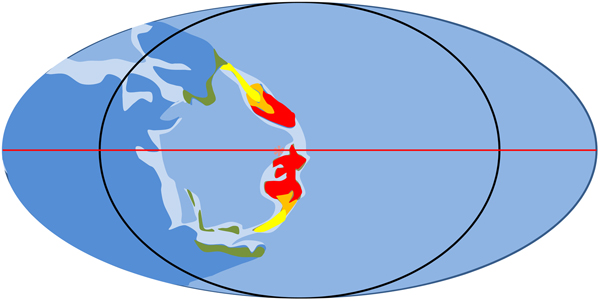
A late Permian Pangaea as an alternative arrangement for a planet with an orbital period of greater than 20 days. We can model the effect of supercontinent arrangements on climate and niche amplitude. All previous features, including colour-coding of niche amplitude are as before. In this gedankenexperiment, the SSP lies over the central Pangaeal mountains and these intercept and focus precipitation. Niche amplitude is low over most of the supercontinent (blue) as radially inflowing air is low in humidity. This is accentuated across the Gondwanaland portion as dry air is flowing over increasingly warm land thus lowering its relative humidity. The Chinese fragments lie near the eastern terminator and receive cold, dry air, also with minimal precipitation. Niche amplitude is high along the western margin of the Paleo-Tethys and has intermediate values along much of the Tethyan margin, where humidity is higher and orographic rainfall is possible.
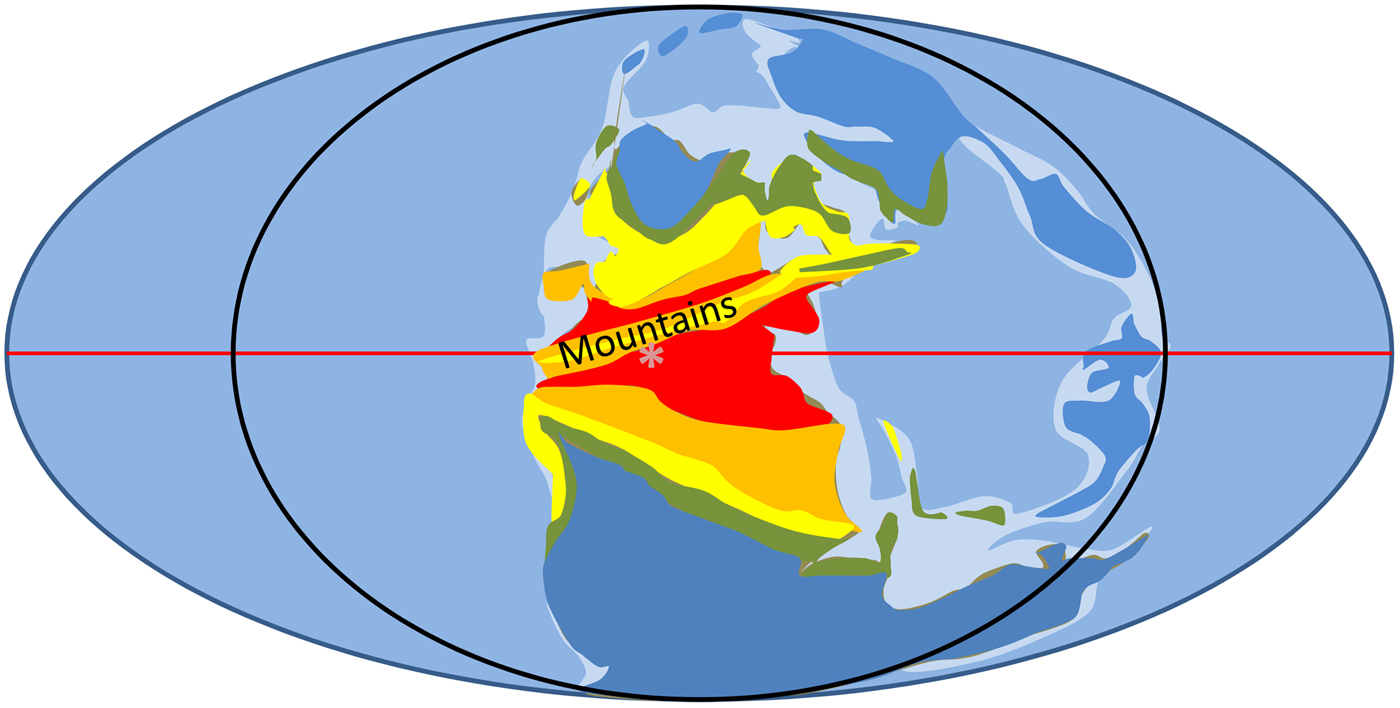
A Pangaeal, slow-rotating model, where Pangaea is shifted westwards. Most of the continent will be frozen and only the Chinese fragments are both warm enough and humid enough to support high niche amplitude. If one applied the same continental setting in a short-rotation period planet, there would be a higher niche amplitude along the western Paleotethhyan margin where easterly winds directed moisture over the subduction-associated mountains that flank the northern shore. All previous features, including colour-coding of niche amplitude are as before.

In the first of these models, the arrangement of the Gondwanaland and Laurasian portions of the continent focuses airflow along the basin, to the south of the ancestral Alpine-Himalayan front. Precipitation is enhanced along the windward slopes, particularly as one approaches the apex of the Paelo-Tethys. Airflow is diverted onto the Appalachian front and onto the northern shores of Gondwanaland. Here, precipitation is enhanced and with it the niche amplitude.
Likewise, broad inflow into Gondwanaland from the north east directs copious moisture. In the absence of intercepting mountains, one would expect the formation of broad, wet basins with abundant precipitation and a high niche amplitude. Most of the central portion of the supercontinent is consequently wet and warm, with a high niche amplitude. To the north of the Appalachian chain, the land is dry except where there are marine transgressions. Precipitation is limited even with modest temperatures. Niche amplitude is consequently low.
The eastern, Antarctic-Indian-Australian portion is relatively cool and dry with limited precipitation and low niche amplitude.
In the second model, the SSP is located in the western Paleo-Tethys. There is ample moist convection in a broad region encompassing the SSP. Chinese continental fragments that lie close to the SSP will be hot and will experience convective rainfall. Abundant topographic barriers in Eastern Eurasia and China further enhance orographic precipitation. However, while niche amplitude is high in these regions, the remainder of Pangaea is dry and cold, with a low niche amplitude. Precipitation is likely to be slight, except where airflow over mountains leads to orographic precipitation on windward slopes.
The late Permian continental arrangement had mostly low-lying continental platform, with mountainous regions confined to the interior and along the northern Tethyan margin. Subduction around the periphery was limited to the South and North American margins, but these subduction zones may have dipped seaward or lay offshore for substantial periods, leading to low-lying continental margins (Rains et al., Reference Rains, Marsaglia and Dunne2012). These kinds of passive margin are not conducive to promoting substantive orographic increases in rainfall, particularly where there is a deep overlying temperature inversion (as one would expect at this angular separation) and where the neighbouring oceans are cold.
Thus, we conclude that the orientation of the supercontinent and its position relative to the SSP, will be critical in determining the niche amplitude of the ecosystems that are present.
Discussion
The aim of this and future work is to take the idea of astrobiology beyond the simple concept of, ‘Is life possible?’ The terrestrial biosphere is a complex web of organisms that respond to and in turn, modifies the environment in which it exists. In this regard, incorporation of ecological and broader geographical concepts and mathematical analysis will facilitate this discussion, extending biology to a series of systems that work in concert with the geography. While this is process is clearly at a formative stage, one suggests the terms astroecology or astrogeography may be more applicable than astrobiology when one comes to integrating biology into whatever home-world we consider.
To this end, we developed a series of thought-models (gedankenexperiments) for planets orbiting within the habitable zone of red dwarfs. These utilize recent high-precision atmospheric models in a terrestrial context (Kopparapu et al., Reference Kopparapu, Wolf, Haqq-Misra, Yang, Kasting, Meadows, Terrien and Mahadeva2016; Haqq-Misra et al., Reference Haqq-Misra, Wolf, Joshi, Zhang and Kopparapu2017; Wolf, Reference Wolf2017; Wolf et al., Reference Wolf, Shields, Kopparapu, Haqq-Misra and Toon2017). Combining these circulation models, with realistic effects of terrestrial landscapes allows us to simply model the potential biosphere of such planets. A key factor is the simple relationship between terrestrial biodiversity and three basic parameters: light intensity; temperature and humidity. As these factors are tightly interrelated on synchronously-rotating planets, it allows us to model the biosphere in simple terms for a variety of relevant exoplanets.
We assume in all cases that exposure to stellar winds or extreme ultraviolet and X-radiation has not degraded the atmosphere and hydrosphere to uninhabitable levels (Luger and Barnes, Reference Luger and Barnes2015; Ribas et al., Reference Ribas, Bolmont, Selsis, Reiners, Leconte, Raymond, Engle, Guinan, Morin, Turbet, Forget, Velasco and Anglada-Escudé2016; Turbet et al., Reference Turbet, Leconte, Selsis, Bolmont, Forget, Ribas, Raymond and Anglada-Escudé2016; Wheatley et al., Reference Wheatley, Louden, Bourrier, Ehrenreich and Gillon2016). We assume that where these processes have or are operating, the planet can replenish resources from its hot mantle, thus mitigating the effects of atmospheric erosion (Kite et al., Reference Kite, Manga and Gaidos2009; Schaefer and Sasselov, Reference Schaefer and Sasselov2015). This implies, of course, that these planets are geologically-active. Assuming that these factors are not limiting and that the supply of nutrients is also not limiting allows us to create three model worlds.
Varying rotation rate has significant effects on the potential biodiversity of each world. In general, reducing the orbital period narrows the habitable region towards the equator, but also extends it in this direction (Figs. 6, 8 and 10). Such fast-rotators are those most likely to experience a catastrophic loss of their atmospheres, rendering these biosphere models mere thought experiments. Planets at longer orbital periods are less likely to be afflicted by atmospheric erosion, in part because the greater orbital separation mitigates the effects of stellar activity, but also because the more massive red dwarfs tend to be less active. In this regard, TRAPPIST-1e, with an orbital period of 6 days, is likely to fit into the short orbital period, fast rotator regime, particularly if its atmosphere is depleted in mass.
Potentially habitable planets in the longer Rhines regime circulation pattern include TRAPIST-1f and Proxima b. The latter has an orbital period of 11 days, but once again, habitability depends on the persistence of its atmosphere, which is currently unclear. Gleise 667Cc and 581d fall into the slow-rotating regimes (Haqq-Misra et al., Reference Haqq-Misra, Wolf, Joshi, Zhang and Kopparapu2017).
An interesting point with these model planets is how little of the surface is likely to experience a high biodiversity – as exemplified by the niche amplitude. The presence of continuous daylight would be expected to produce an abundance of photosynthetic life. However, at least on land, the cold, dry airflow from the night-hemisphere and from the poles, limits both the potential for precipitation and for rapid growth of organisms. Moreover, as the air flows towards the SSP its relative humidity would be expected to fall, unless it crosses bodies of water. Therefore, one expects that in the absence of intervening oceans, precipitation will be limited and, with it, biodiversity. The presence of an overlying temperature inversion will further limit convective rainfall, even where the air is sufficiently humid. Still, the effect of precipitation on photosynthesis remains an anthropocentric observation. Given millions of years with constant conditions, a slow-growing biosphere is entirely plausible and significant biological diversity may be possible if its metabolism is appropriate.
Moreover, the abundance of water may vary as rivers (or melting snow) deposits water in the near-surface environment. In this context, where temperatures are sufficiently high, localized convection may produce sufficient precipitation in these areas to sustain a modest biosphere. However, one presumes that orographic forcing will be required to produce precipitation. Remember that the terrestrial biosphere, on which this is modelled, has a seasonal cycle where the landscape heats, cools, dries and rehydrates annually. On a tidally-locked planet the abundance of water will be governed by precipitation, evaporation and transport on geological timescales, which have no terrestrial analogue. Therefore, one should regard an expectation of low niche amplitudes as a worst case scenario, particularly where planetary temperatures are in the higher part of the habitable range.
Finally, one should note that tropical conditions, in the day hemisphere, are not dissimilar to those experienced on Earth. Therefore, there is the potential for significant biological development wherever there is a suitable atmosphere. This suggests that synchronously-rotating planets make reasonable abodes for complex life, despite the geographical limitations imposed upon them by synchronous rotation.
An essential but as yet impossible to define consideration is the area of continental crust and its distribution. To this end, we present a couple of gedankenexperiments, with Pangaeal configurations and with the SSP at different locations. Clearly, there are an unlimited number of possible iterations of these configurations, so these are a first step. We will develop further models for later publication that take into account orbital period and differing abundances of carbon dioxide. In this regard, one notes the work of Edson et al. (Reference Edson, Kasting, Pollard, Lee and Bannon2012). Here, positioning the SSP, distally to continental margins leads to planets with greater abundances of carbon dioxide than those where the SSP is located on the continent. In the latter model atmospheric convergence and precipitation at the SSP, lowers the concentration of carbon dioxide in the atmosphere. While this has the capacity to alter biodiversity by limiting photosynthesis, it also reduces the overall equilibrium temperature, by removing greenhouse gas. One presumes that planets with a lower abundance of carbon dioxide will be cooler than those with more and that this will reduce precipitation globally, with knock-on effects for biodiversity. Planets lying near the outer edge of the circumstellar habitable zone would then be prone to runaway glaciation (Forget and Leconte, Reference Forget and Leconte2013).
A better appreciation of this key factor will be fundamental to better modelling in the future, both in terms of biodiversity and more fundamentally, atmospheric and ocean circulation. At present we can say that planets with more continental crust are warmer than those that do not for any given instellation (Forget and Leconte, Reference Forget and Leconte2013). That is about it. One hopes, therefore, that the use of niche amplitude will provide a straightforward means through which extraterrestrial biospheres can be dissected using basic astrophysics. Moreover, one hopes that as modelling precision improves, we will see more realistic planets pop out of the calculations that show atmospheric circulation patterns in the presence of continental crust and realistic topography. In this regard, this paper may provide motivation for further atmospheric and oceanographic modelling, perhaps using the Earth as a template. Various paleoclimate models are already present (Scotese et al., Reference Scotese, Bice, Seidov and Barron2002; Scotese, Reference Scotese, Craig, Thurow, Thusu, Whitham and Abutarruma2009). These could be used to compare terrestrial paleoclimate with varying configurations of climate, with models for slow or synchronously-rotating planets.
What about the persistence of the biosphere (Forget and Leconte, Reference Forget and Leconte2013; Loeb et al., Reference Loeb, Batista and Sloan2016)? The models, presented here, might best be considered as snapshots in time and, therefore, do not consider temporal variation in niche amplitude, merely its potential. For example, what is the long-term effect of climate on the abundance of greenhouse gases (Edson et al., Reference Edson, Kasting, Pollard, Lee and Bannon2012)? While we cannot consider temporal variations in niche amplitude, here, we will examine these in a subsequent paper, with some important implications for long-term planetary viability. In this regard, renewed scrutiny of terrestrial paleoclimate models will be enlightening.
While we are currently unable to observe the surfaces of exoplanets, work is at hand to detect mountain chains and with such increased resolution, atmospheric circulation patterns (McTier and Kipping, Reference McTier and Kipping2018). The forthcoming TESS mission (https://tess.gsfc.nasa.gov/index.html) may go some way to providing such data. While the niche amplitude provides a crude first step, the ultimate aim would be to determine broad estimates of species richness. From here we could use the Shannon Diversity Index and relate environmental entropy with species entropy. Here, finally, we can determine how the nature of the environment determines the kinds of species and numbers of species present. One notes, however, that while we have used niche amplitude in this study, measures of species richness (the numbers of types of species present) and Shannon Diversity are broadly similar and provide broadly similar data giving us confidence in the use of niche amplitude in this study (e.g. Kiera et al., Reference Kiera, Krefta, Leeb, Jetzb, Ibischc, Nowickic, Mutkea and Barthlotta2009; Ifo et al., Reference Ifo, Moutsambote, Koubouana, Yoka, Ndzai, Nucia, Bouetou-Kadilamio, Mampouya, Jourdain, Bocko, Mantota, Mouanga-Sokath, Odende, Mondzali, Emmanue, Wenina, Jenkins, Pimmb and Joppac2013; Gillman et al., Reference Gillman, Wright, Cusens, McBride, Malhi and Whittaker2015). This of course, assumes that life follows the same broad rules as on Earth: a requirement for water, energy and nutrition.
Finally, we emphasize that these models are based on one set of atmospheric circulation models. Use of alternative models could, naturally, produce different outcomes. For example, in the circulation models of Carone (Carone et al., Reference Carone, Keppens and Decin2015) there is westerly, equatorial superrotation even at relatively long orbital periods of 20–35 days, depending on planetary radius. Moreover, in some of their models there is high-latitude zonal flow at relatively long orbital periods (greater than 10 days). Therefore, while the qualitative outputs presented in this paper are valid for the climate simulations considered, other simulations may allow a greater degree of zonal (east-west) circulation. In these instances, assuming that these worlds may have exposed continental surfaces, greater precipitation may be possible at locations more distal to the SSP if winds deliver moisture. This will increase the niche amplitude for these mid-latitudinal areas.
In conclusion, these thought experiments represent an initial ‘best fit’ of the terrestrial biosphere to synchronously-rotating planets, given the available data on atmospheric and ocean circulation. While these remain qualitative, they are now underpinned by a mathematical framework, which is applicable to other planets. Moreover, these models are the first that we are aware of that tackle extraterrestrial biodiversity from an astrophysical perspective.
Acknowledgements
I would like to acknowledge the help and assistance of Alfie Gemmell and Christopher Loftus in reviewing some of the content of this manuscript. I would also like to thank the anonymous reviewer who suggested a number of important revisions that have made this article more lucid and pertinent.