Introduction
Sudden sensorineural hearing loss (SNHL) is defined as hearing deterioration of at least 30 dB over at least 3 contiguous frequencies occurring within three days.Reference Conlin and Parnes1, Reference O'Malley and Haynes2 Idiopathic sudden SNHL accounts for 85–90 per cent of cases.Reference O'Malley and Haynes2, Reference Rauch3
Sudden SNHL is probably of multifactorial origin. The main aetiological hypotheses for idiopathic sudden SNHL are vascular occlusion, viral cochleitis, endolymphatic hydrops with membrane breaks in the cochlea, and autoimmune disease of the inner ear.Reference Merchant, Adams and Nadol4–Reference Xenellis, Nikolopoulos, Stavroulaki, Marangoudakis, Androulakis and Tsangaroulakis6
Sudden SNHL has an estimated overall incidence of between 5 and 20 per 100 000 persons per year.Reference O'Malley and Haynes2, Reference Rauch3, Reference Horn, Himel and Selesnick7 Affected patients are typically aged between 43 and 53 years, with an equal sex distribution.Reference Rauch3
The therapeutic approach to sudden SNHL is highly variable, for both in-patient and out-patient treatment. Several oral, topical and systemic treatment regimens have been described. Some otolaryngologists choose not to treat sudden SNHL at all, citing spontaneous recovery rates of up to 65 per cent.Reference O'Malley and Haynes2, Reference Rauch3, Reference Horn, Himel and Selesnick7, Reference Aslan, Oysu, Veyseller and Baserer8
Working from a hypothesis of predominantly ischaemic origin of sudden SNHL, oxygen has a therapeutic advantage in that it easily diffuses across the blood–brain barrier to reach target tissues, and high concentrations are well tolerated.Reference Mazurek, Haupt, Georgiewa, Klapp and Reisshauer9, Reference Bennett, Kertesz and Yeung10 Hyperbaric oxygen therapy has been favoured as a treatment for sudden SNHL by many otolaryngologists, and has resulted sometimes in dramatically improved hearing.Reference Horn, Himel and Selesnick7, Reference Frantz, Pontz and Arnold11, Reference Domachevsky, Keynan, Shupak and Adir12
Materials and methods
We retrospectively investigated 19 patients (nine men and 10 women) who had received hyperbaric oxygen therapy for unilateral sudden SNHL (10 left ears and nine right ears) between November 2003 and February 2008 at the OTI Services hyperbaric medicine service, Venice, Italy. Patients' mean age was 46.68 ± 10.20 years (mean ± standard deviation), with an age range of 29–67 years.
Sudden SNHL was diagnosed based on its current definition, as given above.
Patients underwent clinical history-taking, complete ENT and neuro-otological examination, as well as serological, audiological and vestibular testing, in order to exclude middle-ear pathology, perilymphatic fistula, retrocochlear lesions and any other treatable aetiology. Imaging of the brain was performed to rule out expansile lesions, cerebrovascular accidents and other neurological disease.
Hyperbaric oxygen therapy was proposed if there was no improvement in pure tone hearing thresholds following first-line medical therapy. The hyperbaric oxygen therapy protocol adhered to the guidelines of the Italian Society of Anesthesia, Analgesia, Resuscitation and Intensive Care, the Italian Society of Undersea and Hyperbaric Medicine, and the Private Hyperbaric Chambers National Association study group, except that patients with a therapeutic delay of more than 30 days were still treated.13
Each hyperbaric oxygen therapy session consisted of pure oxygen inhalation at 2.5 absolute atmospheres (ATA) pressure for 90 minutes and free air inhalation for 30 minutes, once a day for five consecutive days, for a median of 28 sessions (interquartile distance 15; range 8 to 46 sessions).
No clinically relevant side effects of hyperbaric oxygen therapy were encountered.
Three patients declined further treatment before receiving 15 sessions, due to a perceived lack of therapeutic success.
Hyperbaric oxygen therapy was administered in two multiplace pressure chambers (Galeazzi, Milano, Italy).
Patients' pre- and post-treatment pure tone hearing thresholds were established. A threshold value of 120 dB HL was assumed if hearing loss exceeded the limits of the audiometric equipment. Absolute improvement and relative improvement for each single test frequency (0.25, 0.5, 1, 2, 4 and 8 kHz) and for the average pure tone hearing threshold were evaluated (Table I). The relative hearing improvement was determined using the simple procedure described by Plontke et al. Reference Plontke, Bauer and Meisner14
Absolute and relative hearing improvement after hyperbaric oxygen therapy

Age (<50 or ≥50 years), therapeutic delay (≤15, >15 and ≤30, or >30 days) and number of hyperbaric oxygen therapy sessions (<30 or ≥30) were identified as factors suspected to influence outcome. Absolute and relative improvements in these groups are reported in Table II.
Absolute and relative hearing improvement after hyperbaric oxygen therapy, by number of sessions, patient age and therapeutic delay

*28.00 (15), median (interquartile range (IQR)); †46.68 ± 10.20, mean ± standard deviation; ‡26.00 (76), median (IQR). Yr = years; pts = patients; Abs imprv = absolute hearing improvement; Rel imprv = relative hearing improvement
The Shapiro–Wilk test was used to assess the normal distribution of the data. The pure tone hearing thresholds of the affected ears were considered for low (0.25 and 0.5 kHz), middle (0.5 and 1 kHz) and high (4 and 8 kHz) frequencies. A stepwise, multivariate analysis of the variables possibly influencing hearing improvement was then performed using Stata software (StataCorp, 2007; College Station, Texas, USA). Values with p ≤ 0.05 were considered statistically significant.
Results
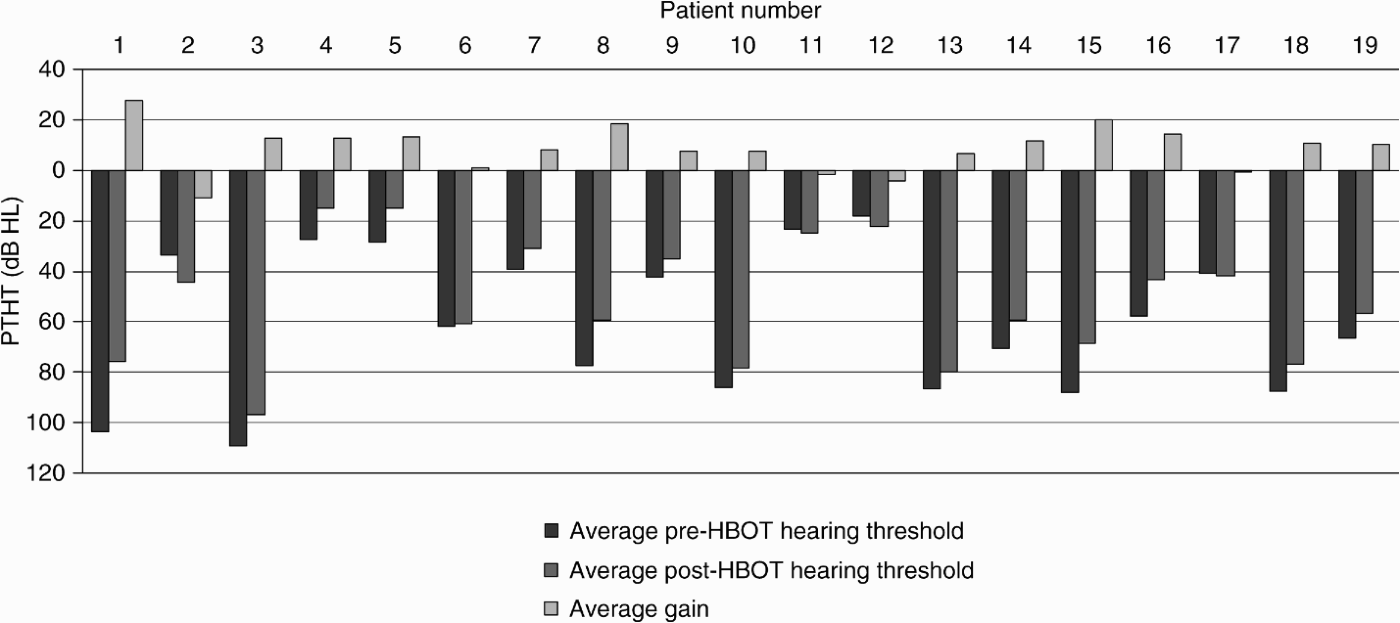
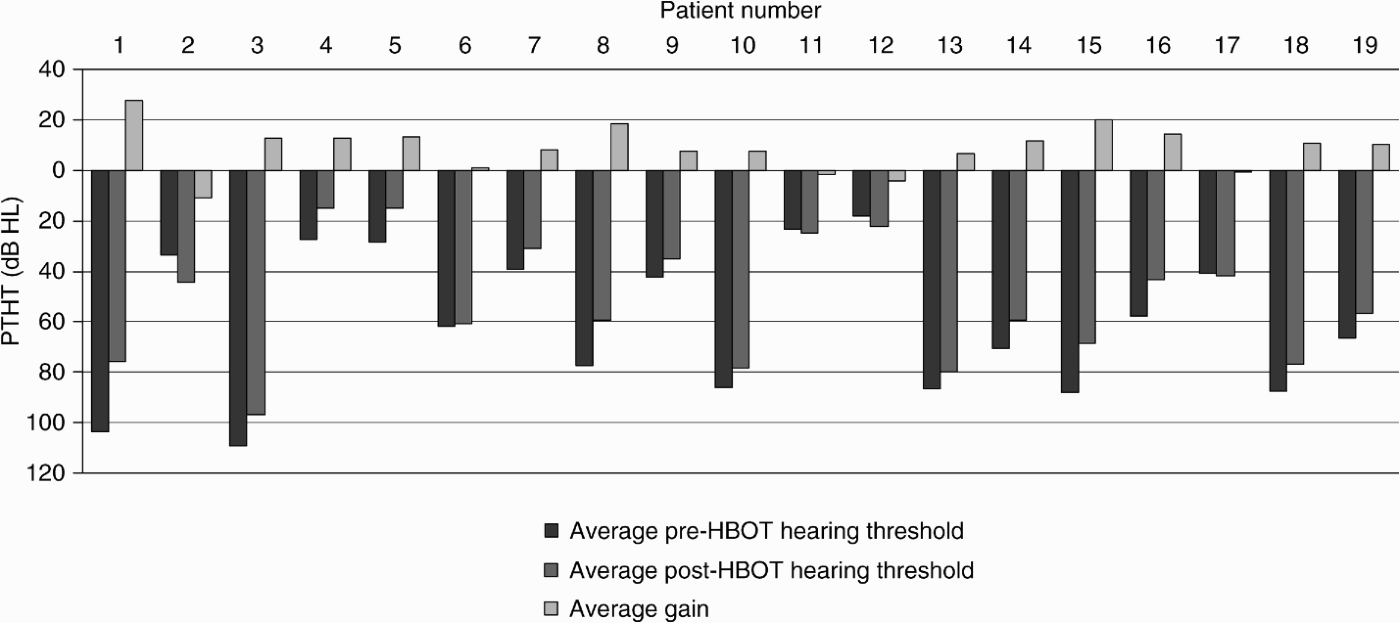
Comparison of pre- and post-treatment pure tone hearing thresholds showed an absolute average gain of 8.64 dB, with change ranging from 27.50 dB improvement to 10.83 dB deterioration. The relative average gain was 16 per cent (Table I). Four patients (21 per cent; cases 2, 11, 12 and 17) had a further hearing loss of 4.38 ± 4.53 dB (Figure 1) during hyperbaric oxygen therapy. Nevertheless, each group showed an average improvement in pure tone hearing threshold.
Patients' average hearing thresholds and gain before and after hyperbaric oxygen therapy (HBOT). PTHT = pure tone hearing threshold
Overall hearing recovery was better at low frequencies (30 per cent for 0.25 kHz and 23 per cent for 0.5 kHz), compared with middle frequencies (15 per cent for 1 kHz and 10 per cent for 2 kHz) and high frequencies (12 per cent for 4 kHz and 4 per cent for 8 kHz) (Table I).
Age and frequencies were expressed as mean ± standard deviation, while hyperbaric oxygen therapy sessions and therapeutic delays were expressed as median and interquartile range (i.e. the difference between values for the 25th and 75th percentiles) as they did not match a normal distribution.
In the <50 year group, hearing improvement was 4.47 dB (8 per cent), whereas in the ≥50 year group it was 14.38 dB (20 per cent).
Patients with worse pure tone hearing thresholds at presentation made better recoveries.
Patients whose therapy was delayed by ≤15 days and by >15 but ≤30 days made similar recoveries (11.67 dB (17 per cent) and 10.83 dB (16 per cent), respectively), while patients whose therapy was delayed by >30 days had a mean hearing improvement of 5 dB (10 per cent).
The number of hyperbaric oxygen therapy sessions received did not significantly affect hearing outcome. Hearing improvement was similar in patients receiving <30 sessions and ≥30 sessions (6.50 dB (13 per cent) and 11.02 dB (15 per cent), respectively).
Stepwise, multivariate analysis of hyperbaric oxygen therapy session number, patient age and therapeutic delay, considered as quantitative variables, gave statistically significant results at low frequencies for age (p = 0.037) and therapeutic delay (p = 0.026). At middle frequencies, the only statistically significant variable was therapeutic delay (p = 0.006). Thus, the longer the therapeutic delay, the smaller the expected improvement in pure tone hearing thresholds at low and middle frequencies. Older age was a statistically significant positive prognostic factor for hearing recovery at low frequencies.
Discussion
Rationale for common therapies for sudden sensorineural hearing loss
Steroids are the most commonly prescribed drugs for sudden SNHL, although systematic reviews and meta-analyses of the literature have questioned the evidence for their use.Reference Conlin and Parnes1–Reference Rauch3, Reference Wei, Mubiru and O'Leary15, Reference Conlin and Parnes16
The rationale for steroids use is that they may reduce the cytotoxic immune response, increase the microvascular blood flow in the cochlea, and decrease the onset of endolymphatic hydrops. The mechanism of action of steroids in the inner ear is generally open to speculation, although it is known that the Na+/K+ adenosine triphosphatases of the lateral wall of the inner ear are modulated by circulating steroids.
Steroids also have an immunosuppressive role in sudden SNHL.Reference Suckfüll17, Reference Klemm, Bepperling, Burschka and Mösges18 The inner ear is believed to be an immunoprivileged site protected by the blood–labyrinthine barrier. Nevertheless, innate cochlear autoimmunity may contribute to the establishment of autoimmune disease. Immune complexes, immunoglobulin G and cell-mediated pathogenesis have been suggested as models of autoimmunity in the cochlea. Despite the possibility of unilateral sudden SNHL as a presentation, it should be noted that the most common clinical manifestation of autoimmune inner ear disease is thought to be bilateral, asymmetrical, progressive audiovestibular dysfunction. There are no standard criteria with which to diagnose autoimmune sudden SNHL.Reference Ågrup and Luxon5
Systemic steroids are usually well tolerated, but there are many contraindications to their use.Reference Westerlaken, de Kleine, van der Laan and Albers19 Intratympanic steroid injection is a safe and potentially effective alternative in some of these cases.Reference O'Malley and Haynes2, Reference Rauch3, Reference Banerjee and Parnes20
Cochrane reviews are under way on the use of vasodilators and antivirals in the treatment of sudden SNHL.Reference Agarwal and Pothier21, Reference Awad, Natt and Pothier22 Histopathological examination of temporal bones from patients with sudden SNHL has indicated that vascular occlusion may be a rare aetiological event, because deposition of connective tissue and new bone, the hallmarks of vascular insult to the cochlea, were rarely found.Reference Merchant, Adams and Nadol4 However, general cardiovascular risk factors and dysfunction of the cochlear microcirculation have been favoured as causes of sudden SNHL by many authors.Reference Cadoni, Scipione, Agostino, Addolorato, Cianfrone and Leggio23 Patients with abnormalities of the vascular or haematological system, such as sickle cell disease, Buerger disease or polycythaemia, have a higher risk of developing sudden SNHL.Reference Fujimura, Suzuki, Shiomori, Udaka and Mori24 Fibrinogen plus low density lipoprotein apheresis and hydroxyethyl starch haemodilution therapy have shown promising results in the treatment of sudden SNHL, indicating that plasma composition influences inner ear conditions.Reference Suckfüll17 Racic et al. have stated that current evidence supports hyperbaric oxygen therapy as being more effective than conventional rheological treatment with pentoxifylline in idiopathic sudden SNHL.Reference Racic, Maslovara, Roje, Dogas and Tafra25 Prostaglandin E-1 and stellate ganglion blockade have also been used for their vasoactive properties.Reference Kawamata, Ohki, Sakuma and Suzaki26, Reference Suzuki, Fujimura, Shiomori, Ohbuchi, Kitamura and Hashida27
Because of their minimal risk and potential benefits, the use of antiviral agents is relatively widespread.Reference O'Malley and Haynes2 The published evidence for a viral abnormality in sudden SNHL is based on its association with upper respiratory tract infections, and on histopathological findings similar to those observed in individuals who lost their hearing while suffering from mumps or rubella in infancy (however, there are significant differences in cochlear neuronal counts in the latter cases). Viruses also interact with erythrocytes and endothelial cells, resulting in haemagglutination, capillary oedema, flow blockage and ischaemia.Reference Çekin, Cincik, Ulubil and Gungor28 Nevertheless, in cases of idiopathic sudden SNHL, there is a lack of evidence of direct viral infection of the inner ear, there is no increase in antibodies against viruses in serum, and direct inoculation into the inner ears of experimental animals does not produce the clinical or histopathological features observed in patients with the disease.Reference Merchant, Adams and Nadol4
Rationale for hyperbaric oxygen therapy for sudden sensorineural hearing loss
Sudden SNHL is currently considered to be an indication for hyperbaric oxygen therapy, according to the guidelines of the Italian Society of Anesthesia, Analgesia, Resuscitation and Intensive Care, the Italian Society of Undersea and Hyperbaric Medicine, and the Private Hyperbaric Chambers National Association study group.13 Despite scientific efforts to justify this indication, hyperbaric oxygen therapy is currently not recommended for sudden SNHL in the English-language literature.Reference Feldmeier29, 30 Attempts have been made to define the role of hyperbaric oxygen therapy in the treatment of sudden SNHL, using experimental and clinical studies as well as prospective, blinded, randomised trials.Reference O'Malley and Haynes2, Reference Bennett, Kertesz and Yeung10 Hyperbaric oxygen therapy has been used either in association with other therapies, as a first-line treatment, or as salvage treatment when medical therapy fails.Reference Horn, Himel and Selesnick7, Reference Aslan, Oysu, Veyseller and Baserer8, Reference Fujimura, Suzuki, Shiomori, Udaka and Mori24–Reference Çekin, Cincik, Ulubil and Gungor28, Reference Narożny, Kuczkowski and Mikaszewski31–Reference Kau, Sendtner-Gress, Ganzer and Arnold37
Biophysical bases
The purpose of hyperbaric oxygen therapy in the treatment of sudden SNHL is to increase the partial pressure of oxygen in the blood and then, via diffusion, to increase the partial pressure of oxygen in the inner ear fluids, which nourish the sensory and neural elements of the cochlea.Reference Fujimura, Suzuki, Shiomori, Udaka and Mori24 Perilymphatic oxygen levels are significantly decreased in some patients with sudden SNHL.Reference Nagahara, Fisch and Yagi38 A diffusion barrier in the cochlea, such as capillary oedema, may result in cochlear ischaemia.Reference Horn, Himel and Selesnick7, Reference Çekin, Cincik, Ulubil and Gungor28 Upon inhaling air at 1 ATA, only 0.32 per cent of total oxygen is dissolved in the blood. If 100 per cent oxygen is inhaled at 2 ATA, the amount of dissolved oxygen rises to 4.44 per cent. The increased partial pressure of oxygen in the perilymph remains significantly high for 60 minutes after hyperbaric oxygen therapy.Reference Fujimura, Suzuki, Shiomori, Udaka and Mori24 Hence, the aim of restoring oxygen tension in the cochlea through blood to perilymph oxygen diffusion is a rational approach.Reference Horn, Himel and Selesnick7 Hyperbaric oxygen therapy also increases the distance that oxygen can travel in the interstitial space.Reference Rossignol39 An adjunctive hypothesis is that the steady-state gradient of oxygen induced by hyperbaric oxygen therapy may actually drive the resolution of tissue oedema.Reference Hills40 Hills considers this ‘oxygen-induced osmosis’ to be an important mechanism for the healing properties of hyperbaric oxygen therapy.Reference Hills40
Biological bases
Hyperbaric oxygen therapy can overcome the effects of cerebral hypoperfusion by providing more oxygen and by inducing angiogenesis via an increase in the concentration of vascular endothelial growth factor. Hypoxia causes apoptosis and inflammation through the induction of hypoxia-induced factor 1α. Hyperbaric oxygen therapy attenuates the expression of hypoxia-induced factor 1α and its target genes. In addition, hyperbaric oxygen therapy prevents apoptosis by inhibiting the expression of the pro-apoptotic, 19 kDa interacting protein 1, and by increasing the expression of B-cell lymphoma protein 2.Reference Rossignol39 Phenomena related to hypoxia-induced factor 1α have also been observed directly in the cochlea in the age-related hearing loss animal model.Reference Riva, Donadieu, Magnan and Lavieille41 Neutrophil infiltration is associated with the inflammation that occurs after an ischaemic injury to the nervous system. Hyperbaric oxygen therapy decreases neutrophil infiltration, inhibits neutrophil attachment to blood vessels and reduces leukocyte adherence. Hyperbaric oxygen therapy also down-regulates the production of pro-inflammatory cytokines, including tumour necrosis factor α and interleukins (IL) 1, 1β and 6, and increases the concentration of anti-inflammatory IL-10 and heat shock protein 90. Moreover, hyperbaric oxygen therapy reduces the production of cyclooxygenase 2 and prostaglandin E-2.Reference Rossignol39, Reference Riva, Donadieu, Magnan and Lavieille41 The anti-inflammatory power of hyperbaric oxygen therapy is reported to be equivalent to diclofenac 20 mg/kg. Interestingly, this property of hyperbaric oxygen therapy seems to be related to the increased pressure, not necessarily to the higher oxygen tension.Reference Rossignol39 Granowitz et al. reported that 2 ATA with either 100 per cent oxygen or 10.5 per cent oxygen resulted in anti-inflammatory activity inhibiting interferon γ release.Reference Granowitz, Skulsky, Benson, Wright, Garb and Cohen42 An increased concentration of peripheral blood T cells capable of producing interferon γ has been used in vivo as a marker of autoimmune sudden SNHL.Reference Ågrup and Luxon5
Concerns have been raised that hyperbaric oxygen therapy might increase reactive oxygen species, in particular through the abnormal activation of cellular stress pathways involving nuclear factor κB.Reference Merchant, Adams and Nadol4, Reference Rossignol39 Long term, repeated administration of hyperbaric oxygen therapy can actually decrease oxidative stress, reducing lipid peroxidation and increasing the activity of antioxidant enzymes such as superoxide dismutase, glutathione peroxidase, catalase, paraoxonase and haeme oxygenase-1.Reference Rossignol39 Many of these enzymes have been found in the cochlea.Reference Fujimura, Suzuki, Shiomori, Udaka and Mori24 Hyperbaric oxygen therapy has also been shown to increase the concentration of heat shock protein 70, which is protective against oxidative stress.Reference Rossignol39
Hyperbaric oxygen therapy stimulates cellular metabolism in the inner ear, even under conditions of poor blood supply.Reference Fujimura, Suzuki, Shiomori, Udaka and Mori24 Mitochondrial function is impaired by hypoxia, since only approximately 0.3 per cent of inhaled oxygen is ultimately delivered to the mitochondria. Hyperbaric oxygen therapy increases oxygen delivery to the mitochondria and improves their function, protects them from deterioration, delays the onset of related neuron damage, prevents apoptosis, and improves neurological recovery by opening mitochondrial adenosine triphosphate sensitive potassium channels. Hyperbaric oxygen therapy activates mitochondrial DNA transcription and replication, and increases the biogenesis of mitochondria in the brains of animals.Reference Rossignol39 Indeed, considering that hyperbaric oxygen therapy has prolonged effects on cellular cultures (for at least 72 hours after the initial exposure), it has been suggested that hyperbaric oxygen therapy may induce gene expression and the synthesis of RNA and/or protein products.Reference Tompach, Lew and Stoll43 Tompach et al. concluded that a second exposure to hyperbaric oxygen therapy within 24 hours had negligible positive effects on tissue healing.Reference Tompach, Lew and Stoll43 Hence, a single hyperbaric oxygen therapy exposure has cellular effects that may persist for several days, relating either to angiogenesis or fibroblast growth.Reference Tompach, Lew and Stoll43
Hyperbaric oxygen therapy has documented antibiotic and antiviral actions.Reference Rossignol39 It has also been argued that hyperbaric oxygen therapy may improve neurotransmitter imbalance.Reference Rossignol39 Finally, hyperbaric oxygen therapy can mobilise stem and progenitor cells from the bone marrow of humans into the systemic circulation: increasing numbers of colony-forming cells have been demonstrated, by an eight-fold increase in the number of cluster of differentiation 34+ glycoprotein cells after 20 hyperbaric oxygen therapy sessions. Since these cells are also produced directly into the nervous system, this raises the hypothesis of neuropoiesis, which may aid in reversing chronic nervous tissue disorders.Reference Rossignol39
Clinical considerations
In the present study, there was an evident bias due to the lack of randomisation, retrospective nature of the study, heterogeneity of the study population and absence of a control group. Caution is recommended in interpreting the analysis of such a case series, because it is known that non-randomised studies influence treatment effects in a positive way; furthermore, the occurrence of spontaneous hearing recovery after sudden SNHL is very unpredictable.Reference Conlin and Parnes1
Nevertheless, the current study represents a reasonable first step in the evaluation of a new therapy.Reference Horn, Himel and Selesnick7
In addition, it is difficult to find an appropriate outcome measure with which to compare sudden SNHL treatments.Reference Plontke, Bauer and Meisner14 Although the absolute difference between pre- and post-treatment hearing levels is often reported, estimating the relative hearing improvement has been suggested as an alternative, as it is less dependent on pre-treatment hearing levels.Reference Plontke, Bauer and Meisner14 If one cannot assume a symmetrical pure tone hearing threshold prior to sudden SNHL onset, then absolute and relative measurements are recommended on the basis of findings from small sample sizes.Reference Plontke, Bauer and Meisner14
It is clear that any improvement in profound sudden SNHL, however small, is of greater importance than improvement in mild sudden SNHL.Reference Plontke, Bauer and Meisner14 Considering that speech discrimination usually improves along with pure tone hearing thresholds, only improvement could result in an additional benefit to the patient's quality of life.Reference Horn, Himel and Selesnick7 Higher recovery rates at low frequencies are common, and are found for therapies other than hyperbaric oxygen therapy.Reference Horn, Himel and Selesnick7, Reference Domachevsky, Keynan, Shupak and Adir12, Reference Kawamata, Ohki, Sakuma and Suzaki26, Reference Jadczak, Rapiejko, Kantor, Szczygielski, Usowski and Piechocki44–Reference Satar, Hidir and Yetiser46 Patients with the most severe hearing loss seem to improve more than patients with mild hearing loss, which can progressively worsen even during hyperbaric oxygen therapy.Reference Fujimura, Suzuki, Shiomori, Udaka and Mori24
The hypothesis that hyperbaric oxygen therapy gives better results in cases of ischaemia could be supported by the observation that increasing age is related either to positive outcomes or to deterioration of the blood micro- and macrocirculation of the cochlea due to several causes (e.g. atherosclerosis).Reference Mazurek, Haupt, Georgiewa, Klapp and Reisshauer9 Experimental studies on arterial cochlear blood flow in animal models demonstrated that occlusions proximal to the brain lead to less severe reduction in cochlear arterial blood flow, because of anastomoses between the anteroinferior cerebellar artery and basilar artery pontine branches.Reference Nakashima, Naganawa, Sone, Tominaga, Hayashi and Yamamoto47 There are indeed only a few clinical studies reporting arterial obstruction of the main trunk of the carotid vertebrobasilar artery as a cause of sudden SNHL.Reference Castro, Almeida and Campos48 In the cochlea, ischaemic insult results in tissue oedema and increased pressure in the membranous labyrinth. Because the modiolus is surrounded by bone, it has been hypothesised that the increased inner ear pressure cannot be transmitted directly to the blood vessels in this portion of the cochlea, preserving the low frequencies from definitive damage.Reference Nakashima, Naganawa, Sone, Tominaga, Hayashi and Yamamoto47
Pressures of between 2 and 3 ATA are usually used in hyperbaric oxygen therapy, and are considered safe.Reference Fujimura, Suzuki, Shiomori, Udaka and Mori24 The side effects of hyperbaric oxygen therapy are usually self-limiting, and are rarely life-threatening.30 Oxygen toxicity may manifest as pulmonary arrest or fibrosis, reversible myopia, cataract maturation, and possible cancer facilitation (via reactive oxygen species). Hyperbaric oxygen therapy reduces the threshold for generalised convulsions. The potential risk of cerebral and cochlear vasoconstriction may be overcome by concurrent vasoactive treatment, such as prostaglandin E-1 infusion or stellate ganglion blockade.Reference Suzuki, Fujimura, Shiomori, Ohbuchi, Kitamura and Hashida27, Reference Orita, Fukushima, Orita and Nishizaki34 Barotraumatic lesions of the middle ear (e.g. serous otitis media), inner ear (e.g. round window rupture and perilymphatic fistula), paranasal sinuses and lungs (e.g. pneumothorax) may occur during hyperbaric oxygen therapy.Reference Horn, Himel and Selesnick7, Reference Fujimura, Suzuki, Shiomori, Udaka and Mori24, 30 In order to prevent foreseeable hyperbaric oxygen therapy toxicity, patients are screened for clinical ENT abnormalities and undergo tympanometry, chest X-ray, electrocardiography and pulmonary function tests. To further reduce the risk of hyperbaric oxygen therapy side effects, studies are necessary to determine if benefits hold true at lower hyperbaric pressures.Reference Rossignol39
Number of sessions
The number of hyperbaric oxygen therapy sessions required for full clinical improvement is unclear. In one study combining serial limited positron emission computed tomography and hyperbaric oxygen therapy, an average of 70 treatments was required to create a significant increase in cerebral blood oxygenation and metabolism in patients with chronic neurological disorders. The rate of improvement in cerebral blood oxygenation was more pronounced during the last 35 hyperbaric oxygen therapy sessions. The optimal number of sessions could not be determined, as it appeared that further hyperbaric oxygen therapy would yield additional improvement.Reference Rossignol39 Of authors studying hyperbaric oxygen therapy for sudden SNHL, Çekin et al. reported minimal benefits after 10 sessions, and Horn et al., Fattori et al. and Ylikoski et al. had positive results with a ‘short course’ of 10, 10 and 8 sessions, respectively.Reference Horn, Himel and Selesnick7, Reference Çekin, Cincik, Ulubil and Gungor28, Reference Fattori, Berrettini, Casani, Nacci, De Vito and De Iaco36, Reference Ylikoski, Mrena, Makitie, Kuokkanen, Pirvola and Savolainen49 Murakawa et al. used a 10- to 15-session programme.Reference Murakawa, Kosaka, Mori, Fukazawa and Misaki32 Hoffmann et al. stopped hyperbaric oxygen therapy at 15 sessions, and Aslan et al. at 20 sessions.Reference Aslan, Oysu, Veyseller and Baserer8, Reference Hoffmann, Bohmer, Desloovere, Li and Cramer50 Orita et al. used hyperbaric oxygen therapy twice a day for 28 sessions.Reference Orita, Fukushima, Orita and Nishizaki34 In the present study, the number of hyperbaric oxygen therapy sessions received did not have a statistically significant influence on treatment outcome.
Pressure
Comparison of hyperbaric and normobaric oxygen therapy in the treatment of sudden SNHL secondary to acute acoustic trauma favours the former.Reference Ylikoski, Mrena, Makitie, Kuokkanen, Pirvola and Savolainen49 Short, high pressure regimes should be preferred. In fact, a longer duration of treatment may aggravate the oxidative stress in ischaemic tissue, as noted by Xue et al. in an animal model.Reference Xue, Yu, Zhang, Liu, Wang and Wang51 Experimental research has found enhanced tissue oxygenation at pressures below 2.4 ATA, whereas higher pressures may result in cell damage.Reference Tompach, Lew and Stoll43 The duration of pure oxygen breathing, usually 60 or 90 minutes, may possibly be reduced to 15 minutes. Cellular culture studies have found that longer treatments, of up to 120 minutes, confer no further benefit.Reference Tompach, Lew and Stoll43
Patient's age
Older age was a significant positive prognostic factor in the present study and others.Reference Bennett, Kertesz and Yeung10 In contrast, Aslan et al. and Murakawa et al. reported better results for additional hyperbaric oxygen therapy in younger patients.Reference Aslan, Oysu, Veyseller and Baserer8, Reference Murakawa, Kosaka, Mori, Fukazawa and Misaki32 Others have not reported a significant correlation between age and sudden SNHL recovery.Reference Çekin, Cincik, Ulubil and Gungor28, Reference Čvorović, Đeric, Probst and Hegemann45
Therapeutic delay
It is generally accepted that, whatever the kind of therapy, the earlier the patient receives treatment for sudden SNHL, the better the outcome.Reference Rauch3, Reference Čvorović, Đeric, Probst and Hegemann45 However, considering that improvements often occur spontaneously in the first two weeks after sudden SNHL onset, it is hard to establish the positive effect of any early treatment. In a guinea pig model, 60 minutes of cochlear anoxia led to irreversible cochlear lesions. If sudden SNHL is due to blood flow interruption, then treatment should begin within 1 hour of onset – an unrealistic goal not supported by clinical evidence.Reference Čvorović, Đeric, Probst and Hegemann45 When hyperbaric oxygen therapy is used as first line treatment, delay can be limited to 48 hours.Reference Fattori, Berrettini, Casani, Nacci, De Vito and De Iaco36 Recent papers on prognostic factors for sudden SNHL state that it is not critical to begin therapy immediately after sudden SNHL, and that the treatment of sudden SNHL should not be considered an emergency.Reference Čvorović, Đeric, Probst and Hegemann45, Reference Huy and Sauvaget52 No significant correlation between complete recovery and treatment delay within the first week after sudden SNHL was noted in patients with up-sloping audiograms treated intravenously with 1 mg/kg corticosteroid and mannitol 10 per cent.Reference Huy and Sauvaget52 Uzun and Yildiz recently studied the therapeutic window for the use of hyperbaric oxygen therapy in the treatment of idiopathic sudden SNHL.Reference Uzun and Yildiz53 Kawamata et al. commenced hyperbaric oxygen therapy and steroids within the first week of onset in 87 per cent of their sudden SNHL patients.Reference Kawamata, Ohki, Sakuma and Suzaki26 Aslan et al. commenced treatment within two weeks of onset of idiopathic sudden SNHL.Reference Aslan, Oysu, Veyseller and Baserer8 Bennett et al. suggested beginning hyperbaric oxygen therapy within two weeks of onset, as there is no evidence of a beneficial effect of hyperbaric oxygen therapy on chronic presentation of idiopathic sudden SNHL (based on the single relevant study available).Reference Bennett, Kertesz and Yeung10 In the study of Murakawa et al., there was a significant difference between patients treated within 14 days and those treated 15 days or more after onset.Reference Murakawa, Kosaka, Mori, Fukazawa and Misaki32 Commonly available guidelines indicate that the therapeutic delay should not exceed 30 days from onset of sudden SNHL.13 Kau et al. reported that patients presenting 3 or more months after sudden SNHL onset had markedly less benefit from hyperbaric oxygen therapy in comparison to those treated earlier, despite 2 per cent regaining normal hearing function and 30 per cent having an improvement of more than 10 dB.Reference Kau, Sendtner-Gress, Ganzer and Arnold37 In cases of sudden SNHL occurring more than a few months previously, no hearing improvement can be expected in the majority of patients.Reference Kau, Sendtner-Gress, Ganzer and Arnold37 Hoffmann et al. noted no benefit of hyperbaric oxygen therapy in the treatment of sudden SNHL in a chronic setting, in comparison with a placebo group; however, a ‘soft’ treatment regime was used (1.5 ATA for 15 sessions).Reference Hoffmann, Bohmer, Desloovere, Li and Cramer50 It is hard to establish if there is a time limit for hyperbaric oxygen therapy indication; for example, one patient recovered completely 102 days after sudden SNHL onset (Figure 1, case four). Analysing the patients of the present study grouped according to therapeutic delay yielded no statistically significant differences in outcome.
Cost-effectiveness
The recent Cochrane systematic review on hyperbaric oxygen therapy for idiopathic sudden SNHL found limited evidence that hyperbaric oxygen therapy improves pure tone hearing thresholds when applied as a first-line treatment for idiopathic sudden SNHL. Analysis of pooled data from two trials appeared to indicate that hyperbaric oxygen therapy increased the proportion of patients gaining more than 25 per cent improvement in hearing; one of these trials suggested there was a greater mean relative improvement in pure tone audiometry results following hyperbaric oxygen therapy.Reference Bennett, Kertesz and Yeung10 Three trials have suggested that hyperbaric oxygen therapy results in improvements in mean hearing, with some evidence that improvement in more severely affected patients results mostly from application of hyperbaric oxygen therapy.Reference Bennett, Kertesz and Yeung10, Reference Topuz, Yigit, Cinar and Seven33, Reference Hoffmann, Bohmer, Desloovere, Li and Cramer50 No evidence was found, in the single relevant trial, that hyperbaric oxygen therapy is useful in patients with long-standing hearing loss of unknown aetiology.Reference Bennett, Kertesz and Yeung10, Reference Hoffmann, Bohmer, Desloovere, Li and Cramer50 Bennett et al. concluded that the routine use of hyperbaric oxygen therapy in idiopathic sudden SNHL patients is not justified, although they warned that the small number of studies, modest numbers of patients, and methodological and reporting inadequacies of the primary studies included in their review warranted a cautious interpretation.Reference Bennett, Kertesz and Yeung10
• At present, there is no standard treatment for sudden sensorineural hearing loss (SNHL)
• Hyperbaric oxygen therapy has been proposed for sudden SNHL, either together with medication, alone as a first-line treatment, or as a salvage therapy
• This study reviewed the rationale of common therapies and of hyperbaric oxygen therapy for sudden SNHL. A preliminary series of patients treated with salvage hyperbaric oxygen therapy was analysed regarding hyperbaric oxygen therapy session number and pressure, patient age and therapeutic delay
• Salvage hyperbaric oxygen therapy for sudden SNHL has a strong scientific rationale and significantly improves hearing, especially at low frequencies; the probability of a positive result increases with increasing age and reduced hyperbaric oxygen therapy delay
• Further research could identify the sudden SNHL patients for whom hyperbaric oxygen therapy is more cost-effective
Funding for hyperbaric oxygen therapy is justified by other strong clinical indications, such as decompression illness, gas gangrene, and air and gas embolism, due to the few available alternatives for these life-threatening conditions.30 There are no available data on the cost of hyperbaric oxygen therapy as treatment for sudden SNHL. An evaluation of the annual cost of hyperbaric oxygen therapy led Treweek and James to conclude that hyperbaric oxygen therapy is an inexpensive treatment which should be routinely available for conditions for which there is evidence that tissue hypoxia is a significant component of the injury or disease.Reference Treweek and James54
Conclusion
When common treatments for sudden SNHL fail, hyperbaric oxygen therapy leads to an improvement of pure tone hearing thresholds, particularly for low frequencies. Hyperbaric oxygen therapy should be commenced as soon as possible, but hearing recovery can occasionally be obtained from delayed hyperbaric oxygen therapy. In the present study, an age greater than 50 years was a positive prognostic factor for recovery at low frequencies.
A cautious interpretation of these results is mandatory, because of the preliminary study design and the intrinsic clinical unpredictability of sudden SNHL. There is a strong scientific rationale for the use of hyperbaric oxygen therapy in the treatment of sudden SNHL, although clinical protocols are sometimes inconclusive. Appropriate selection of patients could minimise the risk of side effects of hyperbaric oxygen therapy. In a salvage treatment setting, the cost of hyperbaric oxygen therapy is probably marginal, where such therapy is already available. Considering these facts, multicentre, randomised, prospective studies of salvage hyperbaric oxygen therapy in large series of sudden SNHL patients should be encouraged.