Introduction
Sedentary behaviours are commonly observed in people with MS; a chronic and often disabling condition, which affects the central nervous system (Ellis & Motl, Reference Ellis and Motl2013). Whilst individuals with primary progressive MS are reported to be less physically active than those with relapsing-remitting MS (Motl, McAuley, & Snook, Reference Motl, McAuley and Snook2005), both disease groups show substantially lower rates of physical activity when compared to healthy adults (Motl, McAuley, Sandroff, & Hubbard, Reference Motl, McAuley, Sandroff and Hubbard2015; Motl et al., Reference Motl, McAuley and Snook2005). In a recent study, 58% of 1521 people with MS were reported to undertake insufficient physical activity per week, in accordance with recommended guidelines (Motl et al., Reference Motl, McAuley, Sandroff and Hubbard2015). Existing physical activity recommendations point to the benefit of moderate–vigorous intensity physical activity. Healthy adults should accumulate at least 30 minutes of moderate intensity physical activity (in one continuous bout or over several shorter bouts each lasting 10 or more minutes), on 5 days each week (Haskell et al., Reference Haskell, Lee, Pate, Powell, Blair, Franklin and Bauman2007). Alternatively, they should engage in vigorous intensity aerobic physical activity for a minimum of 20 minutes, on 3 days each week (Haskell et al., Reference Haskell, Lee, Pate, Powell, Blair, Franklin and Bauman2007). However, recent work has also demonstrated the benefits of increasing the amount of time spent in all non-sedentary physical activity, including low-intensity activity, such as walking a short distance or engaging in light housework (Matthews et al., Reference Matthews, Chen, Freedson, Buchowski, Beech, Pate and Troiano2008; Westerterp, Reference Westerterp2001).
‘Habitual’ physical activity incorporates any movement, in any setting, where energy is expended, and includes engagement in instrumental activities of daily living (IADL; Egerton & Brauer, Reference Egerton and Brauer2009), such as housework, gardening and grocery shopping. This type of physical activity, which is regularly undertaken during an individual's normal daily routine, may hold important health benefits for people with MS, as has been the case in older adults and frail elderly individuals (Egerton & Brauer, Reference Egerton and Brauer2009; Ruuskanen & Parkatti, Reference Ruuskanen and Parkatti1994). However, more research is needed to determine the roles of habitual and/or low-intensity physical activity, and their potential benefits for people with MS.
An array of factors have been identified as impacting uptake and maintenance of physical activity in people with MS. Changes in mood, onset of depression (Motl & McAuley, Reference Motl and McAuley2009; Motl, McAuley, Snook, & Gliottoni, Reference Motl, McAuley, Snook and Gliottoni2009), reduced physical resistance (Frau et al., Reference Frau, Coghe, Lorefice, Fenu, Cadeddu, Marrosu and Cocco2015), fatigue (Motl & McAuley, Reference Motl and McAuley2009; Motl et al., Reference Motl, McAuley, Snook and Gliottoni2009) and a worsening of symptoms (Frau et al., Reference Frau, Coghe, Lorefice, Fenu, Cadeddu, Marrosu and Cocco2015) in the long term, are frequently reported precursors leading to the restriction or complete cessation of physical activity following diagnosis of MS. Mobility limitations, including balance, coordination and walking impairments in people with MS have also been shown to be associated with physical inactivity (Kohn, Coleman, Michael, Sidovar, & Sobieraj, Reference Kohn, Coleman, Michael, Sidovar and Sobieraj2014; Sandroff, Klaren, & Motl, Reference Sandroff, Klaren and Motl2015), which may be driven by a heightened fear of falling or avoidance of exposure to threatening environments (Kasser et al., Reference Kasser, Jacobs, Littenberg, Foley, Cardinal and Maddalozzo2014; Matsuda, Shumway-Cook, Ciol, Bombardier, & Kartin, Reference Matsuda, Shumway-Cook, Ciol, Bombardier and Kartin2012). Whilst it remains inconclusive as to whether a direct relationship exists between physical activity levels and falls (Sosnoff, Sandroff, Pula, Morrison, & Motl, Reference Sosnoff, Sandroff, Pula, Morrison and Motl2012), it is clear that reduced physical activity can accelerate an underlying cycle of physiological deconditioning (Sandroff et al., Reference Sandroff, Klaren and Motl2015). In turn, this can have devastating effects on functional capacity (Stuifbergen, Reference Stuifbergen1997; Stuifbergen, Blozis, Harrison, & Becker, Reference Stuifbergen, Blozis, Harrison and Becker2006) and emotional wellbeing (Marck et al., Reference Marck, Hadgkiss, Weiland, van der Meer, Pereira and Jelinek2014); thereafter, increasing personal and societal burden (Campbell et al., Reference Campbell, Ghushchyan, McQueen, Cahoon-Metzger, Livingston, Vollmer and Nair2014).
Evidence suggests that reduced levels of physical activity and poor physical fitness may also negatively impact cognitive processes in people with MS (Beier, Bombardier, Hartoonian, Motl, & Kraft, Reference Beier, Bombardier, Hartoonian, Motl and Kraft2014; Motl, Gappmaier, Nelson, & Benedict, Reference Motl, Gappmaier, Nelson and Benedict2011; Sandroff et al., Reference Sandroff, Dlugonski, Pilutti, Pula, Benedict and Motl2014). The average daily number of steps taken by individuals with MS has been shown to be weakly but significantly associated with measures of cognitive processing speeds (Motl et al., Reference Motl, Gappmaier, Nelson and Benedict2011; Sandroff et al., Reference Sandroff, Dlugonski, Pilutti, Pula, Benedict and Motl2014), with lower levels of physical activity indicating slower cognitive function. As impaired cognitive processing can significantly impact an individual's ability to effectively participate in society (Benedict et al., Reference Benedict, Wahlig, Bakshi, Fishman, Munschauer, Zivadinov and Weinstock-Guttman2005), these findings suggest that strategies, which target physical activity in people with MS, may enhance their integration and more active involvement within the home and community.
A growing body of literature highlights the health benefits of engaging in physical activity, including both habitual activity and tailored exercise programmes for people with MS (Beier et al., Reference Beier, Bombardier, Hartoonian, Motl and Kraft2014; Briken et al., Reference Briken, Gold, Patra, Vettorazzi, Harbs, Tallner and Heesen2014; Marck et al., Reference Marck, Hadgkiss, Weiland, van der Meer, Pereira and Jelinek2014; Mostert & Kesselring, Reference Mostert and Kesselring2002; Petajan et al., Reference Petajan, Gappmaier, White, Spencer, Mino and Hicks1996). Increased level of physical activity has been reported to be a strong predictor of clinically significant improvements in self-reported quality of life, including community participation, mental and physical health status in people with MS, irrespective of their level of disability (Marck et al., Reference Marck, Hadgkiss, Weiland, van der Meer, Pereira and Jelinek2014). Furthermore, upon completion of a 12-week exercise programme targeting muscular strength and aerobic fitness, people with MS who showed significant improvements in physical fitness, also demonstrated improved performance in assessments of executive functioning (Beier et al., Reference Beier, Bombardier, Hartoonian, Motl and Kraft2014). Other studies have demonstrated that exercise programmes targeting poor aerobic fitness levels in people with MS, have the capacity to bring about secondary improvements in walking ability, depressive symptoms, fatigue, cognitive function – specifically verbal learning processes, alertness, and the ability to shift attention (Briken et al., Reference Briken, Gold, Patra, Vettorazzi, Harbs, Tallner and Heesen2014), quality of life (Petajan et al., Reference Petajan, Gappmaier, White, Spencer, Mino and Hicks1996), perceived health status, resistance to fatigue and activity levels (Mostert & Kesselring, Reference Mostert and Kesselring2002).
Whilst it is clear that engaging in physical activity has the potential to reduce disability and morbidity in people with MS, we have limited understanding as to what specific barriers deter individuals from participating in at least a minimal amount of low-intensity physical activity per week, and whether or not this cumulative volume of physical activity is sufficient to bring about benefits to health and well-being. This evidence is vital to help health care professionals develop more effective, tailored rehabilitation programmes which incorporate appropriate techniques to encourage greater physical activity in people with MS; albeit a shift from sedentary to low-intensity physical activity for some individuals.
Therefore, the aims of this study were threefold, to: (i) explore any differences in habitual physical activity levels and low-intensity physical activity between people with MS and neurologically healthy adults; (ii) determine which factors predict whether people with MS engage in low-intensity physical activity (for a minimum of 15 minutes at least weekly) and (iii) investigate whether engaging in low-intensity physical activity relates to greater home, social and occupational participation, as well as improved mental and physical health status.
Method
Research Design
Data collection for this cross-sectional study was approved by the Behavioural and Social Sciences Ethical Review Committee (#2007001094; MS sample) and the School of Health and Rehabilitation Sciences Ethical Review Committee (#2014SHRS-OT001; healthy sample) at The University of Queensland.
Participants
People with multiple sclerosis
Seventy-four people with MS participated in the study. All of them were recruited in response to a mail advertisement distributed by the MS Society of Queensland to 649 people with MS living in South-East Queensland, Australia, listed on the organisation's member database. Telephone screening was conducted with 108 respondents (17%), who voluntarily contacted the first author (HG) expressing their interest, to provide further details of the study and establish eligibility for inclusion. Inclusion criteria were: clinical diagnosis of MS; aged 18 to 80 years; ability to communicate in English; ability to write; ambulant or independently mobile; community-dwelling and ability to give informed consent. Participants were excluded if they had: severe communication deficits; significant visual impairment; upper limb impairment; pre-morbid psychiatric (e.g. schizophrenia, bipolar disorder) or other neurological disorder (e.g. traumatic brain injury); an exacerbation of MS symptomatology in the previous four weeks; been prescribed psychoactive medications in the past two months; or were living in a residential care facility. Written informed consent was obtained from all participants prior to assessment.
Neurologically healthy people
A sample of 67 neurologically healthy participants from South-East Queensland, Australia, closely matched to the MS group for gender and age, were recruited as controls. Healthy participants were recruited from across The University of Queensland staff and student base, and local community organisations, through departmental newsletters, poster advertisements and via snowball sampling. Individuals interested in taking part in the study were invited to voluntarily contact the first author (HG) for further information. Inclusion criteria for healthy participants were: aged 18–80 years; able to communicate in English (verbal and written) and living within the community in South-East Queensland. Individuals were excluded if they had significant pre-morbid psychiatric or neurological disorders; visual, hearing or upper limb impairment. In total, 141 participants were recruited for the study. A priori power analysis indicated a minimum sample size of 128 was required to achieve power .80 to detect a medium effect size (d = .5) (Faul, Erdfelder, Lang, & Buchner, Reference Faul, Erdfelder, Lang and Buchner2007).
Measures
Habitual and low-intensity physical activity
The FAI is a 15-item self-report questionnaire concerned with an individual's capacity to perform complex IADL (Schuling, de Haan, Limburg, & Groenier, Reference Schuling, de Haan, Limburg and Groenier1993), such as housework, preparing meals, gardening, shopping, social outings, travel in the community and actively pursuing a hobby. The frequency with which each item is undertaken throughout the past 3 or 6 months is assigned a score from 0 to 3 (whereby a score of ‘0’ represents the lowest level of activity). Within this study, a total score on the FAI was used to indicate a cumulative measure of habitual physical activity level. Additionally, one item, examining how often participants engage in ‘walking outside for more than 15 minutes’ (including use of walking aids) was used to specifically assess engagement in minimal low-intensity physical activity, for which the four possible responses were: ‘never’, ‘1–2 times in three months’, ‘3–12 times in three months’ or ‘at least weekly’. Scores were collapsed to create a dichotomised variable (Tabachnick & Fidell, Reference Tabachnick and Fidell2014), according to whether people with MS selected ‘at least weekly’ or any of the other responses denoting ‘less than weekly’. Engagement in a minimum of 15 minutes physical activity outside, at least weekly, was considered to be indicative of engagement in low-intensity physical activity in people with MS. The FAI has been widely used in other neurological populations, such as stroke, and more recently in MS (Kierkegaard, Einarsson, Gottberg, von, & Holmqvist, Reference Kierkegaard, Einarsson, Gottberg, von and Holmqvist2012) and shown to have sufficient reliability and good construct validity (Schuling et al., Reference Schuling, de Haan, Limburg and Groenier1993).
Mobility impairment
The Perceived Impact of Problem Profile (PIPP; Pallant, Misajon, Bennett & Manderson, Reference Pallant, Misajon, Bennett and Manderson2006) was used to measure the impact of MS on mobility from the participants’ perspective. This self-report measure consists of 23 items, which assess impact and related distress across five domains: self-care, participation, relationships, psychological wellbeing and mobility, of which the last domain pertaining to the perceived impact of MS on mobility was used as a covariate in regression analysis. Items were rated on a Likert scale from 1 (no impact/distress) to 6 (extreme impact/distress), or marked as ‘not applicable’. Five items related to mobility, including the ‘ability to sit or stand’ and ‘ability to move around your neighbourhood’ were summed to generate the mobility subscale with higher scores reflecting greater perceived impact of MS. The PIPP has demonstrated adequate psychometric properties when used with a population of adults with mobility impairments, including MS (Pallant et al., Reference Pallant, Misajon, Bennett and Manderson2006).
Community participation
The Community Integration Questionnaire (CIQ; Willer, Rosenthal, Kreutzer, Gordon & Rempel, Reference Willer, Rosenthal, Kreutzer, Gordon and Rempel1993) was used to measure community participation across three domains: home, social and occupational participation. This 15-item questionnaire captures information on the frequency of an individual's engagement in activities, and involvement of others (i.e. completed alone, with someone else or by someone else). Scores for each domain, are summed to provide a total community integration score (range 0–29), with higher scores indicating a greater degree of participation. The CIQ was originally developed for use following traumatic brain injury, and has been described as the most appropriate (Zhang et al., Reference Zhang, Abreu, Gonzales, Seale, Masel and Ottenbacher2002), thoroughly evaluated, reliable and valid measure of community participation in this population (Salter, Foley, Jutai, Bayley & Teasell, Reference Salter, Foley, Jutai, Bayley and Teasell2008). There is preliminary psychometric support for its use as a measure of community participation for adults with other physical disabilities, including MS (Hirsh, Braden, Craggs & Jensen, Reference Hirsh, Braden, Craggs and Jensen2011).
Physical and mental health status
The Short Form-36 (SF-36; Stewart, Hays & Ware, Reference Stewart, Hays and Ware1988) was used to measure perceived health status or health-related quality of life. This 36-item questionnaire was selected based on its inclusion in the Multiple Sclerosis Quality of Life Inventory (MSQLI; Ritvo et al., Reference Ritvo, Fischer, Miller, Andrews, Paty and LaRocca1997), developed by the Consortium of Multiple Sclerosis Centers Health Services Research Subcommittee. It has the capacity to effectively discriminate between individuals with different chronic conditions, and between individuals with different severity levels of the same disease (Ritvo et al., Reference Ritvo, Fischer, Miller, Andrews, Paty and LaRocca1997). The SF-36 has a single item assessing change in health status over the last year, referred to as ‘Health Transition’. In addition, eight multi-item subscales (scored from 0 to 100, with higher scores indicating better health) address: Physical Functioning Scale, Role-Physical Scale, Bodily Pain Scale, General Health Scale, Vitality Scale, Social Functioning Scale, Role-Emotional Scale and Mental Health Scale. The measure can be used to derive a Physical Component Summary Scale and a Mental Component Summary Scale, which were designated using factor analytic methods (Ritvo et al., Reference Ritvo, Fischer, Miller, Andrews, Paty and LaRocca1997): this approach was used in the current study to generate a measure of overall physical and mental health status.
Positive affect
The 18-item version of the Mental Health Inventory (MHI; Veit & Ware, Reference Veit and Ware1983) was used in this study as it has been found to be reliable, and correlate highly with other instruments assessing mental health (Sherbourne, Hays, Ordway, DiMatteo & Kravitz, Reference Sherbourne, Hays, Ordway, DiMatteo and Kravitz1992; Veit & Ware, Reference Veit and Ware1983). The MHI has four subscales: Anxiety, Depression, Behavioural Control and Positive Affect. The transformed subscale and total scores range from 0 to 100, with higher scores indicating better mental health. The positive affect subscale contains items such as ‘has your daily life been full of things that were interesting to you’ and ‘have you felt cheerful and light-hearted’. In the current study, this subscale provided an indicator of subjective emotions or feelings reflecting a level of pleasurable engagement with the environment, such as happiness, joy, excitement, enthusiasm and contentment, in people with MS.
Physical fatigue
The 9-item Fatigue Severity Scale (FSS; Krupp, LaRocca, Muir-Nas & Steinberg, Reference Krupp, LaRocca, Muir-Nash and Steinberg1989) was used to assess levels of fatigue during physical activity. Participants are asked to read each statement and respond using a 7-point scale (1–7), depending on how appropriate they felt the statement applied to them over the preceding week. Lower scores indicate disagreement with the statement whereas higher scores indicate agreement. An overall average score is calculated. The FSS has previously been compared to different rating scales in MS and was found to be most useful in accurately discriminating fatigue in this population (Flachenecker et al., Reference Flachenecker, Kumpfel, Kallmann, Gottschalk, Grauer, Rieckmann and Toyka2002).
Intelligence quotient
The National Adult Reading Test (NART; Nelson, Reference Nelson and Willison1991) was used to estimate pre-morbid intelligence quotient (IQ). During this test, participants are asked to read aloud a list of 50 words, which are presented in order of increasing difficulty. The words are relatively short, yet irregular, with regard to common rules of pronunciation. This minimises the possibility of using phonemic decoding rather than actual word recognition (Nelson, Reference Nelson and Willison1991). The number of errors made is recorded, and Full-Scale IQ can be estimated using a unique formula.
Procedures
Data were collected within a participant's home or at The University of Queensland. People with MS undertook a structured interview and formal assessment process, over two 2 hour sessions, approximately one week apart, conducted by a registered occupational therapist (first author HG). The CIQ was administered in an interview style, at the beginning of the first session. The remaining measures were completed by participants the following week, with HG providing clarification of questions or physical assistance to mark responses where necessary. Two Masters level occupational therapy students conducted a 1 hour assessment with healthy participants, which included administration of the NART, and FAI.
Statistical analyses
Data were analysed using SPSS version 22 (SPSS Inc, Chicago, IL 60606, USA). Participant characteristics and scores from the administered measures were examined with descriptive statistics. Multiple imputation was employed to handle missing data.
Between-group comparisons of demographic variables, levels of habitual physical activity and low-intensity physical activity were conducted using t-test analyses. Logistic regression was used to determine whether demographic and disease factors were predictors of ‘at least weekly’ low-intensity physical activity in people with MS. Associations between low-intensity physical activity, participation outcomes (including home, social and occupational participation), as well as physical and mental health status, were analysed using correlation analysis. For all analyses, the alpha was set to p < .05.
Results
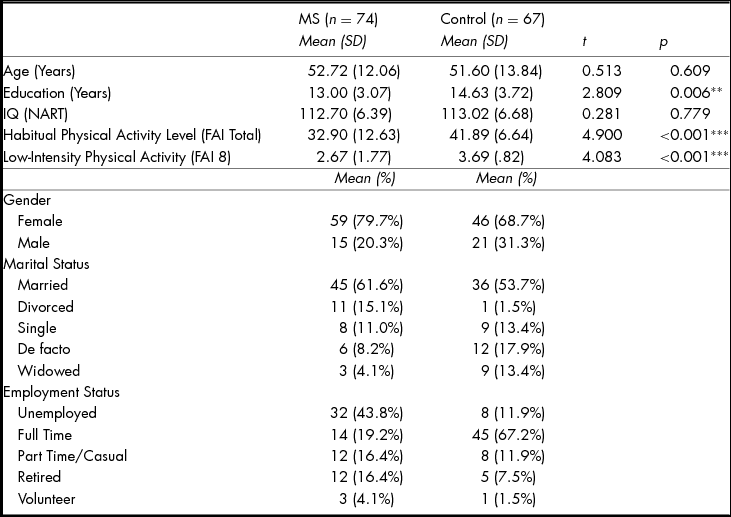
The final sample comprised 74 people with MS and 67 healthy people aged between 22 and 80 years (M = 52.72 and 51.60, respectively). People with MS differed significantly from healthy people with fewer years formal education (t [139] = 2.809, p < .01), but not with respect to IQ or age (see Table 1). The majority of people with MS (49; 66.2%) were diagnosed with relapsing-remitting MS, with 12 (16.2%) having primary progressive and the other 13 (17.6%) secondary progressive disease courses. At the time of the study, 30 people with MS were on disease modifying drug therapy (40.5%).
Comparison of Age, Education, IQ, Habitual Physical Activity Level and Low-Intensity Physical Activity amongst People with MS (n = 74) and Neurologically Healthy People (n = 67) and other Demographic Data

Note. MS = Multiple Sclerosis; IQ = Intelligence Quotient; NART = National Adult Reading Test; FAI = Frenchay Activities Index; *p < .05, **p < .01; ***p < .001.
A greater proportion of healthy people (86.6%) reported ‘at least weekly’ low-intensity physical activity compared to people with MS (61.7%). With 38.3% of people with MS reporting ‘less than weekly’ engagement in comparison to 13.4% of the healthy group. Independent groups t-test analyses also revealed differences in total habitual physical activity level (t [85.56] = 4.900, p < .001), and low-intensity physical activity (t [81.14] = 4.083, p < .001), with people with MS having a lower level of engagement in IADL, and engaging in less frequent low-intensity physical activity than healthy people.
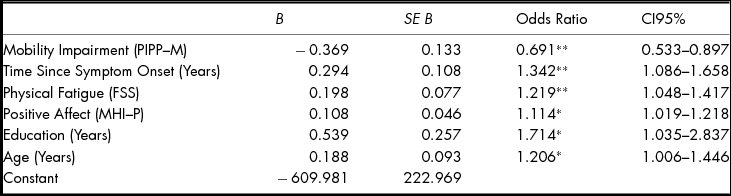
A sequential logistic regression was conducted to determine predictors of ‘at least weekly’ low-intensity physical activity in people with MS (see Table 2). Perceived impact of MS on mobility was entered as a covariate on an initial step and provided a significantly better fit to the data than an intercepts-only model, Δχ 2 (1) = 13.915, p < .001, Nagelkerke R2 = .296. This model had a classification accuracy of 75.4%. After controlling for impact of MS on mobility, results suggested that years since symptom onset, physical fatigue and positive affect were the most significant predictors of low-intensity physical activity, followed by education, and age.
Factors Predictive of ‘At Least Weekly’ Low-Intensity Physical Activity in People with MS (n = 74)
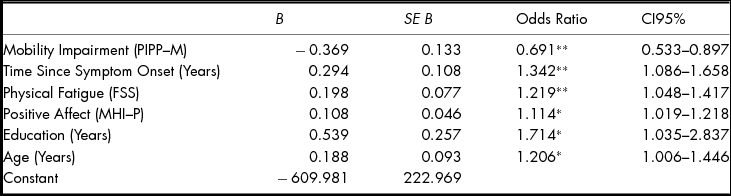
Note. MS = Multiple Sclerosis; PIPP–M = Perceived Impact of Problem Profile – Mobility Subscale; FSS = Fatigue Severity Scale; MHI–P = Mental Health Inventory – Positive Affect Subscale; *p < .05, **p < .01.
Marital status and whether people with MS were working or not did not contribute significantly to the prediction of ‘at least weekly’ low-intensity physical activity. Therefore, these variables were not retained in the final model (see Table 2). The final model was statistically significant and provided a better fit to the data than the covariates-only model, Δχ 2 (5) = 28.837, p < .001, Nagelkerke R2 = .721. The model also had better classification accuracy (87.7%) of those who engaged in ‘at least weekly’ low-intensity physical activity or not.
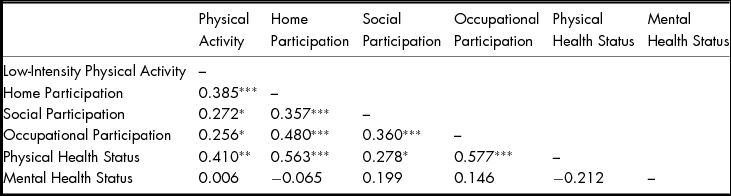
Higher frequency of low-intensity physical activity was significantly associated with greater home participation (r = .385, p = .001), social participation (r = .272, p = .018) and occupational participation (r = .256, p = .025) in people with MS (see Table 3). Hence, frequency of engagement in low-intensity physical activity directly related to the level of community integration of people with MS. Correlation analyses also suggested that low-intensity physical activity was significantly and positively associated with physical health status (r = .410, p = .002), but not mental health status (r = .006, p = .964) on the SF-36, a measure of health-related quality of life.
Associations amongst Low-Intensity Physical Activity, Community Participation and Health Status Outcomes in People with MS (n = 74)

Note. MS = Multiple Sclerosis; *p < .05; **p < .01; ***p < .001.
Discussion
Previous research has shown that sedentary behaviours are commonly observed in people with MS (Ellis & Motl, Reference Ellis and Motl2013). There is acknowledgement that, as in other neurological populations, people with MS are not undertaking sufficient physical activity based on current recommendations (Motl et al., Reference Motl, McAuley, Sandroff and Hubbard2015). This is a concern as reduced physical activity can accelerate physical deconditioning (Sandroff et al., Reference Sandroff, Klaren and Motl2015), thereby reducing functional capacity (Stuifbergen, Reference Stuifbergen1997; Stuifbergen et al., Reference Stuifbergen, Blozis, Harrison and Becker2006) and wellbeing (Marck et al., Reference Marck, Hadgkiss, Weiland, van der Meer, Pereira and Jelinek2014). Results of the current study revealed differences between people with MS and neurologically healthy counterparts in habitual physical activity level. This suggests that people with MS have a lower overall level of engagement in IADL, than healthy people. Further to this, people with MS engaged in less low-intensity physical activity than the control group, consistent with previous work (Motl et al., Reference Motl, McAuley, Sandroff and Hubbard2015; Motl et al., Reference Motl, McAuley and Snook2005).
People with MS may experience an array of symptoms, such as spasticity, muscle weakness, ataxia, impaired sensation and fatigue which can impact on physical functioning and mobility. Hence, people with MS require guidance from health professionals to tailor engagement in physically demanding activity or exercise, including adjustments to the type and pattern of activity, and to monitor symptoms (e.g. heat and fatigue), and pace themselves for optimal benefit. According to Becker and Stuifbergen (Reference Becker and Stuifbergen2003), this is essential to achieving the delicate balance of exertion that promotes health and avoidance of adverse reactions. Promotion of ‘habitual’ physical activity could be beneficial to encourage the necessary shift from sedentary behaviours, or complete cessation of physical activity, to engagement in a minimal level of low-intensity physical activity for people with MS.
However, in the literature, limited evidence exists regarding the potential for low-intensity physical activity or habitual activity, including housework and active pursuit of hobbies, to convey health and wellbeing benefits for people living with disabling conditions, such as MS. Considering this, it is important to ascertain whether low-intensity physical activity, for example, walking outside for 15 minutes ‘at least weekly’, is sufficient to engender benefits to wellbeing and participation for people with MS. Thus, this study sought to determine whether such amounts of low-intensity physical activity may be associated with greater community participation and health status outcomes.
Our findings provide new insight by showing that ‘at least weekly’ low-intensity physical activity is significantly associated with home participation, social participation and occupational participation in people with MS, as well as physical health status. These results support other studies showing that increased level of physical activity is a strong predictor of participation in society, and mental and physical health status, in people with MS, irrespective of level of disability (Marck et al., Reference Marck, Hadgkiss, Weiland, van der Meer, Pereira and Jelinek2014). However, our results differed somewhat, in that we found no association between physical activity and mental health status. This is unusual considering other work has suggested that individuals experiencing disabling conditions identify engagement in physical activity as an important component of their emotional wellbeing, with barriers to staying physically active adversely impacting mental and physical health (Putnam, Geenen, Powers, Finney & Dautel, Reference Putnam, Geenen, Powers, Finney and Dautel2003). Interestingly, the current sample of people with MS reported relatively low rates of borderline or clinically significant anxiety (33.9%) and depression (32.3%) in comparison to established prevalence rates in the MS population (Wood et al., Reference Wood, van der Mei, Ponsonby, Pittas, Quinn, Dwyer and Taylor2013).
Previous work has identified that personal and environmental barriers, as well as impairment associated with a disabling condition, influence individuals’ ability to engage in health-promoting behaviours. In a recent large study, fatigue, degree of impairment, lack of time and the perception that engagement in such activity interferes with other responsibilities, were rated as the most pertinent factors inhibiting health promoting behaviours in people with MS (Becker & Stuifbergen, Reference Becker and Stuifbergen2003). Other work has identified factors, which may contribute to a reduction or complete cessation of physical activity following diagnosis with MS, including changes in mood and onset of depression, reduced physical resistance, fatigue, as well as a misconception that physical activity will worsen symptoms in the long term (Frau et al., Reference Frau, Coghe, Lorefice, Fenu, Cadeddu, Marrosu and Cocco2015).
The current study also identified potential barriers, which may contribute to poor participation in physical activity in people with MS. Importantly, the current study controlled for the impact of MS on mobility, and found that a greater number of years since symptom onset, older age, more prominent physical fatigue, reduced positive affect and fewer years in formal education were the most significant predictors of physical activity level. Whether people with MS were engaged in volunteer/productive work roles did not contribute significantly to the prediction of ‘at least weekly’ physical activity despite only 19% of people with MS enrolled in the study being in full-time employment compared to 67% of healthy people. Similarly, being married or in de facto relationships did not appear to be ‘protective’ against sedentary behaviours for people living with MS.
Considering these identified barriers, it is important for health professionals to continue to advocate for participation in habitual physical activity, as this may enable people with MS to remain ‘active’ during the course of their regular daily routine. Further, the provision of education regarding the benefits of at least a minimal amount of low-intensity physical activity may be crucial, particularly to enhance fatigue management and limit physical deconditioning, in this clinical population. Within the field of neurorehabilitation, there has been an increasing acceptance of the need to understand factors which are predictive of reduced engagement in physical activity in people with MS. In particular, to determine problems that may be addressed in therapy and benefits promoted through health education. Based on the current findings, it would appear that better symptom management, in particular for older people with MS further along the disease continuum, may lead to subsequent improvements in physical activity engagement. However, further work needs to be undertaken to extend these findings.
Limitations
When interpreting the results of the current study, its strengths and limitations must be considered. First, as a mail-out methodology was utilised for recruitment of people with MS, generalisability of results may be limited by non-response bias. For instance, people with MS experiencing severe participation restrictions may not have taken part in the study. In saying this, the response rate achieved in the current study is considered reasonable with regard to advertisement mail-out (Hoyle, Harris & Judd, Reference Hoyle, Harris and Judd2002). Despite, there being more female people with MS enrolled in the study than female healthy people, the sample was consistent with the MS population at large. MS is significantly (i.e. three times) more common in women than men; thus, the study sample is representative of people with MS in Australia (Multiple Sclerosis Research Australia, 2011). Disease composition of the study participants is also representative of the MS population at large (Australian Institute of Health and Welfare, 2004). It is important to note that people with MS differed significantly from healthy people with respect to number of years of formal education, which may be pertinent considering that education was predictive of engagement in physical activity in people with MS.
The limited 4-point Likert scale on the FAI may have created restriction of range, leading to reduced sensitivity or power to detect associations between physical activity and other variables of interest. It must also be acknowledged that the cross-sectional design of the study prevents conclusions regarding causality or direction of effects to be drawn from the results. Future longitudinal studies are recommended to determine whether the link between physical activity levels of people with MS and community participation and health status may be attributed to a cause-and-effect relationship; whereby, a lack of engagement in physical activity results in poorer community participation and health status outcomes.
Acknowledgements
The authors thank all persons with multiple sclerosis who were involved in this study, as well as the Multiple Sclerosis Society of Queensland for facilitation of participant recruitment. In addition, we acknowledge the contribution of Shari Pepperell and Jushin Shokar in collecting data from healthy persons as part of their Masters coursework.
Financial Support
This work was supported by the National Health and Medical Research Council (grant number 511270).
Conflict of Interest
None.
Ethical Standards
The authors assert that all procedures contributing to this work comply with the ethical standards of the relevant national and institutional committees on human experimentation and with the Helsinki Declaration of 1975, as revised in 2008.