Introduction
Worldwide, there are an estimated 4.6 million new cases of dementia every year (Ferri et al., Reference Ferri2005). In Europe alone about 927,000 people were on drug treatments for Alzheimer's disease (AD) in 2004 (Waldemar et al., Reference Waldemar2007), mostly cholinesterase inhibitors. Despite the large numbers, the evidence to guide clinicians on how to manage the risk of the known but rare cardiovascular adverse effects of these drugs is limited.
Concern over cardiac effects of cholinesterase inhibitors relates mainly to vagotonic effects on the heart. Cardiac disease, including sick sinus syndrome, supraventricular conduction abnormalities, unstable angina and congestive heart failure are still cited as conditions that merit caution (Martin, Reference Martin2008). Cholinesterase inhibitors have been associated with an increase in syncope (Birks, Reference Birks2006) and some studies found a reduction in pulse rate, but as yet there is no clear link between these two symptoms (Bordier et al., Reference Bordier2005). More seriously, cases of complete atrioventricular block, which can be potentially fatal, have been reported (Newby et al., Reference Newby, Kenny and McKeith2004; Suleyman et al., Reference Suleyman, Tevfik, Abdulkadir and Ozlem2006; Kayrak et al., Reference Kayrak, Yazici, Ayhan, Koc and Ulgen2008). There is no evidence of increased mortality with the use of these drugs, despite some concerns following a study of galantamine in mild cognitive impairment (López-Pousa et al., Reference López-Pousa2006). Although not a systematic review, the literature on cardiac safety of cholinesterase inhibitors was perhaps best reviewed by Rowland et al. (Reference Rowland, Rigby, Harper and Rowland2007). The authors found serious cardiac events to be rare and unpredictable. They found no evidence that certain pre-existing cardiac conditions or concomitant medication predispose patients to adverse events. Evidence of safety in conditions with the highest theoretical risk, for instance sick sinus syndrome and second-degree heart block, remains inadequate though. As a result of these uncertainties, practice varies greatly – not only in the cardiac conditions that are prescribed for but also in the use of ECGs (Malone and Lindesay, Reference Malone and Lindesay2007). Guidance is limited. In the U.K. the Royal College of Psychiatrists (Royal College of Psychiatrists, 2005) advise “consideration should be given to the need for a baseline ECG when anti-dementia drugs are to be used.” Some authors advise a cautious approach, with ECGs for all prior to treatment (Malone and Lindesay, Reference Malone and Lindesay2007). In contrast, Rowland et al. (Reference Rowland, Rigby, Harper and Rowland2007) found that the current evidence did not justify routine ECG investigation and proposed a protocol without ECG monitoring. Nevertheless, the authors still advised the screening of all patients prior to treatment, by taking a pulse and a history of cardiovascular symptoms, and then investigating further as necessary. Their protocol was recommended by Bullock (Reference Bullock2007) as a pragmatic way to manage risk, and may be an attractive option.
But how might the introduction of the Rowland protocol change practice, and what effects will its implementation have, especially for those services making frequent use of ECGs? We surveyed our own service to examine variables that influence cardiac examinations, as well as their outcomes.
Methods
To survey the cardiac investigation of patients treated for dementia, we selected a sample from an urban community mental health service for around 12,000 people over 65, in Aberdeen, Scotland. All new referrals for the period 7 February to 21 June 2007 were identified, and patient files were scrutinized to identify cases in chronological order. Cases were defined as those patients newly diagnosed with dementia, using ICD-10. Diagnoses were taken to be those made by the clinician.
For patients identified as cases, psychiatric files were searched for information on age, sex, residential status, carers and general practitioner (GP). The clinician, psychiatric diagnosis, and psychotropic drug prescription before and after assessment were also documented. Cardiovascular and other medical conditions were recorded from the referral letters and psychiatric notes in the file.
With regards to cardiac examination, notes were searched for documented pulse examination (rate and/or rhythm), and whether the presence or absence of cardiac symptoms was noted. Files were searched for references to previous ECGs, ECG requests by the psychiatrist, as well as documented reasons for doing, or not doing, ECGs. Note was also taken of where ECGs were performed, and whether there were any difficulties in arranging or obtaining ECGs. Where there were ECG recordings on file, the ECG diagnosis, and whether this was new, was recorded. Letters and notes were also read to find documented evidence of whether ECGs influenced prescribing.
Data analysis was performed using a spreadsheet. Ethical approval for the survey was granted by the Mental Health Clinical Governance Group.
Results
Forty-five cases of newly diagnosed dementia were identified through screening 127 files found from 137 referrals. Of these 11 were male and 34 (76%) female. Men had a mean age of 81 years (range of 75–90), and women 80 (range of 67–90). None of those referred was in formal care at the time of referral. Most lived independently, with only two men and six women in sheltered accommodation. Three men and 17 women lived alone, but only one woman had no formal or informal carer.
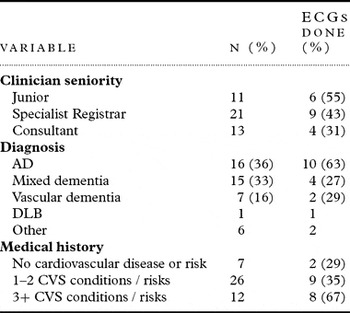
The breakdown of cases according to clinical diagnosis can be seen in Table 1. Amongst the “other” dementias was one case with hypoxic brain damage and five cases with unspecified diagnoses, where alcohol may have played a role in two of them. Twenty-two patients (49 %) were prescribed a cholinesterase inhibitor: 11 out of 16 patients with AD, 10 out of 15 patients diagnosed with mixed dementia, and the one patient with dementia with Lewy bodies (DLB).
ECGs done in all cases, by variable

AD = Alzheimer's disease; DLB = dementia with Lewy bodies; CVS = cardiovascular.
Cardiovascular disease and risk factors were quite common. Among those treated with a cholinesterase inhibitor, half (11) had two or more of these. Conditions included hypertension (11), ischemic heart disease (IHD) (5) and atrial fibrillation (AF) (2), whilst risk factors included diabetes (5), smoking (5) and hypercholesterolemia (2). Nine of the 22 patients were also on medication that could have an effect on cardiac conduction. Six patients were on a beta-blocker, one on amiodarone, one on tamoxifen, and one on venlafaxine. Only one patient received anti-psychotic medication.
Cardiovascular examination
The 22 patients treated with a cholinesterase inhibitor were seen in various settings. Fifteen were outpatients, with follow-up transferred to the day hospital in five cases, and one was admitted to hospital. Four patients were seen at home, with two followed up at the day hospital. Two patients were seen in a general hospital as liaison visits, with one followed up at clinic. In one case we lacked data. Most ECGs were performed at the outpatient clinic (6), but patients were also referred from the day hospital to the local ECG department (2), and others had ECGs at their local GP surgery, physicians' clinic and in (the psychiatric) hospital. Most ECGs were sent away for reporting by a cardiologist.
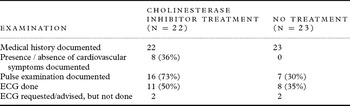
Examinations undertaken are listed in Table 2. It should be noted that for those treated, five cases had neither pulse nor cardiac symptoms recorded, and these patients did not have ECGs either (one previously had a normal ECG, and one had no ECG result recorded after an ECG was requested from the GP; these patients also had lower risk according to their medical history: three had no cardiovascular risk factors, and one had only hypertension). Of the 16 where findings of pulse examinations were documented, in five cases this consisted only of the recorded rate.
Cardiovascular history and examination

From the cardiovascular symptom history and pulse examination, only two cases from the 22 showed an abnormality that would have necessitated further investigation prior to treatment, according to the protocol proposed by Rowland et al. (Reference Rowland, Rigby, Harper and Rowland2007). Both cases had a pulse rate of 50 or below, and were examined further by ECG. This was normal in one, and showed a sinus bradycardia in the other, which delayed treatment. A physician was consulted first, and beta-blocker eye drops changed.
In two other cases a new pulse abnormality was detected. In one case, hypertension and atrial fibrillation were diagnosed after physical examination, with the ECG also showing ventricular hypertrophy and ventricular ectopic beats. In another with known IHD, an irregular pulse was found, with the ECG showing supraventricular premature complexes.
Of the remaining seven ECGs done on those who received treatment, four were normal. One ECG confirmed atrial fibrillation. Another showed ischemic changes in a case with hypertension, which was a new finding. A third showed left ventricular hypertrophy in someone with hypertension and mitral valve prolapse.
Of the ten cases of AD and mixed dementia where the patient was not treated with a cholinesterase inhibitor, cardiac abnormalities found on examination in three cases played a role in the decision not to treat. One patient with vascular risks, who did not have a pulse examination or symptoms documented, was found to have a first-degree heart block and right bundle branch block (RBBB) on ECG. As a result, the patient was advised against treatment. A second patient with vascular risks, but a normal pulse and no recorded cardiac symptoms, had a partial left bundle branch block. The family feared side effects (mostly gastro-intestinal), and treatment was not started. A third patient was found to have an irregular pulse, but no cardiac symptoms were recorded. A subsequent ECG showed up an incomplete RBBB. Donepezil was held back, and anxiety treated first. For the remainder of those not treated, one had a heart murmur and irregular pulse, but was also poorly compliant. A later ECG was normal. Two patients had cancer and atrial fibrillation, and another two were so seriously ill that it was thought they would not benefit from treatment. One patient died shortly after initial assessment, and another was awaiting treatment.
Decision-making
From the study of patient files, the rationale for cardiovascular examinations and ECGs was sometimes unclear. Only in six cases did documentation specify that cholinesterase inhibitor treatment played a role in requesting an ECG. In a further three cases, an abnormal pulse was the indication. Indications for ECGs in the remaining cases can only be inferred to have been possible cholinesterase inhibitor treatment, or underlying (cardio) vascular disease. In two cases where the ECG was done with an intention to treat before the diagnosis was confirmed, the patients were subsequently found to have a dementia unsuitable for cholinesterase inhibitor treatment.
Reasons for not doing ECGs were only stated in two cases: a normal pulse and a previous normal ECG. For the rest an ECG might have been considered and not deemed necessary because no treatment was planned (12), cardiovascular disease or risk was absent (5), or a pulse examination was normal (2). In three cases, non-attendance was significant, and in one case poor compliance precluded treatment. One patient initially refused examinations, leading to a request for an old ECG result (which was not received). In two other cases a GP and physicians were asked to do ECGs, with no outcome documented. One ECG requested at outpatients was not done. In two other cases though, the lack of access to ECGs at the day hospital and a broken machine made it difficult, but did not prevent ECGs.
Data on variables that possibly affected investigation patterns was collected (see Table 1). ECGs were more often done by junior clinicians, in dementia considered treatable, and in patients with several cardiovascular conditions/risks. There was no indication that the monitoring of other psychotropic drugs played a role in decisions. According to Taylor et al. (Reference Taylor, Paton and Kerwin2007), a combination of risk factors and drugs with a moderate to high potential effect on QTc times would have indicated a baseline ECG in eight cases. Of these, six had an ECG.
Discussion
In our service, where ECGs were carried out according to clinical judgment, one in five (5/22) patients had no cardiac screening documented prior to treatment. The presence or absence of cardiac symptoms, in particular, was poorly recorded. Reasons for decisions on cardiac examination were infrequently recorded, but it seems that the seniority of the clinician, medical history, findings on examination, and patient compliance may all have influenced whether patients had an ECG. Even in a service with a relatively homogenous population, patients followed different pathways in cardiac examination towards treatment. Physical examination and ECGs led to new diagnoses, and altered the management of patients even in this relatively small number of patients. However, it seems only 2/11 ECGs would have been indicated by Rowland's protocol.
The findings may be unsurprising, but they suggest that regardless of ECGs, effort is required to ensure all patients receive pulse and cardiac symptom checks. The frequent lack of physical assessment in psychiatry in general, including in memory clinics (Foy, Reference Foy2008), is well known. The absence of a protocol on cardiac monitoring within our service probably contributed to this, and we may only have been aware of Rowland's paper in the last quarter of the study period. Where ECGs are used, introducing the Rowland protocol could lead to a significant reduction in the number of further investigations. What is less clear is the significance of cardiac diagnoses that would be missed in the process, and how such a protocol would fit in with services more involved in physical health care.
We recognize that this survey is limited in its size, and will not be representative of all services. Case notes also often do not accurately capture information and decision-making processes. Nevertheless, we obtained detailed information from an inclusive sample of patients assessed for dementia, and it demonstrates how certain factors may influence the development of a protocol for cardiac monitoring.
Considering protocols
As in our department, clinicians may still find it difficult to agree on the level of vigilance needed, and the degree of involvement in investigation. This may be due to differing care pathways and resources (urban vs. rural), knowledge of cardiology and the evidence on drug safety, adverse experiences, and attitudes towards the management of risk and separation of responsibilities (primary vs. secondary care; psychiatric vs. medical care).
With regards to vigilance at a general level, we support the strategy promoted by Rowland et al. (Reference Rowland, Rigby, Harper and Rowland2007) of screening all but targeting further investigation. For individuals and specific cardiac conditions, anticipated benefits of treatment should be balanced against risks, and many may still be more cautious than Rowland et al. Our study showed how such caution denied treatment to some patients. We also found new cardiac conditions and abnormalities, still within the parameters set out by Rowland et al. The protocol is perhaps unclear in this regard, but suggests these patients can be treated regardless of further investigations, which would presumably be done in primary care. Here a delay in treatment would be balanced against missing conditions that may still be regarded as relative contra-indications or warranting caution. Heart block, for instance, can present with a normal pulse rate. We would argue that cardiac abnormalities and irregular pulses should be investigated prior to treatment. It should also be pointed out that just screening pulse rate (i.e. with an electronic manometer) might miss dysrythmias.
Perhaps for clarity, the Rowland protocol presumes a clear demarcation between mental and physical health care, whereas old age psychiatrists may get involved in the physical health care of their patients to a varying degree. Our study showed that several ECGs were done independently of the need for cardiac monitoring of cholinesterase inhibitors. ECGs would be viewed by many as part of a full cardiovascular examination, and in psychiatry it has become important in the monitoring of other psychotropic drugs. Its absence from psychiatric clinics might therefore become increasingly difficult to justify. This matter, however, is a debate in its own right (Wright et al., Reference Wright, Osborn, Nazareth and King2006) where two important arguments are the availability of resources and the accuracy of ECG interpretation by non-specialists (Mant et al., Reference Mant2007; Solomons et al., Reference Solomons, Trelor and Noronha2008). More basic is the nature of the initial physical examination done by psychiatrists assessing dementia. Routine examination is often omitted (Foy, Reference Foy2008), probably considered to be the responsibility of the primary care physician. Cardiac screening in those reported to be healthy could also be questioned. In our study, finding undiagnosed conditions might lend weight to recommending a basic examination that includes the cardiac screening. It also showed that delaying screening until after diagnosis and a decision to treat may have resulted in fewer ECGs, but would have delayed treatment for several patients. Decisions to examine further and treat may go hand in hand, and clinicians may want to establish all risks before discussing treatment, which could be an emotive issue for the patient.
In conclusion, we recommend that services implement and audit protocols based on local consensus. As a minimum, screening prior to treatment (pulse examination and cardiac symptom history) according to the Rowland protocol should be done. Ideally, an initial assessment and physical examination that includes a basic cardiovascular examination would be followed by further investigations on merit. Checking a pulse and cardiac symptom history at the time of treatment would then be the first step in cardiac monitoring – where follow-up ECGs may still be appropriate. Future research should aim to help clarify risk in cardiac conditions and cardio-active drugs. A prospective study with different investigation arms may help to clarify outcomes and the contribution of variables, including access to ECGs.
Conflict of interest
None.
Description of authors' roles
DM designed the study, collected the data and wrote the paper. TM supervised the study and revised the paper.