Introduction
The emergence and establishment of the Systematist school of music theory, which coincided with the decline of Abbasid political and military power, took place in the mid-thirteenth century.Footnote 1 This development is largely attributed to the works of Ṣafī al-Dīn Urmavī al-Baghdādī in Arabic, specifically Kitāb al-advār fī al-mūsīqī, completed in 1252, and al-Risāla al-sharafiyya fī al-nisab al-taʾlīfiyya, which was completed after Kitāb al-advār.Footnote 2
Ṣafī al-Dīn wrote his treatises almost exclusively in Arabic, the lingua franca of the time; indeed, we see hardly any Systematist music theory treatises written in Persian during his time. Nevertheless, almost six years after Ṣafī al-Dīn's death in 1294, the second authority within that school of music theory, Quṭb al-Dīn Shīrāzī, devoted the fourth fann (science, but here, branch) of the ʿulūm-i rīyāżī (science of mathematics) of his encyclopedia Durrat al-tāj—estimated to have been completed between 1300–1306—to the ʿilm-i mūsīqī (science of music, or rather, music theory).Footnote 3 According to our present knowledge, this is the first Systematist music theory text written in Persian, a language that rapidly, after the Mongol conquest, rose to be an important scientific language in the Islamic world of the fourteenth and fifteenth centuries, as well as beyond.Footnote 4 Quṭb al-Dīn tried to adhere to the principles and methodology established by Ṣafī al-Dīn. However, further development of music theory discussions is evident in his work, particularly with regard to the modes and modal system, which differ to some extent from those of Ṣafī al-Dīn, notably the recognition of a third class of mode, shuʿbas.Footnote 5
While theoretical works continued to be written in Arabic during the fifteenth century, the role of Persian writings in the development of music theory became increasingly prominent.Footnote 6 Therefore, examining works and treatises written in Persian in the fifteenth century is essential to tracing the development of this school of music theory.Footnote 7 The century can be described as the Persian century, first and foremost notable for both the volume of music–theoretical writings produced during this time as well as the presentation of innovative ideas on music theory, which this study discusses and demonstrates with respect to rhythm and rhythmic systems. This century can be considered the latter part of the Systematist period, after which, indeed, this school of music theory completely collapsed due to geopolitical, religious, economic, and military shifts in the region triggered by the emergence of new kingdoms: the Safavids in Iran, the Shaybanids in Central Asia, and the Mughals in the Indian subcontinent. Interestingly and importantly, many of these influential fifteenth-century Persian music–theoretical treatises were written within a limited geographical area, concentrated around the Timurid capital, the city of Herat. This circumstance likely contributed to a greater uniformity and coherence among the surviving music–theoretical treatises compared to earlier periods, both facilitating a deeper understanding of the Systematist school within a specific historical context and mitigating the influence of regional variations, although such differences were not entirely eradicated. In other words, it marked the first instance after the fall of Baghdad in which a significant concentration of music theorists was found in one geographical area—in fact, within a single city.
The Systematist school of music theory is primarily recognized for its innovative approach to intervals and for presenting a modal system that classifies modes based on the intervallic principles outlined in Systematist writings.Footnote 8 Furthermore, Systematist theorists adopted a more practical approach to the rhythmic system compared to their predecessors from the encyclopedic or scholastic period, thereby contributing to the development of rhythm and the rhythmic system.Footnote 9 However, the theoretical discourse regarding rhythm continued to develop throughout the Systematist period, with late Systematist theorists undoubtedly playing an important role in this development. Yet, the precise nature and extent of their contribution remain unclear, largely due to the lack of detailed studies on this aspect of their works.
This article seeks to clarify the role of late Systematist theorists by examining discussions on rhythm and the īqāʿ rhythmic system in Persian music theory writings. The analysis centers on six treatises authored by four theorists: ʿAbd al-Qādir ibn Ghaybī al-Marāghī, an anonymous writer, ʿAlīshāh ibn Ḥājī Būka Awbahī, and ʿAlī ibn Muḥammad al-Miʿmār (known as Banāʾī). By comparing these authors' treatments of rhythm and the īqāʿ system, the study illuminates how rhythmic theory developed during the final century of Systematist dominance and places these discussions within their broader historical context.
The following section provides a concise, chronological introduction to the selected treatises and their authors as a foundation for the analysis.
Exposition
The author of the first two selected treatises, ʿAbd al-Qādir, was born in the city of Marāgha, likely in the year 1353, and died during the plague epidemic at the age of eighty-two or eighty-three in Herat, probably in 1435.Footnote 10 He was one of the most celebrated musicians of his time, as well as a recognized authority in music theory, despite having begun his music theory career relatively late in life, as indicated by his earliest surviving treatise, Jāmiʿ al-alḥān (hereafter JA), completed in 1415 and likely the first theoretical work he authored.Footnote 11
The JA treatise is divided into a muqaddama (introduction), twelve bābs (chapters), and a khātima (conclusion).Footnote 12 In the eleventh chapter, ʿAbd al-Qādir discusses rhythm and the rhythmic system prevalent during his time.Footnote 13 This section contains four faṣls (subchapters), with the following titles:
• “Dar advār-i īqāʿī bidān ṭarīq kih qudamā zikr karda-and” (On the īqāʿ [rhythmic] cycles mentioned by predecessors)
• “Dar advār-i īqāʿī chinān-kih dar īn zamān mustaʿmal va mutadāvil ast” (On the common īqāʿ cycles used during this time)
• “Dar zikr-i advār-i īqāʿī kih ikhtirāʿ-i īn faqīr ast” (On the mentioning of the īqāʿ cycles innovated by this humble one)
• “Dar bayan-i qāʿida-yi dukhūl dar taṣānīf” (On the explanation of the rules of dukhūl [entrance] in taṣānīf [musical compositions]).Footnote 14
The second selected treatise is, very likely, ʿAbd al‑Qādir's last work, Sharḥ-i advār (hereafter ShA), composed sometime between 1419–1435. ShA is a commentary on Ṣafī al‑Dīn Urmavī's epoch‑making Kitāb al‑advār fī al‑mūsīqī and follows the structure of that work. Rhythm and rhythmic cycles are treated in the twelfth faṣl, entitled “fī al‑īqāʿ” (On rhythm). As in Ṣafī al‑Dīn's treatise, ShA begins with the definition of basic terms followed by the fundamentals of the rhythmic system before turning to the common cycles in use, all within a single chapter, without further subdivision. However, ʿAbd al‑Qādir goes beyond his predecessor by describing several additional cycles that emerged after the composition of Kitāb al‑advār. Further material appears in the appendix of ShA, “Zavāʾid al‑favāʾid” (Beneficial addenda). In the ninth fāʾida, which consists of two faṣls, the first section—“Dar bayān‑i advār‑i īqāʿī ghayr az advār‑i sitta‑yi mazkūra” (On the rhythmic cycles other than the six previously mentioned)—presents rhythmic cycles of his own invention. The second section explains the rules governing dukhūl (entrance) and khurūj (exit) rhythm in a taṣnīf (song).Footnote 15
Regarding the third selected treatise, which the editor, Ḥusaynī, presents as Kitāb-i fārsī fī fann al-alḥān, very little is known about its true author, original title, or place of composition. The editor offers considerable speculation on these points, including the proposed title, which does not appear within the treatise itself, and the suggestion that it may have been composed in Nayshābūr.Footnote 16 Although the editor proposes an early fifteenth-century date, specifically 1421 or earlier, for the composition of the treatise, the treatment of rhythm in certain parts of the work suggests a later period, likely after ʿAbd al-Qādir's works, specifically in the mid-fifteenth century. In any case, given the uncertainties surrounding the treatise's authorship, dating, content, and place of composition, we should avoid drawing definitive conclusions about the development of rhythm and the īqāʿ system it describes until further evidence from contemporary music–theoretical sources becomes available. For clarity, this treatise will hereafter be referred to as AT (Anonymous Treatise).
Shifting focus to AT's content, the work is divided into a muqaddama (introduction), two fanns (lit. sciences or arts, but here, parts), and a khātima (conclusion). Each of these parts is divided into several chapters, subchapters, sections, and subsections with different headings, for example: mabḥas (lit. discourse), qism (lit. kind), maqṣad (lit. aim), mawrid (lit. station), and maṭlab (lit. subject).Footnote 17 The author addresses rhythm and the īqāʿ rhythmic system in the second fann, which is divided into two maqṣads (lit. aims), with the following headings:
• “Dar uṣūl-i īn fann” (On the basics of this branch)
• “Dar īqāʿāt-i juzvī” (On the individual rhythmic cycles)Footnote 18
Neither the first nor the second maqṣad in the treatise contains any subdivisions.
The fourth and fifth selected treatises are also written by one author, ʿAlīshāh ibn Ḥājī Būka Awbahī. Awbahī was born in Awbah, a village near Herat, the capital of the Timurid Empire—after relocating from Samarqand sometime during the early fifteenth century—and probably died in the early sixteenth century.Footnote 19 There is little known about his life, but it seems he enjoyed a long one.Footnote 20 Besides his Persian-attributed lexicographical work, Tuḥfat al-aḥbāb, Awbahī penned two or three music theory treatises, probably in the middle or second half of the fifteenth century. Unfortunately, no known copy of his first and more comprehensive treatise, Aṣl al-vuṣūl, also referred to as Uṣūl al-vuṣūl and Aṣl al-uṣūl, has yet to be found. However, a manuscript of his second and more concise treatise, Muqaddamat al-uṣūl, has survived, and a facsimile edition of this manuscript has been published. The exact date of composition of this second treatise is unknown, but since Banāʾī in his Risāla (Treatise) (see below) mentions Awbahī and his muṣannafāt (books/works) on this fann (science/art, i.e., music theory), it is likely that both Aṣl al-uṣūl and Muqaddamat al-uṣūl were written prior to Banāʾī's treatise, which was completed in 1484.Footnote 21
Based on the present condition of Awbahī's concise treatise, Muqaddamat al-uṣūl, and by extension its facsimile edition, it becomes evident that the manuscript comprises two distinct yet fragmentary treatises. This conclusion is based on the fact that the first eighty pages of the manuscript—abruptly ending in the middle of the description of the class of fākhtīyāt—exhibit clear chapter divisions, each marked by the word faṣl but without any topical headings.Footnote 22 From page eighty-one onwards, however, the structure changes: the text begins in the midst of the discussion of the iṣṭikhāb-i zū al-arbaʿ (the tuning based on the fourth) and proceeds to address intervals and the modal advār system—subjects partly treated in the earlier section and partly continued or completed here. Furthermore, each chapter, subchapter, section, and subsection often bears its own topical headings.Footnote 23 One plausible explanation for the present condition of the manuscript is that the scribe or another person had access either to two different versions of Muqaddamat al-uṣūl or to two separate works by Awbahī—one of them Muqaddamat al-uṣūl—both surviving only in incomplete form. In an effort to produce a more complete treatise, he may have combined these materials into a single work. In any event, these two incomplete treatises will henceforth be referred to as MU1 (for the first treatise) and MU2 (for the second treatise).
The part on ʿilm-i īqāʿ (the science of rhythm) in MU1 is organized into an introduction and five faṣls (chapters), each lacking a specific heading apart from the title “faṣl.” The divisions of the chapters along with their contents are as follows:
• Introduction, including the definition of īqāʿ and its components, such as naqra (attack) and zamān (time)
• The first faṣl, on the various time units in music
• The second faṣl, on the various qism (types) of the īqāʾ-i basīṭ (simple rhythm)
• The third faṣl, on the various types of the īqāʿ-i murakkaba (combined rhythm)
• The fourth faṣl, on the common rhythmic cycles and their various classesFootnote 24
The second faṣl includes a tanbīya (further information), wherein the author provides additional explanations on the various types of īqāʿ. Footnote 25 As previously noted, the discussion of rhythmic cycles in the fourth faṣl of MU1 ends abruptly in the midst of the account on the class of fākhtīyāt. Footnote 26 Consequently, MU1 remains incomplete regarding this particular class of cycles. However, it appears that only the descriptions of a few cycles within that class are absent from the treatise.
As for MU2, Awbahī addresses rhythm in the second maqām (lit. position, or station) in that treatise, which is organized into two mawṭans (lit. residence, or home) as follows:
1. The first mawṭan, on the definition of īqāʿ and the basics of the system
2. The second mawṭan, “Dar zikr-i īqāʿāt-i muqārana” (On the mentioning of the related rhythmic cycles).Footnote 27
Although MU2 offers a more thorough and consistent analysis of rhythm, MU1 is also examined in detail to illuminate Awbahī's views on rhythm, even in places where the two treatises do not fully align.
The sixth selected treatise under study is Risāla dar mūsīqī (Treatise on music [theory]) by ʿAlī ibn Muḥammad al-Miʿmār, also known as Banāʾī.Footnote 28 The author was born in Herat in 1453, eighteen years after ʿAbd al-Qādir's passing in the same city, and was very likely contemporary with Awbahī. Although Banāʾī is foremost known as a poet, he was also introduced as one of the navādir (unique) people of his time in the ʿilm-i advār (the science of cycles).Footnote 29 He perished in a massacre of Sunnis in the city of Qarshī at the age of fifty-seven, during the Safavid assault of 1512.Footnote 30 Banāʾī likely completed his treatise on music theory (hereafter RB) on Zī al-Ḥijja 7, 888 (January 6, 1484).Footnote 31 In composing the treatise, Banāʾī appears to have drawn extensively on Awbahī's writings. Banāʾī's single but respectful mention of Awbahī—referring to his muṣannafāt (works/treatises)—strongly suggests that Banāʾī was familiar with both the author and his works.Footnote 32
The treatise is structured into a muqaddama (introduction) and two maqālas (discourses). The second maqāla addresses, in part, the ʿilm al-īqāʿ (the science of rhythm). The part on rhythm is in turn divided into the following faṣls (chapters):
• Introduction, on the definition of īqāʿ
• “Faṣl dar taqrīr-i muqaddamāt-i mabāḥis-i īqāʿ” (The chapter on the explanation of the principles of the discourse of īqā)
• “Faṣl dar bayan-i īqāʿāt-i dawriyya kih mustaʿmal ast miyān-i arbab-i ṣanāʿat-i ʿamliyya” (The chapter on the explanation of rhythmic cycles common among the masters who practice this art)Footnote 33
In addition to the introduction and two chapters, the second discourse contains two additional chapters that are not directly related to the topic of rhythm.Footnote 34
Analyses and comparisons
General aspects
In this part, the most important general aspects of the selected treatises are examined:
• Structure and layout
• Approach
• Terminology
Structure and layout
A structural analysis of the selected treatises' treatment of rhythm and the rhythmic system reveals that the works all begin with an introductory section that includes the definition of īqāʿ (rhythm) and an explanation of its elements: naqra (attack), zamān (duration between two attacks), and the crucial concept essential to defining and understanding rhythm and the rhythmic system.Footnote 35 This introductory section is then followed by a discussion of the foundations of the īqāʿ rhythmic system, beginning with the time units used to construct rhythmic cycles. The works then address the various types of īqāʿ—better understood here as “rhythmic cells”—that arise from different combinations of those time units, including īqāʿ‑i mufaṣṣal (disjunctive rhythm), īqāʿ‑i muvaṣṣal (conjunctive rhythm), and their respective variants.Footnote 36 The third distinct section in these treatises is the presentation of the rhythmic cycles of the authors' times, which vary relatively across different works.Footnote 37 This section can also include a report on the cycles invented by the authors. An example appears in the case of ʿAbd al-Qādir and his JA and ShA, or rather in its appendiceal part, “Zavāʾid al-favāʿid” (Beneficial addenda).Footnote 38
A concluding part appears in JA, the appendix of ShA, and Awbahī's MU2, though each contains different content. In JA and ShA, this concluding part addresses the rules of dukhūl (the entrance of rhythm), referring to the coordination between poetic meter and rhythm at the beginning of a taṣnīf (musical composition).Footnote 39 In contrast, MU2 discusses how to perform two different rhythmic cycles simultaneously in a specific song type known as żarbayn. Footnote 40 Aside from this concluding section—which seems less directly connected to rhythm and the rhythmic system and is not present in all the treatises—the selected works generally follow a clear, structured format:
• The introduction (definitions of key terms)
• The foundations of the system
• The individual rhythmic cycles
This layout is clearly reflected in the chapter divisions—particularly in MU1 and RB from the second half of the fifteenth century—in which distinct chapters, often titled faṣl, are dedicated to each structural section. Nevertheless, MU2 somewhat diverges from this layout, as the first section (the introduction) is merged with the second section, which covers the foundations of the system. This merged section, however, is separated from the section on the individual rhythmic cycles. MU2's division of sections can also be seen in AT. By contrast, ʿAbd al-Qādir's treatises, JA and ShA, do not separate these sections at all.
The reasons behind such variations among the selected treatises remain rather ambiguous, but it is likely they reflect the authors' preferences. Another possible explanation for separating the foundations of the system from the account of individual rhythmic cycles could be that the authors who used this layout intended to emphasize the significance of the system's foundations. It is also plausible that the authors intended to more closely follow Ṣafī al-Dīn's chapter structure in al-Risāla al-sharafiyya rather than that of Kitāb al-advār.Footnote 41
Approach
The examination of the selected sources strongly suggests that all of them adopt an analytical approach to rhythm, breaking down the entire system into smaller components, such as naqra (attack), zamān (the duration between two attacks), and the rhythmic arkān (pillars) or time units. This method enables the authors to describe rhythmic cycles and, consequently, the entire īqāʿ rhythmic system.
However, an analysis and comparison of these treatises indicates that, with the exception of ʿAbd al-Qādir, the other three authors extend this analytical approach further by grouping cycles into three classes: siqāl, ramāl, and favākht or fākhtīyāt. Footnote 42 ʿAbd al-Qādir, on the other hand, maintains the methodology of earlier Systematist theorists, notably Ṣafī al-Dīn Urmavī, by reporting rhythmic cycles without classifying them. In other words, the authors of the later fifteenth century—along with the anonymous author—go beyond their predecessors by focusing more explicitly on the structural relationships among individual cycles and organizing them into classes. This methodological shift clarifies the system's foundational principles and supports a more systematic account of the rhythmic system. Notably, the fundamentals of this classification are comprehensively explained only by Awbahī in MU2 and to a more limited extent in MU1 (For further discussion of Awbahī's treatment of these fundamentals, see below). Nevertheless, despite adopting the classification, RB fails to offer any explanation. Regarding AT, if we accept the proposed date of composition—despite some reservations—it would be among the earliest, if not the earliest, sources to present a more systematic approach through the classification of cycles. Nonetheless, as with Banāʾī and, to some extent, Awbahī in MU1, the basis of his classification remains unexplained, and his introduction to the fundamentals of the system does not extend beyond that already formulated by earlier Systematist theorists.Footnote 43
One question that arises here is how a well-informed and knowledgeable music theorist and musician like ʿAbd al-Qādir could overlook such a significant development, specifically the classification of rhythmic cycles as noted in AT. Footnote 44
Terminology
A comparison of the selected treatises, in particular those of ʿAbd al-Qādir, Awbahī, and, to some extent, Banāʾī, reveals terminological changes. To be more precise, two distinct changes in general terminology occurred during the fifteenth century, transitioning from ʿAbd al-Qādir's time to that of Awbahī and Banāʾī: new terms began to be used and some terms were substituted by others. The initial group of terms includes zamān-i sādisī (MU1, MU2, RB), zamān-i sāminī (MU1, MU2, RB), zamān-i ʿāshirī (RB), żarb-i kafī (MU1, MU2), and żarb-i aṣbaʿī (MU2).Footnote 45 Additionally, three terms—saqīl, ramal, and fākhtī—began to be applied in their plural forms—siqāl, ramāl, and favākht or fākhtīyāt—with a new connotation, specifically designating three classes of rhythmic cycles.Footnote 46 This new connotation was first observed in AT, suggesting that the terminology employed in the treatise aligns more closely with that of Awbahī and Banāʾī than with its contemporary works, such as JA or ShA. Footnote 47 Conversely, the absence of terms such as zamān-i sādisī, zamān-i sāminī, and żarb-i kafī establishes a stronger connection to the general terminology used by ʿAbd al-Qādir.
As for the second type of terminological development, naqra is probably the most important substituted term, replaced by zamān in the treatises of the second half of the fifteenth century.Footnote 48 An example in this regard is the description of the rhythmic cycle ramal, as ʿAbd al-Qādir, like the earlier Systematists, notes that ramal contains twelve naqras, while Awbahī and Banāʾī replace the term with zamān, writing that ramal contains twelve zamāns.Footnote 49 This replacement is evident throughout the chapters on rhythm in the mentioned sources. However, the suggested early-fifteenth-century treatise, AT, also applies the term zamān instead of naqra when describing the same cycle and others.Footnote 50 The term also began to be used in connection with larger and newly established time units, such as zamān-i sādisī (six-[naqra/beat] time unit) or zamān-i sāminī (eight-[naqra/beat] time unit).Footnote 51 The term zamān as a time unit applied for smaller time units, such as zamān-i j, in prosodical terminology, corresponds to the vatad‑i majmuʿ. Accordingly, the application of zamān to new, larger, established time units was simply an extension of its use. In other words, in the second half of the fifteenth century, the term zamān began to be used both in place of naqra in the sense of “attack” or “beat” and for “time units.”
A less significant change in terminology is the replacement of zamān-i a/b/j/h with zamān avval/sānī/sālis/rābiʿ in Awbahī's treatises.Footnote 52 In contrast, Banāʾī continues to use the traditional terms for these various zamāns.Footnote 53 One possible explanation for the absence of certain terms in Banāʾī's treatise is that his approach to the foundations of the rhythmic system is notably more traditional, conservative, and concise compared to Awbahī.Footnote 54
Specific aspects
Definitions of core terms
The selected sources display no significant differences in their definition of īqāʿ (rhythm). The treatises either directly quote Fārābī's definition from Kitāb al-mūsīqī al-kabīr and Ṣafī al-Dīn's from Kitāb al-advār and al-Risāla al-sharafiyya in their original Arabic, accompanied by comments, or present translations of these definitions into Persian, complete with explanations and annotations. None of these additions, however, extend beyond the original definitions.
Nonetheless, in both MU1 and MU2, Awbahī follows Fārābī's definition more closely by omitting the word al-advār (cycles) from his definition of īqāʿ. Footnote 55 This is the only difference between Awbahī's treatises and the rest of the selected works, including Banāʾī's RB, in which, as in almost all Systematist works, īqāʿ is intertwined with advār (cycles), referred to as dawr-hā. Footnote 56
The other terms defined in connection with īqāʿ are naqra (attack, beat) and zamān (duration between two attacks).Footnote 57 No substantial differences appear in the definitions of naqra and zamān among the selected treatises, even though, as previously discussed, naqra began to be replaced by zamān in descriptions of individual rhythmic cycles.
Foundations of the system
Analysis and comparison of the descriptions of the foundations of the system in the selected treatises reveal certain differences. However, all treatises consistently begin by outlining the arkān-i īqāʿī (rhythmic principles) or the principles of azmina-yi naqarāt (attack/beat durations), two closely related sets of principles grounded in the same underlying concepts as awzān-i ashʿār (poetic meter). These arkān denote the time units in music. Each of the selected treatises represents these arkān using either a letter or a figure. The following outlines these representations:
• zamān-i alif (a) (JA, ShA, RB, AT) or zamān-i avvals (1) (AT, MU1, MU2)
• zamān-i bā (b) (JA, ShA, RB, AT) or zamān-i sānī (2) (AT, MU1, MU2)
• zamān-i jīm (j) (JA, ShA, RB, AT) or zamān-i sālis (3) (AT, MU1, MU2)
• zamān-i dāl (d) (JA, ShA, RB) or zamān-i rābiʿ (4) (AT, MU1, MU2)
• zamān-i hā (h) (JA, ShA, RB) (not attested in AT, MU1, MU2)Footnote 58
These arkān are also described through the terminology of poetic meter—specifically the prosodic units sabab, vatad, and fāṣila. This method is particularly evident in JA, ShA, AT, and RB. For instance, the combination of two zamān-i avval units (1 + 1) constitutes a saba-i saqīl, represented as tana by the atānīn method.
In contrast, Awbahī minimizes these connections, avoiding the terms sabab, vatad, and fāṣila until his discussion of the well-known duodenary rhythmic cell types (aqsām-i mashhūra-yi davāzdah-gāna-yi īqāʿī, see below for further discussion).Footnote 59 Moreover, Awbahī appears to treat sabab-i saqīl and vatad (with its variants majmūʿ and mafrūq), as well as fāṣila (with its variants ṣaghīr and kabīr), as rhythmic cell types.Footnote 60 These factors contribute to the ambiguity in MU2—an ambiguity likely caused by the brevity of the treatise, possible lacunae in the surviving manuscript, or even Awbahī's description.
Probably, the most significant difference among the selected treatises concerning the system's foundations relates to the status of the zamān (time unit) a, or avval, as a constituent element within the rhythmic cycles. In both JA and ShA, ʿAbd al-Qādir maintains that the time unit a is either qalīl al-istiʿmāl (infrequently used) or mustaʿmal nabāshand (not used).Footnote 61 He describes only one cycle—khafīf-i saqīl—in which the time unit a, in the form of sabab-i saqīl, is used.Footnote 62
In contrast, Awbahī, Banāʾī, and, to some extent, the anonymous author of AT consider this unit to be one of the four principal and commonly used time units in music.Footnote 63 Awbahī goes further, assigning it the role of marjaʿ (base) for the time units b and j. Since the time unit a corresponds to one naqra (attack, beat), it can serve as the building block for the two- and three-naqra structures of b and j through simple combination.Footnote 64 This approach is reflected in the descriptions of two well-known duodenary rhythmic cell types: sabab-i saqīl and mukhammas-i ṣaghīr (see below).Footnote 65 Awbahī also describes fāṣila-yi ṣughrā as a cell type formed by combining two time units of a (which constitute sabab-i saqīl) with one time unit of b, or sabab-i khafīf. Footnote 66
Awbahī's formulation thus implies a broader functional scope for the time unit a, grounded in its role as marjaʿ. Time unit a may therefore have been combined with other time units to form larger structures, such as zamān-i sāminī (the time unit of eight), which appear in rhythmic cycles such as mużāʿaf-i nīm-saqīl and chahārżarb-i kabīr. Footnote 67 In this way, time unit a came to play an increasingly prominent role in the description and construction of new and larger “time units,” such as zamān-i sāminī, during the latter half of the fifteenth century.
Another distinct difference among the selected sources concerns the time units of j, or zamān-i sālis, and one of its variants, referred to as vatad-i mafrūq, as well as time unit h, which is referred to as fāṣila-yi kubrā. Regarding the variant of the time unit j, vatad-i mafrūq, all selected sources except AT mention it in some capacity; however, only Awbahī provides an example of its application. Specifically, this time unit serves as a constituent component of one of the well-known duodenary rhythmic cell types, rāh-i savārī. Footnote 68 This suggests that earlier theorists did not regard the unit as practically applicable, and some, such as the author of AT, did not even recognize and include it. Banāʾī states this explicitly, noting that vatad-i mafrūq is not mustaʿmal (used).Footnote 69 His remark likely reflects the views of the majority of Systematists from the first half of the fifteenth century and some from the second half.
With regard to time unit h or fāṣila-yi kubrā, three of the six selected sources—JA, ShA, and RB—mention it in their discussions of rhythmic time units, stating that this unit is either rarely or never used.Footnote 70 ʿAbd al-Qādir in JA and ShA describes time unit h as infrequently applied but provides no examples of its use in any cycle, while Banāʾī in RB does offer an example in his description of turkī-yi żarb-i aṣl, despite having earlier emphasized that the unit is never employed.
On the other hand, Awbahī in MU1 does not include fāṣila-yi kubrā in his list of time units, but later invokes it in his description of a type of turkī-yi żarb, where fāṣila-yi kubrā functions as an alternative time unit within the cycle.Footnote 71 In MU2, fāṣila-yi kubrā first appears in the presentation of the twelve duodenary rhythmic cell types, defined as a combination of sabab-i saqīl and vatad-i majmūʿ. Akin to its mention in RB, fāṣila-yi kubrā is also listed in MU2 as a constituent time unit of turkī-yi żarb-i aṣl and as an alternative unit within that cycle.Footnote 72 By contrast, AT is entirely silent on fāṣila-yi kubrā.
Taken together, the later sources—MU1, MU2, and RB—are those that provide explicit examples of the application of time unit h. This pattern suggests that h, or fāṣila-yi kubrā, began to be applied only in the second half of the fifteenth century.
Accordingly, both the second variant of time unit j, vatad-i mafrūq, and time unit h, fāṣila-yi kubrā, began to be applied more extensively in descriptions of specific rhythmic cycles in the second half of the fifteenth century, highlighting a distinct difference between the selected treatises from the first and second halves of the century, specifically between ʿAbd al-Qādir and Awbahī, as well as, to a certain extent, Banāʾī. Concerning AT, the author does not even mention these time units in his treatise. This lack of description aligns the treatise more with works written in the first half of the fifteenth century, indicating that the author does not recognize the time units as applicable to music. These differences may reflect either the authors' individual preferences and/or a broader theoretical development in which the alternative time units j (vatad-i mafrūq) and h (fāṣila-yi kubrā) came to be more fully recognized within the musical theory framework.
Another difference, but of less significance, among the selected treatises is the introduction of a new method for representing standard time units in Awbahī's works. Awbahī employed a combination of words to define these time units, departing from the more traditional approach of using the three syllables ta, na, and nan, known as the atānīn method. This new method is outlined as follows:
• bi (to), representing the time unit a
• man (me), representing the time unit b
• hast (he/she is), representing the time unit j
• dūst (friend), representing the time unit d Footnote 73
However, Awbahī later returns to the traditional, more standard atānīn method (ta/na, tan, tanan, and tananan) of representing time units in combination with the afāʿīl method (fā, fa, mu, muf, etc.) to describe the constituent time units of the rhythmic cycles of his time.Footnote 74 In any case, the system appears to have lacked the necessary flexibility and practicality to effectively demonstrate the constituent time units of rhythmic cycles, although it likely offered some pedagogical advantages.
Having outlined the foundation of the rhythmic system, particularly the various time units used in music, all selected treatises, except RB, go on to combine these time units into “rhythmic cells” from which rhythmic cycles are formed. There are two types of combinations of time units that produce rhythmic cells. The first type is called īqāʿ-i muvaṣṣal (conjunctive īqāʿ), in which the same time unit—for example, b or sabab-i khafīf (tan)—is used. This type includes several variants, depending on which time unit is used in the construction of the cell. The second type is called īqāʿ-i mufaṣṣal (disjunctive īqāʿ), in which different time units—such as b (sabab-i khafīf, tan) and j (vatad-i majmūʿ, tanan)—are combined to form rhythmic cells. This type also has several variants, depending on the order in which the time units appear.
Regarding īqāʿ-i muvaṣṣal (conjunctive īqāʿ), a comparison of the selected treatises reveals a broad consensus: with the exception of RB, which does not address the conjunctive and disjunctive īqāʿs, all authors describe this category in nearly identical terms. The only notable deviation appears in MU1, in which Awbahī introduces a distinctive theoretical framework by dividing īqāʿ-i muṭlaq (absolute rhythm) into two classes—basīṭ (simple) and murakkab (complex)—and assigning both muvaṣṣal and mufaṣṣal types to each.Footnote 75 In this system, what other authors call īqāʿ-i mufaṣṣal (disjunctive īqāʿ) is essentially reinterpreted as a type of simple conjunctive īqāʿ. Yet despite these structural differences, MU1's practical description of the conjunctive īqāʿ corresponds closely to that of ʿAbd al-Qādir, the anonymous author, and MU2.
The situation becomes more complex when considering īqāʿ-i mufaṣṣal (disjunctive īqāʿ). All treatises except RB agree that this category comprises three types, though they employ different labels. What varies significantly, however, is the content and number of variants assigned to each type. In MU1, Awbahī presents an extraordinarily expansive system: twelve variants for the first type, sixty for the second, and 960 for the third.Footnote 76 In MU2, however, he simplifies the system considerably, reducing it to twelve variants used in practice, referred to as the well-known duodenary rhythmic cell types (aqsām-i mashhūra-yi davāzdah-gāna-yi īqāʿī).Footnote 77 Of these, only three serve as foundational components for constructing and classifying rhythmic cycles in his system. AT likewise discusses the three types of disjunctive īqāʿ, together with several subdivisions, though this section of the treatise most closely resembles the approach of ʿAbd al-Qādir.Footnote 78 Still, the section remains disconnected from the classification of cycles that follows.
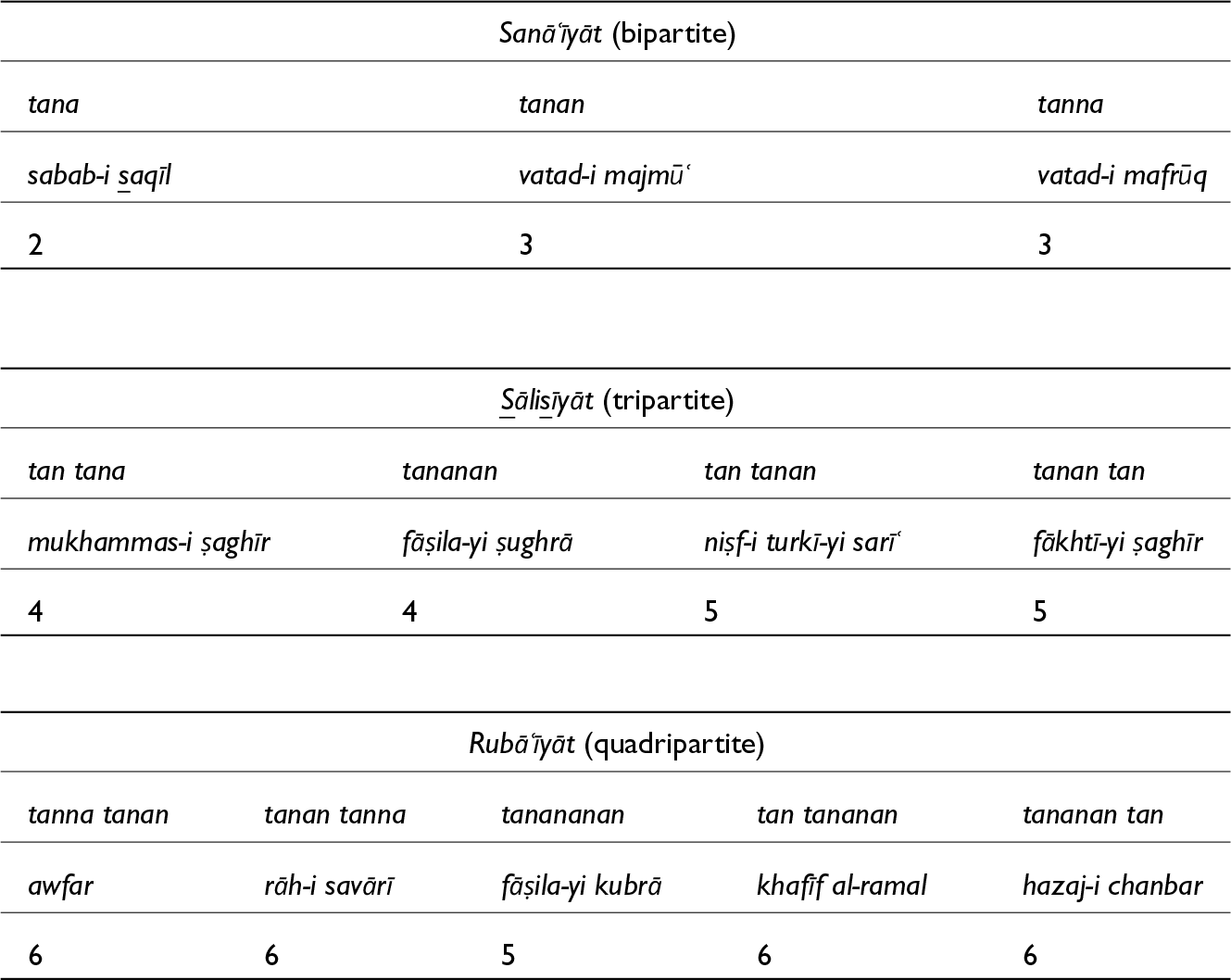
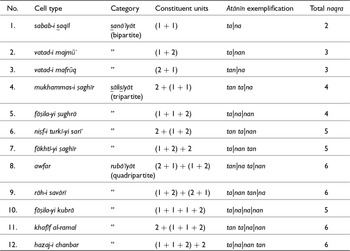
To clarify the structure and contents of these duodenary rhythmic cell types, the tables below are provided.
As previously noted, Awbahī classifies sabab-i saqīl as a mufaṣṣal (complex) īqāʿ, formed of two time units 1 (a) and rendered in the atānīn method as tana (ta + na). By contrast, sabab-i khafīf is treated as a basīṭ (simple) īqāʿ that stands on its own, represented in the atānīn method as tan. The two time units 1 (a) and 2 (b)—the latter corresponding to sabab‑i khafīf—seem to form the basis of the three main categories of the system: sanāʾīyāt, sālisīyāt, and rubāʿīyāt. More precisely, rhythmic cells in the bipartite category are constructed either from two time units 1 or from one time unit 1 combined with one time unit 2. In the tripartite category, rhythmic cells are formed from various combinations of one or two time units 1, together with one or two time units 2. Similarly, the quadripartite category consists of combinations of two time units 1 and two time units 2. This structure is illustrated in the table below, where 1 signifies time unit a and 2 denotes time unit b. The numbers in parentheses indicate that the time units they contain are grouped into larger units, as represented by the atānīn method in MU2. These larger “composite” units are: sabab-i saqīl (ta|na: 1 + 1 = 2), vatad-i majmūʿ (ta|nan: 1 + 2 = 3), vatad-i mafrūq (tan|na: 2 + 1 = 3), fāṣila-yi ṣughrā (ta|na|nan: 1 + 1 + 2 = 4), and fāṣila-yi kubrā (ta|na|na|nan: 1 + 1 + 1 + 2 = 5).
Thus, as the tables shows, the number of naqra (beats or attacks) is not the basis for determining the categorization of these rhythmic cells; rather, it is the number of time units of types 1 (a) and 2 (b). This is evident from the fact that one or two rhythmic cell types in each category diverge in the number of naqra from the others, such as sabab-i saqīl in the first category (sanāʾīyāt, bipartite) and niṣf-i turkī-yi sarīʿ or fākhtī-yi ṣaghīr in the second category (sālisīyāt, tripartite), while the number of constituent time units simply explains the categorization of the cells.
At the same time, two cell types—awfar and khafīf al-ramal—show the same number of zamāns (time units) in an identical sequence (2 + 1 + 1 + 2). The atānīn exemplifications (e.g., ta na nan) of these cell types, however, reveal different internal organizations. Awfar is structured as 2 + 1 (tan|na), corresponding to one vatad-i mafrūq (3), followed by 1 + 2 (ta|nan), or one vatad-i majmūʿ (3). Khafīf al-ramal, by contrast, is organized as 2 (tan) or one sabab-i khafīf followed by 1 + 1 + 2 (ta|na|nan), or one fāṣila-yi ṣaghīr (4).Footnote 80 It remains unclear how decisive this distinction was in defining cell types and, by extension, classifying rhythmic cycles (see also below for further discussion). In any case, the suggested hypothesis above may also be understood in line with the proposal that each category marks the number of executable naqra, referred to as żarbs, or żarb-i kafī in practical terminology, a number that often does not match the full naqra count.Footnote 81
Nevertheless, Awbahī's account is ambiguous. For instance, he initially defines vatad-i majmūʿ as a cell type consisting of one time unit a (1) and one time unit b (2), corresponding to sabab-i khafīf. Later, however, he treats vatad-i majmūʿ as a distinct and standalone time unit—not a cell type—that can be combined with the two time units a and b in the description of another cell type, turkī-yi sarīʿ.Footnote 82 Such shifts create an inconsistency, especially in relation to the sālisīyāt (tripartite) and rubāʿīyāt (quadripartite) categories. If vatad-i majmūʿ and vatad-i mafrūq are considered autonomous time-unit entities, it appears that the number of time units within that particular rhythmic cell type no longer align with the terminology used, namely tripartite and quadripartite, as well as the hypothetical explanation previously suggested. Yet, it is probable that Awbahī considered vatad-i majmūʿ and vatad-i mafrūq, along with fāṣila-yi ṣughrā and fāṣila-yi kubrā, to be both cell types and time units, or rather composite time units. Identifying them in this dual role helps reduce some of the uncertainty in his system, although not completely.
In any case, with these foundational principles in place, all selected treatises go on to detail the rhythmic cycles common during that period. However, only MU2 clearly and firmly links these foundations to the description of the rhythmic cycles. The following section outlines how the authors present these cycles and how the three-class taxonomy emerges from the duodenary rhythmic cell types.
Rhythmic cycles
The examination and comparison of the rhythmic cycles presented in the selected sources reveal significant differences, most notably their differing systems of classification. All authors except ʿAbd al-Qādir employ a taxonomy that groups cycles into three classes, while ʿAbd al-Qādir instead arranges them chronologically into “old” or “classical” and “contemporary” categories, with further subdivisions based on whether the cycles were invented by earlier musicians or by himself.Footnote 83 Although he uses this system consistently in both JA and ShA, the internal ordering of cycles within each group is not chronological, and some classical cycles appear again among the contemporary ones under new names.
By contrast, the remaining sources uniformly classify rhythmic cycles into three classes—siqāl, ramāl, and fākhtī or favākht, even fākhtīyāt—but only Awbahī in MU2 explains the theoretical basis of this system, linking each class to one of the cell types of the aqsām-i mashhūra-yi davāzdah-gāna-yi īqāʿī (well‑known duodenary rhythmic cell types).Footnote 84 Other authors employing the same classification—namely the anonymous author, Awbahī in MU1, and Banāʾī—do not clarify its foundation, leaving readers to infer the underlying logic of the classification.
One may argue that even earlier Systematists suggested such a classification of cycles, although they did not present it formally. For instance, ʿAbd al-Qādir and others arranged rhythmic cycles by first addressing the saqīl (heavy) group—specifically saqīl al-avval, saqīl al-sānī, and khafīf-i saqīl—followed by the ramāl group (including saqīl-i ramal, ramal, and khafīf al-ramal), the hazaj group (closely related to ramal), and finally the fākhtī group. However, this sequence was interrupted by the inclusion of three major cycle groups—chahārżarb, mukhammas, and turkī, each with various variants—whose descriptions, from Qutb al-Dīn Shīrāzī's time onwards, appeared after the fākhtī group.Footnote 85 Even if we disregard this disruption, there is still no clear and systematic explanation for the order in which earlier Systematists addressed and described rhythmic cycles. This was a task that later Systematists, especially from the late fifteenth century, sought to address.
According to Awbahī, each class of rhythmic cycles originates from a specific type of rhythmic cell within two of the three categories of duodenary rhythmic cell types previously outlined. The siqāl class derives from the tripartite category and the cell type mukhammas-i ṣaghīr, also referred to by Awbahī as khafīf al-saqīl, which contains four zamāns; the ramāl class derives from the quadripartite category and the cell type awfar, which comprises six zamāns; and the favākht or fākhtīyāt class likewise derives from the tripartite category but from the cell type niṣf-i turkī-yi sarīʿ, which contains five zamāns.Footnote 86 However, there is a degree of ambiguity in Awbahī's MU2 regarding the exact category associated with the latter class of rhythmic cycles, favākht, as he offers contradictory information about whether it derives from niṣf-i turkī-yi sarīʿ or fākhtī-yi ṣaghīr, both of which contain five zamāns but the inner organization of their time units differ (see Tables 1 and 2).Footnote 87
Three categories of duodenary rhythmic cell typesFootnote 79

Table 1 Long description
The table lists three rhythmic cell types within the bipartite Sanāʿīyāt category and pairs each with a syllabic pattern and a numeric value. The patterns are: sabab-i saqīl = “tana,” vatad-i majmūʿ = “tanan,” and vatad-i mafrūq = “tanna.” The corresponding values are 2 for sabab-i saqīl, 3 for vatad-i majmūʿ, and 3 for vatad-i mafrūq. Vatad-i majmūʿ and vatad-i mafrūq are tied for the highest value, each one unit higher than sabab-i saqīl. The table provides no units or definition for what the numbers represent, so they should be read only as relative counts or weights within this set.
Clarification of the three categories of rhythmic cell types

Table 2 Long description
The table lists four rhythmic patterns under the tripartite category “Sālisīyāt,” pairing each pattern with a named form and a numeric value. The patterns are “tan tana,” “tananan,” “tan tanan,” and “tanan tan.” Their associated forms are mukhammas-i ṣaghīr, fāṣila-yi ṣughrā, niṣf-i turkī-yi sarīʿ, and fākhtī-yi ṣaghīr, respectively. The numeric values are 4 for tan tana and 4 for tananan, and 5 for tan tanan and 5 for tanan tan. Overall, two patterns share the lower value (4) and two share the higher value (5), with a one-point difference between the groups. The table does not define what the numbers represent (for example, length, beats, or complexity), so the values should be interpreted only as relative ratings within this listing.
A question arises here: why, although the categories of sālisīyāt and rubāʿīyāt offer at least two alternatives (with 4 and 6 zamān cell types, respectively), is only one selected as the stem of the classes? One possible explanation is that only those cell types whose time units begin with b (2, sabab-i khafīf) rather than a (1) were able to serve as the fundamental cells of the rhythmic classes. This explanation is only partially satisfactory, however, as niṣf-i turkī-yi sarīʿ, fākhtī-yi ṣaghīr, khafīf al-ramal, and awfar all begin with the time unit b. Footnote 88 All these cell types could theoretically have served the same function as stems of the rhythmic classes. However, fākhtī-yi ṣaghīr and khafīf al-ramal are overlooked while niṣf-i turkī-yi sarīʿ and awfar are selected instead as the stems for the class of favākht or fākhtīyāt and ramāl, respectively.
It therefore seems more likely that the internal arrangement of time units a and b within larger composite units—such as vatad-i majmūʿ and fāṣila-yi ṣughrā—played a role in determining which cell types with the same number of zamāns (beats, attacks) were ultimately chosen as the bases of the cycles.
Taken together, these indications allow the reconstruction of the likely underlying logic of Awbahī's system. Rhythmic cells are first categorized according to their number and sequence of time units (a and b). From the twelve possible cell types, three are selected to classify the rhythmic cycles. This selection appears guided by two criteria: the cell's zamān count (four, five, or six) and the requirement that the initial time unit be b (2, sabab‑i khafīf). Additionally, the internal arrangement of time units into larger composite units may have influenced the preferences for alternative cell types that contain the same number and sequence of these time units.
Given these premises, the rhythmic cycles within each class are formed by doubling the zamāns of the cell type, reorganizing and rearranging them, and then repeating the resulting pattern cyclically. For instance, the rāh-i akhlāṭī cycle, comprising eight zamāns (attacks or beats), is created by duplicating the four-zamān structure of mukhammas-i ṣaghīr. Similarly, mukhammas-i kabīr, which consists of sixteen zamāns, is formed by doubling rāh-i akhlāṭī. Additional cycles, such as varāshān, are generated by reorganizing and rearranging the zamāns from existing cycles—for example, the sixteen zamāns of mukhammas-i kabīr. Through these processes, a chain-like relationship develops among the cycles within each class. Yet despite these structural transformations, the most evident link among the cycles within a class is the number of zamāns specific to their cell type, a quantitative aspect that consistently distinguishes and connects each cycle and primarily determines their classification.
The comparison of the number of rhythmic cycles reported in the selected music–theoretical treatises reveals striking differences among them. Specifically, ʿAbd al‑Qādir presents approximately forty‑four cycles (including those of his invention), the anonymous author lists only thirteen (plus one attributed to Ṣafī al‑Dīn Urmavī), Awbahī describes roughly twenty‑nine in MU1 and thirty‑seven in MU2, and Banāʾī reports thirty‑one.Footnote 89 Despite these numerical discrepancies, the evidence suggests that such variation reflects the individual theorists' preferences rather than any actual expansion or contraction of the repertory of rhythmic cycles in the fifteenth century. This pattern is especially clear in JA and MU2, where the repertory appears broadly consistent. In the case of AT, which is suggested to have been written in Nayshābūr, the markedly lower number of reported cycles may reflect local practice in addition to the author's personal preferences. Taken together, these observations indicate that the fifteenth century maintained a largely stable corpus of rhythmic cycles, even though a few new cycles emerged in its latter half, such as akhlāṭī, du yak, and awfar. Some cycles also underwent changes in nomenclature—for example, saqīl al‑ramal and saqīl‑i avval came to be known as shādīyāna and varāshān, respectively.Footnote 90 Conversely, several cycles gradually fell out of use, including six-naqra chahārżarb and turkī‑yi khafīf (twelve-naqra turkī).
As far as the individual rhythmic cycles are concerned, some major developments related to their structural aspects are noticeable in the selected sources from the second half of the fifteenth century. Probably the most significant of these developments is the change in the reported number of naqras or zamāns in certain cycles, which appears to have significantly altered the characteristics of the cycles. This development is evident in particular in the following five rhythmic cycles:
• Dawr-i shāhī (JA, ShA, MU2) or dawr-i shāhī-żarb (JA, ShA) or dawr-i bāzgūna (MU2)
• Hazaj-i kabīr (JA, MU1, RB) or hazaj-i avval or hazaj-i saqīl (ShA) or hazaj (AT)
• Khafīf (JA, ShA) or saqīl-i sānī
• Khafīf al-ramal
• Żarb al-fatḥ Footnote 91
The second noticeable development, which includes the highest number of cycles, concerns the regrouping of the naqras or zamāns that form the time units of certain rhythmic cycles and, in some cases, even the replacing of the executable naqras or żarbs of cycles. This development appears in the following nine rhythmic cycles:
• Chahārżarb (JA) or twelve-naqra chahārżarb (ShA) or chahārżarb-i ṣaghīr (MU1, MU2, RB)
• Chahārżarb-i kabīr
• Fākhtī-yi kabīr (JA, MU1, MU2, RB) or fākhtī-yi mużāʿaf (ShA) or twenty-zamān fākhtī (AT)
• Fākhtī-yi ṣaghīr (JA, ShA) or ten-naqra fākhtī (JA) or the second qism (type) of fākhtī (AT) or turkī (AT) or fākhtī-yi awsaṭ (MU1, MU2, RB)
• Forty-eight-naqra chahārżarb (JA,ShA) or chahārżarb-i awsaṭ (MU1, MU2, RB)
• Miʾatayn
• Mukhammas-i kabīr
• Turkī-yi aṣl (JA) or turkī-yi aṣl-i kabīr (ShA) or turkī-żarb-i aṣl (MU2, RB)
• Turkī-yi ten-naqra (JA) or farʿ-i turkī-yi aṣl (ShA) or turkī-yi aṣl-i vasaṭ (ShA) or turkī (AT) or the second type of fākhtī or turkī-yi sarīʿ (MU1, MU2, RB)
The most evident and readily identifiable development of the latter part of the Systematist period is the application of larger time units in the descriptions of certain rhythmic cycles compared to traditional or classical ones. The cycles reflecting this development include the following:
• Awsaṭ va nīm-saqīl (MU1, RB) or nīm-saqīl (MU2)
• Chahārżarb-i awsaṭ
• Chahārżarb-i kabīr
• Chahārżarb-i ṣaghīr
• Chakāvakī (MU1) or saqīl (RB)
• Dawr-i shāhī
• Dāyira-yi miʾatayn
• Fākhtī-yi kabīr
• Żarb al-fatḥ
It seems that both the relatively new cycles, such as chahārżarb, and the entirely new cycles, such as żarb al-fatḥ and dawr-i shāhī, underwent this development. The only traditional or classical cycle mentioned in the list above is fākhtī, or, more specifically, the variant fākhtī-yi kabīr, which began to be characterized as a cycle that includes “nontraditional” or larger time units.
Concluding summary
During the late Systematist period—the fifteenth century, often regarded as the golden age of Persian writings on the Systematist school founded by Ṣafī al Dīn al Urmavī—the development of the īqāʿ rhythmic system not only continued but accelerated, especially in the century's second half, when theorists adopted a more systematic and methodical approach to describing rhythmic cycles and their structures. This shift is evident in a classification more closely tied to the system's underlying principles; principles that themselves underwent refinement. Four major developments stand out in this period: the recognition of zaman-i avval (a) as a key time unit; the introduction of duodenary rhythmic cell types, which came to form the basis of the classification of rhythmic cycles; the creation of a ternary classification of rhythmic cycles into siqāl, ramāl, and favākht or fākhtīyāt; and the construction and use of time units larger than the six classical ones described by earlier Systematist theorists. Yet not every source from the later fifteenth century reflects all these developments. Furthermore, the ternary classification of rhythmic cycles may have begun as early as the first half of the century, although this remains uncertain. The ternary classification of rhythmic cycles was most likely developed to address the absence of a taxonomy in the field of rhythm. Regarding individual cycles, although the total number remained relatively stable, notable changes took place. These can be grouped into two categories: major structural modifications—including alteration in the number of naqras/zamāns (attacks/beats), regrouping of naqras/zamāns into time units, and the replacing of traditional time units with new, larger ones—and minor changes, such as renaming cycles. These developments likely addressed the practical needs of a more straightforward and effective description. Considering all these developments, it becomes clear that the late Systematist period was dynamic, characterized by creativity, continuous refinement of the rhythmic system, and ultimately enrichment of the theoretical framework rather than a mere repetition of earlier Systematist ideas.
In the sixteenth century, however, a new approach emerged. Theorists simplified their descriptions of the rhythmic system, mirroring similar simplifications in modal theory and often reducing the number of cycles to seventeen standardized uṣūl (rhythmic patterns), indicating a shift from the analytical approach of the Systematist era to the descriptive one of the post-Systematist period.