Introduction
Mosquitoes significantly threaten human and animal health by transmitting various diseases, leading to thousands of human deaths and substantial economic losses annually. The Aedes (Stegomyia) aegypti (Linnaeus, 1762) mosquito (Diptera: Culicidae) triggers endemic events globally, particularly in countries with tropical and subtropical climates that facilitate its reproduction. (Suresh et al., Reference Suresh, Murugan, Benelli and Nicoletti2015; Kamal et al., Reference Kamal, Kenawy, Rady, Khaled and Samy2018). Aedes aegypti is responsible for transmitting several viruses to humans, such as dengue, zika virus, chikungunya and yellow fever, with the Mayaro virus being a more recent addition (Joubert and O'Neill, Reference Joubert and O'Neill2017; Pliego-Pliego et al., Reference Pliego-Pliego, Gökçe, Bakhsh and Salim2020). Due to its anthropophilia, this species prefers to lay its eggs in man-made containers such as tires, cans, water tanks and plastic items, which facilitate the development of its larval stages (Forattini, Reference Forattini1995; Carlson et al., Reference Carlson, Short and Angleró-Rodríguez2020). Therefore, targeting larval breeding sites, either through mechanical elimination or treatment, is the most effective strategy for controlling mosquito populations, once removing immature stages directly affects the size of the adult mosquito population (Becker et al., 2010; Albeny-Simões et al., Reference Albeny-Simões, Murrell, Vilela and Juliano2015).
Larvicides are the primary method for reducing or even eliminating the larval density of immature mosquitoes in water reservoirs (Zara et al., Reference Zara, Santos, Fernandes-Oliveira, Carvalho and Coelho2016). Therefore, locating and eradicating these breeding sites is crucial for the success of Ae. aegypti control programmes (Becker et al., 2010). However, some reservoirs are situated in areas that are difficult to access for direct larvicide application (Zara et al., Reference Zara, Santos, Fernandes-Oliveira, Carvalho and Coelho2016), or they may be concealed within urban landscapes, creating ‘invisible’ mosquito sources. Studies have explored alternative larvicide application methods that can reach these hard-to-access or hidden containers as effective tools in vector control (Bonds, Reference Bonds2012; Williams et al., Reference Williams, Ramirez and Lesser2022). One new strategy involves wide-area spray applications of larvicide, where a diluted solution is dispersed widely to reach all potential mosquito breeding sites, particularly those in residential backyards. The goal is for the larvae population control agent to inadvertently enter these containers and eliminate the mosquito immature. This method has proven efficient for controlling larval populations, as it allows larvicides to be dispersed in small solution particles, minimising the volume of application, and enhancing the active ingredient's effectiveness in targeting mosquito breeding sites (Correa-Morales et al., Reference Correa-Morales, Dzul-Manzanilla, Bibiano-Marín and Vadillo-Sánchez2019).
The use of biological methods to control mosquito larvae worldwide using bacteria has proven to be quite promising in the current scenario. The use of the bacterium Bacillus thuringiensis var. israelensis, known by the acronym BTI, is an efficient method for controlling Ae. aegypti larval populations (Becker et al., 2010). The bacterium produces toxins that have larvicidal action and result in a high larval mortality rate (Loutfi et al., Reference Loutfi, Fayad, Pellen, Le Jeune, Chakroun, Benfarhat, Lteif and Kallassy2021). It is a highly effective alternative that, being selective to the order Diptera and having no effect on vertebrates, has a reduced effect on the environment (Polanczyk et al., Reference Polanczyk, Garcia and Alves2003; Ben-Dov, Reference Ben-Dov2014; Zara et al., Reference Zara, Santos, Fernandes-Oliveira, Carvalho and Coelho2016). The action of toxins generated by BTI causes lesions in the intestinal epithelium of the larvae, leading to death within minutes (Araújo et al., Reference Araújo, Diniz, Helvecio, Barros, de Oliveira, Ayres, Melo-Santos, Regis and Silva-Filha2013), having a very satisfactory effect even when used in very low concentrations (Polanczyk et al., Reference Polanczyk, Garcia and Alves2003; Alto and Lord, Reference Alto and Lord2016).
However, when employing any method to eliminate pest organisms, it is crucial to monitor the surviving population closely. This is because the use of such treatments can act as a selective filter, potentially leading to the emergence of resistant populations (Naqqash et al., Reference Naqqash, Gökçe, Bakhsh and Salim2016). As noted by Naqqash et al. (Reference Naqqash, Gökçe, Bakhsh and Salim2016), with continuous application of the same treatment, controlling these resistant populations becomes progressively more challenging. This highlights the importance of integrating diverse management strategies and continuously adapting our approaches to manage resistance effectively (Naqqash et al., Reference Naqqash, Gökçe, Bakhsh and Salim2016). The principle described applies similarly to the elimination of larvae through chemical or biological means. When an introduced mortality source, such as an insecticidal larvicide, fails to kill all individuals in a population, the survivors may experience certain benefits (Schröder et al., Reference Schröder, van Leeuwen and Cameron2014). This non-lethal effect can inadvertently select for individuals that are more resistant to the treatment, which could lead to an overall tougher population (Naqqash et al., Reference Naqqash, Gökçe, Bakhsh and Salim2016). This phenomenon underscores the importance of carefully managing and rotating control methods to prevent the development of resistance and to maintain the effectiveness of pest control strategies over time (Alto and Lord, Reference Alto and Lord2016). By reducing the population size and causing mortality, larval competition is lessened, which could inadvertently benefit the surviving larvae (Schröder et al., Reference Schröder, van Leeuwen and Cameron2014).
Additionally, the increase in organic matter available from the decomposition of the dead larvae can provide a richer environment for the survivors. This situation can lead to improved growth and development conditions for the remaining larvae, potentially making them more robust (Neale and Juliano, Reference Neale and Juliano2019; Cozzer et al., Reference Cozzer, Rezende, Lara, Machado, Dal Magro and Albeny-Simões2023). As a result, the surviving individuals may emerge as adults with increased body size, enhancing their fitness and consequently their vectorial and reproductive capacities (Schröder et al., Reference Schröder, van Leeuwen and Cameron2014; Alto and Lord, Reference Alto and Lord2016; Neale and Juliano, Reference Neale and Juliano2019). These positive effects of mortality, related to enhancements in individual or population characteristics, may result in overcompensation (where the benefits exceed what would have occurred without the mortality) or compensation (where benefits match the absent mortality conditions) (McIntire and Juliano, Reference McIntire and Juliano2018). This can affect the number of individuals, total biomass or survival time of the population (McIntire and Juliano, Reference McIntire and Juliano2018). The fitness of surviving individuals increases due to changes in population density (a density-dependent effect), resource availability and individual behaviour (Abrams and Matsuda, Reference Abrams and Matsuda2005; Abrams, Reference Abrams2009).
Understanding how the density-dependent processes act with reductions in mosquito larvae population is crucial for devising more effective and safer control strategies (Gama et al., Reference Gama, Alves, Martins, Eiras and Resende2005). Overcompensation mortality exemplifies the unintended and undesirable effects that can arise from population control measures. It is crucial to establish concentration values that induce higher mortality in mosquito larvae population to develop foundational protocols for use in wide spray area methods. This is based on the following premises: (i) BTI, when applied over a wide area, exerts a lethal effect on Ae. aegypti larvae in breeding sites, (ii) larval mortality reduces negative density-dependent effects and (iii) mortality at early larval stages can lead to overcompensation in survival traits. Our hypotheses are: (i) higher concentrations of BTI cause higher rates of larval mortality in Ae. aegypti, (ii) reduced density-dependent competition could lead to shorter development times and potentially larger adult sizes, and (iii) higher initial rates of larval mortality led to overcompensation in surviving individuals. Our objectives are: (i) assess the lethal effects of the wide-area application of BTI on Ae. aegypti larvae populations (ii) to determine the level of toxicity of BTI on Ae. aegypti larvae, identifying lethal dosages at 20, 50 and 90% mortality and (iii) to measure the effects of BTI dilution as a cause of overcompensation in surviving Ae. aegypti individuals.
Material and methods
Mosquito larvae acquisition
Aedes aegypti larvae were sourced from a long-established mosquito colony maintained at the Ecological Entomology Laboratory (LABENT-Eco) of the Community University of the Chapecó Region (Unochapecó). This colony has been sustained for many years, with new individuals periodically introduced to enhance genetic diversity. Approximately every 6 months, eggs are collected from the urban environment and added to the colony to ensure genetic variability. Although we do not track individual generations within the colony, the periodic introduction of wild-collected mosquitoes serves to maintain a broad genetic base and potentially incorporate any new genetic variations occurring in field populations. The colony is likely naïve to BTI exposure, as this product is not utilised by local governmental vector control agencies. Egg hatching for this study involved submerging egg-laden papers in a Becker-type glass container filled with 1 litre of distilled water, maintaining a larval density of approximately 500 larvae per litre. Larvae were fed 0.150 g l−1 of Spirulina Alcon® fish feed and reared in breeding facilities until reaching the third and fourth instar stages. The breeding room was kept at a controlled temperature of 25 ± 2°C, with a relative humidity of about 60%, and a 12:12 h light photoperiod.
BTI neighbourhood-scale spatial application
In the São Romero Neighbourhood of Xanxerê, Santa Catarina state, Brazil, 64 containers each with a 350 ml capacity and dimensions of 8 × 8 × 10 cm were distributed to simulate potential larval breeding sites and collect the aerosolised larvicide (fig. 1). These containers were placed on the ground in the front yards of residences, with one container per residence, positioned in fully open areas to ensure unobstructed exposure to the BTI mist. This setup was chosen to reflect typical Ae. aegypti breeding conditions, as similar plastic containers are commonly found scattered around residential areas in Brazil, often accumulating water and becoming effective mosquito breeding sites when left unattended. For controls, 36 containers were placed in another location 5 km away. We utilised BTI strain AM 6552, produced by VALENT Biosciences and sold by SUMITOMO Chemical under the name VectoBAC WG®. The larvicidal efficacy of BTI was assessed through spatial application using a Guarani aerosol generator with an ultra-low volume (ULV) atomiser. The device's product tank, which holds 40 litres of broth, was loaded with 2000 g of BTI VectoBac WG per 30 litres of water. A total of 75 litres of this broth, flowing at 23 litres min−1, was deemed sufficient to treat 1 hectare. The application vehicle travelled at a speed of 10 km h−1. The nozzle was adjusted to release water droplets ranging from 101 to 200 mm, optimising product delivery to the target substrate. All containers were placed in the front yards of houses, one container per house, 1 h prior to BTI application. They remained open during the treatment process (fig. 1) and were subsequently collected for analysis at LABENT-Eco, Unochapecó. Field containers were each supplemented with 100 ml of distilled water to simulate rainfall, and ten Ae. aegypti larvae in the final developmental stages (third and fourth instar) to mimic natural larval colonisation. The toxicity test evaluated cumulative larval mortality at 24 and 48 h after introducing the larvae into the containers.
Location and schematic design of the BTI wide area spatial application experiment conducted in São Romero Neighbourhood – Xanxerê/SC (26°53′15.6″S 52°23′11.6″W).

BTI lethal dose determination
Using an experimental microcosm setup, we determined the lethal doses (LDs) required to achieve 20% (LD20 – low mortality), 50% (LD50 – intermediate mortality) and 90% (LD90 – high mortality) mortality rates in Ae. aegypti larvae. Each microcosm comprised a 100 ml Becker-type glass container holding 50 ml of distilled water mixed with various BTI concentrations: 0 (control), 0.050, 0.040, 0.020, 0.015, 0.010, 0.008, 0.005, 0.002, 0.001 ppm, each replicated five times. Fifteen first instar Ae. aegypti larvae were introduced into each microcosm. We recorded the total number of larvae deceased after 24 h. Mortality curves were specifically analysed at concentrations of 0.008, 0.020 and 0.040 ppm, corresponding to LD20, LD50 and LD90, respectively.
Effect of BTI treatment on larval development and characteristics of emerging Ae. aegypti adults
We utilised 500 ml Becker-type glass containers as experimental microcosms. Each container held 375 ml of distilled water, 150 newly hatched Ae. aegypti larvae and an initial input of 0.150 g of Spirulina Alcon® fish food. We tested BTI concentrations of 0 (control), 0.008 (LD20), 0.02 (LD50) and 0.040 ppm (LD90), with each treatment replicated six times. The experiments were conducted under controlled environmental conditions, maintained at 25 ± 2°C with 70–80% relative humidity and a 12:12 h light–dark photoperiod. Larval mortality was monitored every 24 h, with dead larvae counted and removed. Pupae were transferred to 50 ml plastic containers containing 30 ml of distilled water and placed inside small Berlese funnel traps (Bioquip) to capture emerging adults. After emergence, adults were anaesthetised in CO2 gas, transferred to Eppendorf tubes and euthanised by freezing for subsequent wing size measurements. Each mosquito was sexed, and the ventral view of the right wing was measured using a Zeiss Stemi 305 binocular stereoscopic microscope, following the methods described by Cozzer et al. (Reference Cozzer, Rezende, Lara, Machado, Dal Magro and Albeny-Simões2023).
Data analysis
Linear mixed-effects models for evaluating temporal effects of BTI on mosquito mortality
To investigate the effects of BTI exposure on the mortality of Ae. aegypti larvae over time, a linear mixed-effects model was employed. This statistical approach was chosen due to its ability to handle the complexities associated with repeated measures data, where measurements are taken on the same experimental units across different time points. We did not include BTI concentration as an independent variable because we did not measure the actual amount of BTI that accumulated in each container. Since the precise BTI concentration in each experimental unit could not be determined, we focused on assessing the overall effect of BTI presence rather than specific dose–response relationships. The response variable in the model was the number of dead larvae, recorded at two distinct time points, 24 and 48 h post-exposure. The primary explanatory variable was time, treated as a categorical variable with these two levels. Additionally, random effects were included to account for variability between experimental units, which in this context were the individual larval groups, or ‘cups’, used in the experiments. These random-effects component is crucial for modelling the inherent differences among the cups that could affect larval mortality independently of the treatment effect. The model was specified with time as a fixed effect to assess its effect on larval mortality, while random intercepts were modelled for each cup to capture the between-cup variability. The fit of the model was assessed using the restricted maximum likelihood approach, and the significance of the fixed effects was evaluated using t-tests. The adequacy of the model's assumptions and the fit were verified through diagnostic plots of the residuals, which included checks for normality and homoscedasticity. Additionally, the Akaike information criterion and the Bayesian information criterion were calculated to provide measures of the model's relative quality and complexity.
Determination of lethal doses using probit analysis
The LDs required to kill 20, 50 and 90% of the larvae (LD20, LD50 and LD90) were determined using probit analysis. This statistical method involved performing regression analysis to establish the mortality curve, following the methodology outlined by Finney (1971). Based on these analyses, we selected BTI concentrations of 0.008, 0.020 and 0.040 ppm for further experimentation.
Analysis of variance to evaluate treatment effects
We employed generalised linear models (GLMs) with appropriate distribution families to analyse the effects of BTI concentrations on multiple response variables. Specifically, we used Poisson regression to assess longevity, and quasi-binomial regression for the percentage of pupae produced. The proportional mortality and the sex ratio of emerging adults were analysed using a binomial framework. For the average wing sizes of male and female mosquitoes, separate analyses of variance (ANOVAs) were conducted for each sex to examine the effect of different BTI concentrations. After model fitting, an ANOVA was used to test the significance of treatment effects across all response variables. Where significant effects were detected, Tukey's Honestly Significant Difference (HSD) test was subsequently applied for pairwise comparisons among treatment groups. This comprehensive statistical approach allowed us to robustly assess the effect of different BTI concentrations on various biological outcomes relevant to Ae. aegypti control. All analyses were performed using the statistical software R (R Development Core Team, 2014).
Results
BTI neighbourhood-scale spatial application on Ae. aegypti larval mortality
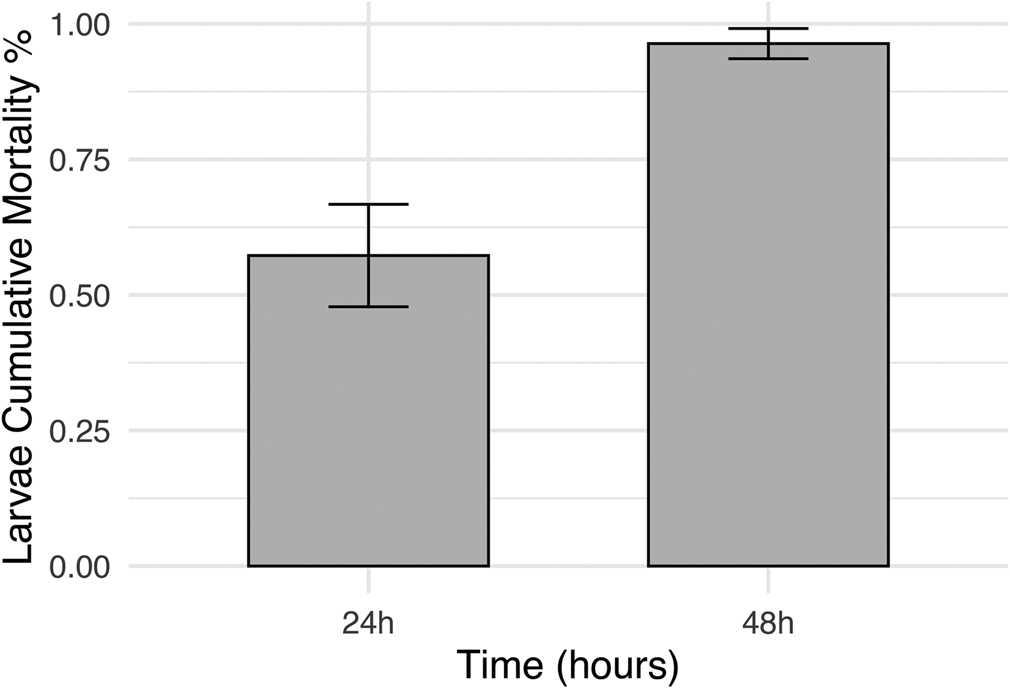
The analysis revealed a significant effect of time on cumulative larval mortality. The GLMM results indicate that the cumulative mortality at 48 h was significantly higher than at 24 h (estimate = 2.98, SE = 0.54, z = 5.48, P < 0.001; fig. 2). This effect demonstrates a marked increase in larval mortality over time, with a higher proportion of Ae. aegypti larvae succumbing by the 48 h time point in response to BTI exposure.
Cumulative mortality of Aedes aegypti larvae (mean percentage ± standard error) observed after 24 and 48 h of exposure to BTI, applied spatially using the ultra-low volume (ULV) method. The figure illustrates the progressive effect of BTI over time, with mortality rates increasing significantly between 24 and 48 h.

The effect of BTI on cumulative larval mortality
In this experiment, cumulative larval mortality of Ae. aegypti was assessed on the ninth day, the final day when live larvae were present across all treatments. By this point, any remaining larvae had either pupated or died. The results demonstrated a clear dose-dependent effect of BTI on larval mortality, with higher concentrations significantly increasing mortality rates. At the highest BTI concentration of 0.04 ppm, larval mortality rose sharply, exceeding the control group by 91.44% (Tukey HSD, P < 0.001), indicating near-total mortality. A moderate concentration of 0.02 ppm also led to a substantial increase in mortality, 49.88% higher than the control (P < 0.001). Comparisons between specific concentrations further illustrated the dose–response pattern: larvae exposed to 0.04 ppm had a 59.55% higher mortality rate compared to those at 0.008 ppm (Tukey HSD, P < 0.001), and a 45.55% increase compared to the 0.02 ppm group (Tukey HSD, P = 0.004). No significant difference in mortality was observed between the 0.02 and 0.008 ppm treatments (Tukey HSD, P = 0.346, fig. 3).
Cumulative larval mortality (average in percentage) of Aedes aegypti larvae exposed to different concentrations of BTI (0, 0.008, 0.02 and 0.04 ppm) in laboratory conditions. Mortality was assessed on day 9, the final day when live larvae were observed across all treatments. Each bar represents the mean cumulative mortality with standard error, reflecting the dose-dependent effects of BTI on larval survival. Different letters above the bars indicate statistically significant differences between treatments (Tukey's test, P < 0.05).

Larval longevity
In this study, larval longevity refers to the duration during which live larvae were observed in each treatment group before reaching the pupal stage. This measure reflects the time frame in which larvae remained in the larval stage under different BTI concentrations. The ANOVA conducted on Ae. aegypti larval longevity showed significant effect of BTI concentrations (F 3,20 = 124.93; P < 0.001). Tukey's post hoc tests revealed the differences between specific treatments. Larvae treated with 0.008, 0.02 and 0.04 ppm of BTI exhibited decreased longevity by 26.6, 50 and 59.5 days respectively, compared to control (for all treatment comparisons Tukey HSD, P < 0.001). Furthermore, there was a statistically significant reduction in longevity between the 0.02 and 0.008 ppm treatments (23.3 days, Tukey HSD, P < 0.001), as well as between the 0.04 and 0.008 ppm treatments (32.8 days, Tukey HSD, P < 0.001). No significant difference was noted between the 0.04 and 0.02 ppm treatments (9.5 days, Tukey HSD, P = 0.279, fig. 4).
Mean larval longevity (days) of Aedes aegypti larvae exposed to different concentrations of BTI (0, 0.008, 0.02 and 0.04 ppm) in laboratory conditions. Each bar represents the mean longevity with standard error, highlighting the effects of increasing BTI concentrations on larval survival duration. Different letters above the bars indicate statistically significant differences between treatments (Tukey's test, P < 0.05).

Effect of BTI concentrations on pupae production
Our results showed that the number of produced pupae was strongly affected by the treatments (F 3,20 = 28.22, P < 0.001). In this analysis, produced pupae refer to the average number of larvae that reached the pupal stage in each treatment group. The Tukey post hoc analysis revealed that there were no significant differences between the lower BTI concentration of 0.008 ppm and both control and 0.02 ppm treatments. However, significant reductions in pupae production were observed when comparing the 0.02 ppm concentration with the control (Tukey HSD, P = 0.018), and even more markedly between the highest concentration, 0.04 ppm and the control (Tukey HSD, P < 0.001). Additionally, the reduction in pupae production at 0.04 ppm was significantly greater compared to both 0.008 ppm (Tukey HSD, P < 0.001) and 0.02 ppm (Tukey HSD, P = 0.002, fig. 5).
Proportion of Aedes aegypti pupae produced across different BTI concentrations (0, 0.008, 0.02 and 0.04 ppm) in a laboratory setting. Bars indicate the mean proportion of pupae produced per treatment, with standard errors. Statistically significant differences between treatments are represented by letters above the bars (P < 0.05, Tukey's post hoc test).

Influence of BTI on Ae. aegypti adult produced
The results show a marked decline in adult Ae. aegypti production with increasing BTI concentrations. In the control group (0 ppm), both male and female mosquitoes were produced in higher numbers, with an overall adult production rate exceeding that of any BTI-treated groups. At lower (0.008 ppm) and intermediate (0.02 ppm) concentrations, the production of adults remained relatively consistent between males and females, although reduced compared to the control (0 ppm). For males, significant reductions were observed when comparing the control with the 0.02 ppm (Tukey HSD, P = 0.002) and 0.04 ppm (Tukey HSD, P < 0.001) treatments. Additionally, a significant difference was found between the 0.008 and 0.04 ppm treatments (Tukey HSD, P < 0.001), indicating a dose-dependent effect of BTI on male survival. However, no significant differences were detected between the 0.008 and 0.02 ppm concentrations (Tukey HSD, P = 0.309). For females, a significant effect was observed at the highest concentration of 0.04 ppm, with production significantly lower compared to the control (Tukey HSD, P = 0.004), 0.008 (Tukey HSD, P = 0.002) and 0.02 ppm concentration (Tukey HSD, P = 0.003). At this highest concentration, adult emergence dropped dramatically, with only a few individuals reaching adulthood (2♂ and 10♀, fig. 6).
Proportion of Aedes aegypti larvae surviving to adulthood across different concentrations of BTI (Bacillus thuringiensis var. israelensis). Bars represent mean survival proportions for each concentration with separate bars for males and females, and error bars indicate standard deviations. The results highlight differences in survival rates between sexes under varying larvicide concentrations.

BTI effects on adult average wing size
In this study, adult mosquito wing length was used as an allometric measure of overall adult size, with longer wing lengths indicating larger adult body size. The treatments had significant effects on average adult wing size for both females (F 3,20 = 18.360; P < 0.001) and males (F 3,20 = 3.560; P < 0.001). Females in the highest BTI concentration treatment (0.04 ppm) exhibited the largest wing size, significantly different from the control, 0.008 and 0.02 ppm treatments (Tukey HSD, P < 0.01 for all comparisons; fig. 7). Additionally, the intermediate treatment of 0.02 ppm resulted in a significantly larger female wing size compared to the control (Tukey HSD, P = 0.04), but no significant difference was found between the 0.02 and 0.008 ppm treatments (Tukey HSD, P = 0.06). Conversely, males in this high-concentration treatment showed the smallest wing size (<1 mm) relative to males in all other treatments, indicating a significant reduction (Tukey HSD, P < 0.05 for all comparisons). However, there was no significant difference in male wing size between the highest concentration (0.04 ppm) and any of the other concentrations (fig. 7).
Wing size (mm) of Aedes aegypti adults across different BTI concentrations (ppm) for both males and females. Bars represent the mean wing size of male and female mosquitoes emerging from larvae exposed to each concentration, with error bars indicating the standard error.

Discussion
Our primary concern regarding the use of BTI as a larvicide for indiscriminately targeting Ae. aegypti larvae involves its effectiveness in reaching potential mosquito breeding sites when applied over wide areas. Additionally, we question whether this method could pose risks by triggering non-lethal effects that may lead to compensatory or over compensatory responses in mosquito larvae. The wide-area insecticide spraying method can target mosquito breeding sites inaccessible to local control agents and residents of the affected areas (Lee et al., Reference Lee, Gregorio, Khadri and Seleena1996). Bohari et al. (Reference Bohari, Jin Hin, Matusop, Abdullah, Ney, Benjamin and Lim2020) demonstrated that utilising this approach in a Malaysian city significantly reduced the Ae. aegypti population density per 100,000 inhabitants. Yap et al. (Reference Yap, Chong, Adanan, Chong, Rohaizat, Malik and Lim1997) reported that ULV application of BTI resulted in larval mortality rates exceeding 80% for Ae. aegypti and Ae. albopictus, and over 60% for Culex quinquefasciatus within 24 h of application. It is important to note that the efficacy of ULV applications may be reduced in certain urban settings, particularly when potential breeding containers are located behind structures or in areas not directly exposed to the aerosolised larvicide. Previous studies in suburban areas in the United States have shown decreased treatment efficacy in containers positioned in the rear of homes or shielded by buildings. Although urban configurations in Brazil may differ, these findings highlight the potential limitations of ULV application in reaching all target containers in complex urban layouts. This emphasises the significance of understanding sublethal effects, as reduced larvicide exposure may lead to incomplete mortality, which could contribute to compensatory or over compensatory responses in mosquito populations. However, caution is warranted when employing this vector population control method, as it might trigger compensatory or over compensatory effects (McIntire and Juliano, Reference McIntire and Juliano2018). In such cases, the surviving larvae could thrive in less crowded conditions with more resources available, potentially leading to the emergence of larger adult mosquitoes with greater energy reserves for dispersal and reproduction (Alto and Lord, Reference Alto and Lord2016). Therefore, it is essential to validate the use of this larvicidal application method to assess the risk of compensatory effects in these specific scenarios. In our field trials, we primarily aimed to evaluate the efficacy of wide-area BTI spraying in reducing larval populations in breeding sites, without directly measuring compensatory responses among survivors. Given the challenges in collecting such data under field conditions, we conducted laboratory experiments to explore potential compensatory and over compensatory responses at sublethal BTI concentrations. These controlled conditions allowed us to investigate how density-dependent effects might arise if BTI concentration in the field is insufficient to cause complete mortality. While our laboratory results provide valuable insights into theoretical compensatory dynamics, we acknowledge the limitation of food availability in our lab setup, which may not fully replicate field conditions. Therefore, we suggest future studies that directly measure compensatory effects in field settings to better understand BTI's ecological effect on Ae. aegypti populations. While our wide area spraying of BTI led to over 90% mortality of Ae. aegypti larvae within 48 h in laboratory conditions (fig. 2), the outcomes in containers receiving only a few drops, potentially insufficient for effective control, remain hypothetical. This uncertainty prompted us to conduct laboratory experiments (fig. 3) aimed at identifying patterns of compensatory and over compensatory mortality among Ae. aegypti larvae. The reduction in mean larval longevity observed in fig. 4 (‘mean larval longevity’ was used as a proxy to infer potential changes in development timing) may suggest that surviving larvae progress more quickly to later developmental stages, potentially allowing vector populations to stabilise rapidly after larvicide application. This accelerated development could result from enhanced access to resources and improved fitness in less competitive environments (McIntire and Juliano, Reference McIntire and Juliano2018)
Our laboratory experiments demonstrated that using lower concentrations of BTI, like those expected from wide area spraying where we cannot control the amount of larvicide reaching potential mosquito breeding sites, significantly affects the mortality rate of mosquito larvae. While susceptibility testing using laboratory colonies is commonly employed to determine sublethal doses, it is essential to recognise that field populations may exhibit variations in susceptibility due to ecological and genetic factors. However, research indicates that resistance to BTI is rare in field populations, even with extensive and prolonged applications. For instance, Becker et al. (Reference Becker, Ludwig and Su2018) documented the absence of resistance in Aedes vexans field populations after 36 years of continuous BTI use in the Upper Rhine Valley, Germany. Therefore, although our susceptibility curve is based on a laboratory colony, we believe our findings are representative of field conditions, given the low likelihood of BTI resistance in Ae. aegypti populations under similar selective pressure. BTI is effective across all Ae. aegypti larval stages (Alto and Lord, Reference Alto and Lord2016), the BTI concentration of 0.04 ppm proved to be highly effective, resulting in 98.66% larval mortality (fig. 3). However, lesser concentrations of 0.008 and 0.02 ppm exhibited moderate lethal effects, reducing the larval population by approximately 50% (fig. 3). Once larvae represent the most vulnerable life cycle stage and the most effective way to reduce population number of individuals (Zara et al., Reference Zara, Santos, Fernandes-Oliveira, Carvalho and Coelho2016), eliminating them significantly affects the adult mosquito populations and, consequently, the transmission of pathogens (Alto and Lord, Reference Alto and Lord2016). At the higher concentration of 0.04 ppm, the high mortality rate implies that even if a few survivors accumulate more energy from available resources, thereby reducing their development time and increasing their size, it is unlikely that these survivors can offset the mortality observed in the microcosms treated with this concentration (Cozzer et al., Reference Cozzer, Rezende, Lara, Machado, Dal Magro and Albeny-Simões2023). On the other hand, the effects observed at lower concentrations of 0.008 and 0.02 ppm, which reduced larval density by 39.11 and 68.22%, respectively, indicate a potential for triggering compensatory or over compensatory mortality effects. This phenomenon is likely due to the decreased larval density resulting from the partial lethal effects of these concentrations (Neale and Juliano, Reference Neale and Juliano2019; Evans et al., Reference Evans, Neale, Holly, Canizela and Juliano2023). Compensation or overcompensation arises in scenarios where reduced populations allow the remaining larvae access to more food and space, alleviating competition (Neale and Juliano, Reference Neale and Juliano2019). This can lead to equivalent or even superior gains in certain characteristics of the surviving individuals, such as size and longevity (McIntire and Juliano, Reference McIntire and Juliano2018), potentially increasing mosquito populations over time. However, it is crucial to recognise that although some surviving females may increase in size and potentially in fecundity, this increase is unlikely to fully compensate for the substantial population reduction seen at higher BTI concentrations, such as 0.04 ppm, where mortality rates reached over 90%. Therefore, while larger surviving females could theoretically disperse farther and have enhanced reproductive potential, the significant reduction in overall numbers is expected to limit this compensatory response, particularly under high BTI doses. These insights emphasise that compensatory and over compensatory effects are more relevant at sublethal doses, which only partially reduce larval density, potentially negating the intended population control effects (Neale and Juliano, Reference Neale and Juliano2019).
The reduction in larval density achieved by higher BTI concentrations of 0.02 and 0.04 ppm led to shorter developmental time for the surviving larvae (fig. 4). This reduction likely resulted from decreased competition for resources (Schröder et al., Reference Schröder, van Leeuwen and Cameron2014), enabling the surviving larvae to assimilate more resources and develop more rapidly (Cozzer et al., Reference Cozzer, Rezende, Lara, Machado, Dal Magro and Albeny-Simões2023). Consequently, they matured into adults faster than those in both the control group and the 0.008 ppm concentration (fig. 4). The reduction in development time observed in larvae exposed to high BTI concentrations may influence the occurrence of compensatory/over compensatory responses (McIntire and Juliano, Reference McIntire and Juliano2018; Evans et al., Reference Evans, Neale, Holly, Canizela and Juliano2023). These phenomena represent adaptive responses within the population, where the loss of individuals leads to the enhancement of specific traits in the survivors (Alto and Lord, Reference Alto and Lord2016). In this context, the reduction in developmental time induced by BTI in the remaining larvae accelerated their transition to later developmental stages, which could potentially lead to a rapid increase in the number of individuals entering the population and, consequently, promote population growth. The effect of BTI concentrations on larval development is critical in driving compensatory and over compensatory mortality, significantly affecting the population density, ecology and resilience of mosquito populations in the face of environmental disturbances (Neale and Juliano, Reference Neale and Juliano2019; Evans et al., Reference Evans, Neale, Holly, Canizela and Juliano2023). These changes in developmental time, resulting in shorter life cycles, highlight the need for caution in using such methods as wide area spray for vector population control. Intermediate larval mortality observed in containers treated with sublethal concentrations of chemical or biological insecticides might foster a microcosm that accelerates the development of individuals (Martins et al., Reference Martins, Peixoto and Silva2021; Tetreau et al., Reference Tetreau, Stalinski, Kersusan, Veyrenc, David, Reynaud and Després2021). The relatively low larval mortality observed in the control likely sustained high levels of intraspecific competition and restricted individual access to resources (Steinwascher, Reference Steinwascher2020), which significantly prolonged larval developmental time. The lethal effect of BTI on larval developmental time in Ae. aegypti stems from reduced population density, fostering a less competitive environment (McIntire and Juliano, Reference McIntire and Juliano2018). Despite the hostile conditions created by BTI's toxicity, this environment may have enabled the surviving larvae to access more nutrients (Schröder et al., Reference Schröder, van Leeuwen and Cameron2014), thus accelerating their growth and resulting in shorter life cycles (McIntire and Juliano, Reference McIntire and Juliano2018). Additionally, our results demonstrated that the concentration of BTI significantly decrease the production of pupae, with a marked decrease observed at the highest concentration (fig. 5). The decrease in intraspecific competition and accelerated development leads to a faster transition to later developmental stages, culminating in earlier pupation (McIntire and Juliano, Reference McIntire and Juliano2018).
The sex ratio was balanced across all treatments except for the control, which exhibited a higher survival and maturation rate among male individuals. However, at the 0.04 ppm concentration, very few adults, both males and females, reached maturity (fig. 6). The observed disparity in the sex ratio in the control group, where no BTI was added, may be attributed to the undisturbed larval environment. Without BTI, density-dependent relief processes such as intraspecific competition are not triggered. It is well-documented that female larvae require more nutrients to support their development (Steinwasher, 2018; Steinwascher, Reference Steinwascher2020). Consequently, in densely populated environments, male larvae, which require fewer resources, have an advantage (Steinwasher, 2018; Steinwascher, Reference Steinwascher2020). However, this dynamic changes when a stressor like BTI is introduced. The reduction in competition due to the overall mortality caused by BTI allows female larvae to access sufficient resources to complete their development.
In response to BTI treatment, we observed contrasting size responses between male and female adult mosquitoes: females increased in wing size with higher BTI concentrations, while males showed a reduction in wing size at the highest concentration (fig. 7). However, it is important to note that at the 0.04 ppm concentration, only 12 adults emerged, comprising two males and ten females. This low number of surviving adults indicates that, at this concentration, the mortality rate is likely too high to support significant compensatory or over compensatory effects in population dynamics, as suggested in previous paragraphs. The observed increase in female size may simply reflect reduced competition among the few surviving larvae, which could have allowed for greater resource allocation toward growth in females specifically (McIntire and Juliano, Reference McIntire and Juliano2018; Evans et al., Reference Evans, Neale, Holly, Canizela and Juliano2023). However, the limited emergence of adults at 0.04 ppm suggests that, while size changes are evident, these do not imply a compensatory effect at the population level. This result underscores the need for careful consideration of BTI concentration in control strategies, as excessively high doses may reduce population numbers without supporting compensatory dynamics.
Conclusion
In this study, we explored the effect of widespread BTI spray applications on Ae. aegypti larval control, focusing particularly on potential density-dependent relief effects. These effects could theoretically arise from varying accumulations of BTI doses in mosquito breeding sites, potentially leading to compensatory or even over compensatory mortality responses among the larvae. To gain insights into such ecological dynamics, we conducted laboratory experiments to examine the influence of different BTI concentrations on larval mortality, development, pupal production and other phenotypic traits of Ae. aegypti larvae.
Our findings provided valuable insights into the role of BTI in mosquito population control, underscoring the importance of selecting concentrations that maximise larval mortality in breeding sites. While high concentrations of BTI led to substantial mortality, the results at lower concentrations revealed potential dynamics that warrant further investigation. Specifically, although we did not observe strong evidence of compensatory mortality or overcompensation in this study, the increased size of some surviving females at sublethal concentrations suggests that compensatory responses might be possible under certain conditions of reduced larval density. This finding highlights the need for additional research to directly assess potential compensatory effects in field settings, as well as the ecological implications of BTI application on mosquito population dynamics.
Our study contributes to the understanding of BTI's effects on Ae. aegypti larval populations and highlights the potential of spatial application of BTI as an effective vector control strategy. Spatial dispersal techniques demonstrated the capability to reach mosquito breeding sites inaccessible to traditional approaches, providing valuable support for epidemic prevention and control, particularly for diseases such as dengue. This approach can complement conventional mosquito control methods, improving the overall effectiveness of vector management. Continued scientific investigation and exploration of BTI applications in diverse settings are essential to enhancing the control and prevention of mosquito-borne diseases, offering substantial benefits to global public health.
Author contributions
Gabriel de Carvalho, Gilberto Dinis Cozzer, Manuelle Osmarin Pinheiro de Almeida and Wiliam Gabriel Borges: preparation, creation and/or presentation of the published work, specifically writing the initial draft (including substantive translation); conducting a research and investigation process, specifically performing the experiments, or data/evidence collection. Renan de Souza Rezende, Bruno Spacek Godoy, Ivoneide Maria da Silva, Daniel Albeny Simões, José Vladmir Oliveira and Jacir Dal Magro: ideas; formulation or evolution of overarching research goals and aims; management and coordination responsibility for the research activity planning and execution; application of statistical, mathematical, computational or other formal techniques to analyse or synthesise study data; preparation, creation and/or presentation of the published work by those from the original research group, specifically critical review, commentary or revision – including pre- or post-publication stages.
Competing interests
None.