Introduction
The whole theory of plant-pathogen interactions was supported for many years by the ‘gene-for-gene’ hypothesis (Flor, Reference Flor1971). However, this concept is being reformulated in the context of recent advances in understanding how plant resistance (R) genes recognize pathogen effectors. Earlier data suggested that plant resistance usually results from a biochemical pathway wherein pathogen specificity is controlled only by a few components (Beynon, Reference Beynon, Crute, Holub and Burdon1997). More recent investigations reveal that plant resistance has evolved by an integration of biochemical processes in a general network of responses induced by pathogen/pest attack. So, plant defense responses to pathogens and pests are mediated by multiple signaling pathways including those regulated by the well-known defense hormones salicylic acid (SA), jasmonic acid (JA) and ethylene (ET) as well as other signaling pathways (Robert-Seilaniantz et al., Reference Robert-Seilaniantz, Grant and Jones2011). These pathways do not work independently from each other as an interconnected interaction network exists (reviewed by Pieterse et al., Reference Pieterse, Van der Does, Zamioudis, Leon-Reyes and Van Wees2012). Pathogens and phloem-feeding insects have evolved strategies to avoid plant defense responses through manipulation of signaling network (Anderson et al., Reference Anderson, Gleason, Foley, Thrall, Burdon and Singh2010; Alba et al., Reference Alba, Glas, Schimmel and Kant2011; Hogenhout & Bos, Reference Hogenhout and Bos2011; Elzinga & Jander, Reference Elzinga and Jander2013). Among these plant hormones, SA is involved in many biological processes including fast activation of defense responses mediated by a subset of R genes, the induction of local defenses to stop the pathogen invasion and activation of systemic acquired resistance (SAR) (reviewed by Kunkel & Brooks, Reference Kunkel and Brooks2002; Fu & Dong, Reference Fu and Dong2013). Arabidopsis thaliana (Arabidopsis) mutants affected in the SA pathway have been used to identify this hormone as a signaling molecule in resistance to pathogens (reviewed by Vlot et al., Reference Vlot, Dempsey and Klessig2009).
Accumulation of SA after aphid feeding and the induction of SAR against aphids by SA or its analogs have been observed in crops such as wheat (Triticum spp.), barley (Hordeum vulgare L.) and tomato (Havlickova et al., Reference Havlickova, Cvikrova, Eder and Hrubcova1998; Chaman et al., Reference Chaman, Copaja and Arg&oña2003; Cooper et al., Reference Cooper, Jia and Goggin2004). A study in Arabidopsis showed that, although SA-regulated gene transcript levels increased after whitefly feeding, this hormone was not essential in defense against this piercing-sucking insect (Zarate et al., Reference Zarate, Kempema and Walling2007). Similarly, a number of reports have shown that, although SA-regulated gene transcript levels increased in Arabidopsis after aphid feeding, using SA biosynthetic and signaling mutants no clear role for SA in Arabidopsis aphid defense have been identified (reviewed in Louis & Shah, Reference Louis and Shah2013).
The role for SA in defense processes in tobacco and tomato was evaluated mainly by the use of transgenic lines constitutively expressing NahG, a bacterial enzyme that degrades SA to catechol (Gaffney et al., Reference Gaffney, Friedrich, Vernooij, Negrotto, Nye, Uknes, Ward, Kessmann and Ryals1993; Delaney et al., Reference Delaney, Uknes, Vernooij, Friedrich, Weymann, Negrotto, Gaffney, Gut-Rella, Kessmann, Ward and Ryals1994). Experiments with NahG transgenic plants have demonstrated a role for SA in various pathogen defense, such as in basal defense to the fungal pathogen Botrytis cinerea (Audenaert et al., Reference Audenaert, De Meyer and Höfte2002), the pathogenic bacterium Pseudomonas syringae and aphids Myzus persicae and Macrosiphum euphorbiae (Thaler et al., Reference Thaler, Agrawal and Halitschke2010) in tomato, and to the powdery mildew fungus Oidium neolycopersici in tobacco (Achuo et al., Reference Achuo, Audenaert, Meziane and Höfte2004). Exogenous treatment of susceptible tomato plants with a SA analog (BTH) induces transient resistance to B. tabaci (Nombela et al., Reference Nombela, Pascual, Aviles, Guillard and Muñiz2005), but the role for SA in basal defense of tomato to this insect was unknown.
NahG tomato plants have been also used to determine the involvement of SA in the resistance mediated by R genes such as Cf-2 and Cf-9 against the fungal pathogen Cladosporium fulvum (Brading et al., Reference Brading, Hammond-Kosack, Parr and Jones2000). Similarly, NahG transgene have been used to test the requirement of SA in Mi-1-mediated resistance to nematodes and aphids (Branch et al., Reference Branch, Hwang, Navarre and Williamson2004; Li et al., Reference Li, Xie, Smith Becker, Navarre and Kaloshian2006; Bhattarai et al., Reference Bhattarai, Xie, Mantelin, Bishnoi, Girke, Navarre and Kaloshian2008). The Mi-1 gene, present in many cultivars of tomato, confers resistance to three species of root-knot nematodes Meloidogyne spp. (Roberts & Thomason Reference Roberts and Thomason1986) and to insects such as the potato aphid, M. euphorbiae (Rossi et al., Reference Rossi, Goggin, Milligan, Kaloshian, Ullman and Williamson1998), and the B and Q biotypes of B. tabaci (Nombela et al., Reference Nombela, Williamson and Muñiz2003). In studies with NahG plants, SA involvement in the resistance mediated by the Mi-1 gene against aphids was demonstrated (Li et al., Reference Li, Xie, Smith Becker, Navarre and Kaloshian2006), but the requirement for SA in nematode resistance remains controversial (Branch et al., Reference Branch, Hwang, Navarre and Williamson2004; Bhattarai et al., Reference Bhattarai, Xie, Mantelin, Bishnoi, Girke, Navarre and Kaloshian2008).
In the first part of the present work, SA and JA levels were measured in leaves of both susceptible and Mi-1-bearing resistant tomato plants, as well as in transgenic tomato plants expressing NahG, before and after B. tabaci infestation. Hormone levels were assessed at two different time points in both compatible and incompatible tomato–whitefly interactions. Moreover, the same tomato transgenic lines and wild-type parents were used in whitefly screens to determine the role for SA in basal defense and in the Mi-1-mediated resistance to B. tabaci.
Materials and methods
Plant material
The tomato cultivars (cv.) used in this study were: VFN (Mi-1/Mi-1) and Moneymaker (mi-1/mi-1), the transgenic Moneymaker expressing NahG gene (Brading et al., Reference Brading, Hammond-Kosack, Parr and Jones2000), and VFN expressing NahG (VFN NahG) introduced by crossing Moneymaker NahG with VFN (Bhattarai et al., Reference Bhattarai, Xie, Mantelin, Bishnoi, Girke, Navarre and Kaloshian2008).
For all assays, surface sterilized seeds were sown in seedling trays filled with autoclaved vermiculite number 3 (Projar, Spain). Tomato seeds were allowed to germinate in the dark in a growth chamber at 25°C. Seed germination of NahG plants was slower than the parental cvs, so they were sown 3 days earlier. After germination, seedlings were maintained in the growth chamber at 25 : 20°C, 70% relative humidity (RH) and a 16 h light and 8 h dark cycle under low light intensity at 41–42 μmol m−2 s−1. Plants were irrigated once every other week with a 3 gr l−1 solution of the nutritive complex 20–20–20 (Nutrichem 60, Miller Chemical, Hanover, PA, USA). Two weeks after germination, plants were transplanted to 12 cm diameter plastic pots filled with the same vermiculite substrate and maintained under the same conditions. Eight week-old plants were used in all assays.
Whitefly infestations
Adult female whiteflies (B. tabaci) from both the B- and Q-biotypes were used. A population of each biotype was initially obtained from a single female captured from the field with horticultural crops and it was separately reared on tomato cv. Marmande plants for more than 50 generations. Biotype identification was initially assessed and periodically confirmed for each population with random amplified polymorphic DNA (RAPD-PCR) technique (Guirao et al., Reference Guirao, Beitia and Cenis1997). However, this biotype nomenclature is no longer used since B. tabaci is presently considered a complex of 24 species (Dinsdale et al., Reference Dinsdale, Cook, Riginos, Buckley and De Barro2010; De Barro et al., Reference De Barro, Liu, Boykin and Dinsdale2011), with the B- and Q-biotypes corresponding, respectively, to the Middle East-Asia Minor 1 (MEAM1) and Mediterranean (MED) species. This new terminology is used from now on, throughout this article.
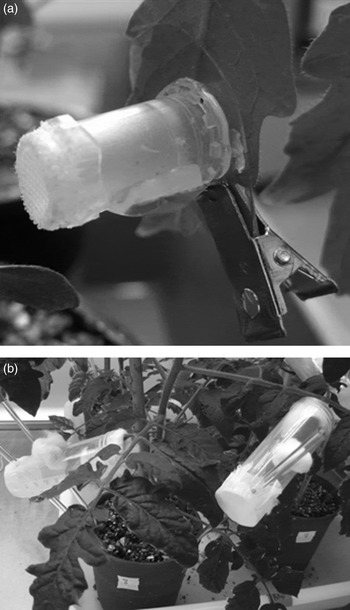
Independent no-choice assays with each the MEAM1 and MED species of B. tabaci were carried out. In a first no-choice assay, 15 eight-week-old tomato plants from each genotype (Moneymaker, Moneymaker NahG, VFN and VFN NahG) were infested with five adult female whiteflies (MED) confined in a plastic clip-cage (Muñiz & Nombela Reference Muñiz and Nombela2001). Every clip-cage was attached to the abaxial surface of a leaflet per plant (fig. 1a). Assays were performed in a growth chamber under low light intensity (41–42 μmol m−2 s−1) to avoid formation of necrotic spots on tomato NahG plants due to the accumulation of catechol. Healthy plants were maintained at a constant temperature of 25°C, with a photoperiod of 16 h light and 8 h dark and 68–75% RH. Females were allowed to oviposit for 6 days and, then, all females and clip-cages were removed from plants. The eggs laid on plants were immediately counted. The eggs were allowed to develop into instars (N) for approximately 21 more days (day 27th after whitefly infestation) until the new adults started to emerge from pupae. Then, the numbers of N3, N4 and new adults (detected as empty pupal cases) on every plant were counted and total number of insects (N3 + N4 + adults) were calculated. Plants losing their clip-cages or damaged for any reason during the assay were discarded.
Methods used for whitefly infestations: (a) a clip-cage used in the assays for the role of SA in basal defense and in the Mi-1 mediated resistance to B. tabaci. (b) Modified Falcon tube used in the assays for hormone quantification.

In another no-choice assay, 24 eight-week-old tomato plants from each genotype were infested with five adult female whiteflies (MEAM1) confined in a clip-cage attached to one leaflet (fig. 1a). Temperature for this no-choice assay was maintained constant at 24°C. After a 6-day oviposition period, the clip-cages and females were removed from all plants. The eggs laid on 12 plants from each genotype were counted and these plants were subsequently eliminated. Eggs on the remaining 12 plants per genotype were allowed to develop for 21 more days, until new adults started to emerge. Insect counts were performed as described for the MED population assay. Every assay was repeated at least twice.
Statistical analysis
Data from every assay were log10 (x + 1) transformed, except for percentages which were arcsine transformed (P/100)1/2. Data were compared among genotypes by a one-way ANOVA and Tukey HSD test for unequal N (Statsoft, 1994) for the percentages of adults, while the percentages of N3 and N4 were analyzed by Mann–Whitney as data were not normalize.
Insect infestation for hormone analysis
An additional no-choice assay was performed to obtain leaf material for SA and JA quantification before and after whitefly infestation. A constant temperature of 25°C was maintained during this assay to fit the insect development to that described by Bonato et al. (Reference Bonato, Lurette, Vidal and Fargues2007). The remaining environmental conditions were the same as described for the MED species assay. Twenty MED females were confined into each of modified 50 ml Falcon tubes (fig. 1b). Every tube was attached to a well-expanded leaflet in the medium-high area of a tomato plant. Three tubes per plant and three plants per genotype were used. For control, empty tubes were attached to other plants. After 2 days, all tubes were removed. During this infestation, additional plants were similarly infested to evaluate whitefly infestation rates. Expected differences, as determined in the previous bioassays, were found in whitefly infestation levels among the tomato genotypes. Two leaf tissue collection times (2 and 12 days post-infestation; 2 dpi and 12 dpi, respectively) were established, each corresponding to a specific time of whitefly development and infestation at this temperature (Bonato et al., Reference Bonato, Lurette, Vidal and Fargues2007). These time points were chosen to evaluate the impact of female feeding and oviposition at 2 dpi and the feeding and movement caused by the first instar (N1) at 12 dpi. This instar is the mobile and most active whitefly nymphal stage, commonly called crawler, uses its stylet to puncture cells to find a suitable feeding site to become immobile and molt. Accordingly, three different treatments were considered: (1) control or non-infested plants (C), obtained 2 days after placement of the empty tubes. (2) 2 dpi, to evaluate the impact of female feeding and oviposition. (3) 12 dpi, at which time most eggs have developed to the N1 stage. Each sample consisted of three leaflets, collected from each of three plants from the same genotype/treatment. Two replicates from each sample were measured. After every sampling time, used plants were discarded. Each sample was wrapped in aluminum foil packages, frozen in liquid nitrogen and stored at −80°C prior processing for SA and JA quantification.
Hormone extraction and quantification
Leaf samples were lyophilized with a lyophilizer Heto FD 1.0 prior to processing according to a standard protocol adapted from Durgbanshi et al. (Reference Durgbanshi, Arbona, Pozo, Miersch, Sancho and Gómez-Cadenas2005).
Samples were analyzed by high-performance liquid chromatography coupled to mass spectrometry (Alliance 2695, Waters Corp, Milford, MA). The chromatographic separation was performed with a column C18 (Kromasil® 100 Å, 5 μm silica particle diameter, 100 × 2.1 mm) using a lineal gradient of metanol and water supplemented with 0.01% acetic acid, with a flow of 300 μl min−1. Both SA and JA were detected and quantified by means of their specific transitions in a mass spectrometer of triple quadrupole (Quattro LC, Micromass Ltd., Manchester, UK). Values were obtained by averaging those recorded from three equivalent samples.
Results
SA and JA levels in tomato leaves before and after infestation by B. tabaci
SA levels were measured in tomato leaves of susceptible cv. Moneymaker (mi-1), transgenic Moneymaker expressing NahG (mi-1; Moneymaker NahG), resistant cv. VFN (Mi-1) and in VFN expressing NahG (Mi-1; VFN NahG). Plant maintaining at low light intensity resulted in healthy NahG plants without the presence of any necrotic spots.
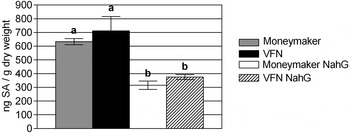
Results of the SA quantification of non-infested tomato leaves are shown in fig. 2. Tomato cvs Moneymaker and VFN displayed similar constitutive SA levels. These SA levels were significantly higher than those in the corresponding genotypes expressing NahG (fig. 2).
Quantification of the salicylic acid (SA) content (mean ± standard error) in tomato leaves from non-infested 8-week-old tomato plants. Different letters indicate significant differences (P < 0.05) among tomato genotypes by the Tukey test.

Changes in the SA levels in the leaves of the non-infested plants (control) and plants infested with B. tabaci (MED species) at 2 and 12 dpi are shown in fig. 3a, separately for each tomato genotype. At 2 dpi, the resistant tomato VFN displayed a dramatic increase in SA content, compared with VFN non-infested control plants (C). At the same time point, SA levels increased significantly, but to a much lesser extent, in the susceptible cv. Moneymaker and Moneymaker NahG, compared with the corresponding non-infested plants. In contrast, SA content in the VFN NahG plants did not change significantly at 2 dpi compared with non-infested plants of this genotype. At 12 dpi, a significant decrease in SA content was detected in all analyzed tomato genotypes, especially in those expressing NahG where the SA levels were even lower than in the non-infested plants (fig. 3a).
Changes in the SA (a) and JA (b) contents of tomato leaves, due to infestation by B. tabaci (MED species). Values were obtained from non-infested control plants (C) and from infested plants at 2 and 12 days post-infestation (2 dpi and 12 dpi, respectively). Different letters in the same tomato genotype indicate significant differences (P < 0.05) among treatments by the Tukey test. Statistical comparisons among tomato genotypes were not made.

The JA contents were also evaluated in the same leaf samples. The JA levels were almost 0 and practically undetectable in all non-infested control plants. These values were compared with those in the infested plants, separately for each tomato genotype (fig. 3b). The JA content in all tomato genotypes increased after infestation with B. tabaci at both 2 dpi and 12 dpi. Except for Moneymaker NahG, the increase in JA content was significantly highest at 2 dpi in all genotypes tested and significantly decreased at 12 dpi. Conversely, the increase in JA levels in the Moneymaker NahG plants was not significant at 2 dpi but was at 12 dpi. At 12 dpi, levels in Moneymaker NahG were similar to those in Moneymaker and VFN NahG. At 12 dpi, JA levels in all tested genotypes were significantly greater than those in non-infested control plants.
The role of SA in basal defense to B. tabaci
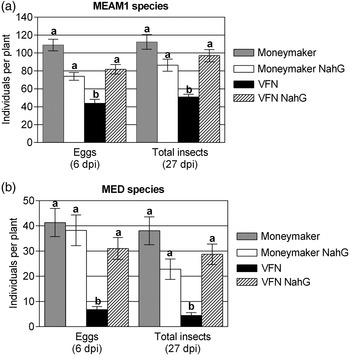
Plants of all four tomato genotypes were infested with adult whiteflies of either MEAM1 or MED and evaluated for female oviposition and infestation (fig. 4).
B. tabaci no-choice assays on tomato genotypes Moneymaker, Moneymaker NahG, VFN and VFN NahG. Independent experiments were performed for MEAM1 (a) and MED (b) species. Eight-week-old plants from each tomato genotype were exposed to five B. tabaci females in insect clip-cages for 6 days. Numbers of eggs were recorded at 6th day post-infestation (6 dpi) and numbers of total individuals (N3 + N4 + new adults) were recorded at the end of the assays (27 dpi). For each of these parameters, data are means ± standard errors, and different letters indicate significant differences (P < 0.05) among tomato genotypes by the Tukey test.

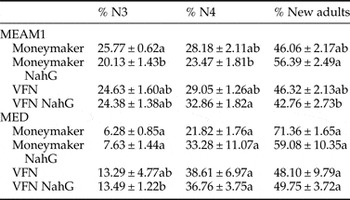
To evaluate a role for SA in the basal defense to B. tabaci, whitefly fecundity, expressed as the number of eggs layed by females during a 6-day oviposition period, was compared with Moneymaker and Moneymaker NahG plants (fig. 4). Whitefly females laid a slightly lower number of eggs on Moneymaker NahG than on Moneymaker, especially the MEAM1 species, but these differences were not statistically significant. Similarly, no significant differences were observed in the total numbers of insects of either whitefly species on Moneymaker NahG and Moneymaker at the end of the assays (day 27th after infestation). In general, oviposition numbers and, consequently, the final infestation values of the MEAM1 were higher than those of MED on both tomato genotypes (fig. 4). Based on the final infestation values shown in fig. 4, the rate of insect development was calculated for each tested tomato genotype (table 1), represented by the percentage of individuals in the late developmental stages N3, N4 and new adults, relative to the total number (N3 + N4 + adults) at the end of the assays. These results indicated that MED population suffered a slight retarded development on Moneymaker NahG plants compared with Moneymaker. In contrast, MEAM1 species developed at a slightly faster rate on Moneymaker NahG compared with Moneymaker. However, the small differences in the percentages of the whitefly developmental stages between Moneymaker NahG and Moneymaker plants were, in general, not statistically significant (table 1).
Percentage of N3, N4 and new adults in relation to the total number of individuals per plant of B. tabaci (MEAM1 and MED species) recorded at the end of the assays (27 dpi). Means ± standard errors are presented.

Means followed by the same letter in a column for each whitefly species do not differ significantly (P < 0.05) by Tukey HSD test for unequal N (% of adults) and by Mann–Whitney test (% of N3 and N4).
The role of SA in the Mi-1-mediated resistance to B. tabaci
To test if SA is required for the Mi-1-mediated resistance to B. tabaci, we compared VFN NahG and parental cv. VFN and Moneymaker NahG with MEAM1 and MED species of B. tabaci in two independent assays (fig. 4). On the VFN NahG plants, the Mi-1-mediated resistance to both MEAM1 and MED species of B. tabaci was lost. Both female oviposition and final infestation values on VFN NahG plants were significantly greater than on the resistant parent VFN, but not significantly different from those on the susceptible parent Moneymaker NahG (fig. 4).
To check if whitefly development was altered on VFN NahG plants, the percentages of N3, N4 and new adults, relative to the total number of individuals recorded at the end of the assay, were compared with those on the parental genotypes VFN and Moneymaker NahG (table 1). For the MED species, approximately 60% of the insects on the Mi-1-lacking Moneymaker NahG plants were adults; this percentage was lower than 50% on the Mi-1 plants (VFN and VFN NahG), although this difference was not statistically significant. Consequently, a slight increase in the percentages of individuals in the nymphal instars N3 and N4 was observed on both VFN and VFN NahG. The difference for N3 between Moneymaker NahG and VFN NahG plants was statistically significant.
In general, MEAM1 development was slower than that observed for MED (table 1). MEAM1 whiteflies developed slower on Mi-1-containing plants, as the percentage of new adults was lower and, conversely, the percentages of N3 and N4 were greater than those on Moneymaker NahG. Only the difference between Moneymaker NahG and VFN NahG in the percentage of N4 was statistically significant. As a whole, these results denoted a slight retardation in the speed of whitefly development due to the Mi-1 gene, for both MEAM1 and MED species.
Finally, no significant differences between VFN and VFN NahG genotypes were observed for any whitefly developmental stages (table 1), which indicated that the presence of the NahG gene had no effect on the rate of MEAM1 and MED species development on Mi-1 plants.
Discussion
Basal levels of SA and JA and efficiency of NahG gene in degrading SA in adult tomato plants
Quantification of SA in uninfested leaves showed similar basal levels of this hormone in Moneymaker (Mi-1) and VFN (Mi-1), and significantly lower levels in Moneymaker NahG (Mi-1) and VFN NahG plants (Mi-1). These results demonstrate the efficiency of salicylate hydroxylase, encoded by NahG, in degrading SA to catechol in leaves of fully developed 8-week-old tomato plants. This reduction in NahG containing lines is approximately 50% from baseline SA levels in the respective wild-type parent cvs Moneymaker and VFN. The difference in SA levels between Moneymaker NahG and Moneymaker is similar to those obtained by Thaler et al. (Reference Thaler, Agrawal and Halitschke2010) from much younger plants, with only two true leaves, of the same genotypes but, according to our information, this is the first time this difference is quantified in 8-week-old plants. Bhattarai et al. (Reference Bhattarai, Xie, Mantelin, Bishnoi, Girke, Navarre and Kaloshian2008) evaluated SA levels in roots of 5-week-old tomato plants and showed a similar decrease (60%) in SA levels in plants containing NahG (Moneymaker NahG and VFN NahG) compared with the respective wild-type genotype. Interestingly, a higher reduction of about 90% in SA content was obtained in monoxenic hairy root cultures of Moneymaker NahG tomato, transformed using Agrobacterium rhyzogenes, suggesting that NahG was expressed at higher levels in this plant growth/transformation system (Branch et al., Reference Branch, Hwang, Navarre and Williamson2004).
The JA foliar content was extremely low in the uninfested plants. Similar low levels of JA have been reported previously in uninfested leaves of different tomato cvs at different plant developmental stages (Li et al., Reference Li, Schilmiller, Liu, Lee, Jayanty, Sageman, Vrebalov, Giovannoni, Yagi, Kobayashi and Howe2005; Thaler et al., Reference Thaler, Agrawal and Halitschke2010; El Oirdi et al., Reference El Oirdi, El Rahman, Rigano, El Hadrami, Rodriguez, Daayf, Vojnov and Bouarab2011). Consequently, the low content of JA in uninfested plants of the present work supported the assumption that the modified Falcon tubes used in the whitefly infestations did not trigger any mechanical damage.
Whitefly infestation increases the SA content in leaves
Infestation of Moneymaker and Moneymaker NahG plants with adult females of B. tabaci (MED species) increased SA levels. At the early infestation time point (2 dpi), the increase in SA level due to whitefly feeding and/or oviposition was significant and similar in both Moneymaker and Moneymaker NahG. This result is contrary to what has been reported for infections with the viral pathogen tobacco mosaic virus (TMV) or the bacterial pathogen P. syringae pv. tomato DC3000, which significantly increase the levels of SA in Moneymaker but not in Moneymaker NahG plants at 7 days after pathogen inoculation (Thaler et al., Reference Thaler, Agrawal and Halitschke2010). Similarly, Li et al. (Reference Li, Xie, Smith Becker, Navarre and Kaloshian2006) have observed that SA levels in Moneymaker NahG plants did not increase significantly after infection with the P. syringae pv. syringae. However, they did not include cv Moneymaker in their analysis, which did not allow a comparison of SA levels between Moneymaker NahG and Moneymaker.
In contrast to SA, the increase of JA levels at 2 dpi with B. tabaci was high in Moneymaker but, surprisingly, this increase was not statistically significant in Moneymaker NahG plants. Similarly, it was previously shown that infection with P. syringae pv. tomato DC3000 also caused an increase in JA levels in young plants of both genotypes, though less pronounced in Moneymaker NahG than in Moneymaker (Thaler et al., Reference Thaler, Agrawal and Halitschke2010). In contrast, TMV infection did not increase the content of JA in either of these two tomato genotypes. It is widely known that JA and ET signaling pathways usually work synergistically while SA and JA/ET pathways are antagonists (Kunkel & Brooks, Reference Kunkel and Brooks2002; Spoel et al., Reference Spoel, Koornneef, Claessens, Korzelius, Van Pelt, Mueller, Buchala, Métraux, Brown, Kazan, Van Loon, Dong and Pieterse2003), although positive coordination between these pathways have been reported (Schenk et al., Reference Schenk, Kazan, Wilson, Anderson, Richmond, Somerville and Manners2000; Rojo et al., Reference Rojo, Solano and Sánchez-Serrano2003; Bostock, Reference Bostock2005; Mur et al., Reference Mur, Kenton, Atzorn, Miersch and Wasternack2006). Most studies of piercing-sucking insects have focused on interactions with aphids (Thompson & Goggin, Reference Thompson and Goggin2006; Walling, Reference Walling2008; Louis & Shah, Reference Louis and Shah2013). During aphid infestations, both SA- and JA-regulated responses are induced in tomato (Martínez de Ilarduya et al., Reference Martínez de Ilarduya, Xie and Kaloshian2003; Li et al., Reference Li, Xie, Smith Becker, Navarre and Kaloshian2006; Bhattarai et al., Reference Bhattarai, Xie, Pourshalimi, Younglove and Kaloshian2007).The present work demonstrates that B. tabaci infestation causes accumulation of both SA and JA hormones in susceptible tomato plants, with a relatively greater increase in JA levels. Taken together, our data indicates the absence of a strict negative cross talk between SA and JA in tomato, since a plant with a functional salicylate pathway would have a weak ability to induce the jasmonate pathway (Thaler et al., Reference Thaler, Agrawal and Halitschke2010). In contrast to tomato, antagonistic relationship between the JA and SA pathways has been demonstrated in Arabidopsis–Bemisia interactions with induction of SA-regulated genes and repression of genes JA/ET-regulated genes (Kempema et al., Reference Kempema, Cui, Holzer and Walling2007; Zarate et al., Reference Zarate, Kempema and Walling2007).
The increase in JA levels by whitefly infestation is not likely due to stylet injury since whitefly feeding on susceptible tomato plants induced expression of JA-dependent pathogenesis-related genes but not expression of JA-dependent wound responsive genes (Puthoff et al., Reference Puthoff, Holzer, Perring and Walling2010). These data suggest that the whitefly stylet is not perceived by the plant as a mechanical stress to activate JA-dependent wound responses (Walling, Reference Walling2008). This is in contrast to responses triggered by chewing herbivores (Pautot et al., Reference Pautot, Holzer, Reisch and Walling1993; Li et al., Reference Li, Lee and Howe2002; Ament et al., Reference Ament, Kant, Sabelis, Haring and Schuurink2004) and some aphids (reviewed by Thompson & Goggin, Reference Thompson and Goggin2006), where JA-regulated wound induced genes are up-regulated in both susceptible and/or resistant plants.
The largest increases in the contents of SA and JA caused by feeding and oviposition of B. tabaci females in this study were detected in the resistant VFN plants. Specifically, the SA content in this genotype at 2 days of infestation was more than 10 times higher than in the respective non-infested plants. Another significant increase in SA levels of VFN have also been observed in younger plants during infection of hypersensitive reaction causing P. syringae pv. syringae (Li et al., Reference Li, Xie, Smith Becker, Navarre and Kaloshian2006). Other works that had quantified the levels of this phytohormone in resistant tomato plants did not analyze the changes that occurred after the attack of an organism (Branch et al., Reference Branch, Hwang, Navarre and Williamson2004; Bhattarai et al., Reference Bhattarai, Xie, Mantelin, Bishnoi, Girke, Navarre and Kaloshian2008) or used only susceptible infested plants (O'Donnell et al., Reference O'Donnell, Schmelz, Block, Miersch, Wasternack, Jones and Klee2003; Thaler et al., Reference Thaler, Agrawal and Halitschke2010). The proportional increase in JA levels in the VFN plants in our study was similar to that observed for SA confirming absence of negative cross talk between these phytohormones in tomato.
As expected, an increase in SA level was not detected in VFN NahG plants at 2 dpi by B. tabaci. Similarly, infection of VFN NahG plants with P. syringae pv. syringae did not increase SA content (Li et al., Reference Li, Xie, Smith Becker, Navarre and Kaloshian2006). In contrast, JA levels were high in VFN NahG plants at 2 dpi with B. tabaci, although to a lesser extent than in VFN plants, indicating that the increase in JA content in VFN NahG is not due to the presence of NahG and negative cross talk between these two hormonal pathways.
The increased levels of SA and JA observed in the present study after infestation by B. tabaci, leads us to hypothesize that perhaps this increase in both phytohormones could be the reason for the induced resistance to aphids previously demonstrated in susceptible tomato plants following an earlier infestation by B. tabaci (Nombela et al., Reference Nombela, Garzo, Duque and Muñiz2009).
The increase in SA and JA levels due to B. tabaci infestation was transient, as the levels detected at 2 dpi decreased at 12 dpi in all tomato genotypes, except for the JA content in Moneymaker NahG which was only slightly elevated. In contrast to our data, B. tabaci infestation of bean plants had resulted in a decrease in SA levels at 3 dpi. However, this effect also proved to be transient, as SA levels increased at 7 dpi which was the last time point tested (Zhang et al., Reference Zhang, Zheng, Loon, van Boland, David, Mumm and Dicke2009). This information indicates that although the timing of SA accumulation varies, B. tabaci infestation induces SA accumulation in a number of plant species.
Taken together, our results showed that feeding and oviposition of adult whitefly females, activities associated with 2 dpi, cause a greater accumulation of SA and JA than the N1 activities associated with 12 dpi, in almost all of tomato genotypes tested. Previous works with whiteflies have focused on SA- and JA-dependent gene expression caused by adult feeding and oviposition on tomato (Puthoff et al., Reference Puthoff, Holzer, Perring and Walling2010), or on hormone levels affected only by the activities of N2–N3 nymphs on Arabidopsis (Zarate et al., Reference Zarate, Kempema and Walling2007). Therefore, these previous works could not draw conclusions on the effect of adult and nymphal activities on the same host.
The SA pathway is not involved in the basal defense of tomato to B. tabaci
The lack of difference in both number of eggs and total number of insects on Moneymaker and Moneymaker NahG plants indicates that SA signaling pathway does not play an important role in the tomato basal defense to both MEAM1 and MED species of B. tabaci. These results are consistent with those obtained in Arabidopsis against B. tabaci by Zarate et al. (Reference Zarate, Kempema and Walling2007) who used mutant plants to demonstrate that SA pathway is not associated with basal defense to this insect. However, Zarate et al. (Reference Zarate, Kempema and Walling2007) showed that whitefly development was delayed on Arabidopsis NahG plants. On the contrary, on tomato no statistical differences between Moneymaker and Moneymaker NahG plants were observed regarding the development of both MEAM1 and MED whitefly species. Slight differences in infestation rates and development between the corresponding B- and Q- whitefly biotypes on susceptible tomato genotypes had been previously reported (Nombela et al., Reference Nombela, Beitia and Muñiz2001).
Our results with B. tabaci also agree with a previous study showing that SA was not involved in basal defense of tomato to root-knot nematodes (Bhattarai et al., Reference Bhattarai, Xie, Mantelin, Bishnoi, Girke, Navarre and Kaloshian2008), and they are in contrast with those previously obtained with aphids by Li et al. (Reference Li, Xie, Smith Becker, Navarre and Kaloshian2006), where a role for SA in the basal defense of tomato to aphids was demonstrated. While SA is required for basal defense to aphids, JA is not required for this basal defense (Bhattarai et al., Reference Bhattarai, Xie, Pourshalimi, Younglove and Kaloshian2007). Differences exist between aphids and whiteflies due to their different feeding habits (van Loon et al., Reference van Loon, Rep and Pieterse2006; Walling, Reference Walling2008) and presumed differences in elicitors in their saliva which may provoke different plant responses (Walling, Reference Walling2000).
Although SA is not required for tomato basal defense to B. tabaci, we had previously shown that exogenous application of BTH, a SA analog, induces resistance to B. tabaci in susceptible tomato plants (Nombela et al., Reference Nombela, Pascual, Aviles, Guillard and Muñiz2005). It is known that treatment with BTH does not cause an increase in SA levels; however, it induces expression of defense genes (Friedrich et al., Reference Friedrich, Lawton, Ruess, Masner, Specker, Rella, Meier, Dincher, Staub, Uknes, Métraux, Kessmann and Ryals1996). BTH must be activating SA-nonresponsive defense genes in tomato and activation of these defense genes might be the reason for the induction of resistance to B. tabaci in susceptible tomato plants after treatment with BTH.
The SA pathway has a role in the Mi-1-mediated resistance to B. tabaci
The results obtained in the present work demonstrate a role for SA in Mi-1-mediated resistance to B. tabaci. These results are consistent with a previous study in which the involvement of SA in resistance mediated by Mi-1 gene to aphids was demonstrated (Li et al., Reference Li, Xie, Smith Becker, Navarre and Kaloshian2006). While the role for SA in Mi-1-mediated resistance to nematodes is controversial (Branch et al., Reference Branch, Hwang, Navarre and Williamson2004; Bhattarai et al., Reference Bhattarai, Xie, Mantelin, Bishnoi, Girke, Navarre and Kaloshian2008), it is clear that Mi-1-mediated herbivore resistance involves SA. The apparent difference between the two studies addressing the role of SA in Mi-1-mediated nematode resistance could be due to the different systems used, mono-axenic hairy roots versus entire transgenic plants, and more efficient degradation of SA in the former.
The very low levels of SA observed in the VFN NahG plants were associated with a reduction in B. tabaci population growth similar to levels on Moneymaker NahG plants. This was in contrast with the negative growth rate on the resistant cv VFN indicating a significant reduction of the insect population in the next generation. Nevertheless, differences in the SA content of plants carrying the Mi-1 gene (VFN and VFN NahG) did not apparently modify the developmental rate of B. tabaci. However, the slight delay (although not significant) in the development of B. tabaci was solely due to the presence of the Mi-1 gene. In previous works performed with aphids and nematodes on these same plant genotypes (Branch et al., Reference Branch, Hwang, Navarre and Williamson2004; Li et al., Reference Li, Xie, Smith Becker, Navarre and Kaloshian2006; Bhattarai et al., Reference Bhattarai, Xie, Mantelin, Bishnoi, Girke, Navarre and Kaloshian2008), the effect on the developmental rates of these organisms was not analyzed.
Further studies are needed to determine whether other defense hormone signaling pathways may be involved in the tomato basal resistance to B. tabaci and/or in the Mi-1-mediated resistance to this insect pest. These studies could include additional tomato mutants to investigate the role of JA/ET hormones and the interaction between SA and JA/ET pathways, as described for whitefly–Arabidopsis (Zarate et al., Reference Zarate, Kempema and Walling2007) and aphid–tomato interactions (Li et al., Reference Li, Xie, Smith Becker, Navarre and Kaloshian2006; Bhattarai et al., Reference Bhattarai, Xie, Pourshalimi, Younglove and Kaloshian2007).
Acknowledgements
Authors are grateful to Angelina Ruano, Ana Azahara Gómez, Daniel Alonso and Valeriana López for their technical assistance in some of the bioassays or in the manuscript preparation. Research presented in this article was funded by a Project (AGL2007-65854/AGR) from the Plan Nacional I + D + I, Spanish Ministry of Education and Science. Clara I. Rodríguez Álvarez was financially supported by a fellowship/contract (AP2006-1035) from the Spanish FPU Program.