Introduction
Fungal sinusitis is broadly categorised as either invasive or non-invasive.Reference Thompson and Patterson1 Non-invasive fungal sinusitis is subdivided into allergic fungal sinusitis and fungus ball.Reference Thompson and Patterson1, Reference Chakrabarti, Denning, Ferguson, Ponikau, Buzina and Kita2 In Japan, fungus ball is the most frequent cause of non-invasive fungal sinusitis, and the maxillary sinus is the most common location.Reference Grosjean and Weber3–Reference Lai, Lee, Chen and Tsai6 The Caldwell–Luc operation was widely used to treat fungus ball sinusitis before the development of endonasal functional endoscopic sinus surgery (FESS).Reference Grosjean and Weber3 At present, FESS has become the accepted treatment for patients with fungal maxillary sinusitis.Reference Grosjean and Weber3–Reference Lai, Lee, Chen and Tsai6 Although the standard FESS approach for chronic maxillary sinusitis uses a middle meatal approach,Reference Kennedy and Adappa7, Reference Kennedy, Zinreich, Shaalan, Kuhn, Naclerio and Loch8 some previous reports have recommended a combined approach, such as both middle and inferior meatal antrostomies, for severe cases of maxillary sinusitis.Reference Hinohira, Hyodo and Gyo9, Reference Ochi, Sugiura, Komatsuzaki, Nishino and Ohashi10 Very few reports have evaluated the results of FESS using a combination of the middle meatal approach with an inferior meatal antrostomy for fungus ball maxillary sinusitis, and it has not been established whether inferior meatal antrostomy is necessary for successful FESS in these patients. Furthermore, the patency of the inferior meatal antrostomy in FESS for fungus ball maxillary sinusitis has not been established. The purpose of this study was to evaluate the effectiveness of the combination of inferior meatal antrostomy with the middle meatal approach in FESS for the treatment of maxillary sinus fungus ball.
Patients and methods
In this retrospective study, fungal ball maxillary sinusitis was defined according to the diagnostic criteria by de Shazo et al. Reference deShazo, O'Brien, Chapin, Soto-Aguilar, Swain and Lyons11
Patients
A total of 380 chronic sinusitis patients, including patients with fungus ball sinusitis, were treated using FESS techniques from 2004 to 2010 in Oda Hospital ENT Surgery Center and Kyushu University Hospital. For this study, detailed clinical analyses of 28 patients (5 males and 23 females) with fungus ball of the maxillary sinus who underwent FESS were performed. All patients included in the study were suspected to have fungus ball maxillary sinusitis based on pre-operative computed tomography (CT) examinations, which revealed sinus opacification with or without associated flocculent calcifications. All included cases were histologically confirmed as Aspergillus or fungus ball maxillary sinusitis by post-operative pathological examination. All patients underwent FESS without extra-nasal approaches (Caldwell-Luc procedure or canine fossa approach). Pre-operative CT was performed in all cases. All patients had chronic non-invasive disease. Eosinophil-related fungal rhinosinusitis including allergic fungal rhinosinusitis was excluded. In all cases, the fungus ball was unilateral and was located in a maxillary sinus and not in the ethmoid, sphenoid or frontal sinuses. Fourteen patients who were treated with FESS using both middle and inferior meatal antrostomies were included in the combined group, and the remaining 14 patients, who were treated with FESS using middle meatal antrostomy alone to make a sufficiently wide opening, comprised the control group. None of the patients received specific antifungal therapy prior to FESS. The mean age at the time of FESS was 60 years, with a range of 26–82 years.
Surgical technique
Complete removal of fungal debris by FESS through a sufficiently wide meatal antrostomy was confirmed in all cases. The FESS procedures were performed using a 0° endoscope and angled endoscopes (30°, 45° and 70°). The surgeries were performed under general or local anaesthesia. The nasal cavity was decongested using gauze with lidocaine and epinephrine; subsequently 0.5 or 1 per cent lidocaine with 1:100 000 epinephrine was injected at the level of the middle turbinate root and uncinate process. The uncinate process was removed in cases of middle meatal antrostomy. After widening of the antrostomy for the maxillary sinus, the fungus ball was extracted using a suction tube, and curved microdebrider blades. A 3 × 15 or 3 × 30 cm2 gauze was generally used to remove fungus balls. This technique was similar to the previously reported gauze-assisted technique.Reference Chao and Liu12 Polyps were removed from sinuses with no exposed bone using the microdebrider blades. Care was taken to avoid any removal of maxillary sinus mucosa. If the ethmoid bulla was severely blocked, ethmoidectomy was also performed to remove fungus balls. The surgeon decided whether or not to perform an inferior meatal antrostomy based on the maxillary sinus findings observed from the middle meatal window. When the fungus ball was located on the anterior or inferior side of the maxillary sinus, or if the surgeon could not see that area, an inferior meatal antrostomy was performed. In this approach, the bridge of bone between the two antrostomies preserved the inferior turbinate. The risk of closure of an inferior meatal antrostomy is thought to be greater than that for middle meatal antrostomy. Therefore, we usually performed a meatal flap procedure to avoid closure or stenosis of the inferior meatal antrostomy. The meatal flap was elevated on the inferior and lateral mucosa in the inferior meatus. After elevation from the meatal bone, the flap was positioned on the nasal floor and an inferior meatal window was then created using a perforator. The bony wall was removed piece by piece to make a sufficiently wide opening in the maxillary sinus. After making the sufficiently wide opening, the mucosal flap was positioned across the inferior lip of the bony window into the maxillary sinus. If the lesion was located in the anterior, inferior or medial regions, the microdebrider blades were passed through the inferior antrostomy using a 70° endoscope. Nasal and sinus saline irrigation was performed at the end of the surgery. The nasal cavity was minimally packed with chitin-coated gauze (Beschitin F, Unitika Co., Ltd, Kyoto, Japan), which was removed at post-operative days 2–4 before discharge. Septoplasty prior to FESS was performed in one case because of severe nasal septal deviation.
Post-operative care and treatment
Nasal and sinus saline irrigation using a bulb syringe was recommended after discharge for five patients (two combined and three control). One patient received antifungal medication after FESS because of high post-operative fever. All patients underwent post-operative CT examination at three or four months after the FESS. The follow-up period ranged from 12 to 60 months (average 18 months).
The main outcome measures were operative time and post-operative CT findings.
Statistical analysis was performed using the Mann–Whitney U test or Fisher's exact test. A p-value of <0.01 was considered statistically significant.
Results and analysis
It was not necessary to make a new mucosal incision at the canine fossa in any patient. There were no complications after FESS. Among all included patients (n = 28), nine (32 per cent) had polyps: all polyps were non-specific inflammatory conditions. Histological examination of the specimens revealed a large number of fungal hyphae in all cases. In the post-operative pathological examination, Aspergillus was confirmed in 20 patients (71 per cent).
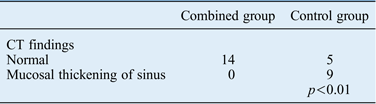
In the combined group (n = 14), the post-operative CT examination at three or four months after the FESS showed a normal maxillary sinus in all cases (Table I). No case of recurrence was observed in the combined group. In contrast, in the control group (n = 14), five patients (36 per cent) had normal CT results, whereas nine (64 per cent) exhibited maxillary mucosal thickening on the post-operative CT scan (Table I, p < 0.001). In the control group, 2 of 14 patients (14 per cent) had persistent fungus ball after FESS without inferior meatal antrostomy. One of these patients required repeat FESS with the combined approach, and the other one required continuation of the nasal washing procedure for clearing of the nasal and sinus cavity. Eventually, all of the patients in the control group improved to normal, but the latter two patients in this group required 6–12 months to complete the healing process of the sinus cavity.
Post-operative CT findings at three to four months after surgery

CT = computed tomography
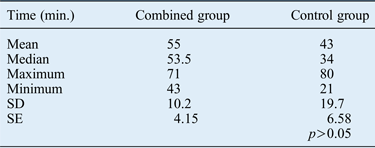
Of the total 28 patients, 15 underwent FESS by a single otolaryngologist. We compared the operative times for this surgeon between the combined group (six cases) and the control group (nine cases). The mean operation time for the combined group was 55 minutes, with a range of 43–71 minutes and the mean operation time for the control group was 43 minutes, with a range of 21–80 minutes, but the differences were not significant (Table II, p = 0.16).
Surgical times for the combined and control groups
SD = standard deviation; SE = standard error
Bleeding between the combined group and control group was not a significant factor.
Discussion
Endoscopic middle meatal maxillary antrostomy is one of the most commonly performed FESS procedures.Reference Kennedy and Adappa7 This procedure was introduced into the English literature in 1987 by Kennedy et al. Reference Kennedy, Zinreich, Shaalan, Kuhn, Naclerio and Loch8 The concept for this procedure was based on research demonstrating mucociliary flow through the natural maxillary ostium. Based on this theory, it is useless to make a new window at the inferior meatus for chronic sinusitis.Reference Kennedy and Adappa7, Reference Kennedy, Zinreich, Shaalan, Kuhn, Naclerio and Loch8 We believe that inferior meatal antrostomy is unnecessary for most cases of chronic sinusitis, but not for fungus ball sinusitis. Only a few reports have evaluated the results of FESS using the combination of the middle meatal approach with an inferior meatal antrostomy for fungus ball maxillary sinusitis, and the present study has shown that the results of FESS with the middle meatal approach and an inferior meatal antrostomy (combined group) were better than those of the middle meatal approach alone (control group). We had two cases of persistent fungus ball in the control group. We propose that this was due to insufficient visualisation of the entire cavity or an incomplete removal of the fungus ball. One of the two patients with residual fungus ball was successfully treated by repeat FESS using the combined approach. In previous reports, the persistence or recurrence rate of fungus ball maxillary sinusitis treated with FESS was 0–4 per cent.Reference Nicolai, Lombardi, Tomenzoli, Villaret, Piccioni and Mensi5, Reference Lai, Lee, Chen and Tsai6, Reference Chao and Liu12–Reference Dufour, Kauffmann-Lacroix, Ferrie, Goujon, Rodier and Karkas14 In our study, in the combined group, post-operative CT examination at three to four months after FESS showed normal maxillary sinus, and no recurrence was observed in any patient in this group (Table I).
During FESS, when we observe the maxillary sinus from a middle meatus window only, it is sometimes difficult to see the anterior inferior or medial inferior wall of the maxillary sinus even when a 70° endoscope is used. Thus, we believe that when a fungus ball is located in the anterior inferior and medial inferior wall of the maxillary sinus, it is possible that its removal from a middle meatus window will be incomplete. Combining middle and inferior meatal antrostomies may provide intra-operative benefits. The double ventilation pathway may be superior to a single ventilation pathway, and the combined approach, compared with single middle meatus approach, makes it easier to visualise the whole sinus, especially the anterior inferior and medial inferior wall of the maxillary sinus.
We can easily insert surgical instruments, including both straight and curved microdebriders, through the inferior window while visualising the maxillary sinus from the antrostomy in the middle meatus. Good visualisation of the sinus and easy insertion of the surgical instruments increase the possibility that incomplete removal of the fungus ball will be avoided. Klossek previously reported a necessity to associate a middle meatus antrostomy with an inferior antrostomy in about 65 per cent of fungus ball cases in order to facilitate access and removal of the fungus ball.Reference Klossek, Serrano, Péloquin, Percodani, Fontanel and Pessey13 Dufour et al., in a report of 150 fungus ball maxillary sinusitis cases that reviewed the FESS procedure, performed both middle meatus antrostomies (n = 53/150, 35 per cent) and combined middle and inferior antrostomies (n = 97/150, 65 per cent).Reference Dufour, Kauffmann-Lacroix, Ferrie, Goujon, Rodier and Karkas14 Based on these reports, the combination of middle and inferior antrostomies seems to be necessary in over 60 per cent of fungus ball maxillary sinusitis FESS procedures. Our study indicates that the difference in operative times was not significant between the combined group and control group. Furthermore, there was no significant difference in blood loss between the two groups. We believe that the combined middle and inferior meatus antrostomy approach is a minimally invasive procedure which can be performed with better results and without added time.
The inferior meatal antrostomy also provides post-operative benefits. The post-operative status of the maxillary sinus can be observed from the inferior meatus antrostomy. Ochi et al. Reference Ochi, Sugiura, Komatsuzaki, Nishino and Ohashi10 previously reported examination of the post-operative mucociliary function using the Indian ink test. They showed that all sinuses exhibited a discharge from the middle meatal window and that three of seven sinuses exhibited a discharge from the inferior meatal window. This report suggested that the combination of middle and inferior meatal antrostomies does not disturb mucociliary clearance. Our result also showed that the combined middle with inferior meatus antrostomy approach did not disturb the post-operative nasal condition. Functional endoscopic sinus surgery is designed to improve the drainage of the sinuses as well as to improve airflow through the nose. We concluded that the double pathway results in good airflow after FESS. The good airflow also suggests a good result of FESS for fungus ball maxillary sinusitis.
• In FESS, using only the middle meatal approach may render insufficient visualisation of the entire cavity or an incomplete removal of the fungus ball. Thus, the combination of the middle meatal approach with inferior meatal antrostomy is a better choice
In previous studies, no patients required antifungal treatments after FESS.Reference Grosjean and Weber3, Reference Dufour, Kauffmann-Lacroix, Ferrie, Goujon, Rodier and Klossek4, Reference Lai, Lee, Chen and Tsai6, Reference Dufour, Kauffmann-Lacroix, Ferrie, Goujon, Rodier and Karkas14 We agree that fungus ball of the maxillary sinus generally does not require adjuvant local or systemic antimycotic chemotherapy. However, in the present study, one patient received systemic antimycotic chemotherapy for 3 days after FESS because she had a high fever immediately after the surgery; although it was unknown whether or not this was necessary. As there was no erosion in this patient's maxillary sinus, it is possible that the systemic antimycotic chemotherapy was not necessary for this case.
Acknowledgement
We thank Dr Masaharu Washizaki (Washizaki ENT Clinic) for his excellent technical assistance.
Financial support
This research received no specific grant from any funding agency, commercial or not-for-profit entity.
Ethical standards
The authors assert that all procedures contributing to this work comply with the ethical standards of the relevant national and institutional guidelines on human experimentation and with the Helsinki Declaration of 1975, as revised in 2008.