Introduction
Enhancing Learning & Research for Humanitarian Assistance (ELRHA) is an independent and collaborative network dedicated to supporting partnerships between higher education institutions and humanitarian organizations and partners worldwide.1 A major objective of ELRHA is to “further enhance the professionalization of the humanitarian sector by bringing together organizations, initiatives and universities from around the world. With experience in training, capacity development and quality assurance for the humanitarian sector, ELRHA works to build an international system for professional development and recognition for the humanitarian sector.”1 Over the past decade, the case for professionalization within the humanitarian community has been building, in no small part due to the fact that the “demand for better coordination and control is heard during and after every major international disaster.”Reference Burkle, Redmond and McArdle2 In 2010, Walker and Russ wrote of the “uneven provision and fragmented and uncoordinated approaches” to aid by the humanitarian sector,Reference Walker and Russ3 and the United Kingdom's (UK) Department of International Development (DFID) emphasized that “overall the level of professionalism in the humanitarian sector needs to be raised through better investment in skills and training.”4
In 2009 Kene and colleagues concluded through a humanitarian list-serve survey that humanitarian health workers self-identify themselves as professionals in humanitarian assistance and as technical experts and expressed a “strong desire to establish a professional society reflecting that self-identification.”Reference Kene, Pack, Greenough and Burkle5 In addition, an ELRHA survey of over 1,000 humanitarian workers worldwide uncovered that opportunities for training “across various continents” can be limited by lack of access to professional development, course expense, lack of time and the small number of people selected for training by their parent non-governmental organization (NGOs).Reference Russ6 Recognizing that there is “no international apparatus to promote the quality and integrity of this workforce,” the published seminal monograph A Blueprint for Professionalizing Humanitarian Assistance strengthened the case for professionalizing humanitarian action among the over 210,000 people employed in the humanitarian sector and growing at a projected six percent per year; and, further called for “an international professional association, the development of core competencies, and the creation of a universal certification system for aid workers.”Reference Walker, Hein, Russ, Bertleff and Caspersz7
In general, whereas NGO community members may favor a self-governing internal evaluation process for their multidisciplinary workforce under their employ, they acknowledge the need to find an acceptable model for professionalization of humanitarian health workers. Universally, health professionals fulfill a competency-based education and training that leads to licensure to practice their individual skills in their own nation-states. An argument, supported by the humanitarian health community, is that health-based best practice skills should only be performed outside their licensed states or provinces if one is legitimately certified to do so; and this equally applies to crisis events in resource poor settings in other countries.Reference Redmond, Mardel and Taithe8 This opinion was further driven home during the 2010 Haitian earthquake when evidence concluded that the emergency medical response was impeded by issues of “accountability, professional ethics, standards of care, and unmet needs” and that surgical procedures were being performed by untrained providers.Reference Redmond, Mardel and Taithe8 During a post- disaster Pan American Health Organization (PAHO)/World Health Organization (WHO) meeting in Cuba in December 2010 authorities with oversight responsibility of the humanitarian community stressed the need for international standards, greater accountability, quality performance, more stringent oversight, better coordination, and improved reporting with “specific concerns raised regarding clinical competency.”9
Subsequently, the Inter-Agency Standing Committee of the WHO submitted guidance that “foreign medical teams that are formally registered internationally to promote accountability and a level of training, equipment and preparedness meet an agreed international professional and ethical standard.”10
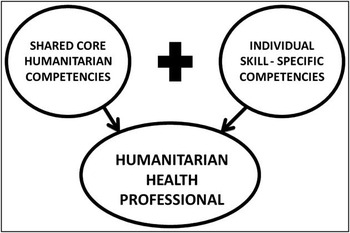
Failures in care occur not necessarily because of a lack of technical skills of a certified health care provider but more often from a lack of a knowledge-base, skills, anticipation of and “behaviors that employees must have, or acquire, in order to achieve high levels of performance” in their humanitarian role.Reference Walker and Russ3, 11 Simply illustrated, the discipline of humanitarian health care workers combines those of their certified profession and those equally required by core-humanitarian competencies shared with all humanitarian workers (Figure 1).
A “humanitarian health professional” can be defined by the combination of individual skill-specific competencies such as those obtained by a medical or nursing degree and the completion of shared core competencies that all humanitarian professionals, such as logisticians, project managers, security personnel, human rights lawyers, and health care workers must possess.

The agreed upon professional essentials defined in humanitarian core competencies represent a framework for knowledge and leadership skills necessary in an emergency response:11
(1) Understanding humanitarian contexts and application of humanitarian principles;
(2) Achieving results effectively, considering the need for speed, scale and quality;
(3) Developing and maintaining collaborative relationships;
(4) Operating safely and securely in high risk environments;
(5) Managing yourself in a pressured and changing environment; and
(6) Leadership in humanitarian response.
Similarly, other surveys have highlighted additional skills in multi-tasking, negotiating, team building, humanitarian law, needs assessment, and monitoring and evaluation skills as key for a humanitarian working in complex, ever-changing environments.Reference Walker and Russ3
As a first step, the Harvard Humanitarian Initiative (HHI), a university-wide multi-disciplinary center that provides expertise in public health, medicine, social science, management, and other sectors to promote evidence-based approaches to humanitarian assistance, sought to identify existing and established academic affiliated training centers in humanitarian health in North America (United States and Canada); and, to survey the centers to identify their education and training characteristics and preferences on professionalization under ELRHA guidelines. ELRHA has established hubs to promote and assist the professionalization process regionally. They currently exist in the United Kingdom, Europe, North America, and East Africa. The North American hub is located at the Feinstein International Center, Tufts University, Medford, Massachusetts under the designated leadership of Peter Walker, PhD. Since many training centers were not familiar with the ELRHA process all training centers surveyed met post-survey in November, 2011 under the supervision of the North American hub to clarify the process and to discuss and debate the implications of operationalizing the way forward in the professionalization process for each training center and the group as a whole.
Survey Study
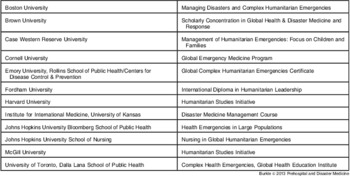
Twelve academic affiliated training centers were identified in North America that have established training and education programs for the humanitarian health care workforce; Table 1 lists the 12 academic affiliated training centers and the title of their major humanitarian health studies course. Several centers have multiple undergraduate and graduate level course opportunities in humanitarian health not listed here.
Established North American Academic Affiliated Training Centers in Humanitarian Health as of 2011

A 20-item, two-part survey was used. Part I questions, initiated by HHI faculty consensus, pertain primarily to queries on education and training of the health care workforce by the training center; Part II questions were taken from the original ELHRA Scope Survey queries, and focused on professionalization.10 Surveys were sent by mail to the listed training center director with a follow up phone and email contact within two weeks and at 30 days. All surveys were completed within six weeks. All surveys were completed either by the center director alone or with consultation of the center administrative and teaching staff. One HHI faculty member (BSS) then contacted each Program Director by phone or met in person to clarify the purpose and content of the survey questions, and allow each program to provide a narrative of their individual program goals and objectives. One hundred percent of the programs complied, although not all questions were completed by every training center.
Survey Findings: Part I
Time in Existence
Programs were in existence from 2-17 years, and offered courses to the humanitarian health care workforce on an annual basis or more frequently. All 12 provided residential face-to-face education; 10 (83%) offered simulation or field experiences. Four (33%) centers provided on-line courses, four (33%) provided apprenticeship opportunities and three (25%) offered mixed opportunity programs.
Course Completion
All 12 programs provided a certificate of completion. No programs provided skill accreditation. Five (42%) provided credits within an existing Masters in Public Health (MPH) degree program curriculum, and in two (17%), the humanitarian curriculum was offered as part of a global health Masters degree program.
Course Support to Other Programs
Of the 12 programs, only eight (67%) responded. In seven (88%), the course supports an existing humanitarian studies or global health program. Five (63%) support an NGO; four (50%) support a professional school and two (25%) support an independent field medical team. Three (38%) supported other academic affiliated departments or programs.
Course Enrollment
Of the 12 programs responding, courses were open to physicians and nurses in seven programs (58%) paramedics, public health professionals, and health educators in seven (58%) programs. Six (50%) offered their programs to disaster managers. Nine (75%) offered course to non-health care providers.
Classroom Composition
Of the seven programs that responded, physicians comprised 30% of the class, nurses 17%, disaster managers seven percent, public health professionals six percent, and health educators and paramedical professionals two percent. In 75% of the programs that responded, physicians made up 33% of the classroom composition, versus 14% of nurses, 13% of public health professionals, five percent disaster managers and paramedical professionals and health educators two percent or less. Thirty percent of the class was comprised of non-health personnel.
Course Registry and Proof of Course Completion
In questioning programs regarding establishment of a registry of graduates, 11 (92%) responded. Eight (73%) did provide a registry, and three (27%) did not. Of those who did, only 25% provided registry information to the humanitarian community and six (75%) did not. All 12 programs provided proof of training completion with 11 (92%) providing a certificate of course completion and six (50%) providing proof of accreditation by an academic institution. Of 11 of the programs, 72% provided this information to outside organizations upon request; three (27%) did not. Eleven (92%) of programs responded to the question whether they monitored long-term participation of graduates with only two (17%) having capacity to monitor graduates, nine (75%) did not.
Program Funding
Of the 12 programs, 11 (92%) reported that their funding was self-sustaining through tuition. Five (42%) were supported by academic institutions, and four (33%) reported funding through outside grants support, philanthropic donations or other sources.
Curriculum/Skill Content
Of the nine programs responding, three (33%) confirmed that they incorporated existing course material, such as the International Committee of the Red Cross course “Health Emergencies in Large Populations” (HELP), within their curriculum (Table 2).
Curriculum/Skill Content Selected by North American Training Centers in Terms of Importance to Curriculum Development
Competency-Based Programs
Only four (33%) of the 12 programs adopted competencies in developing their course curriculum. Of those who answered in the negative, four (50%) would favor a core-competency curriculum, one (13%) did not favor a competency-based curriculum, with three (38%) answering that they did not know.
Primary Course Readings, Curriculum Changes and Evaluation
Of 11 program responses, 100% provided course readings. Of 12 responding programs, eight (67%) reported recent or anticipated changes in their curriculum, four (33%) did not. Eleven (92%) programs responded they all provided course evaluations.
Faculty
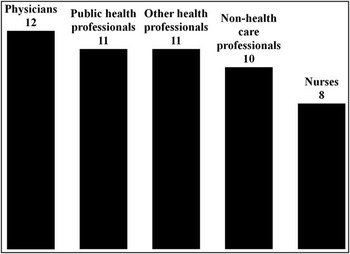
Of the 10 (83%) programs responding, 100% report faculty with prior humanitarian field experience (Figure 2).
Faculty Used in Training Programs

Survey Findings: Part II
Part II Survey questions address both Professionalization and Cost of Training issues. These questions originate from the ELRHA 2010 Scope Survey10 which applied to all humanitarian workers, not humanitarian health workers alone.
Professionalization
Of 11 (92%) programs, 10 (91%) felt that humanitarian health work should be professionalized; one (9%) program did not know. This percentage is similar to that of other current surveys questioning the need to professionalize humanitarian assistance.
Additional survey questions addressed reasons for training, knowledge-based skills and certification:
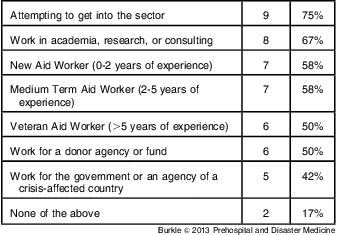
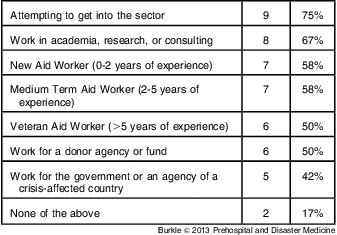
(1) Which of the categories best describe the reasons individuals sought out training (all that apply): 12 responses (100%)—“Attempting to get into the sector,” followed by “work in academia, research or consulting,” was the highest-ranked reason individuals sought out training (Table 3).
Reasons Individuals Sought Education and Training from the 12 North American Training Centers
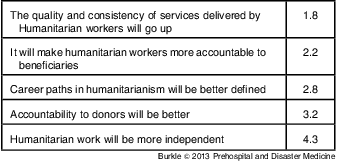
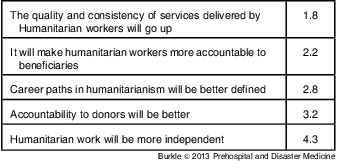
(2) Main advantage of making humanitarian work more like a profession? Why is training valuable? Ranked from 1 (most important) to 5 (least important): nine responses (75%)— Making humanitarian work more independent was ranked the highest of the advantages of professionalizing humanitarian work, followed by improved accountability to donors (Table 4).
Why Professional Education and Training in Humanitarian Work is Valuable
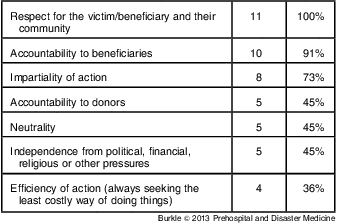
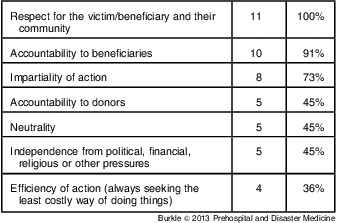
(3) Values or principles essential to humanitarian work that should be understood and practiced by all humanitarian workers? (the selected four most important are listed): seven responses (92%)—“Respect for the victim/beneficiary and their community” and “accountability to beneficiaries” were rated the most important values or principles essential to humanitarian work (Table 5).
Rating of Importance of Essential Values and Principles in Humanitarian Work by the North American Training Centers
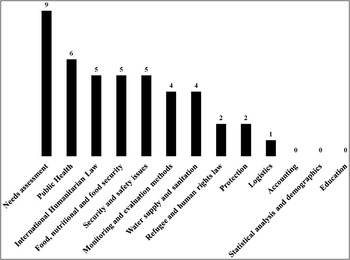
(4) Categories of knowledge all humanitarian workers should have at least some understanding of? (the selected four most important are listed): 10 responses (83%)—Needs assessment, followed by public health, were rated as the top categories of knowledge for humanitarian workers (Figure 3).
Knowledge Base that All Humanitarian Workers Should Understand

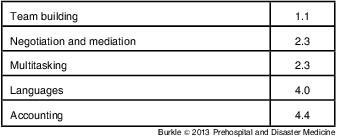
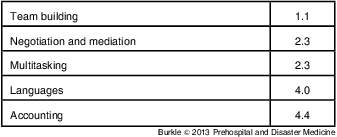
(5) Skills central to being a humanitarian worker? Ranked from 1 (most important) to 7 (least important): five responses (58%)—Accounting skills, followed by language skills, were ranked the highest in importance for humanitarian workers (Table 6).
Skills Considered Central to Humanitarian Work
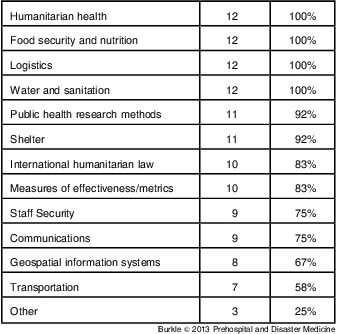
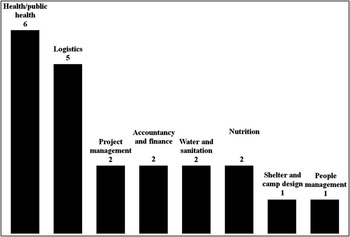
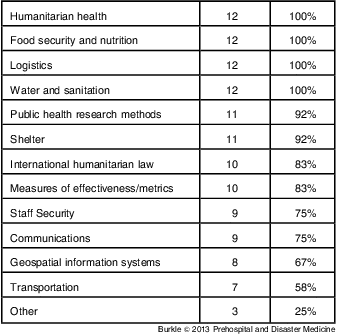
(6) Specializations that should have their own certification system specific to humanitarian work? Eight responses (67%)—Of the list of specializations that should have their own certification system specific to humanitarian work, “health/public health” and “logistics” were ranked the highest (Figure 4).
Humanitarian Specialties That Deserve Their Own Certification

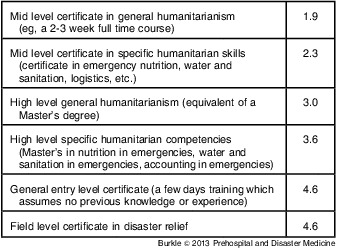
(7) Categories in which it should be possible to obtain an internationally recognized competency certificate in? Ranked from 1 (most urgently needed) to 6 (least needed): nine responses (75%)—“Field level certificate in disaster relief” and “general entry level certificate (a few days training which assumes no previous knowledge or experience)” were tied for the top ranking of the most urgently needed categories for competence-based certificates (Table 7).
Levels of Professionalization that Deserve Competency Certification

Cost of Training
The next two questions addressed both the cost of training and concerns on how professional humanitarian training should be paid for:
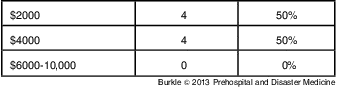
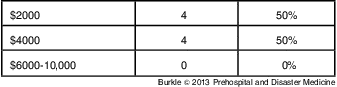
(1) How much the training for a mid-level general certificate in humanitarian assistance (two week residential course) should cost (USD)? What would you be willing to pay or have your employer pay? (One selected): eight responses (67%)—The two lower choices, US $2000 and $4000, were each chosen by four programs. No program chose the US $6,000-$10,000 option (Table 8).
Cost of Training among North American Training Centers (US $)
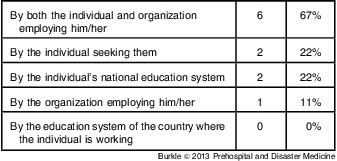
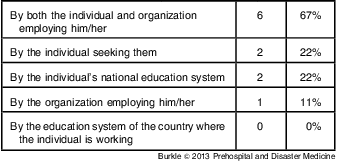
(2) In general, how should the obtaining of professional humanitarian qualifications be paid for? (One selected): nine responses (75%)—When asked how the obtaining of qualifications should be paid for, six programs chose “by both the individual and organization employing him/her,” making this the top-ranked method of payment (Table 9).
How Should Education and Training Be Paid For?
Discussion
This survey recognizes the existence of established training centers in North America devoted to the education and training of a multi-disciplinary health care work force. All are accredited by their University-based academic affiliation and provide either long-term or course-limited accreditation to faculty who teach in their courses. All provide “certification of completion” to participants, but do not “accredit” them in the newly learned humanitarian core skills. Most of the training centers possess characteristics in their training that reflect institutional strengths or preferences. For example, to name a few, a global public health emphasis in their teachings by Emory University and the CDC program, over 10 humanitarian course offerings by Fordham University that meet the professional expectations of United Nations-based diplomatic and other international professionals, emphasis on online course offerings by the University of Kansas before students and faculty meet face-to-face in a residential setting, and well-seasoned simulation/field experiences offered by Harvard University which, because of newly established relationship with other training centers, now offers joint field simulation opportunities with other training center graduates that do not have the means to provide similar experiences.
Additionally, through the individual interviews of training center goals and objectives, institutional characteristics and preferences were revealed. These are reflected in the professionals they train and certify (eg, nurses, physicians, mixed). All programs offer training slots to both civilian and military candidates, and all utilize the expertise of field-experienced health care providers from every health discipline as faculty. While not all training centers formerly state that they use published competencies to guide their curriculum development, in fact all training centers surveyed, especially the older ones, had used discipline-specific competencies and humanitarian field experience to initially guide their course development. The post-survey meeting of the training centers further encouraged all centers to review the newly published humanitarian core competencies to ensure that their program learning objectives are directly linked to these competencies and sub-competencies. While all programs must satisfy the core competencies, in health training attention must also be given to developing health-related sub-competencies that include sub-specialty competencies (eg, anesthesia, surgery, rehabilitation medicine, mental health, pediatrics, tropical medicine, critical care). It is crucial that all training centers move toward a common competency-based language and curriculum that is easily transferable, especially to developing countries.
It is encouraging that the international humanitarian health workforce community has launched a “concerted effort to develop a blueprint for professionalizing humanitarian health care assistance and certification of individual health care providers based on disaster-specific professional health- related skills and cross/multidisciplinary humanitarian health core competencies.”12 ELRHA is currently in the second phase of development, during which it has created “consultation hubs” worldwide to ensure local understanding of how a new structure should look. Within these hubs “are educational and training projects and programs to professionalize not only health providers but also logisticians, security managers, humanitarian law experts, human resources professionals and many others that support life-saving assistance projects in water, sanitation, health, shelter, food and energy. ELRHA encourages that worldwide actions take place between existing hub training centers in developed countries and those struggling to sustain such expertise in developing countries, the goal being to ensure regionally appropriate and culturally sensitive education and training curricula and courses leading to certification in humanitarian assistance on all continents.”12
All ELRHA-designated hubs have a strong health education and training presence. Recently, the European Union (EU) granted funding for the development of a European training curriculum for international crisis management. The EU aims to “consolidate and enhance its disaster response capacity by creating a European Emergency Response Center” with a European multidisciplinary team of experts collaborating to develop a standardized curriculum for international crisis management. Given that the EU is the largest donor of humanitarian aid to developing countries this will have a global outreach.13 The modified ELRHA scoping survey used by the North American hub in this study is being further modified by the grantee, the University of Bonn and co-participant University of Eastern Piedmont, Italy, to survey current training and education capacity in all 27 EU countries.13 In 2011, UK's DFID carried out a Humanitarian Emergency Response Review that recommended they “develop and deploy niche capabilities in a more focused way concentrating on those areas where DFID or the UK is able to add value.” The review recognized that too often in the aftermath of a disaster there was an influx of foreign medical teams not always working to host country or international standards. There was a specific recommendation that DFID “incorporate surgical teams into first phase deployments especially after earthquakes.” To achieve these goals the UK Government has funded the UK International Emergency Trauma Register (www.uk-med.org) that ensures core competencies of registrants and coordinates their deployment.Reference Redmond, O'Dempsey and Taithe14
In 2010, the Geneva Center for Education and Research in Humanitarian Action (CERAH) published a comprehensive inventory of academic training programs on humanitarian action, confirming the great diversity of training options available. In the listing of short course programs (“other post-graduate programs”) the average cost of in-country tuitions was US $4,000 (excluding cost of living). This cost almost doubled for out-of-country tuition. The majority of programs are found in Europe and North America making access a barrier for students from the southern hemisphere. It is anticipated that completion of the ELRHA hubs and collaborative efforts by professional associations of academic affiliated training centers worldwide would lessen this burden.15
This survey was helpful in many ways. It brought the North American-based academic affiliated training centers together for the first time. Many shared lessons learned and voiced the desire to coordinate and collaborate, especially on curriculum and competency development. HHI remains encouraged that this survey and the subsequent gathering of the North American training centers led to the establishment of a formal “consortium” of training centers in humanitarian health. Participants agreed to further explore a potential professional association of academic affiliated training centers in health (acronym PAATCH) which is recommended by ELRHA as a next step in advocating for a discipline-specific recognition of health-related courses and curriculum based on peer reviewed standards of care, best practices, and to better meet the burgeoning demand for a certified health care workforce worldwide. A goal of a sector of health within the North American hub, prominently voiced by training center members, would be to use this professional association and the training center collaborative experiences and lessons learned to assist in the development of similar education and training centers in developing countries, and establish a consortium-wide web site that contains peer reviewed standards of care, published core competencies, sub-competencies, research agendas, and updates of program initiatives offered by individual training centers. This process will be the focus of Part 2 in this two-part series.