People who kept on about narrative tended to have a squiffy view of reality, believing all versions of it to be of equal value.
Ian McEwan, Solar (Jonathan Cape: London, 2010), 147.
What topics dominate our news? Long before a global economic downturn, and long before quantitative easing, sub-prime markets and the euro debt crisis invaded our daily news, the cost of living, wage claims, job losses and unemployment levels, trade deficits and budgets were stock in trade for the media. No radio or TV bulletin or newspaper leader was complete without coverage of such topics. A new codebook of acronyms was invented – GDP, RPI, NEC, OECD, EEC, CAP, TUC, UNCTAD, GATT – and the public recognized that these alphabetic agencies affected their lives in some way or another. If G8 and G10 retained a certain mystique, during the Thatcher years M1 and M3 were understood to be different measures of the money supply and not just concerned with road traffic. No property owner is unaware that the affordability of housing depends to a considerable extent on interest rates. Daily exposure to news headlines has educated the general public to understand that national income and expenditure are linked; limitations on public expenditure and the public sector borrowing requirements (PSBR) required to finance it constrain public services and civic amenities which may then be subcontracted to private agencies in an attempt to bring market forces to bear down on a town council's expenditure. The British public is acutely aware that social work, cultural activities and educational provision, to name only a few arenas, are limited by the public finances, and politicians are equally aware of the long shadow cast by resistance to the ‘Poll Tax’ so that its 1989 successor, the Community Charge, has been frozen or increased at below inflation rates as an electoral gambit.
At a personal level, individuals decide what is affordable – living space, phone contract, car engine size, gym membership – and every day make dozens of decisions based on what economists call ‘preference schedules’ that trade off price, quantity, quality, convenience and design. When purchasing goods and services, we consciously or otherwise evaluate crudely some notion of utility against value. We trade off some undesirable characteristics for others consistent with our priorities. Our behaviour – our choice – is defined and constrained in accordance with these priorities; few can afford to do otherwise. An application for a travel visa requires a Visa payment; go to a Masters tournament and your Mastercard takes a hammering. Fares are zoned; charges are scheduled; coffee is described and priced as grande. Firms’ market position and share value determine managers’ pay, and also define consumers’ spending habits. Even institutions such as universities with their longer-term horizons gear responses to changing fee levels and research funding initiatives using both sticks and carrots. Gift Aid has gifted windfalls in the form of reclaimable tax on a scale sufficient to keep many charities and cultural associations afloat financially, thereby facilitating their objectives, and providing the social cement so important to the enrichment of civil society. The term ‘brownfield site’ has entered the language as shorthand for inner-city redevelopment projects that seek to leverage value from derelict buildings. The process differs only in detail from how property development has taken place over centuries in a sequence that involves landowner, developer, financier, builder, landlord and resident. Profit, rent, vested interest and capital gain are terms that the public recognizes, and even terms such ‘negative equity’ and ‘quantitative easing’ do not seem out of place in everyday language.
Though we rarely put a value on our time explicitly many mundane daily actions have a price and thus a cost. Who has not had an interminable phone call to BT? There are ‘opportunity costs’ to such an experience – what else might you have done in those 15 minutes of your life that an international communications firm took to answer the phone? And ‘transactions costs’ – what would it cost you to change supplier for your phone, TV or mobile service? – are also easily understood. E-commerce may save time in a department store but costs time if the item is delivered when no one is at home and the package then has to be collected from a cloned shed on a distant industrial estate. Costs are thereby shifted from the supplier to the consumer. At a private level, and for an overwhelming proportion of the population, our credit rating is mainly defined by our employment and payments history, and the scope of our actions is defined accordingly. We do not like this, but we understand it and mostly put up with it.
In addition to everyday private commercial experiences consider also how the public sector shapes behaviour through what was once termed ‘municipal trading.’Footnote 1 In Britain, as in European cities generally, municipal responsibilities mushroomed in the last third of the nineteenth century, expanding from the imperatives of a public health campaign to embrace a widely defined cultural agenda with distinctive institutions – museums, galleries, libraries, parks – and finally to the provision of transport networks, power generation, waste incineration and direct labour departments to service many of the city's public services. In Edinburgh, as in many cities, the council's budget was split across 40 heads of expenditure after 1870, the largest of which was interest payments on the capital raised to fund infrastructural investment. If the British economy stuttered before World War I, it was not evident in the cities where a conception of the common good and economies of scale influenced service delivery at levels beyond the competence and resources of most private firms. So pervasive was local service delivery that a perceptive Edinburgh councillor commented in 1862 that ‘the authority and red-tapeism of official men [was] unlikely to be conceded willingly’.Footnote 2 Conceded, however, it eventually was, and nowadays most likely your journey to work in Britain will be courtesy of a German-owned Arriva bus or, as with Merseyrail, owned (50 per cent) and operated by the nationalized Dutch railway company, Nederlandse Spoorwegen. If you live in London, your Thames Water has since 2006 been provided courtesy of the Australian investment group Macquarie who paid £8 billion for the right to supply you. Whatever the corporate status of your provider, the reality is that current public service levels are conditional on financial arrangements and corporate profit expectations as defined by share values. The principle of ‘no taxation without representation’ has been suspended, therefore, since urban infrastructural investment in Britain has been up for sale to foreign ownership with little or no accountability to local users.
The influence of the market on urban development, therefore, is still very evident even if towns and cities are not themselves empowered, as they were in the nineteenth century and as is still the case in American and German cities, to issue municipal bonds on capital markets and raise money independently for their infrastructure projects. Gone, in Britain at least, in the aftermath of international corporate provision of utilities, is the principle, as described by Hennock, of ‘local provision for local wants, locally identified’.Footnote 3 In a world that increasingly recognizes social diversity and multiple cultural identities, localism has been resurrected in a managerial sense as the central state retreats from resource allocation in the social services. In a new form of localism, out-sourcing and sub-contracting by city councils in health, education, prisons and waste collection, for example, has produced geographically disparate levels of service and results in a post-code lottery that means that the average Glasgwegian dies 10 years younger than the Chelsea resident.Footnote 4 It means that IVF treatment, free bus travel for the over 60s, scans for breast and bowel cancer and indicators of local authority efficiency and coverage vary significantly from one town to another. Here, too, the contemporary urban world is dominated by economic and financial factors.
Why is it, then, that urban historians, and indeed Urban History, seem to have overlooked the centrality of economic relationships? Why is it that our daily obsession with economic events appears not to be reflected in scholarship associated with our towns and cities? The evidence drawn from publications would certainly seem to indicate only limited references to the economy, industry and finance.
In the course of 40 years, from the inception of the annual bibliography of urban history in 1974 to the current issue in 2013, over 42,000 items have been identified, categorized, listed and published. They are now available online through the Cambridge Journals Online Urban History database.Footnote 5 It is worth noting that for the first 17 years the same British team of Diana Dixon and Anthony Sutcliffe compiled and classified the bibliography, and so gave it a degree of consistency that was truly remarkable. Since that era, continuity has been achieved both by bibliographers who have always served for at least three years, and by an annual scouring of the same list of journal titles and finding aids for books – until online searching transformed this task. Occasionally, as new journals appeared with an urban history dimension they were added to the list but overall there was a high degree of stability to the methods of collection and classification.Footnote 6 To this British-based bibliographical compilation contributions were made by distinguished North American and French correspondents – Stuart Blumin, Gil Stelter, Elizabeth Bloomfield, Bernard Lepetit, Pierre Costa, Isabelle Backouche – with a much smaller number of citations provided by experts in Australia, South Africa and elsewhere.Footnote 7 As non-UK databases became available online, the bibliographical references in Urban History were largely restricted to a British focus and this accounts to a large extent for the fluctuations in annual citations in the 1980s and the slight downward trend in the 1990s as some of the non-UK citations dropped out. The annual Urban History Bibliography includes 10 major categories subdivided into 61 sub-themes, and the long-run trend of urban history publications is shown in Figure 1.Footnote 8
Bibliographical entries in Urban History, 1974–2013 Source: Annual bibliography, Urban History Yearbook (1974–91) and Urban History (1992–2013), polynomial trend line added. The ‘General’ category of urban history publications has been excluded.

When the 10 major sections are considered in detail some important historiographical features become apparent. By setting aside the all-encompassing ‘General’ category, since it included works such as ‘A History of Somewhere-on-Sea’ and ‘Somewhere: an Illustrated History’, and re-calculating the percentages in the other categories, a profile of urban historiography has been developed (Figure 2). This shows that particular areas of writing on towns and cities have been by-passed. This is the case for publications encompassing mentalités, approaches and perspectives towards towns that are bundled together in a category called ‘attitudes towards the city’ (2 per cent). More surprising, perhaps, is the apparent disinterest in transport and communications (5 per cent) and urban demography and migration (7 per cent). At the other end of the spectrum, social and cultural aspects of towns and cities constitute 39 per cent, and building and planning related topics represent 22 per cent. Thus, three out of every five citations fall into these two groupings. For all its centrality to our everyday life, the broadly defined ‘economy’ category provides only 13 per cent of references. Even this figure is rather generous since it includes many publications that are highly descriptive of a particular industry, working conditions or labour organization, and very rarely employs the conceptual and analytical tools of basic economics – the substitution of land, labour and capital in different blends as a means of explaining resource allocation and exchange.
Publications in urban history, 1974–2013, by category (%) Source: Annual bibliography of urban history publications in Urban History Yearbook and Urban History (1974–2013); Journal of Urban History, contents (1974–2013).
Of course, these percentages should be seen as indicative. The boundaries between the categories can never be sharply delineated, and each reader derives material from a work in ways that are particular to his or her research interests. However, classifying more than 1,300 articles published in the Journal of Urban History (JUH) over the same period, 1974 to 2013, and assigning them to the same categories, produces a not dissimilar distribution to that of the Urban History Bibliography (Figure 2).Footnote 9 Again, attitudes, demography and transportation were the least numerous; social/cultural and building/planning, the most popular areas of scholarship, accounted for two-thirds of all published articles. The economy, loosely defined to include industry, banking, labour and local markets, produced only 6 per cent of items published in the JUH.
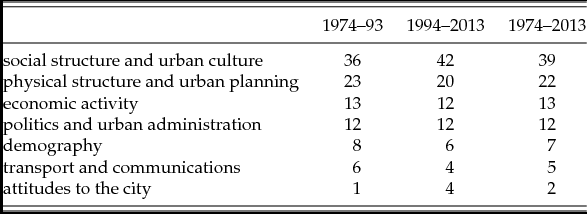
The pattern of publication also produced pulses within the categories (Table 1). Unsurprisingly, for example, the UK database of 42,000 articles and books shows that urban transport, demography and housing have become less fashionable since the 1990s as the literary, cultural and environmental turns, and their related planning and policy dimensions have had increasingly greater appeal for scholars. By contrast, the ‘social’ category has remained fairly stable throughout the 40-year period though offset to some extent by the rising interest in cultural history.

A detailed contents analysis of the Urban History citations and JUH contents is not the purpose of this article, but the statistical evidence does beg the question: how might this denial of the economic context of urban history be explained? It is not a recent phenomenon; splitting the 1974 to 2013 period in half at 1993 makes no significant difference to the percentage distribution in the Urban History Bibliography (Table 1), and the percentage of publications concerned with economic activity is exactly the same throughout – 13 per cent.
One possible explanation is structural and another institutional. Economic history as an area of academic study has shrunk drastically in Britain since the 1990s, and where it does survive it is normally embedded institutionally in a humanities environment rather than a social science-based one. This has had implications for the type of teaching and research on towns and cities, and consequently on the type of graduate produced. This process of shrinkage has been accelerated by the loss of a separate Unit of Assessment in the periodic national quality evaluation (Research Assessment Exercises/Research Excellence Framework), and has thus encouraged academic staff to be more strategic about the placement of their publications and the emphasis of their work. With a considerably larger pool of history-based journals to choose from, a specialist economic history or urban history publishing profile is more difficult to sustain, and the drift towards cultural and social emphases makes tactical sense at the personal level. Thus, job opportunities and publishing potential in the greater history pool has skewed publications, teaching and professional development away from the narrower urban, economic and demographic history fields. Another institutional influence can be discerned after 1992 when a stronger social and cultural historical surge resulted from the absorption of former polytechnics into the ‘New University’ sector.Footnote 10 Similarly, policy-based interests with a social science-based tradition of empiricism and hypothesis testing tended to be located in Urban Studies units rather than in urban history.
If a disciplinary explanation is sought, it might be based around the idea that there are fewer people studying economics. Certainly, this would seem to have some weight if the focus is purely on the numbers sitting economics at school which has collapsed dramatically since 1992 – more so than in any other subject – and remains in 2013 at less than 50 per cent of the level of the late 1980s.Footnote 11 This trend is not matched at degree level, however, according to the Higher Education Statistics Agency, as the student population enrolled on economics courses has increased slightly since the 1990s as a proportion of the total student population. So, to understand why historical studies has resolutely side-stepped an economics dimension, it may be just as relevant to consider how the economics curriculum is delivered within degree programmes and has itself by-passed history. For example, within the Politics, Philosophy and Economics degree at Oxford the historical interconnections between social and economic factors are firmly rooted; most Scottish university degrees in humanities and social sciences require one third of the courses in the first two years to be outside the main discipline. More generally, where a historical dimension to social and political studies is a requirement then there is scope for cross-fertilization, and potential for the urban dimension to form the common ground for different approaches. However, for decades now, the teaching of economics in English universities has effectively limited the curriculum to multiple courses in variants of economics, statistics and mathematical economics, thereby excluding ‘outside’ or ‘supplementary’ subjects and a historical perspective to round out the student's educational experience already narrowed by studying only three subjects at A-level.Footnote 12 As for the American situation, and the paucity of publications with an economic dimension published in the Journal of Urban History the history/economics disciplinary boundary seems just as impermeable even though economic history has always, and continues to be, taught in economics departments.
Nor should the idea gain ground that economics is an impenetrable technical subject and that the dearth of urban history publications concerned with economic activity can be explained in this way. Like other social science disciplines, economics uses jargon as short-hand for commonly used concepts in order to capture relationships. Indeed, a return to ‘political economy’ rather than ‘economics’ might be more helpful for urban historians in the sense that bringing the study of production and exchange, demand and supply, and scarcity and choice into sharper focus around the concept of market power would add explanatory value and a dynamic context to social and cultural perspectives of the town – a local version of the state from which the polities of political economy originated. Since town and city are inherently concerned with the creation and distribution of wealth, and thus with poverty, then the urban historian's armoury might benefit from a deeper engagement with these topics as a basis for understanding the spatial consequences. It is not essential to read Keynes’ General Theory of Employment, Interest and Money with its various subtle arguments, but for historians of urban administration and municipal politics it would be an advantage, whatever the period, to be conscious of Keynes’ central argument that in the short run, and especially during recessions, economic output is strongly influenced by total spending in the local economy, and to be aware that this might induce a degree of inflation however beneficial or otherwise that might be. It is possible to read histories of individual cities that make no reference of such basic interrelationships – the ebb and flow, boom and slump of land, labour and capital – and therefore lack credibility by overlooking the economic realities of daily urban life.
A central characteristic of urban history has been to emphasize the many different elements and forces that combine to produce the particularity of a place. This was captured in 1974 by the founding editor of Urban History, H.J. Dyos, who argued that
the authentic measure of urban history is the degree to which it is concerned directly and generically with cities themselves and not with the historical events and tendencies that have been purely incidental to them. . .it is the study of the characteristically symbiotic relationships of (cities’) different characteristics. . .that distinguishes urban historians from those who may be said merely to be passing through their territory.Footnote 13
Thus, not to allow economic activity to play a full role in these ‘symbiotic relationships’ is to diminish understanding of the town or city itself, and of the processes that forged it. Put differently: the urban historian needs to operate across fields and disciplines, as the bibliographical categories identified in Figure 2 indicate, and to downgrade the economic variable is to deny the very being of place. For many centuries, work has dominated the rhythms of the day and defined daily tasks for the majority, and for the majority of their waking hours. Types of work are so embedded in localities that place-names still retain these cultural identifiers, as with football teams. The association with a local industry – hence Burton ‘Brewers’; Hinckley ‘Knitters’; Northampton ‘Cobblers’; Luton and Stockport both ‘Hatters’; Walsall ‘Saddlers’; West Ham ‘Hammers’ (Thames Iron Works); and Yeovil ‘Glovers’. These, and many more, remain important sporting signifiers of a cultural identity that embraces associational life, customs, rituals and gender, but the important point is that work, labour and employment are themselves strongly tied to place and for many centuries dominated the waking lives for six days a week. To put this in another frame: since three out of every five 25–34-year-old women in Preston were in full-time work in 1911 compared to just one in five in Barrow, it is likely that the household size, patterns of fertility, cultural activities and family rhythms will differ appreciably. The compositional aspects of employment provide a fundamental backdrop to urban behaviour. This is not some structuralist determinism – just commonsense and source-based observation.
Might it also help the explanatory force of urban history if we applied the language of capitalism to the age of capitalism? Profits, costs and prices are the motor force of markets; they are the triggers to human actions (including corporate ones) that provide the dynamics for urban development. Knowledge of markets and manufacturing processes commands a premium because it diminishes risk and uncertainty, and may also spur technological innovations that leapfrog existing production structures. Such ‘margins’ or ‘comparative advantage’ provide the competitive edge for the firm, and generate the quest for a response from firms in the sector, resulting in a series of iterative advances with the hindmost vulnerable to bankruptcy. The language of economic geography gave us location, proximity and factor endowments – each simple and enduring concepts that were both readily understandable and applicable, and useful for analytical and interpretive purposes on a comparative basis. The language of political economy provided profit maximization, marginal costs, diminishing returns and rates of change. Our out of town shopping malls and planning decisions generally are bound up with such dynamic forces and the reality of today's urban development is changed only in form from that of earlier centuries.
The urban perspective has always been highly topical and presents rich opportunities for historians to provide longer-run interpretive frameworks. Take the Independent’s recent report on the best places to live in Britain.Footnote 14 Residents in Solihull (south-east Birmingham), the survey concluded, enjoyed ‘higher incomes, better employment rates and longer life expectancies’ than anywhere else.Footnote 15 The study considered 38 local areas and 24 different factors that included ‘average salaries, disposable household income and the cost of essential goods, such as fuel, food and energy bills’.Footnote 16 Superficially convincing, by deploying what appear to be appropriate economic indicators (though nothing about their relative importance or weighting), it transpires that Solihull is the only urban – actually it is suburban – place and so renders comparisons with the next nine on the list, all of which are counties, as problematical.Footnote 17 So though improvements must be made to render the unit of analysis comparable and the urban scale appropriate, crucially the study exhibits a mindset that seeks to deploy economic indicators to address a research question, yet is mindful that these are not the only criteria.
Economics is a behavioural science. Like psychology or sociology or political science or anthropology it offers partial explanations of human actions and intentions. Each of the social sciences contributes to an overall understanding of motivation, and should the economic dimension be omitted, then the interpretive force is weakened, as it would be if other behavioural sciences were overlooked. This is one of the strengths of urban history, that is to say, it encourages the integration of several disciplines in an effort to develop an overall understanding of urban development at a variety of scales – town and city, urban and suburban, local and national, or international. The emphasis on a conflation of different social science theories and methods provides an understanding of processes that explain our daily actions in a specific locus.
Since we are exposed each day to the language of the market, perhaps it is not at all unreasonable to trust the reader – who generally deals adequately in a private sphere with mortgages, tax, direct debits, currency exchange and makes countless decisions about personal budgets – to have a reasonable understanding of basic market forces and relationships. Even TV serials, such as West Wing and Borgen, ‘get it’ by scripting fictional Nobel prize-winners in economics into their plot lines in order to provide a reality check.
This survey has glimpsed the composition of urban historical scholarship over a 40-year period. The speculation is that by reintroducing the economy, urban history will be greater than the sum of its many individual parts. Not to do so would be as if to deny a printer one of its colour ink cartridges and so render our picture (of the city) as a greyscale version rather than one based on a full palette of colours that reflects more accurately the dynamic of the urban dimension.