1. Introduction
This paper estimates the effect of introducing individual quotas (IQs) on the efficiency performance of fisheries, given a potential selection bias and change in the quality of landings after the introduction of the property rights regime. Our results suggest that both considerations are important and not controlling for them can bias significantly the efficiency estimates.
The economic literature stresses the importance of individual access rights or property rights for efficient fishery management (see e.g., Wilen, Reference Wilen2000). Moreover, the number of international experiences in switching over from traditional “command and control” fisheries management to a rights-based system is large (Arnason, Reference Arnason2002). Although the general perception is that IQs are not a panacea for all management problems, the introduction of this system is thought to generate important efficiency gains in fisheries managed with traditional instruments (Grafton, Reference Grafton1996; Brown, Reference Brown2000). Some literature attempts to directly, empirically assess the effect of introducing a rights-based regulatory system on fishery efficiency (Weninger, Reference Weninger1998; Grafton et al., Reference Grafton, Squires and Fox2000; Pascoe et al., Reference Pascoe, Andersen and de Wilde2001; Brandt, Reference Brandt2007).
The basic approach for assessing the effect of IQs on fishery efficiency is to measure the efficiency level of the fleet in the period previous to the introduction of the rights-based system and compare it with the fleet's efficiency level after this system's implementation. However, the specific way such measurements are done varies among the authors. A recent work by Brandt (Reference Brandt2007) challenges the practice of comparing overall fleet efficiency levels before and after the introduction of individual rights as a valid assessment of the regulatory efficiency gains, arguing that this procedure mixes individual gains with changes in fleet composition, and that the strategic behavior of the vessel owners before the introduction of the rights-based system should lead to an upward bias in the efficiency gains estimates. Brandt proposes a method to cope with this bias and shows that the efficiency advantage of a rights-based regulatory system is lower than the non-bias-corrected estimation. In this paper, we build further on Brandt's analysis in two aspects. First, we reinterpret the strategic component of the efficiency gains: the experience we use to estimate and discuss the efficient component due to changes in fleet composition involves severely restricted possibilities for adopting strategic behavior. This gives new insights into the nature of the efficiency gains generated by the introduction of rights-based regulatory systems in fisheries. Second, we correct the efficiency gains estimates for changes in product quality. A fairly general result to emerge from assessments of the effects produced by introducing IQs in fisheries is that product quality increases (Grafton et al., Reference Grafton, Squires and Fox2000; Fox et al., Reference Fox, Grafton, Kirkley and Squires2003; Gordon et al., Reference Gordon, Dupont, Fox and Grafton2003). However, the estimation and comparison of efficiency gains between different regimes usually does not take into account the fact that different product qualities are being compared. To the extent that the production processes of these different products (qualities) have different input mixes, the efficiency estimates will not be comparable across periods and the efficiency gains obtained will be biased. The results presented herein distinguish between efficiency gains by vessel dimension and firm integration level. The application uses data from the pelagic fisheries in central-southern Chile.
The paper is organized as follows. In section 2, we provide a brief discussion of the effects of strategic behavior and quality change on the measurement of efficiency gains generated by IQs in fisheries. Section 3 provides a description of the industrial pelagic fisheries in central-southern Chile from 1995 to 2005. Additionally, we provide information on the regulatory changes that occurred during that period. The econometric model and data we use for our empirical analysis of the effect of IQs on technical efficiency are presented in section 4. The results of the estimation are presented in section 5. A section of conclusions ends the paper.
2. Individual quota efficiency gains, strategic behavior, and quality
The introduction of IQs can enhance fleet efficiency by inducing a reduction in the total fishing effort employed to catch a given total available quota. This reduction can be achieved by limiting the total number of vessels, opting to use the most efficient ones, and it is considered to be a long-run change in overall fleet efficiency since it reduces inefficient capital. However, the introduction of IQs (as compared with traditional management tools such as temporal closures, no take zones, or a ‘pure’ total allowable catch (TAC) quota regulatory framework) can also affect individual vessel efficiency in the short run in several ways. When an individual quota is allocated, a fisherman can choose the time to initiate and finalize the trip so as to maximize expected profits or minimize expected costs subject to a given harvest level. Moreover, input levels and input composition (vessel characteristics, labor, fuel) can be adjusted optimally, as compared to the prevailing situations under alternative management systems. Furthermore, the quantity and quality of the landed catch can be chosen in accordance with individual profit maximization. Other effects of IQs on efficiency are related to reduced fish wastage and mishandling, safer fishing practices, and less loss of fishing gear. Note that these short-run effects are independent of the ‘transferability properties’ of the rights-based system. Thus, IQs are presumed to increase technical and allocative efficiency, both in the short and long run (Grafton et al., Reference Grafton, Squires and Fox2000), due to efficiency improvements for individual vessels as well as the aggregate fleet. However, this distinction is rarely made in empirical measurement of efficiency gains in fisheries.
In a recent published work, Brandt (Reference Brandt2007) estimates the efficiency gains of introducing individual tradable quotas (ITQs) in the mid-Atlantic surf clam fishery with and without correction for changes in fleet composition. She argues that the vessel owners might have operated with nonefficient vessels in the period prior to the initiation of the ITQ system based on strategic considerations. This would allow the owners to take advantage of the rights allocation system under discussion by increasing their ‘historical rights’ over the TAC.Footnote 1 According to Brandt, ‘rent seeking’ vessel owners introduce idle vessels into their fleet once negotiations on ITQs have begun. Such ‘rent seeking’ behavior presumes that the vessel owners have knowledge of discussions regarding the allocation formulas for the TAC prior to its introduction and that the owners have the capacity to act on this information. This presumption is probably not unrealistic in many cases since, in many fisheries, the stakeholders participate in different stages of designing property rights management systems and idle capital has existed. If this behavior actually occurs and vessel owners adjust their fleet to an optimal level after the ITQ system is introduced, then the measurement of efficiency gains without correcting for fleet composition should be affected by an upward bias since the strategic inclusion of inefficient vessels should bias down the fleet efficiency level prior to the ITQ regulation. Brandt also argues that, regarding the same strategic considerations, some inefficient vessels are not retired from the fleet until after the ITQ system has been introduced. These vessels also contribute to the overestimation of the efficiency gains of ITQ in the fishery.
However, by looking only at the fleet composition corrected efficiency gains, Brandt (Reference Brandt2007) could be underestimating the efficiency gains produced by the introduction of a rights-based system. This is so because, theoretically, the introduction of such a system is expected to reduce the fleet excess effort capacity even when no strategic considerations are present. The use of command and control regulations, or no regulations at all for that matter, generates overinvestment in fleet capacity. Thus, one of the advantages of individual property rights is precisely the reduction of this inefficient overinvestment, thereby increasing overall fleet efficiency. This means that total effort should be reduced, and this is generally done by eliminating the less efficient vessels. In other words, the increase in overall efficiency because of the fleet composition effect is at least partially due to the efficiency enhancing effects of ITQs, and such effects should not be (totally) discounted from the gains obtained under this regulatory system, as Brandt does. One should, notwithstanding, discount the effect of the strategic bias when this exists.
We analyze potential bias effects by looking at one experience with severely reduced, if not completely curtailed, possibilities for such strategies. Thus, all efficiency gains due to fleet composition effects can be assigned to the efficiency enhancing effects of IQs. Moreover, we are able to decompose the efficiency gain effects into fleet composition effects and individual efficiency effects, thereby providing new insights into the nature of the efficiency gains generated by rights-based regulatory systems in fisheries.
The IQ formula discussed for the multispecies pelagic fisheries of central-southern Chile in the late 1990s was a weighted average defined by vessel dimension and historical catches (see next section for details). However, the number of vessels and fishing capacity has been frozen since 1997. Negotiations about IQs did not begin before 1998, when jack mackerel, the main species, suffered an important drop in its estimated biomass. Thus, effective possibilities to act strategically by increasing the number of active vessels or their dimensions did not exist on the part of the vessel owners. Nevertheless, the possibility that rent-seeking vessel owners could have over-reported harvests during the negotiation period did exist. In personal interviews, officials from the Undersecretary of Fisheries have stressed that they increased enforcement efforts during this period to avoid this latter type of behavior. Although a space might have existed for over-reporting during this period, had this been the case, such reports would have falsely increased vessel efficiency; that is, they would have made the vessel appear to be harvesting a larger catch than it really did. This, in turn, would decrease measured efficiency gains after the IQ system was introduced. Thus, we can be sure that, in the case under analysis, the estimated efficiency gains due to the fleet composition effect, if any, should be ascribed to the efficiency enhancing effect of the introduction of IQs. Moreover, if strategic behavior in the form of over-reporting harvests before the IQ actually existed, the total efficiency effect could have been underestimated.
One effect induced by the introduction of IQs that has been recognized in the literature is a higher quality landed catch (see Grafton, Reference Grafton1996; Grafton et al., Reference Grafton, Squires and Fox2000; Fox et al., Reference Fox, Grafton, Kirkley and Squires2003). This effect might arise because the fishers are better able to select the type of catch, preserve it in good shape during the trip and extend the fishing season with IQs. However, empirical assessments have not yet addressed the effect of this change in quality on the measurement of changes in technical efficiency. If quality increases, then part of the efficiency gains can take the form of a higher valued product. Technical efficiency assessments based on the presumption of a stable relation between inputs and outputs and that do not consider that the output is at least partially of a different nature will actually overlook the qualitative effects and, thus, wrongly estimate the efficiency gains of regulatory change.
One of the main changes that occurred in the processing industry supplied by the central-southern pelagic fleet in Chile after the introduction of the IQs was the substitution of fish meal production for human consumption goods production (Dresdner et al., Reference Dresdner, Chávez, Villena, Henríquez, Baquedano, Campos, González, Salazar and Sobenes2007). To make this substitution feasible, the quality of the landings had to improve, which meant that fewer units per trip and fish in better shape had to be landed, ceteris paribus. The final product obtained with this high-quality fish had a much higher price. This shift in the use of fish catches for purposes of human consumption was only made possible by the introduction of the IQ system.Footnote 2 Thus, a purely quantitative assessment of the change in efficiency, calculating the relationship between the quantity of inputs and the number of units landed per vessel, would miss the quality improving effect of the regulation. Moreover, since the quality improving effect reduced the catch per trip in this case, not correcting for this effect might underestimate the efficiency gains from IQs.
To control for the quality improving effect of IQs, we use some special features of the central-southern Chilean pelagic fisheries. The Chilean fishery statistics do not indicate the use given to the landed catch on an individual vessel basis. However, the central-southern Chilean pelagic fleet catches different species, not all of which are suitable for using as input in the human consumption goods industry. Specifically, two of the pelagic species, sardine and anchovy, are used exclusively for fish meal. Moreover, it is possible to track whether the vessels specialize in the catch of certain species or not. We use these facts to control empirically for the change in product quality on efficiency. We construct a restricted sample with those vessels that specialize in species used in fish meal production only, that is, sardine and anchovy. Since the landings of this fleet were used for fish meal production before and after the IQs, we assume that the quality improving effect must be less important than for the landings that were used to shift production to human consumption goods. We construct a base sample with those vessels that do not specialize in sardine and anchovy, which we call the nonspecialized sample.Footnote 3 The quality improving effects of IQs are likely to be important for this fleet. We make all estimations with the nonspecialized sample and with the restricted (sardine and anchovy) sample and compare the results in order to see if the efficiency changes after the introduction of the IQs differ between vessels specialized in fish meal input versus vessels producing input for all production lines. When we use the restricted sample, we eliminate the effect of the shift in product composition due to the IQs. Thus, we are able to assess the ‘pure’ quantitative efficiency gains from IQs.
3. Pelagic fisheries and regulatory activity in central-southern Chile
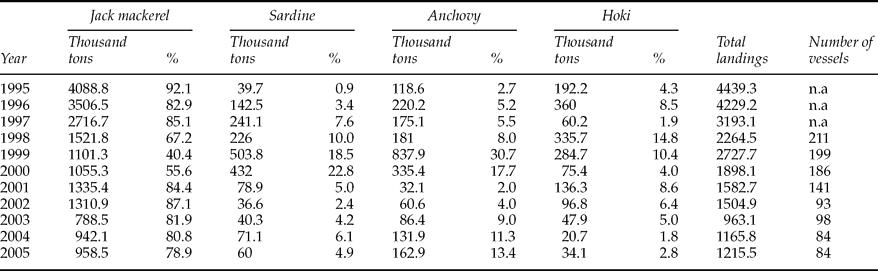
The pelagic fisheries in central-southern Chile are multispecies fisheries predominated by jack mackerel (Trachurus symmetricus). This species represents, on average, about 76 per cent of total industrial landings between 1995 and 2005 (see table 1). Other species caught are common sardine (Strangomera bentincki), anchovy (Engraulis ringens), and South Pacific hoki (Macruronus magellanicus), on average, about 8 per cent, 10 per cent, and 6 per cent respectively of the total industrial fleet's landings of pelagic species in the period. All these species are captured using purse seine. The four species are good input substitutes for each other in fish meal production; however, there are differences among them when considering production oriented to human consumption. Whereas jack mackerel and, to a lesser extent, South Pacific hoki are suitable for producing human consumption goods, common sardine and anchovy are exclusively used for fish meal production. Moreover, the location of the species is spatially differentiated. Whereas common sardine and anchovy are located relatively near the coast, jack mackerel is a migratory species found over a large area and, to a great extent, far away from the coast (IFOP, 2009). This results in different fleet characteristics and vessels that are partially specialized in different species. Finally, a large share of production is exported.
Landings of the industrial fleet operating on pelagic fisheries in central-southern Chile (1995–2005) (thousands of tons and percentages)

Source: Elaborated by the authors based on information provided by the Undersecretary of Fisheries of the Government of Chile.
The pelagic fishing sector in central-southern Chile underwent drastic changes during the last decade. Estimated biomass fell throughout the 1990s and then recovered slightly in 2000–2001. Despite the falling stock, the volume captured by the industry continued to increase until the mid-1990s, when the authorities became increasingly aware of the need to regulate the sector and progressively introduced different regulatory instruments. It seems that a shift in the estimated population structure that increased the juvenile share of aggregated jack mackerel landings in April 1997 induced an increase in the regulatory effort by the national fisheries authorities.
Regulations established since 1993 included the closure of the fishery for new entrants as well as incorporating the fishery under the figure of ‘full exploitation regime’.Footnote 4 This closure was attained through license limitations. Although the regulations were intended to control the fishing effort, they did leave open the possibility to increase this effort either by authorizing previously registered vessel owners to add new vessels to the fleet or by allowing the owners to substitute old vessels with new, modern ones. As a result, the aggregate fishing effort increased until the mid-1990s. However, by the second half of the 1990s (the period comprised in this study), investments in new vessels were completed and the fishery was effectively closed to new entrants. Therefore, during our study period, a vessel could only be observed operating if it was previously registered and licensed for fishing or if it had been introduced into the fishery to replace an older registered, authorized vessel.
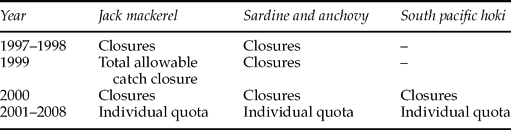
During and after 1997, period catch restrictions in the form of temporal closures were imposed on jack mackerel, sardine, and anchovy. In 1999, a TAC was established for jack mackerel; this was combined with the application of temporal catch restrictions. Temporal closures alone were used again in 2000.Footnote 5 Finally, in 2001, an IQs system with limited transferability was decreed and applied to the four fisheries.
Regulations introduced to control the total catch level of jack mackerel generated greater incentives for the industrial fleet to target other, less regulated pelagic species. As a consequence, by 1999, the composition of the fleet landings of pelagic species changed, especially in favor of common sardine and anchovy (see table 1).Footnote 6 This shift in the behavior of the industrial fleet was perceived by the regulatory authorities, who, in 2000, made the first attempt at jointly regulating the activity of the industrial fleet over all four species. This helps to explain why the new regulatory framework of 2001 considered IQs for all four pelagic species. In 2001, the government imposed the use of a satellite positioning system for the pelagic industrial fleet. This improved the capacity of the authorities to effectively monitor the operation of this fleet, drastically reducing its level of common sardine and anchovy catches. These resources are allocated mainly within the first five nautical miles from the coast, which, according to Chilean Fishery Law, are for exclusive use by artisanal fishermen.
Since 2001, the harvesting of the pelagic fishing industry in central-southern Chile has been regulated by Law 19.713 (2001). This law created and allocated individual use rights or ‘maximum harvest limits’ (MHL) among vessel owners in the industrial fleet operating over the species considered. The law is valid until the year 2012, when it should be renewed or modified. Essentially, the individual quota system in these fisheries created and allocated rights to fish to vessel owners in the form of percentages of participation on the annual TAC. The percentage of participation assigned each vessel owner was defined based on two criteria: historical landings and vessel capacity. The law established that, for the application of the individual quota system, a TAC must be set in each fishery unit being considered, i.e., jack mackerel, sardine, anchovy, and South Pacific hoki (see Appendix 1, available at http://journals.cambridge.org/EDE, for more details on the allocation of MHL). Under the MHL system, vessel owners were not allowed to directly sell, buy, or lease fishing quotas. However, the law considered the possibility that the retirement of old vessels with MHL could generate a certificate of the quota participation. Said certificate would be transferable, so the selling/buying of quotas would only be possible through the exit of vessels. We argue that, given its design, the system considered limited transferability. Moreover, the IQs are species specific, with no possibilities of trade between species. Table 2 synthesizes the evolution of the regulatory activity in the pelagic fisheries of central-southern Chile by species and individual year from 1997 to 2008.
Regulatory activity in the pelagic fishery of central-southern Chile (1997–2008)

Source: Elaborated by the authors based on Regulatory Decrees from the Ministry of Economy, Undersecretary of Fisheries.
The period between 1997 and 2000 could be characterized as a race for fish. Fishermen used the temporal windows without closures to catch as much fish as possible. This obviously had an effect not only on the number of operative vessels at each point in time but also on the intensity and efficiency of their effort. Our guess is, from a purely technical point of view, that the vessels were operated inefficiently. With the prevailing regulatory framework, fishermen could not choose the technically optimal start day, trip duration, crew size or composition, fish location, or percentage of the hold filled up. Thus, we expected the IQs to affect the size of the fleet as well as the individual operational efficiency of the remaining active vessels.
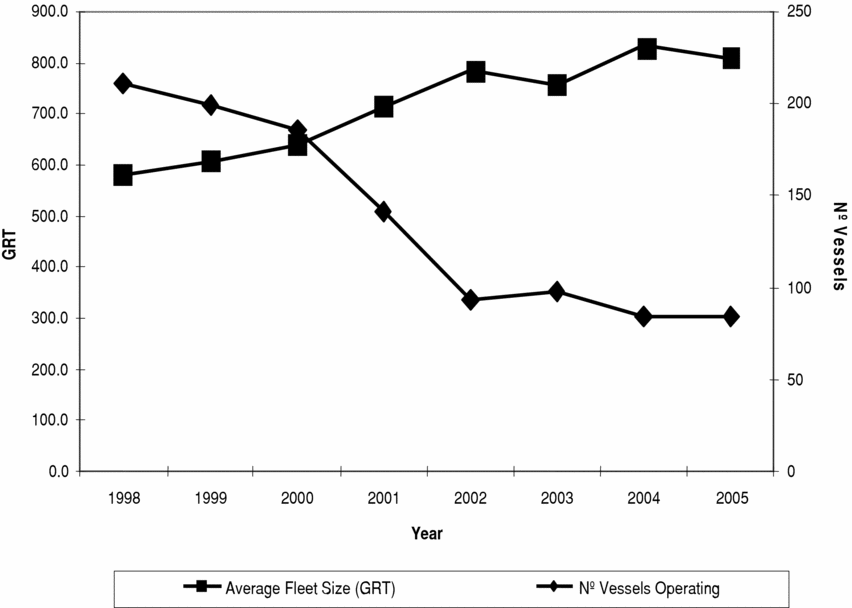
One of the main effects of the introduction of IQs in the pelagic fisheries off central-southern Chile was the drastic reduction in the number and increment in the average size of active vessels operating in the fleet (see figure 1).
Number of vessels and average fleet size (GRT) operating on pelagic fisheries in central-southern Chile (1998–2005)
Source: Elaborated by the authors based on information provided by the Undersecretary of Fisheries of the Government of Chile.

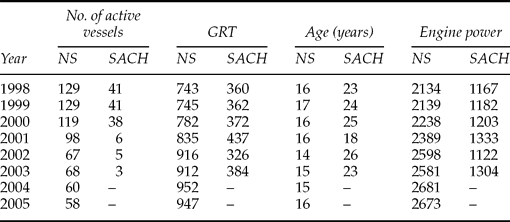
At the beginning of the analysis period, a small proportion of landings was used to produce human consumption goods, principally canned fish. After the regulatory transition to IQs, an increasing share of jack mackerel and South Pacific hoki landings was used in the production of human consumption goods. However, because of their small size, sardine and anchovies were still used exclusively for fish meal production. As can be seen in table 3, the fleet specialized in sardine and anchovy had different technical characteristics than the one catching all four species (nonspecialized fleet). On average, the vessels of the nonspecialized fleet were larger and had more powerful engines than the sardine and anchovy fleet. Notwithstanding, after the IQs, the number of active vessels was reduced in both fleets.
Number of active vessels and average technical characteristics between 1998 and 2005 according to fleet type

Notes: NS refers to the fleet that is not specialized in sardine and anchovy. SACH refers to the fleet specialized in sardine and anchovy.
Source: Elaborated by the authors based on information provided by the Undersecretary of Fisheries of the Government of Chile.
4. Econometric model
The model proposed for estimating the effect of IQs on technical efficiency attempts to capture two basic effects. The first one is that IQs are expected to have a direct positive effect on the level of technical efficiency of the vessels that continue to operate in the fisheries after the introduction of the regulatory change. This effect is related to the expected short-run efficiency gains due to better management of individual vessel activity. The second effect is that the regulatory change also has an efficiency enhancing effect on average vessel efficiency by inducing the selection of the more efficient vessels and, thus, improving fleet performance.
To introduce the first of these effects, we allow the level of individual vessel efficiency to shift between the period without and with IQs. The null hypothesis is that the individual vessel technical efficiency does not change in the period with IQs. This possibility is introduced by a binary state variable in the inefficiency equation of a stochastic production frontier model.
The second effect of IQs on total fleet efficiency is due to the so-called selection effect. This effect arises because, as discussed before, one should expect that only the more efficient vessels remain active in the fleet after the regulatory change. Thus, even if the individual efficiency effect is null for all vessels, one would expect an increase in the average fleet efficiency after the introduction of the IQs simply because the more efficient vessels are selected to remain active. If one does not control for this effect, the average efficiency estimates will include both the individual and selection effects. From an estimation perspective, the existence of a selection effect can bias the parameter estimates of our model (Heckman, Reference Heckman1979). Specifically, the parameter estimate for the IQ's effect on technical inefficiency could potentially be biased if we do not control for the selection effect. Thus, it seems important to introduce this control. To do this, we use Heckman's (1979) two-stage procedure. First, we estimate a model for the probability of selecting a vessel (the participation equation). From basic economic fisheries theory, one can hypothesize different factors that should affect the decision of a vessel owner to select a vessel for a fishing trip (see e.g., Anderson, Reference Anderson1999). Herein, we allow that vessel characteristics, stock abundance, and input and output prices affect said decision. This model results in a by-product: an estimated variable that measures the probability of participation [the inverse Mills ratio (IMR)] for each vessel. Later, this by-product is introduced into the inefficiency equation of the stochastic frontier model.Footnote 7
Brandt (Reference Brandt2007) suggests that part of the selection efficiency gains due to IQs could be a consequence of strategic behavior on the part of the vessel owners. However, such behavior was not possible in the sample analyzed herein, as mentioned previously. Thus, the selection effect can also be ascribed to the introduction of the IQ system.
In summary, the econometric model proposed for assessing the effect of IQs on technical efficiency is composed of three relationships: a stochastic frontier equation, an inefficiency equation, and a participation equation. This model is applied to the ‘nonspecialized’ fleet, which captures all four species (jack mackerel, South Pacific hoki, sardine, anchovy), and to the specialized ‘sardine and anchovy’ fleet.
The stochastic production frontier equation, in its panel data version, is formally represented by

where yit is (the logarithm of) a measure of output of the i-vessel at time (month) t, where i = 1, . . ., N and t = 1, . . ., T; xit is a (1 × k) vector of (the transformations of) associated inputs used by the i-vessel at time t; β is a (k × 1) vector of coefficients for the inputs; vit is a N(0, σ2v) i.i.d. random variable; and uit ≥ 0 is a measure of technical inefficiency for each vessel. There are different assumptions in the literature about the distribution of uit. We use the Battese and Coelli (Reference Battese and Coelli1995) specification, where uit ∼ N+(zit γ, σu2), which are assumed to be independently distributed. The output variable is constructed as a linear aggregation of the different outputs of the corresponding species for the nonspecialized fleet and the sardine and anchovy fleet.Footnote 8 The vector x includes an abundance indicator, vessel characteristics, and fishing effort. Moreover, since we assume a translog form for the production function, it includes the interaction and quadratic terms for these variables. Note that the marginal effects of all three variables are expected to be positive. We construct the abundance indicator from landings data, since we do not have any biomass measurement with monthly frequency. We use aggregate landings divided by the total number of trip days in the month of the fleet and weighted by the yearly average fleet capacity. Finally, we include a time variable to capture eventual changes in vessel technology.
The inefficiency equation captures the effect of different variables on individual vessel efficiency. One of these variables is the regulatory regime.

where zit is a (1 × l) vector of variables that affects the inefficiency level of the i-vessel at time t; γ is a (l × 1) vector of coefficients; ϵit ∼ N(0, σu 2); and ɛ has a lower (variable) truncation point, ɛit ≥ −zitγ. The vector z includes a dummy variable that takes a value of one during the months when the IQ regime is in place and zero otherwise. Moreover, the vector z also includes a dummy variable that takes a value of one if the vessel owner is vertically integrated with a processing firm and zero otherwise, as well as a variable that measures the probability of participation (IMR) of each vessel.
The specification of the inefficiency equation reflects the idea that the regulatory regime can affect technical efficiency at the vessel level. It is expected that, during the period with IQs, vessel technical inefficiency should be reduced. The level of vertical integration can also affect efficiency. If the firm's objective function is to maximize profits from the whole activity (extracting and processing), then the vessel operation will be subordinated to this global aim. Vessel operation could, under some circumstances, be less than fully efficient.Footnote 9 In this case, one should expect integrated vessels to show a higher level of inefficiency than nonintegrated ones. Finally, the probability of participation variable corrects for the selection bias. A significant effect for this variable indicates that there is a selection effect in the sample.
The third equation is the participation equation. This equation estimates the probability that a certain vessel will participate actively in the fisheries. The idea is to control for a potential selection bias (Heckman, Reference Heckman1979). The participation equation is:

where P is the probability indicator; Iit is a binary variable that takes a value of one if the vessel i engages in fishing during period t and zero otherwise; F(·) is the probability function; wit is a (1 × m) vector of variables that affects the decision of using i-vessel at time t; and δ is a (m × 1) vector of coefficients. The vector w includes the size, age, and engine power (EP) of the vessel, the level of fish abundance, and the input and output prices.
Vessel characteristics such as size, age, and EP are variables that should affect the selection decision (to maintain a vessel operative) after the introduction of IQs. Since these characteristics should also be related to vessel efficiency, they capture efficiency considerations in the selection of vessels. However, the decision to select a vessel for fishing can be considered not only as a long-run (capital) decision in which the vessel owner chooses to withdraw the vessel permanently from operation but also as a short-run decision in which the skipper opts continuously over time to remove the vessel from the next fishing period. This short-run decision should be affected by factors related to the time-varying profitability of the trip, e.g., fish abundance and product and input prices (see Anderson, Reference Anderson1999). Fish abundance should increase the probability of selecting any vessel. Product prices affect the marginal income of an additional trip, whereas input prices change the marginal costs. Thus, higher product and input prices should have positive and negative effects, respectively, on the probability of an additional trip and, in this sense, the probability of selecting a vessel at any moment.
The model is estimated in two steps. First, equation (3) is estimated by the maximum likelihood method and the IMR is estimated for each vessel. In the second step, equations (1) and (2) are estimated simultaneously following Battese and Coelli (Reference Battese and Coelli1995). The estimated variable (IMR) in the first step is introduced into equation (2) in the second step. The estimated coefficients are not efficient, but they are consistent.
The estimated results are used to decompose the effect of the regulatory regime shift on fleet efficiency, following the decomposition shown in Appendix 2 (available at http://journals.cambridge.org/EDE). To estimate average fleet efficiency, we calculate a simple average of the estimated vessel efficiencies for the period before and after the introduction of IQs. The size of the change in average fleet efficiency between periods is calculated and then decomposed into the change due to individual vessel efficiency (for vessels active in both periods) and that caused by the removal of less efficient vessels in the second period.
We use a dataset containing microeconomic data on industrial fleet operations to estimate the stochastic production frontier as well as the vessel selection model for the industrial pelagic fisheries in central-southern Chile. This dataset includes information provided by different sources. First, the National Fisheries Service (SERNAPESCA) gathers individual vessel reports on fishing activity for each active vessel in the fleet between 1998 and 2005. Second, we have information on individual vessel characteristics. Third, data are also available on the regulatory instruments used in the fisheries during the period. Fourth, we have monthly-based information on the price of fuel and the prices of industrial commodities based on landed pelagic species.
The data used for the estimations consist of observations of individual vessel activity, aggregated monthly from January 1998 to September 2005. We built a nonspecialized sample of vessels consisting in the vessels that are not specialized in sardine and anchovy. We started to work with the entire population of 223 vessels. However, we refined the data by deleting vessels with GRT lower than 50 tons (artisanal vessels), observations with incomplete information, and vessels dedicated exclusively to catch Hoki. After this refinement, we obtained a sample of 132 vessels. This was a 93-month unbalanced panel with 12,275 monthly cells. To control for the induced change in landing quality, we use a special dataset considering only those vessels targeting sardine and anchovy. In this case, we observe an unbalanced panel of 42 vessels for 72 months with 3,906 monthly cells.Footnote 10
5. Results
The first stage basic equation used to estimate the selection decision regarding a vessel is given by

where GRT is the gross registered tonnage of each vessel, which we use as a measure of vessel size; AGE is the age of the vessel since construction, measured in number of years; EP is the EP of the vessel, measured in horse power units; BIOMASS is the indicator of fish abundance; FISH PRICEt is the average (monthly) FOB price of a ton of fish meal,Footnote 11 FUEL PRICEt is the average (monthly) price of fuel; and MHL is a dummy variable that takes a value of one if the vessel operates during the IQ system and zero otherwise. We also include monthly dummy variables aimed at capturing seasonal patterns. December is used as the baseline month.
We estimate the dichotomous model with Probit; table A.1 in Appendix 3 (available at http://journals.cambridge.org/EDE) shows the results of these estimations for both samples (nonspecialized and sardine–anchovy fleets). A homogeneity test for parameter equality between both samples is rejected at all traditional confidence levels. This strengthens the evidence presented in table 3 for differentiated fleets. From a global perspective, the estimated models are statistically significant. As for the estimated individual parameters, our results indicate that almost all coefficients of the variables have the expected sign and are estimated as statistically significant at a 5 per cent level or lower. The only coefficient with an atypical (in this case, negative) sign corresponds to the variable EP in the sardine and anchovy sample, suggesting that the greater the vessel's EP, the lower its probability to be selected for a fishing operation in this fishery. However, this behavior is consistent with the existence of fishing grounds near the coast, which seems to be the case for the sardine and anchovy species in central-southern Chile. In contrast, the estimated coefficient for the EP in the nonspecialized sample is positive and significant, as expected. The coefficient associated with vessel size (GRT) is positive and significant, suggesting that, controlling for other factors, greater vessels are more likely to be selected for operation in any given month. The variable AGE indicates that newer vessels are preferred over older ones, and this effect is also estimated to be significant. The fish abundance, reflected in the variable BIOMASS, positively affects the probability of vessel selection. Also the higher the product price (FISHPRICE), the greater the probability a vessel will be selected for fishing. The parameter associated with the price of oil (OILPRICE) is negative and its significance level is estimated to be lower than 1 per cent, suggesting that an increase in the price of oil will lower vessel profitability and reduce the probability of selection for operation. Moreover, 75.9 per cent and 87.5 per cent of the values predicted for the nonspecialized sample and for the sardine and anchovy sample are, respectively, correct. In both samples, the proportions of selected and nonselected vessels are relatively similar. Thus, the proposed selection model seems to fit well with the data.
Remarkably, our results also suggest that, in terms of the probability of selecting a given vessel for operation before and after the introduction of the individual quota system, the nonspecialized sample could have experienced different effects due to vessel characteristics, fish abundance, fish price, and even oil price. In particular, the results suggest that the importance of vessel characteristics, fish abundance, and oil price should have increased, and that of fish price should have decreased in vessel selection decisions made after implementing IQs. The same result is not so clear for the sardine and anchovy fleet, stressing once more the differences between the two fleets.
The coefficients of the variable intended to capture the direct effect of the individual quota system on the vessel selection decision (MHL) are, in both samples, estimated to be significant at the 1 per cent level or lower and have the expected sign. In particular, our results suggest that the individual quota regime reduces the probability that a vessel will be selected for operation.
The predicted ‘participation propensity’ (IMR) is used in the second step as an additional regressor in the technical inefficiency equation.
In the second stage, we simultaneously estimate a stochastic production frontier for the log of monthly landings of pelagic species by individual vessels and the technical inefficiency equation using a panel dataset and following the approach proposed by Battese and Coelli (Reference Battese and Coelli1995). To take account of cross-effects, we use a translog production function specification. The final specification is given by

where subscript i and t identify the vessel and time (in months), respectively; LANDING is the total amount of reported landings of pelagic species per month; and DAYS is the number of total days at sea per month. Eleven seasonal dummy variables (in the vector MONTH) are also included in the estimation to control for seasonal effects on fishing activity. TREND is a monthly trend variable.
We estimate an inefficiency equation specified as

where VINTEG is a binary variable that takes a value of one if the vessel owner is integrated with the processing industry and zero otherwise, and LAMBDA1 is the predicted ‘participation propensity’ (IMR).
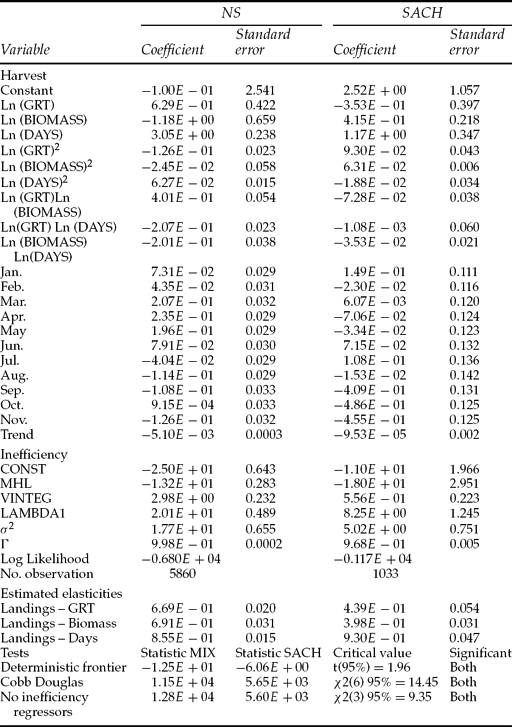
Table 4 presents the results for the frontier model with an inefficiency equation for the sample based on the nonspecialized fleet in the monthly period from January 1998 to September 2005, and the sardine and anchovy fleet from January 1998 to December 2003. The estimated elasticities for the variables GRT, BIOMASS, and DAYS in the production frontiers are all positive as expected and significantly different from zero at the 99 per cent confidence level.Footnote 12 The variables in the inefficiency equation are also statistically significant and have interpretable signs. The estimated coefficient for the shift variable (MHL), which controls for the IQ-regime, is negative, indicating that inefficiency declines during the operation of the IQ system. The variable that controls for integration status (VINTEG) suggests that the integrated vessel owner tends to be less efficient than the nonintegrated one. Finally, the sign of the variable that controls for the ‘participation propensity’ (LAMBDA1) suggests that not controlling for the sample selection effect probably would have biased downward the (absolute) estimated effect of the MHL variable.
Parameter estimates of stochastic production function and inefficiency equation with correction for participation decision

Notes: Dependent variable: Log of total monthly landing per vessel. Nonspecialized (NS) sample (Jan. 1998–Sep. 2005) and sardine–anchovy (SACH) sample (Jan. 1998–Dec. 2003).
Source: Based on econometric results by authors.
We perform several tests on the estimated production frontiers. First, we apply a homogeneity test for pooling the nonspecialized sample and the sardine and anchovy sample (not presented in table 4); this is rejected at very low levels of significance. Clearly, the two frontiers should be estimated separately, as we did. Second, we test for a deterministic frontier against a stochastic one, rejecting the deterministic specification in both samples. The third test, a Cobb Douglas specification, is also rejected against the translog specification. Finally, the null hypothesis of no independent regressors in the inefficiency equation is also rejected. Thus, it seems that the general proposed specification cannot be reduced without loss of information.Footnote 13
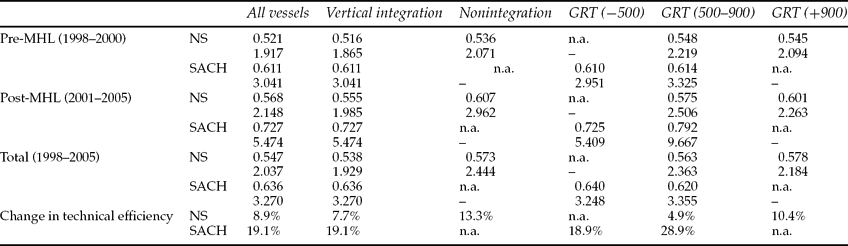
The estimated average efficiency scores for the nonspecialized fleet by vessel attributes before and during the IQ period and estimates of changes in technical efficiency are reported in table 5. The results suggest an improvement in average fleet efficiency for the nonspecialized fleet after the introduction of the IQ system. The results also suggest that the increase in efficiency is more pronounced for the vertically nonintegrated vessels than the vertically integrated ones of this fleet. Moreover, the larger vessels in this fleet show the greatest efficiency gains.
Mean efficiency before and during MHL by vessel attributes for the nonspecialized (NS) and sardine and anchovy (SACH) samples, and estimates for changes in technical efficiency

Notes: t-Statistics under mean efficiency values. n.a.: not available. We omitted the results for the vessel category ‘less than 500 GRT’ for the nonspecialized sample because there were too few observations.
Source: Own elaboration based on econometric results.
However, one should remember that product quality is not controlled for in these results. As stated earlier, one of the main changes perceived in these fisheries after the introduction of the IQ system is a shift in product orientation and higher quality landed fish. Since these effects could be biasing down the estimated results, we now discuss the results obtained for the sample of vessels orientated specifically at fish meal production, that is, the sardine and anchovy fleet.
Table 5 presents the estimated technical efficiency scores for the sardine and anchovy fleet. In these results, changes in the final product composition and quality should be controlled for since these landings continue to be used for fish meal after the introduction of the IQs. The estimated average fleet efficiency level is initially higher for the sardine and anchovy fleet than for the nonspecialized one. To take this initial scale difference into account, we calculate proportional rates of change. The estimated total change in efficiency is greater for the sardine and anchovy sample than for the nonspecialized sample. The estimated growth rate is 19.1 per cent, which is more than 10 percentage points greater than the rates estimated for the nonspecialized fleet.
Some evidence of differences is observed in the levels of technical efficiency for the sardine and anchovy fleet depending on the vessel size. These differences are especially clear during the period in which the fleet is operating under IQs. According to our results, medium-sized vessels have the highest average technical efficiency scores, and, unlike the nonspecialized fleet, the efficiency of the mid-sized vessel category increases the most with IQs.
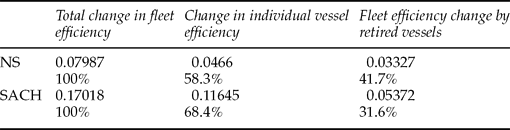
In table 6, we give the results obtained by decomposing the estimated change in fleet technical efficiency originated from the introduction of IQs in the pelagic fisheries off central-southern Chile. The decomposition identifies two sources of change in fleet efficiency: differences in individual vessel efficiency and differences in efficiency between retired and remaining vessels (see Appendix 2 at http://journals.cambridge.org/EDE for details). The decomposition is shown for the results obtained with both nonspecialized and sardine and anchovy samples.
Decomposition of estimated change in total fleet technical efficiency due to MHL in the pelagic fisheries in central-southern Chile for the nonspecialized (NS) and sardine and anchovy samples (SACH)

Note: The Change in Fleet Efficiency is measured as the absolute difference between the weighted average efficiency level post IQ and the weighted average efficiency level prior to the IQ. See Appendix 2 at http://journals.cambridge.org/EDE for details.
Source: Own elaboration based on econometric results.
The nonspecialized sample, as discussed earlier, shows a modest increment in fleet efficiency. Our results indicate that this improvement is caused partially by the retirement of less efficient vessels and partially by improvements in individual efficiency of the vessels still operating in the fisheries.Footnote 14 About half of the measured gain in efficiency is due to retired inefficient vessels and half to the improved performance of the vessels that remain operative in the fisheries. However, one should be cautious with the interpretation of these results because they do not control for quality changes in the catch.
The results for the sardine and anchovy sample differ from those of the nonspecialized sample. In absolute terms, fleet efficiency increases more in the first sample than in the second. Furthermore, this increase is better explained by the improved efficiency of the vessels that remain active in the sardine and anchovy fisheries than by the retirement of less efficient vessels. About two thirds of the fleet's efficiency improvements are due to the first component and the remaining third is due to the second one. Thus, the results tend to confirm the importance of controlling for quality changes when evaluating the effect of IQs on technical efficiency. In our case, the estimated results show that the magnitude of the change is greater when controlling for quality changes and that the composition of the factors behind the gains in fleet efficiency also change.
6. Conclusions
In this paper, we estimate the technical efficiency gains of introducing IQs (individual MHLs) in the pelagic fisheries of central-southern Chile. We use the Heckman two-stage procedure to account for the potential self-selection bias in the estimates that can arise when vessel owners choose to operate more efficient vessels after the regulatory change. Moreover, evidence shows important changes in the quality of the landings, with a large share of the total landings being redirected to the human consumption industry after IQs are introduced in Chile. Since this fact can bias the efficiency change estimates, we attempt to control for quality changes in the catch after the implementation of IQs by using a more homogenous vessel sample. To this end, we select a sample of vessels specializing in capturing the pelagic species (sardine and anchovy) used exclusively for fish meal production and not for human consumption goods. This restricted sample should not be affected by the important quality changes in production that involve shifting production from fish meal to human consumption goods. Thus, our estimations are based on two samples of vessels operating in these fisheries before and after the introduction of IQs: a nonspecialized sample (all vessels not specialized in sardine and anchovy) and a restricted sample (only vessels operating over sardine and anchovy).
The model is successfully estimated, and the results are, in general, significant and show the expected signs. Moreover, there is evidence of a selection bias: more efficient vessels are selected to continue operating after the regulatory change.
The results for the nonspecialized sample suggest that fleet efficiency improves after the introduction of IQs. However, these improvements are modest and, according to our decomposition, partly due to the composition effect (i.e., the withdrawal of the less efficient vessels is responsible for the statistical increase in the measured fleet efficiency) and partly to the individual efficiency enhancing effect. But, in the light of what is known about changes in catch quality after the introduction of the IQs, these results might be biased and should be interpreted carefully.
The results obtained with the restricted (sardine and anchovy) sample differ from those obtained with the nonspecialized sample in two aspects. First, the estimated change in overall fleet efficiency for the restricted sample is larger than for the nonspecialized sample. In fact, the estimated change of the former is more than twice that of the latter. Second, for the restricted sample, the distribution of this change within the fleet follows a distinct pattern. The improvements are greater for small and medium-sized vessels, and the fleet's technical efficiency increases both because of the individual improvements in vessel efficiency and because of the composition (selection) effect. However, the selection effect seems to be less important than the individual efficiency effect.
All this evidence is consistent with the idea that the introduction of IQs in Chile has an important positive impact on fleet efficiency and that, to properly measure this impact, it is necessary to take into account how landings are affected by the self-selection bias and quality changes generated by the regulatory shift. Thus, we conclude that the evidence presented herein suggests the need for care when evaluating the effect of regulatory changes on efficiency; changes in quality must be considered, because these do matter. The results presented in this paper indicate that the efficiency gains associated with IQs might be underestimated if these changes are not taken into account.