Following acquired brain injury (ABI), individuals may experience persistent challenging behaviours (CB) such as aggressive verbal and physical outbursts, social disinhibition and apathy (Benedictus, Spikman, & van der Naalt, Reference Benedictus, Spikman and van der Naalt2010; Hicks et al., Reference Hicks, Gould, Hopwood, Kenardy, Krivonos and Ponsford2017; Ponsford et al., Reference Ponsford, Downing, Olver, Ponsford, Acher, Carty and Spitz2014; Tateno, Jorge, & Robinson, Reference Tateno, Jorge and Robinson2003). These behaviours may impact the individual’s integration within their community (Gould, Hicks et al., Reference Gould, Hicks, Hopwood, Kenardy, Krivonos, Warren and Ponsford2019; Ponsford et al., Reference Ponsford, Downing, Olver, Ponsford, Acher, Carty and Spitz2014) and can strain relationships with family and friends (Gould, Hicks et al., Reference Gould, Hicks, Hopwood, Kenardy, Krivonos, Warren and Ponsford2019; Turkstra, McDonald, & DePompei, Reference Turkstra, McDonald and DePompei2001). Indeed, CB are reported by family members to be the most distressing post-injury change (Anderson, Parmenter, & Mok, Reference Anderson, Parmenter and Mok2002; Ponsford & Schönberger, Reference Ponsford and Schönberger2010). Despite this, many individuals with ABI living in the community do not receive professional behaviour support or are unsatisfied with their current support (Hicks et al., Reference Hicks, Gould, Hopwood, Kenardy, Krivonos and Ponsford2017).
Potentially, this low level of behaviour support results from barriers community ABI therapists face in being trained in and implementing appropriate interventions. It is crucial to identify these barriers, with clinical translation strategies that are tailored to identified barriers shown to be more successful than only disseminating knowledge via practice guidelines (Baker et al., Reference Baker, Camosso-Stefinovic, Gillies, Shaw, Cheater, Flottorp and Jäger2015). The current authors recently conducted a survey of 136 community ABI therapists working in Australia and found that 78% expressed interest in receiving future training in behaviour interventions, with part-day face-to-face workshops, online courses/webinars and clinical supervision the most preferred training formats (Carmichael, Gould, Hicks, Feeney, & Ponsford, Reference Carmichael, Gould, Hicks, Feeney and Ponsford2019). However, 80% reported facing one or more barriers to training in and implementing new behaviour interventions. These barriers included lack of time, limited organisational funding, low therapist confidence and disengagement of support people.
Positive Behaviour Support
One potentially efficacious approach to addressing CB presented by individuals with ABI is Positive Behaviour Support (PBS; Fisher, Bellon, Lawn, & Lennon, Reference Fisher, Bellon, Lawn and Lennon2019; Gould, Ponsford et al., Reference Gould, Ponsford, Hicks, Hopwood, Renison and Feeney2019; Ylvisaker, Jacobs, & Feeney, Reference Ylvisaker, Jacobs and Feeney2003). PBS is a person-directed and context-sensitive approach that primarily aims to improve the individual’s quality of life through skill development, environmental modification and supporting participation in personally meaningful activities and relationships. The intervention is designed, implemented and evaluated in collaboration with the individual and their ‘natural supports’, such as family members and carers (Carr et al., Reference Carr, Dunlap, Koegel, Turnbull, Sailor, Anderson and Fox2002; Feeney, Reference Feeney2010b; Gould, Ponsford et al., Reference Gould, Ponsford, Hicks, Hopwood, Renison and Feeney2019; Ylvisaker et al., Reference Ylvisaker, Jacobs and Feeney2003).
In contrast to traditional consequence-focused approaches (e.g., reinforcement, punishment), PBS involves a comprehensive assessment of the reasons why the individual engages in CB, informing modification of the behavioural antecedents/triggers (Gore et al., Reference Gore, McGill, Toogood, Allen, Hughes, Baker and Denne2013; Ylvisaker et al., Reference Ylvisaker, Turkstra, Coehlo, Yorkston, Kennedy, Sohlberg and Avery2007). Antecedents include personal, injury, social and environmental factors that may be immediately (e.g., an instructional demand) or remotely (e.g., a negative interaction earlier in the day) related to the precipitation of CB. Antecedents may be internal (e.g., loss of previously valued roles) or external to the individual (e.g., presence of someone the individual dislikes; Ylvisaker & Feeney, Reference Ylvisaker and Feeney1998). Antecedent-focused approaches to addressing CB may be preferable given the ability to learn from consequences can be impaired following brain injury (Larson, Kelly, Stigge-Kaufman, Schmalfuss, & Perlstein, Reference Larson, Kelly, Stigge-Kaufman, Schmalfuss and Perlstein2007; Ylvisaker et al., Reference Ylvisaker, Jacobs and Feeney2003). Consequences and consequence-focused approaches may still play a (smaller) role in PBS, but any consequences should be natural, logical and immediate relative to the behaviour (e.g., cleaning up after throwing an item and breaking it; Ylvisaker & Feeney, Reference Ylvisaker and Feeney1998).
Growing evidence from single-participant reports (e.g., Arco & Bishop, Reference Arco and Bishop2009; Feeney, Reference Feeney2010a; Feeney & Achilich, Reference Feeney and Achilich2014; Gould, Ponsford et al., Reference Gould, Ponsford, Hicks, Hopwood, Renison and Feeney2019) and several group studies (e.g., Carnevale, Anselmi, Johnston, Busichio, & Walsh, Reference Carnevale, Anselmi, Johnston, Busichio and Walsh2006; Feeney, Ylvisaker, Rosen, & Greene, Reference Feeney, Ylvisaker, Rosen and Greene2001) suggests that PBS principles can reduce CB and improve community integration following ABI. In the survey of community ABI therapists by Carmichael et al. (Reference Carmichael, Gould, Hicks, Feeney and Ponsford2019), a range of PBS-consistent approaches were viewed as important in addressing CB. These approaches were categorised as: teamwork and collaboration, person-centred practice, working with (identifying, understanding and addressing) antecedents, environmental modification, improving quality of life and skill-building. Despite participants’ support for PBS-consistent approaches, only 13% made specific reference to PBS within their responses. In another recent survey of 191 Australian occupational therapists, most of whom worked with individuals with ABI (91% stroke; 73% traumatic brain injury), only 22% reported using PBS to address neurocognitive impairments (Nott, Barden, Chapparo, & Ranka, Reference Nott, Barden, Chapparo and Ranka2019). These results suggest there may be limited awareness of PBS amongst ABI therapists; however, their understanding of this approach remains largely unknown.
The current study
Although the survey by Carmichael et al. (Reference Carmichael, Gould, Hicks, Feeney and Ponsford2019) provided information about which formats for training in behaviour interventions were preferred by community ABI therapists, it did not elucidate why these were preferred. Furthermore, barriers to the implementation of changes by community ABI therapists may be complex, involving a range of attitudinal, behavioural and organisational factors (Dopson, Locock, Gabbay, Ferlie, & Fitzgerald, Reference Dopson, Locock, Gabbay, Ferlie and Fitzgerald2003) that may not have been fully captured by the pre-determined list of barriers supplied in the survey. Accordingly, the aim of the current study was to gain a deeper insight into community ABI therapists’ experiences of using, training in and implementing behaviour interventions. Qualitative interviews offer a means of obtaining a rich, in-depth account of therapists’ experiences. An additional aim was to determine community ABI therapists’ understanding of PBS, given the growing evidence base for this approach.
Method
Participants
Participants were a sub-sample of the community ABI therapists who completed an online survey by Carmichael et al. (Reference Carmichael, Gould, Hicks, Feeney and Ponsford2019). Participants were recruited for the survey through various Australian brain injury and therapy organisations, by email, social media and newsletters and at a conference. Therapists of any discipline were eligible to participate if they provided behaviour support to adults with ABI and currently practised in community settings within Australia. An invitation to take part in an interview was placed at the end of the online survey, with all 128 therapists who completed the full survey invited. Participants provided written consent to be interviewed.
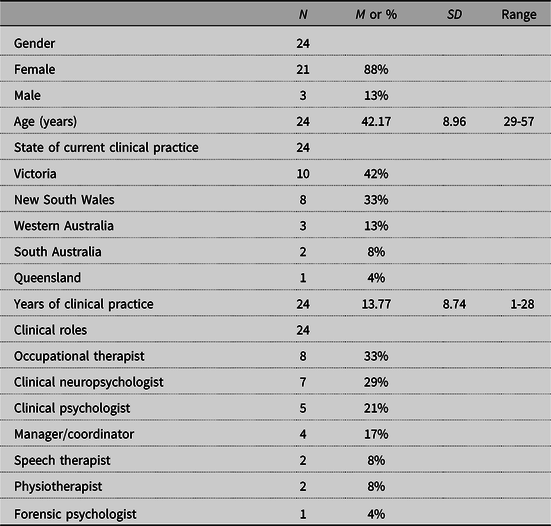
Twenty-four therapists (19%) agreed to be interviewed. See Table 1 for participant demographics. Participants were mostly women (n = 21; 88%) practising in Victoria or New South Wales, with an average 14 years’ clinical experience. The most frequent clinical role was occupational therapist (n = 8; 33%), followed by clinical neuropsychologist (n = 7; 29%) and clinical psychologist (n = 5; 21%).
Participant Demographics

Six participants indicated multiple clinical roles.
Materials
A semi-structured interview schedule was used to elicit an in-depth exploration of participants’ experiences with behaviour interventions and understanding of PBS (see Supplementary Material). Questions were divided into four topics: A) Current use of approaches to address CB, B) Past training in behaviour interventions and preferences for future training, C) Implementing changes into clinical practice and D) Understanding of PBS.
Procedure
Institutional ethics approval was obtained. Interviews were conducted by J.J.C (n = 17), K.R.G (n = 3), A.J.H (n = 2) and P.A (n = 2). Interviewers had a background in psychology or clinical neuropsychology and experience in qualitative interviewing. Interviews were conducted via teleconference (Zoom Video Communications, 2018; n = 17), by phone (n = 1) or in-person at the participant’s home (n = 3), a café (n = 2) or workplace (n = 1). On average, interviews lasted 56.23 min (range 28.55–100.93 min). Interviews were audio-recorded and transcribed. Transcripts were reviewed for transcription accuracy.
Data analysis
To investigate participants’ experiences of using, training in and implementing behaviour interventions, thematic analysis was conducted on participants’ responses to the first three sections of the interview schedule. The analysis was performed using the six-step approach outlined by Braun and Clarke (Reference Braun and Clarke2006). Firstly, the authors familiarised themselves with the data through repeated readings and group discussions of the interview transcripts. The interviewers kept journal reflections on the interviews and shared these reflections with the other authors. Debriefing in this way helped minimise the impact of individual authors’ biases on data interpretation (Barbour, Reference Barbour1998; Curtin & Fossey, Reference Curtin and Fossey2007). Next, using the software programme NVivo Version 12 (QSR International, 2018), J.J.C coded all transcripts based on segments of the raw data that were meaningful and interesting. Data saturation was monitored by calculating the number of new nodes created after coding each interview (Guest, Bunce, & Johnson, Reference Guest, Bunce and Johnson2006). As only 2% of the total nodes were created during coding of the final interview, it was determined data saturation had been reached.
Thirdly, codes were organised into potential themes and sub-themes that reflected broader patterns of meaning across the data. Themes were inductive, as they were derived from the data themselves as opposed to a pre-existing theoretical template (Patton, Reference Patton1990). The generation of themes was a collaborative process amongst the authors, involving several group meetings and discussions. Fourth, a thematic map was produced illustrating the distinctiveness of the themes, and fifth, these themes were named. Lastly, quotes were selected as compelling examples of each theme for inclusion in this article. This process was iterative (Srivastava & Hopwood, Reference Srivastava and Hopwood2009), with the authors undergoing multiple cycles of these steps and generating multiple thematic maps before the final themes were decided upon.
To evaluate inter-coder consensus, transcripts were double-coded. K.R.G. and A.J.H. were provided with definitions of the themes and sub-themes by J.J.C and double-coded randomly selected transcripts using a refined NVivo file containing only the highest-order nodes (Campbell, Quincy, Osserman, & Pedersen, Reference Campbell, Quincy, Osserman and Pedersen2013). K.R.G coded 4 of 13 transcripts (31%), mean Cohen’s kappa = 0.54 (range = 0.31–0.82), indicating moderate agreement between coders (Viera & Garrett, Reference Viera and Garrett2005). A.J.H coded an additional 7 of 24 transcripts (29%), mean Cohen’s kappa = 0.67 (range = 0.60–0.75), indicating substantial agreement (Viera & Garrett, Reference Viera and Garrett2005). Nodes with Cohen’s kappa < 0.50 were reviewed by the coders (Guest et al., Reference Guest, Bunce and Johnson2006) with subsequent changes to the thematic structure, including changes to the number and scope of themes. Additionally, member checking was conducted in which participants provided written feedback on a summary of the findings. One participant indicated an aspect of their experiences (relating to use of restrictive practices) had not been reflected in the analysis and therefore, this was added to the findings.
A content analysis was also performed to address the additional aim of determining community ABI therapists’ understanding of PBS. This involved categorising participants’ responses to the question, ‘Can you tell me your understanding of PBS?’ A category represented an element of PBS as defined by participants. J.J.C and K.R.G performed this analysis together. As the coders progressed through the responses, definitions of each category were developed by listing illustrative examples. Disagreements were resolved by comparing coders’ interpretation of the data to these definitions. All disagreements were resolved collaboratively and 100% consensus was obtained.
Findings
Thematic analysis
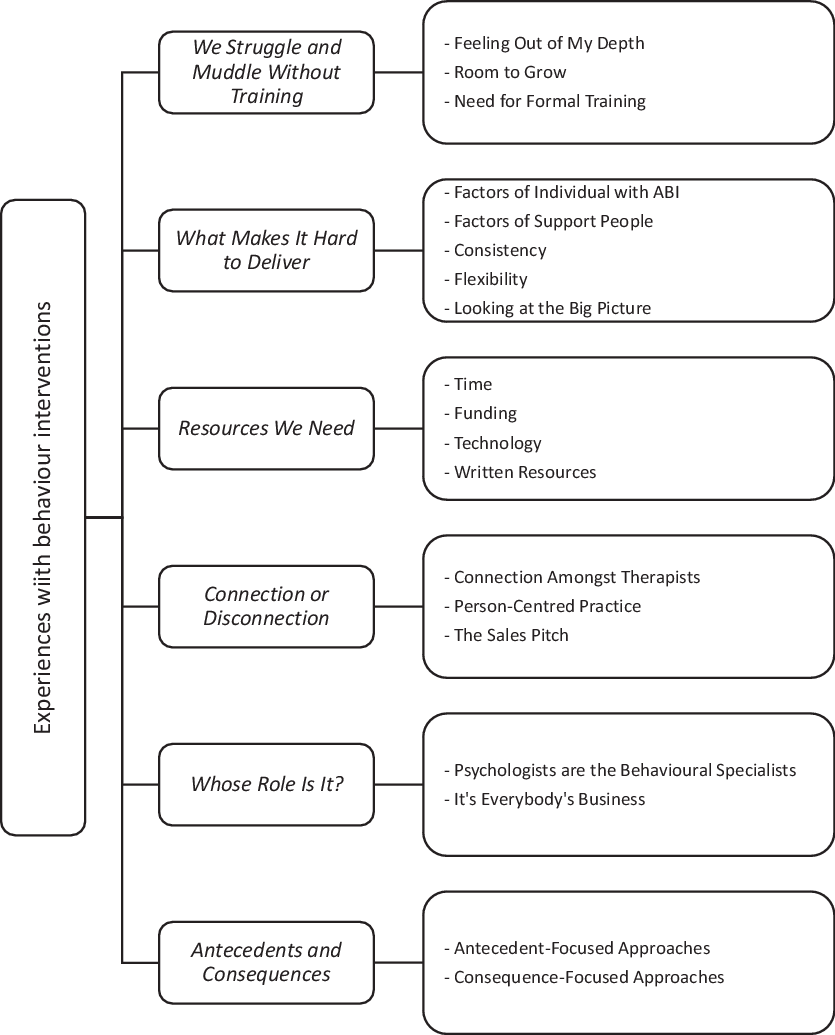
Six themes, divided into 19 sub-themes, were generated that described participants’ experiences of using, training in and implementing behaviour interventions (see Fig. 1).
Overview of themes and sub-themes describing participants’ experiences with behaviour interventions.

We Struggle and Muddle Without Training
This theme described participants’ need and desire for training in behaviour interventions: ‘I hope… a change [is achieved] in the… lack of support that there is in this planet for ABI therapists… we struggle and muddle.’ (Physiotherapist). Some participants reported they had low expertise and confidence in behaviour interventions: ‘You feel out of your depth… and they’re on the phone, ringing you, saying, “What do we do?”’ (Occupational Therapist; Case Manager). Low expertise and confidence were identified as potential barriers to implementation of changes into one’s practice. Participants indicated that training in behaviour interventions could improve their confidence in this area and expressed their desire to learn from behaviour ‘experts’. Irrespective of current expertise, participants generally indicated they had ‘room to grow’, acknowledging the importance of continuing professional development in behaviour interventions: ‘You’re not done [training] til you’re dead.’ (Speech Therapist; Case Coordinator).
However, participants indicated there was a lack of formal training available. Consequently, most training was informal, such as learning on the job and self-directed research. Participants received minimal, if any, university training in behaviour interventions. ‘I can’t think of any formal training I’ve… attended… mainly just learning from on the job with more experienced clinicians’ (Occupational Therapist). However, some participants had received formal training in addressing CB, including a workshop (once-off, 4.5 h), formal supervision (e.g., monthly ‘for a few hours’) and/or online training.
Participants indicated a desire for ABI-specific training in behaviour interventions tailored to their current level of expertise: ‘I don’t want psychology 101’ (Clinical Psychologist). Participants largely preferred practical over theoretical/didactic training, with opportunities to practise new skills and receive feedback (e.g., roleplay, supervision): ‘don’t just tell me; show me’ (Speech Therapist; Case Coordinator).
What Makes It Hard to Deliver
Participants identified a range of factors (of the individual with ABI and their support people) and practice needs (to work consistently, flexibly and holistically) that made it difficult to effectively deliver behaviour interventions. Factors of the individual with ABI that made it difficult included premorbid factors (e.g., personality), living environment (e.g., noisy, messy), cognitive impairments (e.g., in self-awareness, self-regulation and memory), comorbid psychiatric issues and substance use: ‘If you’re pissed [inebriated] when I turn up to your house, you’re not ready to go do that bus trip that we had planned’ (Speech Therapist; Case Coordinator).
Other difficulties related to the individual’s support people, which included both family members and formal support workers. There was often a lack of support people available, which was attributed to lack of funding, the transient nature of the disability support workforce and strained family relationships: ‘whether… the family is prepared to make those changes or they’re carrying emotional resentment towards that person… that’s where the difficulty is’ (Clinical Psychologist). In addition, formal support workers were perceived as unwilling or unable to engage with the intervention, which was attributed to anxiety/stress and lack of training, time and care: ‘Support workers don’t necessarily have the training… to even comprehend the injury let alone the management plan for behaviour’ (Physiotherapist); ‘often the support workers aren’t… particularly passionate about their work… they just don’t care’ (Clinical Psychologist). Participants’ implementation of new practices was impeded by disengaged support people.
Furthermore, participants noted that behaviour interventions needed to be used consistently by the therapy team and support people and that the individual needed structure and routine in their daily life. This was not easily achieved. For example, there was often a temptation or pressure to use a short-term solution or quick fix for the individual’s CB, resulting in reinforcement of the behaviour in the long-term (e.g., by giving in to the individual’s demands).
Balancing consistency with flexibly was important in addressing CB. Working flexibly included adapting approaches on the fly, individualising interventions to each individual and trialling different strategies. Flexibility was required for various reasons, including that each individual is different, unexpected crises may arise in the individual’s life and the individual and their support people may be reluctant to change. Furthermore, flexibility, in the form of openness to change, was important for implementing new practices: ‘it’s just having that openness to realise… your practice has to change’ (Assisted Living Coordinator).
Lastly, it was insufficient for participants to address CB in isolation of other issues. Instead, participants noted the importance of working holistically, ‘look[ing] at the big picture’ (Clinical Psychologist) and considering the individual’s social context and quality of life. Consequently, behaviour interventions were ‘nebulous’, meaning addressing CB overlapped with other areas such as cognitive rehabilitation and community participation: ‘When I think of challenging behaviours, I don’t think it’s something that I can… isolate from everything else’ (Occupational Therapist).
Resources We Need
Four types of resources were indicated as valuable when using, training in and/or implementing behaviour interventions: time, funding, technology and written resources. The availability of these resources varied.
Participants indicated that behaviour rehabilitation was an ongoing, lengthy process. It was important to devote time to understand the individual with ABI and their situation in order to address CB: ‘you need to spend a lot of time just capturing all the data… immersing yourself into that situation’ (Occupational Therapist; Case Manager). In addition, sufficient time was required to train in behaviour interventions and implement these into practice. Participants often had minimal time to attend training during work hours and consequently advocated for shorter courses, afterhours training and online training.
Funding was another valued resource. Concerns were raised about insufficient funding through the Australian Government’s National Disability Insurance Scheme (NDIS). NDIS funding was deemed insufficient to address CB, and the pressure to achieve billable hours also made it more difficult for therapists to take time to attend training. Funders needed convincing of individualised behaviour interventions which may be seen as unconventional (e.g., a project inspired by Game of Thrones): ‘It’s sometimes persuading funders that those outside-the-box thinking things are just as relevant as… doing boring OT work’ (Occupational Therapist).
Participants utilised modern technological resources while addressing CB. This included FaceTime, Skype and email to communicate with the individual with ABI and staff, and apps to compensate for impairments (e.g., Google Calendar for memory difficulties). Technological solutions were also desired for training and post-training support in behaviour interventions, such as via email, teleconferencing software and podcasts. Compared to face-to-face training, online training was valued for its time- and cost-efficiency and for its accessibility for non-metropolitan participants. However, some participants disliked online training as they felt it was more difficult to engage in and offered fewer opportunities for social interaction and networking: ‘Webinars are great because you can do things in the evening at home, but… it’s… not the same because… I never get to meet other OTs’ (Occupational Therapist).
Lastly, participants used a range of written resources in addressing CB. These included behaviour checklists, plans for how the individual will deal with difficult or stressful situations and cue cards to support self-regulation and decision-making. Written resources were also helpful when implementing a new approach: ‘you think, “Oh shit! How do I deal with this now?” and then I’ve got the… book there and I’ll flip through it’ (Clinical Psychologist). Written resources were indicated as most helpful when they were brief, small (e.g., pocket-sized), written in simple language and contained examples.
Connection or Disconnection
Participants’ experiences with behaviour interventions and understanding of PBS were further impacted by their connection, or lack thereof, with other therapists, the individual with ABI and their support people.
To address CB, participants reported working collaboratively with other therapists, with therapists’ unique expertise shared amongst the team. Participants raised the importance of establishing peer support networks and valued training formats that facilitated connection or interaction with other therapists, such as face-to-face workshops and conferences, supervision, mentoring, in-service training and interest groups: ‘Going to a conference, it’s the people at morning tea… which is as valuable as sitting down and learning something new’ (Clinical Psychologist). Connection amongst therapists within a team was essential when implementing new practices. However, the team could fracture when there was a lack of case coordination or information exchange: ‘psychologists… don’t seem to… give information and give support [to the rest of the team]… they seem to just be there for the client’ (Physiotherapist).
Secondly, participants described the importance of connecting with the individual with ABI in a person-centred manner when supporting behaviour change. This included basing the intervention on what was personally meaningful and important to the individual, such as their goals, interests and cultural background. Person-centred practice also involved increasing opportunities for the individual to have autonomy and control. However, participants found this difficult to balance with any impairments in decision-making following the injury: ‘if the support worker says, “Well, it’s his choice as to how many cigarettes he has a day”, and he’s having 150 cigarettes a day… that’s quite a tension’ (Occupational Therapist). Similarly, one participant discussed the complex interface between restrictive practices and human rights: ‘for food restriction… are you upholding their rights to change their mind [about eating less] or are you supporting them to reach their goals by not giving them the food?’ (Occupational Therapist).
Participants also reported they needed to connect with the individual’s support people to gain information about the individual and to implement the behaviour intervention in the individual’s natural environment. However, engagement of the support people was not guaranteed, for example, because they lacked understanding, were overwhelmed or burnt out or were overprotective. Accordingly, participants needed to perform a ‘sales pitch’, a key aspect of which was to educate and train the support people about ABI and CB. Other strategies to promote support people’s engagement included compromising, empathising with their struggles and respecting their expertise: ‘you don’t have a monopoly on knowledge… so you have got to be okay to listen to what [the nursing staff] have to say’ (Clinical Neuropsychologist).
Whose Role Is It?
This theme described two contrasting attitudes, each expressed by both psychologist and non-psychologist participants, regarding whose role it was to address CB. Some participants expressed the attitude that psychologists were the ‘behavioural specialist[s]’ (Clinical Psychologist), owing to their training: ‘I presume psychologists have a much better understanding of it [behaviour interventions] when they come out of uni’ (Occupational Therapist). Consequently, other disciplines often expected and relied on psychologists to take charge of addressing CB.
Conversely, psychologists were potentially constrained by receiving less practical training and observing the individual outside of their natural environment (e.g., in an office). Some participants acknowledged that non-psychologists bring unique perspectives and skill-sets and have their own role to play in addressing CB: ‘it’s not special private psychology business’ (Speech Therapist; Coordinator). Accordingly, many participants advocated for multi-, inter- or trans-disciplinary practice, holding the attitude that addressing CB is ‘everybody’s business’ (Speech Therapist; Coordinator): ‘You can’t, as a psychologist in this area, work alone… you need to have an OT and speech pathologist, because our roles overlap so much’ (Clinical Psychologist). Participants also advocated for training that was multidisciplinary, desiring the opportunity to learn from different disciplines: ‘If you’re on a training session… I get to hear the perspective of… an OT, [who] is going to look at a problem differently to me as a psychologist’ (Clinical Psychologist).
Antecedents and Consequences
Lastly, participants used both antecedent- and consequence-focused approaches to address CB. Antecedent-focused approaches involved identifying and trying to remove, avoid or reduce the impact of antecedents/triggers for the individual’s CB. Antecedents included overstimulation, difficulty communicating, fatigue, pain and unmet needs (e.g., lack of autonomy): ‘it’s… being proactive about addressing the needs [of the individual] before they really get to that dire stage’ (Occupational Therapist). Solutions to reduce antecedents were often practical and involved modifying the environment (e.g., sound-proofing the bedroom to minimise sensory input). However, participants acknowledged it could be difficult to identify, and sometimes impossible to control, antecedents in community settings: ‘the real world means that you can’t control for triggers’ (Speech Therapist; Case Coordinator).
Conversely, some participants identified using consequence-focused approaches, including identification and modification of consequences to CB (e.g., ignoring CB), provision of positive feedback for alternative, desirable behaviours and token economies. No participants identified using punishment. Various limitations of consequence-focused approaches were raised, including that they: may be less effective than antecedent-focused approaches due to cognitive impairments following ABI, may not result in increased intrinsic motivation to engage in positive behaviours and are disrespectful to the individual: ‘[token economies are] not respectful… I think they just encourage the rest of us to think we can control someone else’s behaviour’ (Clinical Neuropsychologist; Clinical Manager). Furthermore, rewards systems were seen as difficult to implement in practice.
Content analysis
Using content analysis, 10 categories were identified that characterised participants’ understanding of PBS (see Fig. 2). Nine of these categories represented elements of PBS as defined by participants, while a tenth category (Don’t Know) was included for seven participants who stated they had a limited understanding of or were unfamiliar with PBS. A definition of PBS was provided by 23 participants, who described an average of three elements (range 1–7) of this multicomponent approach. Each element was described by fewer than half of participants.
Category frequencies for responses to the question, ‘Can you tell me your understanding of PBS?’

The most frequently described element, included in 11 definitions, was that PBS does not involve the use of consequences, particularly when negative (e.g., withdrawal, restriction or judging the individual’s behaviour). At the same time, eight participants’ definitions referred to using positive reinforcement (e.g., positive feedback) or reactive approaches (e.g., a script for repetitive questions): ‘Not consequences for bad behaviour, but rewards for good behaviour’ (Occupational Therapist). While one participant described the use of token economies as an example of PBS, another stated that PBS does not involve the use of token economies as any consequences should be ‘natural [and] logical’ (Speech Therapist; Case Coordinator).
Ten participants defined PBS as a proactive, antecedent-focused approach that involved identifying, understanding and minimising antecedents or triggers for CB: ‘it’s a proactive behaviour strategy… to avoid the behaviour occurring in the first place’ (Clinical Neuropsychologist). This required ‘looking at things much more broadly’ (Occupational Therapist), considering antecedents in the external environment, setting events (i.e., background factors) and antecedents related to the individual’s injury (e.g., fatigue, memory issues). One participant mentioned positive behavioural momentum, an antecedent strategy whereby the individual is provided the opportunity to enjoy success on a series of meaningful tasks before attempting a more challenging task that may otherwise induce negative behaviour.
Nine participants understood PBS to be a person-centred approach. This included respecting the individual with ABI, increasing opportunities for the individual to have autonomy, understanding their injury and challenges, focusing on their strengths, values and goals and working directly with them rather than imposing strategies: ‘support them to… be the person they want to be’ (Speech Therapist; Case Coordinator). Moreover, PBS was considered by nine participants to focus on encouraging or facilitating more prosocial, adaptive or productive behaviours: ‘identifying the ways that people can achieve the same outcome in a more prosocial way’ (Clinical Neuropsychologist).
PBS was described by eight participants to involve modifying the environment (e.g., reducing distraction, providing routines and activities and educating others about behaviour attributions) and by seven participants to involve teaching the individual skills to self-regulate their behaviour, communicate their needs and desires and cope with demands. Four participants mentioned the use of behaviour assessment (charting, diaries) to examine the frequency and duration of behaviours and what occurs before and after the behaviour. Finally, three participants discussed how PBS involves helping build a meaningful, more enjoyable life for the individual: ‘it’s really about… creat[ing] a more positive experience in life for them’ (Clinical Neuropsychologist).
Discussion
This study aimed to gain a deeper insight into community ABI therapists’ experiences of using, training in and implementing behaviour interventions and to determine their understanding of PBS. The inductive thematic analysis resulted in six themes that described participants’ experiences with behaviour interventions. The theme We Struggle and Muddle Without Training described how participants felt they lacked expertise, confidence and formal training to address CB. As described by the theme What Makes It Hard to Deliver, participants found it difficult to address CB due to factors pertaining to the individual with ABI and their support people and the need to work consistently, flexibly and holistically. The theme Resources We Need highlighted four key resources – time, funding, technology and written resources – that were valued in using, training in and implementing behaviour interventions. Within the theme of Connection or Disconnection, participants’ experiences with behaviour interventions were influenced by their collaborative relationships, or lack thereof, with other therapists, the individual with ABI and the individual’s support people. The theme of Whose Role Is It? described contrasting attitudes about whether psychologists are best placed to address CB. Lastly, as reflected by the theme Antecedents and Consequences, antecedent- and consequence-focused approaches were variously defined as essential aspects of behaviour interventions. A content analysis was also conducted to determine participants’ understanding of PBS, with participants identifying three elements of PBS on average. The most common elements related to the absence of consequences, a focus on antecedents, person-centred practice and encouraging prosocial alternatives to CB.
Formats of training in ABI behaviour interventions
This study’s findings provide important considerations for delivery of clinician training in ABI behaviour interventions. While the findings indicate that training programmes should be tailored to different levels of expertise, participants indicated that it was valuable to learn from others with more expertise and therapists of other disciplines, so opportunities for such interactions are also needed. Combined with the previous finding from the Carmichael et al. (Reference Carmichael, Gould, Hicks, Feeney and Ponsford2019) survey that training needs in behaviour interventions did not differ based on clinical role, the theme Whose Role Is It? provides a strong rationale for developing behaviour intervention training for community ABI therapists of all disciplines/roles.
Opportunities for therapist interactions could be provided during practical training, in which therapists are shown how to use new skills, can practise these skills and receive feedback. Participants expressed a strong preference for practical over didactic training, indicating their belief that practice and feedback facilitate implementation of new skills into their practice. This is consistent with previous literature demonstrating the benefits of behaviour-oriented training for clinicians, such as role-play within supervision (Bearman et al., Reference Bearman, Weisz, Chorpita, Hoagwood, Ward and Ugueto2013; Beidas & Kendall, Reference Beidas and Kendall2010; Cross et al., Reference Cross, Seaburn, Gibbs, Schmeelk-Cone, White and Caine2011; Miller, Yahne, Moyers, Martinez, & Pirritano, Reference Miller, Yahne, Moyers, Martinez and Pirritano2004). In the Carmichael et al. (Reference Carmichael, Gould, Hicks, Feeney and Ponsford2019) survey, preferred formats for training in behaviour interventions included face-to-face workshops and supervision, both of which can accommodate interaction and practice.
Importantly, participants’ preferences for workshops and supervision highlight the need for both short- and long-term interaction amongst therapists. The necessity for ongoing or follow-up training/support for the implementation of practices by clinicians is well documented (Beidas, Edmunds, Marcus, & Kendall, Reference Beidas, Edmunds, Marcus and Kendall2012; Herschell, Kolko, Baumann, & Davis, Reference Herschell, Kolko, Baumann and Davis2010; Lyon, Stirman, Kerns, & Bruns, Reference Lyon, Stirman, Kerns and Bruns2011; Webster-Stratton, Reid, & Marsenich, Reference Webster-Stratton, Reid and Marsenich2014). It has been suggested that, while once-off training such as workshops results in knowledge and attitudinal changes, ongoing support, such as supervision or mentoring, is needed to produce the increases in skill and competence necessary for implementation (Decker, Jameson, & Naugle, Reference Decker, Jameson and Naugle2011; Herschell et al., Reference Herschell, Kolko, Baumann and Davis2010; Nadeem, Gleacher, & Beidas, Reference Nadeem, Gleacher and Beidas2013).
Online training (e.g., online courses/webinars) was also highly preferred by participants in the Carmichael et al. (Reference Carmichael, Gould, Hicks, Feeney and Ponsford2019) survey and raised as potentially beneficial in this study. The advantages of online training include time- and cost-efficiency (Berger, Reference Berger2004; Fairburn & Cooper, Reference Fairburn and Cooper2011), with time and cost constraints identified by community ABI therapists as barriers to being trained in and implementing new behaviour interventions (Carmichael et al., Reference Carmichael, Gould, Hicks, Feeney and Ponsford2019). Technological advancements present innovative opportunities to improve training and implementation. As suggested by one participant, podcasts may offer practical advantages as a training format (e.g., allowing community therapists to learn new information while driving to see clients). However, such training approaches need empirical supporting evidence. Moreover, several participants highlighted that online training provides limited opportunities for interaction with other therapists. Accordingly, a combination of online and face-to-face training and online peer networks (e.g., the Google group ‘BRAINSPaN’) that offer dual benefits of practicality and interaction may be beneficial.
Finally, participants indicated that written resources could facilitate post-training implementation, in part by helping overcome feelings of uncertainty associated with changing their practice. Trainers could provide written resources to this end; however, they must be cautious of creating overly prescriptive procedural frameworks or manuals, given the need to work flexibly raised by participants. Ultimately, therapists’ effective use of behaviour interventions will depend on their clinical skills to individualise interventions and their understanding of the dynamic nature of the lives, goals and challenges of individuals with ABI (Gould, Hicks et al., Reference Gould, Hicks, Hopwood, Kenardy, Krivonos, Warren and Ponsford2019).
Content of training in ABI behaviour interventions
In addition to informing delivery of training programmes, participants perceived several difficulties of addressing CB which can inform the content of training. One difficulty was engaging the individual’s support people, which was previously identified in the Carmichael et al. (Reference Carmichael, Gould, Hicks, Feeney and Ponsford2019) survey as a major barrier to implementation of new behaviour interventions. Collaboration with natural supports such as family members has been suggested to facilitate optimal rehabilitation outcomes for the individual with ABI, provide opportunities to address family members’ unmet needs and reduce dependency on formal services (Doig, Fleming, & Kuipers, Reference Doig, Fleming and Kuipers2008; Fisher, Bellon, Lawn, Lennon, & Sohlberg, Reference Fisher, Bellon, Lawn, Lennon and Sohlberg2019).
Therefore, it would be beneficial for training programmes to equip community ABI therapists with strategies and resources to engage support people in behaviour interventions (i.e., to perform the ‘sales pitch’). Fisher, Bellon, Lawn, Lennon and Sohlberg (Reference Fisher, Bellon, Lawn, Lennon and Sohlberg2019) and Foster et al. (Reference Foster, Armstrong, Buckley, Sherry, Young, Foliaki and McPherson2012) have developed frameworks for promoting family members’ engagement in ABI rehabilitation which would be useful resources for behaviour intervention training. Consistent with this study’s finding of the ‘sales pitch’, these frameworks include strategies such as education and skills training for family members, active listening, respecting family members’ expertise and family-directed practice. Adopting PBS may also assist community ABI therapists to address this difficulty. PBS aims to unite and build rapport with the individual’s natural supports by treating them as experts and equal contributors in the design, implementation and evaluation of the intervention (Gould, Ponsford et al., Reference Gould, Ponsford, Hicks, Hopwood, Renison and Feeney2019).
Participants also found it difficult to address CB presented by individuals with severe cognitive impairments or psychiatric comorbidity. In cases of severe cognitive impairment, trainers should demonstrate the flexible use of behaviour approaches, such as placing greater emphasis on environmental modification and collaboration with the individual’s support people (Gould, Ponsford et al., Reference Gould, Ponsford, Hicks, Hopwood, Renison and Feeney2019). In cases of psychiatric comorbidities, trainers should note that psychiatric treatment may be required in the first instance, with complementary psychological therapies (e.g., Motivational Interviewing and Cognitive Behavioural Therapy; Ponsford et al., Reference Ponsford, Lee, Wong, McKay, Haines, Alway and O’Donnell2016) and/or pharmacological interventions (e.g., selective serotonin reuptake inhibitors; Chew & Zafonte, Reference Chew and Zafonte2009) used when clinically appropriate.
Overall, working with individuals with ABI with multiple issues and complex needs requires a flexible, holistic and multidisciplinary team approach. Importantly, working flexibly and holistically were also highlighted in this study as difficult aspects of delivering behaviour interventions. PBS encourages flexibility in using a variety of scientific data collection methods, adjusting intervention strategies based on the individual’s unique needs and embracing trial and error. Moreover, PBS can be seen as holistic in its overall focus on improving quality of life and incorporation of complementary strategies for cognitive, emotional and social support (Carr et al., Reference Carr, Dunlap, Koegel, Turnbull, Sailor, Anderson and Fox2002; Feeney, Reference Feeney2010a; Gould, Ponsford et al., Reference Gould, Ponsford, Hicks, Hopwood, Renison and Feeney2019).
Community ABI therapists’ understanding of PBS
PBS is well matched to address community ABI therapists’ needs in delivering behaviour interventions. However, this study’s findings suggest these therapists may have a limited understanding of PBS. Although PBS involves the flexible combination of a range of strategies and principles (Gore et al., Reference Gore, McGill, Toogood, Allen, Hughes, Baker and Denne2013; LaVigna & Willis, Reference LaVigna and Willis2012), participants described only an average of three out of nine elements of PBS provided overall and each element was described by less than half of participants. Furthermore, seven participants explicitly stated they had limited understanding of or were unfamiliar with PBS.
Participants’ definitions most often revolved around consequences, generally believing PBS to involve the use of positive but not negative consequences. As PBS is an antecedent-focused approach that aims to proactively reduce the need for CB (Gore et al., Reference Gore, McGill, Toogood, Allen, Hughes, Baker and Denne2013; Ylvisaker et al., Reference Ylvisaker, Turkstra, Coehlo, Yorkston, Kennedy, Sohlberg and Avery2007), a consequence-focused definition does not demonstrate a sound understanding of this approach. Compared to antecedents and consequences, there was less mention of other elements of PBS in participants’ definitions. In particular, despite the primary focus of PBS on improving quality of life, which distinguishes it from traditional behaviour approaches (Carr et al., Reference Carr, Dunlap, Koegel, Turnbull, Sailor, Anderson and Fox2002; Ylvisaker et al., Reference Ylvisaker, Turkstra, Coehlo, Yorkston, Kennedy, Sohlberg and Avery2007), only three participants identified PBS as helping build a meaningful, more enjoyable life for the individual. Likewise, few participants touched upon the importance of understanding the functions served by the CB, a key component of PBS which informs the intervention (Gore et al., Reference Gore, McGill, Toogood, Allen, Hughes, Baker and Denne2013).
The limited understanding of PBS observed in this study suggests a need for training to increase awareness and understanding of this approach amongst community ABI therapists. Synthesising previous research, definitions and their professional experience, Gore et al. (Reference Gore, McGill, Toogood, Allen, Hughes, Baker and Denne2013) have developed a framework of the values, theory and strategies of PBS that may assist in establishing a clear definition to be used in training. Gould, Ponsford et al. (Reference Gould, Ponsford, Hicks, Hopwood, Renison and Feeney2019) describe their own specific style of PBS for CB after ABI, called ‘PBS + PLUS’, including foundational principles, a flexible framework for intervention design and a non-prescriptive list of strategies. Furthermore, though participants misunderstood the involvement of consequences in PBS, it should be noted that application of natural, logical and immediate consequences can be beneficial (Ylvisaker & Feeney, Reference Ylvisaker and Feeney1998). For example, considering the consequences of one’s behaviours (e.g., ‘if I puncture my neighbour’s tyres, they may not help me when I need it’) may serve as a useful self-regulation strategy (Gould, Ponsford, et al., Reference Gould, Ponsford, Hicks, Hopwood, Renison and Feeney2019). Training should assist ABI therapists to understand how both antecedents and consequences can be utilised in behaviour interventions in ways that are respectful and meaningful to the individual.
Study strengths and limitations
This qualitative study provided additional findings beyond the previous quantitative survey, highlighting the lack of formal training available in ABI behaviour interventions, community ABI therapists’ desire for ABI-specific, practical, interactive and multidisciplinary training, and flexibility and connection amongst therapists as facilitators of change implementation. In combination, the quantitative and qualitative studies provide a wealth of information to promote the clinical translation of behaviour interventions by developing training and implementation strategies tailored to the specific challenges faced by, and preferences of, community ABI therapists.
It is a potential limitation of this study that the sample may be biased towards individuals interested in receiving further training in behaviour interventions or with an interest in PBS. Moreover, this study did not obtain the perspectives of individuals with ABI or their close others. The authors are aware of the desire of these stakeholder groups for more behaviour support (Fisher, Bellon, Lawn, & Lennon, Reference Fisher, Bellon, Lawn and Lennon2017; Hicks et al., Reference Hicks, Gould, Hopwood, Kenardy, Krivonos and Ponsford2017). A study addressing the experiences of adults with ABI and their close others in a randomised controlled trial of PBS is currently underway. The perspectives of formal support workers should be investigated in future studies, especially given that, in the Australian context, the introduction of the NDIS means these support people are increasingly expected to implement behaviour support strategies.
Conclusion
Through in-depth qualitative interviews, this study investigated community ABI therapists’ experiences of using, training in and implementing behaviour interventions and understanding of PBS. The findings suggest a need for training that provides opportunities for short- and long-term interaction amongst therapists of different disciplines and levels of expertise, opportunities for practice and feedback and written resources to facilitate implementation into community practice. Furthermore, training and implementation strategies should assist therapists with overcoming the perceived difficulties of addressing CB, such as engaging the individual’s support people. Community ABI therapists’ understanding of PBS as a specific approach to addressing CB was limited, which suggests a need for training to increase awareness and understanding of this approach. Promoting training in and implementation of behaviour interventions may improve the provision of effective behaviour support to individuals with ABI and, hence, enhance their quality of life.
Supplementary material
For supplementary material for this article, please visit https://doi.org/10.1017/BrImp.2020.6
Acknowledgements
The authors would like to thank the therapists who generously donated their time to be interviewed.
Financial support
This work was supported by the Transport Accident Commission through the Institute for Safety Compensation and Recovery Research (grant number 135).
Conflict of interest
The authors have no conflicts of interest to disclose.
Ethical standards
The authors assert that all procedures contributing to this work comply with the ethical standards of the relevant national and institutional committees on human experimentation and with the Helsinki Declaration of 1975, as revised in 2008.