Introduction
The early republican period remains a source of inspiration when pursuing the traces of the political culture of modern Turkey, and it is possible to observe similarities to and stark differences from the political culture of the present-day republic by embarking on a journey through the archived material of its past. Any insights that result from examining this era may well also reflect on the contemporary political culture of Turkey. For instance, disputes regarding the efforts to move to a multi-party regime in the 1930s reveal the difficulties of democratization and highlight how “opponents” were historically seen. However, the aim of this article is not to perform such a comparison. Rather, this study will focus mainly on the atmosphere of the early republican days and provide a panoramic view of the representation of Free Republican Party (FRP; Serbest Cumhuriyet Fırkası) elites—i.e., “the opponents”—by examining newspaper cartoons.
The close links between the journalistic establishment and the republican political elite in the 1930s caused the press to mobilize to launch a smear campaign against the FRP. This campaign evoked the historical memory of the society through the stigmatization and delegitimization of society’s default “dangerous groups,” including the FRP elites in collaboration with them. The political cartoons of the era became powerful instruments of propaganda, representing the FRP’s leading figures in terms of the visual codes of discriminated-against “others” by using racialized clichés and sexist stereotypes. Although the FRP was a short-lived experiment, a detailed examination of how it was represented and delegitimized through satire highlights the significance of discriminatory strategies, which continue to play an important role in the political culture of contemporary Turkey.
This article consists of two parts: Part 1 discusses the scope and concept of the political cartoon, while Part 2 probes the foundation of the FRP and the representation of its elites in the cartoons of the day by using content and thematic analysis from the selected newspapers. The analysis of the papers covers a four-month period lasting from the foundation of the FRP in August 1930 to its dissolution in November 1930.
Cartoons: the power of the visual in political communication
Political cartoons are one of the most powerful ways of signaling opposition in political communication. Making high-brow politicians appear ridiculous provides catharsis for people, and anger toward politicians can be expressed through the indirect channel of humor. Cartoons are also easy ways of delivering political messages to society concerning critical issues, thereby influencing the public’s stance on such matters. These features of political cartoons frequently lead power elites to interfere with them either directly or indirectly, with these elites’ fear of political cartoons resting on at least three elements:
(a) the cartoon’s savage ability to depict in unflattering caricature;
(b) the cartoon’s ability to crystallize complex issues into a simple metaphor, a mobilizing call for action;
(c) the cartoon’s availability, even to those who may not be especially literate or politically aware.Footnote 1
However, if the groups in power have control over caricaturists and/or publications in which cartoons appear, the cartoons may become a tool for the power elite. For instance, during World War II, caricatureFootnote 2 was used as a powerful weapon of instruction and persuasion, primarily in the form of propaganda.Footnote 3 By way of definition, El Rafaie notes:
A political cartoon is an illustration, usually in a single panel, published on the editorial or comments pages of a newspaper. Most commonly, cartoons address a current political issue or event, a social trend, or a famous personality, in a way that takes a stand or presents a particular point of view. Although political cartoons are not always humorous, they do generally contain an element of irony or at least something incongruous or surprising.Footnote 4
Satire and caricature can be construed as sub-forms of cartoons. Whereas satire exposes and denounces vice, folly, and abuses in order to scorn and ridicule, a caricature is a picture or description that ludicrously exaggerates the pecularities or defects in persons or things.Footnote 5 Etymologically, it comes from the Italian word caricare, which means “to load,” but also means “to attack, to assault.”Footnote 6 According to Kleeman:
The communicative power of cartoons lies in their ability to present often complex issues, events, and trends in a simplified and accessible form. They usually do this by employing the devices of caricature, analogy, and ludicrous juxtaposition to sharpen the public’s view of contemporary issues.Footnote 7
Greenberg further notes the following:
Political cartoons offer newsreaders condensed claims or mini-narratives about putative “problem” conditions and draw upon, and reinforce, taken-for-granted meanings of the world. By doing so, political cartoons provide metalanguage for discourse about the social order by constructing idealizations of the world, positioning readers within a discursive context of “meaning making” and offering readers a tool for deliberating on present conditions. Cartoons “frame” phenomena by situating the “problem” in question within the context of everyday life and, in this way, exploit “universal values” as means of persuading readers to identify with an image and its intended message.Footnote 8
Political cartoons also reproduce the local realm of meanings and representations. Commonly accepted stereotypes, stigmas, and prejudices are iterated and reiterated through political cartoons. Humor is generated through these shared stereotypes, which reproduce the power relations in a given society. As El Rafaie points out:
Political cartoons generally operate on two distinct levels: on one level, they tell an imaginary story about a make-believe world, while on a second, more abstract level, they refer to real-life events and characters. This relationship between the two levels of meaning is essentially metaphorical, inviting people to map properties from a more tangible area of reality onto one that is more abstract. A viewer who understands a cartoon on the level of its fictional narrative may nevertheless struggle to discern its real-life referents, since this kind of interpretation requires some interest in public affairs and knowledge of politics. The metaphorical combination of the real and the imaginary is one of the features of cartoons that distinguish them from other newspaper images such as press photographs and illustrative drawings.Footnote 9
The cartoon thus requires background information for the reader to penetrate the message. A bond must exist between the reader, the paper, and current political life in order for the political cartoon to be effectively perceived. That is, the power of the cartoon lies in its ability to address sociopolitical and historical memory through common metaphors and symbols. Despite the use of universal symbols, the cartoon amplifies its message by making use of local culture as well.
Cartoons are of importance in newspapers because the reader grasps them all at once and with relative ease. They are also the only form of message in a newspaper—apart from opinion columns—which do not require the criteria of “objectivity.” Political cartoons thereby provide a liberated realm of expression in newspapers, one where only minimum objectivity. As Bezirgân Arar notes:
As a visual form attached to the news, [the cartoon] has the ability to express judgements, assertions, and images ethically avoided in the news text by making use of its specific illustrative methods. Even though the cartoon seems to look independent on the page, negative judgements and images present in the news are transferred to the cartoon.Footnote 10
Moreover, according to Kleeman, “political cartoons highlight and comment on what the cartoonist (or their editors) believe to be the significant news of the day, with the aim of the cartoonist being to influence the reader to adopt a particular point of view and predispose him or her to a particular course of action.”Footnote 11 Thus, political cartoons in newspapers can be interpreted as a reinforcement of the newspaper text, one where the audience is exposed to emotional and humor-based appeals so as to enhance the reception of the messages.
Political cartoons use five main strategies to convey their messages to readers: symbolism, exaggeration, analogy, captioning/labeling, and irony.Footnote 12 The use of simple objects in such a way as to be reminiscent of larger concepts or ideas constitutes symbolism. According to the needs of the cartoonist, the symbols thus created might be universal or local in nature. Exaggeration refers to the magnification of the physical or psychological characteristics of the elements in the cartoon. Thus, an already distinctive feature of a person or thing might be exaggerated in order to create humor or raise interest. Analogy refers to the comparison of unlike objects or people that nonetheless share certain characteristics, and thus is the depiction of the similarities between these objects or people.Footnote 13 Captioning and labeling are used to stress the message of the cartoon by limiting possible interpretations by the reader. Finally, irony is the difference between the ways things are and the ways things are expected to be.Footnote 14 Irony is used primarily to render the cartoon more humorous, to criticize an issue or person, or to deliver direct political messages.
In connection with the message of political cartoons, Kleeman notes:
Whatever their style is, political cartoons constitute a powerful instrument for shaping the parameters of public discourse and debate and ultimately influence public opinion. Often (but not always) political cartoons support the ideological positioning of the publication in which they appear and in some instances, conform to the political and social views of the proprietor.Footnote 15
Political cartoons epitomize daily social and political issues and position the related personalities in whatever contexts the publications deem best, mostly in relation to the expectations of their audience. They reinforce news stories with their visual power as well as through the direct messages delivered via their captions. They also refer to commonly used stereotypes for the construction of their messages. Most especially, cartoons—which are seen as political instruments rather than as works of art—are invested with power by journalists and those otherwise engaged in the profession of journalism. They are never left to deliver messages accidentally.
The Free Republican Party and its depiction in political cartoons
Background and the foundation of the Free Republican Party
The year 1930 is a significant turning point both for the genealogy of cartoons and for the political superstructure that emerged in Turkey.Footnote 16 It marks the irreversible consolidation of the regime after the Free Republican Party experiment and the onset of the Great Depression. During the 1920s, the aim of a Westernized, secular society based on the principles of scientific rationality shaped the political agenda of the republican elite.Footnote 17 Yet the immense changes enacted in pursuit of this aim resulted in turmoil and unrest, resulting in the enactment of the Law on the Maintenance of Order (Takrir-i Sükûn Kanunu) between 1925 and 1929. Following this period, the regime backed off, until it saw the unexpected support the newly founded Free Republican Party was receiving, not to mention the Menemen Incident of December 23, 1930, both of which awakened the fears of the republican elite. The rise of the FRP and the soaring of religious opposition led the regime to take severe precautions and consolidate its power. As an external factor, the Great Depression facilitated “a state-directed and state-controlled economy,”Footnote 18 in conjunction with certain domestic policies. But for a short time before this consolidation of power could be successfully completed, the FRP experiment sidelined the single-party regime.
The Great Depression and the economic failure it led to are widely considered among the reasons for the FRP’s foundation. According to this view, Mustafa Kemal Atatürk sought an external balance-and-control system for the Republican People’s Party (Cumhuriyet Halk Partisi, RPP). Such is the explanation claimed by structural perspectives, stressing the fact that there was considerable resentment within society stemming from the single-party regime, the Westernizing agenda, and the economic failure of the 1920s.Footnote 19 Also stated as reasons for the regime’s multi-party experiment are the out-of-control bureaucratization of the RPP, a rupture within Turkish society, power-hungry local partners, and a parliament that proved ineffective in balancing the party.Footnote 20
Atatürk and his desire for a Western type of democracy are also commonly stressed reasons. According to Atatürk, the Turkish political system was regarded as a dictatorship in the world’s estimation, which made him particularly uncomfortable. He specifically complained of Western journalists’ presentation of the Turkish political system as an authoritarian one.Footnote 21 Additionally, Öz states that the Westernization ideal for Turkey meant that it was compulsory for the country to transition to a multi-party system.Footnote 22
As the new FRP began its political activities, an unexpected number of people supported it by attending meetings and becoming party members. The supporters came mostly from the west of Turkey, where economic ties to world capitalism were stronger and therefore the impact of the Great Depression was felt more keenly.Footnote 23 Even so, the supporters did not constitute a homogeneous whole: gathering under the FRP umbrella were intellectuals outside of the RPP, opponents of the republic, tradesmen, and laymen. What they had in common were a religious sensitivity, anger as a result of the economic crisis, and opposition to the authorities.Footnote 24 Despite their diversity, the RPP, as a discourse strategy against the new party, accused supporters of being reactionaries and enemies of the republic.
According to Akın, following the establishment of the FRP:
The regime began to experience profound uncertainty regarding the relationship between the administrative/political apparatus and society. The intensified political crisis, which coincided with a deteriorating socioeconomic situation and several reactionary outbursts, such as the Menemen incident and Kurdish rebellions in the eastern provinces, led to a “legitimacy crisis” for the Kemalist leadership.Footnote 25
As a result, the regime—which had begun to ease restrictions after 1929 by abolishing the Law on the Maintenance of Order—again returned to an authoritarian phase, during which nongovernmental organizations were closed and pressures on the press reinstituted. This phase marked the transition to a party-state.Footnote 26
The FRP has also proven important in studying its formative experience in connection with the foundation of the Democratic Party (DP). There is general agreement on the idea that the FRP was the ancestor of the DP, given that it had the same founding elite and supporters.Footnote 27 This highlights the importance of the FRP experience for Turkey’s political culture and history. Tellingly, such descriptive Kemalist features as “statism,” a “single-party” regime, and a “national leader” system did not appear before the 1930s.Footnote 28 After the FRP experiment, the state system became more authoritarian and prudent, and Kemalist reforms were not to be left to chance.
Overview of the Free Republican Party in political cartoons
The political cartoon as a genre flourished after the Young Turk Revolution of 1908, although there had been earlier efforts in satirical magazines during the Tanzimat era and later the First Constitutional Era in the late 1870s.Footnote 29 In the first years of the republic, the political cartoon was mostly used as a tool for propaganda. Sweeping changes like the abolition of the caliphate, the alphabet reform, and efforts to create a secular public sphere were depicted in cartoons through stereotypes of a Western, secular republic versus the backward, reactionary masses.Footnote 30 Gencer states:
Early Republican cartoons constitute the visual foundations of the modern “imagined community” that was in the process of being envisioned and built for the new nation. The satirical journals in which these cartoons appeared thus served as vehicles through which images defining and promoting the Turkish Republic were disseminated into the public sphere.Footnote 31
The power of the cartoon as a tool for propaganda lies in its ability to address a wide-ranging audience, including the illiterate as well as the literate. Referring to the cartoons of the Second Constitutional Era that followed the Young Turk Revolution, Brummett stresses that during this period:
Cartoons, especially, bridged the gap between literate and illiterate culture because cartoons (as quickly grasped and powerfully communicative visual fields) provided a common ground on which the ideologies and symbols of literate and illiterate were mingled. […] Cartoons were freer, more mobile, than their constraining or complementary surrounding text; they were torn out, passed around, hung up, and posted in the streets.Footnote 32
She also points out the significance of coffeehouses as public places where cartoons could be disseminated and consumed.Footnote 33 These assumptions may also be valid for the early years of the republic. Especially after the alphabet reform of 1929, which decreased circulation, newspapers began turning to graphic material in general, and cartoons in particular, in order to keep their readership from shrinking even further.Footnote 34 Yet the atmosphere of political freedom that enabled oppositional cartoons to be published in satirical magazines during the Second Constitutional Era no longer existed during the republic’s early years. In particular, the passing of the Law on the Maintenance of Order resulted in direct censorship, and self-censorship continued to endure even after the abolition of the law. Although the press began to operate relatively freely in 1929, the Free Republican Party experiment, support for the party, and the Menemen Incident led once again to restrictions. The press law enacted in 1931 allowed for the temporary closure of newspapers and magazines if their publication policies were perceived to be against the general policies of the country. Brockett summarizes the print regime of the era as follows:
Throughout the single-party period the effects of authoritarian rule were manifest in a relatively weak printing and publishing industry infused with both a Kemalist and centrist perspective.(…) Limited largely to major metropolitan centers, print culture in the years 1925–1945 discouraged public debate and conspicuously failed to validate alternative popular perspectives to Mustafa Kemal’s vision for the nation. Instead, the Kemalist elite envisioned print media as the ideal means to inculcate a national loyalty in the people.(…) [I]n these years print culture was thorougly Kemalist in orientation.
This was largely the result of the Republican People’s Party’s direct involvement in printing and publishing. Deputies themselves controlled most of the prominent metropolitan newspapers, including prominent figures such as Falih Rıfkı Atay (1894–1971; Hâkimiyet-i Milliye [Sovereignty of the Nation]), Hakkı Tarık Us (1889–1956; Vakit), Necmettin Sadak (1890–1953; Akşam), Hüseyin Cahit Yalçın (1874–1957; Tanin [Resounding Noise]), and Yunus Nadi (1879–1945; Cumhuriyet). The Republican People’s Party directly engaged in producing its own publications, the best known of which was Hâkimiyet-i Milliye (later to become Ulus [Nation]), and the rural paper Yurt [Homeland].Footnote 35
Despite widely shared assumptions on the oppositional nature of humor,Footnote 36 the newspaper cartoons of this era were primarily examples of a power-driven humor, owing to the repressive political atmosphere. Censorhip and self-censorship caused the proliferation of “civic cartoons” where “a popular understanding that thematized the contradictions of daily life became predominant. The political cartoons observed during the Second Constitutional Era (1908–1918) gave way to cartoons that were depoliticized due to political censorship.”Footnote 37 In fact, apart from such civic cartoons, the first pages of the newspapers also featured highly political cartoons, such as those addressed in this study. The aim of these was to produce consent for the regime and create public sensitivity on matters chosen by the power elites. Their positioning—first page, lower right corner—was not accidental, as this was the place where news stories could be backed up visually and receive the utmost attention.
In this study, the newspapers selected for analysis of the cartoons that they ran are Cumhuriyet, Milliyet, and Vakit. Cumhuriyet Footnote 38 and Vakit were the leading newspapers of the Kemalist regime and were under the direct control of deputies; they also alternated having the highest circulation rates between 1927 and 1938.Footnote 39Milliyet’s head columnist was also named as “Mahmut, deputy for Siirt” on the paper’s first page. These three newspapers were all in favor of the RPP, and their publications had an important impact on the construction of the FRP’s image.
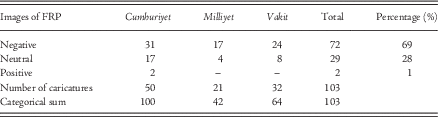
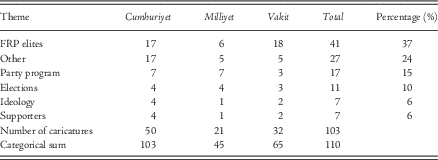
The analysis of the papers covers a four-month period lasting from the foundation of the FRP in August 1930 to its dissolution in November 1930. The total number of caricatures examined are 103. Table 1 shows a brief content analysis of the images, followed by a probe into details of the cartoons.
Image of the Free Republican Party in Newspaper Cartoons
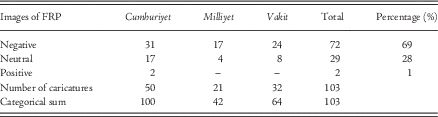
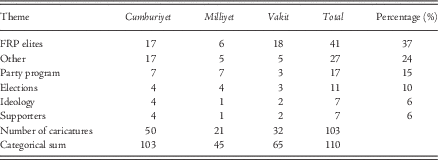
Table 2 shows the themes of the cartoons. The categorical themes refer to the general idea in the cartoons. From time to time, two themes might occur in a single cartoon. “FRP elites” refers to those cartoons wherein the political elite of the new party is depicted; in these, it is highly probable that the depictions will be stereotypical and negative. “Other” refers to any themes fitting into no other category of the theme sample, as decided by the author. These cartoons are mostly based on humor and do not contain direct political messages. “Party program” refers to criticism against the new party, as well as including cartoons where the party program is depicted. “Elections” includes those cartoons which directly or indirectly mention the results or content of elections. “Ideology” includes cartoons depicting the political and ideological stance of the new party, especially discussions about whether it would be right- or left-wing. “Supporters” refers to those cartoons that depict the party’s political supporters, stereotyping and criticizing them.
Theme Frequency in the Cartoons
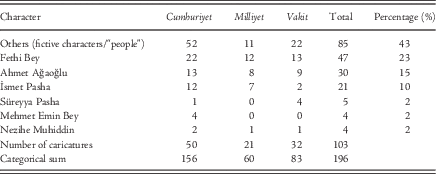
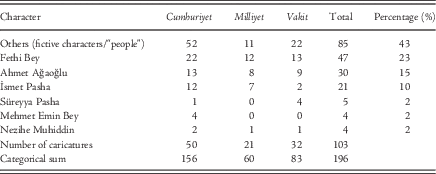
Before proceeding to examine the themes and stereotypes in the cartoons, it is also worth mentioning the characters represented in the cartoons. The endeavor to transition to a multi-party regime is embodied in the two leaders of both parties: Fethi Bey (later Fethi Okyar) of the FRP and İsmet Pasha (later İsmet İnönü) of the RPP. One remarkable point concerns the secondary characters: although İsmet Pasha is the sole figure used to represent the RPP, the FRP is represented by not only Fethi Bey, but also Ahmet Ağaoğlu, Süreyya Pasha, Mehmet Emin Yurdakul, and Nezihe Muhiddin. It must be noted that these characters can appear in the cartoons as either protagonists or as secondary characters. Another noteworthy detail in regards to this is that unlike during the first years of the republic, when Atatürk was depicted constantly in the cartoons as a protagonist and the “father of the nation,”Footnote 40 in the cartoons examined in this study he is treated as a kind of demigod or distant monarch, standing as a holy figure aloof from daily politics. The fact that he is not depicted even once in these cartoons serves as a reminder of the level of power bestowed upon him and of his new position in the political culture. Table 3 shows the frequency of the characters used in the cartoons.
Frequency of Characters
A deliberately guarded welcome
The newspapers’ attitude toward the FRP, especially in the party’s early days, seems to be deliberately circumspect or guarded. Cumhuriyet is more positive, for instance publishing a photograph where İsmet Pasha and Fethi Bey stand beside one another in a friendly manner.Footnote 41Milliyet seems more deliberate, with a headline stating, “The opposition party has been officially founded.”Footnote 42Vakit published a photo of Mustafa Kemal and Fethi Bey working together on the process of establishing the new party, and the headline welcomes the party, stating that “a new and auspicious horizon is emerging in the political sky of the young Turkish Republic.”Footnote 43 Both Vakit and Cumhuriyet assume that the new party will be a remedy for the shortfalls of the regime. Milliyet, however, seems less enthusiastic, announcing the party’s establishment to its audience in a deliberate manner, relaying Fethi Bey’s statement that his party will focus on juridical and economic matters and publishing photos of three ex-RPP deputies who have joined the new party. One remarkable observation in regard to the party’s founding in the three newspapers is the fact that Vakit and Cumhuriyet both use almost the same photographs, and there is an emphasis on the unity of all leaders around the idea of a “republican ideal,” despite the fact that the news concerns the establishment of an opposition party.
The elites of the Free Republican Party
Fethi Bey
The FRP is constructed in the collective memory through its elites. The frequency of representation indicates that Fethi Bey, along with Ahmet Ağaoğlu, embodies the party in his character. The two characters go hand in hand in the cartoons, mostly showing Fethi Bey as the protagonist and Ağaoğlu as his “apprentice.” However, the image of Fethi Bey is, to an extent, more untouchable than that of Ağaoğlu. He is not ridiculed, and is depicted realistically. In some of the cartoons, his shoes or lips may be exaggerated; however, this mainly gives the impression of making him look different from reality, as a necessity of being in a cartoon. He is used in the cartoons as a label to refer to the FRP. Despite his being the protagonist of the cartoons, his features frequently make him look rather dim. He is not depicted as a colorful personality, but mostly as a clumsy politician removed from the country’s realities, in which regard he is constantly compared with İsmet Pasha. This is a comparison that involves political achievements, and it shows İsmet Pasha as having the upper hand. The depiction of İsmet Pasha and Fethi Bey as main characters implies that the game is between the two of them. As Fethi Bey will be analyzed below along with the rest of the cartoons, it is sufficient here to say that, despite his being the main character in the cartoons, no prominent feature of his personality or appearance is specifically used to mark him off. On the other hand, Ahmet Ağaoğlu and Nezihe Muhiddin are characters whom the press depicts rather more freely. In this regard, Ağaoğlu seems to be a more interesting figure than Fethi Bey.
Ahmet Ağaoğlu
As shown in Table 3, Ağaoğlu is the second most frequently depicted figure in cartoons related to the FRP. Born in Shusha in 1869, during his later years in Baku he worked for the rise of Turkish nationalism. In the Second Constitutional Era, he came to İstanbul and worked for the journal Türk Yurdu (Turkish Homeland) and the Türk Ocağı (Turkish Hearth) movement, which were among the leading Turkish nationalist organizations of the time. He supported the War of Independence and became a deputy after the war.Footnote 44 Ağaoğlu is counted among the ideologues of the FRP.Footnote 45 He also prepared the party’s policy guidelines. After the FRP “adventure,” he continued his intellectual activities independently, never joining the RPP as did many of his colleagues in the FRP. His employment was terminated with the university reform of 1933. During the time of FRP activity, he was criticized severely in the press—including in the cartoons—because of his persistent criticism of the RPP, even before the actual foundation of the FRP. He was the first to call the FRP’s opposition “artificial.”Footnote 46
Ağaoğlu was praised by contemporary elites for the consistency of his ideas. According to Zekeriya Sertel, among all FRP members, Ağaoğlu was the most openly liberal, and he knew exactly what he wanted.Footnote 47 Şevket Süreyya also states that “he was the only defender of a Western type of democracy at the time.”Footnote 48 His refusal to return to politics as a RPP member after the FRP’s dissolution, and his continuance of intellectual activity independently, may also serve as indicative of his political stance.
During the days of the FRP, Ağaoğlu stood out for his severe criticism of the RPP. He called the government to account on many issues, including the Müller Report, which had been prepared by a foreign expert on economic and fiscal matters. Ağaoğlu claimed that the numbers provided to Müller had been manipulated by the government, resulting in incorrect evaluations in the report. As a result of this claim directed against Şükrü Saraçoğlu, the Minister of Finance, a cartoon was published showing Saraçoğlu as a rock that could not be moved by Fethi Bey and Ağaoğlu despite all of their efforts.Footnote 49 Ağaoğlu was also blamed for criticizing RPP policies, even though he had actually played a part in forming some of those policies, such as in the case of the sugar monopoly.Footnote 50
One particular dialogue that occurred between Ağaoğlu and Mustafa Kemal makes one think that the former was on the latter’s blacklist for some time. In the dialogue, Mustafa Kemal (here called “Ghazi”) implies to Ağaoğlu that he is not pleased with his criticism of the RPP:
— Ahmet Bey: My Pasha, this party cannot be formed.
— Ghazi: Why not?
— Ahmet Bey: On the one hand, there is the İsmet Pasha government, with all its means and instruments of government, not to mention the powerful influence of Your Honor […]. On the other hand, there is the former ambassador Fethi Bey; no one will go along with him.
— Ghazi: You will; you have desired this for a long time. You were complaining about not being able to speak freely.
— Ahmet Bey: I will not separate from you.
— Ghazi: What, are you attached to me?Footnote 51
The tense tone of the dialogue is a reminder that Ağaoğlu was already not very well liked by the Kemalist elite of the time. In his memoirs, he also confesses that his joining the new party had been forced upon him.Footnote 52 Furthermore, he condemns the press for being biased, saying that “the journalists of the RPP got new orders!”Footnote 53
Ağaoğlu’s depiction in the cartoons is particularly distinctive, and validates the idea that he was seen as more fair game than the other members of the party, including Fethi Bey: he is shown using physical exaggeration, while Fethi Bey is generally “untouchable” in such matters. In most of the cartoons, he is shown as the party’s second man, always either next to Fethi Bey or sometimes “hidden” behind him. His depiction is also based on ethnic characteristics, as he is ridiculed for his non-Turkish origins and his Azerbaijani accent.
In the caricature in Figure 1, he is depicted as being in collaboration with the “dangerous” groups against which the press had started a smear campaign after the elections. The exaggeration of certain of Ağaoğlu’s features—his eyes, his hands, his chin—is especially noteworthy, and can be observed, to a lesser extent, in the cartoons’ depictions of Fethi Bey as well. As we know that exaggeration is used mostly to ridicule and make a point,Footnote 54 the point here may have been to show Ağaoğlu as unlikable. The minority groups in the cartoon are also depicted in a stereotypical manner by showing them, mostly, in religious costume. Inasmuch as “[c]aricatures are negative definitions, stereotypes which are aimed at dramatizing aggressive tendencies through the definition of targets, the collective integration of ‘private’ feelings into public sentiments of ‘self-defense’ and the training of hatred and debunking techniques,”Footnote 55 it might be said that the cartoons that focus on minority groups stigmatize them through their religious leaders. The cartoon’s caption also uses Ağaoğlu’s Azerbaijani accent to ridicule him. This issue of accent and origins came up during parliamentary discussions as well. Şükrü Saraçoğlu, for instance, “invites him to learn Turkish first,” adding that “he will answer his criticism afterwards.”Footnote 56 One leading journalist, Falih Rıfkı, also used racist expressions against Ağaoğlu: “Ahmet Bey is originally Turkish; his language is mixed and his mind is hybrid.”Footnote 57
Cumhuriyet , October 14, 1930 Ağaoğlu Ahmet B. — [with Azerbaijani accent] “My dears, I hereby end my conference. I know you are sniggering at my beautiful speech; I wish you all success.”

When the FRP came to an end, the pressure on Ağaoğlu turned into a smear campaign. He was delegitimized as an aggressive man who attacked those around him: in one cartoon, for instance, he is shown slapping Fazli Ahmet Bey, who has called him an “old man.”Footnote 58 His persistent criticism of and by the RPP seems to have converted him into a scapegoat embodying all the reactions against the FRP. This is evident in Figure 2, where he is implicitly warned about publishing his ideas in a newspaper article. His strange clothes, the clownish hat on his head, and the strange objects in front of him depict him as half-crazy. The caption supports this image, portraying him as a man insane enough to even challenge natural disasters. Overall, the cartoons show Ağaoğlu being ridiculed and delegitimized in a noticeably racist manner, as he served as an easier target than Fethi Bey and was beaten down owing to his persistent criticisms of the RPP.
Vakit , November 9, 1930 [Top caption] Ağaoğlu published a satirical article in one of the newspapers. [Bottom caption] The man who does not fear cliffs, fires, earthquakes!
Nezihe Muhiddin
Nezihe Muhiddin was one of the leading feminists of the late Ottoman Empire and early Republic of Turkey. She began publishing articles first in the magazine Kadınlar Dünyası (Women’s World) in 1913, and later became the founder of the Women’s People’s Party (Kadınlar Halk Fırkası) on June 16, 1923. The formation of this party represented the first attempt to institutionalize women’s political activism in the form of a political party. Although the İstanbul provincial administration rejected the petition for authorization, stipulating that women did not have the right to vote and hence could not establish a political party, these efforts later bore fruit with the 1924 founding of the Turkish Women’s Federation (Türk Kadınlar Birliği). The real reason for the rejection of the foundation of the Women’s People’s Party was the ongoing preparations at the time for the establishment of the Kemalist RPP.Footnote 59 After this initial unsuccessful attempt, the Turkish Women’s Federation was allowed to be established on condition that all the political articles in its program be withdrawn. In 1930, Muhiddin’s political life continued as part of the FRP. She campaigned for the party in outlying districts before joining the election race as a candidate from the Beyoğlu and Beyazit districts; however, she lost in the elections.Footnote 60
Alongside Ahmet Ağaoğlu, Nezihe Muhiddin is another character depicted negatively in the cartoons. Like Ağaoğlu, she had persistently criticized the RPP, and the Women’s People’s Party and Turkish Women’s Federation can be seen as challenges to the founding elites of the republic, who wanted women to be supporting forces rather than political activists. Within the context of a patriarchal society, Nezihe Muhiddin might well have been seen as quite demanding, not being satisfied with what the “fathers” and/or “husbands” had provided. Her life indicates that she was a woman who was one step ahead of the society she lived in: she was ambitious, passionate, clever, and unable to adapt to the restrictive role placed on women. At the end of her life, she lost her mental health.Footnote 61
Muhiddin is used as a protagonist in the cartoons, alongside Fethi Bey and Ahmet Ağaoğlu. Despite her relatively unimportant position in the party, the press seems to view her as interesting material, and like Ağaoğlu, she is also less “untouchable” than Fethi Bey and others. For instance, the party’s general secretary, Nuri Conker, does not appear in the cartoons at all; however, both Muhiddin and Ağaoğlu are treated roughly. This serves as a reminder that there was a kind of “protective shield” around some people, such as Nuri Conker or Reşid Galip, the RPP’s Aydın deputy who, like the others, joined the FRP at the insistence of Mustafa Kemal; this “shield,” that is, surrounded those who were close to the president. Nuri Conker was a childhood friend of Mustafa Kemal, and he was also the one and only person who could address him by his first name. In a letter to Salih Bozok, Mustafa Kemal expressed his feelings toward Nuri Conker as follows: “If there is just one person for me whose memory will always be in my heart and mind, it is my brother Nuri.”Footnote 62 These words make the stance of the press clear. On the other hand, Süreyya Pasha, Mehmet Emin Yurdakul, Ahmet Ağaoğlu, and Nezihe Muhiddin were figures whom the press freely depicted in the cartoons as unlikeable, portraying them as power-hungry, clumsy politicians through the use of racist or sexist stereotypes.
In Figure 3, for instance, Muhiddin is depicted with an exaggerated nose. The black cat next to her is noteworthy as a symbol of bad luck. She and her friend are depicted as contemporary feminists, with short hair and/or glasses. Nevertheless, the cartoon’s message implies that a woman’s one and only ideal is physical in nature, with a beauty contest and elections being spoken of on equal terms, thereby trivializing woman’s capacity to devote herself to an ideal. The phrase kadın mefkûresi (“women’s ideal”) was used in the late Ottoman and early republican periods to refer to the idea of women’s rights or feminism.Footnote 63 The humiliation directed at this ideology is an overall stance shared by late Ottoman and Kemalist elites, who thought that it should suffice for women to be mothers, or at least to act like mothers in the public sphere by being active not in politics but rather in charity work. According to this elite conception, a woman’s fundamental duties were to give birth and raise children for the nation, while a secondary duty was to look modern and Westernized so as to be able to display the nation well. It was through just such an identity that women were expected to participate in public life, though an alternative was to eliminate the features of their gender and become masculinized like Sabiha Gökçen, with her masculine outfits and short hair.Footnote 64 By keeping their feminine looks in this cartoon, Muhiddin and her friend are portrayed as unusual feminist figures, yet their fight is trivialized through their depiction as being “stupid,” while their feminist ideal is limited to the requirements of their “sex.”
Cumhuriyet , September 15, 1930 [Top caption] Women’s Ideal! [Bottom caption] — “Sister, don’t worry. If we can’t win in the local elections, we’ll enter the beauty contest and win there!”
Nezihe Muhiddin is also criticized in the cartoons for being ambitious. For instance, she is condemned for applying for candidacy to both the RPP and the FRP at different times, which is presented as proof of her ambitious character and desire for prestige and influence. In one article about her in Cumhuriyet, she is blamed for changing sides the moment the FRP is founded. The headline of the interview is remarkable: “Bye bye!”Footnote 65 However, the underlying anger toward her can be seen not only in the headline, but also in the content of the interview. The interviewer says, “Pardon madam, if I am not mistaken, you had recourse to RPP before, too, didn’t you?” Muhiddin’s answer was remarkable: “Yes, recently I did. Then, there was no possibility to choose, as there were not two parties at the time.”Footnote 66 Other papers refer to her “ambitious” character as well, implying that she is after power and prestige. In Milliyet, there is a subtitle reading, “Miss Nezihe lost her hırka (cardigan) for the party!”Footnote 67 which also implies her will for power. The newspapers share a common discourse in referring to a hırka, which connotes Nezihe Muhiddin’s individual interests of Nezihe Muhiddin. The ironic tone of the news text—“The poor woman says, ‘I need a hırka, not a party’.”Footnote 68—also shows the negative stance taken toward her.
One important point is that, despite her depiction as a protagonist in the cartoons, she is not counted among the “important” characters of the FRP. The next cartoon (Figure 4) shows the disbanding of the party. While the key players—Fethi Bey, Ahmet Ağaoğlu, Mehmet Emin Bey—are all there, Nezihe Muhiddin has not been included. This negligence is a reminder that, despite her evaluation and delegitimization as a prominent character in the cartoons, she is not seen as a part of this men’s coalition. Such sexist discrimination results in the use of Muhiddin as a figure to delegitimize feminism. Her “changing sides” after the foundation of the new party and her persistent challenge to the RPP ever since the experiment of the Women’s People’s Party had made her an unsympathetic figure. While she is included in all the burdens of being associated with the party, she is excluded from the blessings.
Cumhuriyet , November 18, 1930 [Couplet at top] He was not at ease himself, nor did he give the people peace. / He collapsed and left this world; let the dead now endure him! [Bottom captions] Once there was … – … and then there wasn’t!
Süreyya Pasha and Mehmet Emin Yurdakul
Süreyya Pasha was a soldier, politician, and deputy of the RPP. He joined the FRP on August 31, 1930, with the permission of Mustafa Kemal.Footnote 69 Like Ağaoğlu, Süreyya Pasha also criticized the FRP adventure openly. He blamed Mustafa Kemal for his unbalanced approach to FRP elites, and his memoirs indicate that he had also been on Mustafa Kemal’s blacklist owing to his persistent criticism of the RPP. Once, Mustafa Kemal even warned him by saying, “Will you make a revolution in the country?”Footnote 70
After joining the party, Süreyya Pasha was tasked by Fethi Bey with the party organization of İstanbul’s Anatolian side, which he carried out using mostly his own money. A certain remarkable action of his from this period would prove to be the basic theme used concerning him in the cartoons. In an interview given to the newspapers, he stated that, with the foundation of the new party, “The lock on the mouth is unlocked.”Footnote 71 After this interview, there followed cartoons depicting Ağaoğlu opening the lock on Süreyya Pasha’s mouth (Figure 5). Ağaoğlu and Süreyya Pasha are illustrated as two “opponents” who are nevertheless in collaboration, acting together. Ağaoğlu, shown opening the lock, is bestowed a position of leadership as compared with Süreyya Pasha, and he is also shown as the head of opposition against the RPP. It is interesting that it is not Fethi Bey, the actual founder of the party, who is placed in such a position, which once again indicates the “protective shield” around him as compared to the rest of the FRP elite. Ağaoğlu seems to be seen as the head of the opposition, despite Fethi Bey’s being the head of the party.
Vakit , September 6, 1930 Depiction of the unlocking of the lock on Süreyya Pasha’s mouth
Mehmet Emin Yurdakul is also depicted in the cartoons as an elite close to Fethi Bey. A poet of the nationalist literature movement who had also served as a deputy in the Ottoman and republican parliaments, in the 1910s he was a member of the Turkish Association (Türk Derneği), which attempted to position itself outside of politics but also had pan-Turkist tendencies.Footnote 72 He was also one of the founders of the Turkish Hearths (Türk Ocakları), a nationalist organization that aimed to spread the idea of Turkish nationalism. After the foundation of the republic, Mustafa Kemal entrusted this organization with the task of spreading populism and nationalism throughout the country, and both of these organizations were long seen as the cultural branches of the RPP.Footnote 73 But when the FRP was founded, the Turkish Hearths lent an unexpected level of support to the new party. Ideological differences had already been developing between Kemalist elites and the members of the Turkish Hearths, whose understanding of nationalism was more race-based, irredentist, and proactively conceptualized as Turanism.Footnote 74 The support the Turkish Hearths gave to the FRP increased the RPP’s suspicions about the organization, and when the Hearths were closed down in 1931, articles in the press showed that the organization had been put on the regime’s blacklist. In one article, for instance, Falih Rıfkı stated that the Hearths had a voter potential like that of a secret party and might lead to another case like that of the FRP in the future.Footnote 75 Following the Hearths’ closure, the People’s Houses (Halkevleri) were founded in their place, as an organization loyal to the RPP.
Mehmet Emin Yurdakul’s ideological position and his entrance into the new party explain the negative attitude displayed toward him. Like the politicians discussed previously, he is also depicted as ambitious and power hungry. In Figure 6, he is depicted as thoughtful about and somehow regretful for his decisions about the new party. Taking into account that this cartoon was published after the İzmir incidents,Footnote 76 and with part of the newspaper’s headline quoting Mustafa Kemal—“I am the general leader of the RPP. I am historically bound to this organization. There is no reason or necessity to dissolve this bond, and this will not happen.”Footnote 77—one may conclude that some FRP politicians regretted their decision and were in some panic about joining the new party, especially given Mustafa Kemal’s new position. The cartoon in Figure 6 verifies these concerns, showing Yurdakul weighing profit and loss, pragmatically trying to find a way to save himself from the situation.
Cumhuriyet , 10 September 1930 [Top caption] While going for wool … First Emin Bey — “What do you say, sir? What if we come home shorn?” Other Emin Bey — “Well, sir, I just don’t know, I am stunned!”
The party program
One Symbol, Two Leaders: The Railway
The FRP’s Party Program was a manifesto for political and economical liberty that was addressed to all of the unsatisfied groups in the society. It promised to end the undisputed power of the RPP. The program’s first article declared the party’s republican, nationalist, and secular character, in which regard it paralleled the principles of the RPP. This article also emphasized the party’s negative stance toward regional, ethnic, or religious identity politics. The second article was a criticism of İsmet Pasha’s economic and fiscal policies, including taxes and methods of tax collection. The third article concerned railway policies, which were thought to be increasing taxes.Footnote 78
The party program was criticized in the press for being unrealistic and anti-national. This criticism was accomplished through a comparison of the two party leaders, İsmet Pasha and Fethi Bey: while İsmet Pasha was accorded a good deal of trust overall and his performance was glorified, Fethi Bey was depicted as an ambitious politician unaware of the realities of the country and distant from republican ideals. Moreover, whereas İsmet Pasha was praised for his idealistic projects, such as the railway, Fethi Bey was accused of collaborating with foreign capital and its local extensions (i.e., minorities). İsmet Pasha was shown as representing republican ideals, locality, patriotism, and, above all, realism. Fethi Bey, on the other hand, was depicted as a symbol of utopian ideals and projects that had little to do with the country’s realities. He was also depicted as a “liberal” who would collaborate with “foreigners” in order to exploit the country and the nation.
The themes in the cartoons make frequent use of this comparison between the two leaders. In particular, İsmet Pasha’s railway project is one of the themes used to praise his accomplishments. Fethi Bey, in the party program, criticized this project, asserting that the venture must be expanded only over time and across generations. In his view, investment in the railways was too expensive and exceeded the government’s economic power. The government was increasing taxes in order to pay debts that accrued as a result of the investment, and hundreds of people were being sent to prison for tax delinquency.Footnote 79
From the perspective of the RPP, the railway project was the country’s savior. The Kemalist elites who had faced the collapse of the Ottoman Empire accorded strategic importance to railways for the country’s defense. In the daily Hâkimiyet-i Milliye, the reasons for the railway project were explained by Mahmut, deputy for Siirt, as follows: “To connect Ankara to Sivas and the Black Sea to the Mediterranean, and to bring coal to the center of the country and the valuable mine of Ergani to a port.”Footnote 80 İsmet Pasha also stressed the importance of railways, stating that “the need for railways is a matter of national unity, national security, and national policy for a nation-state.”Footnote 81 The railway issue was certainly one of the most important contemporary issues, and one that revealed the policy differences between the two parties. It also revealed the parties’ ideological stances, which would later result in the RPP positioning itself as more statist.
The railway issue was an important theme in the cartoons as well. In one cartoon, for instance, while a train was depicted as a symbol of technology, passing by at rapid speed, Fethi Bey and Ahmet Ağaoğlu are shown trying to work from a type of ox-cart called a kağnı, which was widely used as a symbol for feudalism and backwardness in Kemalist discourse. The caption reads: “The difference between work and words,” referring to the “real” accomplishments of İsmet Pasha as opposed to the mere “propaganda” of Fethi Bey.Footnote 82
In another cartoon (Figure 7), İsmet Pasha is symbolized by a train haunting the dreams of Fethi Bey. The naive symbolism is remarkable. What is of especial importance is the date: August 30, Victory Day in Turkey, celebrating the country’s independence. Cumhuriyet backs up this cartoon with a headline reading, “Listen to the sound of victory!”, next to an image of a train, thus identifying victory with the train (and also İsmet Pasha, whose photograph is just below the image) as a symbol of independence and national development.Footnote 83Milliyet also used the train as a symbol of victory on its first page, along with news related to the independence holiday and İsmet Pasha’s speech.Footnote 84
Cumhuriyet , August 30, 1930 [Top caption] Nightmare! Fethi Bey — “Lord, protect me from being crushed beneath it! … ”
The train is the only persistent symbol used in the cartoons to refer to the concrete accomplishments of the RPP. Dramatic central characters, captions, and the simplistic use of the train metaphor juxtaposed against a simple background make the message clear for any potential reader, or viewer, of the paper.Footnote 85 The lack of variety in the symbolism used in the cartoons indicates a minimum level of abstraction, which would seem to indicate that the cartoons targeted a wide-ranging audience from all levels of cultural and intellectual backgrounds.
Another theme of the cartoons that refers to the party programme is the depiction of the FRP elites as a group of men who are distant from the people and the realities of the country (figure 8). This depiction implies that the RPP itself embodies the public and is the very essence of the nation.
Vakit , September 11, 1930 [Top caption] In his speech in Manisa, Fethi Bey spoke against the port monopoly. (—from the newspapers—) — “Sir, why did you speak about port issues in Manisa? What does it have to do with the local community?” Fethi Bey — “Because the drafts of the speeches had been prepared in İstanbul … ”
Economic issues seem to be the basic focus of criticism about the program of the new Party. It is generally claimed that the RPP began to position itself as “statist” following the FRP’s foundation and the new party’s claims against the RPP’s actions.Footnote 86 The Great Depression also forced Kemalist elites to determine their position on economic issues, and the newspapers of the era are replete with the discourse of statism.Footnote 87 While the practice involved such capitalist tendencies as encouraging individual enterprise and diminishing labor rights, the RPP’s discourse expressed statist views by positioning itself as in favor of local products and against foreign capital. This positioning was accomplished through a bipolar representation of the RPP and FRP. The symbolism seen in the cartoon in Figure 9 shows some aspects of this representation. While İsmet Pasha is represented on a train—the symbol of national unity, independence, and development—with local products (yerli malı) in the freight car, Fethi Bey is depicted on an old nag trying to catch the train while loaded down with foreign capital (ecnebî sermaye) and money bags.
Cumhuriyet , August 26, 1930 Let’s see who will win the race!
The cartoon in Figure 10 also criticizes the FRP’s program, which promised, as the sign Fethi Bey is wearing reads, “cheap prices, lower taxes, the abolition of monopolies, and employment for the people.” By showing Fethi Bey as suspicious of even his own promises, the cartoon implies the FRP’s weakness and the emptiness of its claims. The cartoon also depicts an irony between the promises of the party and the reactions from the people: while the promises may look satisfying, the reactions of the masses are portrayed as irresponsible and illogical. This irony is attributable to the İzmir incidents, which took place during Fethi Bey’s visit to that city. The newspaper’s headline, “Beware: Anarchy is being provoked,”Footnote 88 is reinforced by this cartoon, which depicts FRP supporters as a bunch of alcoholics. Fethi Bey’s “confession” that he did not like what he himself had invented also implies that he has lost control of matters.
Milliyet , September 7, 1930 Fethi Bey — “Man, I invented this new drink, but even I don’t like it!!”
Elections
The FRP participated in the municipal elections by Mustafa Kemal’s order in October 1930. In their memoirs, Süreyya İlmen and Ahmet Ağaoğlu state that they did not wish the party to participate in these elections because of its insufficient organization and experience at the time.Footnote 89 During the elections, the FRP was prevented from campaigning and its supporters were threatened by local police and even injured.Footnote 90 The RPP won the elections despite the objections raised by the FRP.
In the cartoons, the elections are depicted using familiar symbolism, being compared with football or boxing matches and the leaders being illustrated as sportsmen. Winning the elections is shown either as scoring a goal or knocking out the opponent.Footnote 91 The winning party is also compared with a steadily sailing ship while the losing party is shown sinking in the storm of the elections.Footnote 92 It was also during this time that there appeared cartoons illustrating, and attacking, the party’s supporters.Footnote 93 Supporters are condemned as enemies of the republic or as uneducated laymen harassing people in the streets to get them to vote for the FRP.Footnote 94
Another theme of the cartoons during the elections is the desperation of Fethi Bey and Ahmet Ağaoğlu after the results. The cartoon in Figure 11, for instance, depicts Ağaoğlu and Fethi Bey facing the results together, hopelessly.Footnote 95 While it implies that Ağaoğlu and Fethi Bey are the two leading figures representing the party themselves, it also signals the end of the party after the lost elections. The depiction of the party as a broken vase with a few ballots patching it together effectively symbolizes an irreversible impasse. Ağaoğlu, carrying tools meant to repair the vase, seems desperate to find a remedy, while Fethi Bey just stands there looking thoughtful. The cartoon thus seems to depict the natural division of labor that had existed between them ever since the party was founded.
Milliyet , October 8, 1930 [Top caption] Elections in İstanbul … Fethi Bey — “It would be great if we could use these ballots to keep it from falling apart.” [on the vase: FRP]
Ideology: what the new party will look like
Another important theme in the cartoons on the FRP concerns the political and ideological position that the new party would take. From the memoirs of Fethi Bey, we know that Mustafa Kemal wanted the new party to be liberal and position itself as leftist, thinking that, in this way, the reforms would be protected. Fethi Bey also explains his position by saying, “I am completely in favor of liberty. Therefore, a party founded by me would be liberal […] Naturally, such a Party would be to the left of the Republican People’s Party.”Footnote 96 At the time, both parties claimed to be more “left” than the other, and tried to prevent being seen as “right-wing.”Footnote 97 But the meaning of “left” was construed in a highly local manner. For the FRP, it was the symbol of a libertarian order, while for the RPP being “right” meant to be opposed to the reforms.Footnote 98 The cartoons of the era depict the party’s political position as “left” and announce it to the public this way (figure 12).
Cumhuriyet , September 4, 1930 — “Sir, I’ve been a member of your party since its very foundation.” — “How come?” — “Sir, I’m left-handed!”
One important illustration appears in a contemporary piece of news in Vakit, one which shows the history of political tendencies in Turkey. It proposes that the new party is prone to being right-wing rather than left-wing. This is an important point when we take into account the claims that the FRP was the ancestor of the Democrat Party and represented the beginning of an economically liberal and culturally conservative political tradition that continued through to the Justice and Development Party (Adalet ve Kalkınma Partisi, AKP) of the 2000s. The illustration in Vakit shows political tendencies, from left to right, as follows: Socialist – Free Republican Party – Republican People’s Party – Progressive Republican Party – Committee of Union and Progress – Despotism.Footnote 99 Taner Timur also states that, considering its economic stance, the FRP’s program was right-wing rather than left-wing. The dilemma lies in the fact that the party addressed landowners, the bourgeois, and the poor proletariat and villagers all at the same time.Footnote 100 Despite such assumptions, the newspapers of the day presented the new party as “left” to the public, and their leaders positioned themselves as such.
Supporters
The FRP’s supporters were a mixture of all those social and economic groups unsatisfied with the RPP’s policies. Politically, they were intellectuals whose common ground lay in their opposition to authoritarianism. A second group of supporters included those whose main sensitivity was religion. And thirdly, the party attracted the middle class and merchants, whose common concern was the economic crisis.Footnote 101 As such, the party’s supporters encompassed a variety of social groups whose interests and concerns were entirely different from each other.
Along with criticisms of the FRP’s program, accusations against its supporters and members occasionally turned into an all-out smear campaign. It was the incidents that took place during Fethi Bey’s visit to İzmir that triggered the emergence of these campaigns. The interest in the party seems to have shocked the RPP elites. In an interview, Fethi Bey stressed the republican and secular character of the party, and claimed that anyone who agreed with such notions could become a party member.Footnote 102 The party programme also stressed the secular, nationalist, and republican character of the party. Despite this, RPP elites continued to assert that the “backward masses” flocked to the party as a force against republican reforms. According to Tunçay, the republican elite who saw the rise of the FRP and understood that power was being lost began to put pressure on Mustafa Kemal to clarify his position and declare his support for the RPP.Footnote 103
The cartoons of this period indicate the RPP’s worries about the supporters of the FRP. What is especially interesting is that, even before the İzmir incidents, there seem to have been serious concerns about the support the FRP was gaining. The cartoon in Figure 13, for example, expresses these concerns at the early date of August 21, 1930—just nine days after the new party was established and before the İzmir incidents took place. In the cartoon, the man on the sofa is shown reading the names of people who have joined the FRP. They all bear religious titles, such as molla or hafız, a reference to the “anti-republican masses” of Kemalist historical memory. Considering that one of the later Kemalist reforms—passed in 1934, four years after this—would be the “abolition of the usage of cognomens and titles [i.e., religious titles],” the connotations of the cartoon become clear. What was at stake here was quite unlike the perspective of the Ottoman satirical press, wherein Islam was viewed as “social cement”Footnote 104 and not targeted directly but only indirectly by means of science.Footnote 105 In the republican era, political cartoons did not refrain from “employing narrative dichotomies and pictorial opposites in order to illustrate and drive political messages.”Footnote 106 These dichotomies and opposites were formulated so as to show the Westernized/secular/progressive republic versus the reactionary/backward opposition. The basic aim, though, was to oust Islam from the public sphere and confine it to the private realm, rather than excluding it from all aspects of civic life.Footnote 107 The names mentioned in the cartoon refer to the RPP elite’s concern that Islam would return to politics via the FRP as an oppositional force. The Islamic titles reminded the audience of Ottoman public life, where religion had been a legitimate and valid reference in politics. Republican secularism, on the other hand, demanded that religion be confined to the private realm, a necessity in a supposedly neutral and equal public space.
Cumhuriyet , August 21, 1930 — “Necmettin Molla,110 Ziya Molla, Hacı111 Mehmet, Hafız112… ” — “What is that? Are you reading the Stories of the Prophets?… ” — “No, this is today’s paper … I’m reading the names of the people who’ve joined the Free Republican Party … ”
Another interesting point in regards to the cartoon in Figure 13 is that, in the news related above and to the left of the cartoon, an intermediate heading reads: “Reactionaries are not accepted into the party,”Footnote 108 referring to certain clarifications by the FRP elite. The cartoon, however, essentially says the opposite, thereby clarifying the real editorial policy of the newspaper. Taking into account the possibility of “subjectivity” in the cartoons,Footnote 109 one could assume or conclude that Cumhuriyet’s real ideological position was transferred to the visual power of the cartoonFootnote Footnote Footnote .
The cartoon in Figure 14 also implies that the forces collaborating with the FRP are either Muslim religious communities, which were coded as “backward,” or minority groups, who were seen as associating with foreign imperialism. This cartoon backs the news at the top of the page, which bears the title “FRP supporters attempted to beat a policeman” and the subtitle “Who speaks about the rebels of Ağrı Mountain instead of voting?”Footnote 113 Another article in Vakit expresses these ideas even more clearly: “The four enemies of [the] Turkish Revolution joined hands and shouted ‘Freedom!’” The four enemies in question are listed as “Islamic reactionaries; imperialists; minorities, the sentries of imperialists; and import agents exploiting Turkish producers.”Footnote 114 It is obvious that there is an overlap between the coded “enemies” of the republic and the supporters of the FRP.
Vakit , October 10, 1930 [Top caption] FRP Signalman I.H.B — “Gentlemen, over here! See what eminent men we have!”
Contemporary newspapers related that Fethi Bey and the FRP elites were liberal in their attitudes toward minorities. Fethi Bey, for instance, expressed the idea that all were equal before the law regardless of ethnicity, religion, and so on. He also stated that minorities should take part in every area of life and that he was in favor of their realizing this aim.Footnote 115 We also know that minority candidates took part in the elections as FRP candidates. This position must have been considered dangerous by some of the authoritarian elites of the day, who tended to view minorities as the reason for the Ottoman Empire’s collapse. There also seems to have been a certain ongoing anger directed toward minorities’ economic power in society and among elites, which only became more enflamed by nationalist feelings. It was during this very period that Mahmut Esat Bozkurt proclaimed his racist statement: “My idea—and let anyone, friend or foe, know it—is that the master of this country is the Turk. Those who are not native Turkish have one right in [a] Turkish country: to be a servant, to be a slave.”Footnote 116
It was also during this time that Cumhuriyet warned the public about FRP candidates from minority groups:
The FRP is bringing Greeks and Armenians to power. Esteemed citizens, do you hear? The FRP has nominated six Greeks and four Armenians as candidates in İstanbul. How can you vote for a party that wants to bring to power those who, just ten years ago, did every kind of malice to poison you in your homeland, who attacked your honor and your good name? Here are the names of the Greek and Armenian FRP candidates in İstanbul […] O Turkish nation, be careful. Do not again be the tool of Greek and Armenian games!Footnote 117
In connection with such issues, Brummett points out the following in regard to David Laitin’s model of hegemony:
He argues that hegemonic power is not completely free to forge identities. Rather it must have a real basis in the symbolic repertoire of the society. Challenges to hegemonic power must attempt to delegitimize what their own society sees as obviously and eternally legitimate.Footnote 118
Ultimately, the political cartoons evaluated in this study are examples of a kind of delegitimization through the use of stereotypes stemming from the historical memory of the society. Cartoons paved the way for the creation of a repressive atmosphere toward the FRP, awakening society’s historical symbolic repertoire through their sheer visual power. Robert states that:
The successful cartoon, using familiar symbols, creates a picture of reality with which its public can identify. Then, through focusing on that particular society’s “points of concern,” the cartoon delivers its message and suggests an appropriate mood, with the ultimate objective of either challenging or affirming the dominant discourse.Footnote 119
This example can be evaluated as a struggle against counter-discourses by means of an affirmation of the dominant discourse. By being identified with “dangerous groups,” the FRP was delegitimized, and its discourse was challenged as a counter-discourse. Considering the minority policies of the day,Footnote 120 it is relatively easy to understand the pressure mounting on the FRP owing to its attitude toward minority groups. Nation-state policies and the historical anger toward these groups as a result of the final years of the Ottoman Empire brought the nationalist elites closer to the idea of an organic nation where racist diversions could easily be observed.Footnote 121 The pressure on the FRP, whose discourse was oriented more toward territorial citizenship, shows the discriminatory practices brought to bear even against men of the regime if they ever dared to cross the line in this regard.
Conclusion
The Free Republican Party experiment has much to teach us about contemporary Turkey, as it presents a typical example of how the features of political culture play out. It highlights the way “opponents” are depicted and the efforts made to delegitimize and marginalize them. It is also an important historical example of the embeddedness of the press, which had an undeniable effect on the disbanding of the FRP through a smear campaign that was launched even before the İzmir incidents occurred and elections were held.Footnote 122
Political humor in general, and cartoons in particular, are often associated with resistance and opposition. They are frequently discussed as “weapons of the weak” against the ruling elite. The cartoons discussed in this article, however, highlight how graphic humor can also be used as a powerful weapon of propaganda in and by authoritarian regimes. They reveal how racist and gender-based stereotypes can be mobilized to reproduce existing power relations in political contexts where both the journalists and cartoonists are dependent on the power elite. In this case, the FRP elites were associated with groups coded as “dangerous” by the historical memory of society and were blamed for collaborating with foreign powers. The noteworthy detail in all this is the delegitimization of those figures who had persistently criticized the Republican People’s Party even before the foundation of the FRP. Ahmet Ağaoğlu, Nezihe Muhiddin, Süreyya Pasha, and Mehmet Emin Yurdakul were all targeted directly, whereas Fethi Bey, Nuri Conker, and Reşid Galip were relatively “protected,” despite their higher positions in the party. It appears that those figures who were closer to Mustafa Kemal Atatürk and the RPP were effectively evaluated as being only temporary members of the new party, figures whose real political home was considered to be the RPP. The depiction of FRP politicians was the cliché of a power-hungry, clumsy politician who stood only for his own benefit. In the visual codes of political cartoons, the caricaturized features of characters articulate all of the prevailing racist and sexist stereotypes, especially as seen in the cases of Ahmet Ağaoğlu and Nezihe Muhiddin.
The cartoons studied in this paper employed a rich fabric of detail in terms of faces and costumes, yet the backgrounds were typically unelaborate, suggesting that the fundamental stress was placed on the characters. Cartoonists use labels and captions “to complement and expand the imagery as well as to bracket the cartoon’s range of interpretative readings.”Footnote 123 Captions are long and descriptive, which actually serves to “force” an audience toward a more narrow interpretation; in this way, audiences are prompted toward a relatively limited reading. All of the cartoons selected for this study appeared on the first page of their respective newspapers, mostly in the lower right corner, which was a position used as a means of supporting the headline and the first-page news. In Cumhuriyet, all of the cartoons were signed by Ramiz (Gökçe), a leading cartoonist who had been drawing since 1908 but who came to prominence only during the War of Independence; the cartoons in Milliyet and Vakit, on the other hand, were anonymous. Almost all of the cartoons reflected the editorial policy of the newspapers they appeared in, and most were in harmony with the headline or the news, backing up their messages in a visual manner. The cartoons managed to attract the reader—whether literate or illiterate—in such a way as to juxtapose the meanings that might arise in readers’ minds with the messages intended by the newspaper.