
Introduction
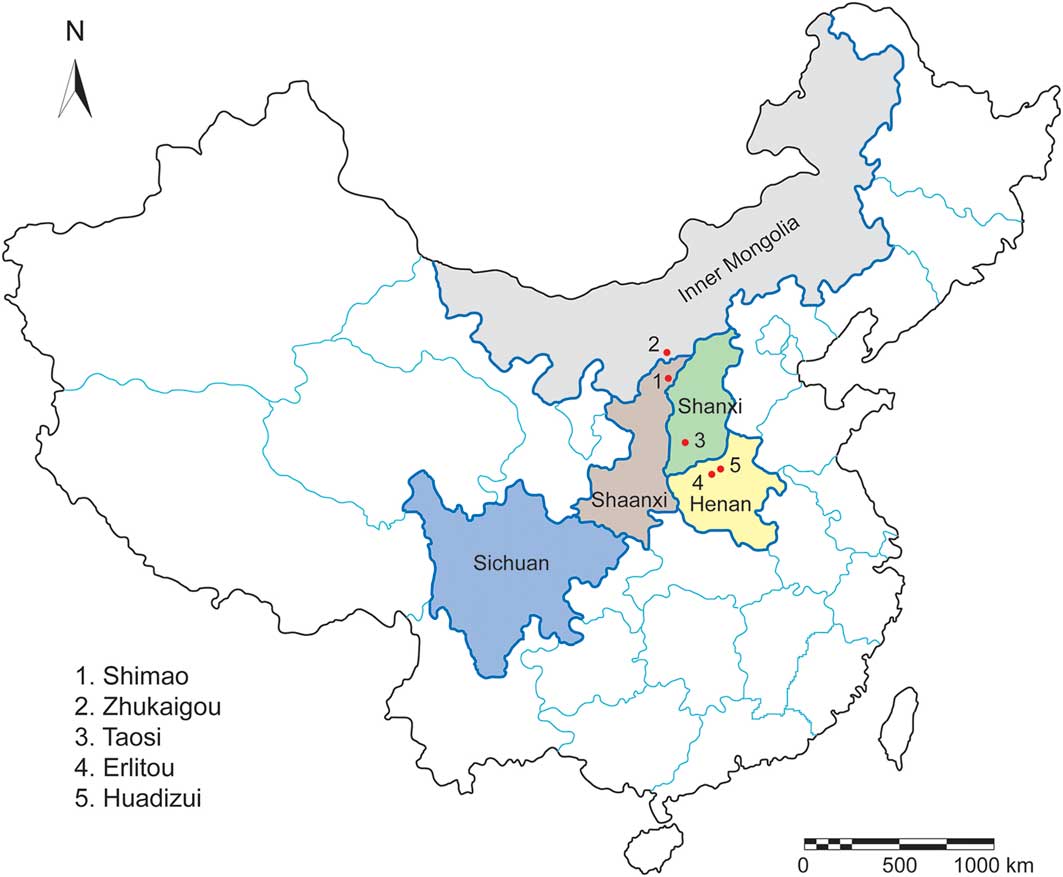
Recent ground-breaking archaeological discoveries at the Bronze Age site of Shimao (Figure 1) fundamentally challenge the traditional understanding of ‘peripheries’ and ‘centres’ in ancient China. The Shimao site is located on hilly terrain in the northern part of the modern Shaanxi province in the loess highland. Its location, far to the north of the Central Plains—which are mainly in the modern southern Shanxi and Henan provinces (Figure 1)—and bordering the steppe, explains why the area around Shimao has been traditionally defined as part of the ‘Northern Zone’, or the zone of contact between the Central Plains and the steppe (for a definition, see Lin Reference Lin1986). This region has also been termed the ‘Great Wall area’, as part of the famous wall constructed in the historical period that runs through here. In short, the Great Wall marked this area as the ecological and cultural frontier between China and Inner Asia (Di Cosmo Reference Di Cosmo2002). The classification of this area, either as part of the ‘Northern Zone’ or the ‘area along the Great Wall’, reflects the stereotypical view that Shimao and the adjacent loess highland were borderlands and peripheral to the centre—that is, to the Central Plains of China. This stereotype is deeply rooted in a Sinocentric perspective and largely derives from traditional Chinese historiographically informed representations that focus on the Central Plains (von Falkenhausen Reference von Falkenhausen1993). Moreover, as the area borders the steppe region, it has often been described in Chinese histories as a land of ‘barbarians’ (Linduff Reference Linduff1995). Shimao and its adjacent region, even in comparison with other ‘peripheries’, was thus further diminished as they were viewed through the lens of the ‘civilised’ centre. Beholden to a notion of uninterrupted cultural, historic and ethnic continuity (von Falkenhausen Reference von Falkenhausen1993), this historiography-driven bias has not been confined to the historical period, but has also been translated almost seamlessly into research on prehistory. This is evident in the sparse archaeological work related to social complexity in this region. Research has been largely confined to investigating mobile life ways, or treating this region as a contact zone for exchanges between the steppe and ancient China (e.g. Fu Reference Fu2007; Yang & Cao Reference Yang and Cao2007). Overall, hegemonic narratives—whether archaeological or textual—of how social hierarchies, urban centres or early states emerged and developed have rarely included Shimao and its adjacent region.
Provinces and sites mentioned in the text.

Completely at odds with the traditional view of the region as peripheral, however, is the enormous prehistoric walled settlement recently revealed at Shimao, a site once mistaken for part of the Great Wall (Sun et al. Reference Sun, Shao, Shao, Kang, Qu and Liu2013). Dating to the late third and early second millennia BC, the Shimao walled settlement enclosed an area of more than 400ha at its zenith (Sun et al. Reference Sun, Shao, Shao, Kang, Qu and Liu2013, Reference Sun, Shao, Shao, Zhao, Yang, Kang, Zhou, Li, Qu, Liu, Wei, Xu and Gao2016). It was therefore not only the largest walled settlement of its time in ancient China, but was also among the largest centres in the world. In stark contrast to the rammed-earth construction of major architecture in contemporaneous sites in the Central Plains, the walls and the palace centre of Shimao were mainly built of stone. The extensive stone construction at Shimao would have required an investment of labour that significantly surpassed that in any of the rammed-earth settlements in the Central Plains. Moreover, the latest research shows that the Shimao-centred polity sat at the top of a four-level settlement hierarchy (Sun Reference Sun2016)—well before that of the Erlitou polity in the Central Plains, which is commonly regarded as the first state in China (Liu & Chen Reference Liu and Chen2003; Xu Reference Xu2009; but see Campbell Reference Campbell2009, Reference Campbell2014). Together with its political network, the Shimao-centred polity was also the heartland of economic exchanges of especially high-value materials. Perhaps even more remarkable given the assumptions about the peripheral nature of the loess highland is the evidence that a series of core symbols associated with subsequent Central Plains Bronze Age civilisation were actually created at Shimao (Li Reference Li2016, Reference Li2017).
Confronting the traditional Central Plains stereotype, this article describes and analyses the Shimao settlement and its polity, and then examines their economic and political networks. Comparison with polities in the Central Plains clearly shows that the loess highland ‘periphery’ was in fact the ‘centre’ at around 2000 BC. This, in turn, indicates the need for a thorough, archaeology-based approach to re-examining the ancient cultural landscape within the territory of modern China.
The Shimao walled settlement and the Shimao-centred polity
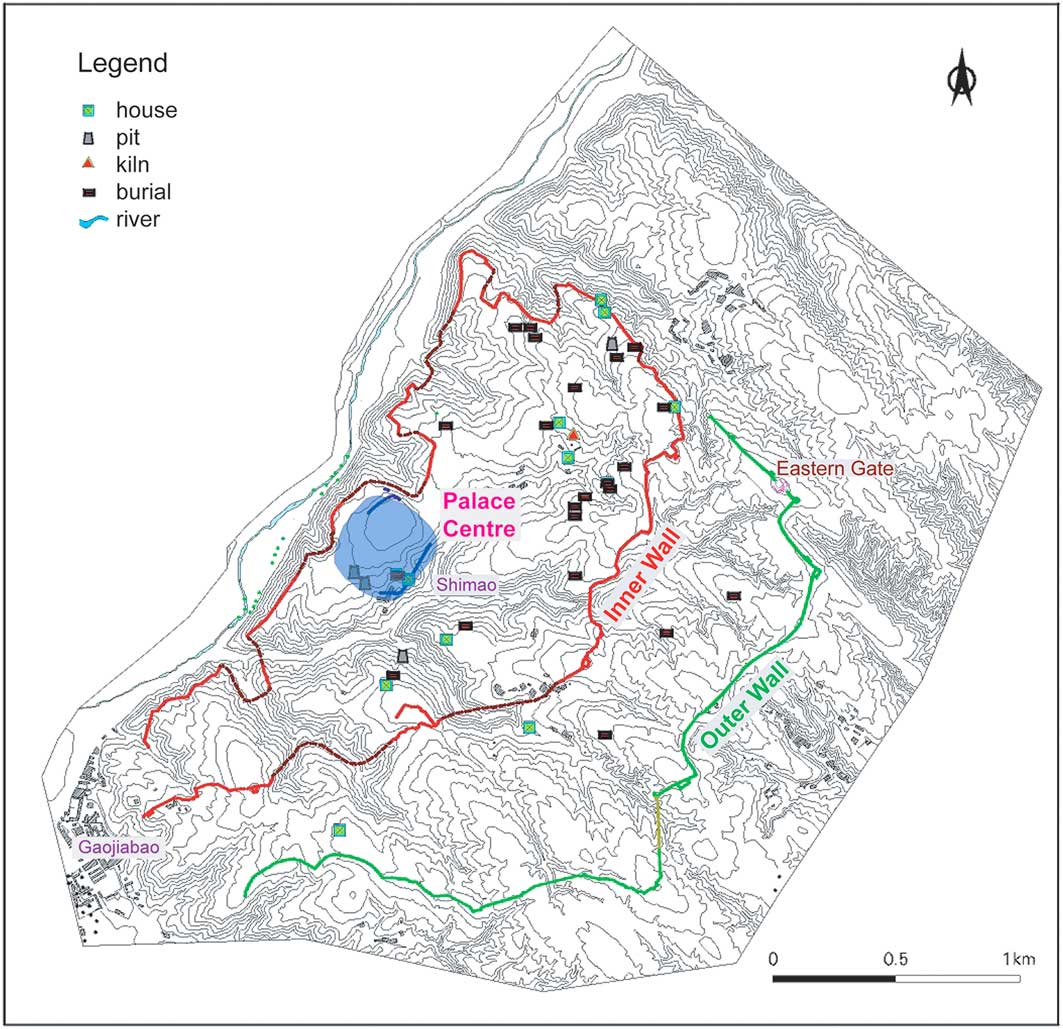
The Shimao settlement, which existed from around 2300 BC–1800 BC, is located on a ridge above the Tuwei River, a tributary of the Yellow River (Sun et al. Reference Sun, Shao, Shao, Kang, Qu and Liu2013). Its monumental stone-built structures comprise three principal parts: a pyramid palace centre, an inner enclosure and an outer rampart (Figure 2).
Plan of the Shimao walled settlement (modified after Sun et al. Reference Sun, Shao, Shao, Zhao, Yang, Kang, Zhou, Li, Qu, Liu, Wei, Xu and Gao2016: fig. 2).

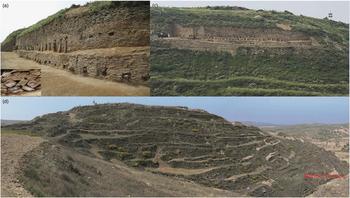
The palace centre, built around 2300 BC, was the first monument to be established and was followed by a series of other buildings (Shao Reference Shao2016). In the form of a stepped pyramid, the palace centre was constructed out of a loess hill, which was modified into around 11 platforms of decreasing size built atop one another (Figure 3; Sun et al. Reference Sun, Shao, Di, Kang, Zhao, Shao and Xia2017). Each platform of the step pyramid—the lowermost platform covering an area of 24ha and the topmost 8ha (Sun et al. Reference Sun, Shao, Di, Kang, Zhao, Shao and Xia2017)—was ringed and reinforced by stone buttresses (Figure 3a, c–d). At the entrance to the stepped pyramid were sophisticated bulwarks, whose design suggests that they were intended to provide both defence and highly restricted access (Sun et al. Reference Sun, Shao, Di, Kang, Zhao, Shao and Xia2017). Outside the entrance was a large open plaza where rituals and political gatherings may have been held. On the topmost platform of the pyramid were extensive palaces built of rammed earth, with wooden pillars and roofing tiles, a gigantic water reservoir and domestic remains (e.g. ceramics) related to daily life (Sun et al. Reference Sun, Shao, Di, Kang, Zhao, Shao and Xia2017). The extremely sophisticated construction and high labour investment suggest that the palace centre was associated with the residence of the ruling elites (Guo et al. Reference Guo, Sun and Shao2016; Sun et al. Reference Sun, Shao, Di, Kang, Zhao, Shao and Xia2017). In addition, debris from tool making—namely bone working and bronze casting—have been identified among refuse dumped from the palace centre (Sun & Shao Reference Sun and Shao2017; Sun et al. Reference Sun, Shao, Di, Kang, Zhao, Shao and Xia2017).
Pyramid-shaped palace centre at Shimao and related discoveries: a) part of the buttresses of the second and the third terraces; b) eye symbols; c) a view of the buttresses under excavation; d) a general view of the pyramid-shaped palace centre before excavation (photographs courtesy of Zhouyong Sun and Jing Shao).

Evidence so far suggests that the stepped pyramid complex functioned not only as a residential space for ruling Shimao elites, but also as a space for artisanal or industrial craft production. Considering the exceptional value of metallurgy and metal artefacts in the Bronze Age Eurasian network (Jaang Reference Jaang2015), the manufacture of metal artefacts in the palace centre may suggest that such production was under the direct control of Shimao’s rulers. Moreover, with its imposing height of at least 70m (Figure 3d; Sun et al. Reference Sun, Shao, Di, Kang, Zhao, Shao and Xia2017), the pyramid could be seen from everywhere within the settlement, from the suburbs and even the rural fringes. Thus it could well have provided a constant and overwhelming reminder to the Shimao population of the power of the ruling elites residing atop it—a concrete example of the ‘social pyramid’. Symbols of eyes and anthropomorphic carved stone faces were also embedded in great quantities in the façades of the stepped pyramid (Figure 3b; Sun & Shao Reference Sun and Shao2017). These may have endowed the stepped pyramid with special religious power and further strengthened the general visual impression on its large audience.
Adjacent to the pyramid complex were houses, burials, pottery kilns and pits used for storage or for the disposal of domestic debris (Figure 2; Sun et al. Reference Sun, Shao, Shao, Kang, Qu, Liu and Bai2015, Reference Sun, Shao, Shao, Zhao, Yang, Kang, Zhou, Li, Qu, Liu, Wei, Xu and Gao2016). The date of these features ranges from the establishment of the pyramid centre to the last phase of the Shimao settlement (Shao Reference Shao2016; Sun et al. Reference Sun, Shao, Shao, Zhao, Yang, Kang, Zhou, Li, Qu, Liu, Wei, Xu and Gao2016). In addition to its stunning monumentality and defensive structures (discussed below), this evidence of daily domestic activity suggests that the Shimao settlement also functioned, throughout its existence, as a space for ordinary life and for the afterlife. In comparison with the palaces atop the pyramid, constructions beyond the pyramid complex were much more humble, both in terms of size and building techniques. These structures were in the form of either cave dwellings or subterranean/semi-subterranenan dwellings (which is evident by the presence of postholes) (Sun et al. Reference Sun, Shao, Shao, Kang, Qu, Liu and Bai2015). In short, hierarchical differences were clearly delineated in the Shimao residential space, although highly valued artefacts, such as alligator skins, have also been recovered from dwellings beyond the pyramid centre (Sun et al. Reference Sun, Shao, Shao, Kang, Qu, Liu and Bai2015). This suggests that at least some of the residents of Shimao, despite being socially inferior to the elites residing atop the stepped pyramid, may have been of high status, or were at least comparatively wealthy. Burial plots or small cemeteries were associated with each group of residential structures. That contrasts with the single but enormous cemetery of more than 10 000 burials at approximately contemporaneous Taosi on the Central Plains (Sun et al. Reference Sun, Shao, Shao, Kang, Qu, Liu and Bai2015, Reference Sun, Shao, Shao, Zhao, Yang, Kang, Zhou, Li, Qu, Liu, Wei, Xu and Gao2016; for the Taosi cemetery, see ZKKS & Shanxisheng Reference ZKKS and Shanxisheng2015). The close association of living and mortuary space, together with the absence of a common cemetery, could suggest that the Shimao population comprised diverse ethnic identities, possibly bound together by kinship in each compact zone of housing and burial (Sun et al. Reference Sun, Shao, Shao, Kang, Qu and Liu2013).
A stone wall (inner wall in Figure 2) enclosed an area of up to 210ha. This wall, which encircled both the pyramid centre and the surrounding area containing dwellings and other structures related to daily life, was erected sometime after the stepped pyramid (Shao Reference Shao2016). The stone wall delineated the boundaries of the Shimao settlement and obviously also functioned as a defensive fortification.
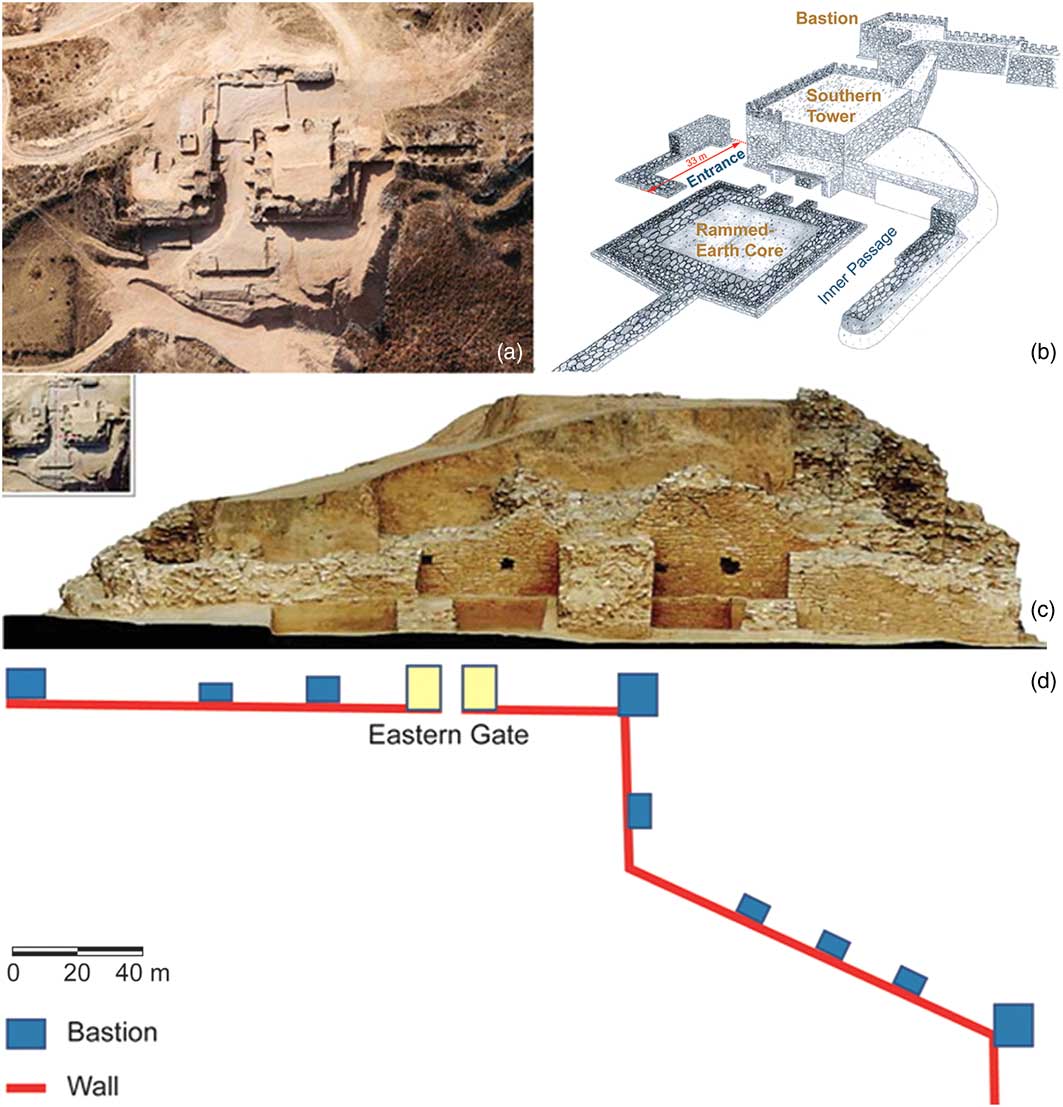
An additional rampart (outer wall on Figure 2) was constructed in approximately 2100 BC (Shao Reference Shao2016). The previous walled area became the inner portion, and the new wall, which marked the farthest extent of the Shimao walled settlement, enclosed an additional 190ha (Sun et al. Reference Sun, Shao, Shao, Kang, Qu and Liu2013). The outer rampart had a much more sophisticated design than the inner wall, and reflected a higher concern for defence, as suggested by its exceptionally well-planned and well-constructed barbicans and bastions. Of the four gates in the outer rampart, the eastern gate is the most elaborate. It was a visually impressive, extraordinarily sophisticated barbican (Figure 4). The eastern gate is flanked by two towers, covering a total area of 2500m2 (Sun et al. Reference Sun, Shao, Shao, Kang, Qu and Liu2013). Before the entrance to the eastern gate was a U-shaped, stone-built barrier measuring 33m in length, which completely blocked direct entry from the front and restricted the entrances from two lateral approaches to a 10m-wide passageway (Figure 4). Further constricting entry was an L-shaped barrier in the internal gateway. Connected to the southern tower, this barrier forced all who entered, after passing through the gate, to advance along a narrow corridor between it and the northern tower. The careful setting of the tower would not only have hampered an attacking enemy, but would also have impeded easy entry on a daily basis by requiring people to go through multiple checkpoints. Aside from these physical impediments, murals of geometric patterns were painted on the L-shaped barrier during the final period of the Shimao settlement (Sun & Shao Reference Sun and Shao2016a). These may have been intended to impose religious or ritual control over the movement of people. In addition to the heavily fortified gateways, a series of bastions were also constructed on the outer wall, located approximately 40m from each other (Figure 4d; Sun & Shao Reference Shao2016b). The many bone arrowheads discovered at Shimao suggest that the effective range of contemporaneous bows may have determined the close arrangement of the bastions (Sun & Shao Reference Shao2016b; for a study of the effective range of similar bows, see Cattelain Reference Cattelain2006). The sophisticated defensive works of the outer rampart, especially in comparison with the inner wall with its simple gate towers and no bastions, suggest that the threat of violence and conflict may have significantly intensified by 2100 BC.
The eastern gate and bastions on the outer rampart: a) a bird’s-eye view of the eastern gate (photograph courtesy of Zhouyong Sun and Jing Shao); b) a reconstruction of the eastern gate (modified after Guo et al. Reference Guo, Sun and Shao2016: fig. 28); c) section of the northern tower (after Sun et al. Reference Sun, Shao, Shao, Kang, Qu and Liu2013: fig. 8); d) plan of bastions near the eastern gate (image courtesy of Zhouyong Sun and Jing Shao).

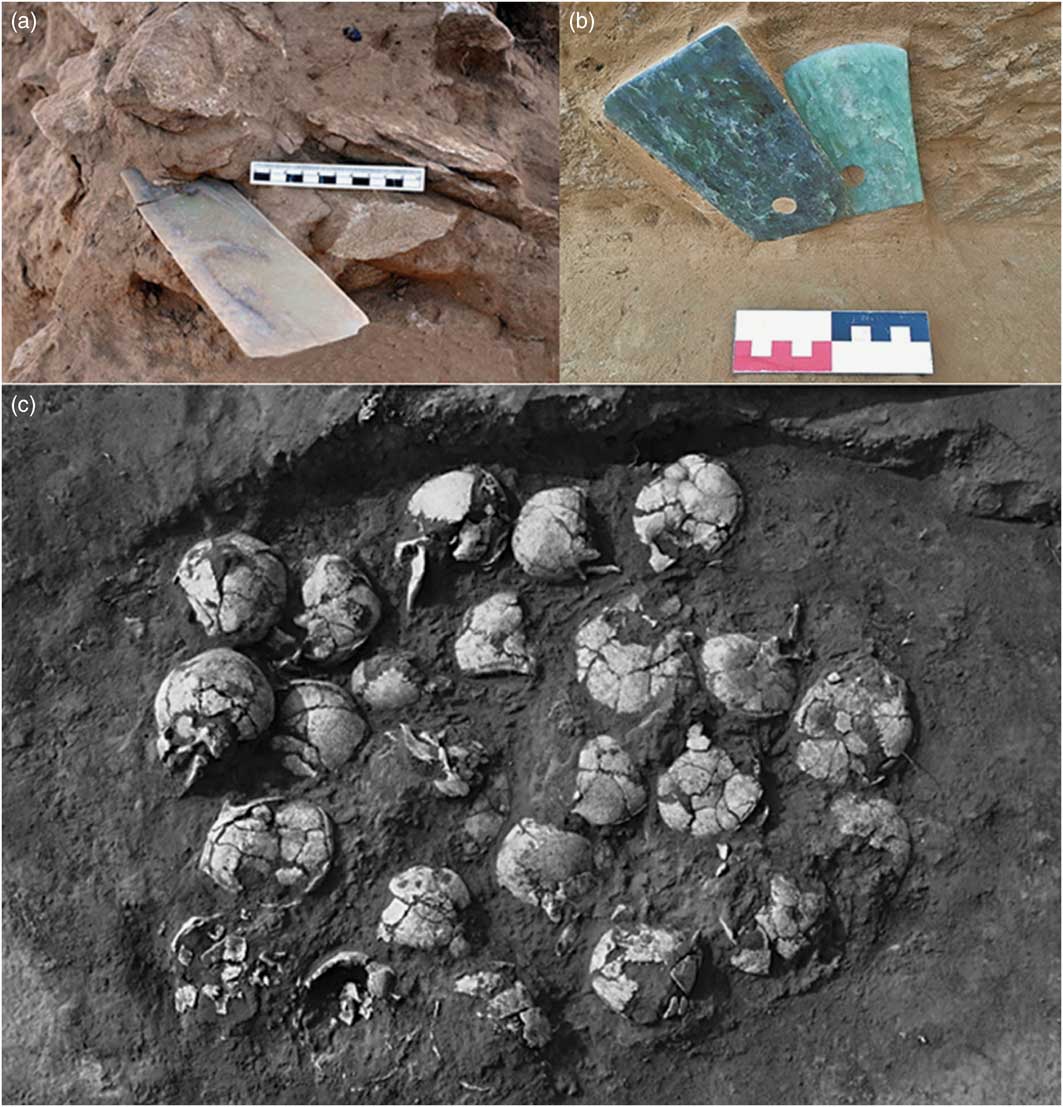
All the stone monuments at Shimao, including the walls, the gates and the stepped pyramid, were built with two unique associated features: jade insets and human sacrifice. Excavations have revealed that jade objects, such as axes and sceptres, were commonly placed between the stone blocks throughout all of the monuments at this site (Figure 5a–b; Sun et al. Reference Sun, Shao, Shao, Kang, Qu and Liu2013, Reference Sun, Shao, Di, Kang, Zhao, Shao and Xia2017). Thousands of jade artefacts have been recovered from the Shimao stone structures since the beginning of the last century (Dai Reference Dai1993), and countless others are undoubtedly still hidden in situ. Unfortunately, many more will probably never be recovered by archaeological work as these artefacts have long been the target of looters and antiquarians (Wang & Sun Reference Wang and Sun2011). Human sacrifice on a massive scale is another feature of Shimao. In the outer gateway of the eastern gate on the outer rampart alone, six pits containing decapitated human heads have been found (Figure 5c; Sun et al. Reference Sun, Shao, Shao, Kang, Qu and Liu2013; Chen et al. Reference Chen, Xiong, Shao and Sun2016). Many pits containing human heads have also been found associated with other Shimao monuments (Sun et al. Reference Sun, Shao, Di, Kang, Zhao, Shao and Xia2017). The jade objects and human sacrifice may have imbued the very walls of Shimao with ritual and religious potency (Li Reference Li2016, Reference Li2017), amplifying its significance as a monumental centre, enhancing the protective efficacy of the walls and making this a place of power in every sense.
Features of Shimao construction: a–b) examples of jade insets (after Sun et al. Reference Sun, Shao, Shao, Kang, Qu and Liu2013: fig. 5; photograph courtesy of Zhouyong Sun and Jing Shao); c) a sacrificial pit of human skulls (after Sun & Shao Reference Sun and Shao2016a: fig. 3).

In any event, all the monumental structures demonstrate that the layout of the Shimao settlement was the result of careful civic planning in which political, religious and military functions were deeply embedded.
The Shimao settlement was the centre of a large and densely settled polity. The core of this polity, as reflected in its highly homogeneous ceramic tradition, ranged across an area of at least 4 300 000ha, from the Yinshan Mountains to the north, to the Lüliangshan Mountains to the east, and the Baiyunshan Mountains to the south (Sun Reference Sun2016; Sun & Shao Reference Sun and Shao2017). This trans-regional polity was based mainly on the loess plateau, but also incorporated the Ordos Plateau, the Maowusu Desert and the Hetao Plains. New research has shown, for example, that the Zhukaigou site (Figure 1), located on the Ordos Plateau, also became part of the Shimao polity (for a summary in English of the Zhukaigou discoveries, see Linduff Reference Linduff1995). This is evident not only in the similarity in the ceramic tradition of the Ordos region with that of Shimao (Dai Reference Dai2016; Sun & Shao Reference Sun and Shao2017), but also in the identification of sacrificial victims unearthed at the eastern gate of the outer rampart. Morphological analysis of the human remains suggests that the victims may have been related to the residents of Zhukaigou (Chen et al. Reference Chen, Xiong, Shao and Sun2016), which could further suggest that they were taken to Shimao as captives during the expansion of the Shimao polity. In the Tuwei River Valley alone, more than 200 settlements have been revealed in regional surveys, more than 10 of which were enclosed by stone walls (Sun Reference Sun2016). As a whole, the core of the Shimao-centred polity may have encompassed more than 4000 settlements, all part of a four-tiered hierarchy (Sun Reference Sun2016). According to information available so far, it appears that these settlements were laid out in a pattern similar to that of Shimao; they featured a large structure resembling the Shimao stepped pyramid at the core (Zhao Reference Zhao2016; Sun et al. Reference Sun, Shao, Di, Kang, Zhao, Shao and Xia2017; for examples, see Wang et al. Reference Wang, Hai, Zhang, Bai, Zhang, Jia, An, Sun, Liang and Gao2016; Zhang & Ding Reference Zhang and Ding2016). The use of jade in construction, as seen in the Shimao settlement, is evident in the walled settlements of Bicun and Shiluoluoshan, and at Xinhua (Shaanxisheng & Yulinshi 2005; Wang et al. Reference Wang, Hai, Zhang, Bai, Zhang, Jia, An, Sun, Liang and Gao2016; Zhang & Ding Reference Zhang and Ding2016). This use of jade may have been common throughout the Shimao polity, but additional excavation and research is required to confirm this.
Shimao as a political and economic centre
In its time, the polity centred on Shimao was the largest and, politically and economically, the most important society within the territory of what is today China. Its political power reached its first peak around 2000 BC, at a time of turmoil in the Taosi-centred polity to the south. The Taosi settlement (c. 2300–1900 BC) was located in the Jinnan Basin in the southern part of Shanxi Province (Figure 1), within the Central Plains. The outer rammed-earth wall of the Taosi settlement enclosed an area of 280ha (Yan & He Reference Yan and He2005), which made Taosi the largest contemporaneous walled settlement in the Central Plains. The sophisticated culture of the Taosi elites was reflected in their burials, to which highly valuable prestige goods and intensive labour were devoted (ZKKS & Shanxisheng Reference ZKKS and Shanxisheng2015). The Jinnan Basin, with Taosi as its largest settlement, was the most heavily populated region in the Central Plains (Liu & Chen Reference Chen2012; Li Reference Li2016, Reference Li2017). In short, the Taosi settlement and its affiliated sites were the most significant polity in the Central Plains at the end of the third millennium BC. The late phase of Taosi (2000–1900 BC), however, was accompanied by political turmoil and horrendous violence; the outer wall was breached and at least 50 human individuals were butchered in the palatial centre (Yan & He Reference Yan and He2005). The palace itself was destroyed and turned into a craft production area, and the corpses of the elites were dragged out of their tombs (He et al. Reference He, Yan and Song2003; Yan & He Reference Yan and He2005). Abrupt and fundamental changes occurred thereafter in the mortuary tradition at Taosi (Yan & He Reference Yan and He2005), with completely new customs indicating a major change of population. The ceramic tradition in the Jinnan Basin was abandoned in favour of the Shimao tradition (Li Reference Li2016, Reference Li2017). Archaeozoological analysis also suggests a simultaneous shift, as the Taosi dietary preference for pork became aligned with that of the Shimao preference for caprids (Brunson Reference Brunson2011). The evidence overwhelmingly indicates a fundamental political change in the Jinnan Basin (Han Reference Han2007; Li Reference Li2016, Reference Li2017), whereby the Taosi polity was violently overthrown and the Basin became a colony in the expanding political network of Shimao.
The political power of Shimao continued to grow until around 1900 BC. This is evident in the archaeological record at the Huadizui site in the Luoyang Basin, which, farther to the south of the loess highland, has been considered the heartland of the Central Plains in the historical period (Figure 1). Huadizui is on a ridge, with a spectacular view overlooking the confluence of the Yiluo and Yellow Rivers (Gu & Zhang Reference Gu and Zhang2005; Li Reference Li2016, Reference Li2017). This strategic location would have been the natural point of entry into the Luoyang Basin from the north. Extensive feasting, human and animal sacrifice, and ritual dedications were performed at Huadizui. All of this suggests that these activities were associated with high-status elites (Zhang Reference Zhang2012). Participants in the activities at Huadizui were from a variety of regions, with those of a loess-highland background being most notable. This background is identified through a series of Shimao cultural features in the feasting and ritual ceremonies at Huadizui, including Shimao-style domestic pottery, its preference for caprid consumption and oracle-bone divination (Zhang Reference Zhang2012). Most significantly, the zhang jade sceptre, the symbol of the Shimao political and religious authority, was also employed in ritual practice at Huadizui (Gu & Zhang Reference Gu and Zhang2005; Li Reference Li2016, Reference Li2017). The appearance of Shimao’s core symbols at a place of great geographic importance in the Luoyang Basin had significant social meaning. It reveals that the elite culture and the ruling elites from the loess highland played an important role in the ceremonies at Huadizui (Zhang Reference Zhang2012). This may represent the penetration of Shimao political power deep into the heartland of the Central Plains.
Shimao was also the economic heartland of an immense exchange network. A huge quantity of jade artefacts discovered at the Shimao settlement were sourced from and produced in areas that ranged from the coast to the east, to the Ejin River Transfer Zone (for a definition, see Jaang Reference Jaang2015) to the west, and to the Yangtze River in the south (Dai Reference Dai1993; Deng Reference Deng1993; Wang & Sun Reference Wang and Sun2011; Li Reference Li2016, Reference Li2017). Given the extensive use of jade at Shimao, trade with the sources of jade would have been substantial. Indeed, in the Ejin River Transfer Zone alone, researchers have identified a number of workshops in which large quantities of jade artefacts of the same style and technique as those employed at Shimao were processed (Wang Reference Wang2012; Ye Reference Ye2013). The raw materials were quarried from jade mines in the Ejin River Transfer Zone (Ye Reference Ye2013). A number of concomitant settlements and cemeteries with features of the Ejin River Transfer Zone appeared along the Upper Yellow River (Chen Reference Chen2012), the main route connecting the Zone and the loess highland (Jaang Reference Jaang2015). These sites may have functioned as trading posts between Shimao and the Ejin River Transfer Zone. The demand from Shimao for exotic luxury goods may not only have stimulated trading and exchange activities across a vast area, but may also have promoted production throughout this expansive network. Moreover, cowrie shells and metal artefacts—all highly valued across the Eurasian exchange network (Peng & Zhu Reference Peng and Zhu1995; Jaang Reference Jaang2011, Reference Jaang2015)—also made their appearance at Shimao, indicating that the Shimao economic network had a truly vast reach.
Discussion: the loess highland vs the Central Plains around 2000 BC
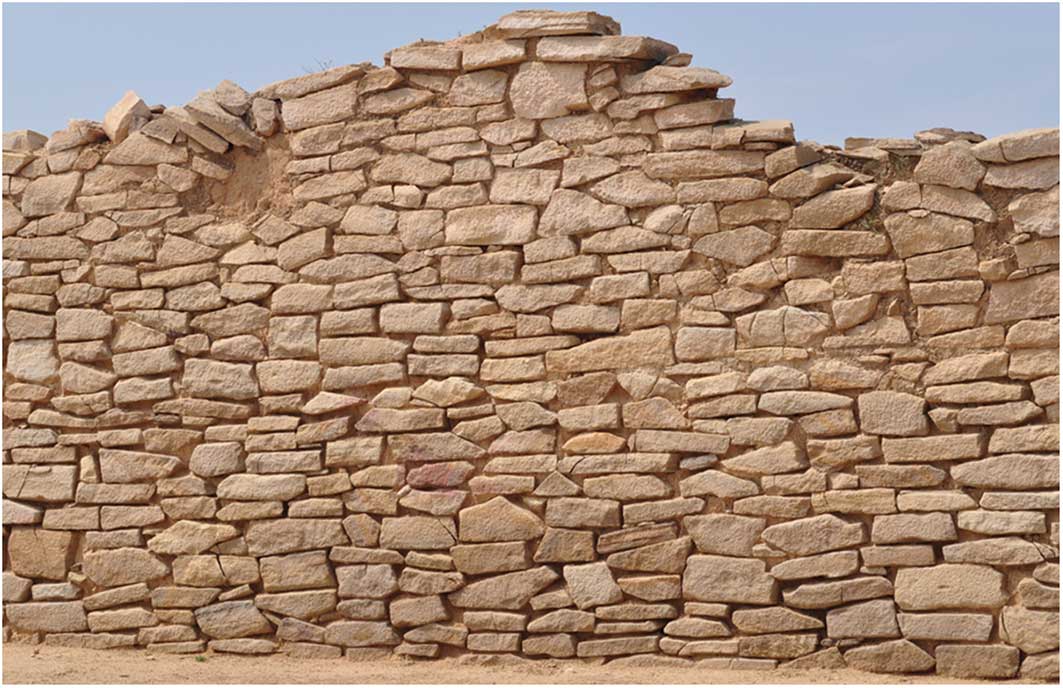
The archaeological evidence from Bronze Age Shimao calls into question the traditional text-based narrative in which Chinese civilisation supposedly arose on the Central Plains and then spread to other regions. The labour employed in construction at Shimao alone significantly surpassed that of any contemporaneous settlement in the Central Plains. Although the stone blocks used at Shimao were quarried from locally available sandstone (Guo et al. Reference Guo, Sun and Shao2016), their extraction, transport, preparation and use in construction nonetheless required large-scale and sophisticated planning, supervision and labour. According to previous analyses, building stone-walled fortifications, such as that at the Sanzuodian site in Inner Mongolia (2000–1200 BC), required more labour than the rammed-earth constructions that were traditional in the Central Plains (Shelach et al. Reference Shelach, Raphael and Jaffee2011). Although the stone boulders used at Sanzuodian were unshaped (Shelach et al. Reference Shelach, Raphael and Jaffee2011), those at Shimao were carefully dressed (Figure 6). This would have significantly increased the investment of labour. Furthermore, construction at Shimao employed large timber beams laid between stone blocks as reinforcement (Figure 3a; Guo et al. Reference Guo, Sun and Shao2016)—a sophisticated technique not evidenced in any settlement in China beyond the loess highland. To acquire and to mount such imposing timber beams, and to do so in large numbers, would have added to the demand for labour. The stone walls of Shimao were also significantly larger, in length and in volume, than the rammed-earth walls of either Taosi or the Erlitou settlement that succeeded it. All of this evidence implies that the building of the Shimao infrastructure required a much larger population than that of any settlement elsewhere in contemporaneous China. The capability to gather and to manage labourers on a very large scale indicates that the loess highland enjoyed a more complex social organisation than the Central Plains.
An example of surface processing (dressing).

What is striking about the Shimao-centred polity is not only its size, but also the social complexity reflected in its settlement system. As a densely settled, supra-regional polity, its settlement hierarchy reached a four-tier level earlier than the Erlitou polity (1900–1550 BC) in the Central Plains, which has conventionally been regarded as the first Chinese state (Xu Reference Xu2009). While at its peak, the Erlitou polity stretched at most 500km from the centre (Liu Reference Liu2004), the range of the Shimao polity had already reached this distance by absorbing Taosi. To manage a very large number of settlements spread across such a large area would have required sophisticated political institutions.
The archaeological record reveals that the loess highland, with the Shimao settlement as its hub, was the economic heartland of an extensive network of exchange and trade involving highly valued artefacts, rather than a passive transfer zone between the steppe and the Central Plains (as portrayed in the Sinocentric stereotype). By acquiring knowledge of metallurgy and engaging in metallurgical production, Shimao also laid the foundation for the Middle Yellow River tradition. This saw bronze production embedded in the local elite culture, adapting metallurgy into the aesthetic tradition and demands for ‘prestige goods’ to demonstrate the political authority of the indigenous rulers. This tradition was followed and developed later at Erlitou (Jaang Reference Jaang2015). Bone-working debris—especially from the chaîne opératoire of producing bone needles—has also been revealed at the central Shimao pyramid (Sun et al. Reference Sun, Shao, Di, Kang, Zhao, Shao and Xia2017). This discovery suggests the existence of associated craft specialisation, sponsored or patronised by the Shimao ruling elites. Although such institutionalised production also took place at Erlitou—indeed, it has been considered an essential feature of the Erlitou economy (Xu Reference Xu2009)—it appeared first at Shimao. Hence, this might be another instance where Erlitou emulated the Shimao model in the domain of production.
A series of core symbols associated with the Bronze Age civilisation of the Central Plains were, in fact, originally created in the loess highland (Li Reference Li2016, Reference Li2017). This is evident, for example, in the very important zhang jade sceptre—a core symbol of political and religious power—which was created at Shimao and soon adopted across a very large sphere stretching from the Central Plains to the east coast of China, the Sichuan Basin and the southern coast as far as northern Vietnam (Deng Reference Deng1997; Sun Reference Sun2008; Li Reference Li2017).
The impact of Shimao’s legacy on polities in the Central Plains would have been substantial. A clearer picture of how the political institutions and the economic organisation of Taosi and Erlitou responded to and developed from those of Shimao should emerge with further excavation and analysis.
Conclusion
Although highland realms are of profound concern at a global level (Glatz & Casana Reference Glatz and Casana2016), research on the emergence of Chinese civilisation, which has mainly drawn from Sinocentric text-based narratives limited to a lowland perspective, has long underestimated the centrality of the Bronze Age loess plateau. Breakthroughs in understanding of the loess highland have challenged previous stereotypes of that region and models of how Chinese civilisation came into being. The discoveries at Shimao have provided a local perspective on socio-political organisation and development, and have led to a re-examination of the Sinocentric interpretation of the cultural landscape of ancient China during the late third and early second millennia BC. Analysis and comparison of new archaeological data from the loess highland have revealed a highly complex society, the political and economic heartland, and possibly the most powerful polity, of the territory of what is today China. The inherited stereotypes of the loess highland as a peripheral and passive contact zone between the Central Plains and the steppe have proven to be invalid. In view of the centrality of the highland region, the terms ‘Northern Zone’ and ‘Great Wall area’—which marginalise Shimao—should be avoided, and the role of the Central Plains should be reconsidered from the perspective of the highland world, of which the Shimao polity was a part.
Acknowledgements
This research was supported by the National Funds of Social Science, China (grant 15CKG007); the state scientific survey project ‘Geological records of environmental changes and evidence for human activities in Chinese deserts’ (2017FY101001); the key project of Songshan Civilization Foundation (2015K-2); and by the distinguished junior scholar fund from Zhengzhou University (2015SKQD27). We are deeply grateful for the very constructive comments and suggestions by Jan Bremmer, Roderick Campbell and two anonymous reviewers.