


Introduction
Given the growing importance of evidence-based practice, therapists are increasingly mindful of delivering interventions with adherence, using theoretically sound and research-supported treatments. At the same time, such treatments may not yet have demonstrated efficacy with under-represented populations, such as clients with diverse gender identities (e.g. individuals who identify as transgender, non-binary, or gender non-conforming) and sexual orientations (e.g. Heck et al., Reference Heck, Mirabito, LeMaire, Livingston and Flentje2017). For transgender and gender non-conforming (TGNC) clients (Hope et al., Reference Hope, Mocarski, Bautista and Holt2016) as well as sexual minority clients (O'Shaughnessy and Speir, Reference O'Shaughnessy and Speir2018), the need for evidence-based treatment that effectively integrates knowledge of psychosocial stigma has been highlighted in the literature. This is because minority stress connected with stigma can negatively influence mental health for clients with diverse sexual orientations (Meyer, Reference Meyer2003) and gender identities (Hendricks and Testa, Reference Hendricks and Testa2012). Attending to this need, researchers have begun to examine the efficacy of treatments tailored towards LGBTQ+ populations, and as a result, have noted positive outcomes. Examples include improvements in mood and reduced problematic drinking and risky sexual behaviours for sexual minorities (Pachankis et al., Reference Pachankis, Hatzenbuehler, Rendine, Safren and Parsons2015; Millar et al., Reference Millar, Wang and Pachankis2016), as well as decreased social anxiety in transgender youth (Busa et al., Reference Busa, Janssen and Lakshman2018).
In our experience, orienting treatments to meet the needs of LGBTQ+ clients can be complicated, necessitating a balance of responsiveness and fidelity. This paper describes an example of this type of clinical task: tailoring dialectical behaviour therapy (DBT) to address the needs of clients with diverse gender identities and sexual orientations who have experienced stigma. Herek et al. (Reference Herek, Gillis and Cogan2009) present a model of sexual stigma that consists of effects at multiple levels (structural, enacted, felt and internalized). Their framework highlights the ways that socially based discrimination and prejudice can be invalidating and associated with self-directed heterosexist stigma for lesbian, gay and bisexual individuals. We are expanding the model presented by Herek et al. (Reference Herek, Gillis and Cogan2009) to include TGNC individuals because we believe that the skills used to cope with stigma based on one's sexual orientation can also be effectively used to cope with experiences of prejudice associated with one's gender identity or presentation.
In the realm of DBT, Linehan (Reference Linehan1993) describes how cultural sexism can function as an invalidating environment and be associated with self-invalidation. Likewise, gender-based discrimination may be experienced by all members of the LGBTQ+ community. For instance, a gay man may be perceived as not conforming to gender archetypes because he has a higher pitched voice or exhibits non-verbal behaviours typically classified as feminine characteristics, and thus may experience gender-based prejudice. Similarly, a transgender woman called by her name assigned at birth by her physician, after repeatedly expressing her preferred name and pronouns, is also facing gender-based prejudice. DBT skills can be strategically applied to address experiences with stigma for LGBTQ+ people, thus shaping the treatment to help them effectively manage the effects of prejudice.
This paper joins theoretical paradigms focused on sexual stigma with the theoretical framework underlying DBT (the biosocial model of emotional dysregulation), highlighting common themes of external and internalized invalidation. First, both theoretical frameworks will be described. Next, multiple examples of using DBT skills to address LGBTQ+ stigma are provided. Finally, an expanded DBT case is presented that demonstrates the use of DBT-informed case conceptualization and specific DBT skills that can be used to mitigate the effects of stigma in clients with diverse gender identities and sexual orientations.
We are not suggesting that all LGBTQ+ people who are struggling with the effects of sexual stigma need DBT treatment, nor that DBT is a specialized treatment for those who identify as LGBTQ+. Rather, our goal is to offer helpful insights for clinicians about how to apply DBT for those who may benefit from the treatment more broadly and are also struggling with the impact of sexual stigma. Furthermore, DBT is a highly complex treatment. The nuances of this treatment are not easily captured within a standard length article. This article is meant to provide an overview of how DBT skills and techniques can be applied to sexual stigma. We recommend more in-depth reading (e.g. Linehan, Reference Linehan1993) for those who would like deeper insight about the treatment as a whole.
Sexual stigma: macro- and micro-levels of invalidation
Minority stress theory posits that the stress derived from living with minority status can be associated with increased prevalence of mental health disorders for lesbian, gay and bisexual (Meyer, Reference Meyer2003) as well as TGNC (Hendricks and Testa, Reference Hendricks and Testa2012; Testa et al., Reference Testa, Habarth, Peta, Balsam and Bockting2015) people. This process includes chronic stress associated with psychosocial oppression as well as stress derived from specific negative life events resulting from discrimination, prejudice and stigma. Minority stress has been identified as an important factor related to negative mental and physical health outcomes (Meyer, Reference Meyer2003; White Hughto et al., Reference White Hughto, Reisner and Pachankis2015; Nadal, Reference Nadal2018). For sexual minorities, minority stress has been implicated in an increased risk of mental health disorders, as well as behavioural (e.g. concealing), cognitive (e.g. expectations of rejection), and emotional (e.g. internalized homophobia) consequences (Meyer, Reference Meyer2003). Consequences of minority stress among TGNC people can include concealing of one's gender identity, fears of intimidation, and potentially internalized transphobia (Hendricks and Testa, Reference Hendricks and Testa2012). Minority stress theory provides a framework for understanding how experiences with stigma constitute invalidating messages that communicate ‘you shouldn't feel the way that you feel’ or ‘your genuine response is abnormal’ (Nadal et al., Reference Nadal, Issa, Leon, Meterko, Wideman and Wong2011; Nadal, Reference Nadal2013), which can also become internalized and self-directed (i.e. self-invalidation) and lead to negative health outcomes.
One model for understanding overt and covert invalidation is that of sexual stigma (Herek et al., Reference Herek, Gillis and Cogan2009), which describes stigma at both macro (structural stigma) and micro (enacted, felt and internalized stigma) levels. Beginning at the structural level, culturally based invalidating messages about those with diverse gender identities and sexual orientations have been espoused by medical, psychological and scientific institutions. For example, homosexuality was pathologized until the release of the revised third edition of the Diagnostic and Statistical Manual (DSM-III-R) in 1987 (APA, 1987), and until the release of the 7th version of the World Professional Association for Transgender Health (WPATH) Standards of Care in 2011, mental health providers functioned as ‘gatekeepers’ to medical transition for transgender individuals (Coleman et al., Reference Coleman, Bockting, Botzer, Cohen-Kettenis, DeCuypere, Feldman, Fraser, Green, Knudson, Meyer, Monstrey, Adler, Brown, Devor, Ehrbar, Ettner, Eyler, Garofalo, Karasic, Lev, Mayer, Meyer-Bahlburg, Hall, Pfaefflin, Rachlin, Robinson, Schechter, Tangpricha, van Trotsenburg, Vitale, Winter, Whittle, Wylie and Zucker2012). More recently, a significant shift in psychology has initiated new guidelines and policies that have helped reverse the effects of heterosexism; however, this institutional betrayal may continue to impact our LGBTQ+ clients and their willingness to engage in therapy.
Given this, it is important to recognize ways that therapists may currently contribute to experiences of stigma. Practitioners can contribute to institutional betrayal, intentionally or unintentionally, in a number of ways. For example, they may engage in microaggressions in session or pathologize clients’ behaviour and emotions when they actually ‘fit the facts’ in the context of prejudice and discrimination. Microaggressions are brief and commonplace verbal and behavioural indignities that communicate negative (e.g. heterosexist, transphobic) slights and carry potentially harmful consequences (Sue and Sue, Reference Sue and Sue2013). Microaggressions can be intentional or unintentional. Research suggests that therapists should be aware to create a validating environment to reduce, and not replicate, microaggressions (Nadal, Reference Nadal2013; Shelton and Delgado-Romero, Reference Shelton and Delgado-Romero2011). Strategies for achieving this may include validating emotions, communicating understanding, providing psychoeducation regarding the experience of stigma, and accepting clients with a non-judgemental stance. Additionally, ensuring that practitioners’ environments demonstrate values of inclusivity and affirmation can provide functional validation. This may include displays of safety symbols (e.g. safe space/ally signs after engaging in appropriate training, LGBTQ+ affirming books), using forms that allow clients to express varied gender identities and sexual orientations, providing gender neutral restrooms, and crafting and displaying an inclusivity statement that guides the work of the clinic.
At the broad, cultural level, structural stigma is described by Herek et al. (Reference Herek, Gillis and Cogan2009) as ‘heterosexism’. Outside a clinical context, examples of structural stigma stemming from cultural heterosexism include religious messages denouncing homosexuality and unequal legal protection for individuals with diverse gender identities and sexual orientations. Invalidation at the structural level can have a striking cumulative impact: sexual minority individuals living in areas where culturally based invalidation is high have an average lifespan that is 12 years shorter than their counterparts living in areas where culturally based invalidation is low (Hatzenbuehler et al., Reference Hatzenbuehler, Bellatorre, Lee, Finch, Muennig and Fiscella2014).
Beyond the structural level described above, invalidation can also transmit through stigmatizing experiences that occur proximally – within an individual's immediate experience. In their model, Herek et al. (Reference Herek, Gillis and Cogan2009) describe three such types of invalidating experiences: enacted stigma, felt stigma, and internalized stigma. Enacted stigma occurs when discrete stigmatizing events are personally experienced or witnessed. It is an overt expression of stigma. Relevant examples of enacted stigma include hate crimes, misgendering someone, or refusing to provide goods or services (e.g. refusing to rent housing to a gay couple or not allowing open access to restrooms consistent with an individual's gender identity) to LGBTQ+ individuals.
Felt stigma occurs when an individual recognizes or anticipates negative experiences caused by culturally based anti-LGBTQ+ views (Herek et al., Reference Herek, Chopp, Strohl, Meyer and Northridge2007). It includes both stigma awareness (e.g. recognizing that discrimination is occurring), and the mechanisms by which individuals predict and avoid experiencing enacted stigma in order to protect themselves (Herek et al., Reference Herek, Chopp, Strohl, Meyer and Northridge2007). For example, transgender clients may experience felt stigma when they are misgendered, which has been cited as a likely ‘novel minority stressor’ for this population (McLemore, Reference McLemore2018). Similarly, bisexual individuals with same-sex partners may feel fear when holding their partner's hand in public. For sexual minorities, felt stigma may elicit avoidance behaviours that could negatively impact their psychological health: discretion (not disclosing pertinent information to others), concealment (preventing others from discovering personal information), and fabrication (giving false information about the self to others) (Herek et al., Reference Herek, Chopp, Strohl, Meyer and Northridge2007).
The final type of sexual stigma that Herek et al. (Reference Herek, Gillis and Cogan2009) describe is internalized stigma. Internalized stigma occurs when individuals consume the cultural and societal biases and accept them as personal truths, which may then be reflected in their values and self-perceptions. This is very similar to the transactional process described by Linehan (Reference Linehan1993) when discussing the dialectic of environmental invalidation and self-invalidation (described below). When negative evaluations are internalized by LGBTQ+ individuals, they can manifest as ‘self-stigma’, which is by nature ‘self-invalidation’. These constructs are synonymous with ‘internalized homophobia’, ‘internalized heterosexism’, ‘internalized transphobia’, and ‘internalized homonegativity’ (Herek et al., Reference Herek, Chopp, Strohl, Meyer and Northridge2007, p. 189). In our experience, clients’ internalization of negative views about the self and seeing them as merited can lead to innumerable negative outcomes, not least of which are high levels of shame and self-derogation.
A wealth of data exists connecting internalized stigma with negative mental health outcomes, generally demonstrating that high levels of self-stigma are associated with compromised well-being including: depression, anxiety, substance use disorders, risky sexual behaviours, low social support, concealment, body image problems, disrupted identity formation, and access to healthcare (see Newcomb and Mustanski, Reference Newcomb and Mustanski2010, Reference Newcomb and Mustanski2011; Berg et al., Reference Berg, Munthe-Kaas and Ross2016, for reviews).
Dialectical behaviour therapy: biosocial model of emotion dysregulation
Given the clear impact that self-invalidation has on the well-being of LGBTQ+ clients, and the fact that this internalization occurs within a broader context marked by cultural heterosexism, the parallels between this transactional process and Linehan's (Reference Linehan1993) work are instructive. DBT was developed by Linehan (Reference Linehan1993) and has primarily been used to treat suicidal clients with borderline personality disorder (BPD) in an outpatient setting; however, it has also been adapted to treat clients across many disorders and settings (Dimeff and Koerner, Reference Dimeff and Koerner2007). DBT is a well-established, research-supported treatment with strong empirical evidence, including several randomized controlled trials (for an overview, see Neacsiu and Linehan, Reference Neacsiu, Linehan and Barlow2014). It is a comprehensive treatment with multiple modes including individual psychotherapy, group skills training, consultation team, and out-of-session telephone coaching.
The theoretical basis of DBT is grounded in a biosocial model of emotion dysregulation (Linehan, Reference Linehan1993). The model describes how emotionally vulnerable individuals, in transaction with an invalidating environment, develop a pervasive difficulty in regulating emotions. Biological vulnerability consists of high emotional sensitivity, high emotional reactivity, and slower return to emotional baseline. This type of biological vulnerability can lead to what Koerner (Reference Koerner2012) refers to as ‘exquisite’ emotional sensitivity, highlighting the substantial depth of sensitivity that can often occur with BPD. Such vulnerability can make it difficult for individuals to resist acting on emotional impulses and to engage in organized, goal-oriented behaviours in the face of high-intensity emotions.
A person who is extremely emotionally sensitive may experience chronic invalidation from the environment, which can be both subtle and direct. Pervasive invalidation occurs when ‘. . .caregivers consistently and persistently fail to respond as needed to primary emotion and its expression’ (Koerner, Reference Koerner2012, p. 6). Invalidating environments may inadvertently reinforce strong emotional displays, over-simplify problem solving, or punish adaptive displays of emotion. Over time, the transactional nature of emotional vulnerability with pervasive environmental invalidation can result in self-doubt, avoidance of one's own internal experience, and becoming highly attentive to cues that invalidation might occur. While this process is often understood within an immediate context, where the client has emotional vulnerability and experiences invalidation from family or friends, Linehan (Reference Linehan1993) extends this idea further to include invalidation at social and cultural levels. She notes that structural aspects of sexism, such as de-valuing mutual dependency in relationships, masculine/feminine dichotomized stereotypes about the talents and interests of people, and higher rates of sexual abuse of girls vs boys are all examples of cultural level invalidation (Linehan, Reference Linehan1993). Thus, at the immediate level, one may be attentive to potential invalidation from family members; more broadly, one may be attuned to constraining gender role stereotypes. We hypothesize that a similar process is happening in both of these instances.
We suggest that sexual stigma as defined by Herek et al. (Reference Herek, Gillis and Cogan2009) can function in similar ways by potentially invalidating LGBTQ+ clients’ experiences of their own gender identity and/or sexual orientation. Similar to Linehan's biosocial model linking environmental invalidation with self-invalidation, Herek et al. (Reference Herek, Gillis and Cogan2009) highlight the ways that socially based discrimination and prejudice can influence an LGBTQ+ person's sense of self through internalization. Meaningful parallels exist between the two models, in that they both theorize how environmental stigma and invalidation interact with individuals’ intrapersonal experience and identity. Furthermore, for LGBTQ+ clients in DBT, the framework of Herek et al. (Reference Herek, Gillis and Cogan2009) can be used to define and target their specific needs, depending on the level of stigma they are experiencing.
Using DBT skills to address LGBTQ+ stigma
While it is not clear how many DBT clients also identify as LGBTQ+, clients with diverse gender identities and sexual orientations certainly do participate in this treatment. There is some research suggesting that BPD symptoms may be more common among LGBTQ+ people; however, we emphasize caution in drawing strong conclusions here because of the potential for client sexual orientation to influence the diagnosis of BPD (see Eubanks-Carter and Goldfried, Reference Eubanks-Carter and Goldfried2006). In one study of relationship patterns of inpatient clients having either a BPD diagnosis or another personality disorder diagnosis, Bradford Reich and Zanarini (Reference Bradford Reich and Zanarini2008) found that those with a BPD diagnosis were 75% more likely to report either a lesbian, gay or bisexual orientation than those with another personality disorder. Additionally, research suggests higher risk for suicidal ideation, self-harm and substance use among LGBTQ+ clients (King et al., Reference King, Semlyen, See Tai, Killapsy, Osborn, Popelyuk and Nazareth2008; see Haas et al., Reference Haas, Eliason, Mays, Mathy, Cochran, D'Augelli, Silverman, Fisher, Hughes, Rosario, Russell, Malley, Reed, Litts, Haller, Sell, Remafedi, Bradford, Beautrais, Brown, Diamond, Friedman, Garofalo, Turner, Hollibaugh and Clayton2011, for a review of the literature on suicide risk for lesbian, gay, bisexual and transgender populations), and these types of problems are common in BPD. These authors explicitly link elevated rates of suicide attempts in clients with diverse gender identities and sexual orientations with experiences of stigma.
Given the heightened risk for suicidal behaviour, some authors (e.g. Haas et al., Reference Haas, Eliason, Mays, Mathy, Cochran, D'Augelli, Silverman, Fisher, Hughes, Rosario, Russell, Malley, Reed, Litts, Haller, Sell, Remafedi, Bradford, Beautrais, Brown, Diamond, Friedman, Garofalo, Turner, Hollibaugh and Clayton2011) have called for the prioritization of the mental health needs of LGBTQ+ individuals. Yet, the research on LGBTQ+ affirmative treatments is relatively limited. Recently, one review identified 44 psychosocial interventions aimed at reducing the negative impact of sexual minority stress (Chaudoir et al., Reference Chaudoir, Wang and Pachankis2017). The interventions were categorized as either reducing sexual minority stress directly (30 studies), bolstering coping skills for managing sexual minority stress (12 studies), or both (two studies). Of the interventions designed to directly reduce minority stress frequency or severity, five targeted the structural level, 10 the interpersonal level, 23 the individual level, and one targeted all three levels (some studies included interventions for more than one level, thus these sums do not equal 30). Of the interventions designed to bolster coping resources, none targeted the structural or interpersonal level in isolation, one the interpersonal level and individual level, nine the individual level, and two multi-level (individual, interpersonal and structural) interventions. Only two interventions were designed to directly reduce minority stress and bolster coping resources, and they did so on multiple levels. From our perspective, applying DBT within an LGBTQ+ affirmative framework would probably fall into this last category, as it involves both directly reducing environmental stressors (e.g. Problem Solving) and introduces direct strategies (e.g. Self-Respect Effectiveness) that can bolster effective coping with minority stress.
Based on this review (Chaudoir et al., Reference Chaudoir, Wang and Pachankis2017), the majority of the interventions aimed to reduce minority stressors rather than increasing coping strategies for how to manage them. A benefit of learning direct coping strategies is that one acquires specific knowledge about skills and when to use them, which can then be generalized across contexts and situations. For example, if a transgender person learns to correct others who misgender him, he may be more likely to remember and use this skill in the future and across different life domains (i.e. at work and at home). Such a task can be accomplished by applying the Interpersonal Effectiveness skill called FAST (used to bolster self-respect effectiveness) [i.e. being honest about his gender identity (T) even when it is uncomfortable and without apologizing (A)]. In this way, DBT's focus on using skills to directly deal with stigma-related stressors could be an extremely valuable addition to interventions aimed at targeting minority stress.
Because DBT directly and explicitly addresses environmental and self-invalidation (Linehan, Reference Linehan1993), we believe that DBT skills (Linehan, Reference Linehan2015) can effectively target structural, enacted, felt and internalized stigma (Herek et al., Reference Herek, Gillis and Cogan2009) for LGBTQ+ clients in DBT. Prior work has suggested DBT as an appropriate treatment for transgender adolescents and young adults, given the increased risk in this population for self-harm, suicide attempts and suicidal ideation (Oransky et al., Reference Oransky, Burke and Steever2018), in addition to using a DBT-informed approach to conceptualize work with transgender individuals (Sloan et al., Reference Sloan, Berke and Shipherd2017).
DBT skills are organized into four modules: core mindfulness (CM), emotion regulation (ER), distress tolerance (DT), and interpersonal effectiveness (IE). DBT skills are meant to help clients acquire the capability to effectively regulate their emotions, with the ultimate goal of ‘building a life worth living’. For some LGBTQ+ clients, experiences with the multiple levels of stigma can get in the way of this ultimate goal, and thus, tailoring the skills they are learning in DBT to address what is happening in their lives has the potential to improve their treatment overall. Depending on the level of stigma (structural, enacted, felt or internalized), different combinations of DBT skills could be applied, as we discuss below. For each level of stigma, a table is included with examples of common treatment tasks and potentially useful DBT skills to accomplish the task.
It is important to be mindful of the fact that, while it may be tempting to simply select skills from this list to apply in a specific case, DBT as a treatment is complex and individualized skills plans are constructed after careful assessment. Reducing DBT to being simply about skills is oversimplified and can result in missing the significant influence of contextual factors in each client's life. For this reason, after presenting the skills examples below, we have included an expanded case conceptualization as an illustration of how one client's unique case can be treated within a DBT framework that goes beyond a ‘cut and paste’ list of skills. While we hope our suggestions provide a helpful guide for clinicians, we encourage thorough case conceptualization before selecting treatments for individual patients.
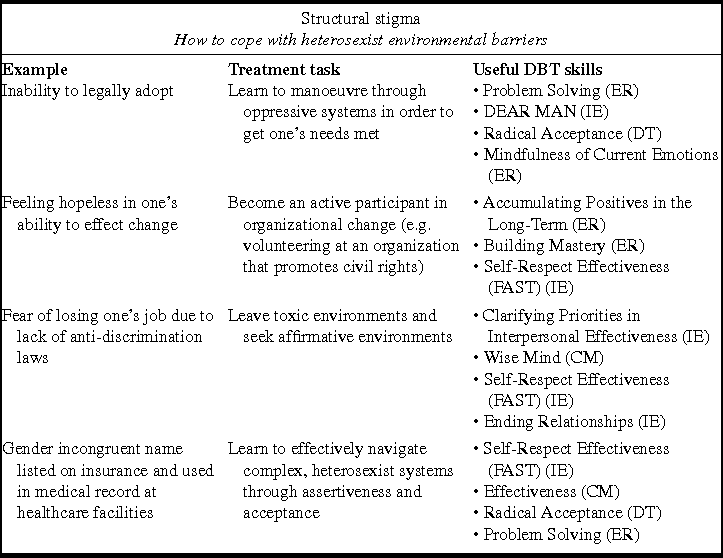
To begin, structural stigma (Table 1) can affect LGBTQ+ clients to varying degrees depending on their larger and more intimate social environments (e.g. country, city, family and friend group). Problem Solving (ER) can be used with clients to explore ways they could impact and change institutional- and system-level discrimination. Because there are many ways to impact stigma and prejudice, DBT's focus on clarifying one's Values and Priorities (ER) may help clients explore domains that may be the most meaningful to them (e.g. LGBTQ+ homelessness, lack of discrimination laws, health care, etc.). DEAR MAN (IE; an interpersonal skill used to strengthen objectives effectiveness) can be useful to ask for allies who can affect structures and institutions that reinforce or uphold heterosexism (Rasinski and Czopp, Reference Rasinski and Czopp2010; Gulker et al., Reference Gulker, Mark and Monteith2013). Although clients will likely benefit from encouragement and empowerment to enact change, in line with DBT, a dialectical approach synthesizing change and acceptance strategies is imperative. Specifically, Radical Acceptance (DT) is an essential skill for clients to develop as it would be an unreasonable short-term goal to eradicate structural stigma. Additionally, Mindfulness of Current Emotions (ER) may also be used for clients to acknowledge, experience and move through challenging emotions related to structural stigma.
Examples of DBT skills for intervention of structural stigma
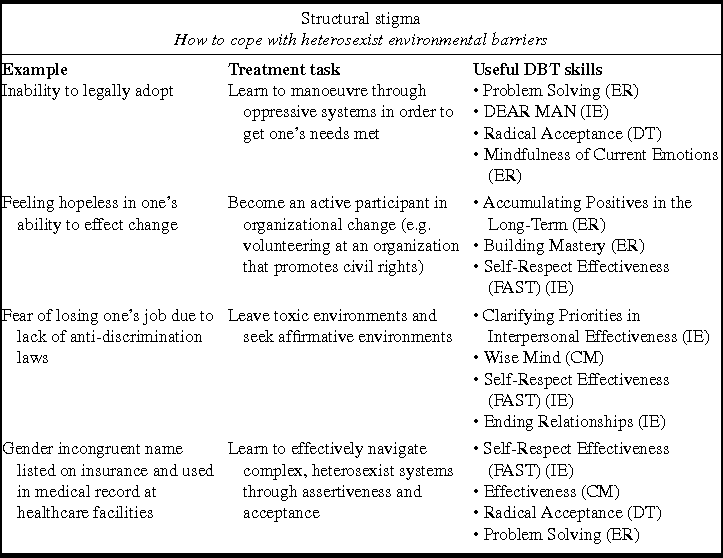
CM, Core Mindfulness module; IE, Interpersonal Effectiveness module; ER, Emotion Regulation module; DT, Distress Tolerance module.
Next, enacted stigma (Table 2) can be addressed by using many of the IE skills. For example, DEAR MAN + FAST (IE) can help clients build their confidence and ability to be assertive in situations where they experience enacted stigma. If they are being called derogatory names or otherwise experiencing discrimination, therapists may help clients develop a DEAR MAN (IE) to explain the stigmatizing nature of the situation (describe), the effect it has on them (express), ask the person to stop making such comments (assert), and communicate how it would be beneficial to the relationship if the other person interacts differently with your client (reinforce). The therapist could coach the client in appearing confident, not over-apologizing, and sticking to their values. Supporting this, research suggests confrontation of prejudice can be effective in reducing further discriminatory behaviour (e.g. Blanchard et al., Reference Blanchard, Crandall, Brigham and Vaughn1994; Czopp et al., Reference Czopp, Monteith and Mark2006; Dickter, Reference Dickter2012; Dickter et al., Reference Dickter, Kittel and Gyurovski2012). Furthermore, supplemental IE skills like Ending (destructive) Relationships and Finding and Getting People to Like You, may be beneficial to help LGBTQ+ clients to build their support and friend networks.
Examples of DBT skills for intervention of enacted stigma
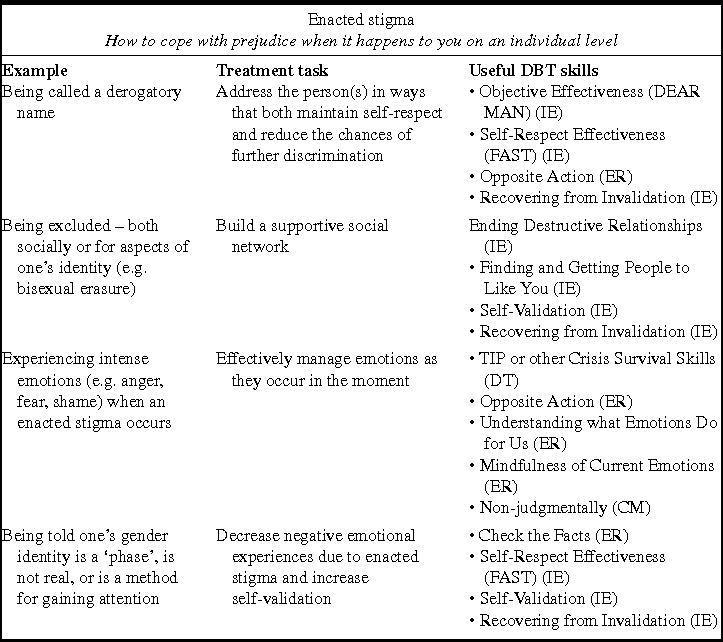
CM, Core Mindfulness module; IE, Interpersonal Effectiveness module; ER, Emotion Regulation module; DT, Distress Tolerance module; TIP, Temperature, Intense Exercise, Paced Breathing, and Paired Muscle Relaxation.
Third, examples of felt stigma (Table 3) include clients feeling ‘on guard’ for prejudice in situations or being directly targeted by discrimination. At times, it may be beneficial for therapists to help clients Check the Facts (ER) regarding felt stigma. This might involve psychoeducation and research about the reality of felt stigma, the psychological impact of prejudice and discrimination, and factors that motivate biases in others. Managing and reducing negative impacts of felt stigma can be addressed by Coping Ahead (ER). For example, therapists can help clients participate in valued activities (e.g. attending social events that bring about fear related to anticipated discrimination) by planning skills to use in the moment, should they encounter prejudice. Here, the therapist could coach the client in actively visualizing and rehearsing effective coping before the event. Mindfulness (CM) of current thoughts, emotions and action urges combined with Opposite Action (ER) to shame and anxiety may also be useful in helping clients participate in valued activities if felt stigma is getting in the way. Increasing the client's awareness of thoughts, emotions and urges that impact their willingness to engage in these valued activities and practising both ER and DT skills can all potentially disrupt the impact of felt stigma.
Examples of DBT skills for intervention of felt stigma
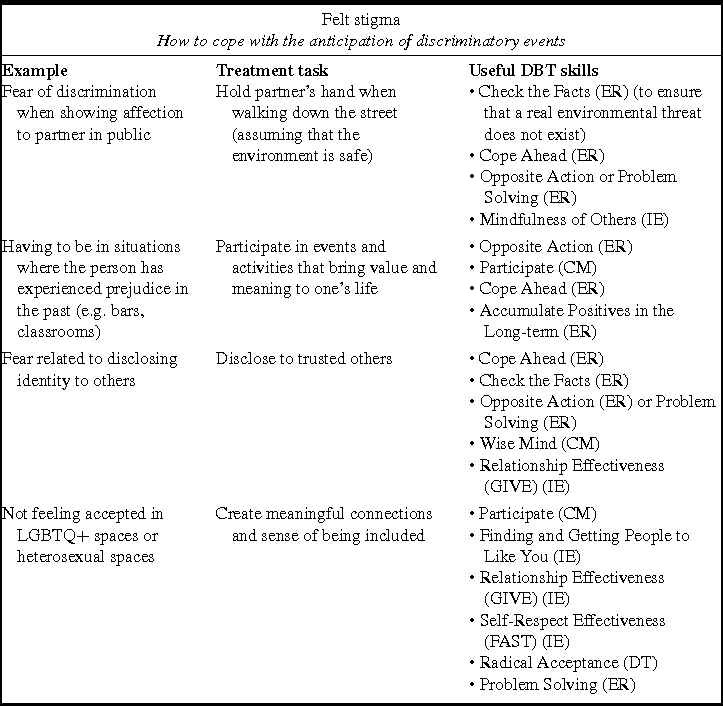
CM, Core Mindfulness module; IE, Interpersonal Effectiveness module; ER, Emotion Regulation module; DT, Distress Tolerance module.
Finally, therapists can help clients explore and understand the ways that internalized stigma (Table 4) affect how they see themselves and how this impacts their lives. For example, clients may experience shame, which can contribute to significant self-criticism and decreased engagement in values-based activities. To reduce internalized stigma, therapists may suggest skills to target shame and to increase positive feelings toward oneself. Some examples are: Opposite Action to shame (ER), increasing Self-Respect Effectiveness (FAST) (IE) in communication with others, Self-Validation (IE), Loving Kindness meditation (CM), and Encouragement from IMPROVE the Moment (DT; a skill focused on relieving emotional distress in the moment). Clients may benefit from exploring their Values and Priorities (ER) and using Opposite Action (ER) to ‘avoid avoiding’ by engaging in behaviours that are consistent with their values. Values-based behavioural activation can help clients increase their sense of meaning and purpose in life. Supporting this, finding meaning from IMPROVE the Moment (DT) has been shown to be an effective way of mitigating the negative impact of internalized heterosexism (Szymanski and Mikorski, Reference Szymanski and Mikorski2016). Furthermore, engaging in values-based activities as well as pleasant events (Accumulating Positives in the short-term; ER) and self-care (PLEASE) skills (ER; skills used to balance biological vulnerabilities) may help reduce shame by giving clients the message that they are ‘worth’ taking care of and reinforcing it behaviourally.
Examples of DBT skills for intervention of internalized stigma
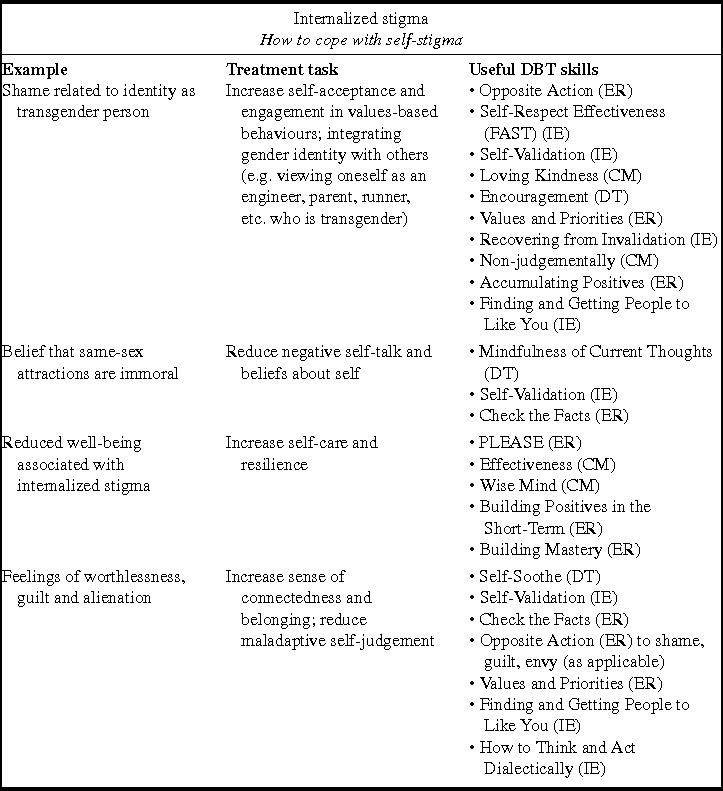
CM, Core Mindfulness module; IE, Interpersonal Effectiveness module; ER, Emotion Regulation module; DT, Distress Tolerance module.
Case conceptualization and intervention example
This case conceptualization is based on a combination of clients that we have worked with over our years in practice. In creating this conceptualization example, we reflected on our practice and chose demographic factors that are representative of many DBT clients we have treated in our outpatient settings. In the conceptualization, we have included background information, primary and secondary targets conceptualized from a DBT perspective, and an example of a behavioural chain analysis and solution analysis as would be commonly conducted in DBT.
Background information
Carla is a 42-year-old cisgender, Latina, lesbian-identified female who comes from a lower middle class socioeconomic background. Her primary diagnosis is borderline personality disorder, and she was referred to DBT for treatment following several inpatient hospitalizations for suicide attempts. In the past year, she has made three suicide attempts via overdose, and also engages in self-harm behaviour in the form of cutting on her upper arms. At intake, she states that her main treatment goal is to stay out of the hospital, as she acknowledges that her multiple hospitalizations are interfering with her ability to maintain relationships and employment. Carla's ‘life worth living’ goals are to achieve consistent long-term employment and a stable romantic relationship. She describes herself as lonely and isolated. Carla is ‘out’ to very few people, none of whom are family members.
Primary and secondary DBT targets
Through early work with Carla, the following primary treatment targets were collaboratively identified:
• Life-threatening: suicide attempts and crisis behaviours (three overdose attempts in the past year), self-harm behaviours (non-lethal cutting on upper arms approximately once per week).
• Therapy-interfering: shutting down in session (becoming non-responsive, avoiding eye contact, dissociating) secondary to shame, threatening to quit therapy/not come to session due to severe hopelessness, multiple hospitalizations involving time away from outpatient DBT.
• Quality-of-life-interfering: series of unstable romantic relationships, multiple job losses due to hospitalizations.
Carla's secondary treatment targets were as follows:
• Emotional vulnerability vs self-invalidation: Carla regularly experiences the emotion of shame, which is apparent when she uses phrases to describe herself like ‘I'm completely useless’ and ‘I'm a defective person’ (internalized stigma). Her family and larger cultural context value heterosexual relationships. She expresses embarrassment about her sexual orientation, and works to hide it from others – particularly her immediate family (felt stigma). While she considers her relationship with her mother to be close, Carla has never disclosed her sexual orientation to her mother (felt stigma). When romantic relationships end, Carla feels hopeless desperation that tends to lead to increased suicidal ideation, yet she does not reach out for help. Instead, she tends to engage in negative judgemental thinking about herself (internalized stigma) that leads to increased emotional vulnerability. Shame often occurs on behavioural chains toward self-harm behaviour and suicidal ideation. After engaging in self-harm, Carla feels more intense shame and negative self-judgement, which ultimately increases her emotional vulnerability and heightens the likelihood of future self-harm and suicidal ideation.
• Unrelenting crisis vs inhibited emotions: Carla feels hopelessness related to achieving her ‘life worth living’ goals. She often expresses the belief that she is not capable of maintaining a stable job and romantic relationship, and is convinced that if her employer knew of her sexual orientation she would be fired (structural stigma). She has experienced discrimination at work in the past (enacted stigma), which was a prompting event for a suicide attempt. When Carla's emotions such as sadness spike to intense levels (i.e. hopelessness), emotional numbing tends to occur. Her self-harm behaviour of cutting functions as a distraction mechanism from the intense hopelessness. She also uses marijuana nearly every evening as a way of ‘shutting off her mind’ and numbing her emotions. The consequences of Carla's emotional numbing efforts have tended to be crisis-generating. For instance, she has lost relationships in the past when friends and partners have learned of her self-harm behaviour. Likewise, Carla has been ‘written up’ at her current job due to smoking marijuana during her lunch break.
• Active passivity vs apparent competence: This dialectic is most easily seen in Carla's relationship patterns. In order to keep relationships, Carla tends to under-express her desires and her emotions when things bother her, creating an incongruence between what is demonstrated and what she experiences internally. For example, a casual friend who did not know that Carla identified as lesbian told some ‘jokes’ that Carla found offensive (enacted stigma). Rather than confronting it, Carla concealed her sexual orientation (felt stigma) and chuckled. Afterward, Carla stopped responding to this person's calls, which prompted them to get worried about Carla's well-being. This person eventually called to express concern about whether Carla was safe. During the next session (which she arrived late for), Carla asked the therapist to “tell her what to do” to solve her problem with the person and became angry when solutions were not immediately offered, threatening to drop out of therapy.
Behavioural chain analysis
Behavioural chain analysis and solution analysis are therapeutic tools that help clients understand antecedents and consequences of specific behaviours, and identify DBT skills they could use to change this process in the future. During a recent session, the therapist and Carla conducted a behavioural chain analysis of an episode of self-harm behaviour (cutting on her arm) that occurred a few days before. The key links and solution analysis are shown in Table 5. The prompting event was that Carla saw a news story about a local gay man who experienced housing discrimination (structural and enacted stigma). This resonated with Carla's own past experiences with discrimination at work (felt and internalized stigma), one of which led to a suicide attempt at the time.
Behavioral chain analysis of Carla's self-harm behaviour
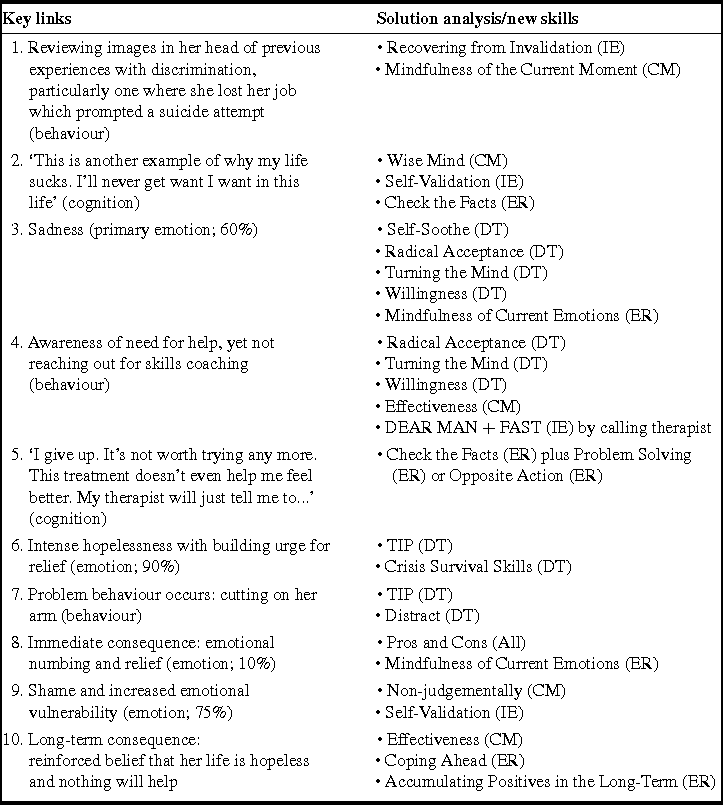
TIP, Temperature, Intense Exercise, Paced Breathing, and Paired Muscle Relaxation.
Skills plan based on behavioural chain analysis data
As an example, we will focus on link #3 (sadness at 60), as this is a controlling variable that often shows up in various forms (e.g. loneliness, hopelessness) on behavioural chains of self-harm and suicidal ideation for Carla. Additionally, building skills around the emotion of sadness can potentially treat multiple secondary targets described above. The skills identified in the solution analysis were: Self-Soothe (DT), Radical Acceptance (DT), Turning the Mind (DT), Willingness (DT), and Mindfulness of Current Emotions (ER).
In session, the need for Radical Acceptance of the emotion of sadness was identified. Carla observed that she was beginning to experience the emotion of sadness in that moment and she reported strong urges to leave the session. This was seen as an opportunity to practise emotional experiencing skills (Mindfulness of Current Emotions) right in session. Carla was actively coached to use her mindfulness skills to attend to the physical sensations of the emotion, which takes the form of an informal emotional exposure. Carla was encouraged to be aware of when she was internally inhibiting or pushing the sadness away, and when this occurred she was coached in Turning the Mind. All of this was in service of increasing Carla's willingness to experience the emotion without inhibiting it.
Working through this process, Carla was asked to report the intensity level of the sadness. When the intensity level approached her skills breakdown point, Carla was coached on using self-soothing. To do this, she was oriented to a colourful painting in the office and the therapist narrated a process of being mindful of it – coaching Carla on self-soothing through vision. As the intensity level dropped, the positive consequences of her willingness to engage with the emotion (e.g. she is building mastery in the area of emotional experiencing), and the skills she used in session to manage it effectively without inhibiting, were highlighted. It was also highlighted that because she used skills to experience the emotion, she was not stuck with negative consequences like shame and increased vulnerability (link 9) that would typically happen after she used self-harm as a way to deal with the emotion. It was discussed with Carla how she should practise this mini treatment plan between sessions, and use commitment strategies to build the likelihood that she would call for skills coaching if she needs it. Contingency clarification was used here – pointing out that her use of skills coaching to avoid inhibiting would help her achieve her ‘life worth living’ goals much more effectively than emotional numbing. Carla left the session with a notecard outlining the mini treatment plan that she would practise for homework, which would be followed up on at the next session.
Conclusions and future directions
Until recently, there was no evidence for LGBTQ+ affirmative interventions reducing the negative impacts of structural and individual stigma. We now have evidence that using empirically supported strategies has been effective at reducing anxiety, depression, problematic drinking and risky sexual behaviour in sexually diverse men (e.g. Pachankis et al., Reference Pachankis, Hatzenbuehler, Rendine, Safren and Parsons2015; Millar et al., Reference Millar, Wang and Pachankis2016). Interventions for treating problems that stem from the unique experiences of LGBTQ+ individuals are incredibly important for growing the availability of treatments that meet the needs of clients with diverse gender identities and sexual orientations. At the same time, it may also be beneficial to make use of existing treatments with solid empirical support by carefully shaping and calibrating them to provide effective mental health care to LGBTQ+ individuals. This approach would enable providers to build on skill sets that they already have, and thus require less training and dissemination efforts than learning or promoting a novel treatment intervention.
We believe that for LGBTQ+ clients in DBT, the model proposed by Herek et al. (Reference Herek, Gillis and Cogan2009) may be integrated to produce a synergistic treatment that helps clients manage the effects of stigma. The analogous foundations of Linehan's (1993) biosocial theory of emotion dysregulation and the experience of environmental invalidation through stigmatizing events in LGBTQ+ individuals’ lives is distinctive, and suggests that DBT skills could be used by such clients who struggle to cope with the effects of stigma. Using clinical examples, we have outlined specific ways that DBT skills can be useful in accomplishing a variety of therapeutic tasks specific to clients with diverse gender identities and sexual orientations. We hope that these contributions will be helpful for clinicians who wish to guide their work with LGBTQ+ clients using existing skills and strategies that are well supported by research.
Although these skills have already shown themselves to be useful in our own clinical experiences, an important future direction of this work is to conduct empirical research to affirm the effectiveness of using DBT skills with LGBTQ+ individuals to reduce the impact of internalized and structural stigma. We also recommend investigating whether there are unique experiences of LGBTQ+ individuals that might require special application of DBT skills in order to be maximally effective (e.g. using LGBTQ+-specific examples when teaching skills). Conversely, identifying treatments outside of DBT and demonstrating their effectiveness for clients with diverse sexual orientations and gender identities is a critical future direction, which we expect to grow within the current context of evidence-based practice. Finally, we hope to explore further how clinicians may more effectively serve as allies for their LGBTQ+ clients as a means of providing validation and engaging in community advocacy.
Main points
(1) When working with LGBTQ+ clients who are in DBT (Linehan, Reference Linehan1993), it may be beneficial to help them use DBT skills to effectively manage stigma. The sexual stigma model of Herek et al. (Reference Herek, Gillis and Cogan2009) provides a framework for therapists to understand the types of stigma experienced by LGBTQ+ clients.
(2) This paper provides examples of how DBT skills may apply to managing stigma at four levels: structural, enacted, felt and internalized.
(3) A case study including conceptualization is used to illustrate these points.
Acknowledgements
The authors thank Neal Moglowsky, LPC for thoughtful feedback on this manuscript.
Conflicts of interest
The authors have no conflicts of interest with respect to this publication.
Ethical statement
The authors have abided by the Ethical Principles of Psychologists and Code of Conduct as set out by the APA. No ethical approval was needed, as this paper does not include any collected data or actual clinical material.
Funding
This work received no specific grant from any funding agency, commercial or not-for-profit sectors.
(1) Readers will learn the levels of sexual stigma and how they relate to self-invalidation.
(2) Readers will learn how LGBTQ+ clients in DBT can apply DBT skills to target the effects of sexual stigma.
(3) Readers will learn how to incorporate LGBTQ+ clients’ experiences of sexual stigma into DBT case formulation.




Comments
No Comments have been published for this article.