INTRODUCTION
Electoral politics in Africa is widely regarded as clientelistic and politicians are expected to maintain and rely on extensive patronage networks for electoral support. Clientelism is defined as ‘a transaction between politicians and citizens whereby material favors are offered in return for political support at the polls' (Wantchekon Reference Wantchekon2003: 400). When goods or cash are distributed during electoral campaigns, this is commonly referred to as ‘electoral’ or ‘campaign’ clientelism. Such practices present major obstacles to democratisation and economic development because they limit the provision of public goods, exacerbate incumbents' already considerable advantage, and may push the opposition to resort to political violence (Easterly & Levine Reference Easterly and Levine1997; Vicente & Wantchekon Reference Vicente and Wantchekon2009).
A large body of literature has focused on the nature of clientelistic relationships, their adverse effects for redistribution and democratisation, and the conditions for their decline. It is commonly believed that patron-client relationships are prevalent when inequality is high, productivity is low, social relations are starkly hierarchical, power is centralised, and the size of the public sector economy is large (Lemarchand & Legg Reference Lemarchand and Legg1972; Bates Reference Bates1974). In such conditions, patronage networks are seen as stable and reliable in delivering votes, particularly when buttressed by coethnicity (Berman Reference Berman1998). Therefore, in places where patronage relationships are prevalent, one would expect stable political support for incumbents and non-competitive electoral contests.Footnote 1 Conversely, destabilised patronage networks are associated with more electoral volatility and heightened political competition.
Recent research has found that voters in Sub-Saharan Africa exhibit high levels of political sophistication and take into consideration a range of factors when making political decisions, such as candidates' past performance and ideology (Weghorst & Lindberg Reference Weghorst and Lindberg2013). Theories of the move towards programmatic politics in democracies stress the combination of vote secrecy and political competition as important for undermining the stability of clientelistic networks (Shefter Reference Shefter1977). Scholars have also argued that vote-buying constitutes a signal of candidate credibility in ensuring future transfers rather than an enforceable economic transaction (Kramon Reference Kramon2013), or have questioned the effectiveness of personalised material inducements altogether (Bratton Reference Bratton2008; Guardado & Wantchekon Reference Guardado and Wantchekon2014).
Despite the assumed centrality of patron-client relationships to political outcomes in Sub-Saharan Africa and Kitschelt's lament over a decade ago that ‘the rigorous operationalisation of linkage mechanisms [between citizens and politicians], particularly clientelism, is absent from the comparative politics literature’ (Kitschelt Reference Kitschelt2000: 869), empirical studies remain rare. Such studies are important for two main reasons: first, clientelism is detrimental to public goods provision and democratic stability by leading to a concentration of resources in some geographical areas and among some communities, cementing incumbents' hold on power, and precluding political accountability, issue deliberation and public goods provision. And second, empirical studies of electoral clientelism in competitive environments could help us trace the consequences of political competition on voting behaviour and party strategy, and thus understand the micro foundations of theories of the transition towards programmatic politics in new democracies. Micro-level data can improve conceptual clarity and theoretical inference regarding the logic and consequences of electoral clientelism in ‘patronage democracies’.
To gain insight into how electoral clientelism operates in conditions of political competition, I study voting and candidate behaviour in two competitive rural districts in Ghana's Upper East region. I argue that in the presence of stable demands for individual material inducements, politicians face incentives to match or undermine the rewards given by competitors in order to ‘stay in the game’. Conspicuous gift-giving is necessary to signal status, authority, and political viability, but insufficient to ensure electoral victory. In the privacy of the election booth, voters pick one among several gift-giving candidates for a variety of other reasons. Chief among these reasons are evaluations of MPs' past records in providing local public goods, and attitudes towards parties' broader policies. Politicians thus face pressures to continue providing gifts but differentiate in other ways. It is therefore plausible that rising voter sophistication and parties' move towards policy deliberation and ideological differentiation can coexist with campaign clientelism in Africa's patronage democracies. The status affirmation theory accounts for the persistence of electoral clientelism despite ballot secrecy in Sub-Saharan Africa and the puzzling finding that voters take into account performance evaluations, policies and ideology in places where electoral clientelism is widespread.
This paper joins the few recent studies questioning the effectiveness of gifts to secure votes in Sub-Saharan Africa (Weghorst & Lindberg Reference Weghorst and Lindberg2011; Guardado & Wantchekon Reference Guardado and Wantchekon2014) and advances this work in three ways: it provides an explanation for the persistence of vote buying despite recognition of its futility, it shows that the ineffectiveness of gifts to guarantee votes is partly due to voters' awareness of candidates' records of public goods provision and the subversive actions of the opposition, and it traces the implications of electoral clientelism as status affirmation for parties' broader outreach strategies. It is one of the few studies to focus on competitive areas in Sub-Saharan Africa explicitly and present micro-level data of both voter considerations and candidate strategies. It builds on research by Nugent and Lindberg on MPs' accountability pressures and campaign behaviour in Ghana and adds three additional aspects to this research: how voters evaluate such campaigning, how MPs respond to opponents' electoral clientelism locally, and how the various campaign gifts are intended and rationalised by candidates in competitive environments. Empirically, the paper presents data on campaign clientelism in Ghana's North, which has so far remained largely outside rigorous studies of clientelism and voting behaviour in the country.
IS ELECTORAL CLIENTELISM A TOOL FOR MOBILISATION OR PERSUASION?
How private transfers translate into votes in patronage democracies and whether parties target core supporters or swing voters has been subject to much debate. Instrumentalist theories view clientelist practices as mutually beneficial contingent exchanges between politicians and voters (Stokes Reference Stokes2005; Kitschelt & Wilkinson Reference Kitschelt, Wilkinson, Kitschelt and Wilkinson2007). Valuable resources are supplied in settings where poverty and inequality are high and voter compliance is ensured through monitoring and sanctioning. The influence of material inducements is thus strictly conditional on the ability to sanction defectors. But are electoral gifts effective without the support of political machines?
Most empirical research of vote buying in sub-Saharan Africa has focused on non-competitive elections where persuasion effects cannot be captured (Wantchekon Reference Wantchekon2003; Vicente Reference Vicente2014). Scholars have assumed that parties distribute particularistic benefits in order to influence voting choices, but have studied settings where voters hardly face real options. This literature is likely examining the effects of gift-giving on mobilisation or ‘turnout buying’ instead (Nichter Reference Nichter2008). By comparing turn-out rates in places where rewards were offered to ones where they were not, these studies find that offers of electoral rewards are effective and favour incumbents in rural areas in particular (Vicente & Wantchekon Reference Vicente and Wantchekon2009). Would electoral rewards be as effective in competitive elections? Are voters presented with options likely to be swayed by patronage?
One of the few studies to examine how voters make political choices in contested areas versus safe havens finds that the provision of electoral rewards is slightly more important in contested areas. The authors conclude that ‘clientelism is more likely when political competition is intense’ (Lindberg & Morrison Reference Lindberg and Morrison2008: 119–20), suggesting that clientelistic rewards are used to change the opinions of ‘swing voters’ and that the high marginal value of each swing voter is sufficient to justify increasing campaign expenses. There are indications that political liberalisation has been accompanied by increased patronage provision in Sub-Saharan Africa in terms of the share of MPs' salaries allocated to ‘chop money’ (Lindberg Reference Lindberg2003). However, we do not have evidence that persuadable voters are indeed influenced by the provision of clientelistic goods, or that parties provide those with the intention of convincing undecideds.
Instead, the rising costs associated with electoral clientelism in competitive elections appear to be demand-driven: competition strengthens the leverage of clients in relation to patrons and voters increasingly use elections as ‘harvesting seasons' – extracting as many resources as they can from all sides (Lindberg Reference Lindberg2010, Reference Lindberg2013). Lindberg (Reference Lindberg2010) documents the pressures and expectations MPs in Ghana face from their constituencies: the provision of personal benefits and a moral obligation to act as ‘heads of the family’, bringing community development, community representation, legislation and executive oversight. What role do personalised gifts play for voters' choices when parties are reacting to the demand for patronage and not shaping it?
The puzzle of electoral clientelism in the presence of ballot secrecy also remains unresolved. Stokes (Reference Stokes2005) suggests one way political machines overcome this is by monitoring vote-buying, but in practice such interventions are unlikely where party institutionalisation is low. Another solution views clientelistic bargains as self-reinforcing because of strong norms of reciprocity (Lawson & Greene Reference Lawson and Greene2014), but evidence is mixed, particularly when elections are competitive. Bratton (Reference Bratton2008) studies vote buying and violence in Nigeria and finds that while vote buying increases partisan loyalties, compliance with politicians' demands is not guaranteed and voters who face offers from both incumbents and the opposition are likely to take gifts but vote as they please. Nugent (Reference Nugent, Basedau, Erdmann and Mehler2007: 254–5) argues that when ballots are secret, ‘money cannot literally buy votes … at best it can buy good will’.
A third set of approaches suggests that campaign clientelism continues despite ballot secrecy because it provides a credible signal of candidates' future ability to deliver patronage, particularly in low information environments (Kramon Reference Kramon2013; Muñoz Reference Muñoz2014). However, if candidates' past records are known to voters, as is likely over consecutive electoral rounds, campaign handouts would be a much weaker signal of political competence and future performance. Recent research has demonstrated that the majority of voters consider performance when making decisions across Africa and has drawn attention to retrospective voting in Ghana in particular (Hoffman & Long Reference Hoffman and Long2013). Guardado & Wantchekon (Reference Guardado and Wantchekon2014) argue that if votes cannot be monitored and more than one party offers gifts, the practice would be ineffective and become prohibitively expensive. Would parties continue to provide electoral rewards particularly in view of their rising costs and potential futility? If so – why?
THE RATIONALE FOR ELECTORAL CLIENTELISM IN COMPETITIVE ELECTIONS WITH SECRET BALLOTS
Below, I present a theory of campaign clientelism as status affirmation in places where voters expect gifts, but ballots are secret and elections are competitive. The theory explains why vote-buying persists in light of its futility to guarantee support. It traces the implications of competitiveness on behaviour vis-à-vis other candidates, predicts that parties will seek to diversify their linkage strategies, and reconciles ubiquitous electoral clientelism with rising voter sophistication in Sub-Saharan Africa.
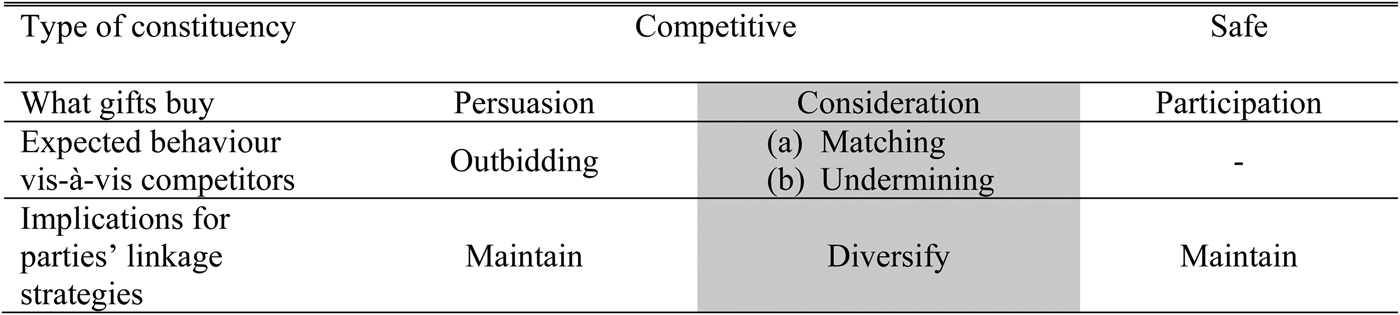
I begin with the assumption that in an environment where voters seek and expect material rewards, politicians face strong incentives to provide those in campaigns. However, the strategic rationale for providing gifts varies according to whether electoral constituencies are competitive or safe (Figure 1).
The rationale for providing electoral gifts by constituency competitiveness

When parties face no credible opposition locally (often when candidates are running unopposed), they provide rewards in order to ensure electoral participation, or ‘buy turn-out’ (Nichter Reference Nichter2008). For voters, the choice is between selecting the only candidate on the ballot, or not voting at all.
If constituencies are competitive, voters have several credible options apart from abstaining. In such conditions, electoral rewards can be used for persuasion (to buy voters' support) or to ensure voters' consideration (by giving a token in order to be seen as a legitimate player). If electoral gifts are intended to persuade, competition should lead to outbidding: candidates should seek to give more than competitors. In such cases, gifts alone determine political support, issue competition is under-developed and candidates' past records are irrelevant. As ballots are secret, however, outbidding is costly and uncertain – the candidate who has provided the highest reward cannot monitor the returns to his or her investment.
In the case of buying consideration, candidates aim to match each other's rewards and attempt to shift the dimension of political competition away from immediate personalised transfers. Matching does not buy voters' support but ensures other candidates' gifts are not solely effective either. This strategy has advantages particularly when candidates have limited financial resources: it is more cost-effective and it ensures resources are not wasted on activities with questionable returns. Thus, while gifts are provided, because they are matched, other issues determine voting choices. Note that matching gifts is not incompatible with an overall increase in MPs' electoral expenses when it is demand-driven, i.e. when voters demand larger gifts or when more voters demand gifts.
Candidates wishing to stay in the game in competitive environments where gift-giving is expected can also undermine the effectiveness of opponents' gifts directly: either by providing smaller rewards and stressing symbolism and affection, or by instructing voters to altogether break the norms of reciprocity binding giver to receiver. For example, in Zambia's 2011 electoral campaign, the opposition Patriotic Front (PF) adopted the slogan ‘don't kubeba’ (don't tell) urging voters to accept the gifts of the incumbent Movement for Multi-Party Democracy (MMD) but vote for PF candidates.Footnote 2 This was clearly an attempt by an opposition party to undercut incumbent advantage in an environment where electoral clientelism is ubiquitous, but ballots are secret. The effects of such undermining tactics on vote-buying in Sub-Saharan Africa are not yet fully understood. We know from research on clientelism in other settings that a shift in voters' attitudes is important for undermining its effectiveness (Fox Reference Fox1994; Warner Reference Warner and Piattoni2001) and there is evidence voters in Africa view electoral gifts as rights and not obligations (Lindberg Reference Lindberg2013), consistent with increased emancipation and a departure from reciprocity norms. In both cases of consideration-buying, parties and candidates have strong incentives to invest time and resources in diversifying their linkages to voters.
What do gifts signal in order to ensure voters' consideration? When candidates' records are known, electoral handouts alone cannot reassure voters of future transfers. Thus, gifts in competitive elections where information on candidates' past promises and performance is available are less likely to be credible as promises of future benefits, but can serve to consolidate candidates' current status as serious contenders and demonstrate deference to norms of generosity, social solidarity and personalised attention.Footnote 3 An extensive literature equates ostentatious displays of wealth and the willingness and ability to give gifts with success, authority, and legitimacy in Sub-Saharan Africa (Bayart Reference Bayart1993; Chabal & Daloz Reference Chabal and Daloz1999; Nugent Reference Nugent, Basedau, Erdmann and Mehler2007). To voters, wealth signals a candidate's ability to extract resources, and is thus equated with political viability (Hansen Reference Hansen2010). Sharing wealth is in turn a sign of civic virtue (Lonsdale Reference Lonsdale, Kaarsholm and Huttin1994). Conversely not giving gifts when competitors do so would signal not just lack of political viability, but also lack of empathy, morality, and respect, and be equated with selfishness, greed, even witchcraft (Austen Reference Austen and Comaroff1993). Chabal & Daloz (Reference Chabal and Daloz1999: 43–4) write that ‘not to display wealth opulently would be tantamount to an admission of low collective self-esteem’.
Given also the central role gifts played in guaranteeing the consent of the governed during the colonial period and the single-party era in Sub-Saharan Africa (Englebert Reference Englebert2002), newcomers do not face a clean slate. Aspiring politicians must first establish their status through partaking in the gift-giving ritual. This status requires constant re-affirmation subsequently, particularly in the presence of competitors. Campaign gifts are therefore disbursed publicly and ostentatiously as displays of wealth are constituted as performances intended to reach a broader audience. Unlike future performance signalling, gift giving as status affirmation is conspicuous but insufficient to guarantee voters' support.
The rationale for providing electoral gifts in Sub-Saharan Africa is crucial for whether the practice subverts democratic accountability, issue deliberation, political system maturity, and public goods provision. It is important to understand whether candidates engage in persuasion or consideration-buying and whether voters decide on the basis of gifts alone. If material inducements alone determine voting choices, whether as a direct contingent exchange or as a credible signal of future performance, then parties do not face incentives to differentiate their linkage strategies and electoral clientelism is likely to result in highly uneven resource distribution. If gift-giving is insufficient to guarantee victory but persists as status affirmation, politicians are forced to reach out to voters in other ways. Formulating and contesting policy proposals aimed at broader constituencies is one alternative to vote-buying as parties consolidate. Thus, electoral clientelism need not be incompatible with public goods provision, political accountability, and increased political system maturity in patronage democracies.
RESEARCH SETTING
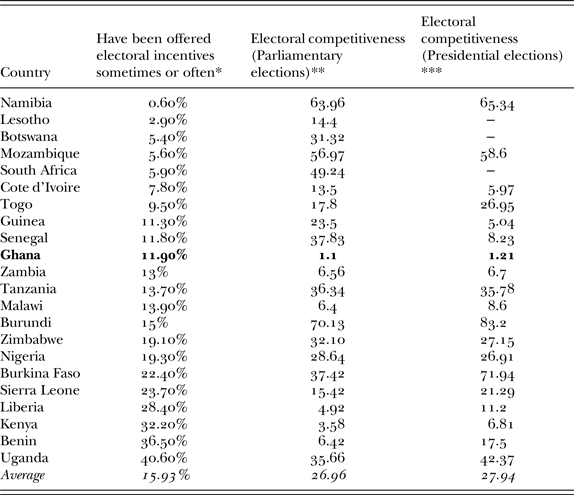
To study how electoral clientelism functions at the micro level in competitive environments, I focus on two neighbouring rural districts in Ghana's Upper East region: Kassena-Nankana (Paga-Chiana parliamentary constituency) and Talensi-Nabdam (Nabdam parliamentary constituency). Ghana is a good setting to study the rationale for providing electoral gifts in competitive environments in Sub-Saharan Africa because the rate of vote-buying is close to the regional mean, yet electoral competitiveness is very high (Table I).
Campaign gifts and national-level electoral competitiveness in Sub-Saharan Africa.

*Source: Afrobarometer Round 5, 2011–2013.
** Per cent difference between the winner and runner up in the parliamentary election closest to when the Afrobarometer Round 5 survey was administered in each country.
*** Per cent difference between the winner and runner up in the presidential election closest to when the Afrobarometer Round 5 survey was administered in each country.
The country is divided into 275 parliamentary constituencies and an MP is elected in each constituency by a simple majority (plurality vote) every four years. The two main parties, the National Democratic Congress (NDC) and the New Patriotic Party (NPP), are closely matched in terms of resources and local institutional networks and have alternated in power in the country, allowing them to field credible parliamentary candidates in most constituencies.
Kassena/Nankana and Talensi-Nabdam are among the poorest districts in Ghana.Footnote 4 The Nabdam and Paga parliamentary constituencies are also competitive as evidenced by electoral swings and small winning margins. In 2012, Paga elected Abuga Pele, an MP from the NDC, and in 2008 the NPP MP, Alowa Kaba, won by less than 1000 votes in the constituency. Nabdam voted the sitting NDC MP – Moses Asaga – out in 2012, also by a margin of less than 3% of the total votes cast.Footnote 5 The electoral swing in Nabdam is particularly remarkable because the deposed MP, Moses Asaga, had held the seat since 1996 and had been instrumental in lobbying the NDC government for the establishment of a new district prior to 2012. District creation is seen as a major funnel of patronage by incumbent governments in Sub-Saharan Africa (Green Reference Green2010) and is often valued highly and rewarded by voters. Both constituencies are in a region which traditionally supports the NDC and the NDC Presidential candidate, John Atta Mills, won both in 2008 and 2012.Footnote 6
In sum, the research setting is appropriate for studying how electoral clientelism functions in locally competitive environments in a new democracy. Because poverty is high and elections were closely fought, these parliamentary constituencies are also a most likely case for persuasion-buying and gift outbidding, and thus a hard test for the status affirmation theory developed in this paper. The setting further allows me to examine the effect of national-level incumbency on local patronage provision and the stability of clientelistic networks: in Nabdam in 2012, the deposed MP was from the ruling party (NDC), and in neighbouring Paga, the former MP was from the opposition (NPP).
METHODOLOGY AND DATA
In January and February 2014, I conducted interviews and focus group discussions with local party functionaries, government officials, chiefs and opinion leaders in the Nabdam and Paga parliamentary constituencies, as well as interviews with party strategists and analysts in Accra. In line with the theory, I was interested in the following: (a) Was the provision of gifts at election times common and was ballot secrecy circumvented? (b) Was vote-buying sufficient to guarantee support, particularly in light of candidates' performance records? (c) Did the campaigns attempt to up, match, or undermine the gifts given by opponents? (d) Was there evidence of policy competition and debate on the provision of non-particularistic goods and were those important for voters?
I asked questions related to the political campaign process and strategy, MPs' expectations, voters' predispositions, the most important issues locally, and the conduct of campaign events. Since the incumbent MPs were voted out in both districts, I also sought to gauge the reasoning given for this change from all sides of the political divide and from voters. During informal conversations and additional semi-structured interviews, I was able to ask for clarifications and follow-up questions.
Further, I conducted a survey of voters in the Nabdam and Chiana/Paga parliamentary constituencies. Four hundred randomly sampled respondents in 20 settlements were interviewed by research assistants (200 in each constituency).Footnote 7 Having data at the settlement level allows me to examine a number of additional factors relevant to the theory: whether there were local party strongholds within the two constituencies, whether communities were selectively rewarded or penalised through gifts, and whether intra-communal policing may have jeopardised the secrecy of the ballot. It also allows me to match on the lowest relevant geographical unit – the settlement level – in estimating the effect of electoral gifts on voting.
While the survey method has potential biases (see below), it is preferable to experimental methods given the theoretical concern with the effects of incumbent performance and retrospective evaluations on voting choices. MPs' past records in public goods provision would be difficult to manipulate and conducting experiments in these highly competitive districts is unfeasible. Open-ended survey questions, while costly to administer and more difficult to code and aggregate, are shown to be more accurate in capturing respondents' salient concerns and political calculations (Campbell Reference Campbell1980; Kelley Reference Kelley1983; Geer Reference Geer1991). The results obtained using the survey instrument are very close to those reported in studies using list experiments (Kramon Reference Kramon2010) and cross-country surveys such as those administered by Afrobarometer.Footnote 8
The survey posed questions about how interviewees decide which candidate to support in parliamentary elections, whether the secrecy of the ballot was a concern, whether they had benefited from parties' electoral gifts, and whether these gifts were an important consideration in deciding who to support. Voters were also asked if they had switched support from one MP to another and what the reasoning behind this change was.Footnote 9
Further, while social desirability bias influences how individuals characterise their own motivations and behaviour, it has a smaller effect on how they interpret the actions of others. As I was interested in the overall prevalence of campaign clientelism in the two constituencies and the general extent to which it influenced voter behaviour, I also asked respondents to reflect on the behaviour and voting motivations of others. The questions were embedded among others asking about respondents' daily needs and attitudes towards local government, the ongoing process of devolution in the country, and the successes and challenges of public goods provision locally. Finally, conducting the survey midway through the electoral cycle (the parliamentary election in Ghana had been held in December 2012 and the survey was conducted between February and March 2014) and outside of the highly politicised environment surrounding the campaigns is an advantage to the extent that it allows voters to speak more candidly about their decisions and preferences.Footnote 10
In addition, I spoke informally and at length to a large number of people in both constituencies about their attitudes to politics and voting, their political preferences, their needs and expectations, and their opinions of the sitting and deposed MPs.
FINDINGS
Party functionaries, local opinion leaders, and voters all confirmed that gifts were frequently and openly provided by all candidates during the campaigns. All parties engaged in conspicuous and diffuse gift-giving during rallies and campaign walk-abouts and were frequently portrayed as ‘parading wealth and money’.Footnote 11
The gifts included cash, food, drinks, clothes, petrol, offers to pay children's school fees, sewing machines, bicycles. Some respondents claimed they had not received anything, but would have gladly accepted gifts if such had been offered to them. Others expressed resentment that the gifts were not shared fairly and that some had benefited more than others. The frequency of (self-reported) cash handouts was 16% in Nabdam and 13% in Paga, and larger gifts accounted for an additional 1% of all gifts received. These figures are in line with other research on the prevalence of vote-buying in Ghana and elsewhere in Sub-Saharan Africa.Footnote 12
The responses confirm what has long been noted in other research on Ghana and Sub-Saharan Africa more generally: gift-giving is ubiquitous, normalised and expected during electoral campaigns.Footnote 13 The ease with which voters discussed desiring and taking gifts is evidence against the presence of response bias potentially resulting in the under-reporting of vote-buying in these two constituencies, improving confidence in the validity of the survey instrument.
Virtually none of the people interviewed expressed concern that ballot secrecy had been violated. As an additional check, and to test whether internal policing may have been a way to undermine the secrecy of the ballots as suggested by the machine politics literature, I asked whether respondents knew how their families or neighbours had voted. The majority (62%) said they did not, 12% qualified they knew how their families had voted, but not their neighbours, and a further 8% said they could infer neighbours' voting intentions from partisanship.Footnote 14
During informal conversations with voters, I was told that additional ways had been devised to bind voters to the gifts they had received: ‘they make you swear an oath before taking gifts, they use “oath of thunder” to strike you all of a sudden [if you defect] … it is a new trend, people are superstitious',Footnote 15 but these were also of questionable efficacy: ‘you can take certain actions to break it, you can pray to other deities’.Footnote 16 Overall, circumventing the secrecy of the ballot was not how parties monitored whether persons who had taken gifts voted for particular candidates. Local political organisers from opposition parties frequently pointed out voting secrecy to constituents:‘We tell them to take the gifts but vote their conscience. We tell them voting is secret.’Footnote 17
To examine the role gifts had played for voting choices in the two constituencies in relation to other considerations, the survey posed three different open questions: (1) how respondents decide which candidate to support; (2) why, in their opinion, others support the opposition; and (3) why the incumbent MPs had been voted out. This approach attempts to minimise bias by prompting respondents to reflect both on their own and on others' motivations and behaviour. If gifts had been a key factor behind voting patterns in the two constituencies, this may have been under-reported in responses to the first question, but it should have featured prominently in responses to the other two.
Open questions also provide important information on the justifications and narratives voters construct in support of a candidate and when reflecting on the motivations of others. One way to study the range of citizen-politician linkages in new democracies is to examine these justifications and narratives and compare them to candidates' mobilisation strategies. Thus, voters' reflections on their own decision process and the decision processes of others are key to understanding not only how individuals interpret their political environment, but the extent to which the campaigns had been able to influence this interpretation (more on this below). The questions were also intended to probe voters' attitudes towards MPs' records in local public goods provision. For the purposes of the theory, it is important to examine whether negative retrospective evaluations of incumbents had contributed to voters' switching support to another candidate despite having benefited from campaign gifts.
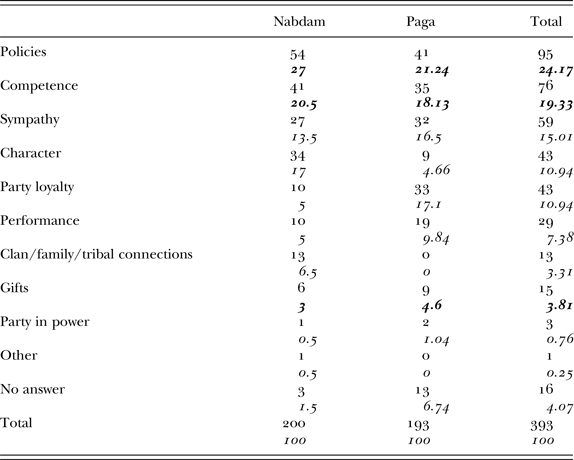
It is clear that the proportion of respondents who took gifts was higher than the ones who reported that gifts were an important consideration in deciding who to support in either constituency (Table II). The qualitative responses are telling: ‘I will take the gifts but vote according to my choice. No gift can change my choice’, ‘I will receive the gift but [he] will not follow me into the booth on the voting day’, ‘If in addition to the gifts the party has good policies, yes, otherwise I don't vote based on gifts’. These responses suggest that reciprocity norms were ineffective and vote-buying bargains were not self-reinforcing in the two constituencies.
Self-reported reasons for selecting parliamentary candidates by constituency

Note: Column percentages in italics. Question wording: ‘When there is an election and you have to go and vote, how do you choose which candidate for parliament you prefer?’ Categories created from qualitative responses. LR χ2(10) = 81.3945 (p = 0.000).
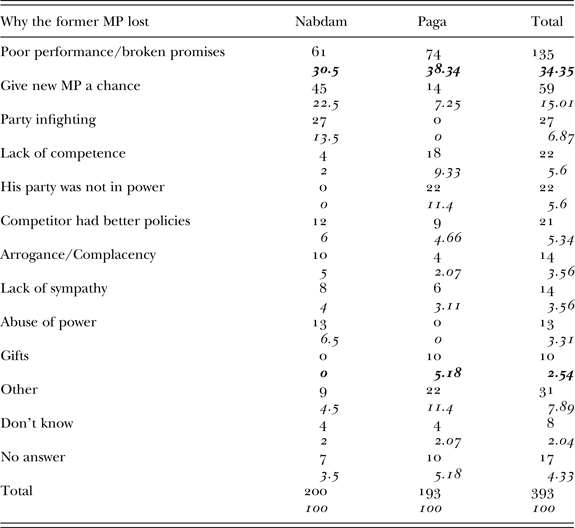
Further, while there were significant differences in respondents' opinions as to why the incumbent MPs lost, gifts seem to have played a very minor role (Table III).
Reasons for MPs' loss

Note: Column percentages in italics. Question wording: ‘Before, the old MP was from one party, the new one is from another party. Why do you think people picked the new MP from the other party?’ Column percentages in italics. Categories created from qualitative responses.Footnote 18 LR χ2(12) = 137.2432 (p = 0.000).
In both constituencies, poor performance, complacency and lack of sympathy for the community were given as the main reasons for voting the former MPs out: ‘the old MP was not living up to expectations’, ‘he did not honour his promises’, ‘[he was] taking the community for granted’, ‘no single respect, not even for the elder in the community’, ‘not being physically present during the campaigns’. In contrast, opponents showed ‘visible respect for the people’ and were perceived as more involved and personable. Finally, only 4% of respondents thought others voted on the basis of gifts (see Table A6 in the online Appendix) – a rate very similar to the self-reported figure for the extent to which gifts influenced voting choices (Table II). Most people said they did not know why others supported political opponents, or thought it was out of party loyalty, tribal connections or because they preferred other parties' policies.
To gauge the effect of electoral clientelism on persuasion, I test whether benefiting from campaign gifts made respondents more or less likely to change their vote. Because of concerns about response bias, the survey asked whether respondents had voted for the same person in the past two elections, rather than who they had supported in particular.
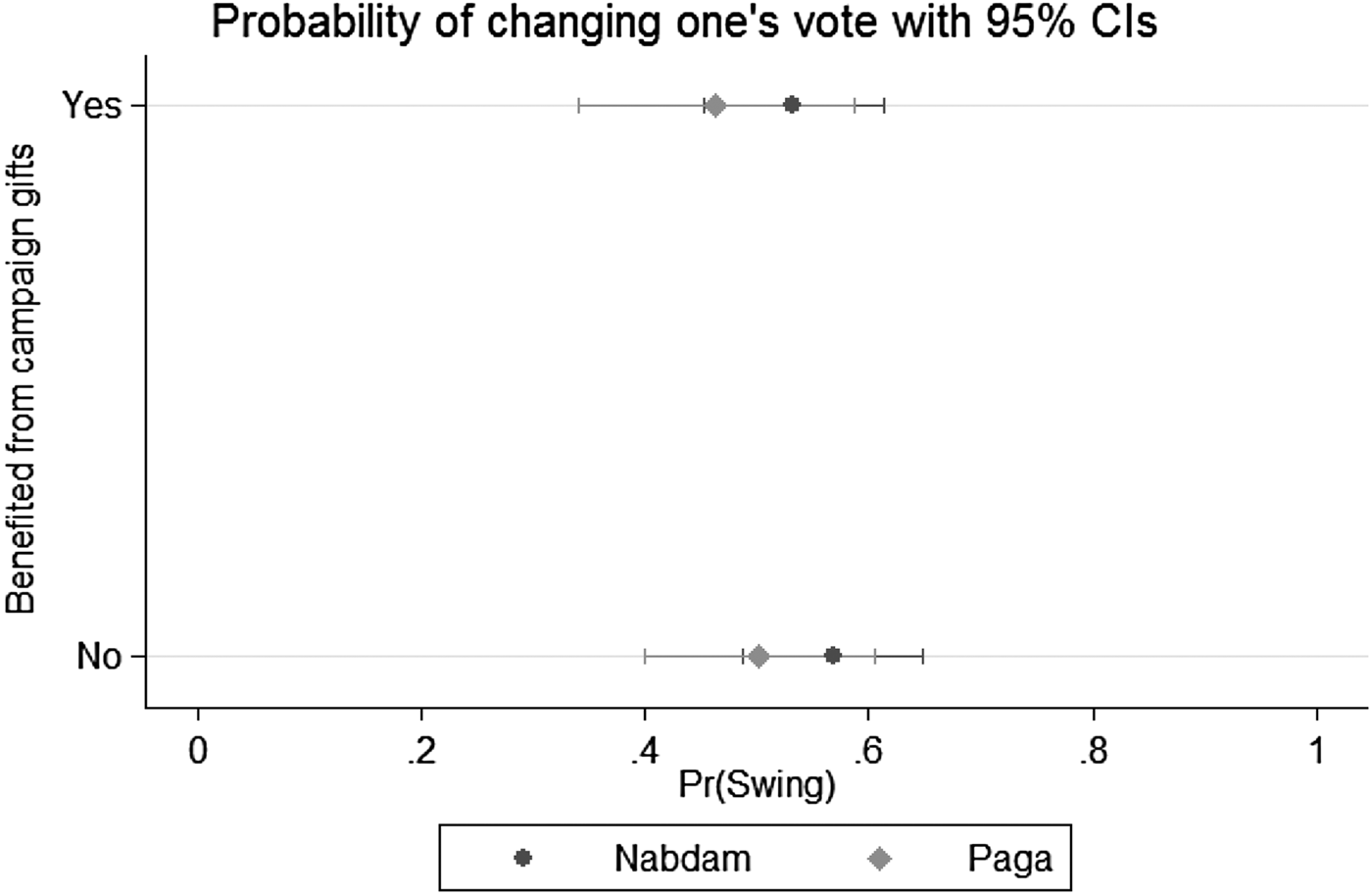
Taking campaign gifts had no significant effect on voting choices: respondents who took gifts were no more likely to remain loyal to candidates than those who did not in either constituency (having benefitted from campaign gifts does not impact the probability of changing one's vote between elections, Figure 2). These results are based on self-reported behaviour so response bias is a concern, but it is notable that even people who admitted they took gifts were no more likely to change their vote than the rest of the sample. In line with research showing that cash incentives may be viewed differently from other gifts, such as clothes or food, I also test whether voters who reported receiving food, drinks, cash or larger gifts were more likely to remain loyal or switch support. I find no significant differences in the effectiveness of the various types of gifts either (in the online Appendix). To account for the potential non-random targeting of electoral gifts and examine the counterfactual of whether voters would have behaved differently had they not been offered gifts, I also employ matching techniques (in the Online Appendix). The matching estimates do not reveal significant persuasion effects of vote-buying either.
Effect of campaign gifts on probability of changing one's vote.

A potential limitation is that I am not able to distinguish which party's gifts voters accepted or whether they took multiple gifts. The results show that no candidate benefited from gift-giving overall. Three scenarios can explain this outcome: (a) voters accepted more than one candidate's gifts; (b) voters took only one candidate's gifts but many chose someone else; (c) voters picked the candidates who gave them gifts but opponents were able to persuade as many voters through gifts as they lost to the opposition so the aggregate effect of gift-giving was zero. Evidence from the survey, informal conversations with voters and discussions with party operatives strongly suggests that a combination of (a) and (b) was most likely. Both during informal conversations and in focus group discussions, voters told me they had tried to take as many gifts as possible by attending different rallies and other campaign events. The survey responses show that such practices were widely viewed as acceptable: voters felt entitled to gifts and resentful if they didn't receive any. Crucially, party officials were aware of such ‘gift shopping’ and were largely resigned about it.
The respondents who reported that gift-giving was an important consideration equated it with a show of attention, respect, and affection: ‘It means [the candidate] cares for me’, ‘it shows a person who loves the people’, ‘the candidate who cares, gives’, ‘because [by giving a gift] he will show me he cares for me’. These answers suggest that what Hyden (Reference Hyden2004) has termed ‘the economy of affection’ and Lindberg (Reference Lindberg2010) highlighted as the informal side of the institution of the MP is very much also at work in Northern Ghana and has become fused with vote-buying in the multi-party era. Votes are seen as something personal, to be given in exchange for individual attention and affection. Such personal attention was also highly valued by respondents who did not identify gifts as important determinants of their voting choices: ‘I choose a candidate who loves and cares for the people’, ‘someone I can trust’, ‘someone who has good plans for my community’, ‘someone who loves the community and is ready to see it develop’, ‘a candidate who loves people and cares for them.’
Being present, in contact with voters, and showing concern for the community were all listed as key to successful campaigns during interviews and focus group discussions with party leaders. Attendance at weddings, funerals, naming ceremonies and showing sympathy when meeting voters were cited as making a big difference in whether politicians were liked or not.Footnote 19 The gifts given during these events appear secondary to the act of reaffirming social bonds with constituents.
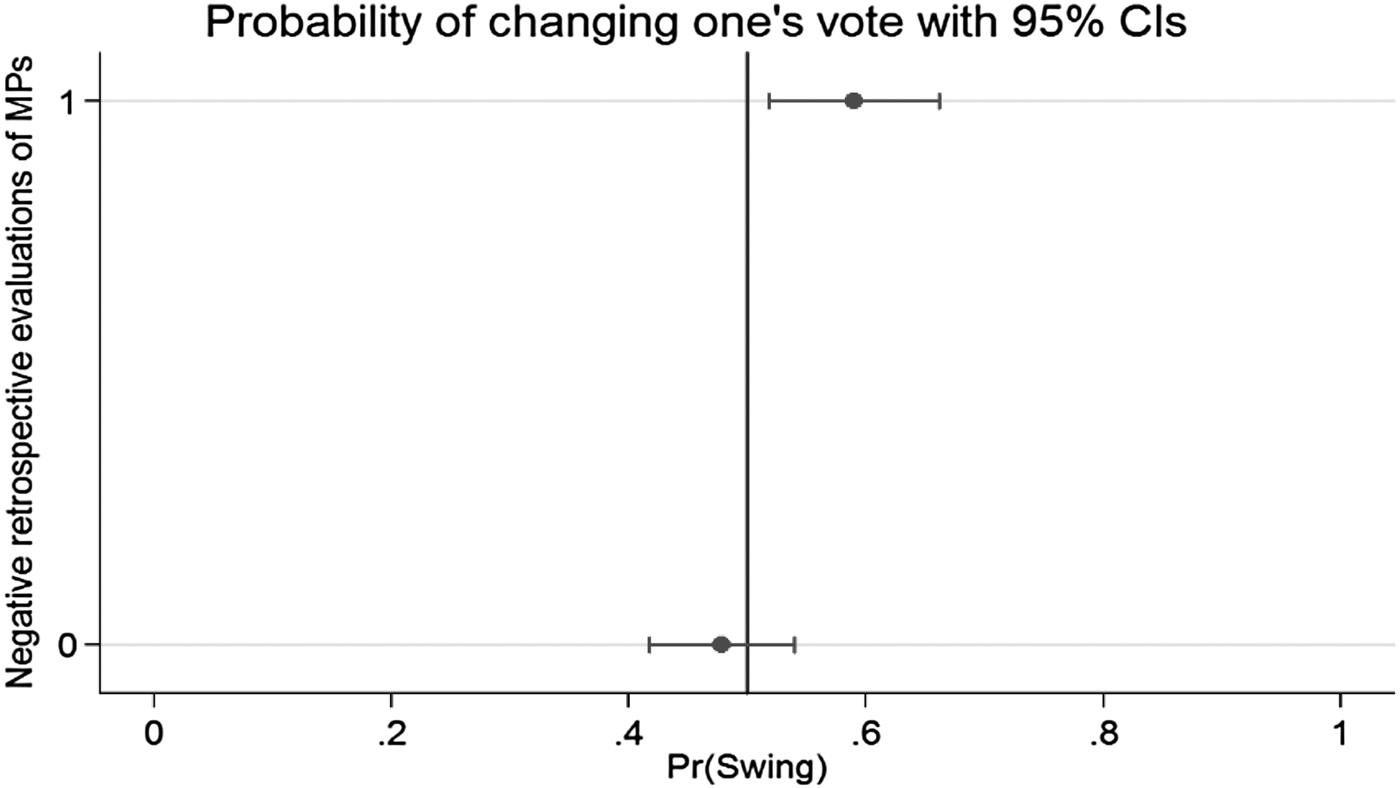
And in the presence of conflicting signals – when candidates give gifts but ‘break promises’ or appear incompetent – MPs' performance is a much stronger predictor of changing one's vote (Figure 3, the online Appendix provides matching estimates). Controlling for having taken gifts, partisanship, and a host of individual characteristics, respondents who viewed MPs' performance negatively were 20% more likely to change their vote compared to respondents who did not express a negative evaluation of MPs' performance. This suggests that the electoral effect of campaign handouts is small, while the importance of local public goods is high and that the two should be distinguished in studies of clientelistic redistribution in developing countries.
Effect of negative retrospective evaluations on swing voting.

It was also clear that these constituencies were not ‘low-information environments’ despite being remote and poor. People had followed the election closely, attended rallies and campaign stops, were aware of candidates' past records and parties' different policies for their area, and had clear preferences and expectations. In such environments and as all sides give gifts, electoral handouts are unlikely to be a credible signal of future performance and will not be sufficient to guarantee voters' support. The survey results and qualitative responses suggest a negligible role for campaign gifts in influencing voting behaviour in the two constituencies examined, even in the presence of high poverty and demand for personalistic rewards. Instead, perceptions of candidates' records and ability to ‘bring development’ – or provide local public goods – were the strongest predictors of individual voting choices. How do parties take this into account and how do they rationalise electoral clientelism in such settings?
CANDIDATES' CROSS-PRESSURES AND ELECTORAL STRATEGIES
All political operatives and elected officials I spoke to confirmed that campaign gifts were not sufficient to guarantee voters' support. However, it was underlined that a politician unable to offer inducements would be automatically ‘knocked out’ of the electoral ‘game’: ‘They continue doing it because everybody else does it, just to stay in the game.’ ‘If you don't give a gift, you're not even considered – not even a chance.’ ‘Gifts give you a chance although do not guarantee victory. Parties know this but continue.’ Qualitative evidence from elsewhere in Ghana confirms these dynamics: Nugent (Reference Nugent, Basedau, Erdmann and Mehler2007: 268) writes of a parliamentary candidate in Hohoe constituency providing gifts to his constituents and insisting that ‘nobody would vote for a candidate who did not demonstrate his generosity in this way’, emphasis mine. Gift-giving continues more as a signal of a candidate's status as a serious contender than as a way to guarantee support. It also constitutes a performance and is intended to be conspicuous – wealth is ‘demonstrated’ or ‘paraded’ because it is associated with success, capability and by extension leadership ability. The need for such overt status signalling is greater in the presence of competitors.
The manner of electoral gift exchange is telling: most of it happens openly during party rallies or campaign ‘walkabouts’ shortly prior to the election. Lindberg (Reference Lindberg2013: 129) describes candidates' campaign walkabouts in the following way: ‘campaigning is often about walking around various neighborhoods, talking to people about what they do and what their life is, while one of “the boys” continues to feed the MP with small notes for handouts from a small envelope’. Campaigns are akin to ‘parades’ where food, drinks, clothes and money are distributed to those in attendance irrespective of party affiliation or voting intentions. An expectation is deliberately fostered among voters that if they attend campaign stops or rallies, they will ‘get something’. Nugent (Reference Nugent, Basedau, Erdmann and Mehler2007) draws attention to the broader social importance of gift-giving during elections in Sub-Saharan Africa – wealth is transformed into a symbolic resource used to construct a public image and ‘cleansed’ through its investment in rural social networks. Thus, the manner of gift exchange is indicative of the intent of the gift: to reaffirm candidates' status as generous and benevolent ‘big men’ willing and able to take care of the community.
Turnout at rallies is another important signal of political viability, one which was often cited as a proxy for popularity and hence electoral prospects. Parties thus aim to encourage as wide attendance as possible. The provision of food, drinks and small gifts at rallies was also justified by the need to cover attendees' opportunity costs: to be present at public events, people had to take time off their daily chores, which they and their families depend on for subsistence in a very direct way.Footnote 20 By attending a rally, a voter hopes to receive a gift or food, but also expects to witness candidates' displays of wealth, largesse and status. Gifts are just one part of this display, other status symbols involve cars, music equipment, dancers. The ability to draw a large crowd is a status symbol in itself (Hansen Reference Hansen2010). So strong is this expectation on the part of voters that all candidates must engage in status displays in order to be competitive.
If gifts are intended as a demonstration of generosity and recognition of social responsibility rather than attempts to change voters' opinions, competition should not lead to an increase in the monetary value of individual electoral inducements. My interviewees reported going to great lengths to find out what competitors were offering and striving to match it: ‘We have to match the other guy, try to undo the others.’Footnote 21 This included both personalised inducements to individual voters, such as cash, drinks, clothes, bikes, school fees, but also larger gifts intended to benefit communities. There were multiple accounts of communities receiving two sets of bore-holes, two sheds for elders, and other such electoral ‘projects’ prior to voting day.Footnote 22 Such inducement matching makes sense in an environment where the act of giving is as important as the gift itself: participating demonstrates affection and respect, not outbidding ensures resources are not wasted on activities with questionable returns.
Some of the gifts appear demand-driven as well: political operatives described engaging in ‘bargaining’ with individual voters over gifts where the type and value of the gift was negotiated according to what other candidates had offered. Crucially, the process involved independently verifying the gift-giving strategies of opponents and not taking demanders' word at face value.
Could smaller gifts also signal status and allow competitors to stay in the game? I was repeatedly told that ‘the highest bidder won't get his way’.Footnote 23 Ensuring voters that ‘they are in your heart’ can be achieved through smaller gifts, but individual attention was valued greatly.Footnote 24 After all, the Nabdam MP was voted out despite being able to secure one of the largest prizes for local communities: a new district. This electoral economy of affection, in which gift-giving is seen as a sign of empathy and respect also partly explains why the practice persists despite acknowledgement of its futility and why efforts are not made to outbid competitors or agree to not give gifts altogether. Enforcing a pact to halt campaign clientelism in environments where demand is high, the practice is normalised, and gifts are equated with empathy and concern for voters would be near impossible. Moreover, candidates and their campaign operatives are deeply embedded in social networks in these communities and would be ostracised and suffer severe reputation costs if they refuse to pay homage to long-standing norms of generosity and ostentatious displays of wealth associated with people in leadership positions (Olivier de Sardan Reference Olivier de Sardan1999). Nevertheless, pressures on MPs to assist with school fees appear to have influenced the decision to promise free secondary education in the country. Thus, one way parties can escape the suboptimal equilibrium they find themselves in is to frame personal demands on individual MPs as national public goods and seek to shift such expenses to the state.
There was also ample evidence politicians were attempting to undermine the effectiveness of opponents' gifts. The campaigns actively encouraged voters to accept gifts from the opposition: ‘we tell them to take the gifts but vote their conscience’, ‘we make sure they know voting is secret’, ‘we tell them not to refuse but don't vote for them … if they refuse, they'll know you're not one of them and single you out for intimidation’.Footnote 25 This also suggests that the act of disbursing gifts during the campaigns has another purpose: it serves as a measure of parties' popularity and the loyalty of support bases – in the absence of opinion polls, it also helps to estimate the support of the opposition. While accepting a gift may not guarantee a voter would support a candidate, not taking it is a sure signal she or he will not. Thus, paradoxically, taking gifts ensures the anonymity and privacy of voters' choices and the secrecy of the ballot.
Campaign officials from the two smaller parties in particular (Ghana's PNC and CPP), who could not match the larger parties' resources and ability to give gifts, were actively engaged in educating voters how to ‘play the game’: profit from the material benefits available at election times, yet reserve the freedom to vote for a different candidate.Footnote 26 The framing of such undermining efforts is telling: rather than portray campaign spending as detrimental to democracy or something that voters should shun, smaller parties framed it as an entitlement and part of just redistribution: ‘[we tell them] this is their money, take advantage now while [the campaigns] are here, they won't see them again for four years'. This demonstrates deference to the same norms of gift-giving and generosity, which compel the larger parties to engage in campaign clientelism. The implication is that smaller parties would also give gifts if only they had the means to do so. Evidence from the survey, informal conversations with individual voters, and other research on Ghana (Lindberg Reference Lindberg2010, Reference Lindberg2013) strongly suggests that this message had sunk in: voters felt they were entitled to electoral gifts and that these gifts did not constitute a binding obligation to support a candidate.
In sum, the evidence is consistent with electoral rewards as status affirmation in these two competitive constituencies. Individuals reported that considerations other than gifts influenced their voting decisions and parties acted accordingly. In this case, can issue deliberation and policy discussion coexist with electoral clientelism in patronage democracies?
Vote-buying and clientelism are seen as impediments to development and democratisation because they can substitute public goods provision, limit debate on key issues, and stifle the opposition. Parties sustained by ethnic or clientelistic networks do not develop coherent ideologies, do not formulate policy positions, and are not accountable to the largest share of their voters. Yet, the majority of voters surveyed in Paga and Nabdam pointed out that performance, ideas and ability matter. ‘Pragmatic policies’, ‘ability to bring development’, ‘ability to create jobs’, ‘good manifesto’, ‘good healthcare’, ‘good policies for the youth’ were all mentioned as desirable of candidates and platforms.
Further, both the intention and ability to hold candidates accountable were evident in voters' responses to questions about why the previous MPs had been voted out: ‘the old MP was not living up to expectations', ‘he forgot farmers and all his attention was on students and youth’, ‘his policies were not good enough’, ‘he did not honour his promises'. There was broad agreement that the presence of challengers contributed to incumbents being ‘measured differently’ and incumbent complacency was clearly penalised.Footnote 27 Both challengers had made the need for change the cornerstone of their campaigns: they had tried to convince voters to try someone new, and that if it doesn't work out, they can vote the old MPs back in.Footnote 28
The status affirmation theory also predicts that if personalised inducements are insufficient to guarantee voters' support, parties would be forced to diversify their linkages to voters. In line with Kitschelt's (Reference Kitschelt2000) taxonomy, I looked for evidence of charismatic appeals or policy programmes complementing electoral clientelism in the two constituencies. I found that the main parties had identified key groups to target through specific policy proposals and these were popularised locally during the campaigns at rallies and via communal forums. The NPP promised free secondary education and targeted the youth with custom employment initiatives. The NDC courted farmers: they promised to subsidise farming produce, gave loans to local producers, and instituted a ‘best farmer award’, which was very popular locally. There was evidence the policy distinctions had been understood: the above were all mentioned in the survey and during informal conversations as reasons voters supported the parties, or switched to a competitor: ‘The new MP came with good manifesto policies especially jobs for the youth’, ‘The new MP cares for the youth’, ‘[I prefer] a candidate who gives priority to education and the youth’, ‘I think the new MP won the election because the youth lost trust in the old [MP]’, ‘the government has put some measures in place to take care of farmers’, ‘they provide funds and loans to farmers’, ‘he [lost because he] forgot farmers and their needs’.
Overall, there was evidence that electoral inducements to voters did not preclude issue deliberation, policy definition and debate, and did not sideline the opposition in these two constituencies in Northern Ghana. The opposition was able to neutralise the material advantage of incumbents either by matching their gifts, or by taking part in the ritual of gift exchange, which in many cases was sufficient to satisfy voters' expectations of personal attention. Further, opposition candidates actively promoted voter emancipation by providing tips on how to game the system (take gifts and maintain vote secrecy) and encouraging incumbent accountability.
The electoral contest centred on whether and how well aspiring MPs could provide for the larger needs of communities. These needs were identified as infrastructure, schools, electricity, fertiliser and seeds, watering holes, loans to farmers, youth employment. The success or failure of MPs hinged on whether they could address these issues and voters were both willing and able to hold MPs accountable for promises made during the campaigns. Parties' nation-wide policies reflected proposed solutions to such local demands: free secondary education, focus on vocational training, the ‘youth in agriculture’ employment scheme, fertiliser distribution at 50% off to farmers, and support for agricultural mechanisation.Footnote 29 Thus, many of the negative effects of electoral patronage for accountability and public goods provision had been moderated in the presence of viable political competition.
CONCLUSION
I argue that electoral clientelism persists as status affirmation in places where gift-giving is normalised and expected, but elections are competitive. Gifts demonstrate a candidate's viability, leadership ability, popularity and concern for individual voters. Unlike theories of campaign clientelism as signalling, however, I show that gifts alone are insufficient to guarantee victory. This is partly a result of ballot secrecy, and partly due to the undermining tactics of the opposition. Parties are therefore forced to differentiate in other ways and I find evidence of nascent programmatic competition even in a setting where poverty and inequality are high and vote-buying is expected to be most effective. Further, candidates' records are a much stronger signal of ability to provide local public goods and voters are both willing and able to punish underperforming incumbents. The theory of gift-giving as status affirmation is able to reconcile the ubiquity of campaign clientelism in Sub-Saharan Africa with recent findings that voters consider candidate performance and party ideology when deciding who to support.
If vote-buying persists as status affirmation and not as a contingent direct exchange able to guarantee political support, then is electoral politics clientelistic at all in these settings? To the extent that reciprocity is not guaranteed, the gift transaction is one-sided, and other considerations are more important for voters, electoral politics does not fit the narrow definition of clientelism. This is the point Nugent (Reference Nugent2001, Reference Nugent, Basedau, Erdmann and Mehler2007) makes when he argues that to be effective, material resources have to be transformed into ‘some kind of moral authority’ and are thus different from bribing.
While a variety of explanations for the provision of material rewards during electoral campaigns in Africa have been put forward in the literature, attention to the practice is often motivated by a common concern about its broader implications for redistribution and accountability. I have shown that electoral handouts can coexist with issue deliberation, a focus on candidates' performance, and the pursuit of political accountability in ‘patronage democracies’. However, while some of the negative effects of a contingent direct exchange of material benefits for votes are alleviated when handouts are viewed as entitlements and not obligations, status-affirmative electoral clientelism of the type described in this paper has other detrimental consequences. It could create incentives for individual politicians to extract rents locally or from the state to recover expenses. The longer the practice continues, the more it could reinforce a need to accumulate and parade personal wealth, a view of public institutions as opportunities for enrichment, and a lack of a public service ethic among civil servants. And while gifts were insufficient to guarantee votes during the election, money plays a significant role during party primaries in Ghana: I was told a number of times ‘it is the only thing that matters’ for securing nominations. Thus, politics in the country remains clientelistic, but the role and intent of material inducements varies across the stages of the political process.
This paper draws attention to the actions and incentives of political competitors in environments where vote-buying is pervasive but voting is secret. I show that opponents not only strive to win voters' support through gifts, but also attempt to undermine the effectiveness of competitors' gifts. These tactics contributed to the overall decline of the effectiveness of electoral clientelism in the two constituencies I study. The subversive attempts of the opposition in particular appear to have reshaped individual attitudes to material inducements – voters increasingly viewed gifts as entitlements and not obligations. Such changes in mindset have been key to the transition from clientelism to citizenship elsewhere (Gay Reference Gay, Fernandez-Kelly and Shefner2006) and there is evidence similar tactics are employed elsewhere in Africa.Footnote 30
The diminished effectiveness of electoral clientelism has implications for parties' linkage strategies in newly democratising states. When material inducements are insufficient to guarantee a win, parties must find other ways to persuade voters. One such strategy is to target constituencies defined by some common preference for redistribution with policy proposals. In Northern Ghana, such policy proposals were extended to farmers and the youth and I present evidence that they were effective in winning voters' support. The process through which preferences are articulated and aggregated in the political arena requires relatively stable and responsive party structures, however. The majority of African parties remain weak, fragmented, disorganised and personality-centred (Manning Reference Manning2005). Faced with pressures to pursue other linkages to voters in light of the diminished effectiveness of clientelism, candidates may engage in charismatic appeals, morality politics, or violence and intimidation. Which strategy politicians engage in is of great significance for the quality of democracy on the continent and calls for serious attention.